Contents:
1. How do we see objects?
2. Common phenomena of light
3. Straight line path of light
4. Particle and wave nature of light
5. Spherical mirrors
6. How to draw ray diagram?
7. Image formation by a concave mirror
8. Image formation by a convex mirror
9. Uses of concave and convex mirror
10.Sign convention for reflection by spherical mirror
11.Mirror formula and magnification formula
Created by C. Mani, Principal, K V No.1, AFS, Jalahalli West, Bangalore
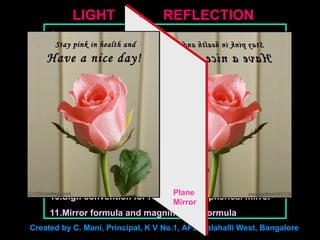
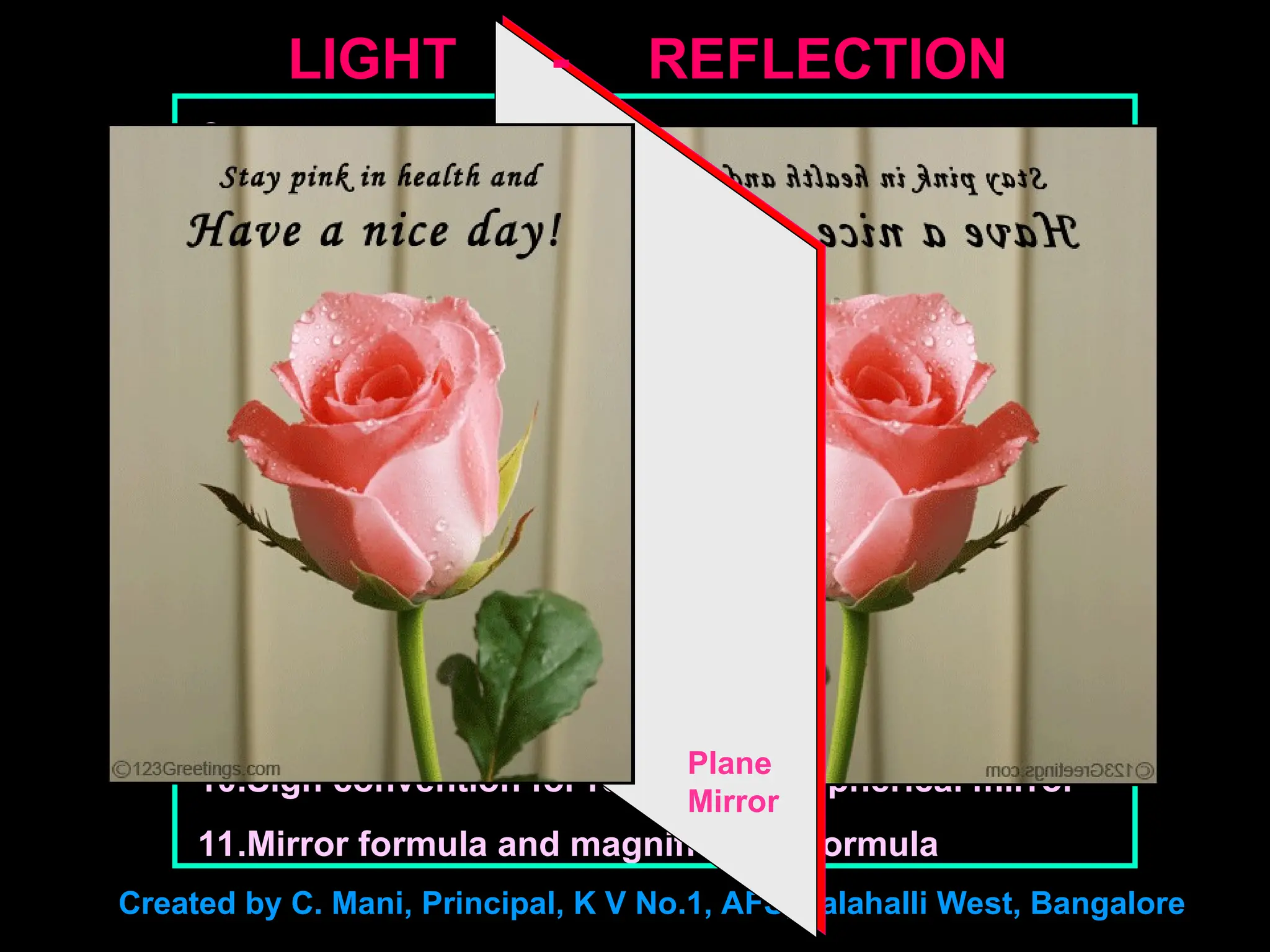
Plane
Mirror
LIGHT - REFLECTION
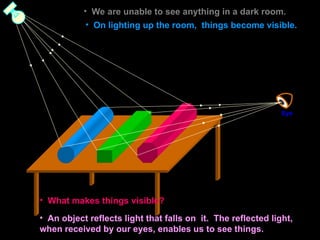
• We are unable to see anything in a dark room.
• On lighting up the room, things become visible.
• What makes things visible?
• An object reflects light that falls on it. The reflected light,
when received by our eyes, enables us to see things.
Eye
• Common phenomena of light are
- image formation by mirrors
- image formation by lenses
- twinkling of stars
- beautiful colours of a rainbow
- bending of light by a medium
- sparkling of diamonds
- colours formed on thin oil films
- colours formed in soap bubbles
- reddish appearance of sun while rising and setting
- blue colour of the sky
and many more
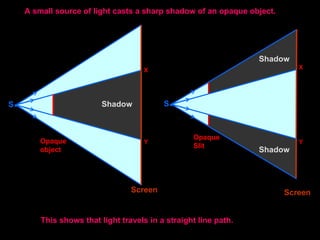
A small source of light casts a sharp shadow of an opaque object.
S• Shadow
X
Y
Opaque
object
Screen
This shows that light travels in a straight line path.
S•
X
Y
Opaque
Slit
Screen
Shadow
Shadow
•
•
S1
S2
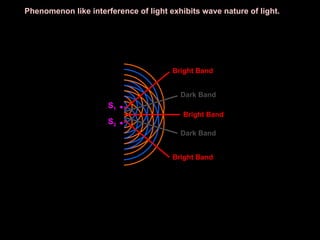
Bright Band
Dark Band
Dark Band
Bright Band
Bright Band
Phenomenon like interference of light exhibits wave nature of light.
S• Shadow
Opaque
object
Screen
S•
Opaque
Slit
Screen
Shadow
Shadow
X
Y
X
Y
Diffraction at a slit
Diffraction at an obstacle
X & Y – Region of diffraction
Phenomenon like diffraction of light also exhibits wave nature of light.
• • • • • •
Polariser
Tourmaline
Crystal
Analyser
Tourmaline
Crystal
Unpolarised
light
Plane
Polarised
light
Plane
Polarised
light
Optic Axis
• • • • • • 90°
Unpolarised
light
Plane
Polarised
light
No light
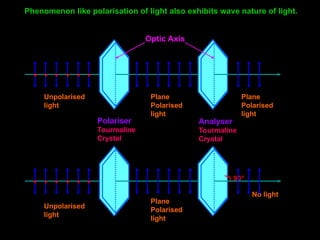
Phenomenon like polarisation of light also exhibits wave nature of light.
UV
Metals
Metals other than Alkali Metals
Alkali Metals
Visible light
No photoelectrons
Photoelectrons Photoelectrons
Visible light
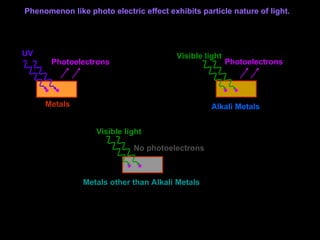
Phenomenon like photo electric effect exhibits particle nature of light.
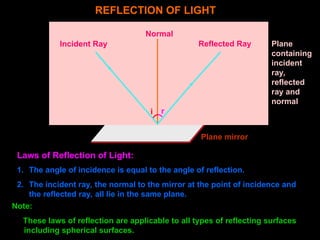
REFLECTION OF LIGHT
Note:
These laws of reflection are applicable to all types of reflecting surfaces
including spherical surfaces.
Incident Ray Reflected Ray
Normal
i r
Plane mirror
Plane
containing
incident
ray,
reflected
ray and
normal
Laws of Reflection of Light:
1. The angle of incidence is equal to the angle of reflection.
2. The incident ray, the normal to the mirror at the point of incidence and
the reflected ray, all lie in the same plane.
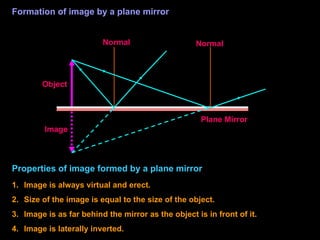
Properties of image formed by a plane mirror
1. Image is always virtual and erect.
2. Size of the image is equal to the size of the object.
3. Image is as far behind the mirror as the object is in front of it.
4. Image is laterally inverted.
Object
Image
Plane Mirror
Normal Normal
Formation of image by a plane mirror
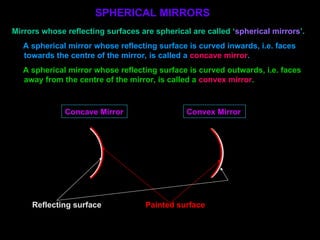
SPHERICAL MIRRORS
Mirrors whose reflecting surfaces are spherical are called ‘spherical mirrors’.
A spherical mirror whose reflecting surface is curved inwards, i.e. faces
towards the centre of the mirror, is called a concave mirror.
A spherical mirror whose reflecting surface is curved outwards, i.e. faces
away from the centre of the mirror, is called a convex mirror.
Convex Mirror
Concave Mirror
Painted surface
Reflecting surface
Convex Mirror
Concave Mirror
F
C
P
F C
P
X X
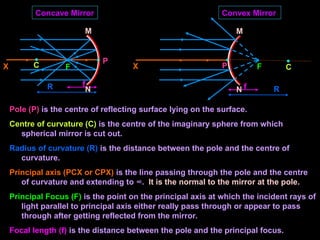
Pole (P) is the centre of reflecting surface lying on the surface.
Centre of curvature (C) is the centre of the imaginary sphere from which
spherical mirror is cut out.
Radius of curvature (R) is the distance between the pole and the centre of
curvature.
Principal axis (PCX or CPX) is the line passing through the pole and the centre
of curvature and extending to ∞. It is the normal to the mirror at the pole.
Principal Focus (F) is the point on the principal axis at which the incident rays of
light parallel to principal axis either really pass through or appear to pass
through after getting reflected from the mirror.
Focal length (f) is the distance between the pole and the principal focus.
f
R f R
M
N
M
N
Radius of curvature is approximately twice the focal length. R ≈ 2f
Aperture (MN) is the diameter of the reflecting surface. Note that it is not the
diameter of the sphere from which the mirror is cut out.
Rays to be considered for drawing Ray Diagram
The intersection of at least two reflected rays give the position of image of the
point object.
Any two of the following rays can be considered for locating the image.
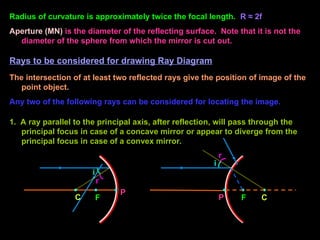
1. A ray parallel to the principal axis, after reflection, will pass through the
principal focus in case of a concave mirror or appear to diverge from the
principal focus in case of a convex mirror.
P
C F P C
F
i
r
r
i
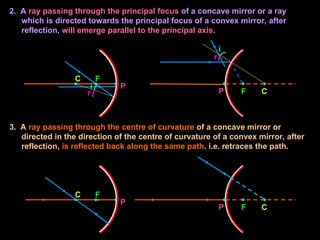
2. A ray passing through the principal focus of a concave mirror or a ray
which is directed towards the principal focus of a convex mirror, after
reflection, will emerge parallel to the principal axis.
C
P
F
F C
P
i
i
r
r
3. A ray passing through the centre of curvature of a concave mirror or
directed in the direction of the centre of curvature of a convex mirror, after
reflection, is reflected back along the same path. i.e. retraces the path.
F
C
P
F C
P
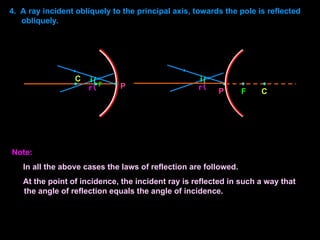
4. A ray incident obliquely to the principal axis, towards the pole is reflected
obliquely.
C
P
F
i
r
i
r
F C
P
Note:
In all the above cases the laws of reflection are followed.
At the point of incidence, the incident ray is reflected in such a way that
the angle of reflection equals the angle of incidence.
Image formation by a concave mirror
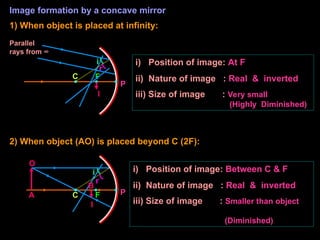
1) When object is placed at infinity:
C
P
F
i
r
Parallel
rays from ∞
I
i) Position of image: At F
ii) Nature of image : Real & inverted
iii) Size of image : Very small
(Highly Diminished)
2) When object (AO) is placed beyond C (2F):
i
r
A
O
B
I
i) Position of image: Between C & F
ii) Nature of image : Real & inverted
iii) Size of image : Smaller than object
(Diminished)
C F P
i
r
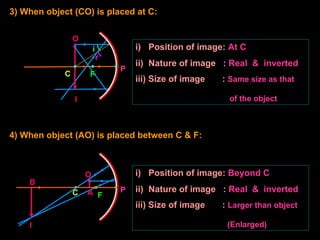
3) When object (CO) is placed at C:
O
I
i) Position of image: At C
ii) Nature of image : Real & inverted
iii) Size of image : Same size as that
of the object
4) When object (AO) is placed between C & F:
i) Position of image: Beyond C
ii) Nature of image : Real & inverted
iii) Size of image : Larger than object
(Enlarged)
C F
P
A
O
C F
P
B
I
O
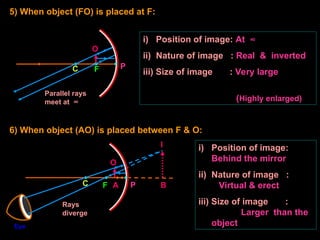
5) When object (FO) is placed at F:
i) Position of image: At ∞
ii) Nature of image : Real & inverted
iii) Size of image : Very large
(Highly enlarged)
Parallel rays
meet at ∞
B
I
6) When object (AO) is placed between F & O:
Rays
diverge
O
A
C F P
i) Position of image:
Behind the mirror
ii) Nature of image :
Virtual & erect
iii) Size of image :
Larger than the
object
Eye
C F P
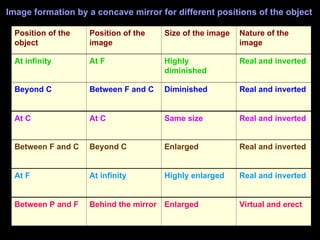
Between P and F Behind the mirror Enlarged Virtual and erect
Image formation by a concave mirror for different positions of the object
Beyond C Between F and C Diminished Real and inverted
At C At C Same size Real and inverted
Between F and C Beyond C Enlarged Real and inverted
At F At infinity Highly enlarged Real and inverted
Position of the
object
Position of the
image
Size of the image Nature of the
image
At infinity At F Highly
diminished
Real and inverted
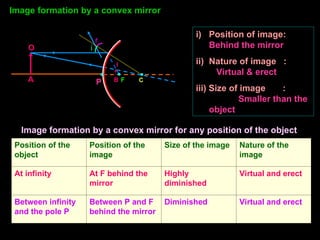
Image formation by a convex mirror
A
O
r
i
C
P F
I
B
i) Position of image:
Behind the mirror
ii) Nature of image :
Virtual & erect
iii) Size of image :
Smaller than the
object
Position of the
object
Position of the
image
Size of the image Nature of the
image
At infinity At F behind the
mirror
Highly
diminished
Virtual and erect
Between infinity
and the pole P
Between P and F
behind the mirror
Diminished Virtual and erect
Image formation by a convex mirror for any position of the object
Uses of concave mirror
1. Concave mirrors are used in torches, search-lights and headlights of
vehicles.
2. They are used as shaving mirrors.
3. They are used by dentists to see large images of the teeth.
4. Large concave mirrors are used to concentrate sunlight to produce heat in
solar furnaces.
Uses of convex mirror
1. Convex mirrors are used as rear view mirrors in vehicles as they form
diminished images of the large objects on the road.
2. They are used as magic mirrors and to form funny images.
Sign Conventions for Reflection by Spherical Mirrors
(New Cartesian Sign Convention)
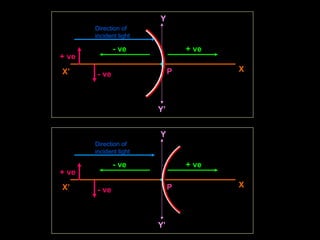
1. The object is always placed to the left of the mirror. i.e. the incident rays
from the object always move from left to right.
2. All distances parallel to the principal axis are measured from the pole (P)
of the mirror.
3. All the distances measured to the right of the Pole (along +ve x-axis) are
taken +ve while those measured to the left of the Pole (along - ve x-axis)
are taken –ve.
4. Distances measured perpendicular to and above the principal axis (along
+ve y-axis) are taken +ve while those measured below the principal axis
(along –ve y-axis) are taken –ve.
Note:
While solving numerical problems, new Cartesian sign convention must be
used for substituting the known values of u, v, f, h and R.
P
Direction of
incident light
- ve + ve
+ ve
- ve
X
X’
Y
Y’
P
Direction of
incident light
- ve + ve
+ ve
- ve
X
X’
Y
Y’
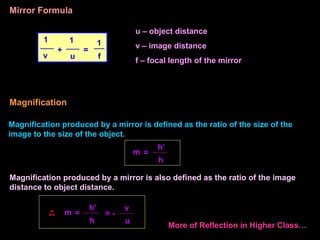
Mirror Formula
1
v f
+ =
1
1
u
u – object distance
v – image distance
f – focal length of the mirror
Magnification
Magnification produced by a mirror is defined as the ratio of the size of the
image to the size of the object.
Magnification produced by a mirror is also defined as the ratio of the image
distance to object distance.
m =
h’
h
m =
h’
h
= -
v
u
More of Reflection in Higher Class…

Light_Reflection.ppt science 10 ( Physics )

  • 1.
    Contents: 1. How dowe see objects? 2. Common phenomena of light 3. Straight line path of light 4. Particle and wave nature of light 5. Spherical mirrors 6. How to draw ray diagram? 7. Image formation by a concave mirror 8. Image formation by a convex mirror 9. Uses of concave and convex mirror 10.Sign convention for reflection by spherical mirror 11.Mirror formula and magnification formula Created by C. Mani, Principal, K V No.1, AFS, Jalahalli West, Bangalore Plane Mirror LIGHT - REFLECTION
  • 2.
    • We areunable to see anything in a dark room. • On lighting up the room, things become visible. • What makes things visible? • An object reflects light that falls on it. The reflected light, when received by our eyes, enables us to see things. Eye
  • 3.
    • Common phenomenaof light are - image formation by mirrors - image formation by lenses - twinkling of stars - beautiful colours of a rainbow - bending of light by a medium - sparkling of diamonds - colours formed on thin oil films - colours formed in soap bubbles - reddish appearance of sun while rising and setting - blue colour of the sky and many more
  • 4.
    A small sourceof light casts a sharp shadow of an opaque object. S• Shadow X Y Opaque object Screen This shows that light travels in a straight line path. S• X Y Opaque Slit Screen Shadow Shadow
  • 5.
    • • S1 S2 Bright Band Dark Band DarkBand Bright Band Bright Band Phenomenon like interference of light exhibits wave nature of light.
  • 6.
    S• Shadow Opaque object Screen S• Opaque Slit Screen Shadow Shadow X Y X Y Diffraction ata slit Diffraction at an obstacle X & Y – Region of diffraction Phenomenon like diffraction of light also exhibits wave nature of light.
  • 7.
    • • •• • • Polariser Tourmaline Crystal Analyser Tourmaline Crystal Unpolarised light Plane Polarised light Plane Polarised light Optic Axis • • • • • • 90° Unpolarised light Plane Polarised light No light Phenomenon like polarisation of light also exhibits wave nature of light.
  • 8.
    UV Metals Metals other thanAlkali Metals Alkali Metals Visible light No photoelectrons Photoelectrons Photoelectrons Visible light Phenomenon like photo electric effect exhibits particle nature of light.
  • 9.
    REFLECTION OF LIGHT Note: Theselaws of reflection are applicable to all types of reflecting surfaces including spherical surfaces. Incident Ray Reflected Ray Normal i r Plane mirror Plane containing incident ray, reflected ray and normal Laws of Reflection of Light: 1. The angle of incidence is equal to the angle of reflection. 2. The incident ray, the normal to the mirror at the point of incidence and the reflected ray, all lie in the same plane.
  • 10.
    Properties of imageformed by a plane mirror 1. Image is always virtual and erect. 2. Size of the image is equal to the size of the object. 3. Image is as far behind the mirror as the object is in front of it. 4. Image is laterally inverted. Object Image Plane Mirror Normal Normal Formation of image by a plane mirror
  • 11.
    SPHERICAL MIRRORS Mirrors whosereflecting surfaces are spherical are called ‘spherical mirrors’. A spherical mirror whose reflecting surface is curved inwards, i.e. faces towards the centre of the mirror, is called a concave mirror. A spherical mirror whose reflecting surface is curved outwards, i.e. faces away from the centre of the mirror, is called a convex mirror. Convex Mirror Concave Mirror Painted surface Reflecting surface
  • 12.
    Convex Mirror Concave Mirror F C P FC P X X Pole (P) is the centre of reflecting surface lying on the surface. Centre of curvature (C) is the centre of the imaginary sphere from which spherical mirror is cut out. Radius of curvature (R) is the distance between the pole and the centre of curvature. Principal axis (PCX or CPX) is the line passing through the pole and the centre of curvature and extending to ∞. It is the normal to the mirror at the pole. Principal Focus (F) is the point on the principal axis at which the incident rays of light parallel to principal axis either really pass through or appear to pass through after getting reflected from the mirror. Focal length (f) is the distance between the pole and the principal focus. f R f R M N M N
  • 13.
    Radius of curvatureis approximately twice the focal length. R ≈ 2f Aperture (MN) is the diameter of the reflecting surface. Note that it is not the diameter of the sphere from which the mirror is cut out. Rays to be considered for drawing Ray Diagram The intersection of at least two reflected rays give the position of image of the point object. Any two of the following rays can be considered for locating the image. 1. A ray parallel to the principal axis, after reflection, will pass through the principal focus in case of a concave mirror or appear to diverge from the principal focus in case of a convex mirror. P C F P C F i r r i
  • 14.
    2. A raypassing through the principal focus of a concave mirror or a ray which is directed towards the principal focus of a convex mirror, after reflection, will emerge parallel to the principal axis. C P F F C P i i r r 3. A ray passing through the centre of curvature of a concave mirror or directed in the direction of the centre of curvature of a convex mirror, after reflection, is reflected back along the same path. i.e. retraces the path. F C P F C P
  • 15.
    4. A rayincident obliquely to the principal axis, towards the pole is reflected obliquely. C P F i r i r F C P Note: In all the above cases the laws of reflection are followed. At the point of incidence, the incident ray is reflected in such a way that the angle of reflection equals the angle of incidence.
  • 16.
    Image formation bya concave mirror 1) When object is placed at infinity: C P F i r Parallel rays from ∞ I i) Position of image: At F ii) Nature of image : Real & inverted iii) Size of image : Very small (Highly Diminished) 2) When object (AO) is placed beyond C (2F): i r A O B I i) Position of image: Between C & F ii) Nature of image : Real & inverted iii) Size of image : Smaller than object (Diminished) C F P
  • 17.
    i r 3) When object(CO) is placed at C: O I i) Position of image: At C ii) Nature of image : Real & inverted iii) Size of image : Same size as that of the object 4) When object (AO) is placed between C & F: i) Position of image: Beyond C ii) Nature of image : Real & inverted iii) Size of image : Larger than object (Enlarged) C F P A O C F P B I
  • 18.
    O 5) When object(FO) is placed at F: i) Position of image: At ∞ ii) Nature of image : Real & inverted iii) Size of image : Very large (Highly enlarged) Parallel rays meet at ∞ B I 6) When object (AO) is placed between F & O: Rays diverge O A C F P i) Position of image: Behind the mirror ii) Nature of image : Virtual & erect iii) Size of image : Larger than the object Eye C F P
  • 19.
    Between P andF Behind the mirror Enlarged Virtual and erect Image formation by a concave mirror for different positions of the object Beyond C Between F and C Diminished Real and inverted At C At C Same size Real and inverted Between F and C Beyond C Enlarged Real and inverted At F At infinity Highly enlarged Real and inverted Position of the object Position of the image Size of the image Nature of the image At infinity At F Highly diminished Real and inverted
  • 20.
    Image formation bya convex mirror A O r i C P F I B i) Position of image: Behind the mirror ii) Nature of image : Virtual & erect iii) Size of image : Smaller than the object Position of the object Position of the image Size of the image Nature of the image At infinity At F behind the mirror Highly diminished Virtual and erect Between infinity and the pole P Between P and F behind the mirror Diminished Virtual and erect Image formation by a convex mirror for any position of the object
  • 21.
    Uses of concavemirror 1. Concave mirrors are used in torches, search-lights and headlights of vehicles. 2. They are used as shaving mirrors. 3. They are used by dentists to see large images of the teeth. 4. Large concave mirrors are used to concentrate sunlight to produce heat in solar furnaces. Uses of convex mirror 1. Convex mirrors are used as rear view mirrors in vehicles as they form diminished images of the large objects on the road. 2. They are used as magic mirrors and to form funny images.
  • 22.
    Sign Conventions forReflection by Spherical Mirrors (New Cartesian Sign Convention) 1. The object is always placed to the left of the mirror. i.e. the incident rays from the object always move from left to right. 2. All distances parallel to the principal axis are measured from the pole (P) of the mirror. 3. All the distances measured to the right of the Pole (along +ve x-axis) are taken +ve while those measured to the left of the Pole (along - ve x-axis) are taken –ve. 4. Distances measured perpendicular to and above the principal axis (along +ve y-axis) are taken +ve while those measured below the principal axis (along –ve y-axis) are taken –ve. Note: While solving numerical problems, new Cartesian sign convention must be used for substituting the known values of u, v, f, h and R.
  • 23.
    P Direction of incident light -ve + ve + ve - ve X X’ Y Y’ P Direction of incident light - ve + ve + ve - ve X X’ Y Y’
  • 24.
    Mirror Formula 1 v f += 1 1 u u – object distance v – image distance f – focal length of the mirror Magnification Magnification produced by a mirror is defined as the ratio of the size of the image to the size of the object. Magnification produced by a mirror is also defined as the ratio of the image distance to object distance. m = h’ h m = h’ h = - v u More of Reflection in Higher Class…