Light – Reflection and Refraction (Class 10 ) (Chapter-9).pptx
1.
Light – Reflectionand Refraction
(Class 10 ) (Chapter-9)
Class 10th Study Camp
2.
# Light
Light isa form of energy which enables us to see .
An object reflects light that falls on it. This reflected light, when received by our eyes,
enables us to see things.
Light seems to travel in straight lines. The fact that a small source of light casts a sharp
shadow of an opaque object points to this straight-line path of light, usually indicated as a
ray of light.
Phenomena of reflection and refraction of light using the straight-line propagation of
light.
The speed of light in vacuum is 3 x 10⁸
m/s.
3.
# Reflection ofLight
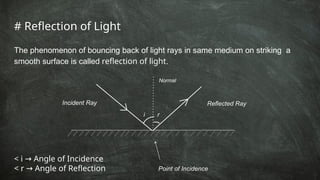
The phenomenon of bouncing back of light rays in same medium on striking a
smooth surface is called reflection of light.
Normal
i r
Incident Ray Reflected Ray
Point of Incidence
< i Angle of Incidence
→
< r Angle of Reflection
→
4.
● Laws ofReflection
(i) The angle of incidence is equal to the angle of reflection
(ii) The incident ray, the normal to the mirror at the point of incidence and the
reflected ray, all lie in the same plane.
These laws of reflection are applicable to all types of reflecting surfaces
including spherical surfaces.
5.
# Types ofImages
● Real Image : If the light rays coming from a point meet after reflection then
real images are formed.
1) Can be formed on screen
2) Always inverted
3) A real image is formed by only concave mirror
● Virtual Image : If light rays coming from a point after reflection appear to meet
then virtual images are formed.
1) Cannot be formed on screen
2) Always erect
3) A virtual image can be formed by concave,convex and plane mirrors .
4) Formed by the imaginary intersection of light rays
5) Virtual image can only be seen in mirror.
6.
# Plane Mirror
Theformation of image by a plane mirror:
● Image formed by a plane mirror is always virtual and erect.
● The size of the image is equal to that of the object.
● The image formed is as far behind the mirror as the object is in front of it.
Further, the image is laterally inverted.
● The image is laterally inverted.
7.
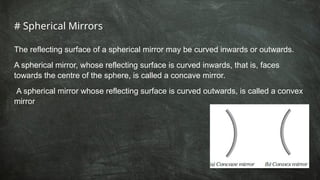
# Spherical Mirrors
Thereflecting surface of a spherical mirror may be curved inwards or outwards.
A spherical mirror, whose reflecting surface is curved inwards, that is, faces
towards the centre of the sphere, is called a concave mirror.
A spherical mirror whose reflecting surface is curved outwards, is called a convex
mirror
8.
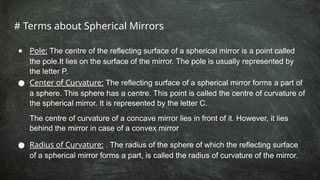
# Terms aboutSpherical Mirrors
● Pole: The centre of the reflecting surface of a spherical mirror is a point called
the pole.It lies on the surface of the mirror. The pole is usually represented by
the letter P.
● Center of Curvature: The reflecting surface of a spherical mirror forms a part of
a sphere. This sphere has a centre. This point is called the centre of curvature of
the spherical mirror. It is represented by the letter C.
The centre of curvature of a concave mirror lies in front of it. However, it lies
behind the mirror in case of a convex mirror
● Radius of Curvature: . The radius of the sphere of which the reflecting surface
of a spherical mirror forms a part, is called the radius of curvature of the mirror.
9.
● Principal Axis:A straight line passing through the pole and the centre of
curvature of a spherical mirror. This line is called the principal axis.
Principal axis is normal to the mirror at its pole.
● Aperture: It is the diameter of the reflecting surface of a spherical mirror. It is
the part of the reflecting surface of the mirror.
10.
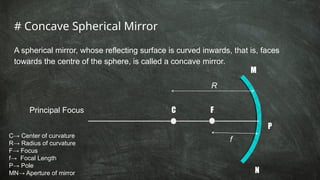
# Concave SphericalMirror
A spherical mirror, whose reflecting surface is curved inwards, that is, faces
towards the centre of the sphere, is called a concave mirror.
P
M
N
F
C
Principal Focus
f
R
C→ Center of curvature
R→ Radius of curvature
F→ Focus
f→ Focal Length
P→ Pole
MN→ Aperture of mirror
11.
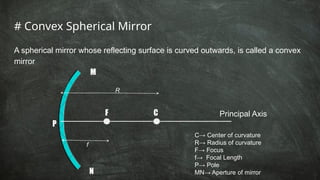
# Convex SphericalMirror
A spherical mirror whose reflecting surface is curved outwards, is called a convex
mirror
M
N
F C
P
Principal Axis
R
f
C→ Center of curvature
R→ Radius of curvature
F→ Focus
f→ Focal Length
P→ Pole
MN→ Aperture of mirror
12.
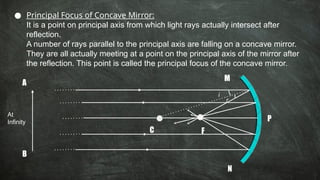
● Principal Focusof Concave Mirror:
It is a point on principal axis from which light rays actually intersect after
reflection.
A number of rays parallel to the principal axis are falling on a concave mirror.
They are all actually meeting at a point on the principal axis of the mirror after
the reflection. This point is called the principal focus of the concave mirror.
C F
A
B
M
N
P
i
r
At
Infinity
13.
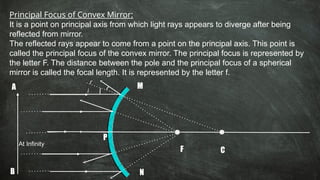
Principal Focus ofConvex Mirror:
It is a point on principal axis from which light rays appears to diverge after being
reflected from mirror.
The reflected rays appear to come from a point on the principal axis. This point is
called the principal focus of the convex mirror. The principal focus is represented by
the letter F. The distance between the pole and the principal focus of a spherical
mirror is called the focal length. It is represented by the letter f.
A
B
F C
P
At Infinity
r
i
M
N
14.
# Relationship betweenR & f
R → Radius of curvature & f → Focal length of spherical mirror
For spherical mirrors of small apertures, the radius of curvature is found to be
equal to twice the focal length.
R = 2 f
This implies that the principal focus of a spherical mirror lies midway between the
pole and centre of curvature .i.e f = R/2
15.
# Representation ofimages formed by Spherical Mirrors
It is more convenient to consider only two rays, for the sake of clarity of the ray
diagram. These rays are so chosen that it is easy to know their directions after
reflection from the mirror.
The intersection of at least two reflected rays give the position of image of the
point object.
16.
1) For ConcaveMirror : The rays that are parallel to the principal axis will pass
through principal focus.
For Convex Mirror : The rays that are parallel to principal axis seems to come
from focus or appear to diverge from the principal focus.
F
C
i
r
P
P
F C
r
i
Convex Mirror Concave Mirror
17.
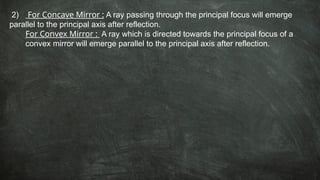
2) For ConcaveMirror : A ray passing through the principal focus will emerge
parallel to the principal axis after reflection.
For Convex Mirror : A ray which is directed towards the principal focus of a
convex mirror will emerge parallel to the principal axis after reflection.







![[Abhay Pratap Singh ] REFLECTION PPT[1].pptx](https://cdn.slidesharecdn.com/ss_thumbnails/abhaypratapsinghreflectionppt1-250104031916-5918ff92-thumbnail.jpg?width=640&height=640&fit=bounds)


