Computer Networks
Computer Networks
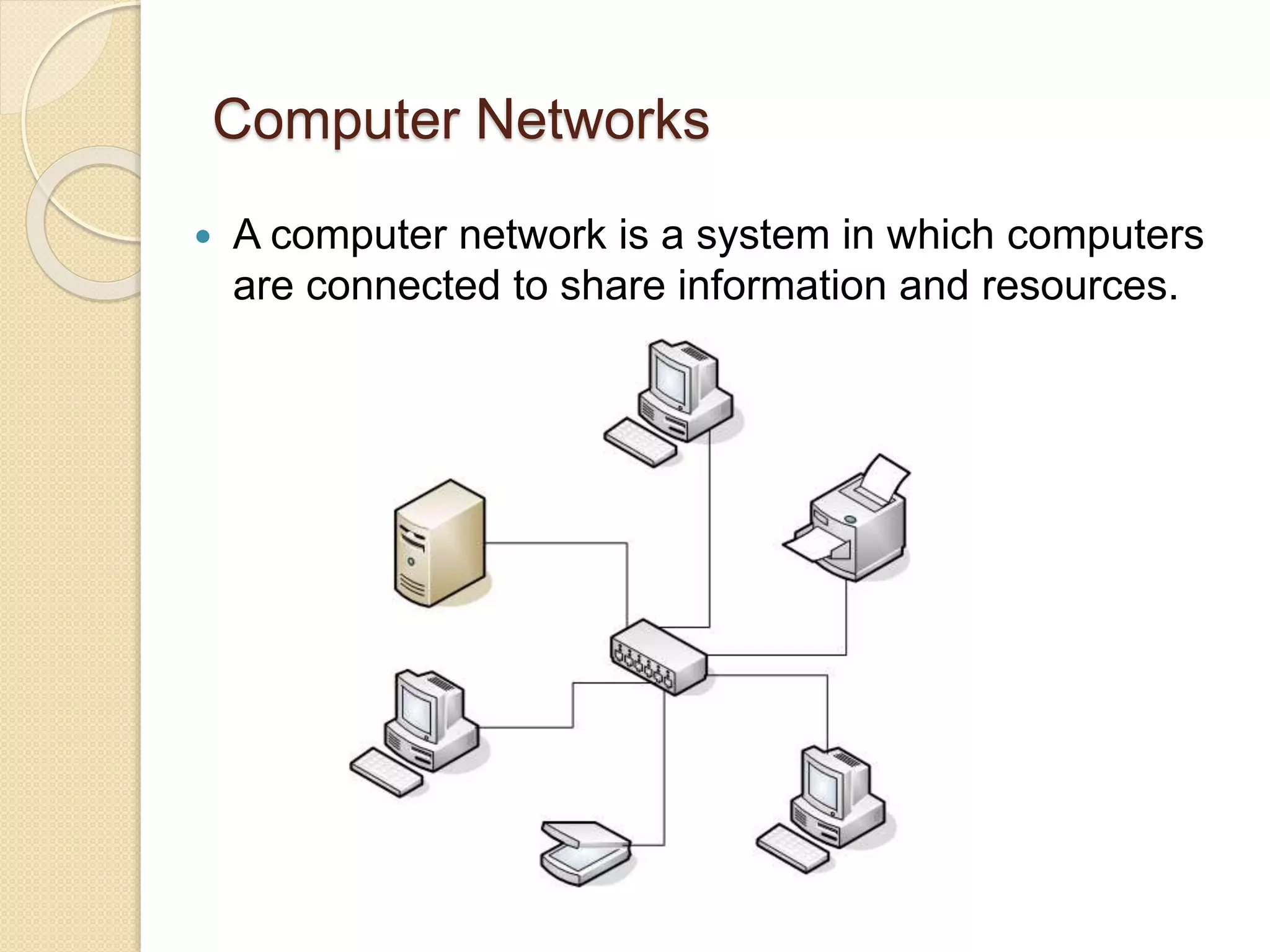
 A computer network is a system in which computers
are connected to share information and resources.
Computer Networks
History:
 Sputnik 1st Artificial Satellite in Earth Orbit in 1957
 ARPA in 1958 to create IPTO (Information Processing Technique Office)
 ARPA Net in 1959
Computer Networks
Uses of Computer Networks:
 Facilitating Communication
Via email, instant messaging, telephone
 Sharing Hardware:
Printer, Scanners.
 Sharing Files, Data & Info :
Any authorized user can access data from other
computer
 Sharing Software's:
Users connected to a network can access
application programs on a network.
Computer Networks
Types of Computer Networks based on:
 Medium used to transport the data
 Topology
 Organization Structure
Computer Networks
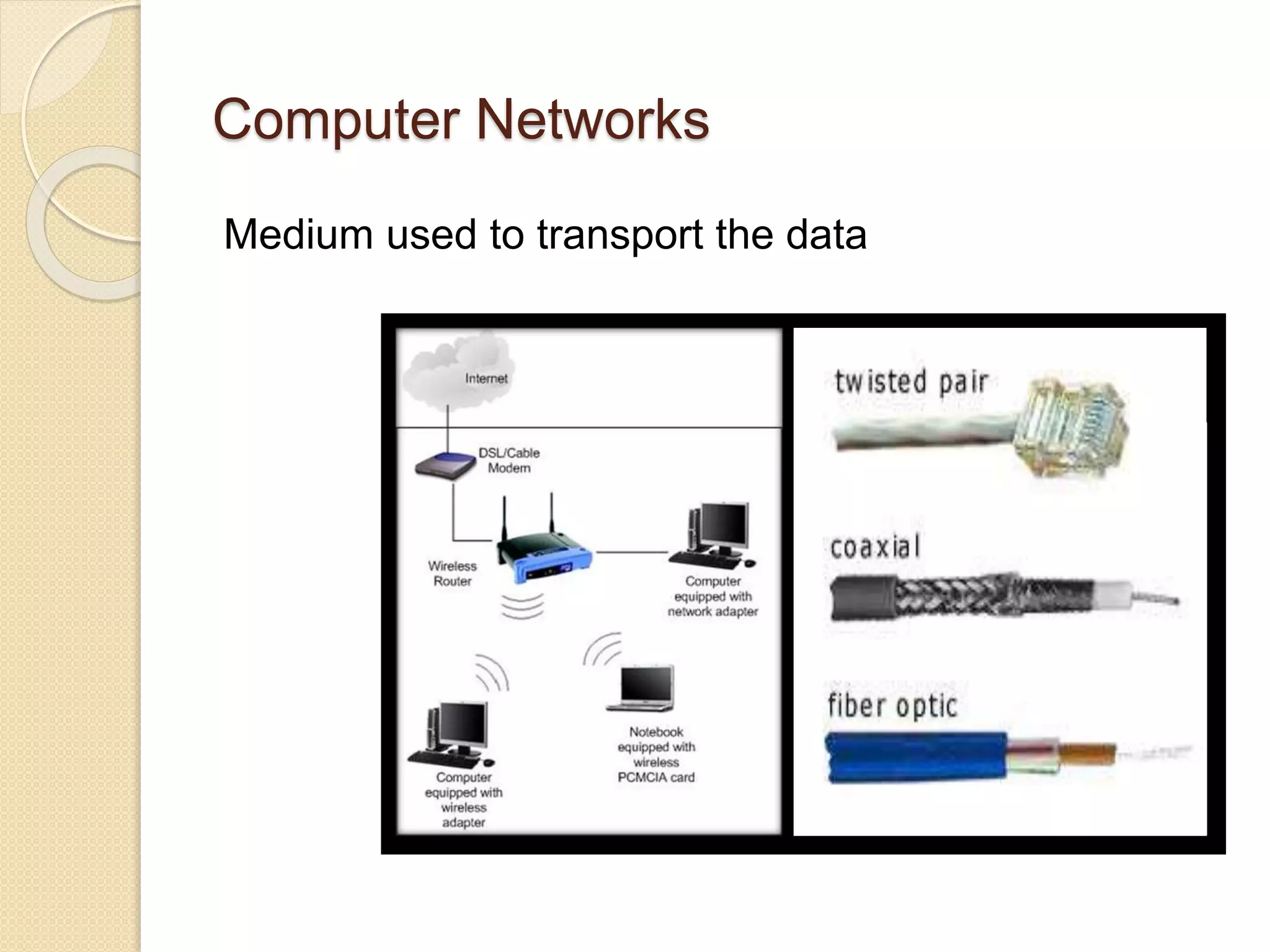
Medium used to transport the data
Computer Networks
 Topology
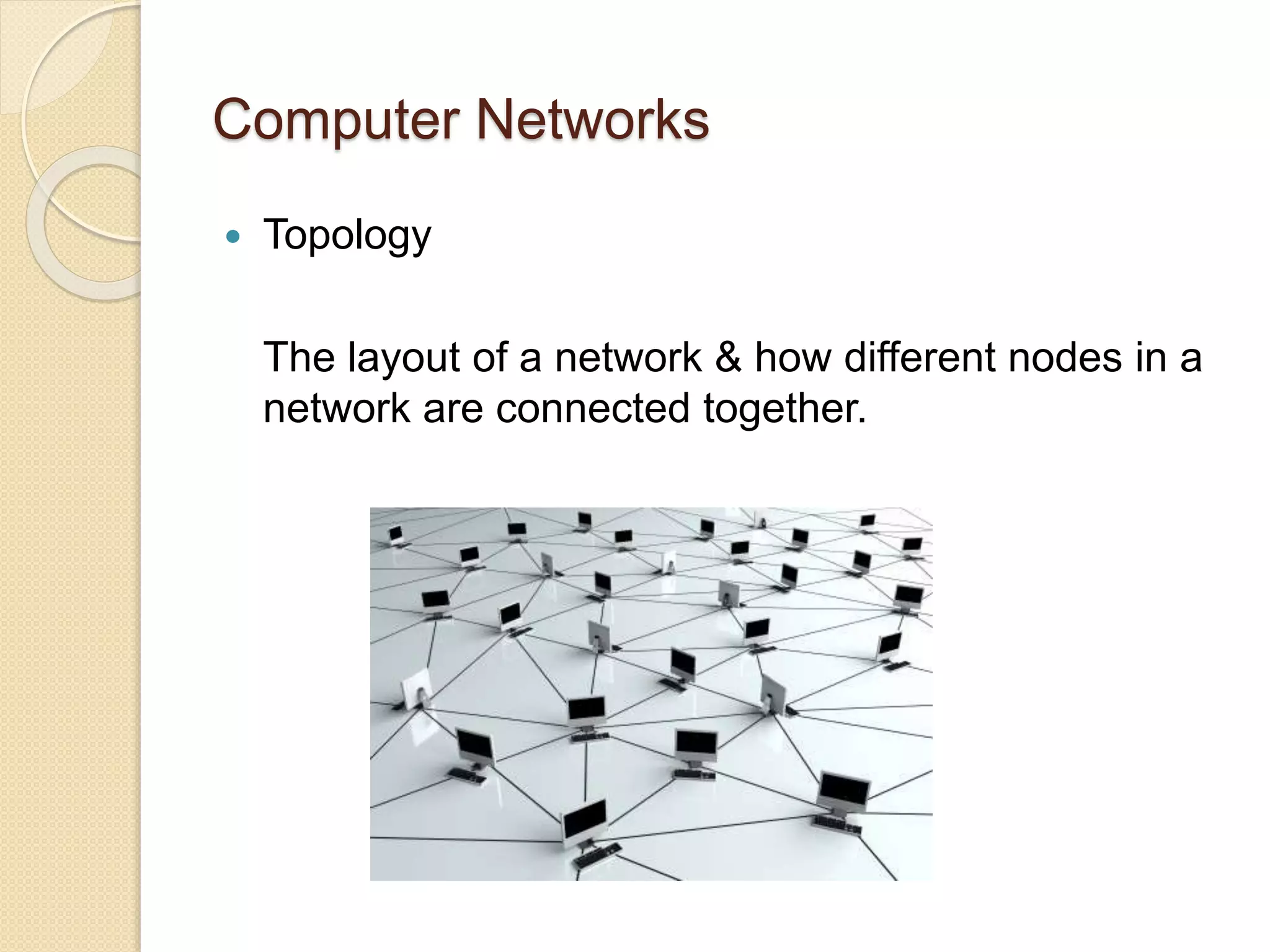
The layout of a network & how different nodes in a
network are connected together.
Computer Networks
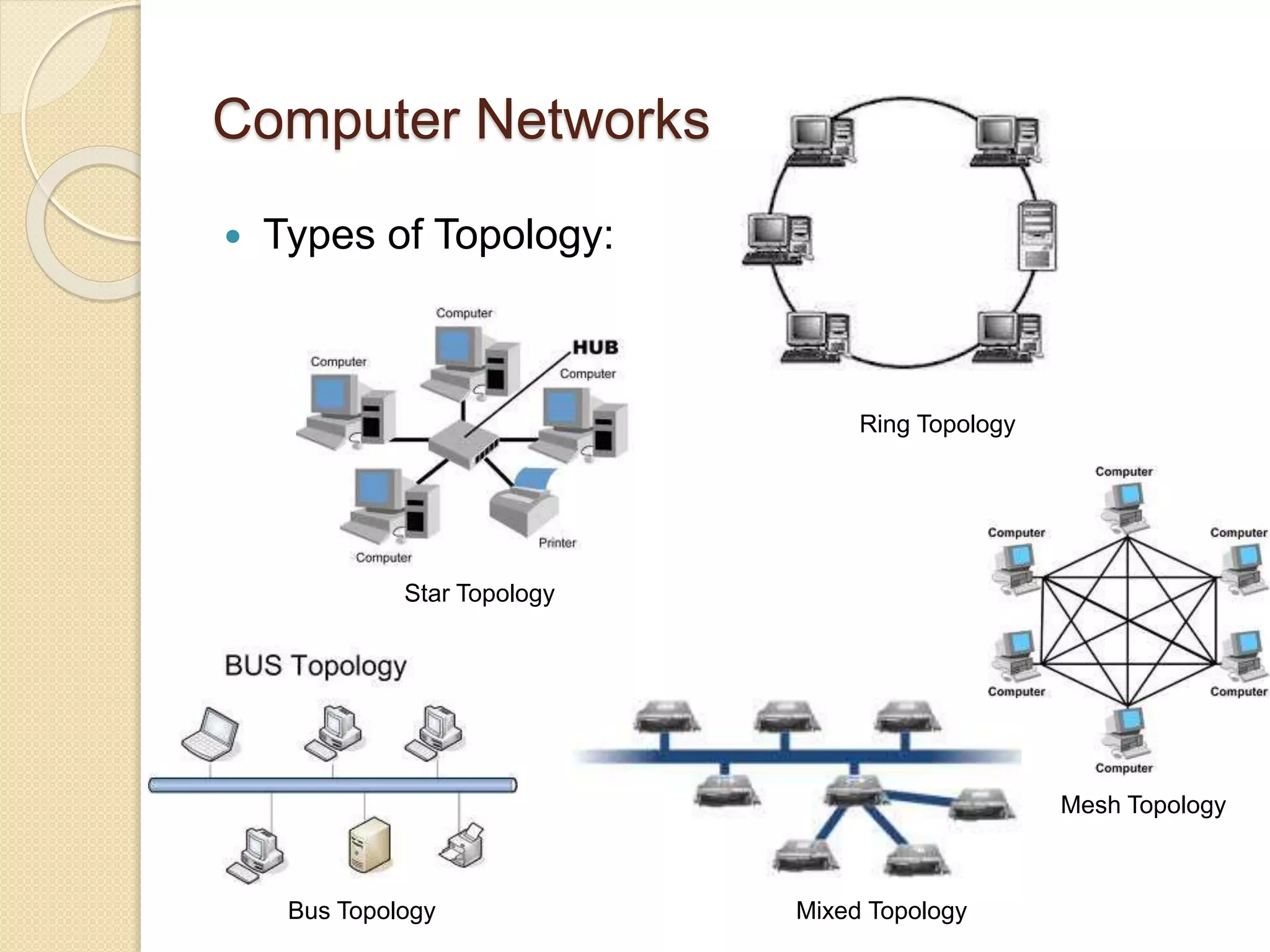
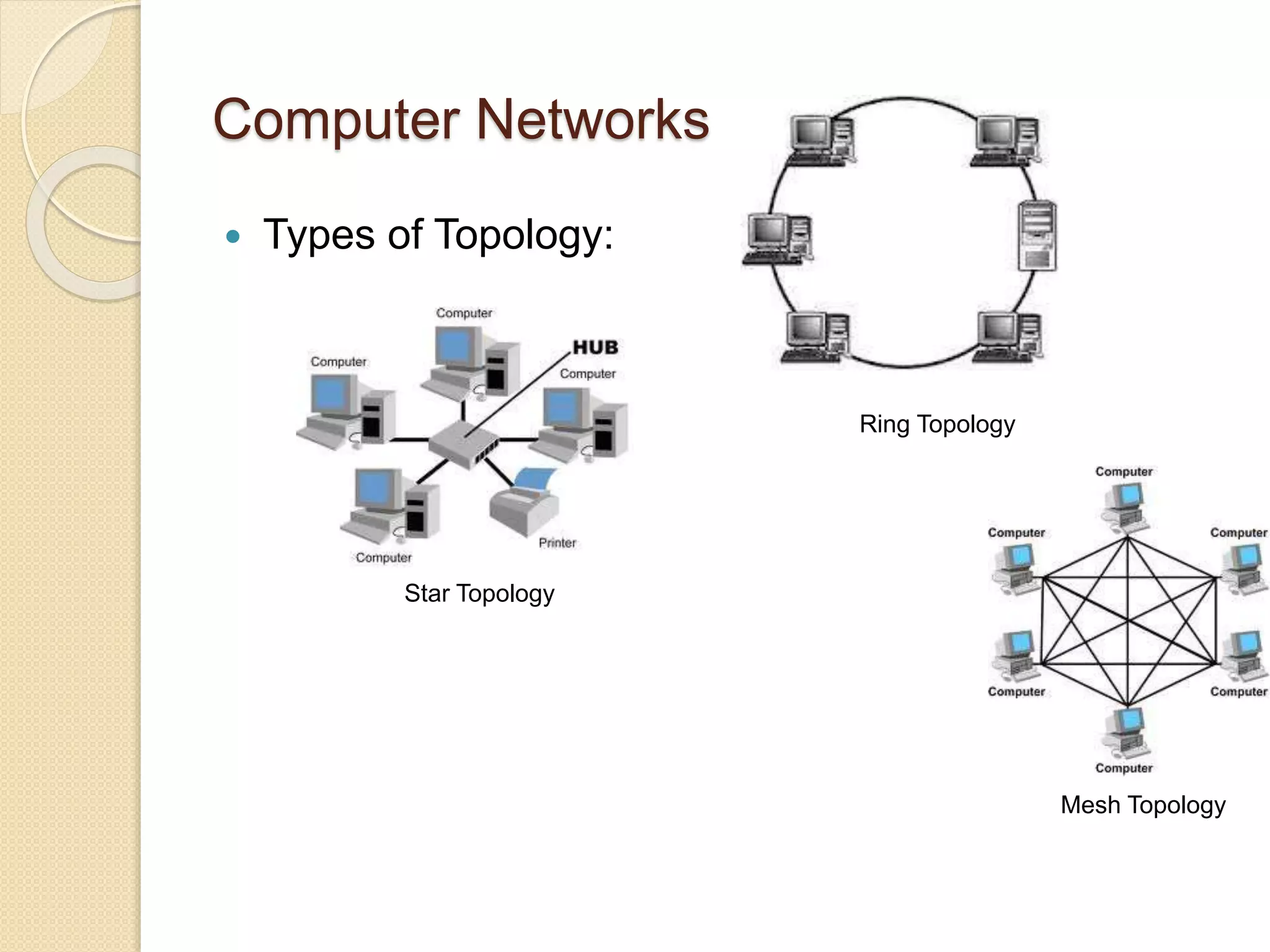
 Types of Topology:
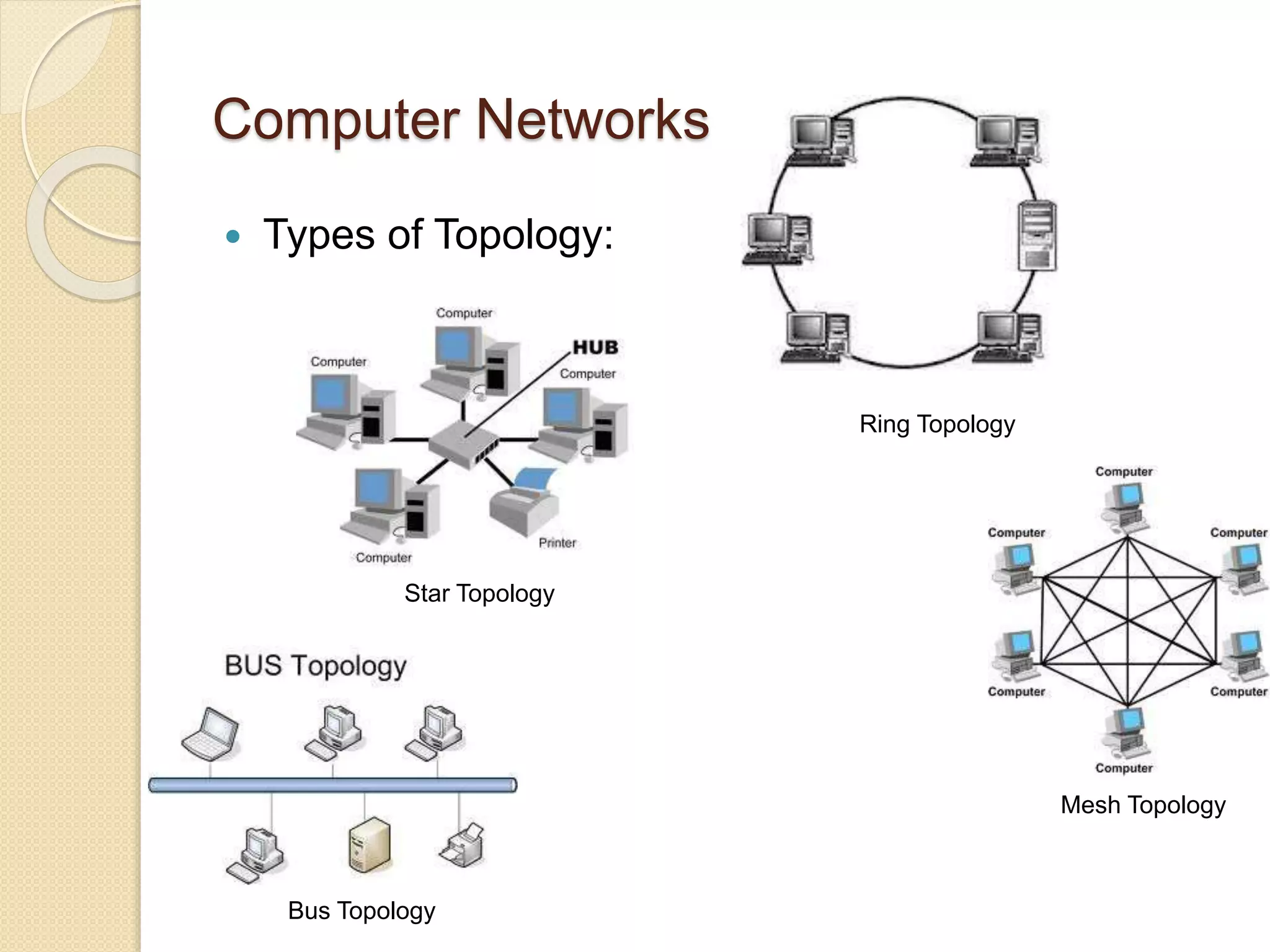
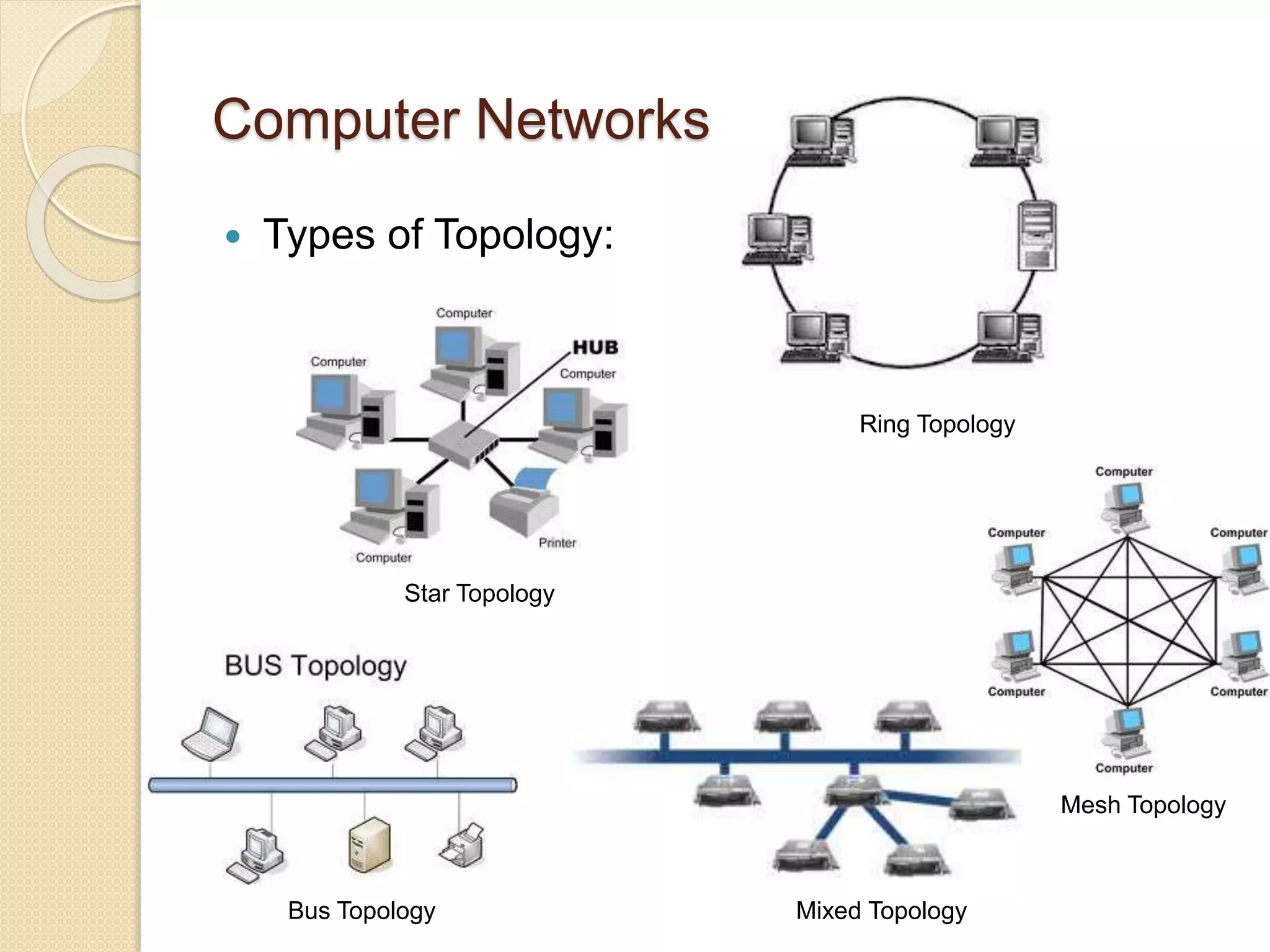
Ring Topology
Star Topology
Mesh Topology
Bus Topology Mixed Topology
Computer Networks
 Types of Topology:
Ring Topology
Computer Networks
 Types of Topology:
Ring Topology
Star Topology
Computer Networks
 Types of Topology:
Ring Topology
Star Topology
Mesh Topology
Computer Networks
 Types of Topology:
Ring Topology
Star Topology
Mesh Topology
Bus Topology
Computer Networks
 Types of Topology:
Ring Topology
Star Topology
Mesh Topology
Bus Topology Mixed Topology
Computer Networks
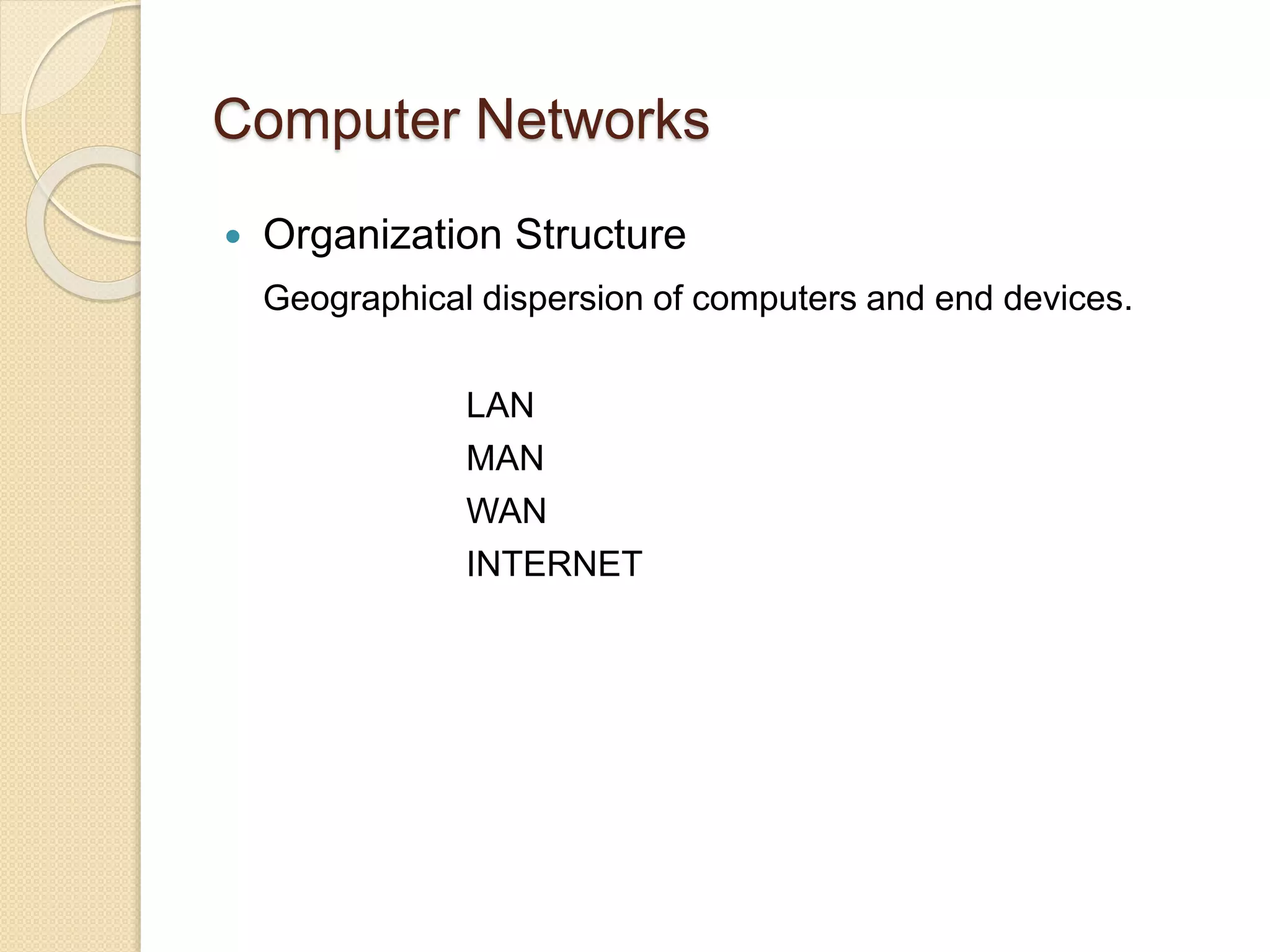
 Organization Structure
Geographical dispersion of computers and end devices.
LAN
MAN
WAN
INTERNET
Computer Networks
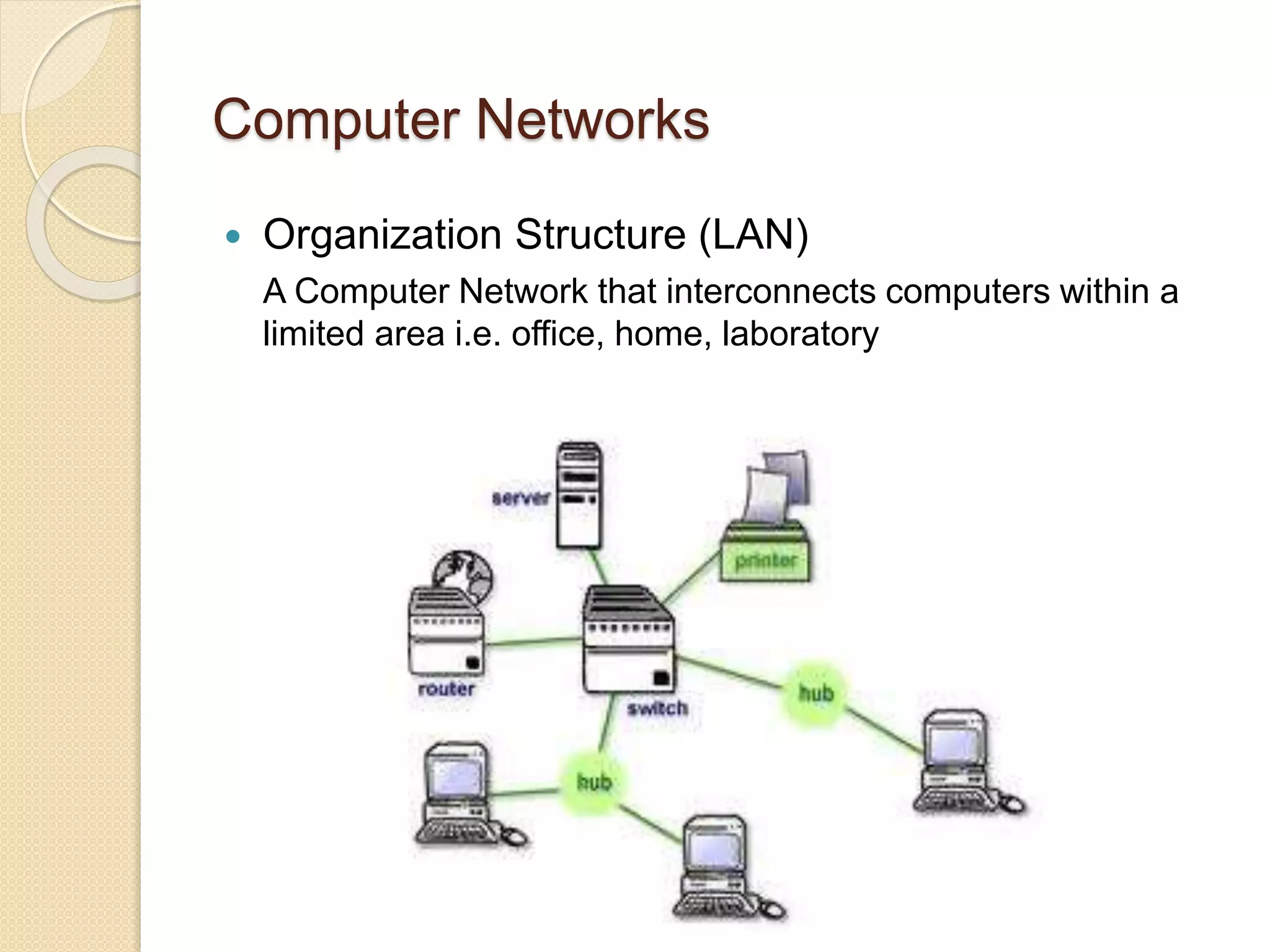
 Organization Structure (LAN)
A Computer Network that interconnects computers within a
limited area i.e. office, home, laboratory
Computer Networks
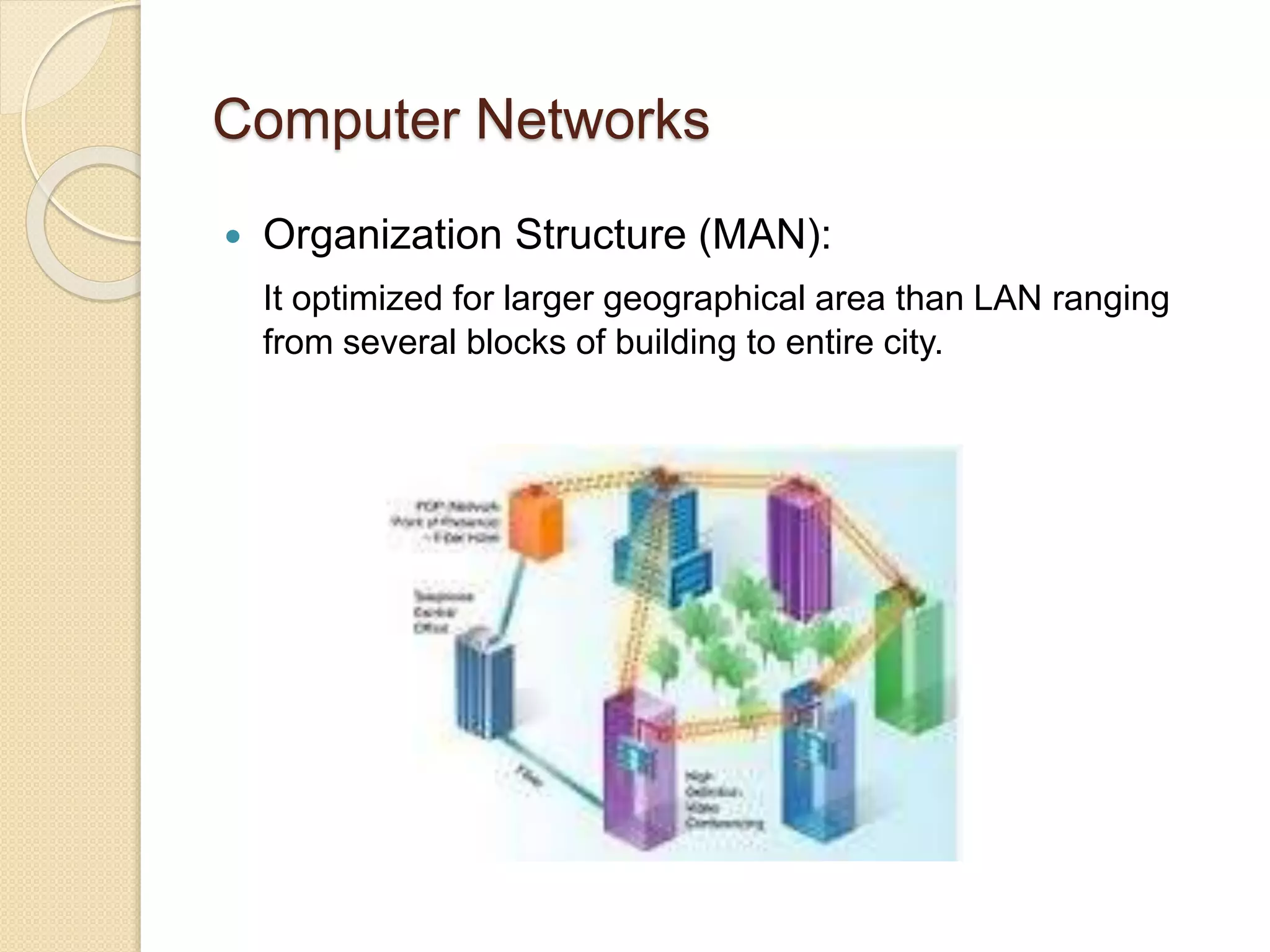
 Organization Structure (MAN):
It optimized for larger geographical area than LAN ranging
from several blocks of building to entire city.
Computer Networks
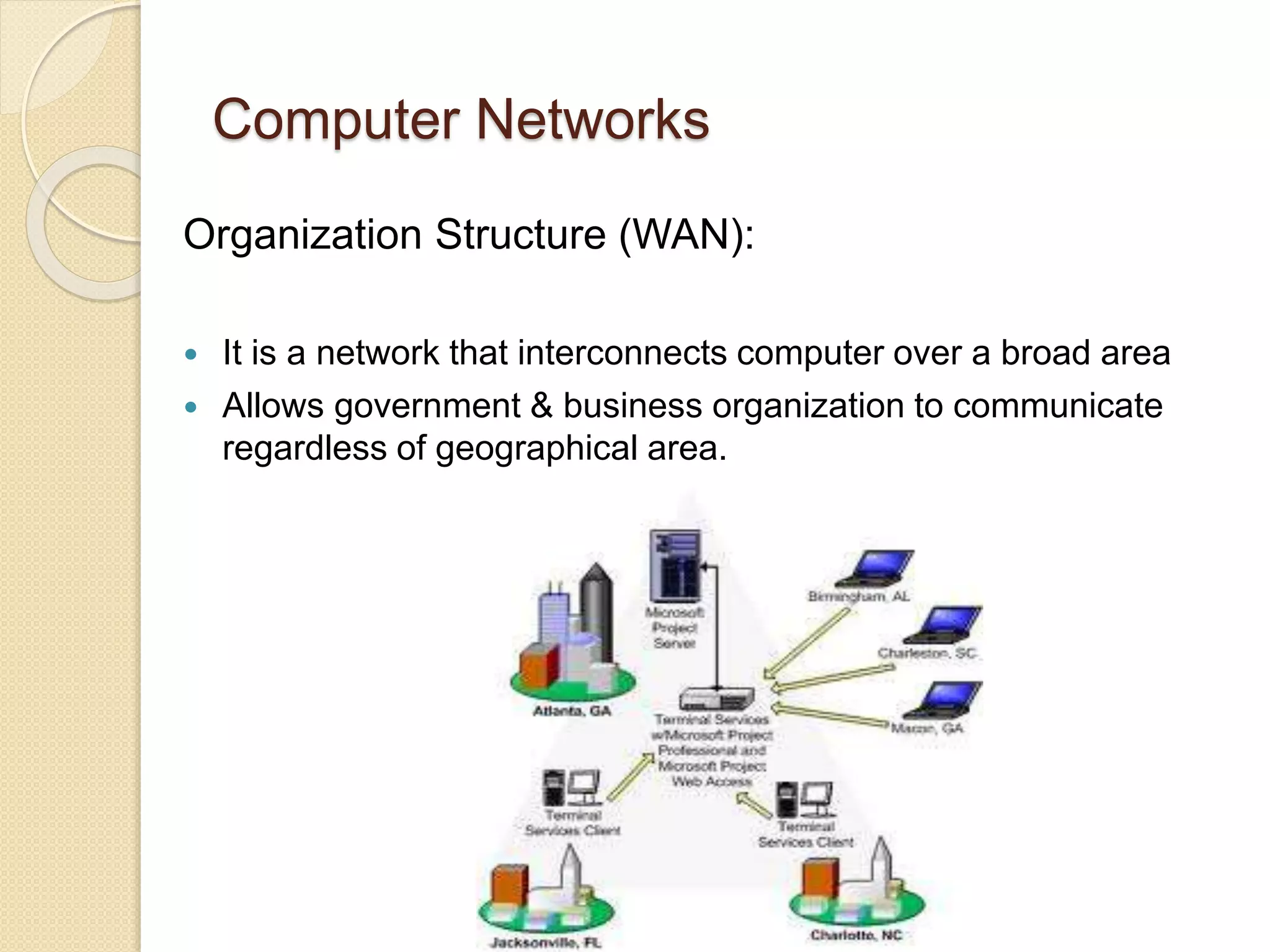
Organization Structure (WAN):
 It is a network that interconnects computer over a broad area
 Allows government & business organization to communicate
regardless of geographical area.
Computer Networks
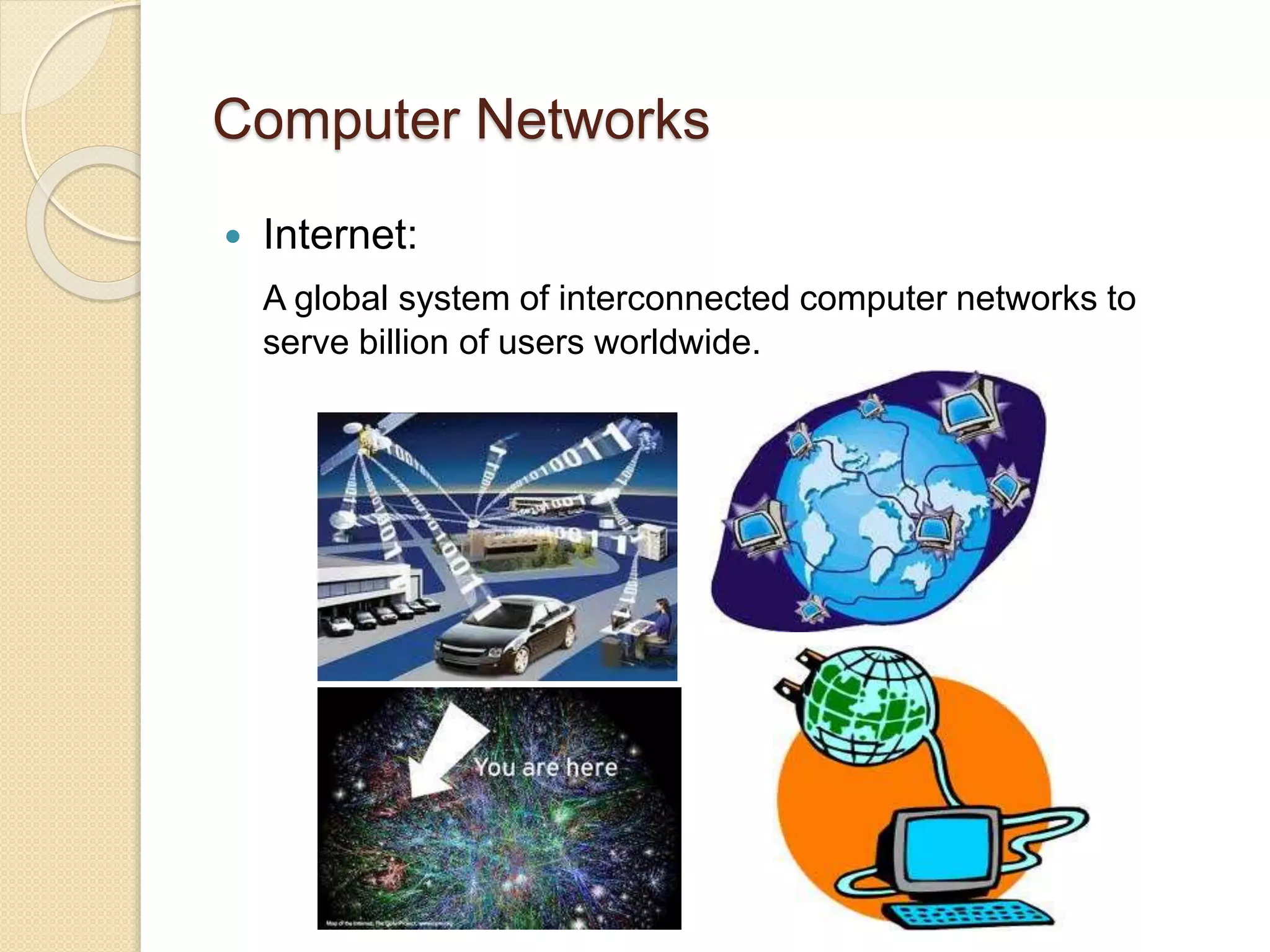
 Internet:
A global system of interconnected computer networks to
serve billion of users worldwide.
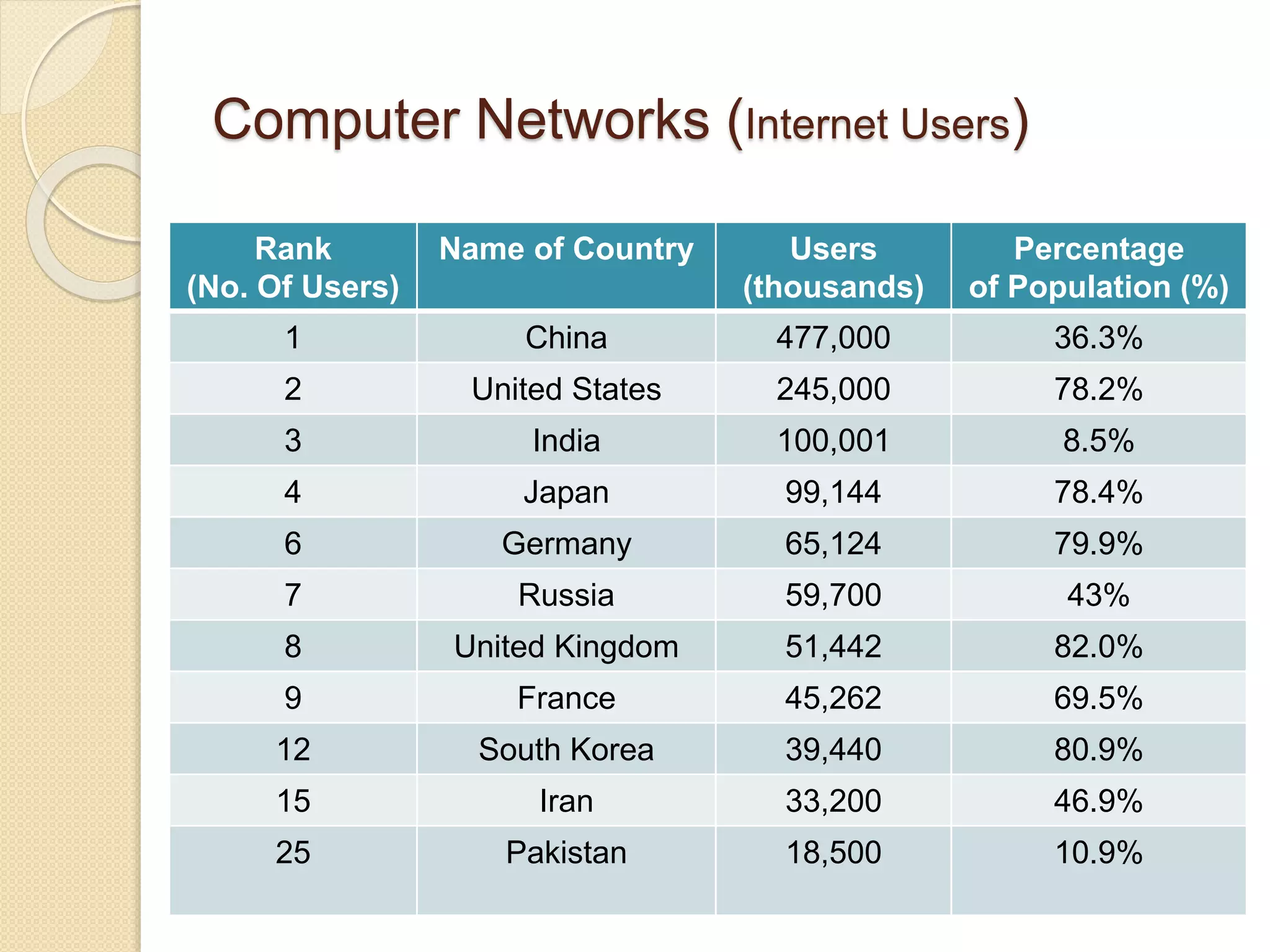
Computer Networks (Internet Users)
Rank
(No. Of Users)
Name of Country Users
(thousands)
Percentage
of Population (%)
1 China 477,000 36.3%
2 United States 245,000 78.2%
3 India 100,001 8.5%
4 Japan 99,144 78.4%
6 Germany 65,124 79.9%
7 Russia 59,700 43%
8 United Kingdom 51,442 82.0%
9 France 45,262 69.5%
12 South Korea 39,440 80.9%
15 Iran 33,200 46.9%
25 Pakistan 18,500 10.9%
Future
Of
Computer Networks
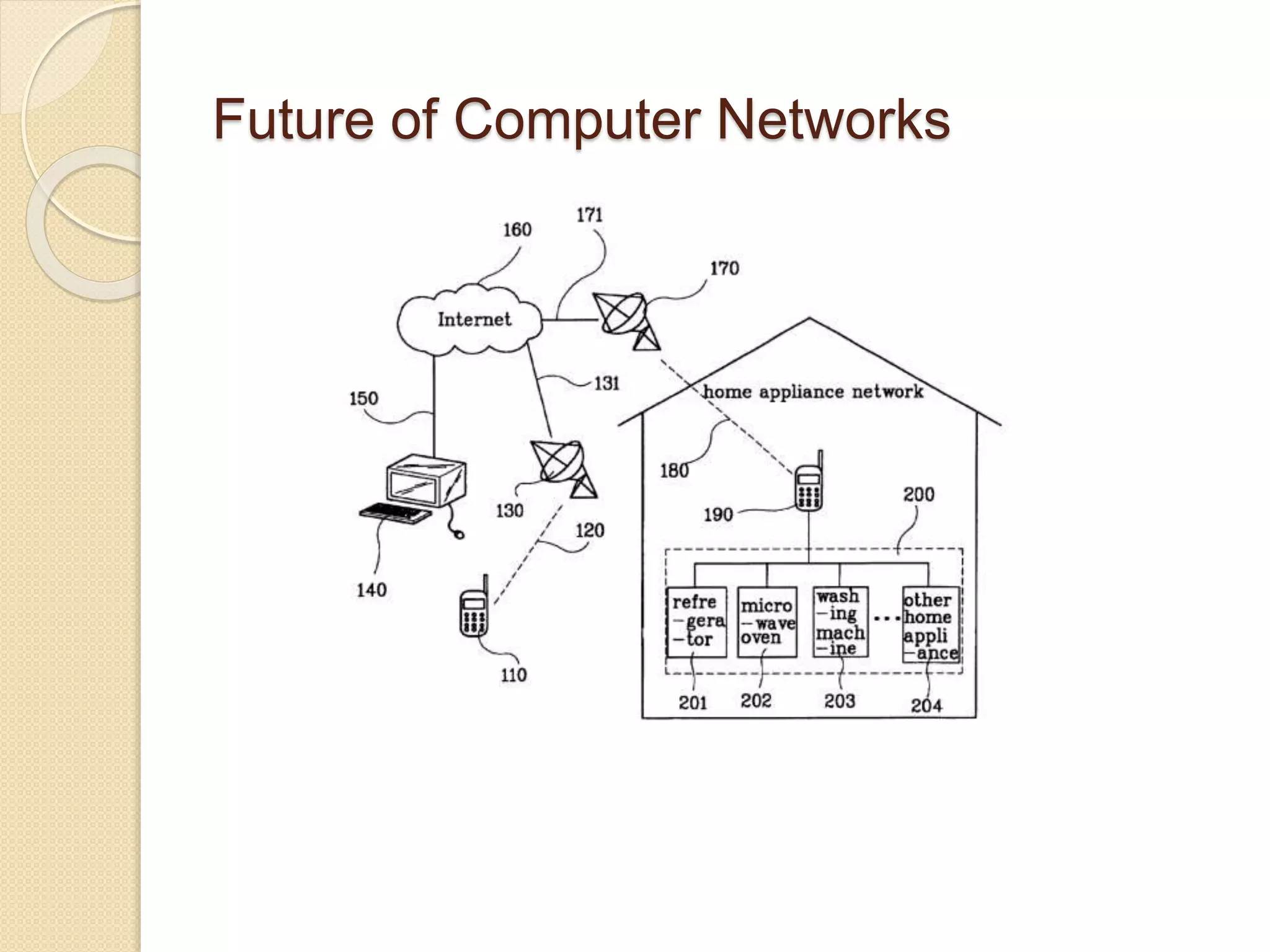
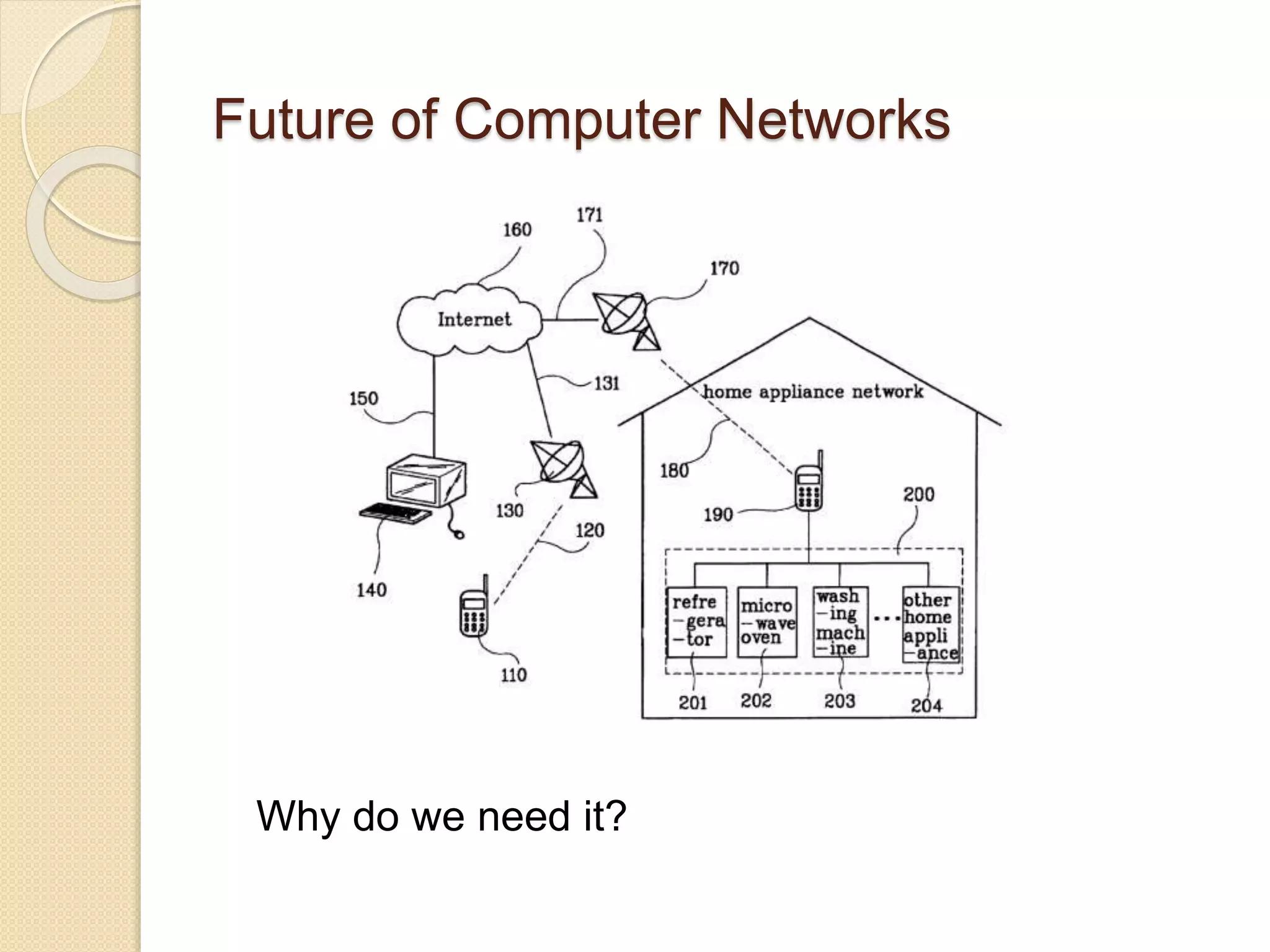
Future of Computer Networks
Future Networks will be completely different from
present networks.
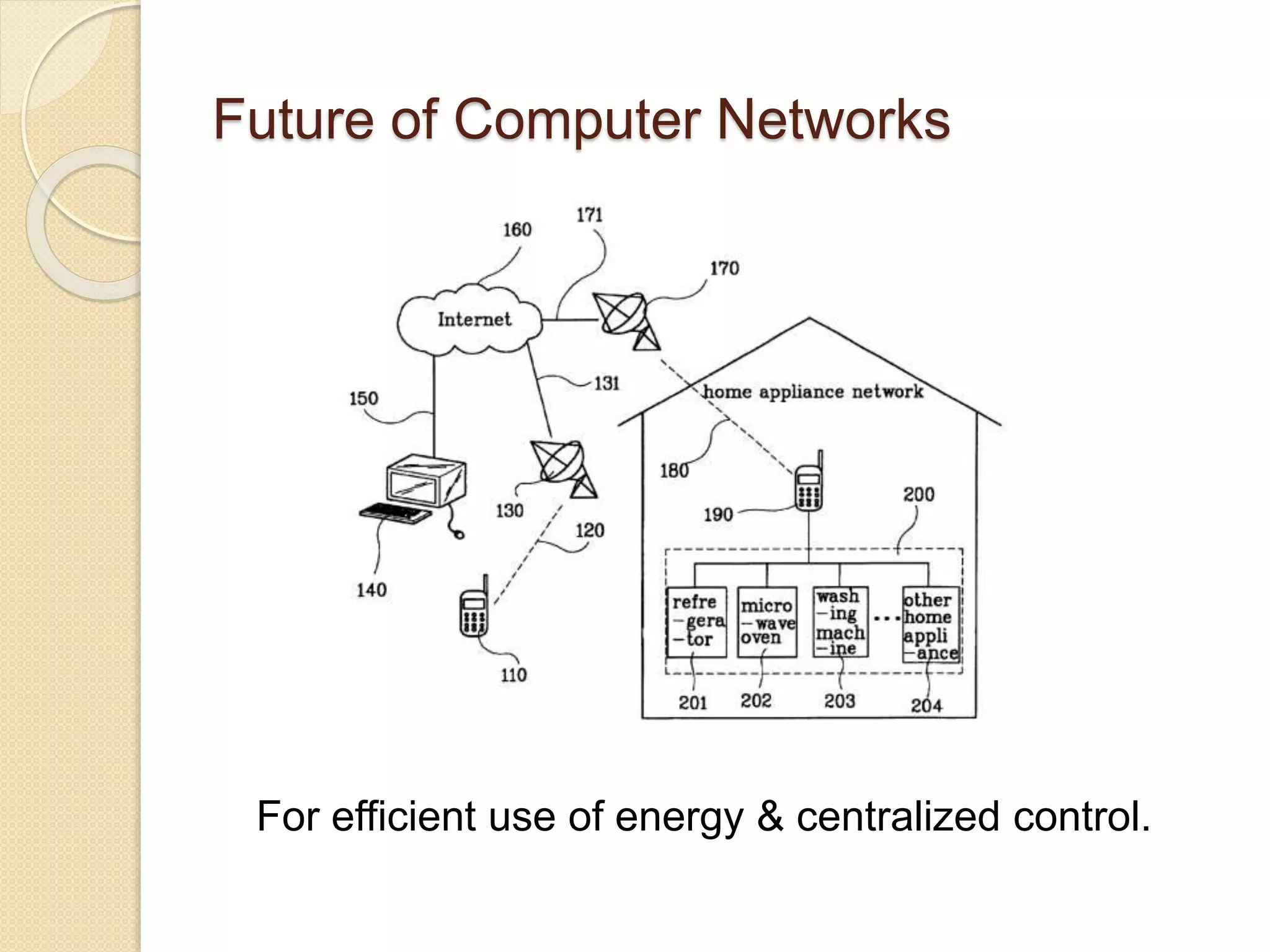
 We are expecting even house hold appliances like
electric bulb and toaster to be a part of network.
 They will have their own IP Addresses to make
them accessible & Controlled by Network.
Future of Computer Networks
Why do we need it?
Future of Computer Networks
For efficient use of energy & centralized control.
Future of Computer Networks
 In future, networks will be over whelmed data.
 The security concern will also increase.
 It is not expected even for a full time system
administrator to deal with these concerns.
Future of Computer Networks
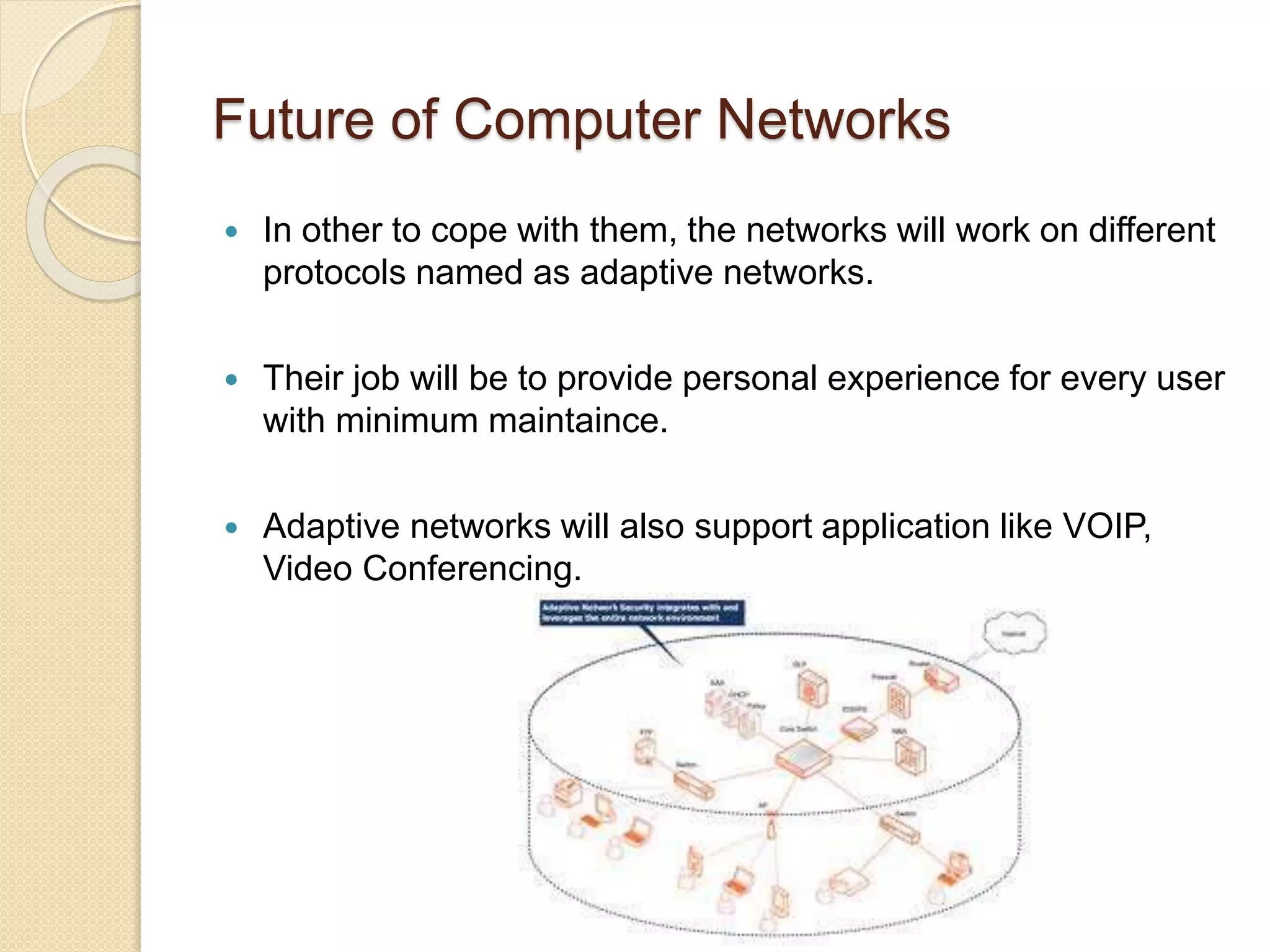
 In other to cope with them, the networks will work on different
protocols named as adaptive networks.
 Their job will be to provide personal experience for every user
with minimum maintaince.
 Adaptive networks will also support application like VOIP,
Video Conferencing.
Future of Computer Networks
 Bluetooth will replace every wire that we use.
Future of Computer Networks
 Bluetooth will replace every wire that we use.
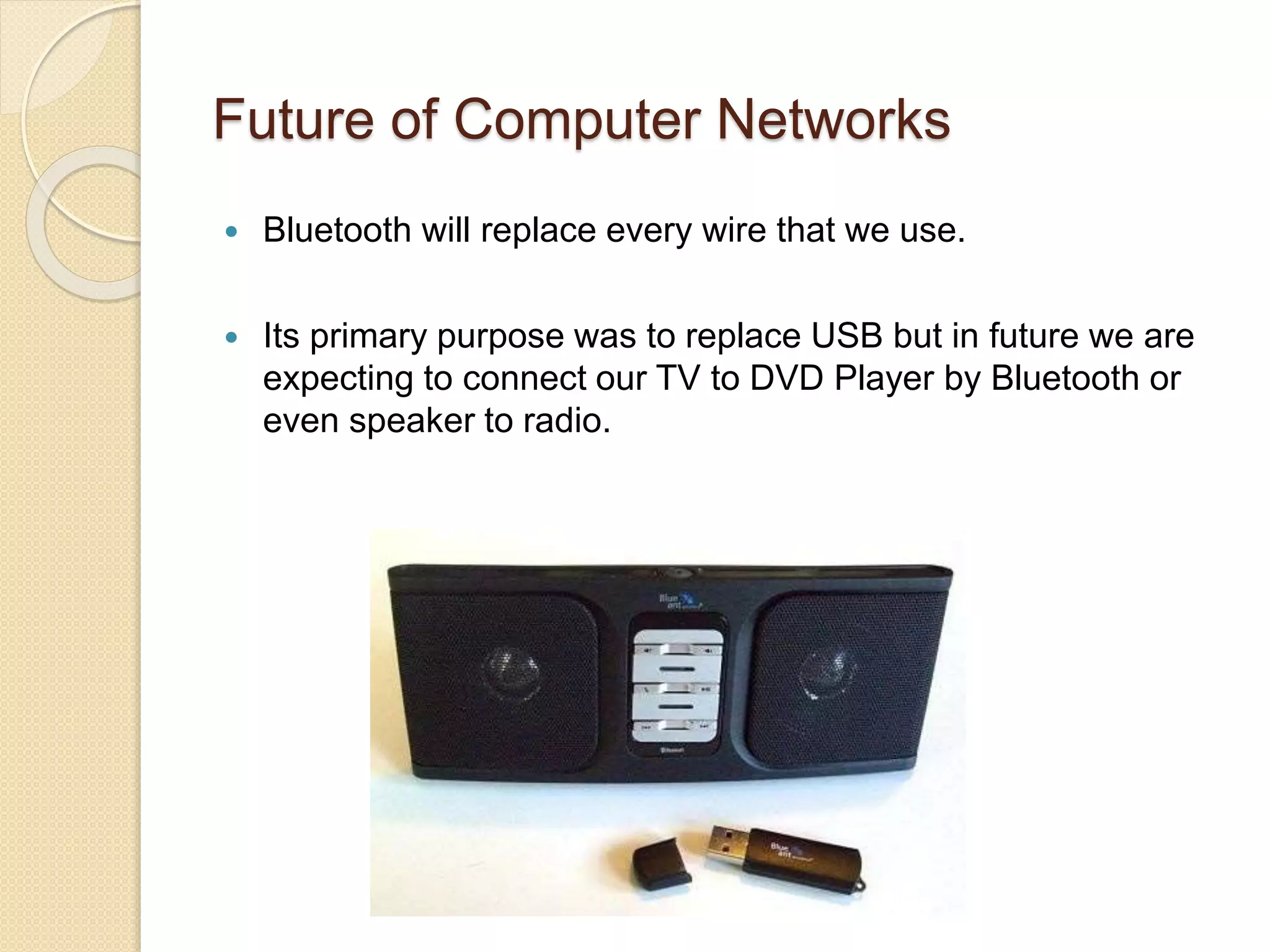
 Its primary purpose was to replace USB but in future we are
expecting to connect our TV to DVD Player by Bluetooth or
even speaker to radio.
Future of Computer Networks
 Bluetooth will replace every wire that we use.
 Its primary purpose was to replace USB but in future we are
expecting to connect our TV to DVD Player by Bluetooth or
even speaker to radio.

Computer networks

  • 1.
  • 2.
    Computer Networks  Acomputer network is a system in which computers are connected to share information and resources.
  • 3.
    Computer Networks History:  Sputnik1st Artificial Satellite in Earth Orbit in 1957  ARPA in 1958 to create IPTO (Information Processing Technique Office)  ARPA Net in 1959
  • 4.
    Computer Networks Uses ofComputer Networks:  Facilitating Communication Via email, instant messaging, telephone  Sharing Hardware: Printer, Scanners.  Sharing Files, Data & Info : Any authorized user can access data from other computer  Sharing Software's: Users connected to a network can access application programs on a network.
  • 5.
    Computer Networks Types ofComputer Networks based on:  Medium used to transport the data  Topology  Organization Structure
  • 6.
    Computer Networks Medium usedto transport the data
  • 7.
    Computer Networks  Topology Thelayout of a network & how different nodes in a network are connected together.
  • 8.
    Computer Networks  Typesof Topology: Ring Topology Star Topology Mesh Topology Bus Topology Mixed Topology
  • 9.
    Computer Networks  Typesof Topology: Ring Topology
  • 10.
    Computer Networks  Typesof Topology: Ring Topology Star Topology
  • 11.
    Computer Networks  Typesof Topology: Ring Topology Star Topology Mesh Topology
  • 12.
    Computer Networks  Typesof Topology: Ring Topology Star Topology Mesh Topology Bus Topology
  • 13.
    Computer Networks  Typesof Topology: Ring Topology Star Topology Mesh Topology Bus Topology Mixed Topology
  • 14.
    Computer Networks  OrganizationStructure Geographical dispersion of computers and end devices. LAN MAN WAN INTERNET
  • 15.
    Computer Networks  OrganizationStructure (LAN) A Computer Network that interconnects computers within a limited area i.e. office, home, laboratory
  • 16.
    Computer Networks  OrganizationStructure (MAN): It optimized for larger geographical area than LAN ranging from several blocks of building to entire city.
  • 17.
    Computer Networks Organization Structure(WAN):  It is a network that interconnects computer over a broad area  Allows government & business organization to communicate regardless of geographical area.
  • 18.
    Computer Networks  Internet: Aglobal system of interconnected computer networks to serve billion of users worldwide.
  • 19.
    Computer Networks (InternetUsers) Rank (No. Of Users) Name of Country Users (thousands) Percentage of Population (%) 1 China 477,000 36.3% 2 United States 245,000 78.2% 3 India 100,001 8.5% 4 Japan 99,144 78.4% 6 Germany 65,124 79.9% 7 Russia 59,700 43% 8 United Kingdom 51,442 82.0% 9 France 45,262 69.5% 12 South Korea 39,440 80.9% 15 Iran 33,200 46.9% 25 Pakistan 18,500 10.9%
  • 20.
  • 21.
    Future of ComputerNetworks Future Networks will be completely different from present networks.  We are expecting even house hold appliances like electric bulb and toaster to be a part of network.  They will have their own IP Addresses to make them accessible & Controlled by Network.
  • 22.
  • 23.
    Future of ComputerNetworks Why do we need it?
  • 24.
    Future of ComputerNetworks For efficient use of energy & centralized control.
  • 25.
    Future of ComputerNetworks  In future, networks will be over whelmed data.  The security concern will also increase.  It is not expected even for a full time system administrator to deal with these concerns.
  • 26.
    Future of ComputerNetworks  In other to cope with them, the networks will work on different protocols named as adaptive networks.  Their job will be to provide personal experience for every user with minimum maintaince.  Adaptive networks will also support application like VOIP, Video Conferencing.
  • 27.
    Future of ComputerNetworks  Bluetooth will replace every wire that we use.
  • 28.
    Future of ComputerNetworks  Bluetooth will replace every wire that we use.  Its primary purpose was to replace USB but in future we are expecting to connect our TV to DVD Player by Bluetooth or even speaker to radio.
  • 29.
    Future of ComputerNetworks  Bluetooth will replace every wire that we use.  Its primary purpose was to replace USB but in future we are expecting to connect our TV to DVD Player by Bluetooth or even speaker to radio.