
Designed by Rita Gokani
 Before we understand what is computer
network we should know why it is
required?
 In daily life we need to talk or
communicate with other person in order
to share some information message or
experiences. Same way computer’s also
share information with other computer’s.
For that it requires a computer network.
 A Computer Network is a
collection of two or more
computers connected together in
order to communicate and share
the data and information.
 There are 2 ways to connect to a
network. They are using wires or
by using signals.
 Sharing of resources such as printers,
scanners & camera’s.
 Sharing of expensive software's and
database.
 Communication from one computer to
another computer.
 Exchange of data and information among
users via network.
 Sharing of information over
geographically wide areas.
 Increased speed
 Reduced cost
 Improved security
 Centralized software managements
 Electronic mail
 Flexible access
 High cost of installation
 Requires time for administration
 Failure of server
 Cable faults
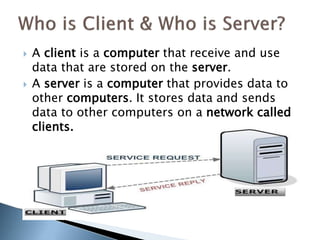
 A client is a computer that receive and use
data that are stored on the server.
 A server is a computer that provides data to
other computers. It stores data and sends
data to other computers on a network called
clients.
Computer Networking - Its Advantages & Disadvantages

Computer Networking - Its Advantages & Disadvantages

  • 1.
  • 2.
     Before weunderstand what is computer network we should know why it is required?  In daily life we need to talk or communicate with other person in order to share some information message or experiences. Same way computer’s also share information with other computer’s. For that it requires a computer network.
  • 3.
     A ComputerNetwork is a collection of two or more computers connected together in order to communicate and share the data and information.  There are 2 ways to connect to a network. They are using wires or by using signals.
  • 4.
     Sharing ofresources such as printers, scanners & camera’s.  Sharing of expensive software's and database.  Communication from one computer to another computer.  Exchange of data and information among users via network.  Sharing of information over geographically wide areas.
  • 5.
     Increased speed Reduced cost  Improved security  Centralized software managements  Electronic mail  Flexible access
  • 6.
     High costof installation  Requires time for administration  Failure of server  Cable faults
  • 7.
     A clientis a computer that receive and use data that are stored on the server.  A server is a computer that provides data to other computers. It stores data and sends data to other computers on a network called clients.