Introduction to Computer
Aided Process Planning
Computer Integrated Manufacturing
(CIM)
• Computer Aided Design (CAD)
– 2D
– 3D
– Concurrent Engineering
• Computer Aided Process Planning (CAPP)
– Variant
– Generative
• Computer Aided Manufacturing (CAM)
– CNC
– Robotics
– Material Handling
– Just in Time (JIT)
– Group Technology
– Flexible Manufacturing Systems
What is process planning?
• Recipe/Algorithm/Step-by-step instructions
• Fast Food Chain
• Same taste everywhere from NY to New
Delhi
• How do they do it?
• Customization in formal dinner restaurant
Manufacturing Environment
• Role of the master machinist in small batch
manufacturing
• Manufacturing is more complex than cooking yet
the planning for it is similar
• Job shop: group machines which perform same
operation together
• Routing of parts through the various
departments
• Process plan defines the route
• Reduction in the necessary skill of operator can
be achieved by using a detailed process plan
Formal Definition
“Process planning can be defined as an act of
preparing processing documentation for the
manufacturing of a piece, part or an assembly”
• depending on the production environment can
be
– Rough
– Detailed
• When process planning is done using a
computer : “Computer Aided Process Planning”
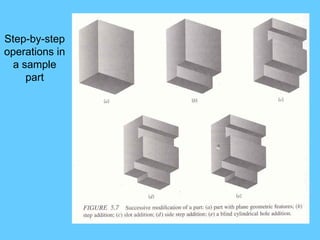
Step-by-step
operations in
a sample
part
• Manufacturing a part to meet design specs.
– Selection of initial block
– Sequence of operations
– Selection of machine, process
• Surface finish
• Quality
• Tolerance
• Hardness
• Life
• Cost
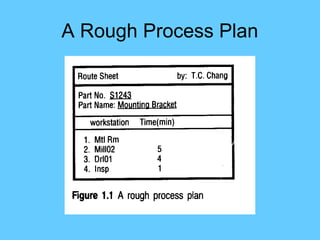
A Rough Process Plan
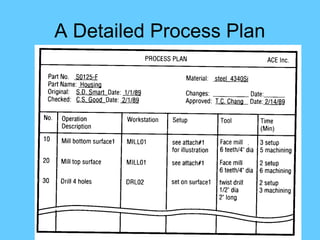
A Detailed Process Plan
Components of Process Planning
• Selection of machining operations
• Sequencing of machining operations
• Selection of cutting tools
• Determining the setup requirements
• Calculation of cutting parameters
• Tool path planning and generation of
NC/CNC programs
• Design of Jigs/Fixtures
Process Planning in different
environments
• In tool-room type manufacturing
– “make part as per drawing” is sufficient
• In metal-forming type operations
– The process planning requirements are embedded
directly into the die.
– Process planning is fairly trivial
• Job-shop type manufacturing requires most
detailed process planning
– Design of tools, jigs, fixtures and manufacturing
sequence are dictated directly by the process plan.
Requirements for process planner
• Must be able to analyze and understand
part requirements
• Have extensive knowledge of machine
tools, cutting tools and their capabilities
• Understand the interactions between the
part, manufacturing, quality and cost
Traditional process planning
• Experienced based and performed manually
• Variability in planner’s judgment and experience
can lead to differences in the of what constitutes
best quality
• Problem facing modern industry is the current
lack of skilled labor force to produce machined
parts as was done in the past
• Hence Computer Integrated Manufacturing and
Computer Aided Process Planning
Advantages of CAPP
• Reduces the demand on the skilled
planner
• Reduces the process planning time
• Reduces both process planning and
manufacturing cost
• Creates consistent plans
• It produces accurate plans
• It increases productivity
Approaches to CAPP
• Variant
• Generative
• Automatic
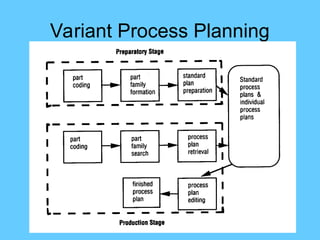
Variant Process Planning
“based on the valid conjecture that similar
parts will have similar process plans”
Preparatory stage
• GT-based part coding
– Families of similar parts are created
– Family matrix
• A process plan is to manufacture the
entire family is created
Variant Process Planning
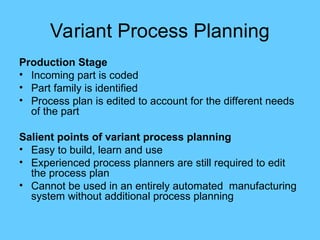
Production Stage
• Incoming part is coded
• Part family is identified
• Process plan is edited to account for the different needs
of the part
Salient points of variant process planning
• Easy to build, learn and use
• Experienced process planners are still required to edit
the process plan
• Cannot be used in an entirely automated manufacturing
system without additional process planning
Variant Process Planning
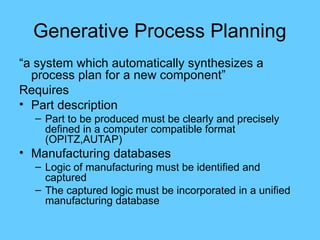
Generative Process Planning
“a system which automatically synthesizes a
process plan for a new component”
Requires
• Part description
– Part to be produced must be clearly and precisely
defined in a computer compatible format
(OPITZ,AUTAP)
• Manufacturing databases
– Logic of manufacturing must be identified and
captured
– The captured logic must be incorporated in a unified
manufacturing database
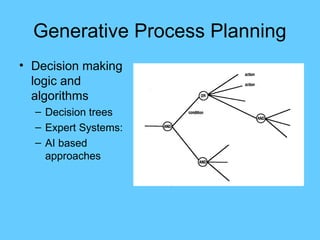
Generative Process Planning
• Decision making
logic and
algorithms
– Decision trees
– Expert Systems:
– AI based
approaches
Automatic Process Planning
“ generate a complete process plan directly from a
CAD drawing”
Requires:
• Automated CAD interface
– Take a general CAD model ( 3D for unambiguous
data) and develop an interface to develop a
manufacturing interface for this model : Feature
Recognition of CAD
– Design the parts with available manufacturing
features : Feature based CAD
– Dual: useful features of both approaches
• Intelligent (computer based) process planner
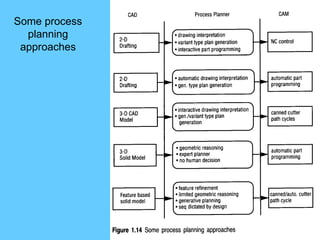
Some process
planning
approaches
SUMMARY
• CAPP is a highly effective technology for
discrete manufacturers with a significant
number of products and process steps.
• Rapid strides are being made to develop
generative planning capabilities and
incorporate CAPP into a computer-
integrated manufacturing architecture.
SUMMARY
• The first step is the implementation of GT
and coding.
• Commercially-available software tools
currently exist to support both GT and
CAPP.
SUMMARY
• As a result, many companies can achieve
the benefits of GT and CAPP with minimal
cost and risk.
• Effective use of these tools can improve a
manufacturer's competitive advantage.
References
Systems Approach To Computer Integrated
Design and Manufacturing
• Author: Nanua Singh
• Publisher: John Wiley & Sons
Expert Process Planning For Manufacturing
• Author: Tien-chien Chang
• Publisher: Addison-Wesley Publishing
Company

computer aided process planning and cost estimation

  • 1.
  • 2.
    Computer Integrated Manufacturing (CIM) •Computer Aided Design (CAD) – 2D – 3D – Concurrent Engineering • Computer Aided Process Planning (CAPP) – Variant – Generative • Computer Aided Manufacturing (CAM) – CNC – Robotics – Material Handling – Just in Time (JIT) – Group Technology – Flexible Manufacturing Systems
  • 3.
    What is processplanning? • Recipe/Algorithm/Step-by-step instructions • Fast Food Chain • Same taste everywhere from NY to New Delhi • How do they do it? • Customization in formal dinner restaurant
  • 4.
    Manufacturing Environment • Roleof the master machinist in small batch manufacturing • Manufacturing is more complex than cooking yet the planning for it is similar • Job shop: group machines which perform same operation together • Routing of parts through the various departments • Process plan defines the route • Reduction in the necessary skill of operator can be achieved by using a detailed process plan
  • 5.
    Formal Definition “Process planningcan be defined as an act of preparing processing documentation for the manufacturing of a piece, part or an assembly” • depending on the production environment can be – Rough – Detailed • When process planning is done using a computer : “Computer Aided Process Planning”
  • 6.
  • 7.
    • Manufacturing apart to meet design specs. – Selection of initial block – Sequence of operations – Selection of machine, process • Surface finish • Quality • Tolerance • Hardness • Life • Cost
  • 8.
  • 9.
  • 10.
    Components of ProcessPlanning • Selection of machining operations • Sequencing of machining operations • Selection of cutting tools • Determining the setup requirements • Calculation of cutting parameters • Tool path planning and generation of NC/CNC programs • Design of Jigs/Fixtures
  • 11.
    Process Planning indifferent environments • In tool-room type manufacturing – “make part as per drawing” is sufficient • In metal-forming type operations – The process planning requirements are embedded directly into the die. – Process planning is fairly trivial • Job-shop type manufacturing requires most detailed process planning – Design of tools, jigs, fixtures and manufacturing sequence are dictated directly by the process plan.
  • 12.
    Requirements for processplanner • Must be able to analyze and understand part requirements • Have extensive knowledge of machine tools, cutting tools and their capabilities • Understand the interactions between the part, manufacturing, quality and cost
  • 13.
    Traditional process planning •Experienced based and performed manually • Variability in planner’s judgment and experience can lead to differences in the of what constitutes best quality • Problem facing modern industry is the current lack of skilled labor force to produce machined parts as was done in the past • Hence Computer Integrated Manufacturing and Computer Aided Process Planning
  • 14.
    Advantages of CAPP •Reduces the demand on the skilled planner • Reduces the process planning time • Reduces both process planning and manufacturing cost • Creates consistent plans • It produces accurate plans • It increases productivity
  • 15.
    Approaches to CAPP •Variant • Generative • Automatic
  • 16.
    Variant Process Planning “basedon the valid conjecture that similar parts will have similar process plans” Preparatory stage • GT-based part coding – Families of similar parts are created – Family matrix • A process plan is to manufacture the entire family is created
  • 17.
    Variant Process Planning ProductionStage • Incoming part is coded • Part family is identified • Process plan is edited to account for the different needs of the part Salient points of variant process planning • Easy to build, learn and use • Experienced process planners are still required to edit the process plan • Cannot be used in an entirely automated manufacturing system without additional process planning
  • 18.
  • 19.
    Generative Process Planning “asystem which automatically synthesizes a process plan for a new component” Requires • Part description – Part to be produced must be clearly and precisely defined in a computer compatible format (OPITZ,AUTAP) • Manufacturing databases – Logic of manufacturing must be identified and captured – The captured logic must be incorporated in a unified manufacturing database
  • 20.
    Generative Process Planning •Decision making logic and algorithms – Decision trees – Expert Systems: – AI based approaches
  • 21.
    Automatic Process Planning “generate a complete process plan directly from a CAD drawing” Requires: • Automated CAD interface – Take a general CAD model ( 3D for unambiguous data) and develop an interface to develop a manufacturing interface for this model : Feature Recognition of CAD – Design the parts with available manufacturing features : Feature based CAD – Dual: useful features of both approaches • Intelligent (computer based) process planner
  • 22.
  • 23.
    SUMMARY • CAPP isa highly effective technology for discrete manufacturers with a significant number of products and process steps. • Rapid strides are being made to develop generative planning capabilities and incorporate CAPP into a computer- integrated manufacturing architecture.
  • 24.
    SUMMARY • The firststep is the implementation of GT and coding. • Commercially-available software tools currently exist to support both GT and CAPP.
  • 25.
    SUMMARY • As aresult, many companies can achieve the benefits of GT and CAPP with minimal cost and risk. • Effective use of these tools can improve a manufacturer's competitive advantage.
  • 26.
    References Systems Approach ToComputer Integrated Design and Manufacturing • Author: Nanua Singh • Publisher: John Wiley & Sons Expert Process Planning For Manufacturing • Author: Tien-chien Chang • Publisher: Addison-Wesley Publishing Company