Pharmacist DevelopmentGroup
Scientific DepartmentEasy PharmacologyprogrammePresent
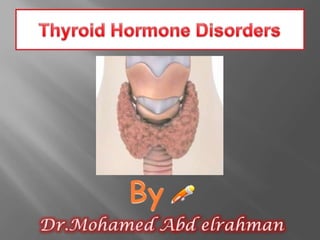
Thyroid Hormone DisordersByDr.MohamedAbdelrahman
The Lecture In Points
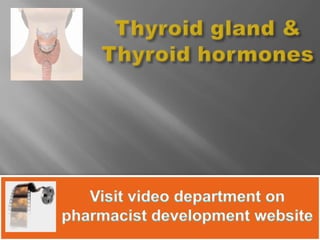
Thyroid gland & Thyroid hormonesVisit video department onpharmacist development website
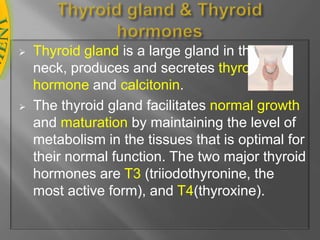
Thyroid gland & Thyroid hormonesThyroidglandis a large gland in the               neck, produces and secretes thyroid            hormone and calcitonin.
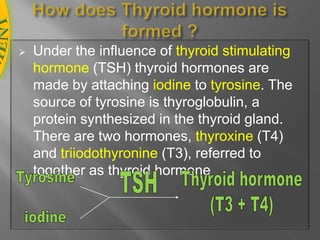
The thyroid gland facilitates normal growth and maturation by maintaining the level of metabolism in the tissues that is optimal for their normal function. The two major thyroid hormones are T3 (triiodothyronine, the most active form), and T4(thyroxine). How does Thyroid hormone is formed ?Under the influence of thyroid stimulating hormone (TSH) thyroid hormones are made by attaching iodine to tyrosine. The source of tyrosine is thyroglobulin, a protein synthesized in the thyroid gland. There are two hormones, thyroxine (T4) and triiodothyronine (T3), referred to together as thyroid hormoneTyrosineiodineTSHThyroid hormone(T3 + T4)
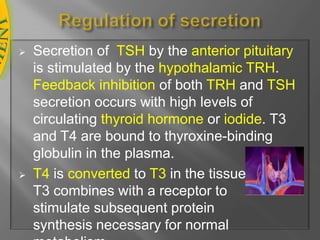
Regulation of secretionSecretion of  TSH by the anterior pituitary is stimulated by the hypothalamic TRH. Feedback inhibition of both TRH and TSH secretion occurs with high levels of circulating thyroid hormone or iodide. T3 and T4 are bound to thyroxine-binding globulin in the plasma.
T4 is converted to T3 in the tissues.                T3 combines with a receptor to           stimulate subsequent protein               synthesis necessary for normal metabolism.HypothyroidismRefresh your information by medical reminder on pharmacist development website mean page
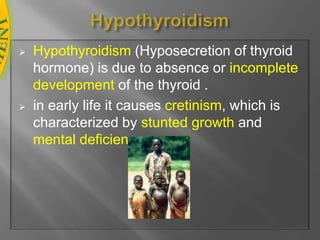
HypothyroidismHypothyroidism (Hyposecretion of thyroid hormone) is due to absence or incompletedevelopment of the thyroid .
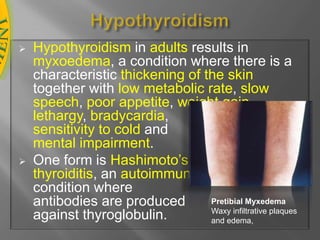
in early life it causes cretinism, which is characterized by stuntedgrowth and mentaldeficiency.HypothyroidismHypothyroidism in adults results in myxoedema, a condition where there is a characteristic thickening of the skin together with low metabolic rate, slow speech, poor appetite, weight gain,                                   lethargy, bradycardia,                                sensitivity to cold and                                            mental impairment.
One form is Hashimoto’s                          thyroiditis, an autoimmune                                    condition where                                       antibodies are produced                                    against thyroglobulin.PretibialMyxedemaWaxy infiltrative plaques and edema,
Treatment of hypothyroidism Hypothyroidism is treated by replacement therapy with levothyroxine (T4) .
Hypothyroidism with goitrecan result (rarely) from deficiency of iodine in the diet; in which case treatment is with iodine supplementation.Administration of Levothyroxinlevothyroxine (T4)(Eltroxin, Euthyrox) is given once daily because of its long half-life. Steady state is achieved at 6-8 weeks.
Toxicity is directly related to thyroxine levels and manifests itself as nervousness, tachycardia, intolerance to heat and unexplained weight loss. Levothyroxin interactionsoral anticoagulants :May increase anticoagulant effects .
Cholestyramine : May decrease thyroid hormone efficacy .
digitalis glycosides: May reduce effects of glycosides .
Fasting :Increases absorption of levothyroxin from GI tract.
Iron salts: May decrease efficacy of levothyroxine, resulting in hypothyroidism. Levothyroxin cautionsPregnancy: Category A.
Lactation :Minimal amounts excreted in breast milk.
Children :When drug is administered for congenital hypothyroidism, routine determinations of serum T4or TSH are strongly advised in neonates. In infants, excessive doses of thyroid hormone preparations may produce craniosynostosis. Children may experience transient partial hair loss in first few months of thyroid therapy .Levothyroxin cautionsInfertility: Drug is unjustified for treatment of male or female infertility unless condition is accompanied by hypothyroidism.
Endocrine disorders: Therapy in patients with concomitant diabetes mellitus, diabetes insipidusor adrenal insufficiency (Addison's disease) exacerbates intensity of their symptoms. Levothyroxin cautionsMyxedema coma: Patients are particularly sensitive to thyroid preparations. Sudden administration of large doses is not without cardiovascular risks and may cause myxedema coma. so, small initial doses are indicated.Therapy of myxedemacoma requires simultaneous administration of glucocorticoids. Levothyroxin cautionsCardiovascular disease : Use caution when integrity of cardiovascular system, particularly coronary arteries, is suspect (eg, angina, elderly). Development of chest pain or worsening cardiovascular disease requires decrease in dosage.
Obesity :Drug should not be used for weight reduction; may produce serious or life-threatening toxicity in large doses, particularly when given with anorexiants .HyperthyroidismPharmadevelopChannelMedical videos all over the day Learn & enjoy
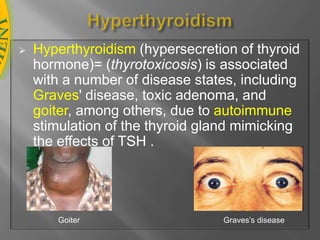
HyperthyroidismHyperthyroidism (hypersecretion of thyroid hormone)= (thyrotoxicosis) is associated with a number of disease states, including Graves' disease, toxic adenoma, and goiter, among others, due to autoimmune stimulation of the thyroid gland mimicking the effects of TSH .Graves’s diseaseGoiter
Symptoms & treatment of HyperthyroidismSymptoms are high metabolic rate, increased temperature,sweating, nervousness, tremor, tachycardia,increased  appetite, loss of weight,goitre and protrusion of the eyeballs                         (exophthalmia).
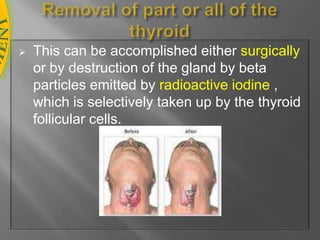
The goal of therapy is to decrease synthesis and/or release of additional hormone. This can be accomplished by removing part or all of the thyroid gland, by inhibiting synthesis of the hormones, or by blocking release of the hormones from the follicle. Removal of part or all of the thyroidThis can be accomplished either surgically or by destruction of the gland by beta particles emitted by radioactive iodine , which is selectively taken up by the thyroid follicular cells. Blockade of hormone release A pharmacologic dose of iodide inhibits the iodination of tyrosines, thus decreasing the supply of stored thyroglobulin. Iodide also inhibits thyroid hormone release by mechanisms not yet understood. Today, iodide is rarely used as sole therapy. However, it is employed to treat potentially fatal thyrotoxic crisis (thyroid storm), or prior to surgery, since it decreases the vascularity of the thyroid gland. Iodide is not useful for long-term therapy, because the thyroid ceases to respond to the drug after a few weeks. Iodide is administered orally. Adverse effects are relatively minor and include sore mouth and throat, rashes, ulcerations of mucous membranes, and a metallic taste in the mouth. Inhibition of thyroid hormone synthesisPropylthiouracil (PTU)(Thyrocil) and carbimazole (neo-mercazol), are concentrated in the thyroid where they inhibit thyroid hormone synthesis .
The effects of these drugs are slow in onset and thus they are not effective in the treatment of thyroid storm.Additive drugsPropranolol: beta-Blockers are effective in blunting the widespread sympathetic stimulation that occurs in hyperthyroidism .Mechanism of action of antithyroidPropylthiouracil  and carbimazole are concentrated in the thyroid where they inhibit the iodination of tyrosyl groups and the coupling of iodotyrosines to form T3 and T4 . PTU can also block the conversion of T4 to T3. [Note: These drugs have no effect on the thyroglobulin already stored in the gland; therefore observation of any clinical effect of these drugs may be delayed until thyroglobulin stores are depleted.] Administration of antithyroid drugsPropylthiourathil (PTU) is given each 8 hr (to maintain serum drug levels) whereas a single dose of carbimazole is sufficient due to the long duration of its antithyroid effect.
Carbimazole and PTU are taken with meals (to minimize GI irritation) and with same amount of food to facilitate uniform absorption.
Encourage fluid intake of 3 to 4 L/day, unless contraindicated .
Carbimazole and PTU have relatively rare adverse effects include agranulocytosis, rash, and edema. this is rare and reversible on stopping drug therapy.Antithyroid drugs interactionsAnticoagulants: Altered anticoagulant action.
Beta blockers: Increased effects of beta blockers.
Digitalis glycosides: Increased digitalis levels, resulting in toxicity.
Theophylline: Altered theophylline clearance in hyperthyroid or hypothyroid patients.  Antithyroid drugs cautionsPregnancy: Category D
Lactation:Avoid nursing. However, if antithyroid drug is essential, PTU is preferred antithyroid agent while nursing.
Children:Hepatotoxicity has occurred in pediatric patients. Discontinue drug immediately if signs and symptoms of hepatic dysfunction develop
Agranulocytosis: Potentially most serious side effect. Discontinue drug if agranulocytosis, aplastic anemia, hepatitis, fever, or exfoliative dermatitis occur. Hemorrhagic effects:May cause hypoprothrombinemia and bleeding.Practical notesPharmadevelop notesFind the best information inThe easiest way
General notesExplain to patient that medication will probably need to be taken for life. Instruct patient not to discontinue taking medication or change dosage without consulting physician.
Caution patient not to take OTC or other prescribed medications without consulting physician .
Instruct patient to check pulse daily
Do not switch from one brand to another without comparison studies of bioavailability.Lipid lowering agents : rapid review
General notesTeach patient how to monitor for signs and symptoms of thyroid deficit  or excess. Instruct patient to notify physician of following persistent signs and symptoms: Headache, nervousness, diarrhea, excessive sweating, heat intolerance, chest pain, increased pulse rate and palpitations
Advise patient to monitor weight at least 2 to 3 times/wk or per physician instruction, obtaining weight at same time, using same scale. Encourage patient to keep recorded chart.
Instruct patient to notify dentist or physician of drug regimen before surgical or dental procedures. secretion of thyroxin hormone : video
Practical notes on levothyroxinInstruct patient to take levothyroxine at same time each day, To maintain steady blood levels, preferably in morning before breakfast.

‫Thyroid gland disorders

  • 1.
  • 2.
  • 3.
  • 4.
  • 5.
    Thyroid gland &Thyroid hormonesVisit video department onpharmacist development website
  • 6.
    Thyroid gland &Thyroid hormonesThyroidglandis a large gland in the neck, produces and secretes thyroid hormone and calcitonin.
  • 7.
    The thyroid glandfacilitates normal growth and maturation by maintaining the level of metabolism in the tissues that is optimal for their normal function. The two major thyroid hormones are T3 (triiodothyronine, the most active form), and T4(thyroxine). How does Thyroid hormone is formed ?Under the influence of thyroid stimulating hormone (TSH) thyroid hormones are made by attaching iodine to tyrosine. The source of tyrosine is thyroglobulin, a protein synthesized in the thyroid gland. There are two hormones, thyroxine (T4) and triiodothyronine (T3), referred to together as thyroid hormoneTyrosineiodineTSHThyroid hormone(T3 + T4)
  • 8.
    Regulation of secretionSecretionof TSH by the anterior pituitary is stimulated by the hypothalamic TRH. Feedback inhibition of both TRH and TSH secretion occurs with high levels of circulating thyroid hormone or iodide. T3 and T4 are bound to thyroxine-binding globulin in the plasma.
  • 9.
    T4 is convertedto T3 in the tissues. T3 combines with a receptor to stimulate subsequent protein synthesis necessary for normal metabolism.HypothyroidismRefresh your information by medical reminder on pharmacist development website mean page
  • 10.
    HypothyroidismHypothyroidism (Hyposecretion ofthyroid hormone) is due to absence or incompletedevelopment of the thyroid .
  • 11.
    in early lifeit causes cretinism, which is characterized by stuntedgrowth and mentaldeficiency.HypothyroidismHypothyroidism in adults results in myxoedema, a condition where there is a characteristic thickening of the skin together with low metabolic rate, slow speech, poor appetite, weight gain, lethargy, bradycardia, sensitivity to cold and mental impairment.
  • 12.
    One form isHashimoto’s thyroiditis, an autoimmune condition where antibodies are produced against thyroglobulin.PretibialMyxedemaWaxy infiltrative plaques and edema,
  • 13.
    Treatment of hypothyroidismHypothyroidism is treated by replacement therapy with levothyroxine (T4) .
  • 14.
    Hypothyroidism with goitrecanresult (rarely) from deficiency of iodine in the diet; in which case treatment is with iodine supplementation.Administration of Levothyroxinlevothyroxine (T4)(Eltroxin, Euthyrox) is given once daily because of its long half-life. Steady state is achieved at 6-8 weeks.
  • 15.
    Toxicity is directlyrelated to thyroxine levels and manifests itself as nervousness, tachycardia, intolerance to heat and unexplained weight loss. Levothyroxin interactionsoral anticoagulants :May increase anticoagulant effects .
  • 16.
    Cholestyramine : Maydecrease thyroid hormone efficacy .
  • 17.
    digitalis glycosides: Mayreduce effects of glycosides .
  • 18.
    Fasting :Increases absorptionof levothyroxin from GI tract.
  • 19.
    Iron salts: Maydecrease efficacy of levothyroxine, resulting in hypothyroidism. Levothyroxin cautionsPregnancy: Category A.
  • 20.
    Lactation :Minimal amountsexcreted in breast milk.
  • 21.
    Children :When drugis administered for congenital hypothyroidism, routine determinations of serum T4or TSH are strongly advised in neonates. In infants, excessive doses of thyroid hormone preparations may produce craniosynostosis. Children may experience transient partial hair loss in first few months of thyroid therapy .Levothyroxin cautionsInfertility: Drug is unjustified for treatment of male or female infertility unless condition is accompanied by hypothyroidism.
  • 22.
    Endocrine disorders: Therapyin patients with concomitant diabetes mellitus, diabetes insipidusor adrenal insufficiency (Addison's disease) exacerbates intensity of their symptoms. Levothyroxin cautionsMyxedema coma: Patients are particularly sensitive to thyroid preparations. Sudden administration of large doses is not without cardiovascular risks and may cause myxedema coma. so, small initial doses are indicated.Therapy of myxedemacoma requires simultaneous administration of glucocorticoids. Levothyroxin cautionsCardiovascular disease : Use caution when integrity of cardiovascular system, particularly coronary arteries, is suspect (eg, angina, elderly). Development of chest pain or worsening cardiovascular disease requires decrease in dosage.
  • 23.
    Obesity :Drug shouldnot be used for weight reduction; may produce serious or life-threatening toxicity in large doses, particularly when given with anorexiants .HyperthyroidismPharmadevelopChannelMedical videos all over the day Learn & enjoy
  • 24.
    HyperthyroidismHyperthyroidism (hypersecretion ofthyroid hormone)= (thyrotoxicosis) is associated with a number of disease states, including Graves' disease, toxic adenoma, and goiter, among others, due to autoimmune stimulation of the thyroid gland mimicking the effects of TSH .Graves’s diseaseGoiter
  • 25.
    Symptoms & treatmentof HyperthyroidismSymptoms are high metabolic rate, increased temperature,sweating, nervousness, tremor, tachycardia,increased appetite, loss of weight,goitre and protrusion of the eyeballs (exophthalmia).
  • 26.
    The goal oftherapy is to decrease synthesis and/or release of additional hormone. This can be accomplished by removing part or all of the thyroid gland, by inhibiting synthesis of the hormones, or by blocking release of the hormones from the follicle. Removal of part or all of the thyroidThis can be accomplished either surgically or by destruction of the gland by beta particles emitted by radioactive iodine , which is selectively taken up by the thyroid follicular cells. Blockade of hormone release A pharmacologic dose of iodide inhibits the iodination of tyrosines, thus decreasing the supply of stored thyroglobulin. Iodide also inhibits thyroid hormone release by mechanisms not yet understood. Today, iodide is rarely used as sole therapy. However, it is employed to treat potentially fatal thyrotoxic crisis (thyroid storm), or prior to surgery, since it decreases the vascularity of the thyroid gland. Iodide is not useful for long-term therapy, because the thyroid ceases to respond to the drug after a few weeks. Iodide is administered orally. Adverse effects are relatively minor and include sore mouth and throat, rashes, ulcerations of mucous membranes, and a metallic taste in the mouth. Inhibition of thyroid hormone synthesisPropylthiouracil (PTU)(Thyrocil) and carbimazole (neo-mercazol), are concentrated in the thyroid where they inhibit thyroid hormone synthesis .
  • 27.
    The effects ofthese drugs are slow in onset and thus they are not effective in the treatment of thyroid storm.Additive drugsPropranolol: beta-Blockers are effective in blunting the widespread sympathetic stimulation that occurs in hyperthyroidism .Mechanism of action of antithyroidPropylthiouracil and carbimazole are concentrated in the thyroid where they inhibit the iodination of tyrosyl groups and the coupling of iodotyrosines to form T3 and T4 . PTU can also block the conversion of T4 to T3. [Note: These drugs have no effect on the thyroglobulin already stored in the gland; therefore observation of any clinical effect of these drugs may be delayed until thyroglobulin stores are depleted.] Administration of antithyroid drugsPropylthiourathil (PTU) is given each 8 hr (to maintain serum drug levels) whereas a single dose of carbimazole is sufficient due to the long duration of its antithyroid effect.
  • 28.
    Carbimazole and PTUare taken with meals (to minimize GI irritation) and with same amount of food to facilitate uniform absorption.
  • 29.
    Encourage fluid intakeof 3 to 4 L/day, unless contraindicated .
  • 30.
    Carbimazole and PTUhave relatively rare adverse effects include agranulocytosis, rash, and edema. this is rare and reversible on stopping drug therapy.Antithyroid drugs interactionsAnticoagulants: Altered anticoagulant action.
  • 31.
    Beta blockers: Increasedeffects of beta blockers.
  • 32.
    Digitalis glycosides: Increaseddigitalis levels, resulting in toxicity.
  • 33.
    Theophylline: Altered theophyllineclearance in hyperthyroid or hypothyroid patients.  Antithyroid drugs cautionsPregnancy: Category D
  • 34.
    Lactation:Avoid nursing. However,if antithyroid drug is essential, PTU is preferred antithyroid agent while nursing.
  • 35.
    Children:Hepatotoxicity has occurredin pediatric patients. Discontinue drug immediately if signs and symptoms of hepatic dysfunction develop
  • 36.
    Agranulocytosis: Potentially mostserious side effect. Discontinue drug if agranulocytosis, aplastic anemia, hepatitis, fever, or exfoliative dermatitis occur. Hemorrhagic effects:May cause hypoprothrombinemia and bleeding.Practical notesPharmadevelop notesFind the best information inThe easiest way
  • 37.
    General notesExplain topatient that medication will probably need to be taken for life. Instruct patient not to discontinue taking medication or change dosage without consulting physician.
  • 38.
    Caution patient notto take OTC or other prescribed medications without consulting physician .
  • 39.
    Instruct patient tocheck pulse daily
  • 40.
    Do not switchfrom one brand to another without comparison studies of bioavailability.Lipid lowering agents : rapid review
  • 41.
    General notesTeach patienthow to monitor for signs and symptoms of thyroid deficit or excess. Instruct patient to notify physician of following persistent signs and symptoms: Headache, nervousness, diarrhea, excessive sweating, heat intolerance, chest pain, increased pulse rate and palpitations
  • 42.
    Advise patient tomonitor weight at least 2 to 3 times/wk or per physician instruction, obtaining weight at same time, using same scale. Encourage patient to keep recorded chart.
  • 43.
    Instruct patient tonotify dentist or physician of drug regimen before surgical or dental procedures. secretion of thyroxin hormone : video
  • 44.
    Practical notes onlevothyroxinInstruct patient to take levothyroxine at same time each day, To maintain steady blood levels, preferably in morning before breakfast.