CADD 109-Feb-2019
What is CADD
CADD 209-Feb-2019
CADD 3
• Drug design is the inventive process of finding
new medications based on the knowledge of a
biological target.
• If the same process was done by using
Computer/Software then it is referred as
CADD
09-Feb-2019
Why CADD…?
 Drug Discovery today are facing a serious challenge because
of the increased cost and enormous amount of time taken to
discover a new drug, and also because of rigorous
competition amongst different pharmaceutical companies.
09-Feb-2019 CADD 4
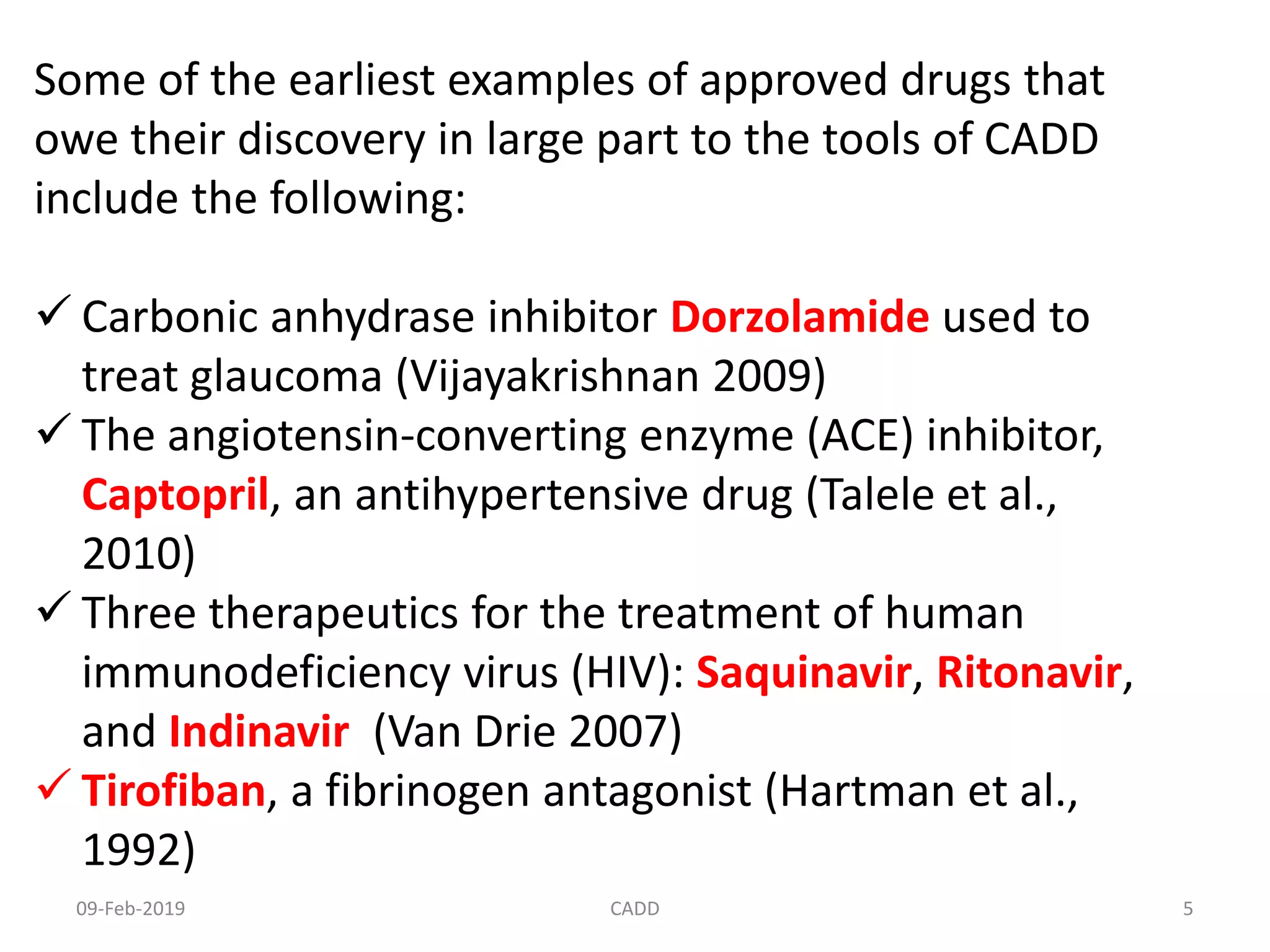
Some of the earliest examples of approved drugs that
owe their discovery in large part to the tools of CADD
include the following:
 Carbonic anhydrase inhibitor Dorzolamide used to
treat glaucoma (Vijayakrishnan 2009)
 The angiotensin-converting enzyme (ACE) inhibitor,
Captopril, an antihypertensive drug (Talele et al.,
2010)
 Three therapeutics for the treatment of human
immunodeficiency virus (HIV): Saquinavir, Ritonavir,
and Indinavir (Van Drie 2007)
 Tirofiban, a fibrinogen antagonist (Hartman et al.,
1992)
09-Feb-2019 CADD 5
Some of the earliest examples of approved drugs that owe their discovery in
large part to the tools of CADD
09-Feb-2019 CADD 6
Drug Discovery & Development
Identify disease
Isolate protein
involved in
disease (2-5 years)
Find a drug effective
against disease protein
(2-5 years)
Preclinical testing
(1-3 years)
Formulation
Human clinical trials
(2-10 years)
Scale-up
FDA approval
(2-3 years)
09-Feb-2019 CADD 7
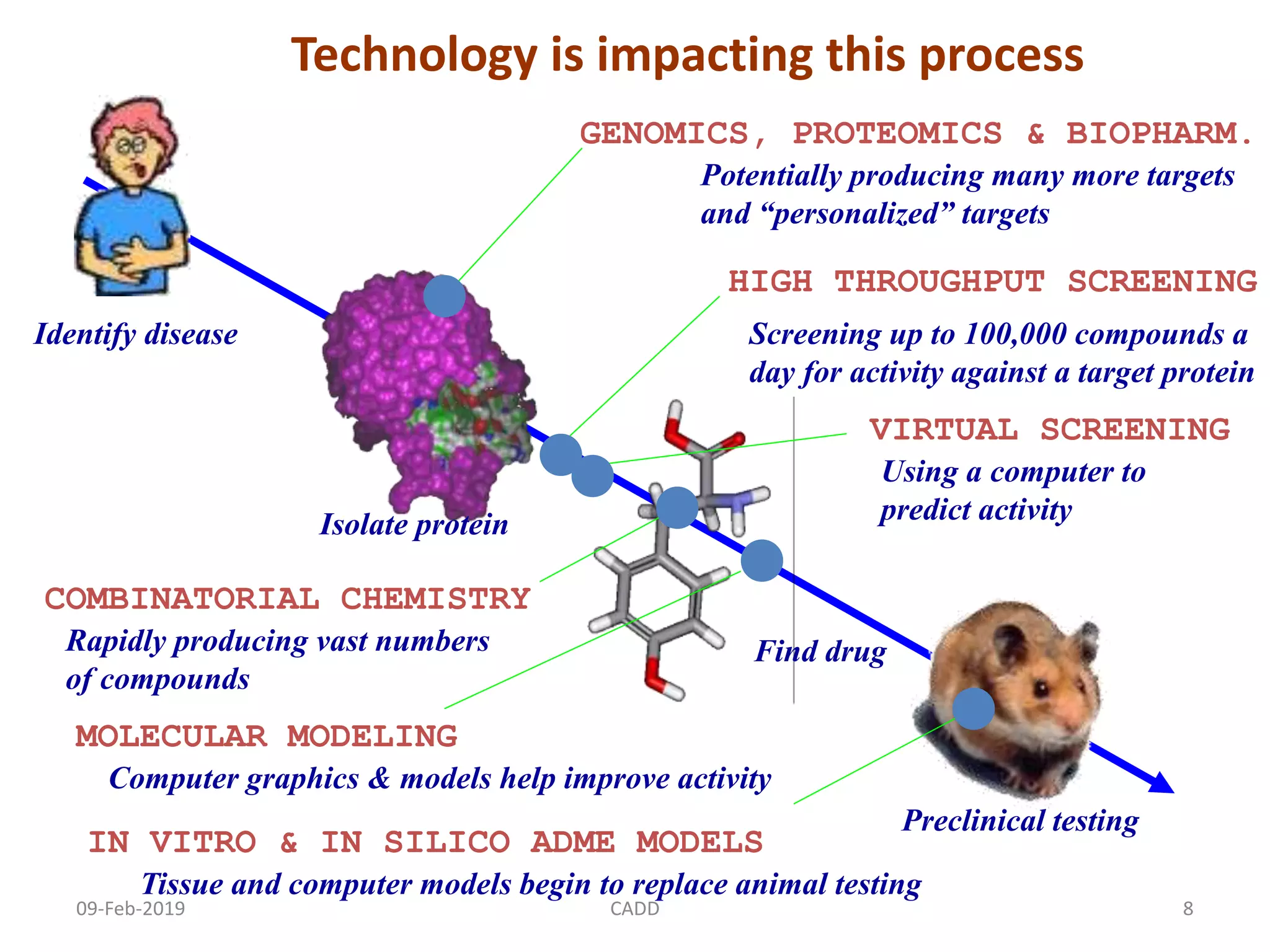
Technology is impacting this process
Identify disease
Isolate protein
Find drug
Preclinical testing
GENOMICS, PROTEOMICS & BIOPHARM.
HIGH THROUGHPUT SCREENING
MOLECULAR MODELING
VIRTUAL SCREENING
COMBINATORIAL CHEMISTRY
IN VITRO & IN SILICO ADME MODELS
Potentially producing many more targets
and “personalized” targets
Screening up to 100,000 compounds a
day for activity against a target protein
Using a computer to
predict activity
Rapidly producing vast numbers
of compounds
Computer graphics & models help improve activity
Tissue and computer models begin to replace animal testing
09-Feb-2019 CADD 8
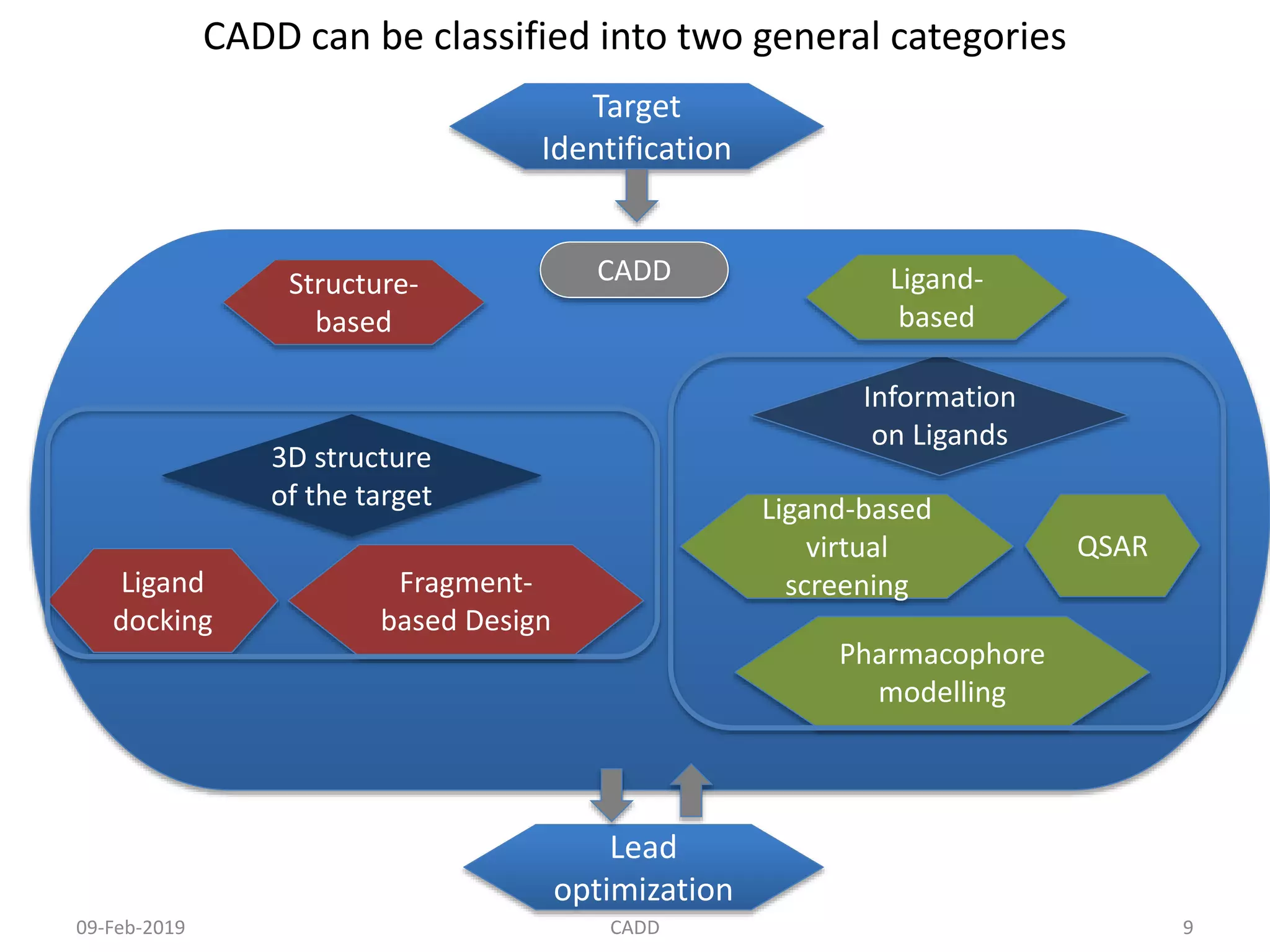
Target
Identification
CADDStructure-
based
Ligand-
based
3D structure
of the target
Information
on Ligands
Ligand
docking
Fragment-
based Design
Ligand-based
virtual
screening
QSAR
Pharmacophore
modelling
Lead
optimization
09-Feb-2019 CADD 9
CADD can be classified into two general categories
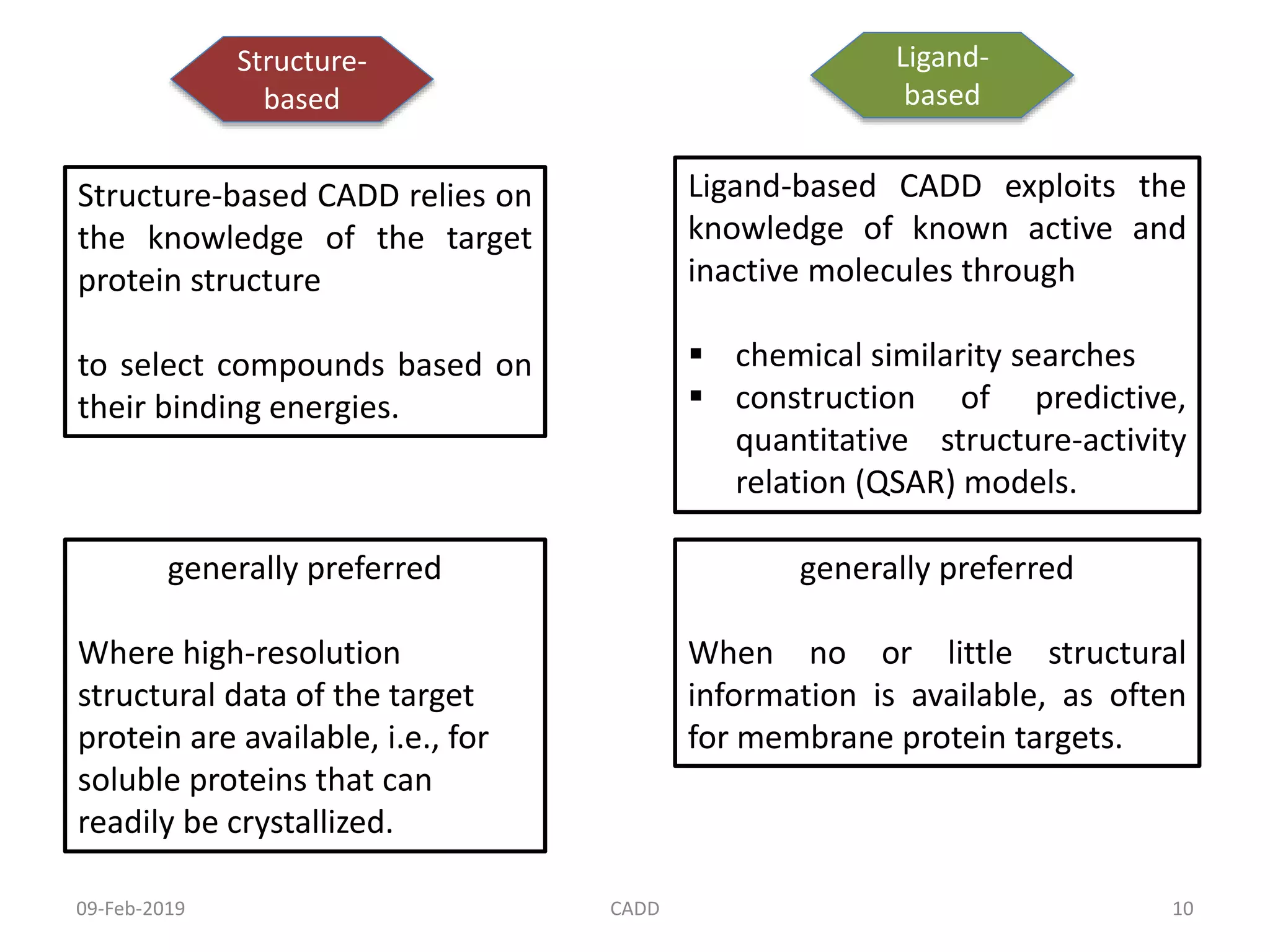
Structure-
based
Ligand-
based
Structure-based CADD relies on
the knowledge of the target
protein structure
to select compounds based on
their binding energies.
Ligand-based CADD exploits the
knowledge of known active and
inactive molecules through
 chemical similarity searches
 construction of predictive,
quantitative structure-activity
relation (QSAR) models.
09-Feb-2019 CADD 10
generally preferred
Where high-resolution
structural data of the target
protein are available, i.e., for
soluble proteins that can
readily be crystallized.
generally preferred
When no or little structural
information is available, as often
for membrane protein targets.
CADD 11
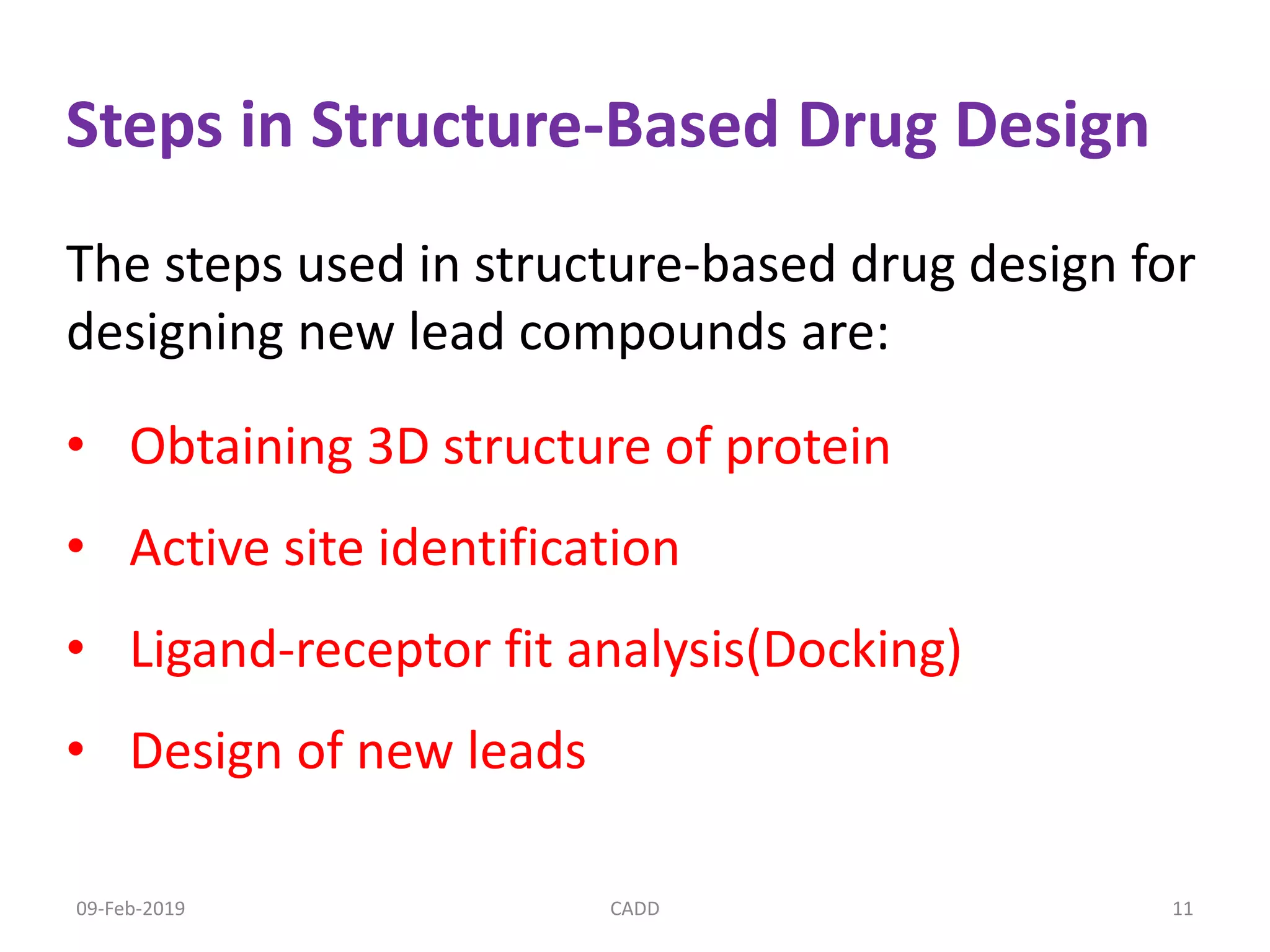
• Obtaining 3D structure of protein
• Active site identification
• Ligand-receptor fit analysis(Docking)
• Design of new leads
Steps in Structure-Based Drug Design
The steps used in structure-based drug design for
designing new lead compounds are:
09-Feb-2019
09-Feb-2019 CADD 12
Acetylcholine Esterase
• RCSB Protein Data
Bank (PDB)
• Human disease-
molecular biology
databases
– SWISS-PROT
– OMIM
– GenBank
– MEDLINE
09-Feb-2019 CADD 13
09-Feb-2019 CADD 14
Combinatorial Libraries
• Thousands of variations to a fixed template
• Good libraries span large areas of chemical and
conformational space - molecular diversity
• Diversity in - steric, electrostatic, hydrophobic interactions...
• Desire to be as broad as “Merck” compounds from
random screening
• Computer aided library design is in its infancy
09-Feb-2019 CADD 15
09-Feb-2019 CADD 16
E bind = E intra + E nonpolar + E polar
Docking Score
Various parameters used in QSAR studies are
1. Lipophilic parameters: partition coefficient, π-substitution
constant
2. Polarizability parameters: molar refractivity, parachor
3. Electronic parameters: Hammet constant, dipole moment.
4. Steric parameters: Taft’s constant.
5. Miscellaneous parameters: molecular weight, geometric
parameters.
Ligand Based Drug Design
QSAR PARAMETERS
The parameter is the measure of the potential contribution of
its group to a particular property of the parent drug
09-Feb-2019 CADD 17
Lipophilic parameters
Lipophilicity is partitioning of the compound between
an aqueous and non-aqueous phase.
Partition coefficient:
• P = [drug] in octanol / [drug] in water
Typically over a small range of log P, e.g. 1-4, a straight
line is obtained
e.g. log 1/C = 0.75 log P + 2.30
• If graph is extended to very high log P values, then
get a parabolic curve
log 1/C = - k1 (log P)2 + k2 log P + k3
• When P small, dominated by log P term
• When P large, log P squared dominates & so activity
decreases
09-Feb-2019 CADD 18
π-substituent constant or hydrophobic substituent
constants:
• The π-substituent constant defined by hansch and co-
workers by the following equation.
px = log Px - log PH
• Apositive πvalue indicates that the πsubstituent has a
higher
lipophilicity than hydrogen and the drug favours the organic
phase.
• A negative πvalue indicates that the πsubstituent has a lower
lipophilicity than hydrogen and the drug favours the aqueous
phase.
09-Feb-2019 CADD 19
09-Feb-2019 CADD 20
Log P = logP(benzenz) + π Cl + πCONH2
= 2.13 + 0.17 + (-1.49)
= 1.35
Electronic parameters
The Hammett constant(σ)
σ x = log (Kx/Kbenzoicacid)
Electron Withdrawing Groups
• Equilibrium shifts Right & Kx > Kbenzoicacid
• Since sx = log Kx – log Kbenzoicacid, then s will be
positive .
• Hammett constant takes into account both
resonance and inductive effects; thus, the value
depends on whether the substituent is para or
meta substituted
-ortho not measured due to steric effects.
09-Feb-2019 CADD 21
Steric Substitution Constant
It is a measure of the bulkiness of the group it represents and it
effects on the closeness of contact between the drug and receptor
site.
much harder to quantitate
Examples are:
Taft’s steric factor (Es) an experimental value based on rate
constants
Molar refractivity (MR)--measure of the volume occupied by an
atom or group--equation includes the MW, density, and the index of
refraction
Verloop steric parameter--computer program uses bond angles,
van derWaals radii, bond lengths
09-Feb-2019 CADD 22
09-Feb-2019 CADD 23
09-Feb-2019 CADD 24

COMPUTER AIDED DRUG DESIGN

  • 1.
  • 2.
    What is CADD CADD209-Feb-2019
  • 3.
    CADD 3 • Drugdesign is the inventive process of finding new medications based on the knowledge of a biological target. • If the same process was done by using Computer/Software then it is referred as CADD 09-Feb-2019
  • 4.
    Why CADD…?  DrugDiscovery today are facing a serious challenge because of the increased cost and enormous amount of time taken to discover a new drug, and also because of rigorous competition amongst different pharmaceutical companies. 09-Feb-2019 CADD 4
  • 5.
    Some of theearliest examples of approved drugs that owe their discovery in large part to the tools of CADD include the following:  Carbonic anhydrase inhibitor Dorzolamide used to treat glaucoma (Vijayakrishnan 2009)  The angiotensin-converting enzyme (ACE) inhibitor, Captopril, an antihypertensive drug (Talele et al., 2010)  Three therapeutics for the treatment of human immunodeficiency virus (HIV): Saquinavir, Ritonavir, and Indinavir (Van Drie 2007)  Tirofiban, a fibrinogen antagonist (Hartman et al., 1992) 09-Feb-2019 CADD 5
  • 6.
    Some of theearliest examples of approved drugs that owe their discovery in large part to the tools of CADD 09-Feb-2019 CADD 6
  • 7.
    Drug Discovery &Development Identify disease Isolate protein involved in disease (2-5 years) Find a drug effective against disease protein (2-5 years) Preclinical testing (1-3 years) Formulation Human clinical trials (2-10 years) Scale-up FDA approval (2-3 years) 09-Feb-2019 CADD 7
  • 8.
    Technology is impactingthis process Identify disease Isolate protein Find drug Preclinical testing GENOMICS, PROTEOMICS & BIOPHARM. HIGH THROUGHPUT SCREENING MOLECULAR MODELING VIRTUAL SCREENING COMBINATORIAL CHEMISTRY IN VITRO & IN SILICO ADME MODELS Potentially producing many more targets and “personalized” targets Screening up to 100,000 compounds a day for activity against a target protein Using a computer to predict activity Rapidly producing vast numbers of compounds Computer graphics & models help improve activity Tissue and computer models begin to replace animal testing 09-Feb-2019 CADD 8
  • 9.
    Target Identification CADDStructure- based Ligand- based 3D structure of thetarget Information on Ligands Ligand docking Fragment- based Design Ligand-based virtual screening QSAR Pharmacophore modelling Lead optimization 09-Feb-2019 CADD 9 CADD can be classified into two general categories
  • 10.
    Structure- based Ligand- based Structure-based CADD relieson the knowledge of the target protein structure to select compounds based on their binding energies. Ligand-based CADD exploits the knowledge of known active and inactive molecules through  chemical similarity searches  construction of predictive, quantitative structure-activity relation (QSAR) models. 09-Feb-2019 CADD 10 generally preferred Where high-resolution structural data of the target protein are available, i.e., for soluble proteins that can readily be crystallized. generally preferred When no or little structural information is available, as often for membrane protein targets.
  • 11.
    CADD 11 • Obtaining3D structure of protein • Active site identification • Ligand-receptor fit analysis(Docking) • Design of new leads Steps in Structure-Based Drug Design The steps used in structure-based drug design for designing new lead compounds are: 09-Feb-2019
  • 12.
  • 13.
    Acetylcholine Esterase • RCSBProtein Data Bank (PDB) • Human disease- molecular biology databases – SWISS-PROT – OMIM – GenBank – MEDLINE 09-Feb-2019 CADD 13
  • 14.
    09-Feb-2019 CADD 14 CombinatorialLibraries • Thousands of variations to a fixed template • Good libraries span large areas of chemical and conformational space - molecular diversity • Diversity in - steric, electrostatic, hydrophobic interactions... • Desire to be as broad as “Merck” compounds from random screening • Computer aided library design is in its infancy
  • 15.
  • 16.
    09-Feb-2019 CADD 16 Ebind = E intra + E nonpolar + E polar Docking Score
  • 17.
    Various parameters usedin QSAR studies are 1. Lipophilic parameters: partition coefficient, π-substitution constant 2. Polarizability parameters: molar refractivity, parachor 3. Electronic parameters: Hammet constant, dipole moment. 4. Steric parameters: Taft’s constant. 5. Miscellaneous parameters: molecular weight, geometric parameters. Ligand Based Drug Design QSAR PARAMETERS The parameter is the measure of the potential contribution of its group to a particular property of the parent drug 09-Feb-2019 CADD 17
  • 18.
    Lipophilic parameters Lipophilicity ispartitioning of the compound between an aqueous and non-aqueous phase. Partition coefficient: • P = [drug] in octanol / [drug] in water Typically over a small range of log P, e.g. 1-4, a straight line is obtained e.g. log 1/C = 0.75 log P + 2.30 • If graph is extended to very high log P values, then get a parabolic curve log 1/C = - k1 (log P)2 + k2 log P + k3 • When P small, dominated by log P term • When P large, log P squared dominates & so activity decreases 09-Feb-2019 CADD 18
  • 19.
    π-substituent constant orhydrophobic substituent constants: • The π-substituent constant defined by hansch and co- workers by the following equation. px = log Px - log PH • Apositive πvalue indicates that the πsubstituent has a higher lipophilicity than hydrogen and the drug favours the organic phase. • A negative πvalue indicates that the πsubstituent has a lower lipophilicity than hydrogen and the drug favours the aqueous phase. 09-Feb-2019 CADD 19
  • 20.
    09-Feb-2019 CADD 20 LogP = logP(benzenz) + π Cl + πCONH2 = 2.13 + 0.17 + (-1.49) = 1.35
  • 21.
    Electronic parameters The Hammettconstant(σ) σ x = log (Kx/Kbenzoicacid) Electron Withdrawing Groups • Equilibrium shifts Right & Kx > Kbenzoicacid • Since sx = log Kx – log Kbenzoicacid, then s will be positive . • Hammett constant takes into account both resonance and inductive effects; thus, the value depends on whether the substituent is para or meta substituted -ortho not measured due to steric effects. 09-Feb-2019 CADD 21
  • 22.
    Steric Substitution Constant Itis a measure of the bulkiness of the group it represents and it effects on the closeness of contact between the drug and receptor site. much harder to quantitate Examples are: Taft’s steric factor (Es) an experimental value based on rate constants Molar refractivity (MR)--measure of the volume occupied by an atom or group--equation includes the MW, density, and the index of refraction Verloop steric parameter--computer program uses bond angles, van derWaals radii, bond lengths 09-Feb-2019 CADD 22
  • 23.
  • 24.