The fastest method for evaluating the drug-like properties of a
compound is to apply “rules.”
Rules are a set of guidelines for the structural properties of
compounds that have a higher probability of being well
absorbed after oral dosing.
Introduction
DRUG-LIKE PROPERTIES: CONCEPTS,STRUCTURE DESIGN AND METHODS:FROM ADME TO TOXICITY OPTIMIZATION EDWARD H.
KERNS
There are various guidelines to help, the most well-known of which is the
Lipinski Rule of Five
 molecular weight < 500
 logP < 5
 < 5 H-bond donors (sum of NH and OH)
 < 10 H-bond acceptors (sum of N and O)
Otherwise absorption and bioavailability are likely to be poor.
NB This is for oral drugs only.
Note that all numbers
are multiples of five,
which is the origin of
the rule's name.
Lipinski Rule of Five
DRUG-LIKE PROPERTIES: CONCEPTS,STRUCTURE DESIGN AND METHODS:FROM ADME TO TOXICITY OPTIMIZATION EDWARD H.
KERNS
Although “violation” of one rule may not result in poor
absorption, the likelihood of poor absorption increases with
the number of rules broken and the extent to which they
are exceeded.
DRUG-LIKE PROPERTIES: CONCEPTS,STRUCTURE DESIGN AND METHODS:FROM ADME TO TOXICITY OPTIMIZATION EDWARD H. KERNS
N.B.
Hydrogen bonds :
 Hydrogen bonds increase solubility in water and must be broken in
order for the compound to permeate into and through the lipid
bilayer membrane.
 Thus, an increasing number of hydrogen bonds reduces
partitioning from the aqueous phase into the lipid bilayer membrane
for permeation by passive diffusion.
DRUG-LIKE PROPERTIES: CONCEPTS,STRUCTURE DESIGN AND METHODS:FROM ADME TO TOXICITY OPTIMIZATION EDWARD H.
KERNS
Molecular weight (MW)
 Molecular weight (MW) is related to the size of the molecule.
 As molecular size increases, a larger cavity must be formed in
water in order to solubilize the compound, and solubility
decreases.
 Increasing MW reduces the compound concentration at the
surface of the intestinal epithelium, thus reducing absorption.
• Increasing size also impedes passive diffusion through the tightly
packed aliphatic side chains of the bilayer membrane.
DRUG-LIKE PROPERTIES: CONCEPTS,STRUCTURE DESIGN AND METHODS:FROM ADME TO TOXICITY OPTIMIZATION EDWARD H. KERNS
octanol-water partition coefficient log P Log P:
Increasing Log P also decreases aqueous solubility, which reduces
absorption.
DRUG-LIKE PROPERTIES: CONCEPTS,STRUCTURE DESIGN AND METHODS:FROM ADME TO TOXICITY OPTIMIZATION EDWARD
H. KERNS
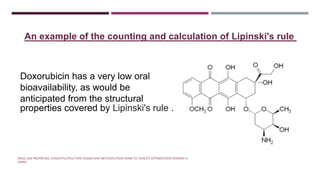
Doxorubicin has a very low oral
bioavailability, as would be
anticipated from the structural
properties covered by Lipinski's rule .
An example of the counting and calculation of Lipinski's rule
DRUG-LIKE PROPERTIES: CONCEPTS,STRUCTURE DESIGN AND METHODS:FROM ADME TO TOXICITY OPTIMIZATION EDWARD H.
KERNS
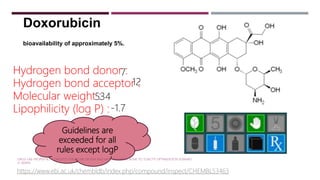
Doxorubicin
Molecule Features
Hydrogen bond donor :
Hydrogen bond acceptor :
Molecular weight :
Lipophilicity (log P) :
7
12
534
-1.7
https://www.ebi.ac.uk/chembldb/index.php/compound/inspect/CHEMBL53463
Guidelines are
exceeded for all
rules except logP
bioavailability of approximately 5%.
DRUG-LIKE PROPERTIES: CONCEPTS,STRUCTURE DESIGN AND METHODS:FROM ADME TO TOXICITY OPTIMIZATION EDWARD
H. KERNS
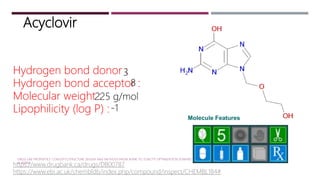
Acyclovir
Molecule Features
Hydrogen bond donor :
Hydrogen bond acceptor :
Molecular weight :
Lipophilicity (log P) :
3
8
225 g/mol
-1
https://www.drugbank.ca/drugs/DB00787
https://www.ebi.ac.uk/chembldb/index.php/compound/inspect/CHEMBL184#
DRUG-LIKE PROPERTIES: CONCEPTS,STRUCTURE DESIGN AND METHODS:FROM ADME TO TOXICITY OPTIMIZATION EDWARD
H. KERNS
Lipinski et al. discussed important implications of these
rules in light of current drug discovery strategies.
The discovery lead optimization stage often increases
target binding by adding hydrogen bonds and
lipophilicity.
Thus, activity optimization can reduce the drug-like
properties of a compound series.
DRUG-LIKE PROPERTIES: CONCEPTS,STRUCTURE DESIGN AND METHODS:FROM ADME TO TOXICITY OPTIMIZATION EDWARD H.
KERNS
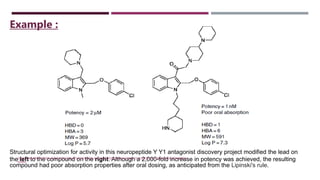
Structural optimization for activity in this neuropeptide Y Y1 antagonist discovery project modified the lead on
the left to the compound on the right. Although a 2,000-fold increase in potency was achieved, the resulting
compound had poor absorption properties after oral dosing, as anticipated from the Lipinski's rule.
Example :
DRUG-LIKE PROPERTIES: CONCEPTS,STRUCTURE DESIGN AND METHODS:FROM ADME TO TOXICITY OPTIMIZATION EDWARD H.
KERNS

Lipinski rule

  • 1.
    The fastest methodfor evaluating the drug-like properties of a compound is to apply “rules.” Rules are a set of guidelines for the structural properties of compounds that have a higher probability of being well absorbed after oral dosing. Introduction DRUG-LIKE PROPERTIES: CONCEPTS,STRUCTURE DESIGN AND METHODS:FROM ADME TO TOXICITY OPTIMIZATION EDWARD H. KERNS
  • 2.
    There are variousguidelines to help, the most well-known of which is the Lipinski Rule of Five  molecular weight < 500  logP < 5  < 5 H-bond donors (sum of NH and OH)  < 10 H-bond acceptors (sum of N and O) Otherwise absorption and bioavailability are likely to be poor. NB This is for oral drugs only. Note that all numbers are multiples of five, which is the origin of the rule's name. Lipinski Rule of Five DRUG-LIKE PROPERTIES: CONCEPTS,STRUCTURE DESIGN AND METHODS:FROM ADME TO TOXICITY OPTIMIZATION EDWARD H. KERNS
  • 3.
    Although “violation” ofone rule may not result in poor absorption, the likelihood of poor absorption increases with the number of rules broken and the extent to which they are exceeded. DRUG-LIKE PROPERTIES: CONCEPTS,STRUCTURE DESIGN AND METHODS:FROM ADME TO TOXICITY OPTIMIZATION EDWARD H. KERNS N.B.
  • 4.
    Hydrogen bonds : Hydrogen bonds increase solubility in water and must be broken in order for the compound to permeate into and through the lipid bilayer membrane.  Thus, an increasing number of hydrogen bonds reduces partitioning from the aqueous phase into the lipid bilayer membrane for permeation by passive diffusion. DRUG-LIKE PROPERTIES: CONCEPTS,STRUCTURE DESIGN AND METHODS:FROM ADME TO TOXICITY OPTIMIZATION EDWARD H. KERNS
  • 5.
    Molecular weight (MW) Molecular weight (MW) is related to the size of the molecule.  As molecular size increases, a larger cavity must be formed in water in order to solubilize the compound, and solubility decreases.  Increasing MW reduces the compound concentration at the surface of the intestinal epithelium, thus reducing absorption. • Increasing size also impedes passive diffusion through the tightly packed aliphatic side chains of the bilayer membrane. DRUG-LIKE PROPERTIES: CONCEPTS,STRUCTURE DESIGN AND METHODS:FROM ADME TO TOXICITY OPTIMIZATION EDWARD H. KERNS
  • 6.
    octanol-water partition coefficientlog P Log P: Increasing Log P also decreases aqueous solubility, which reduces absorption. DRUG-LIKE PROPERTIES: CONCEPTS,STRUCTURE DESIGN AND METHODS:FROM ADME TO TOXICITY OPTIMIZATION EDWARD H. KERNS
  • 7.
    Doxorubicin has avery low oral bioavailability, as would be anticipated from the structural properties covered by Lipinski's rule . An example of the counting and calculation of Lipinski's rule DRUG-LIKE PROPERTIES: CONCEPTS,STRUCTURE DESIGN AND METHODS:FROM ADME TO TOXICITY OPTIMIZATION EDWARD H. KERNS
  • 8.
    Doxorubicin Molecule Features Hydrogen bonddonor : Hydrogen bond acceptor : Molecular weight : Lipophilicity (log P) : 7 12 534 -1.7 https://www.ebi.ac.uk/chembldb/index.php/compound/inspect/CHEMBL53463 Guidelines are exceeded for all rules except logP bioavailability of approximately 5%. DRUG-LIKE PROPERTIES: CONCEPTS,STRUCTURE DESIGN AND METHODS:FROM ADME TO TOXICITY OPTIMIZATION EDWARD H. KERNS
  • 9.
    Acyclovir Molecule Features Hydrogen bonddonor : Hydrogen bond acceptor : Molecular weight : Lipophilicity (log P) : 3 8 225 g/mol -1 https://www.drugbank.ca/drugs/DB00787 https://www.ebi.ac.uk/chembldb/index.php/compound/inspect/CHEMBL184# DRUG-LIKE PROPERTIES: CONCEPTS,STRUCTURE DESIGN AND METHODS:FROM ADME TO TOXICITY OPTIMIZATION EDWARD H. KERNS
  • 10.
    Lipinski et al.discussed important implications of these rules in light of current drug discovery strategies. The discovery lead optimization stage often increases target binding by adding hydrogen bonds and lipophilicity. Thus, activity optimization can reduce the drug-like properties of a compound series. DRUG-LIKE PROPERTIES: CONCEPTS,STRUCTURE DESIGN AND METHODS:FROM ADME TO TOXICITY OPTIMIZATION EDWARD H. KERNS
  • 11.
    Structural optimization foractivity in this neuropeptide Y Y1 antagonist discovery project modified the lead on the left to the compound on the right. Although a 2,000-fold increase in potency was achieved, the resulting compound had poor absorption properties after oral dosing, as anticipated from the Lipinski's rule. Example : DRUG-LIKE PROPERTIES: CONCEPTS,STRUCTURE DESIGN AND METHODS:FROM ADME TO TOXICITY OPTIMIZATION EDWARD H. KERNS