ANTHELMINTICS
• DEFINITION
•CLASSIFICATION
•DRUGS
Mr. Naga Prashant Koppuravuri, M.Pharm (Ph.D), FAGE.,
Assistant Professor,
Department of Pharmaceutical Chemistry.
DEFINITION
Are the agents which are used to
destroy (or) eliminate parasitic
worms (HELMINTH) from the GIT.
act by killing (or) paralysing the
worms.
So that such worms could be easily
expelled out of gut.
REPRODUCTION
 These parasitic worms firmly hold the intestinal mucosa and
continue their reproduction by egg production.
 They harm the host by depriving them of
 Food
 Causing blood loss
 Injury to organs
 Intestinal & lymphatic
obstruction
 Secreting toxins
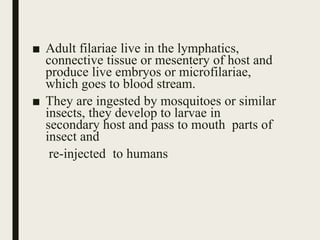
■ Adult filariae live in the lymphatics,
connective tissue or mesentery of host and
produce live embryos or microfilariae,
which goes to blood stream.
■ They are ingested by mosquitoes or similar
insects, they develop to larvae in
secondary host and pass to mouth parts of
insect and
re-injected to humans
TYPES OFWORMS
■ Cestodes (tape worm)
■ Nematodes (round worm)
■ Trematodes (Flukes)
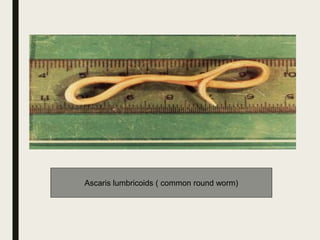
Ascaris lumbricoids ( common round worm)
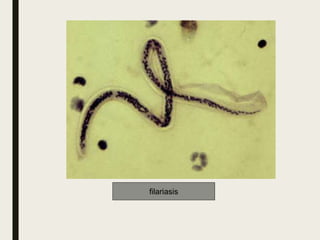
filariasis
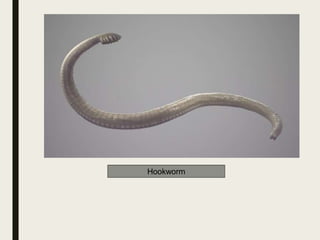
Hookworm
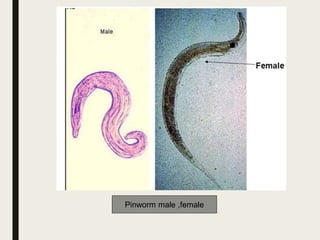
Pinworm male ,female
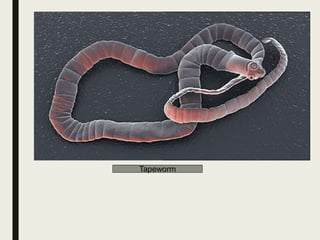
Tapeworm
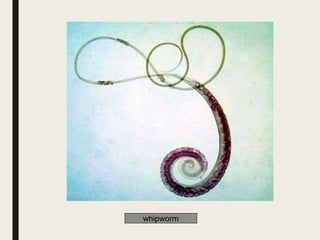
whipworm
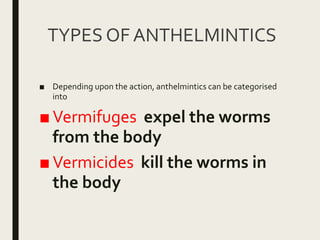
TYPES OF ANTHELMINTICS
■ Depending upon the action, anthelmintics can be categorised
into
■Vermifuges expel the worms
from the body
■Vermicides kill the worms in
the body
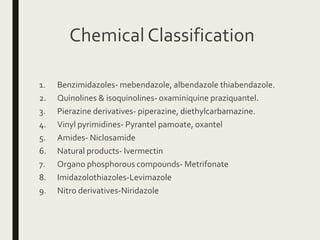
Chemical Classification
1. Benzimidazoles- mebendazole, albendazole thiabendazole.
2. Quinolines & isoquinolines- oxaminiquine praziquantel.
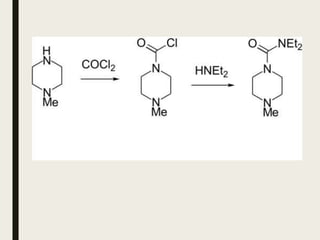
3. Pierazine derivatives- piperazine, diethylcarbamazine.
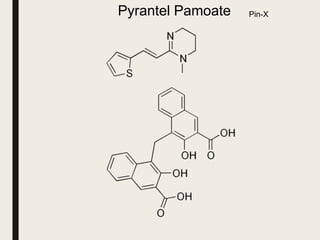
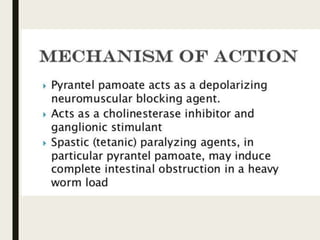
4. Vinyl pyrimidines- Pyrantel pamoate, oxantel
5. Amides- Niclosamide
6. Natural products- Ivermectin
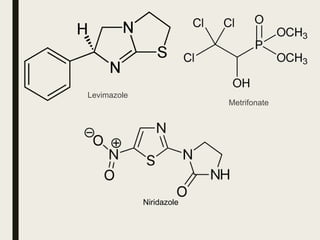
7. Organo phosphorous compounds- Metrifonate
8. Imidazolothiazoles-Levimazole
9. Nitro derivatives-Niridazole
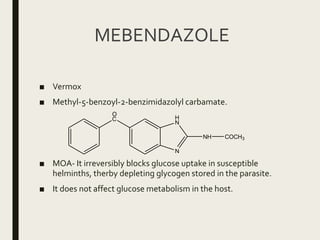
MEBENDAZOLE
■ Vermox
■ Methyl-5-benzoyl-2-benzimidazolyl carbamate.
■ MOA- It irreversibly blocks glucose uptake in susceptible
helminths, therby depleting glycogen stored in the parasite.
■ It does not affect glucose metabolism in the host.
N
H
N
NH COCH3
O
C
USES
■ Effective against
■ Whip worm (Trichuria )
■ Pin worm(Enterobius vermicularis)
■ Hook worm
■ Ascaris lumbricoides
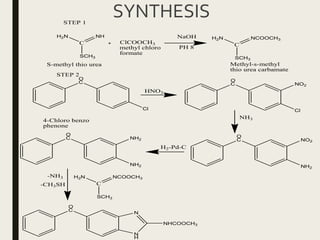
SYNTHESIS
C
SCH3
H2N NH
ClCOOCH3
S-methyl thio urea
methyl chloro
formate
C
SCH3
H2N NCOOCH3
NaOH
PH 8
Methyl-s-methyl
thio urea carbamate
STEP 1
STEP 2
O
C
Cl
4-Chloro benzo
phenone
HNO3
O
C
Cl
NO2
NH3
O
C
NH2
H2-Pd-C
NO2
O
C
NH2
NH2
C
SCH3
H2N NCOOCH3
O
C
N
H
N
NHCOOCH3
-NH3
-CH3SH
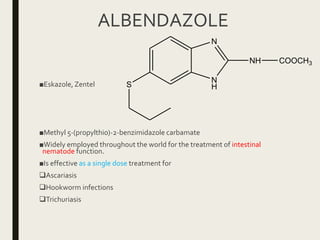
ALBENDAZOLE
■Eskazole, Zentel
■Methyl 5-(propylthio)-2-benzimidazole carbamate
■Widely employed throughout the world for the treatment of intestinal
nematode function.
■Is effective as a single dose treatment for
Ascariasis
Hookworm infections
Trichuriasis
N
H
N
NH COOCH3
S
THIABENDAZOLE
 Mintezol
 2[4-thiazolyl]benzimidazole
N
H
N
S
N
MECHANISMOF ACTION
 bind with β-tubulin and inhibit microtubule polymerization.
 β-tubulin is the precursor of formation of microtubules.Thereby
arrest in cell division in nematodes.
■Biochemical Changes
■Inhibition of mitochondrial fumerate reductase
■Reduced glucose transport
■Uncoupling of oxidative phosphorylation
THIABENDAZOLE (cont)
■It has a broad spectrum anthelmintic activity.
■Used to treat
■Enterobiasis (thread worm)
■Ascariasis (round worm)
■Trichuriasis (whip worm)
■In addition to its use in human medicine, it is
widely employed in vertinary practice to control
helminths.
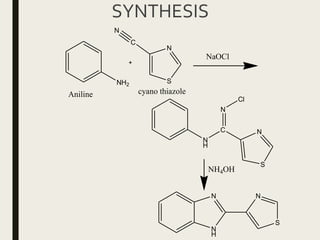
SYNTHESIS
NH2
S
N
C
N
Aniline cyano thiazole
NaOCl
N
H
C
N
Cl
S
N
N
H
N
S
N
NH4OH
OXAMNIQUINE
■ Vansil
■ 1,2,3,4-tetrahydro-2-[isopropyl-amino) methyl]-7-nitro-6-
quinoline methanol.
■ It inhibits DNA, RNA & protein synthesis.
■ SAR- OH group is essential for activity.
■ For the treatment of intestinal schistosomiasis.
N
H
O2N
HOH2C
CH2NHCH
PRAZIQUANTEL
■ Biltricide
■ 2-(cyclohexyl carbonyl)-1,2,3,6,7,11b-hexahydro-4H-
pyrazino[2,1-a]isoquinolin-4-one.
■ It increases cell membrane permeability of susceptible worms,
resulting in loss of intracellular calcium and loss of extracellular
sodium.
N
N
C
O
■ Massive contractions & ultimate
paralysis of the fluke musculature occurs.
■ The worms lose grip of intestinal mucosa
and are expelled.
■ USE- It has become the agent of choice
for the treatment of infections caused by
fluke infections
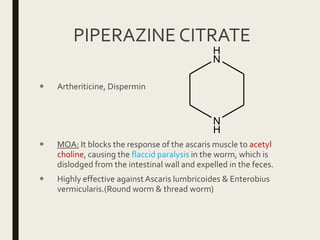
PIPERAZINE CITRATE
 Artheriticine, Dispermin
 MOA: It blocks the response of the ascaris muscle to acetyl
choline, causing the flaccid paralysis in the worm, which is
dislodged from the intestinal wall and expelled in the feces.
 Highly effective againstAscaris lumbricoides & Enterobius
vermicularis.(Round worm & thread worm)
N
H
H
N
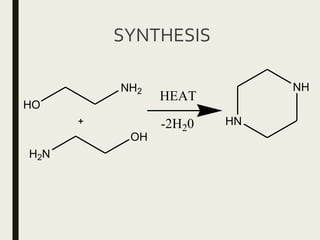
SYNTHESIS
HO
NH2
H2N
OH
-2H20
HEAT
HN
NH
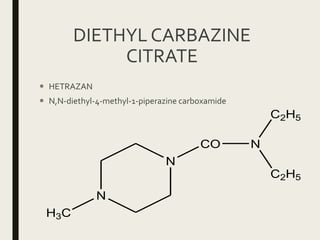
DIETHYL CARBAZINE
CITRATE
 HETRAZAN
 N,N-diethyl-4-methyl-1-piperazine carboxamide
N
N
H3C
CO N
C2H5
C2H5
Mechanism Of Action
■Immobilizes microfilariae and alters their surface structure,displacing them from
tissues & making them susceptible to destruction by host defense mechanism
■ It has immunosuppressive effects
■Filariasis and ascariasis
Pyrantel Pamoate Pin-X
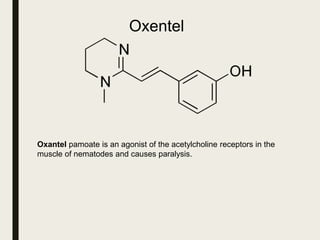
Oxentel
Oxantel pamoate is an agonist of the acetylcholine receptors in the
muscle of nematodes and causes paralysis.
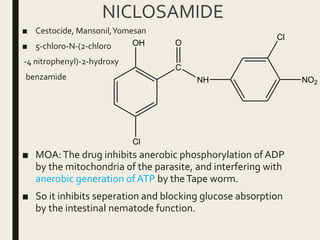
NICLOSAMIDE
■ Cestocide, Mansonil,Yomesan
■ 5-chloro-N-(2-chloro
-4 nitrophenyl)-2-hydroxy
benzamide
■ MOA:The drug inhibits anerobic phosphorylation ofADP
by the mitochondria of the parasite, and interfering with
anerobic generation of ATP by theTape worm.
■ So it inhibits seperation and blocking glucose absorption
by the intestinal nematode function.
OH
Cl
C
O
NH NO2
Cl
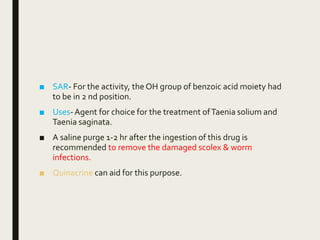
■ SAR- For the activity, the OH group of benzoic acid moiety had
to be in 2 nd position.
■ Uses-Agent for choice for the treatment ofTaenia solium and
Taenia saginata.
■ A saline purge 1-2 hr after the ingestion of this drug is
recommended to remove the damaged scolex & worm
infections.
■ Quinacrine can aid for this purpose.
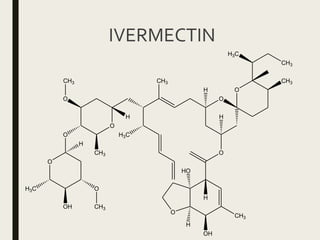
IVERMECTIN
O
CH3
O
HO
H
H
OH
O
O
CH3
CH3
H3C
CH3
H3C
H
H
O
H
CH3
O
CH3
O
O
OH
OH3C
CH3
H
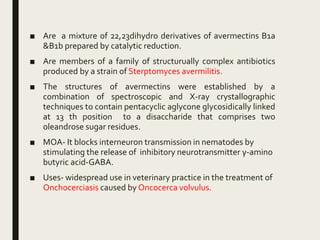
■ Are a mixture of 22,23dihydro derivatives of avermectins B1a
&B1b prepared by catalytic reduction.
■ Are members of a family of structurually complex antibiotics
produced by a strain of Sterptomyces avermilitis.
■ The structures of avermectins were established by a
combination of spectroscopic and X-ray crystallographic
techniques to contain pentacyclic aglycone glycosidically linked
at 13 th position to a disaccharide that comprises two
oleandrose sugar residues.
■ MOA- It blocks interneuron transmission in nematodes by
stimulating the release of inhibitory neurotransmitter γ-amino
butyric acid-GABA.
■ Uses- widespread use in veterinary practice in the treatment of
Onchocerciasis caused by Oncocerca volvulus.
Levimazole
Metrifonate
Niridazole

Anthelmintics

  • 1.
    ANTHELMINTICS • DEFINITION •CLASSIFICATION •DRUGS Mr. NagaPrashant Koppuravuri, M.Pharm (Ph.D), FAGE., Assistant Professor, Department of Pharmaceutical Chemistry.
  • 2.
    DEFINITION Are the agentswhich are used to destroy (or) eliminate parasitic worms (HELMINTH) from the GIT. act by killing (or) paralysing the worms. So that such worms could be easily expelled out of gut.
  • 3.
    REPRODUCTION  These parasiticworms firmly hold the intestinal mucosa and continue their reproduction by egg production.  They harm the host by depriving them of  Food  Causing blood loss  Injury to organs  Intestinal & lymphatic obstruction  Secreting toxins
  • 4.
    ■ Adult filariaelive in the lymphatics, connective tissue or mesentery of host and produce live embryos or microfilariae, which goes to blood stream. ■ They are ingested by mosquitoes or similar insects, they develop to larvae in secondary host and pass to mouth parts of insect and re-injected to humans
  • 5.
    TYPES OFWORMS ■ Cestodes(tape worm) ■ Nematodes (round worm) ■ Trematodes (Flukes)
  • 6.
    Ascaris lumbricoids (common round worm)
  • 7.
  • 8.
  • 9.
  • 10.
  • 11.
  • 12.
    TYPES OF ANTHELMINTICS ■Depending upon the action, anthelmintics can be categorised into ■Vermifuges expel the worms from the body ■Vermicides kill the worms in the body
  • 13.
    Chemical Classification 1. Benzimidazoles-mebendazole, albendazole thiabendazole. 2. Quinolines & isoquinolines- oxaminiquine praziquantel. 3. Pierazine derivatives- piperazine, diethylcarbamazine. 4. Vinyl pyrimidines- Pyrantel pamoate, oxantel 5. Amides- Niclosamide 6. Natural products- Ivermectin 7. Organo phosphorous compounds- Metrifonate 8. Imidazolothiazoles-Levimazole 9. Nitro derivatives-Niridazole
  • 16.
    MEBENDAZOLE ■ Vermox ■ Methyl-5-benzoyl-2-benzimidazolylcarbamate. ■ MOA- It irreversibly blocks glucose uptake in susceptible helminths, therby depleting glycogen stored in the parasite. ■ It does not affect glucose metabolism in the host. N H N NH COCH3 O C
  • 17.
    USES ■ Effective against ■Whip worm (Trichuria ) ■ Pin worm(Enterobius vermicularis) ■ Hook worm ■ Ascaris lumbricoides
  • 18.
    SYNTHESIS C SCH3 H2N NH ClCOOCH3 S-methyl thiourea methyl chloro formate C SCH3 H2N NCOOCH3 NaOH PH 8 Methyl-s-methyl thio urea carbamate STEP 1 STEP 2 O C Cl 4-Chloro benzo phenone HNO3 O C Cl NO2 NH3 O C NH2 H2-Pd-C NO2 O C NH2 NH2 C SCH3 H2N NCOOCH3 O C N H N NHCOOCH3 -NH3 -CH3SH
  • 19.
    ALBENDAZOLE ■Eskazole, Zentel ■Methyl 5-(propylthio)-2-benzimidazolecarbamate ■Widely employed throughout the world for the treatment of intestinal nematode function. ■Is effective as a single dose treatment for Ascariasis Hookworm infections Trichuriasis N H N NH COOCH3 S
  • 20.
  • 21.
    MECHANISMOF ACTION  bindwith β-tubulin and inhibit microtubule polymerization.  β-tubulin is the precursor of formation of microtubules.Thereby arrest in cell division in nematodes. ■Biochemical Changes ■Inhibition of mitochondrial fumerate reductase ■Reduced glucose transport ■Uncoupling of oxidative phosphorylation
  • 22.
    THIABENDAZOLE (cont) ■It hasa broad spectrum anthelmintic activity. ■Used to treat ■Enterobiasis (thread worm) ■Ascariasis (round worm) ■Trichuriasis (whip worm) ■In addition to its use in human medicine, it is widely employed in vertinary practice to control helminths.
  • 23.
  • 24.
    OXAMNIQUINE ■ Vansil ■ 1,2,3,4-tetrahydro-2-[isopropyl-amino)methyl]-7-nitro-6- quinoline methanol. ■ It inhibits DNA, RNA & protein synthesis. ■ SAR- OH group is essential for activity. ■ For the treatment of intestinal schistosomiasis. N H O2N HOH2C CH2NHCH
  • 25.
    PRAZIQUANTEL ■ Biltricide ■ 2-(cyclohexylcarbonyl)-1,2,3,6,7,11b-hexahydro-4H- pyrazino[2,1-a]isoquinolin-4-one. ■ It increases cell membrane permeability of susceptible worms, resulting in loss of intracellular calcium and loss of extracellular sodium. N N C O
  • 26.
    ■ Massive contractions& ultimate paralysis of the fluke musculature occurs. ■ The worms lose grip of intestinal mucosa and are expelled. ■ USE- It has become the agent of choice for the treatment of infections caused by fluke infections
  • 27.
    PIPERAZINE CITRATE  Artheriticine,Dispermin  MOA: It blocks the response of the ascaris muscle to acetyl choline, causing the flaccid paralysis in the worm, which is dislodged from the intestinal wall and expelled in the feces.  Highly effective againstAscaris lumbricoides & Enterobius vermicularis.(Round worm & thread worm) N H H N
  • 28.
  • 29.
    DIETHYL CARBAZINE CITRATE  HETRAZAN N,N-diethyl-4-methyl-1-piperazine carboxamide N N H3C CO N C2H5 C2H5
  • 30.
    Mechanism Of Action ■Immobilizesmicrofilariae and alters their surface structure,displacing them from tissues & making them susceptible to destruction by host defense mechanism ■ It has immunosuppressive effects ■Filariasis and ascariasis
  • 32.
  • 34.
    Oxentel Oxantel pamoate isan agonist of the acetylcholine receptors in the muscle of nematodes and causes paralysis.
  • 35.
    NICLOSAMIDE ■ Cestocide, Mansonil,Yomesan ■5-chloro-N-(2-chloro -4 nitrophenyl)-2-hydroxy benzamide ■ MOA:The drug inhibits anerobic phosphorylation ofADP by the mitochondria of the parasite, and interfering with anerobic generation of ATP by theTape worm. ■ So it inhibits seperation and blocking glucose absorption by the intestinal nematode function. OH Cl C O NH NO2 Cl
  • 36.
    ■ SAR- Forthe activity, the OH group of benzoic acid moiety had to be in 2 nd position. ■ Uses-Agent for choice for the treatment ofTaenia solium and Taenia saginata. ■ A saline purge 1-2 hr after the ingestion of this drug is recommended to remove the damaged scolex & worm infections. ■ Quinacrine can aid for this purpose.
  • 37.
  • 38.
    ■ Are amixture of 22,23dihydro derivatives of avermectins B1a &B1b prepared by catalytic reduction. ■ Are members of a family of structurually complex antibiotics produced by a strain of Sterptomyces avermilitis. ■ The structures of avermectins were established by a combination of spectroscopic and X-ray crystallographic techniques to contain pentacyclic aglycone glycosidically linked at 13 th position to a disaccharide that comprises two oleandrose sugar residues. ■ MOA- It blocks interneuron transmission in nematodes by stimulating the release of inhibitory neurotransmitter γ-amino butyric acid-GABA. ■ Uses- widespread use in veterinary practice in the treatment of Onchocerciasis caused by Oncocerca volvulus.
  • 39.