Focus on Medical Chemistry
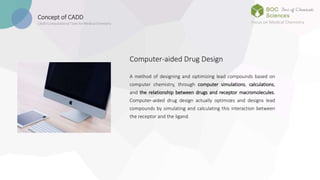
Computer-Aided Drug Design
BOC Sciences - Pharmaceutical Value Creator
Focus on Medical Chemistry
PART 1 Computational Tools for Medical Chemistry
Background of Computer-Aided Drug Design(CADD)
Focus on Medical Chemistry
Computer-aided drug design (CADD) is a widely used technology
using computational tools and resources for the storage,
management, analysis and modeling of compounds.
What is CADD?
It relies on digital repositories for study of designing compounds with
physicochemical characteristics, predicting whether a given molecule
will be combined with the target.
How does CADD work?
Computer based methods can help us to search new hits in drug
discovery, screen many irrelevant compounds at the same time and
study the structure-activity relationship of drug molecules.
What can CADD do?
CADD methods can increase the odds of identifying compounds with
desirable characteristics, speed up the hit-to-lead process and improve
the chances of getting your compound past the hurdles of preclinical
testing.
Why do we use CADD?
CADD-Background
CADD-Computational Tools for Medical Chemistry
Focus on Medical Chemistry
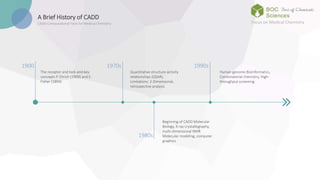
A Brief History of CADD
CADD-Computational Tools for Medical Chemistry
The receptor and lock-and-key
concepts P. Ehrich (1909) and E.
Fisher (1894)
1900
Beginning of CADD Molecular
Biology, X-ray crystallography,
multi-dimensional NMR
Molecular modeling, computer
graphics
1980s
Quantitative structure-activity
relationships (QSAR),
Limitations: 2-Dimensional,
retrospective analysis
1970s
Human genome Bioinformatics,
Combinatorial chemistry, High-
throughput screening
1990s
Focus on Medical Chemistry
Concept of CADD
CADD-Computational Tools for Medical Chemistry
A method of designing and optimizing lead compounds based on
computer chemistry, through computer simulations, calculations,
and the relationship between drugs and receptor macromolecules.
Computer-aided drug design actually optimizes and designs lead
compounds by simulating and calculating this interaction between
the receptor and the ligand.
Computer-aided Drug Design
Focus on Medical Chemistry
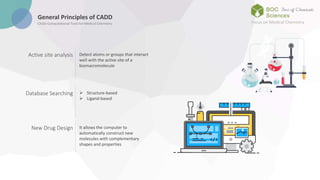
Active site analysis Detect atoms or groups that interact
well with the active site of a
biomacromolecule
Database Searching  Structure-based
 Ligand-based
New Drug Design It allows the computer to
automatically construct new
molecules with complementary
shapes and properties
General Principles of CADD
CADD-Computational Tools for Medical Chemistry
Focus on Medical Chemistry
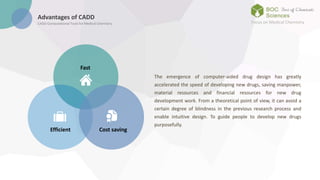
The emergence of computer-aided drug design has greatly
accelerated the speed of developing new drugs, saving manpower,
material resources and financial resources for new drug
development work. From a theoretical point of view, it can avoid a
certain degree of blindness in the previous research process and
enable intuitive design. To guide people to develop new drugs
purposefully.
Advantages of CADD
Fast
Efficient Cost saving
CADD-Computational Tools for Medical Chemistry
Focus on Medical Chemistry
PART 2 Computational Tools for Medical Chemistry
Application of Computer-Aided Drug Discovery(CADD)
Focus on Medical Chemistry
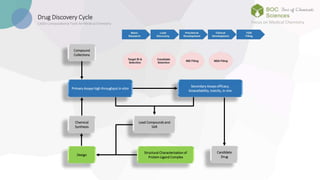
Drug Discovery Cycle
CADD-Computational Tools for Medical Chemistry
Compound
Collections
Primary Assays high throughput in vitro
Chemical
Synthesis
Design
Secondary Assays efficacy,
bioavailability, toxicity, in vivo
Lead Compounds and
SAR
Structural Characterization of
Protein-Ligand Complex
Candidate
Drug
Focus on Medical Chemistry
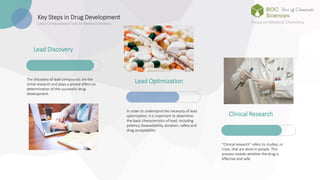
Key Steps in Drug Development
CADD-Computational Tools for Medical Chemistry
Lead Discovery
The discovery of lead compounds are the
initial research and plays a pivotal effect on
determination of the successful drug
development.
Lead Optimization
In order to understand the necessity of lead
optimization, it is important to determine
the basic characteristics of lead, including
potency, bioavailability, duration, safety and
drug acceptability.
Clinical Research
“Clinical research” refers to studies, or
trials, that are done in people. This
process reveals whether the drug is
effective and safe.
Focus on Medical Chemistry
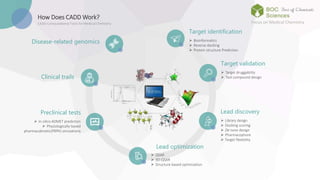
How Does CADD Work?
CADD-Computational Tools for Medical Chemistry
Disease-related genomics
Clinical trails
Target identification
Target validation
 Bioinformatics
 Reverse docking
 Protein structure Prediction
 Target druggability
 Tool compound design
Lead discovery
 Library design
 Docking scoring
 De novo design
 Pharmacophore
 Target flexibility
Preclinical tests
 In silico ADMET prediction
 Physiologically-based
pharmacokinetic(PBPK) simulations
Lead optimization
 QSAR
 3D-QSAR
 Structure-based optimization
Focus on Medical Chemistry
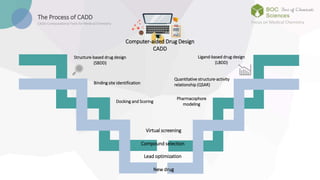
The Process of CADD
CADD-Computational Tools for Medical Chemistry
Structure-based drug design
(SBDD)
Binding site identification
Docking and Scoring
Ligand-based drug design
(LBDD)
Pharmacophore
modeling
Quantitative structure-activity
relationship (QSAR)
Virtual screening
Compound selection
Lead optimization
New drug
Computer-aided Drug Design
CADD
Focus on Medical Chemistry
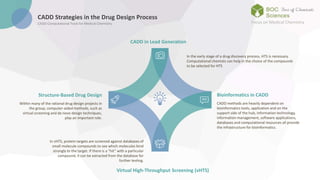
In the early stage of a drug discovery process, HTS is necessary.
Computational chemists can help in the choice of the compounds
to be selected for HTS
CADD in Lead Generation
In vHTS, protein targets are screened against databases of
small molecule compounds to see which molecules bind
strongly to the target. If there is a “hit” with a particular
compound, it can be extracted from the database for
further testing.
Virtual High-Throughput Screening (vHTS)
CADD methods are heavily dependent on
bioinformatics tools, application and on the
support side of the hub, information technology,
information management, software applications,
databases and computational resources all provide
the infrastructure for bioinformatics.
Bioinformatics in CADD
Within many of the rational drug design projects in
the group, computer-aided methods, such as
virtual screening and de novo design techniques,
play an important role.
Structure-Based Drug Design
CADD Strategies in the Drug Design Process
CADD-Computational Tools for Medical Chemistry
Focus on Medical Chemistry
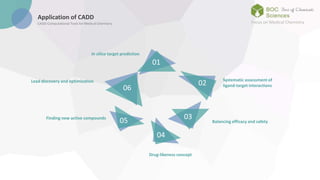
01
02
03
04
05
06
In silico target prediction
Lead discovery and optimization
Finding new active compounds
Systematic assessment of
ligand-target interactions
Balancing efficacy and safety
Drug-likeness concept
Application of CADD
CADD-Computational Tools for Medical Chemistry

Computer aided-drug-design-boc sciences

  • 1.
    Focus on MedicalChemistry Computer-Aided Drug Design BOC Sciences - Pharmaceutical Value Creator
  • 2.
    Focus on MedicalChemistry PART 1 Computational Tools for Medical Chemistry Background of Computer-Aided Drug Design(CADD)
  • 3.
    Focus on MedicalChemistry Computer-aided drug design (CADD) is a widely used technology using computational tools and resources for the storage, management, analysis and modeling of compounds. What is CADD? It relies on digital repositories for study of designing compounds with physicochemical characteristics, predicting whether a given molecule will be combined with the target. How does CADD work? Computer based methods can help us to search new hits in drug discovery, screen many irrelevant compounds at the same time and study the structure-activity relationship of drug molecules. What can CADD do? CADD methods can increase the odds of identifying compounds with desirable characteristics, speed up the hit-to-lead process and improve the chances of getting your compound past the hurdles of preclinical testing. Why do we use CADD? CADD-Background CADD-Computational Tools for Medical Chemistry
  • 4.
    Focus on MedicalChemistry A Brief History of CADD CADD-Computational Tools for Medical Chemistry The receptor and lock-and-key concepts P. Ehrich (1909) and E. Fisher (1894) 1900 Beginning of CADD Molecular Biology, X-ray crystallography, multi-dimensional NMR Molecular modeling, computer graphics 1980s Quantitative structure-activity relationships (QSAR), Limitations: 2-Dimensional, retrospective analysis 1970s Human genome Bioinformatics, Combinatorial chemistry, High- throughput screening 1990s
  • 5.
    Focus on MedicalChemistry Concept of CADD CADD-Computational Tools for Medical Chemistry A method of designing and optimizing lead compounds based on computer chemistry, through computer simulations, calculations, and the relationship between drugs and receptor macromolecules. Computer-aided drug design actually optimizes and designs lead compounds by simulating and calculating this interaction between the receptor and the ligand. Computer-aided Drug Design
  • 6.
    Focus on MedicalChemistry Active site analysis Detect atoms or groups that interact well with the active site of a biomacromolecule Database Searching  Structure-based  Ligand-based New Drug Design It allows the computer to automatically construct new molecules with complementary shapes and properties General Principles of CADD CADD-Computational Tools for Medical Chemistry
  • 7.
    Focus on MedicalChemistry The emergence of computer-aided drug design has greatly accelerated the speed of developing new drugs, saving manpower, material resources and financial resources for new drug development work. From a theoretical point of view, it can avoid a certain degree of blindness in the previous research process and enable intuitive design. To guide people to develop new drugs purposefully. Advantages of CADD Fast Efficient Cost saving CADD-Computational Tools for Medical Chemistry
  • 8.
    Focus on MedicalChemistry PART 2 Computational Tools for Medical Chemistry Application of Computer-Aided Drug Discovery(CADD)
  • 9.
    Focus on MedicalChemistry Drug Discovery Cycle CADD-Computational Tools for Medical Chemistry Compound Collections Primary Assays high throughput in vitro Chemical Synthesis Design Secondary Assays efficacy, bioavailability, toxicity, in vivo Lead Compounds and SAR Structural Characterization of Protein-Ligand Complex Candidate Drug
  • 10.
    Focus on MedicalChemistry Key Steps in Drug Development CADD-Computational Tools for Medical Chemistry Lead Discovery The discovery of lead compounds are the initial research and plays a pivotal effect on determination of the successful drug development. Lead Optimization In order to understand the necessity of lead optimization, it is important to determine the basic characteristics of lead, including potency, bioavailability, duration, safety and drug acceptability. Clinical Research “Clinical research” refers to studies, or trials, that are done in people. This process reveals whether the drug is effective and safe.
  • 11.
    Focus on MedicalChemistry How Does CADD Work? CADD-Computational Tools for Medical Chemistry Disease-related genomics Clinical trails Target identification Target validation  Bioinformatics  Reverse docking  Protein structure Prediction  Target druggability  Tool compound design Lead discovery  Library design  Docking scoring  De novo design  Pharmacophore  Target flexibility Preclinical tests  In silico ADMET prediction  Physiologically-based pharmacokinetic(PBPK) simulations Lead optimization  QSAR  3D-QSAR  Structure-based optimization
  • 12.
    Focus on MedicalChemistry The Process of CADD CADD-Computational Tools for Medical Chemistry Structure-based drug design (SBDD) Binding site identification Docking and Scoring Ligand-based drug design (LBDD) Pharmacophore modeling Quantitative structure-activity relationship (QSAR) Virtual screening Compound selection Lead optimization New drug Computer-aided Drug Design CADD
  • 13.
    Focus on MedicalChemistry In the early stage of a drug discovery process, HTS is necessary. Computational chemists can help in the choice of the compounds to be selected for HTS CADD in Lead Generation In vHTS, protein targets are screened against databases of small molecule compounds to see which molecules bind strongly to the target. If there is a “hit” with a particular compound, it can be extracted from the database for further testing. Virtual High-Throughput Screening (vHTS) CADD methods are heavily dependent on bioinformatics tools, application and on the support side of the hub, information technology, information management, software applications, databases and computational resources all provide the infrastructure for bioinformatics. Bioinformatics in CADD Within many of the rational drug design projects in the group, computer-aided methods, such as virtual screening and de novo design techniques, play an important role. Structure-Based Drug Design CADD Strategies in the Drug Design Process CADD-Computational Tools for Medical Chemistry
  • 14.
    Focus on MedicalChemistry 01 02 03 04 05 06 In silico target prediction Lead discovery and optimization Finding new active compounds Systematic assessment of ligand-target interactions Balancing efficacy and safety Drug-likeness concept Application of CADD CADD-Computational Tools for Medical Chemistry