Sulfonamides
Mr. Naga Prashant Koppuravuri,
M.Pharm,(Ph.D), FAGE
Discovery, Mechanism of action,
sulfonamides prodrugs
SAR, solubility problems and solutions,
Sulfonamides
• The sulfonamides are bacteriostatic when administered to humans in achievable doses.
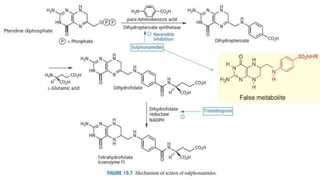
• They inhibit the enzyme dihydropteroate synthase, an important enzyme needed for the
biosynthesis of folic acid derivatives and, ultimately, the thymidine required for DNA
• They do this by competing at the active site with p -aminobenzoicacid (PABA), a normal
structural componentof folic acid derivatives.
• Humans have no dihydropteroate synthase, which explains sulfonamides selectivity for
bacterial cells.
• Indeed, the antimicrobial efficacy of sulfonamides can be reversed by adding significant
quantitiesof PABA into the diet
Sulfonamides (Sulfa or sulpha drugs)
 Diseases like pneumonia, meningitis, dysentryetc., could not be treated effectively until the
discoveryof sulfadrugs which weresuitable for internal useagainstgram+ bacteria.
 p-aminobenzenesulphonamide (sulfanilamide) was initially synthesized in 1908 as
intermediateforazodyes, lateron, itwas observed that it is effectiveagainst streptococci
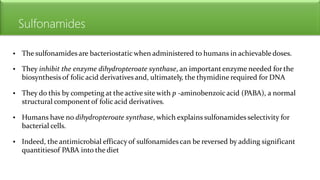
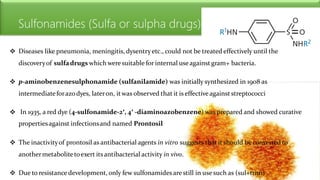
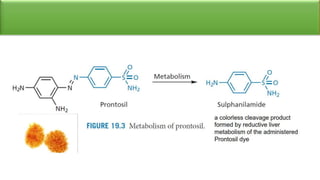
 In 1935, a red dye (4-sulfonamide-2′, 4′ -diaminoazobenzene) was prepared and showed curative
propertiesagainst infectionsand named Prontosil
 The inactivityof prontosil as antibacterial agents in vitro suggests that it should be converted to
anothermetabolitetoexert itsantibacterial activity in vivo.
 Due to resistancedevelopment, only few sulfonamidesare still in use such as (sul+trim)
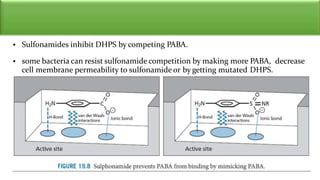
• Sulfonamides inhibit DHPS by competing PABA.
• some bacteria can resist sulfonamide competition by making more PABA, decrease
cell membrane permeability to sulfonamide or by getting mutated DHPS.
Ionization of
sulfonamides
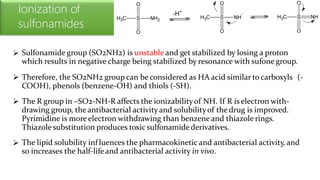
 Sulfonamide group (SO2NH2) is unstable and get stabilized by losing a proton
which results in negative charge being stabilized by resonance with sufone group.
 Therefore, the SO2NH2 group can be considered as HA acid similar to carboxyls
COOH), phenols (benzene-OH) and thiols (-SH).
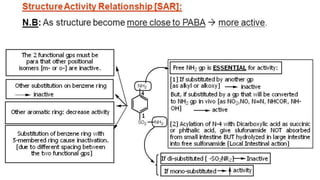
The R group in –SO2-NH-R affects the ionizabilityof NH. If R is electron with-
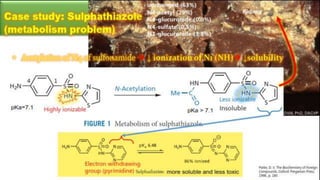
drawing group, the antibacterial activityand solubilityof the drug is improved.
Pyrimidine is more electron withdrawing than benzene and thiazole rings.
Thiazole substitution produces toxic sulfonamidederivatives.
(-

 The lipid solubility inf luences the pharmacokinetic and antibacterial activity, and
so increases the half-life and antibacterial activity in vivo.
Crystalluria and pKa of sulfonamides
 Despite the good ability to treat infections, the
sulfanilamide are associated with sever renal damage
due to crystallization in the kidneys
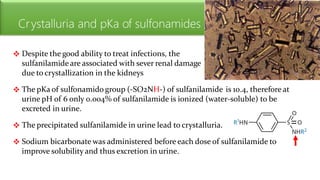
 The pKa of sulfonamido group (-SO2NH-) of sulfanilamide is 10.4, therefore at
urine pH of 6 only 0.004% of sulfanilamide is ionized (water-soluble) to be
excreted in urine.
 The precipitated sulfanilamide in urine lead to crystalluria.
 Sodium bicarbonate was administered before each dose of sulfanilamide to
improve solubility and thus excretion in urine.
How to reduce crystalurea for sulfonamides
So the methodsused to reduce thecrystalureaof sulfonamides is:
1. Increase urine f low to reduce the opportunity forcrystals to seed in kidney
2. Increase the urine pH. The closer the urine pH to 10.4 (i.e. the pka of sulfanilamide), the more
ionized, watersoluble-salt will form. increase urine pH can be achieved by taking sodium
bicarbonate.
3. Preparing derivatives of sulfanilamide that have low pKa as close as possible to urine pH (pH 6) to
ensurepart of thedose is ionized in the kidney tubules. The pKa can be lowered by using electron
withdrawinggroupat N1.
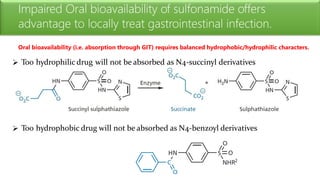
Impaired Oral bioavailability of sulfonamide offers
advantage to locally treat gastrointestinal infection.
Oral bioavailability (i.e. absorption through GIT) requires balanced hydrophobic/hydrophilic characters.
 Too hydrophilic drug will not be absorbed as N4-succinyl derivatives
 Too hydrophobic drug will not be absorbed as N4-benzoyl derivatives
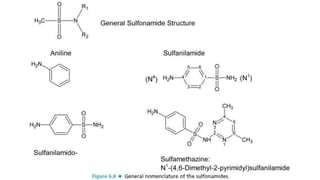
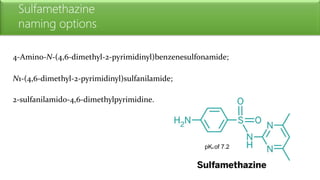
Sulfamethazine
naming options
4-Amino-N-(4,6-dimethyl-2-pyrimidinyl)benzenesulfonamide;
N1-(4,6-dimethyl-2-pyrimidinyl)sulfanilamide;
2-sulfanilamido-4,6-dimethylpyrimidine.
pKa of 7.2
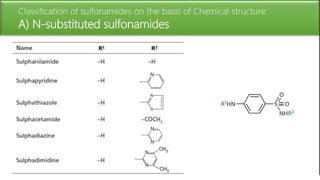
Classification of sulfonamides on the basis of
Chemical structure
 N-substituted sulphonamide: Sulphadiazine, Sulphacetamide, Sulphadimidine.
 • N-4 substituted sulphonamides (prodrugs): Prontosil.
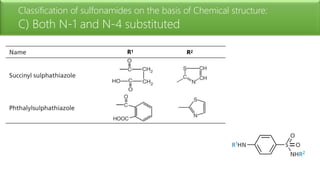
 • Both N-1 and N-4 substituted sulphonamides: Succinyl sulphathiazole,
Phthalylsulphathiazole.
 • Miscellaneous: Mafenide sodium.
Classification of sulfonamides on the basis of Chemical structure:
B) N-4 substituted sulphonamides (prodrugs)
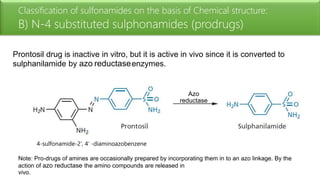
Prontosil drug is inactive in vitro, but it is active in vivo since it is converted to
by azo reductasesulphanilamide enzymes.
Azo
reductase
4-sulfonamide-2′, 4′ -diaminoazobenzene
Note: Pro-drugs of amines are occasionally prepared by incorporating them in to an azo linkage. By the
action of azo reductase the amino compounds are released in
vivo.
Classification of sulfonamides on the basis of Chemical structure:
B) N-4 substituted sulphonamides (prodrugs)
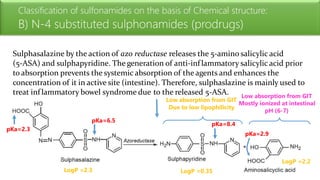
Sulphasalazine by the action of azo reductase releases the 5-amino salicylic acid
(5-ASA) and sulphapyridine. The generation of anti-inflammatory salicylic acid prior
to absorption prevents the systemic absorption of the agents and enhances the
concentration of it in active site (intestine). Therefore, sulphaslazine is mainly used to
treat inf lammatory bowel syndrome due to the released 5-ASA.
Low absorption from GIT
Mostly ionized at intestinal
pH (6-7)
Due to low lipophilicity
pKa=6.5
pKa=8.4
pKa=2.3
pKa=2.9
LogP =2.2
LogP =2.3 LogP =0.35
Classification of sulfonamides on the basis of Chemical structure:
C) Both N-1 and N-4 substituted
R1 R2
Classification of sulfonamides on the basis of Chemical structure:
D) Miscellaneous
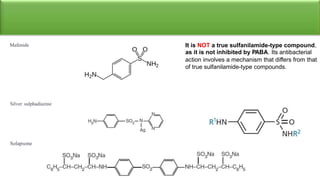
It is NOT a true sulfanilamide-type compound,
as it is not inhibited by PABA. Its antibacterial
Mafenide
action involves a mechanism that differs from that
of true sulfanilamide-type compounds.
Silver sulphadiazine
Solapsone
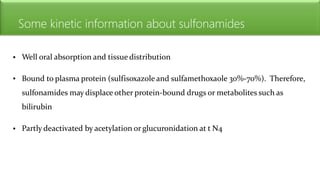
Some kinetic information about sulfonamides
• Well oral absorption and tissue distribution
• Bound to plasma protein (sulfisoxazole and sulfamethoxaole 30%-70%). Therefore,
sulfonamides may displace other protein-bound drugs or metabolites such as
bilirubin
• Partly deactivated by acetylation or glucuronidation at t N4
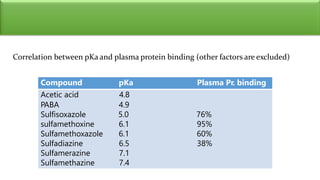
Correlation between pKa and plasma protein binding (other factors are excluded)
Compound pKa Plasma Pr. binding
Acetic acid 4.8
PABA 4.9
Sulfisoxazole 5.0 76%
sulfamethoxine 6.1 95%
Sulfamethoxazole 6.1 60%
Sulfadiazine 6.5 38%
Sulfamerazine 7.1
Sulfamethazine 7.4
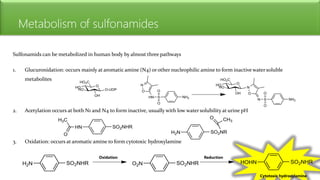
Metabolism of sulfonamides
Sulfonamids can be metabolized in human body by almost three pathways
1. Glucuronidation: occurs mainly at aromatic amine (N4) or other nucleophilic amine to form inactive water soluble
metabolites
2. Acetylation occurs at both N1 and N4 to form inactive, usually with low water solubility at urine pH
3. Oxidation: occurs at aromatic amine to form cytotoxic hydroxylamine
Oxidation Reduction
Cytotoxic hydroxylamine
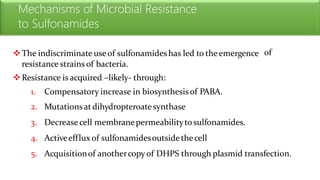
Mechanisms of Microbial Resistance
to Sulfonamides
The indiscriminate useof sulfonamideshas led to theemergence
resistance strains of bacteria.
Resistance is acquired –likely- through:
of
1.
2.
3.
4.
5.
Compensatory increase in biosynthesisof PABA.
Mutationsatdihydropteroatesynthase
Decrease cell membranepermeabilitytosulfonamides.
Activeefflux of sulfonamidesoutsidethecell
Acquisitionof anothercopy of DHPS through plasmid transfection.
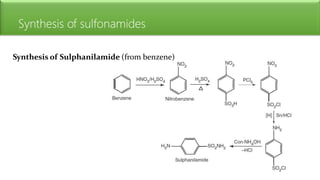
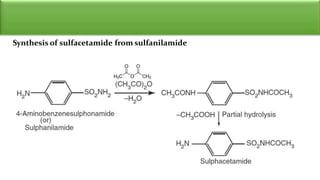
Synthesis of sulfonamides
Synthesis of Sulphanilamide (from benzene)
Synthesis of sulfacetamide from sulfanilamide

Sulphonamides

  • 1.
    Sulfonamides Mr. Naga PrashantKoppuravuri, M.Pharm,(Ph.D), FAGE Discovery, Mechanism of action, sulfonamides prodrugs SAR, solubility problems and solutions,
  • 2.
    Sulfonamides • The sulfonamidesare bacteriostatic when administered to humans in achievable doses. • They inhibit the enzyme dihydropteroate synthase, an important enzyme needed for the biosynthesis of folic acid derivatives and, ultimately, the thymidine required for DNA • They do this by competing at the active site with p -aminobenzoicacid (PABA), a normal structural componentof folic acid derivatives. • Humans have no dihydropteroate synthase, which explains sulfonamides selectivity for bacterial cells. • Indeed, the antimicrobial efficacy of sulfonamides can be reversed by adding significant quantitiesof PABA into the diet
  • 3.
    Sulfonamides (Sulfa orsulpha drugs)  Diseases like pneumonia, meningitis, dysentryetc., could not be treated effectively until the discoveryof sulfadrugs which weresuitable for internal useagainstgram+ bacteria.  p-aminobenzenesulphonamide (sulfanilamide) was initially synthesized in 1908 as intermediateforazodyes, lateron, itwas observed that it is effectiveagainst streptococci  In 1935, a red dye (4-sulfonamide-2′, 4′ -diaminoazobenzene) was prepared and showed curative propertiesagainst infectionsand named Prontosil  The inactivityof prontosil as antibacterial agents in vitro suggests that it should be converted to anothermetabolitetoexert itsantibacterial activity in vivo.  Due to resistancedevelopment, only few sulfonamidesare still in use such as (sul+trim)
  • 6.
    • Sulfonamides inhibitDHPS by competing PABA. • some bacteria can resist sulfonamide competition by making more PABA, decrease cell membrane permeability to sulfonamide or by getting mutated DHPS.
  • 9.
    Ionization of sulfonamides  Sulfonamidegroup (SO2NH2) is unstable and get stabilized by losing a proton which results in negative charge being stabilized by resonance with sufone group.  Therefore, the SO2NH2 group can be considered as HA acid similar to carboxyls COOH), phenols (benzene-OH) and thiols (-SH). The R group in –SO2-NH-R affects the ionizabilityof NH. If R is electron with- drawing group, the antibacterial activityand solubilityof the drug is improved. Pyrimidine is more electron withdrawing than benzene and thiazole rings. Thiazole substitution produces toxic sulfonamidederivatives. (-   The lipid solubility inf luences the pharmacokinetic and antibacterial activity, and so increases the half-life and antibacterial activity in vivo.
  • 10.
    Crystalluria and pKaof sulfonamides  Despite the good ability to treat infections, the sulfanilamide are associated with sever renal damage due to crystallization in the kidneys  The pKa of sulfonamido group (-SO2NH-) of sulfanilamide is 10.4, therefore at urine pH of 6 only 0.004% of sulfanilamide is ionized (water-soluble) to be excreted in urine.  The precipitated sulfanilamide in urine lead to crystalluria.  Sodium bicarbonate was administered before each dose of sulfanilamide to improve solubility and thus excretion in urine.
  • 12.
    How to reducecrystalurea for sulfonamides So the methodsused to reduce thecrystalureaof sulfonamides is: 1. Increase urine f low to reduce the opportunity forcrystals to seed in kidney 2. Increase the urine pH. The closer the urine pH to 10.4 (i.e. the pka of sulfanilamide), the more ionized, watersoluble-salt will form. increase urine pH can be achieved by taking sodium bicarbonate. 3. Preparing derivatives of sulfanilamide that have low pKa as close as possible to urine pH (pH 6) to ensurepart of thedose is ionized in the kidney tubules. The pKa can be lowered by using electron withdrawinggroupat N1.
  • 13.
    Impaired Oral bioavailabilityof sulfonamide offers advantage to locally treat gastrointestinal infection. Oral bioavailability (i.e. absorption through GIT) requires balanced hydrophobic/hydrophilic characters.  Too hydrophilic drug will not be absorbed as N4-succinyl derivatives  Too hydrophobic drug will not be absorbed as N4-benzoyl derivatives
  • 14.
  • 15.
    Classification of sulfonamideson the basis of Chemical structure  N-substituted sulphonamide: Sulphadiazine, Sulphacetamide, Sulphadimidine.  • N-4 substituted sulphonamides (prodrugs): Prontosil.  • Both N-1 and N-4 substituted sulphonamides: Succinyl sulphathiazole, Phthalylsulphathiazole.  • Miscellaneous: Mafenide sodium.
  • 17.
    Classification of sulfonamideson the basis of Chemical structure: B) N-4 substituted sulphonamides (prodrugs) Prontosil drug is inactive in vitro, but it is active in vivo since it is converted to by azo reductasesulphanilamide enzymes. Azo reductase 4-sulfonamide-2′, 4′ -diaminoazobenzene Note: Pro-drugs of amines are occasionally prepared by incorporating them in to an azo linkage. By the action of azo reductase the amino compounds are released in vivo.
  • 18.
    Classification of sulfonamideson the basis of Chemical structure: B) N-4 substituted sulphonamides (prodrugs) Sulphasalazine by the action of azo reductase releases the 5-amino salicylic acid (5-ASA) and sulphapyridine. The generation of anti-inflammatory salicylic acid prior to absorption prevents the systemic absorption of the agents and enhances the concentration of it in active site (intestine). Therefore, sulphaslazine is mainly used to treat inf lammatory bowel syndrome due to the released 5-ASA. Low absorption from GIT Low absorption from GIT Mostly ionized at intestinal pH (6-7) Due to low lipophilicity pKa=6.5 pKa=8.4 pKa=2.3 pKa=2.9 LogP =2.2 LogP =2.3 LogP =0.35
  • 19.
    Classification of sulfonamideson the basis of Chemical structure: C) Both N-1 and N-4 substituted R1 R2
  • 20.
    Classification of sulfonamideson the basis of Chemical structure: D) Miscellaneous It is NOT a true sulfanilamide-type compound, as it is not inhibited by PABA. Its antibacterial Mafenide action involves a mechanism that differs from that of true sulfanilamide-type compounds. Silver sulphadiazine Solapsone
  • 21.
    Some kinetic informationabout sulfonamides • Well oral absorption and tissue distribution • Bound to plasma protein (sulfisoxazole and sulfamethoxaole 30%-70%). Therefore, sulfonamides may displace other protein-bound drugs or metabolites such as bilirubin • Partly deactivated by acetylation or glucuronidation at t N4
  • 22.
    Correlation between pKaand plasma protein binding (other factors are excluded) Compound pKa Plasma Pr. binding Acetic acid 4.8 PABA 4.9 Sulfisoxazole 5.0 76% sulfamethoxine 6.1 95% Sulfamethoxazole 6.1 60% Sulfadiazine 6.5 38% Sulfamerazine 7.1 Sulfamethazine 7.4
  • 23.
    Metabolism of sulfonamides Sulfonamidscan be metabolized in human body by almost three pathways 1. Glucuronidation: occurs mainly at aromatic amine (N4) or other nucleophilic amine to form inactive water soluble metabolites 2. Acetylation occurs at both N1 and N4 to form inactive, usually with low water solubility at urine pH 3. Oxidation: occurs at aromatic amine to form cytotoxic hydroxylamine Oxidation Reduction Cytotoxic hydroxylamine
  • 24.
    Mechanisms of MicrobialResistance to Sulfonamides The indiscriminate useof sulfonamideshas led to theemergence resistance strains of bacteria. Resistance is acquired –likely- through: of 1. 2. 3. 4. 5. Compensatory increase in biosynthesisof PABA. Mutationsatdihydropteroatesynthase Decrease cell membranepermeabilitytosulfonamides. Activeefflux of sulfonamidesoutsidethecell Acquisitionof anothercopy of DHPS through plasmid transfection.
  • 25.
    Synthesis of sulfonamides Synthesisof Sulphanilamide (from benzene)
  • 26.
    Synthesis of sulfacetamidefrom sulfanilamide