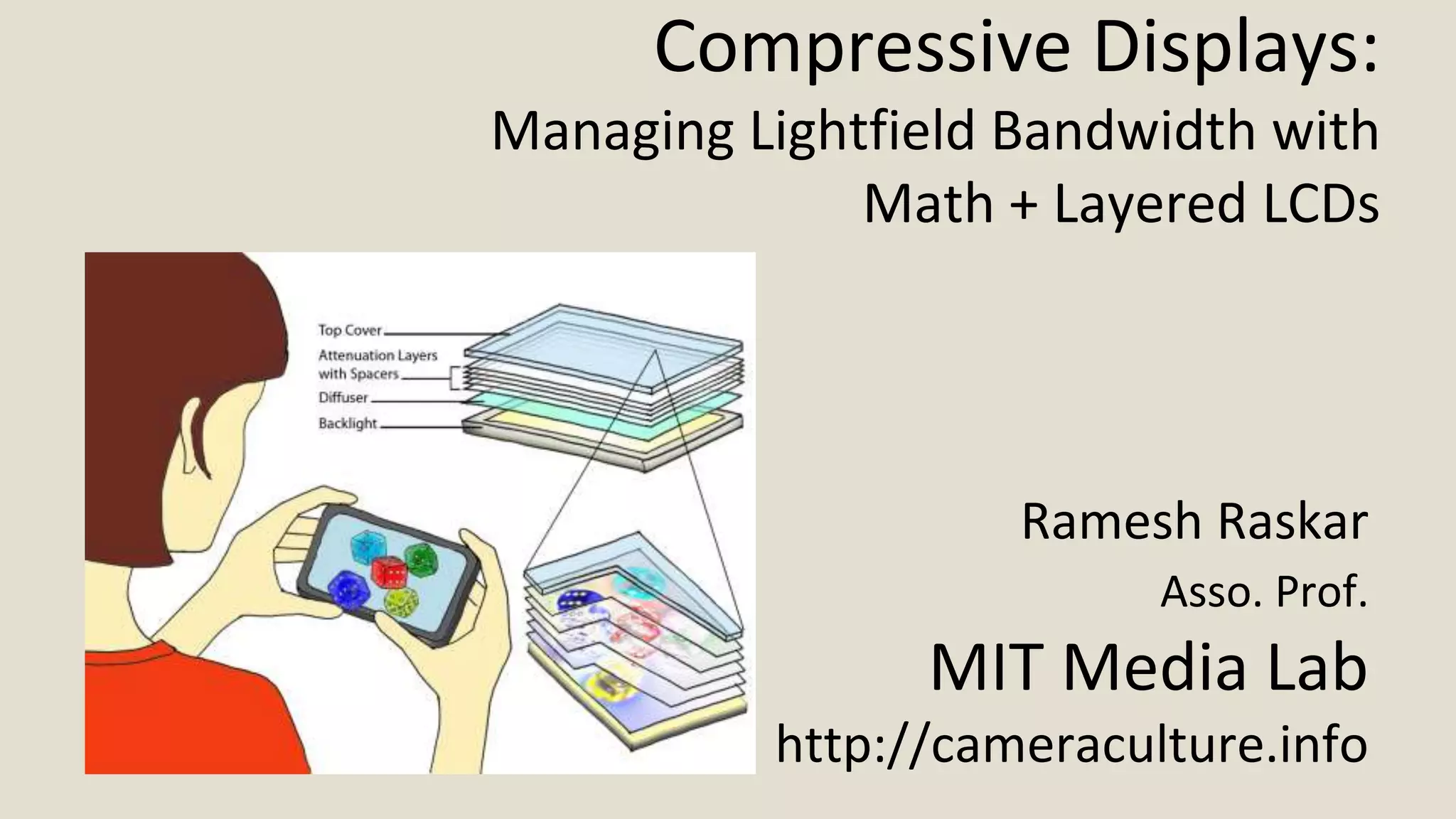
Compressive Displays:
Managing Lightfield Bandwidth with
              Math + Layered LCDs


                    Ramesh Raskar
                          Asso. Prof.
                MIT Media Lab
          http://cameraculture.info
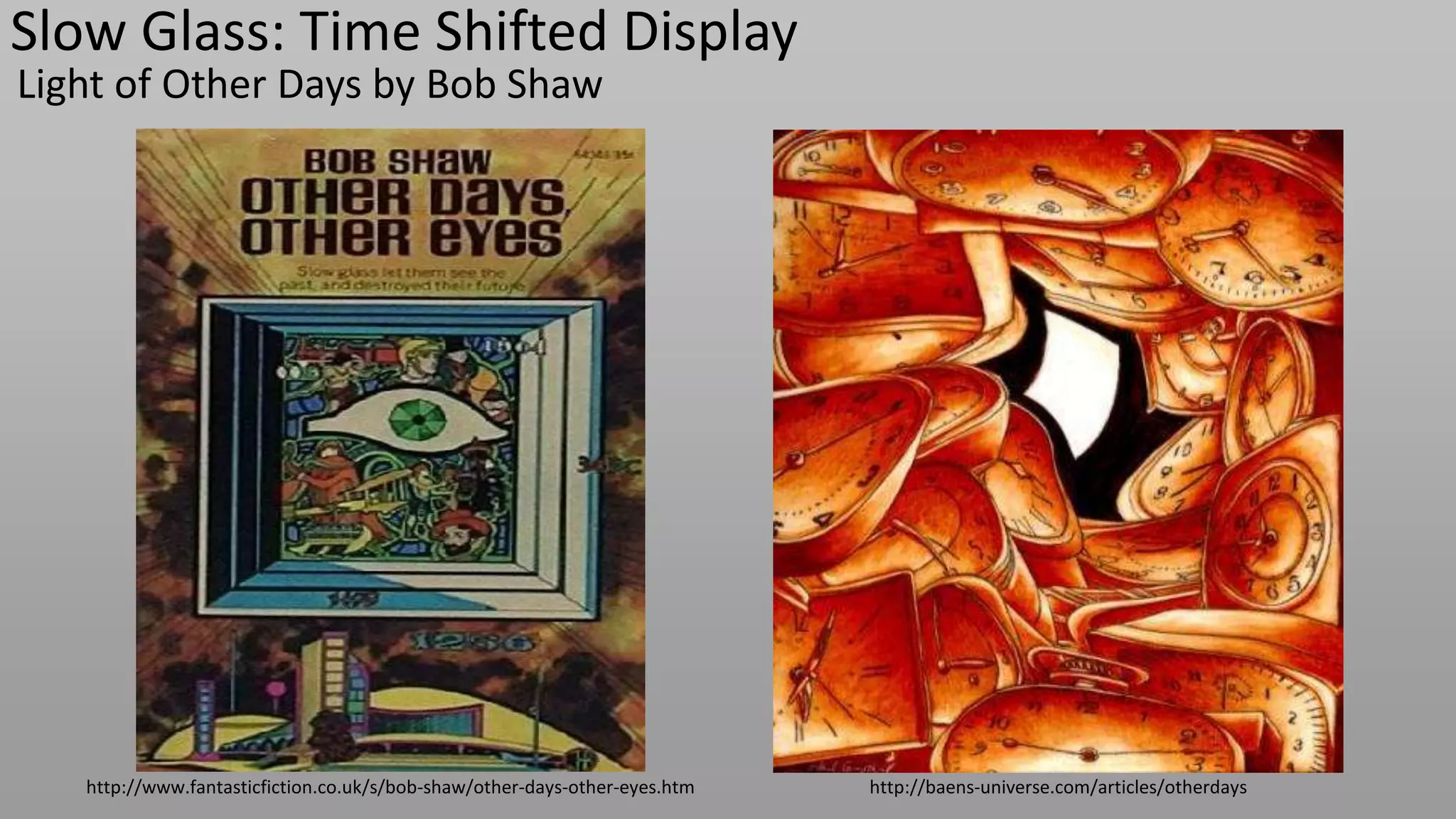
Slow Glass: Time Shifted Display
Light of Other Days by Bob Shaw


   http://www.fantasticfiction.co.uk/s/bob-shaw/other-days-other-eyes.htm   http://baens-universe.com/articles/otherdays
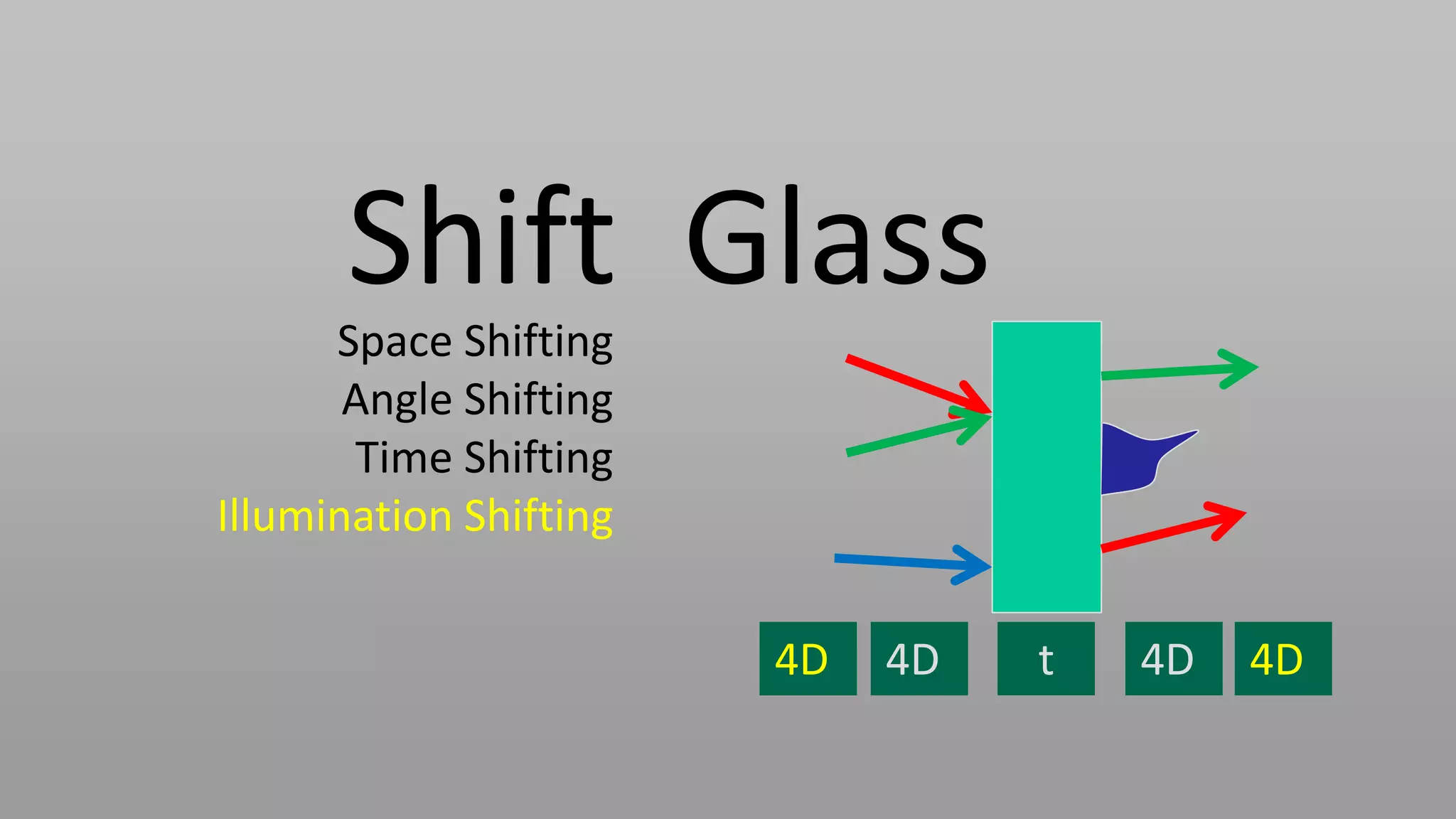
Shift Glass
      Space Shifting
       Angle Shifting
       Time Shifting
Illumination Shifting

                        4D   4D   t   4D   4D
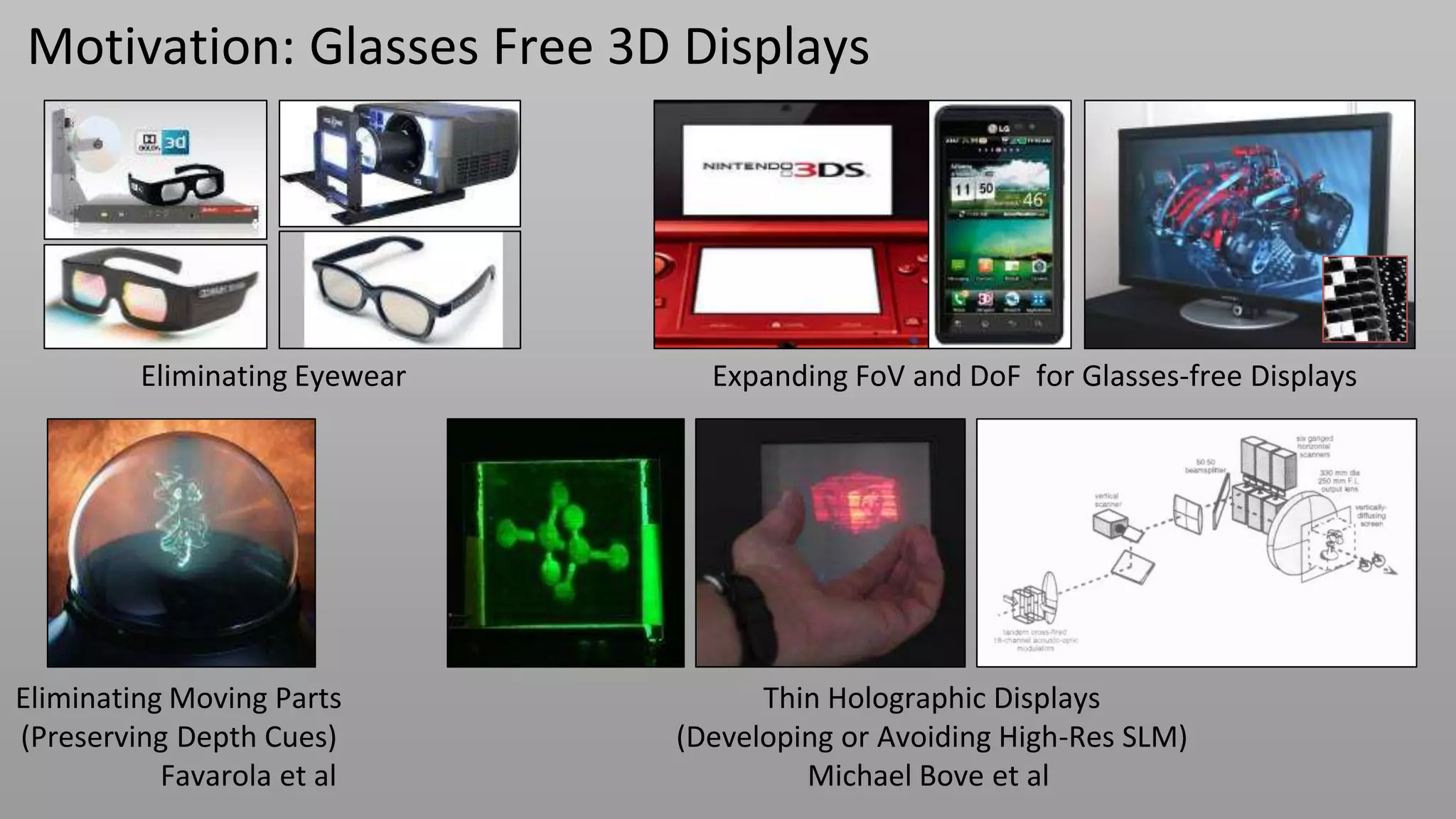
Motivation: Glasses Free 3D Displays


         Eliminating Eyewear     Expanding FoV and DoF for Glasses-free Displays


Eliminating Moving Parts             Thin Holographic Displays
(Preserving Depth Cues)        (Developing or Avoiding High-Res SLM)
           Favarola et al               Michael Bove et al
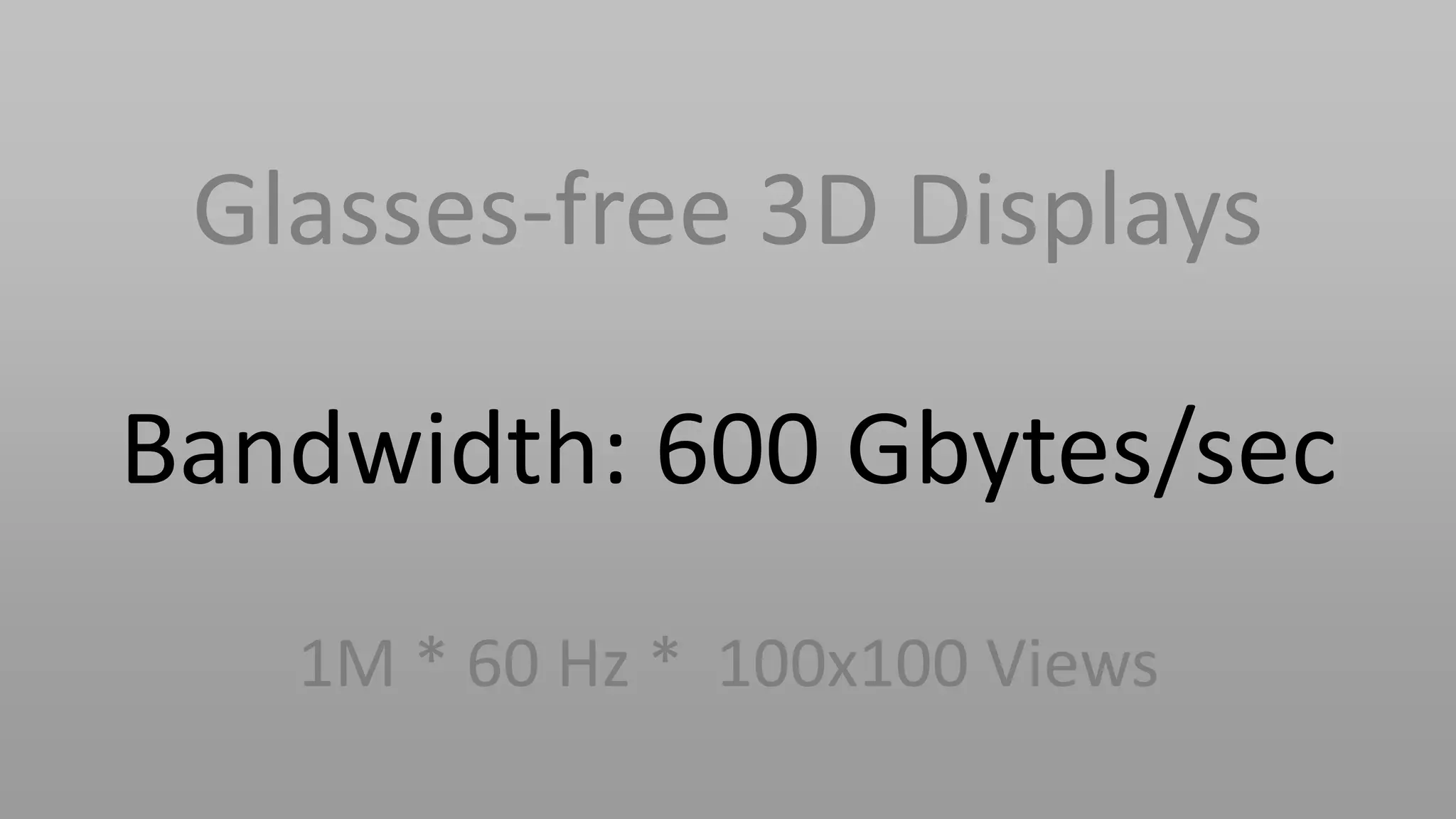
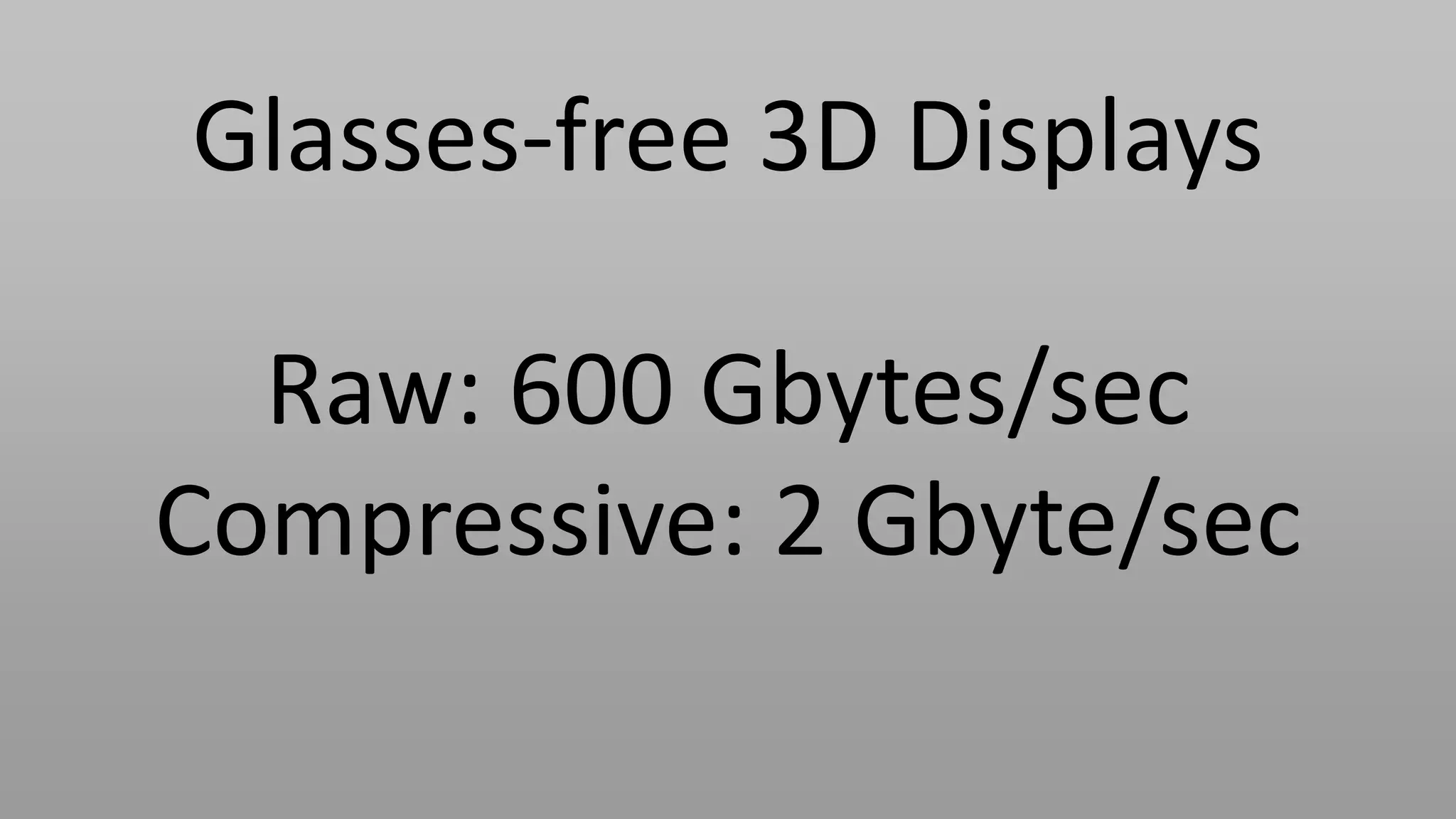
Glasses-free 3D Displays

Bandwidth: 600 Gbytes/sec
   1M * 60 Hz * 100x100 Views
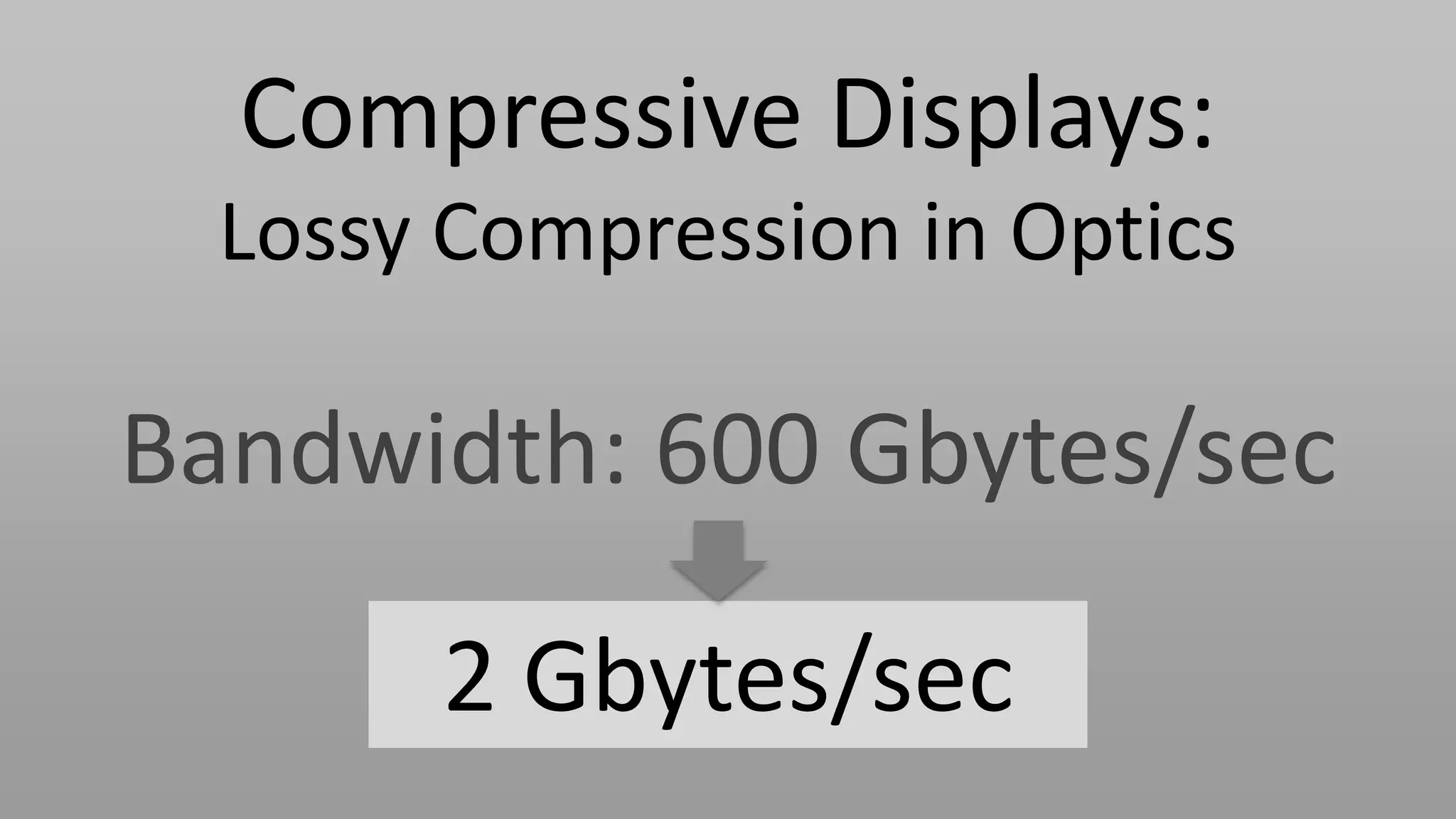
Compressive Displays:
  Lossy Compression in Optics

Bandwidth: 600 Gbytes/sec

       2 Gbytes/sec
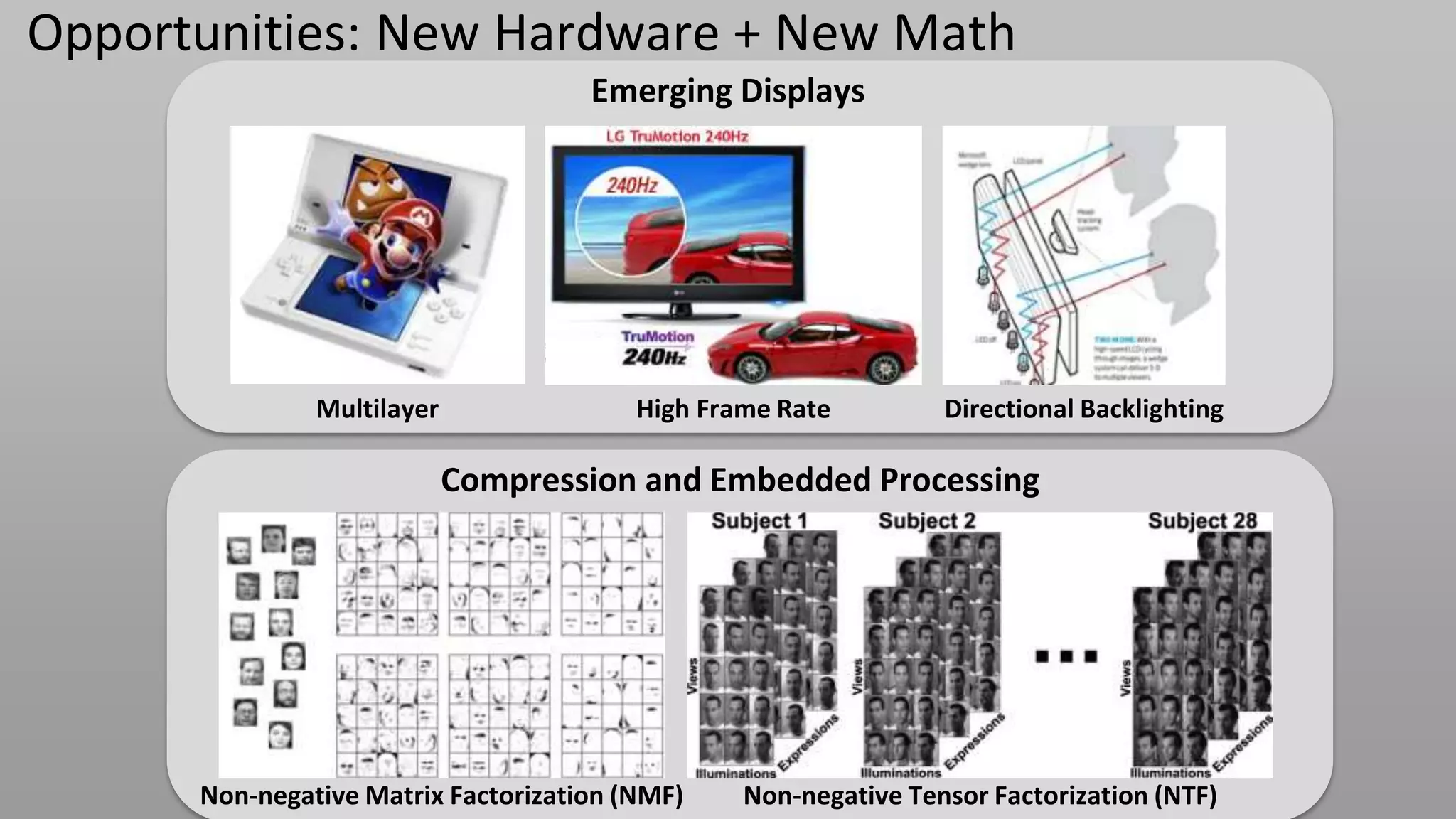
Opportunities: New Hardware + New Math
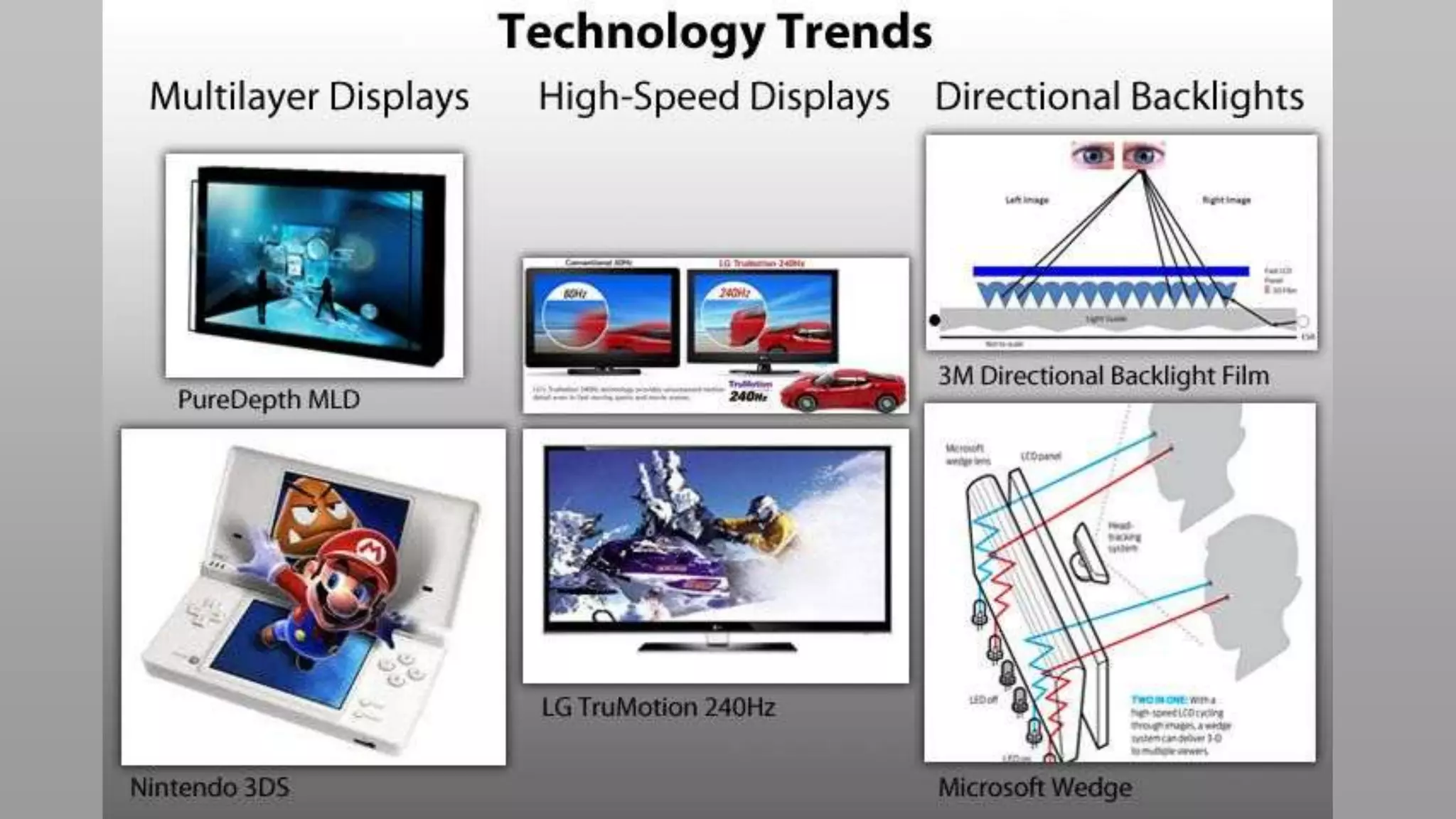
                                     Emerging Displays


               Multilayer                High Frame Rate         Directional Backlighting

                            Compression and Embedded Processing


      Non-negative Matrix Factorization (NMF)    Non-negative Tensor Factorization (NTF)
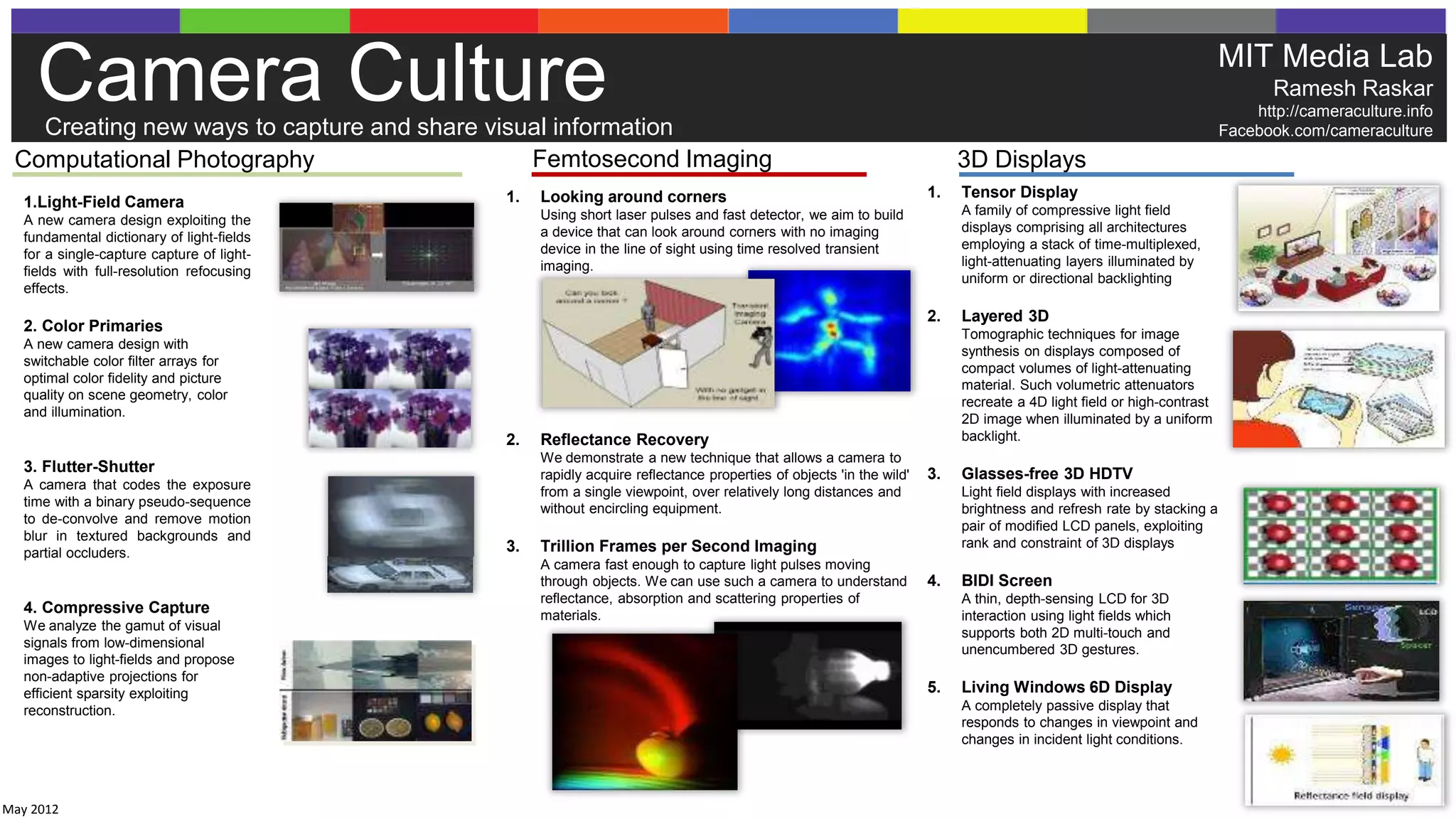
Camera Culture
   Creating new ways to capture and share visual information
                                                                                                                                                                     MIT Media Lab
                                                                                                                                                                            Ramesh Raskar
                                                                                                                                                                         http://cameraculture.info
                                                                                                                                                                     Facebook.com/cameraculture
 Computational Photography                    Femtosecond Imaging                                                       3D Displays
                                            1.   Looking around corners                                            1.   Tensor Display
   1.Light-Field Camera                                                                                                 A family of compressive light field
   A new camera design exploiting the            Using short laser pulses and fast detector, we aim to build
                                                 a device that can look around corners with no imaging                  displays comprising all architectures
   fundamental dictionary of light-fields
                                                 device in the line of sight using time resolved transient              employing a stack of time-multiplexed,
   for a single-capture capture of light-
                                                 imaging.                                                               light-attenuating layers illuminated by
   fields with full-resolution refocusing
                                                                                                                        uniform or directional backlighting
   effects.

                                                                                                                   2.   Layered 3D
   2. Color Primaries                                                                                                   Tomographic techniques for image
   A new camera design with
                                                                                                                        synthesis on displays composed of
   switchable color filter arrays for                                                                                   compact volumes of light-attenuating
   optimal color fidelity and picture                                                                                   material. Such volumetric attenuators
   quality on scene geometry, color                                                                                     recreate a 4D light field or high-contrast
   and illumination.                                                                                                    2D image when illuminated by a uniform
                                            2.   Reflectance Recovery                                                   backlight.
                                                 We demonstrate a new technique that allows a camera to
   3. Flutter-Shutter                            rapidly acquire reflectance properties of objects 'in the wild'   3.   Glasses-free 3D HDTV
   A camera that codes the exposure              from a single viewpoint, over relatively long distances and            Light field displays with increased
   time with a binary pseudo-sequence            without encircling equipment.                                          brightness and refresh rate by stacking a
   to de-convolve and remove motion
                                                                                                                        pair of modified LCD panels, exploiting
   blur in textured backgrounds and                                                                                     rank and constraint of 3D displays
   partial occluders.                       3.   Trillion Frames per Second Imaging
                                                 A camera fast enough to capture light pulses moving
                                                 through objects. We can use such a camera to understand           4.   BIDI Screen
                                                 reflectance, absorption and scattering properties of                   A thin, depth-sensing LCD for 3D
   4. Compressive Capture                        materials.                                                             interaction using light fields which
   We analyze the gamut of visual
                                                                                                                        supports both 2D multi-touch and
   signals from low-dimensional
                                                                                                                        unencumbered 3D gestures.
   images to light-fields and propose
   non-adaptive projections for
   efficient sparsity exploiting                                                                                   5.   Living Windows 6D Display
   reconstruction.                                                                                                      A completely passive display that
                                                                                                                        responds to changes in viewpoint and
                                                                                                                        changes in incident light conditions.


May 2012
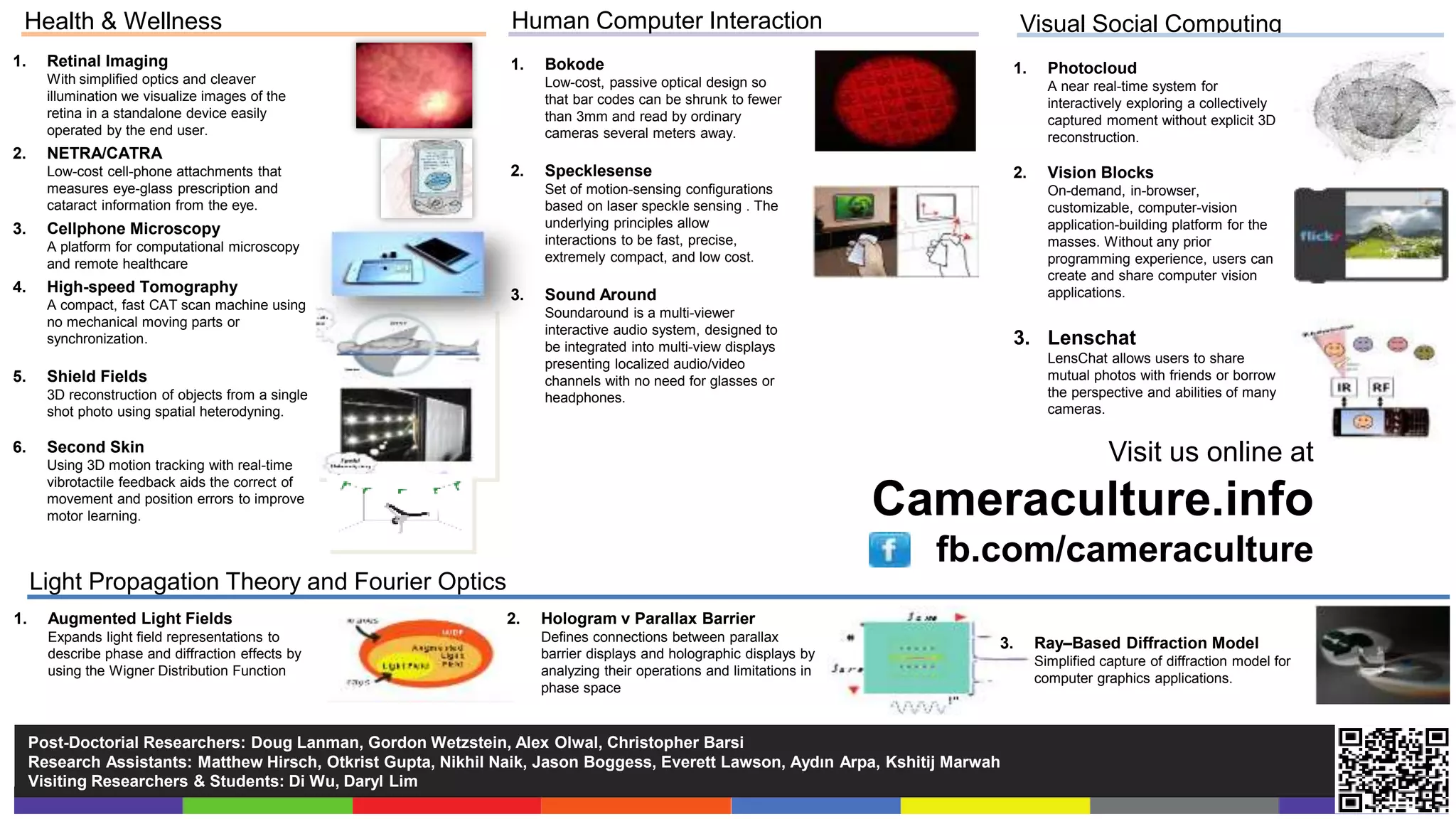
Health & Wellness                                               Human Computer Interaction                                        Visual Social Computing
1.     Retinal Imaging                                           1.   Bokode                                                      1.     Photocloud
       With simplified optics and cleaver                             Low-cost, passive optical design so                                A near real-time system for
       illumination we visualize images of the                        that bar codes can be shrunk to fewer                              interactively exploring a collectively
       retina in a standalone device easily                           than 3mm and read by ordinary                                      captured moment without explicit 3D
       operated by the end user.                                      cameras several meters away.                                       reconstruction.
2.     NETRA/CATRA
       Low-cost cell-phone attachments that                      2.   Specklesense                                                2.     Vision Blocks
       measures eye-glass prescription and                            Set of motion-sensing configurations                               On-demand, in-browser,
       cataract information from the eye.                             based on laser speckle sensing . The                               customizable, computer-vision
3.     Cellphone Microscopy                                           underlying principles allow                                        application-building platform for the
       A platform for computational microscopy                        interactions to be fast, precise,                                  masses. Without any prior
       and remote healthcare                                          extremely compact, and low cost.                                   programming experience, users can
                                                                                                                                         create and share computer vision
4.     High-speed Tomography                                     3.   Sound Around                                                       applications.
       A compact, fast CAT scan machine using
                                                                      Soundaround is a multi-viewer
       no mechanical moving parts or
                                                                      interactive audio system, designed to
       synchronization.
                                                                      be integrated into multi-view displays
                                                                                                                                  3. Lenschat
                                                                      presenting localized audio/video                                   LensChat allows users to share
5.     Shield Fields                                                  channels with no need for glasses or                               mutual photos with friends or borrow
       3D reconstruction of objects from a single                     headphones.                                                        the perspective and abilities of many
       shot photo using spatial heterodyning.                                                                                            cameras.

6.     Second Skin
       Using 3D motion tracking with real-time
                                                                                                                                                   Visit us online at
       vibrotactile feedback aids the correct of
       movement and position errors to improve
       motor learning.                                                                                                Cameraculture.info
                                                                                                                        fb.com/cameraculture
     Light Propagation Theory and Fourier Optics
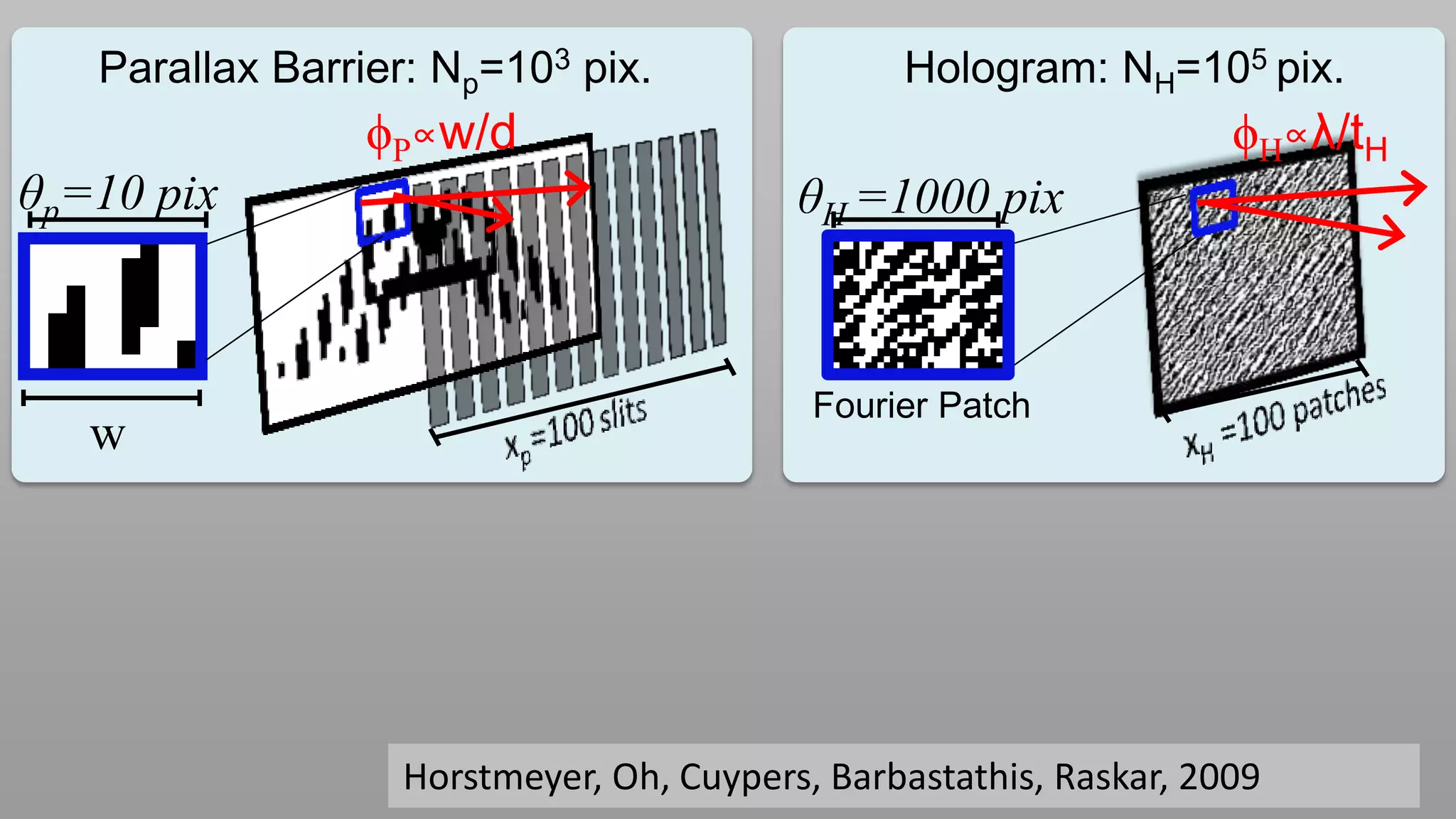
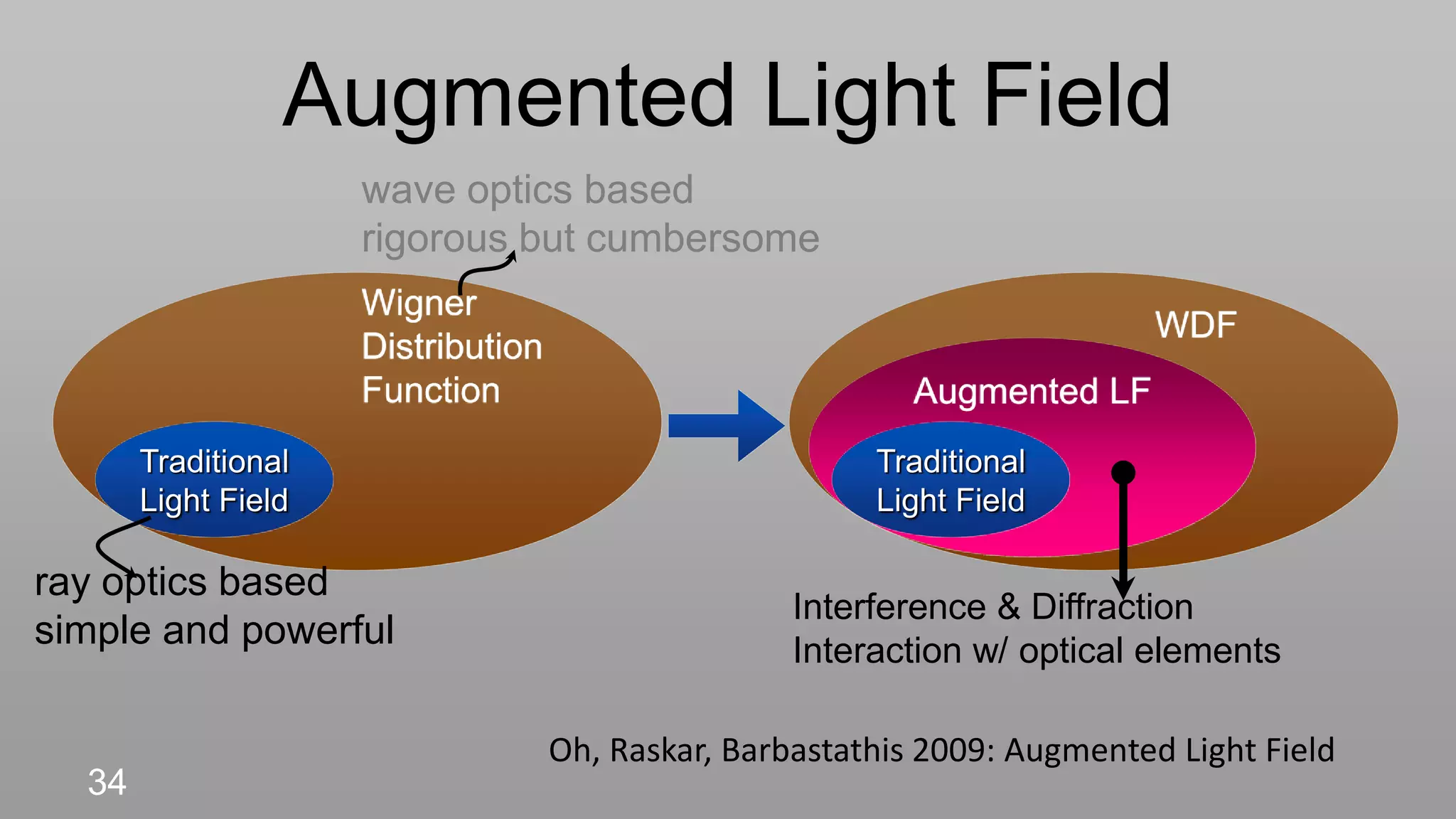
1.     Augmented Light Fields                                    2.   Hologram v Parallax Barrier
       Expands light field representations to                         Defines connections between parallax                    3.       Ray–Based Diffraction Model
       describe phase and diffraction effects by                      barrier displays and holographic displays by
                                                                                                                                       Simplified capture of diffraction model for
       using the Wigner Distribution Function                         analyzing their operations and limitations in
                                                                                                                                       computer graphics applications.
                                                                      phase space


     Post-Doctorial Researchers: Doug Lanman, Gordon Wetzstein, Alex Olwal, Christopher Barsi
     Research Assistants: Matthew Hirsch, Otkrist Gupta, Nikhil Naik, Jason Boggess, Everett Lawson, Aydın Arpa, Kshitij Marwah
     Visiting Researchers & Students: Di Wu, Daryl Lim
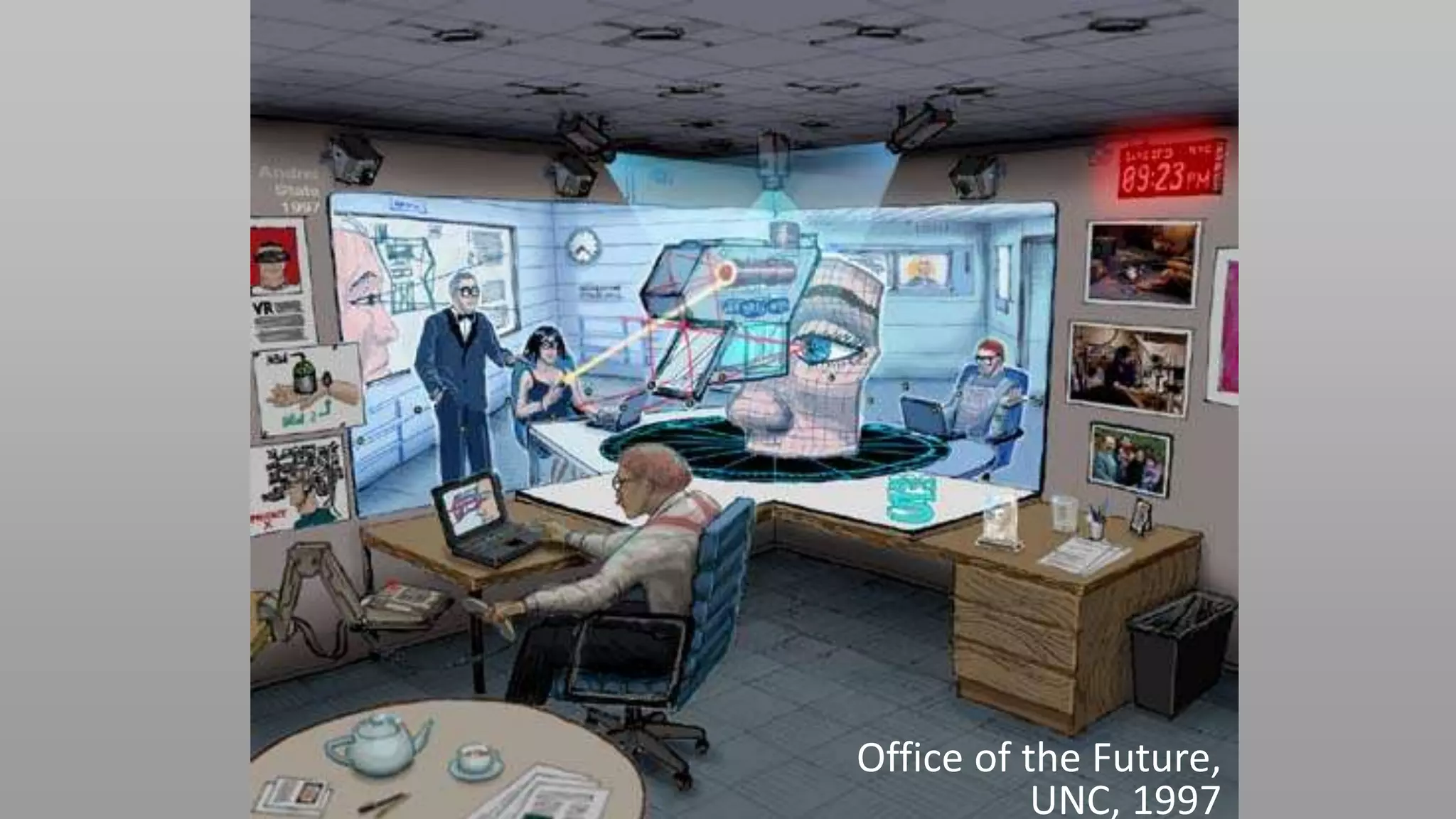
Office of the Future,
           UNC, 1997
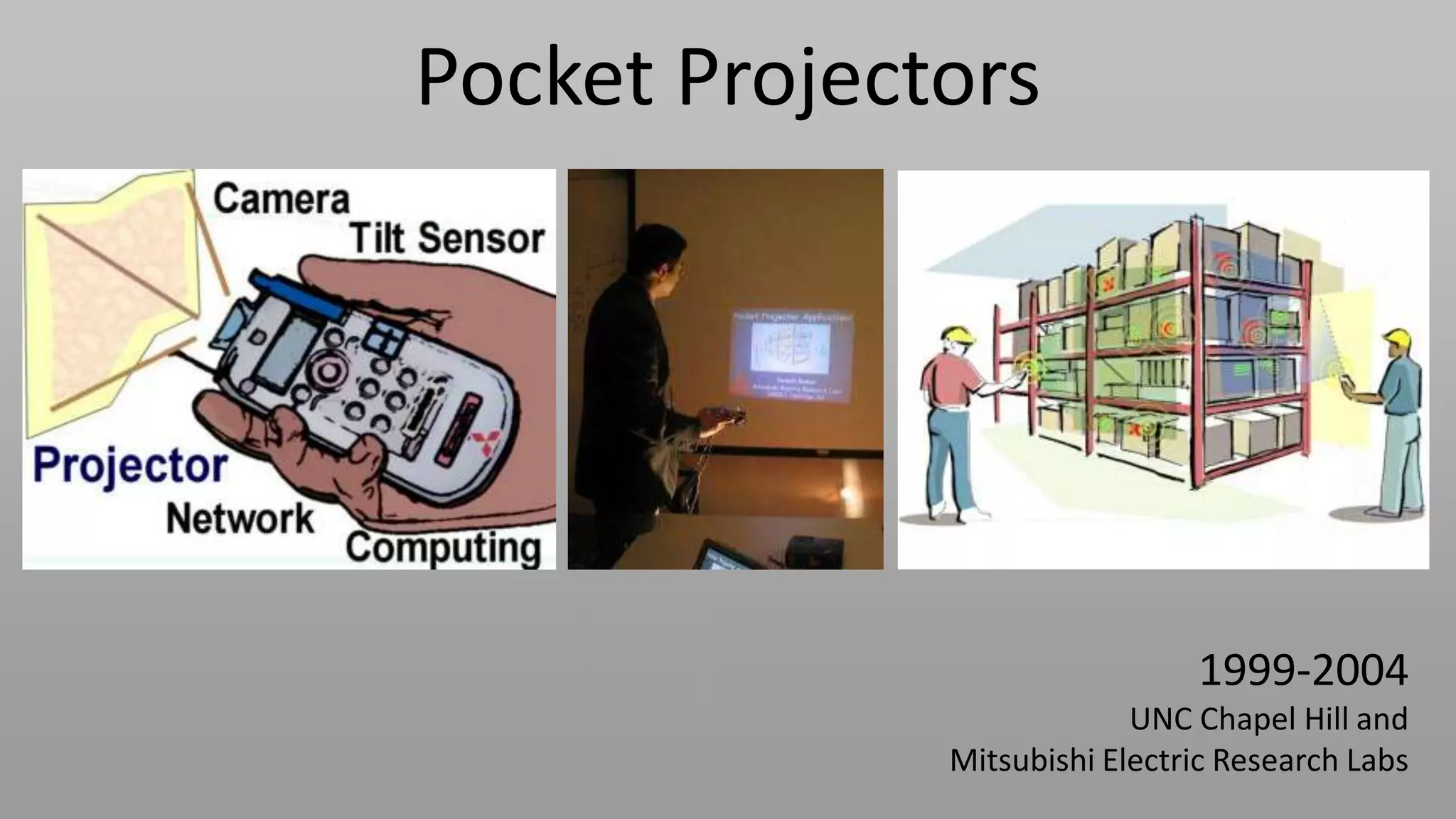
Pocket Projectors


                               1999-2004
                           UNC Chapel Hill and
              Mitsubishi Electric Research Labs
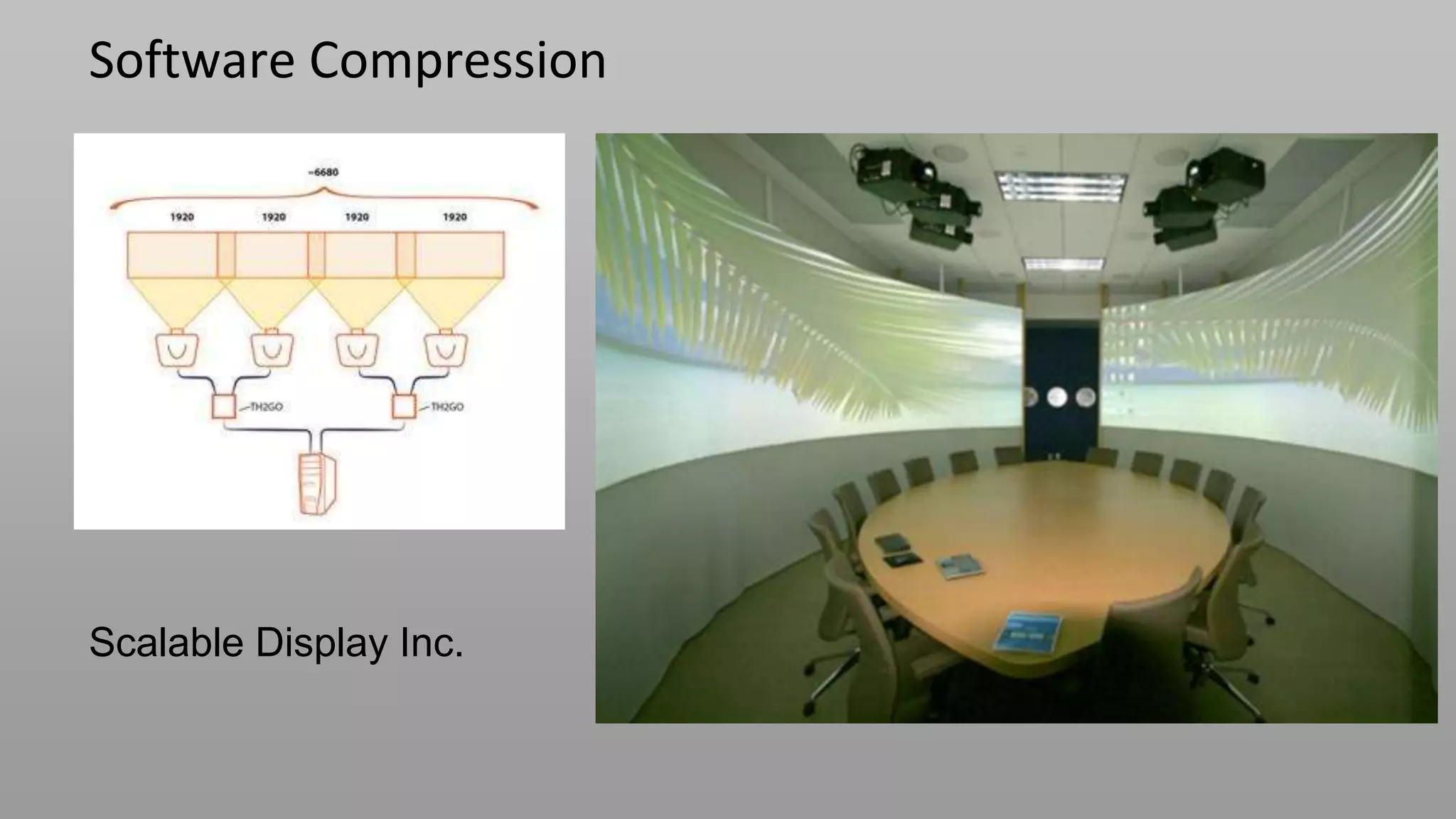
Software Compression


Scalable Display Inc.
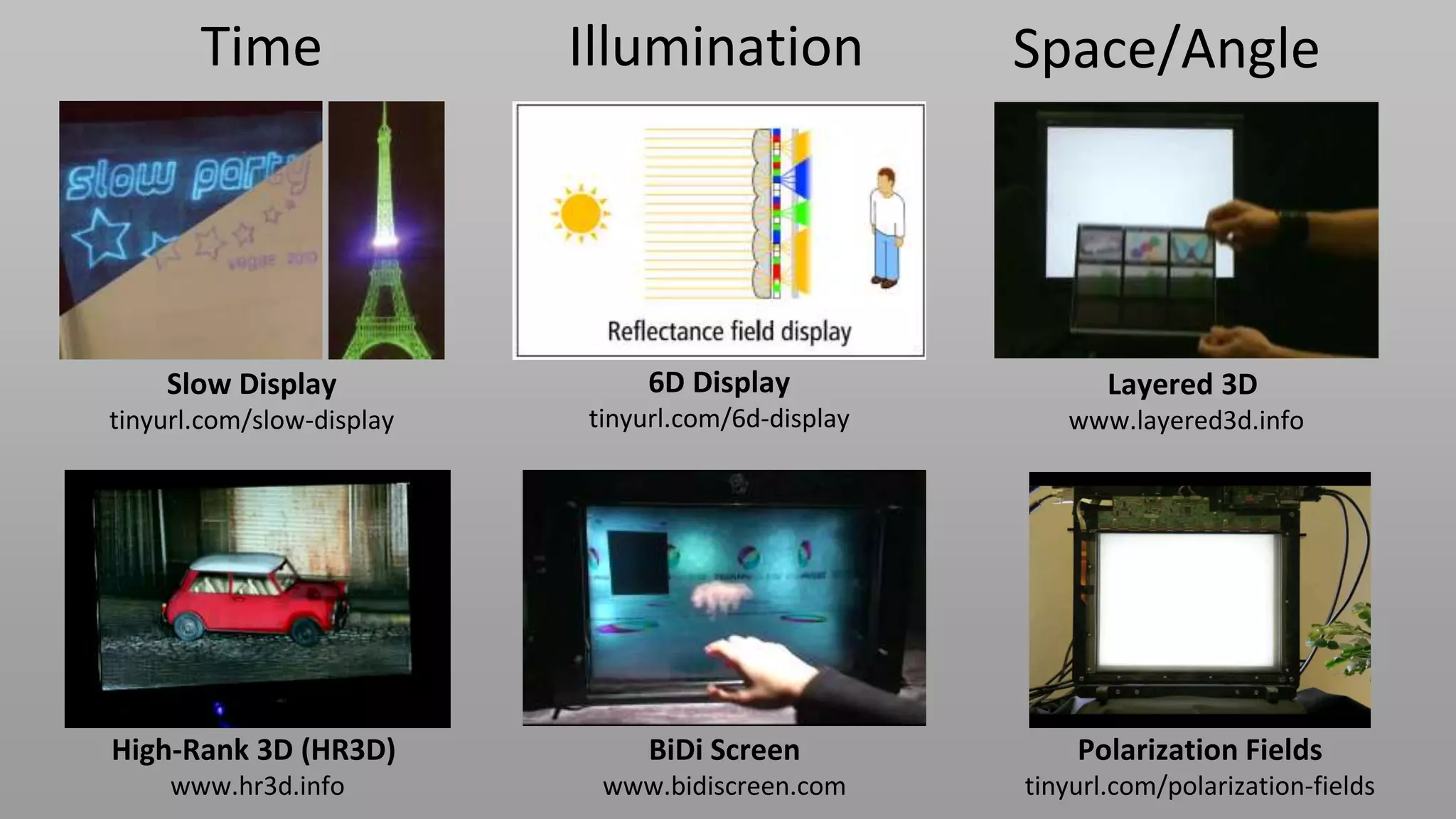
Time                Illumination             Space/Angle


    Slow Display                6D Display                 Layered 3D
tinyurl.com/slow-display   tinyurl.com/6d-display      www.layered3d.info


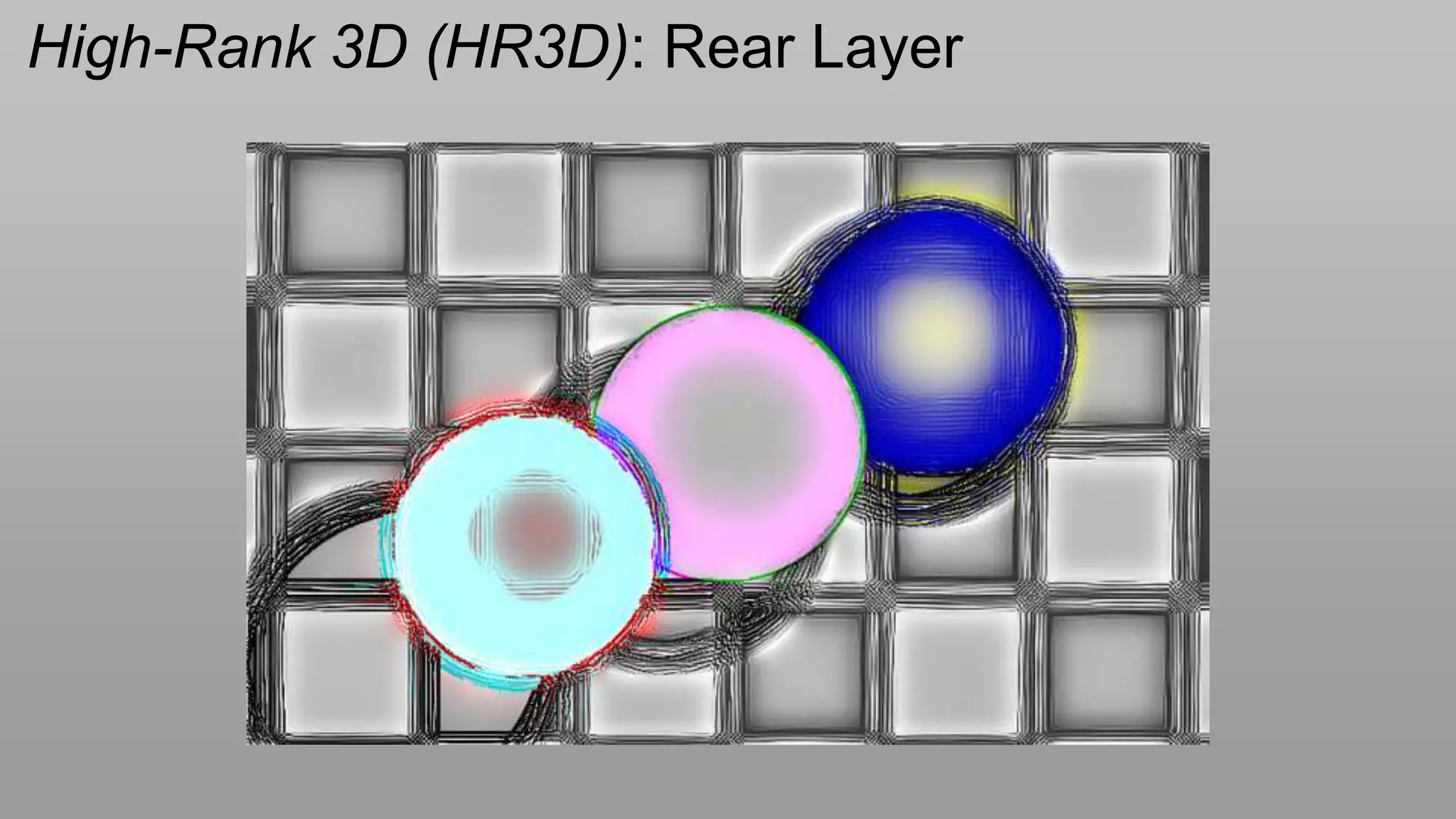
High-Rank 3D (HR3D)             BiDi Screen             Polarization Fields
     www.hr3d.info          www.bidiscreen.com      tinyurl.com/polarization-fields
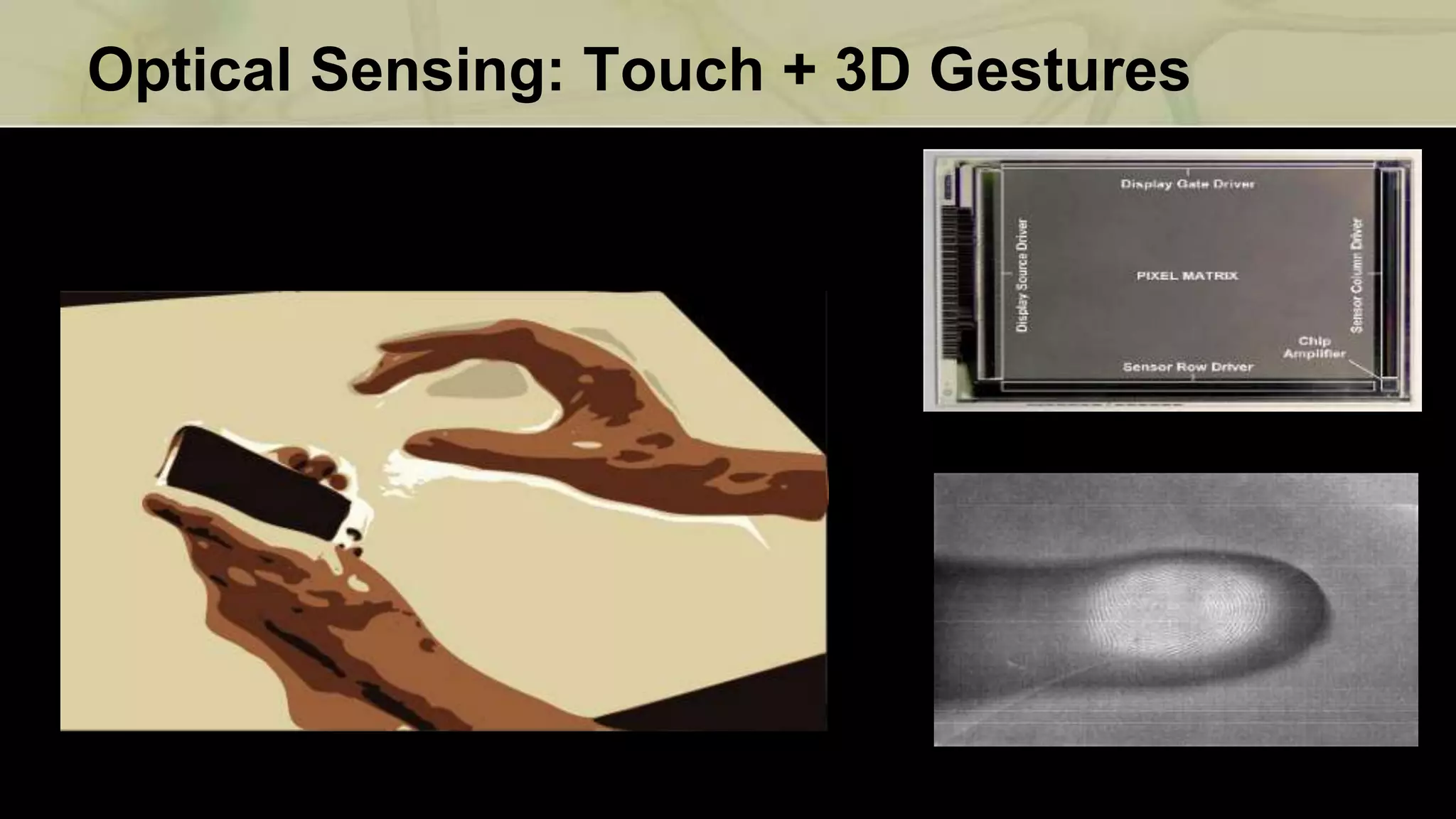
Optical Sensing: Touch + 3D Gestures
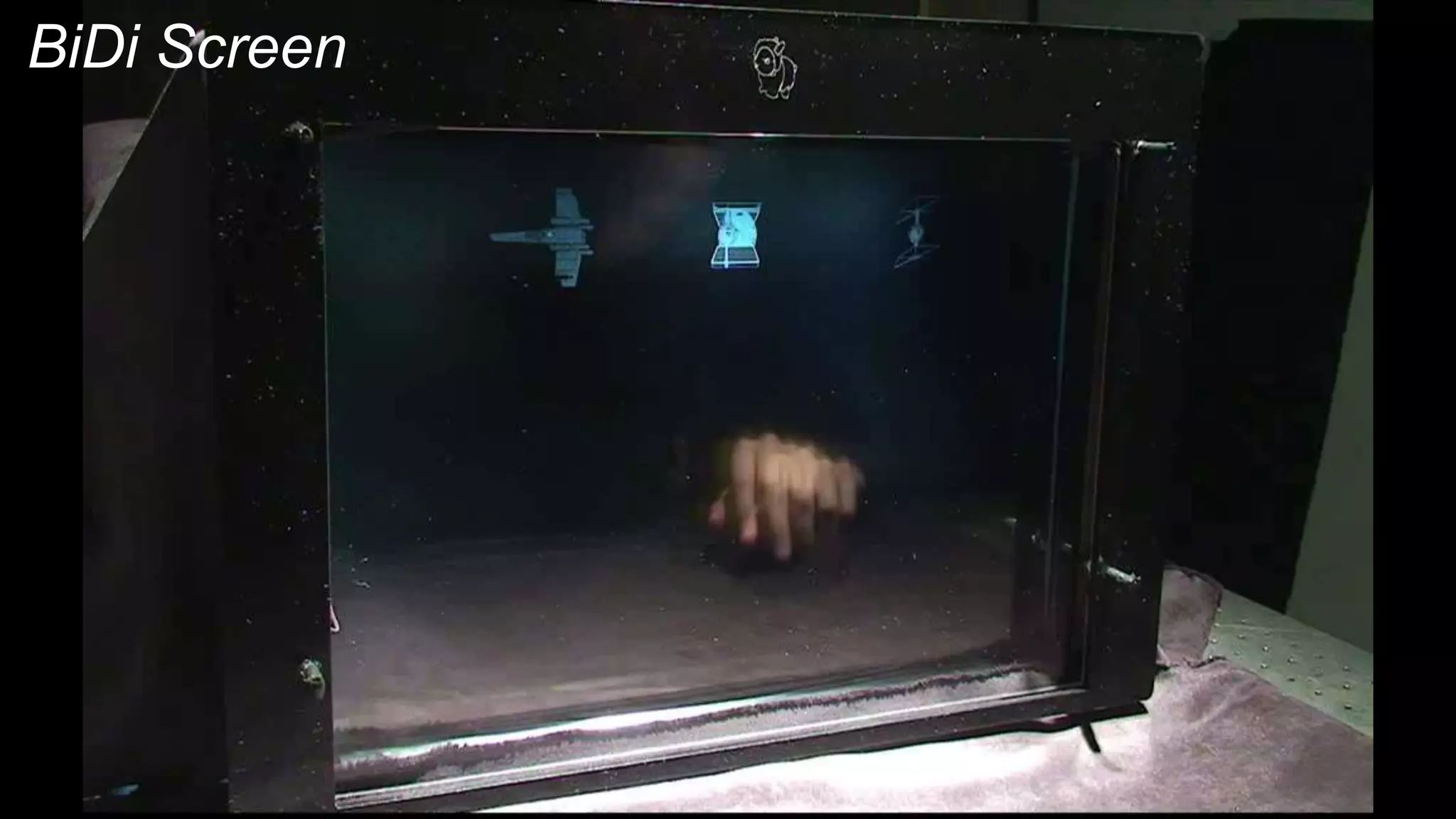
BiDi Screen
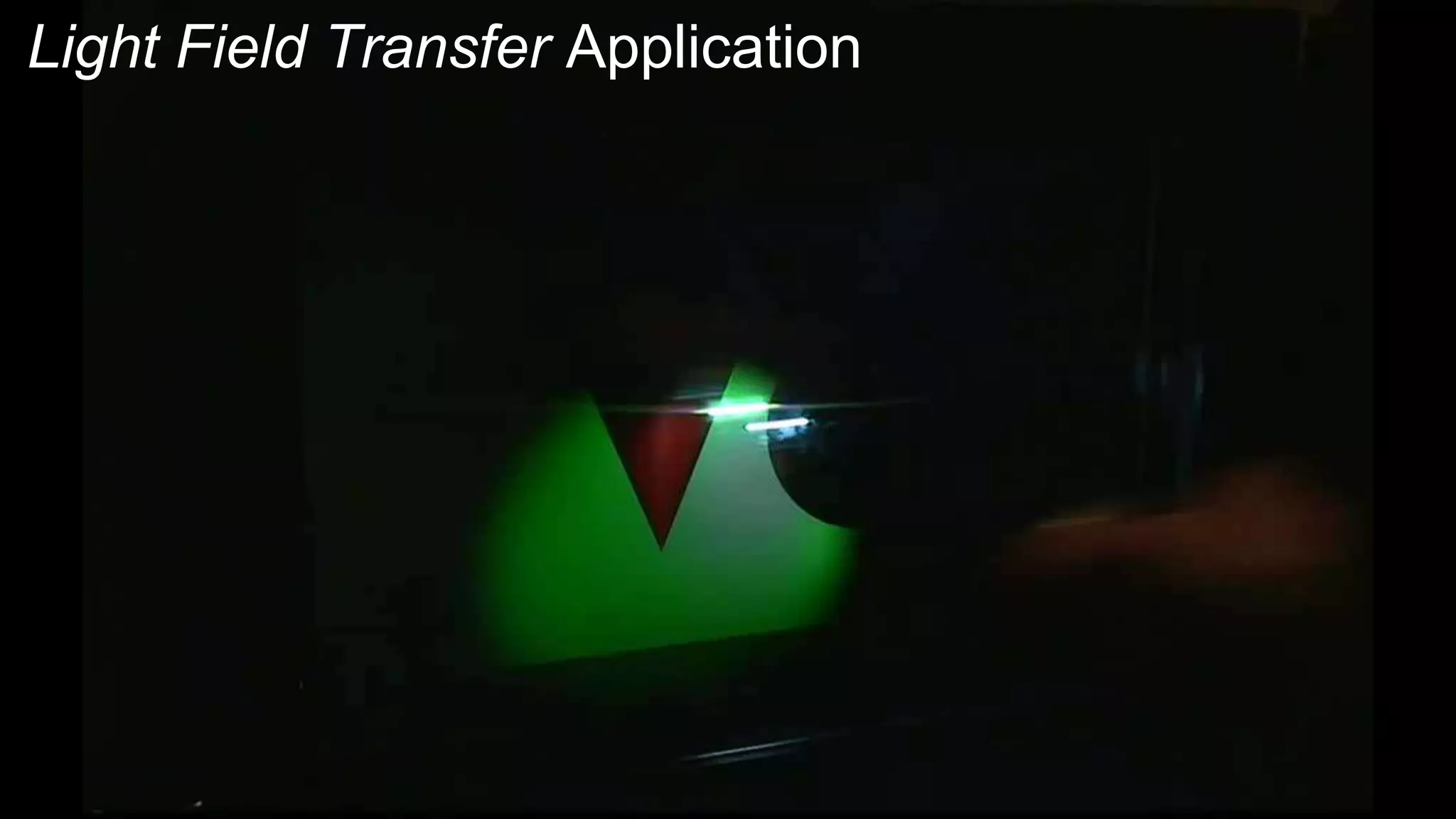
Light Field Transfer Application
MIT media lab   camera culture                                    EyeNetra.com

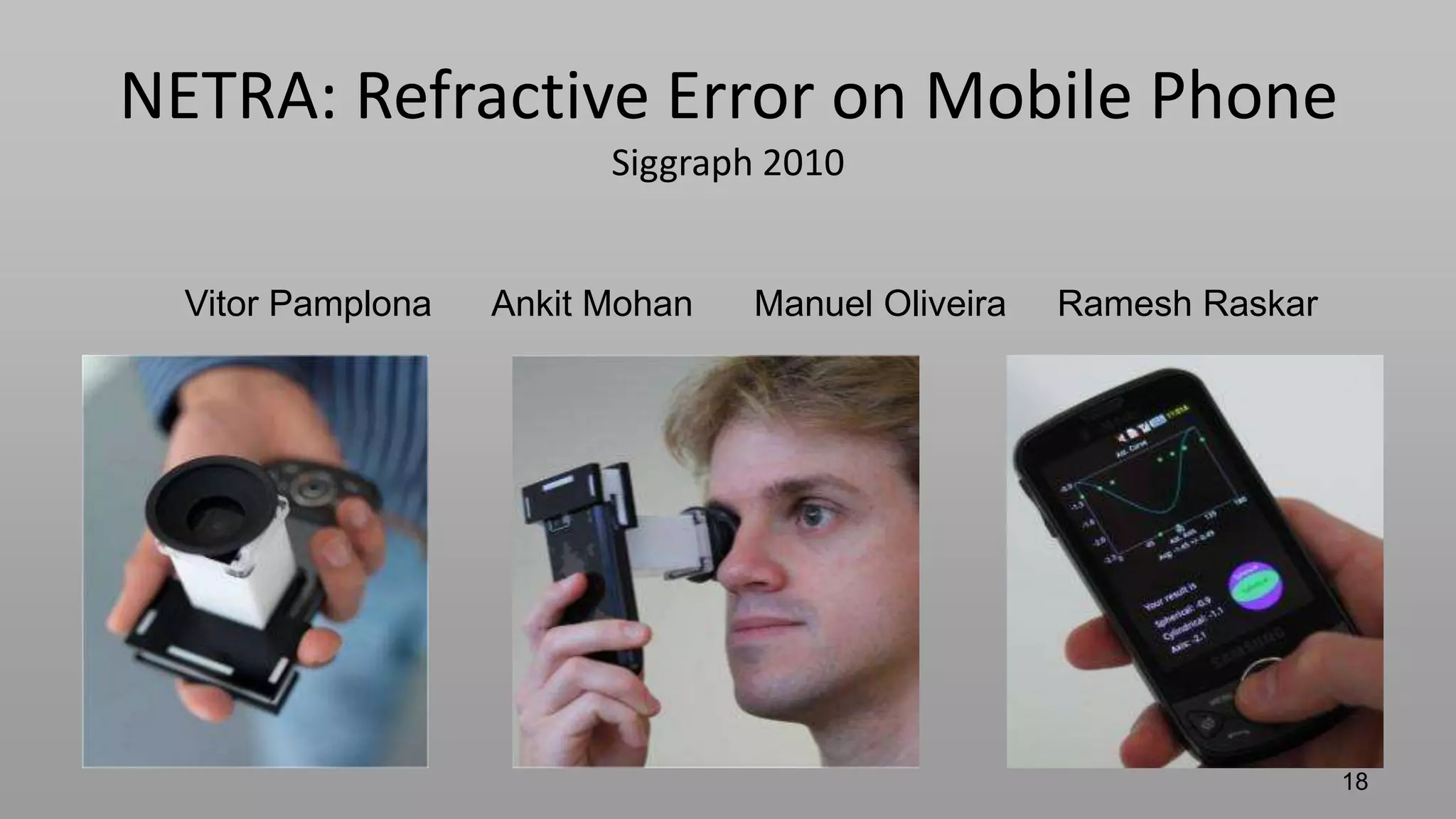
     NETRA: Refractive Error on Mobile Phone
                                 Siggraph 2010


         Vitor Pamplona    Ankit Mohan   Manuel Oliveira   Ramesh Raskar


                                                                           18
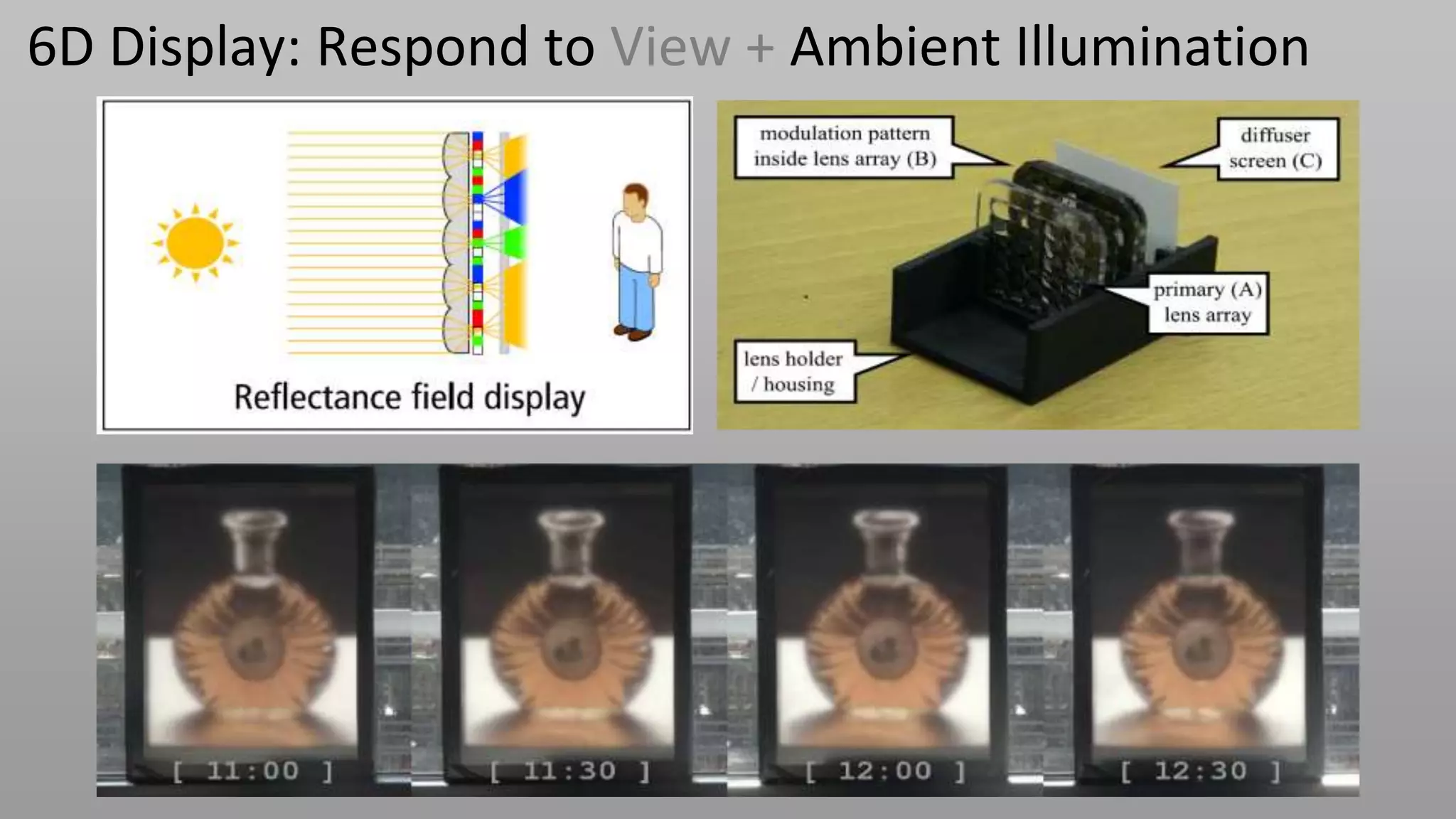
6D Display: Respond to View + Ambient Illumination
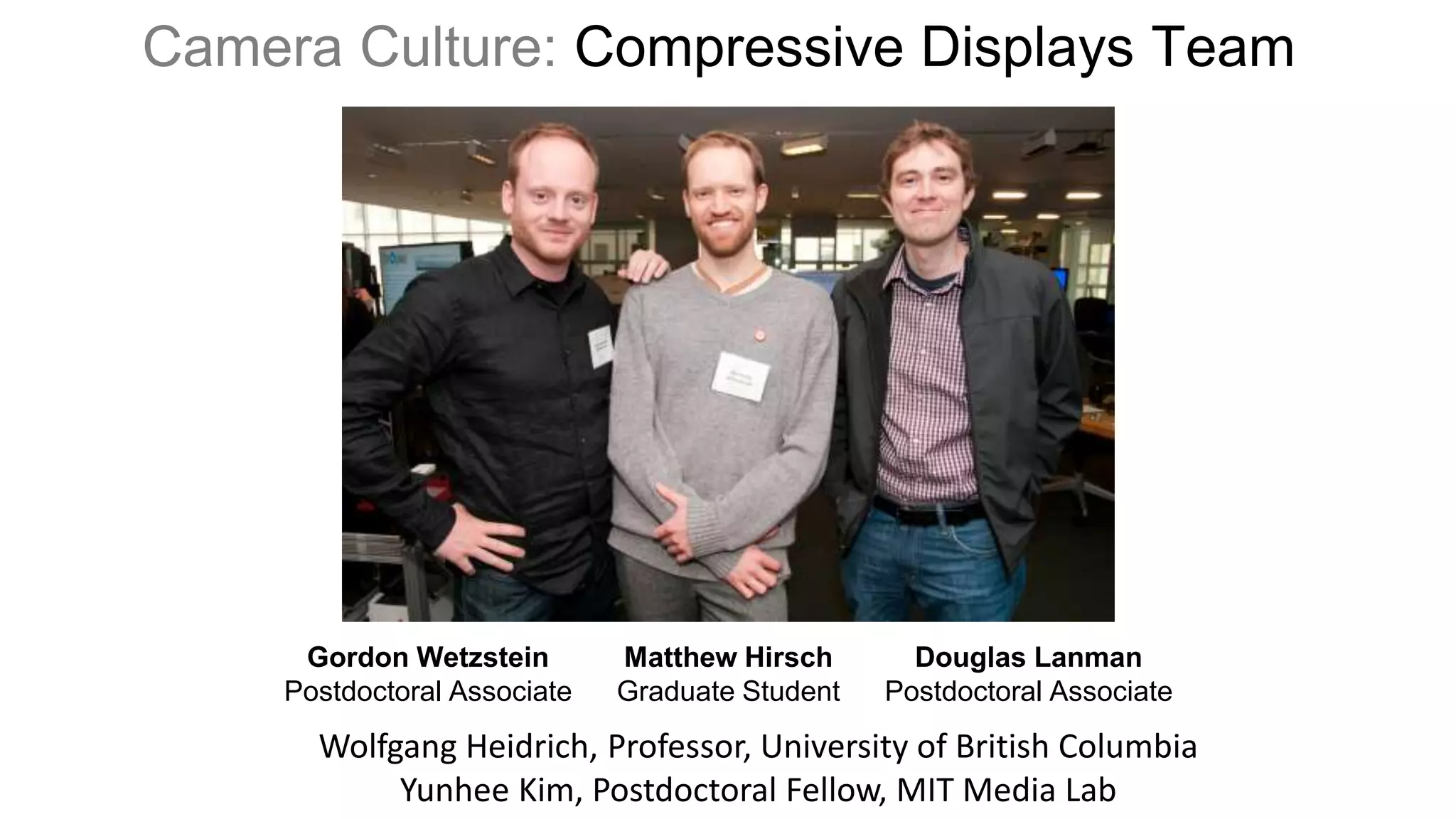
Camera Culture: Compressive Displays Team


      Gordon Wetzstein        Matthew Hirsch       Douglas Lanman
     Postdoctoral Associate   Graduate Student   Postdoctoral Associate
       Wolfgang Heidrich, Professor, University of British Columbia
            Yunhee Kim, Postdoctoral Fellow, MIT Media Lab
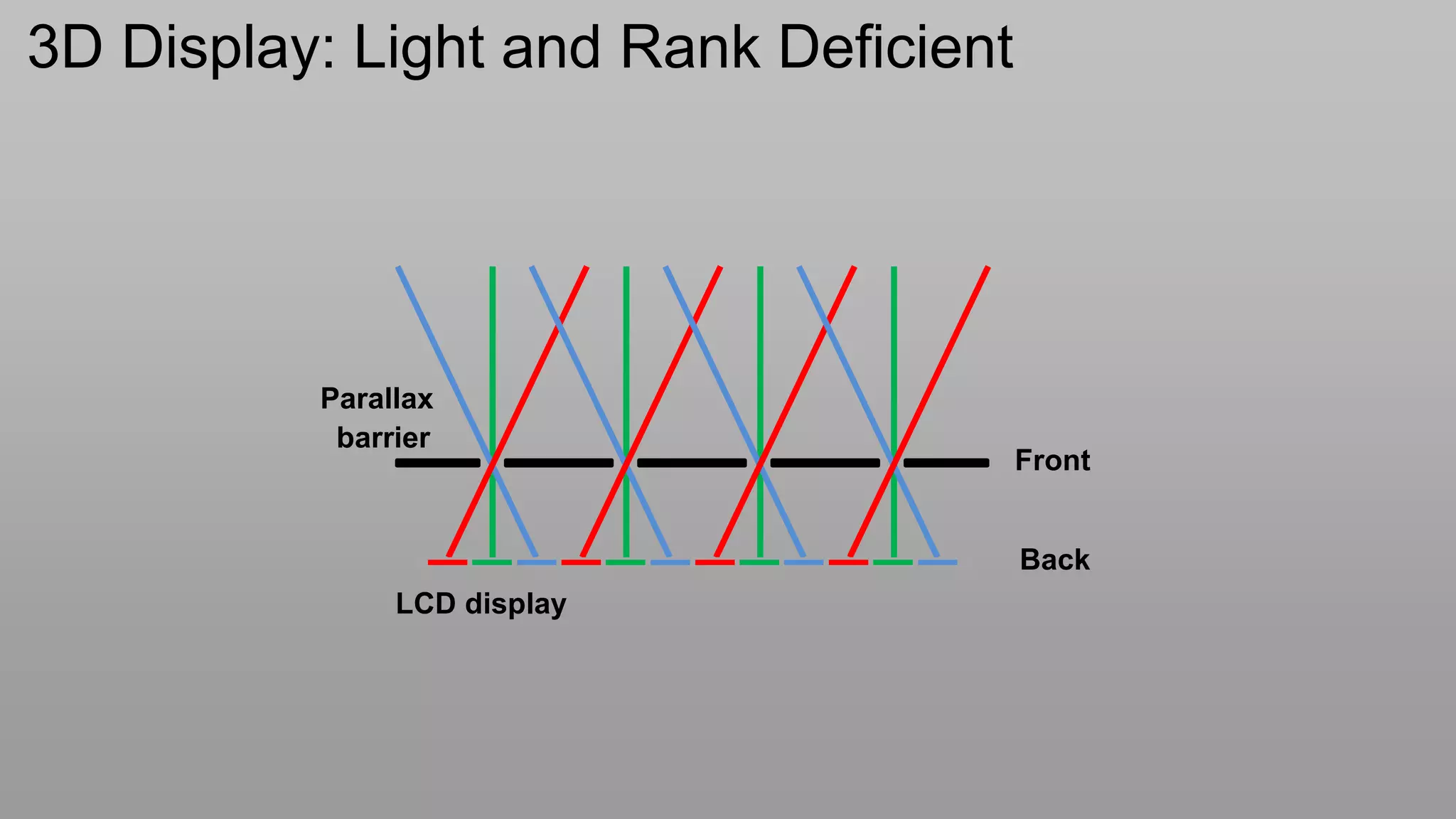
3D Display: Light and Rank Deficient


          Parallax
           barrier
                                       Front


                                       Back
               LCD display
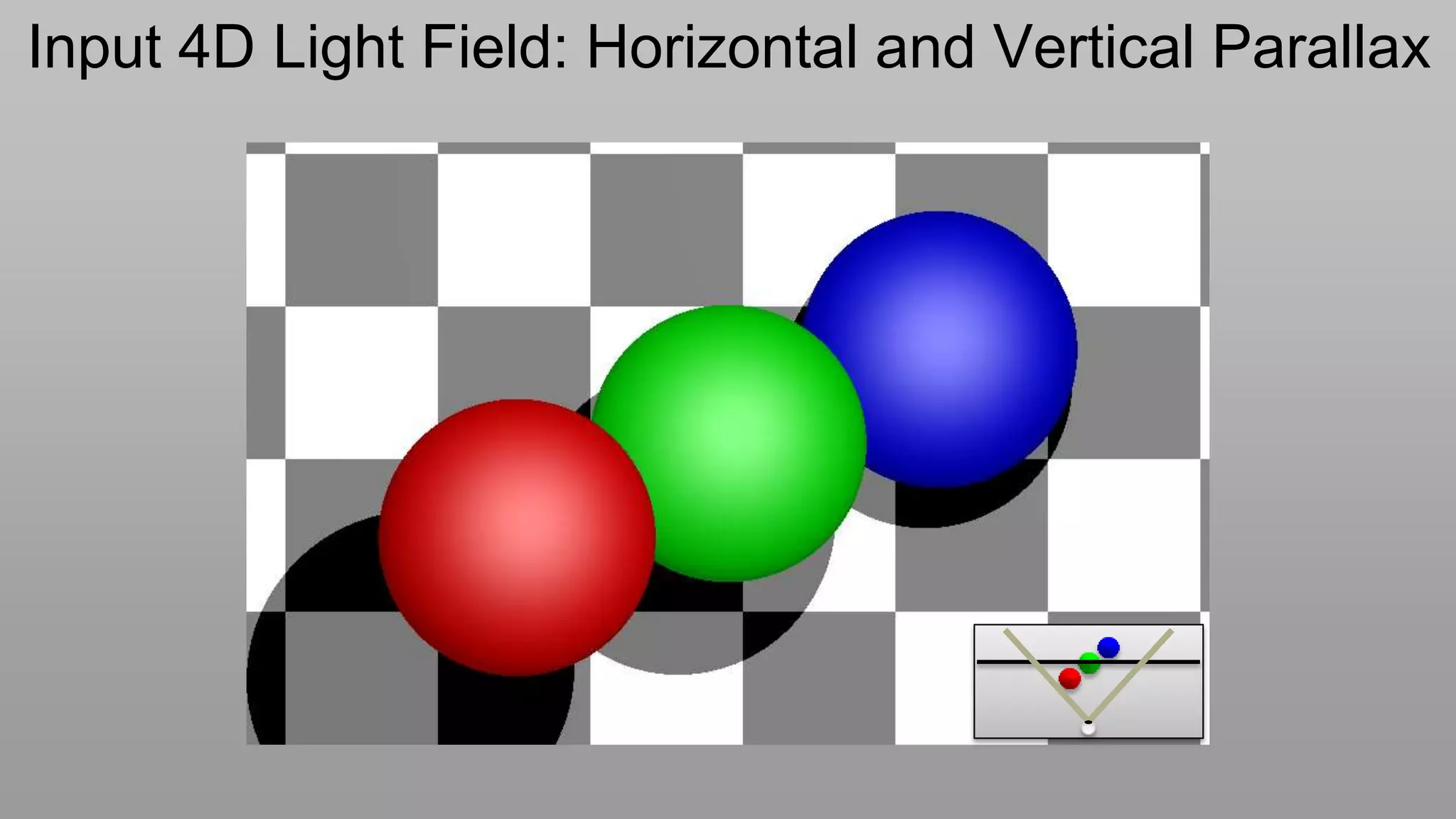
Input 4D Light Field: Horizontal and Vertical Parallax
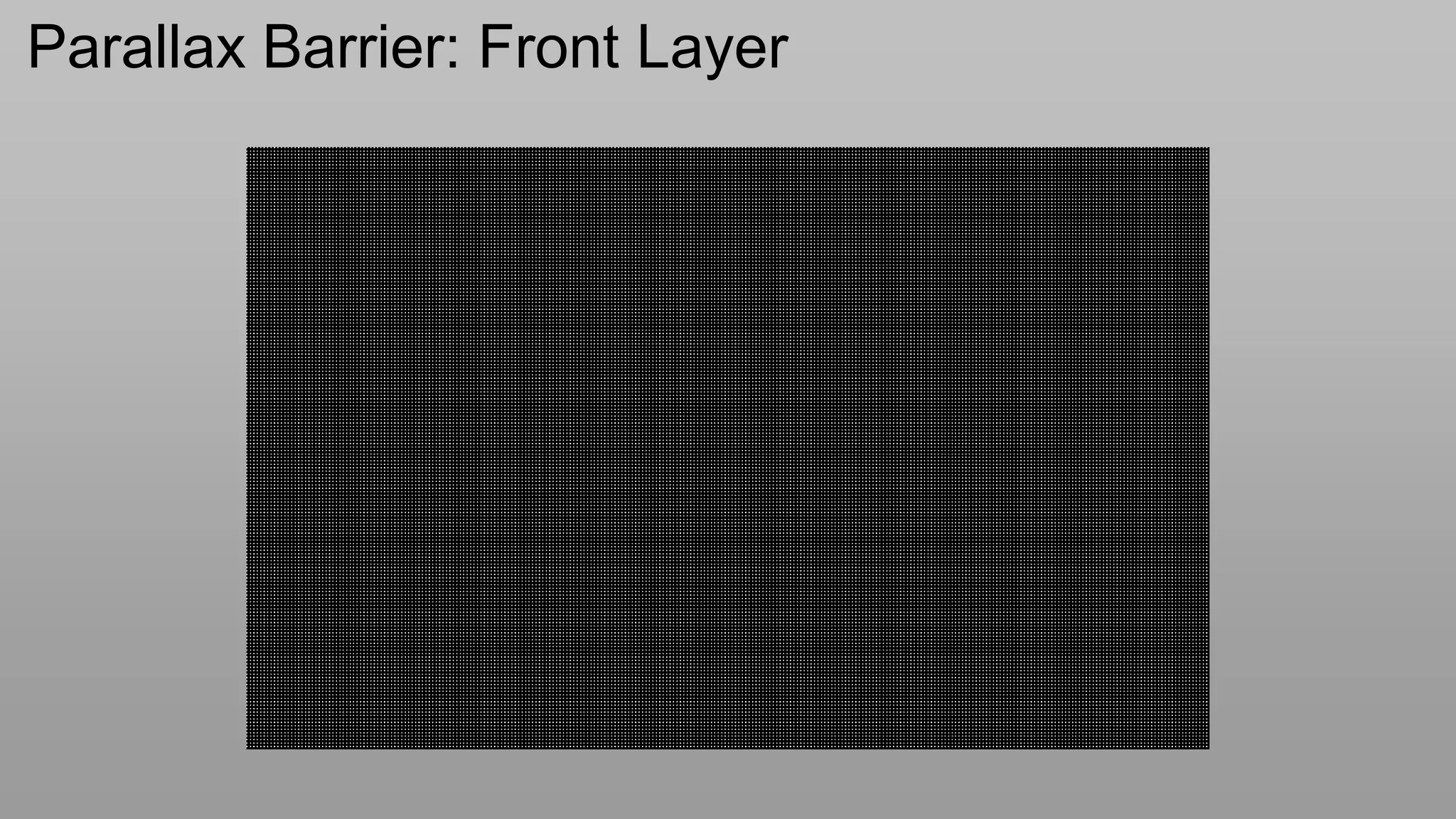
Parallax Barrier: Front Layer
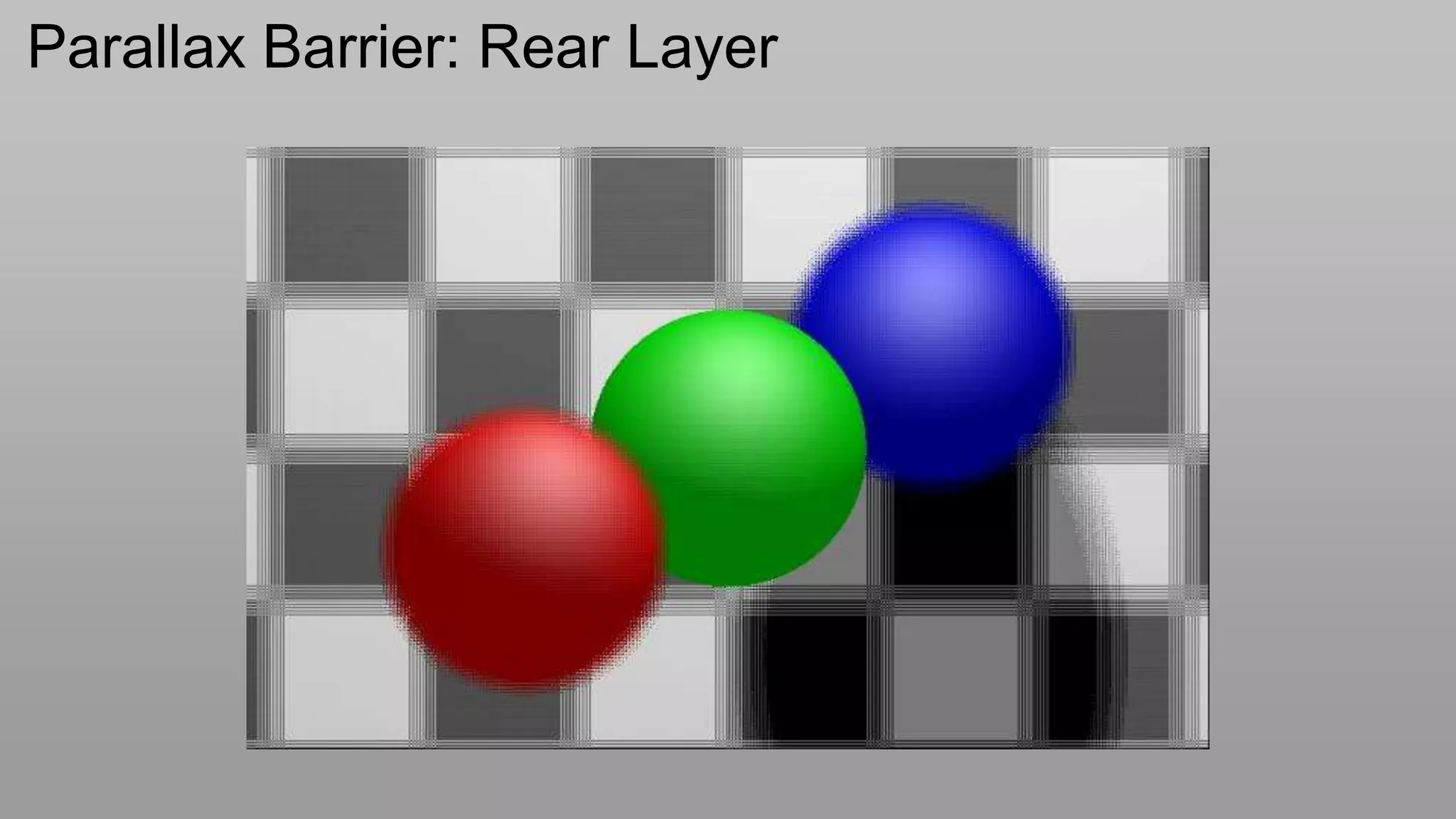
Parallax Barrier: Rear Layer
Light Field of Parallax Barriers: Rank 1

                                      k
               L[i,k]
                                  i
        k
g[k]
        i                                     `
f[i]

               light box

       L[i, k ]  f [i]  g[k ]           L f g
Dual LCD: Content-Adaptive Parallax Barriers

                                      G
           L[i,k]

       k
g[k]
                                     ~
       i                 F           L`
f[i]

           light box
                       ~
                       L  FG
Dual LCD: Content-Adaptive Parallax Barriers

                                                       G
           L[i,k]

       k
g[k]
       i                          F                    ~
f[i]                                                   L`

           light box
                           ~
                           L  FG
           Lanman, Hirsch, Kim, Raskar   Siggraph Asia 2010
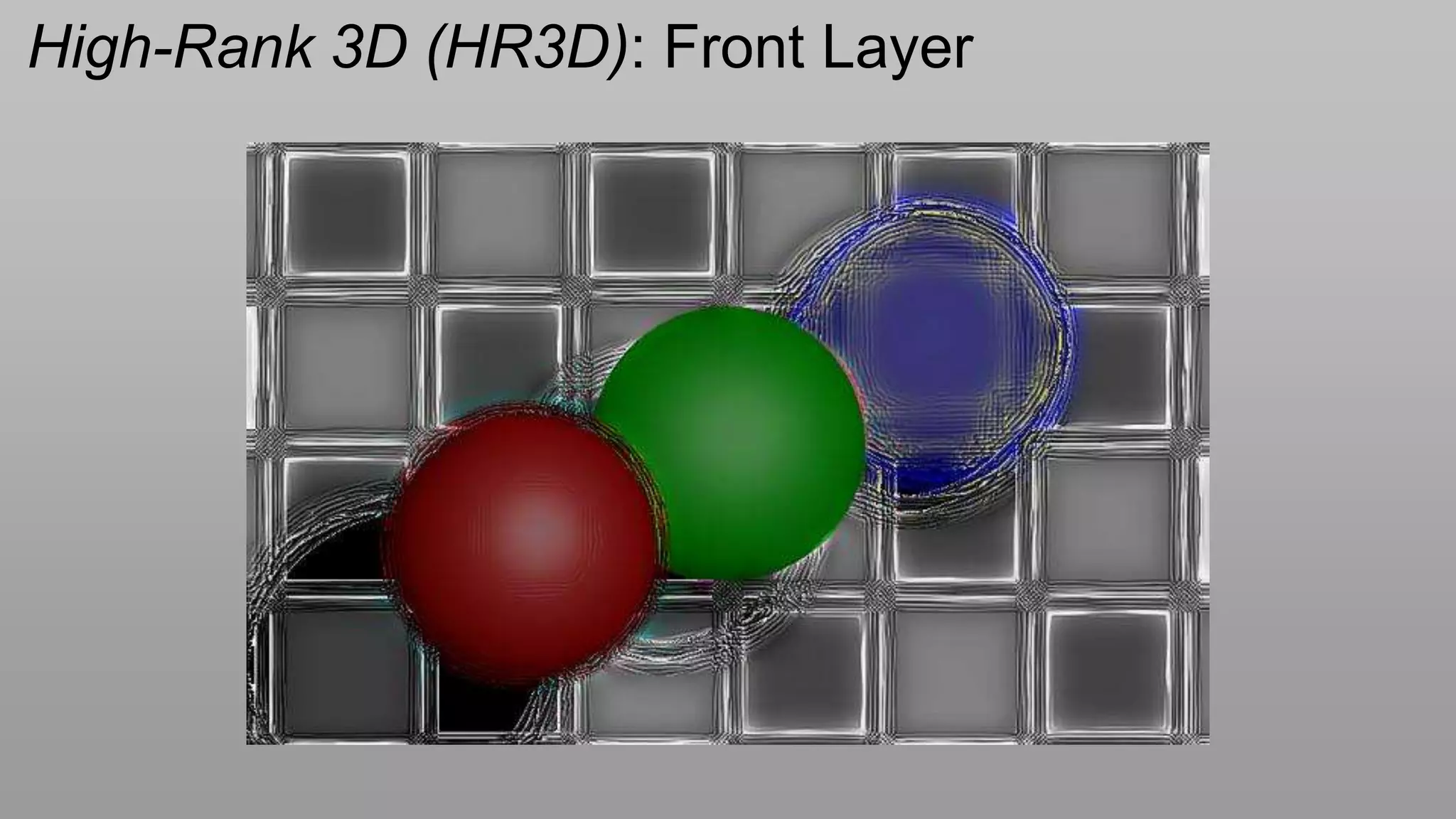
High-Rank 3D (HR3D): Front Layer
High-Rank 3D (HR3D): Rear Layer
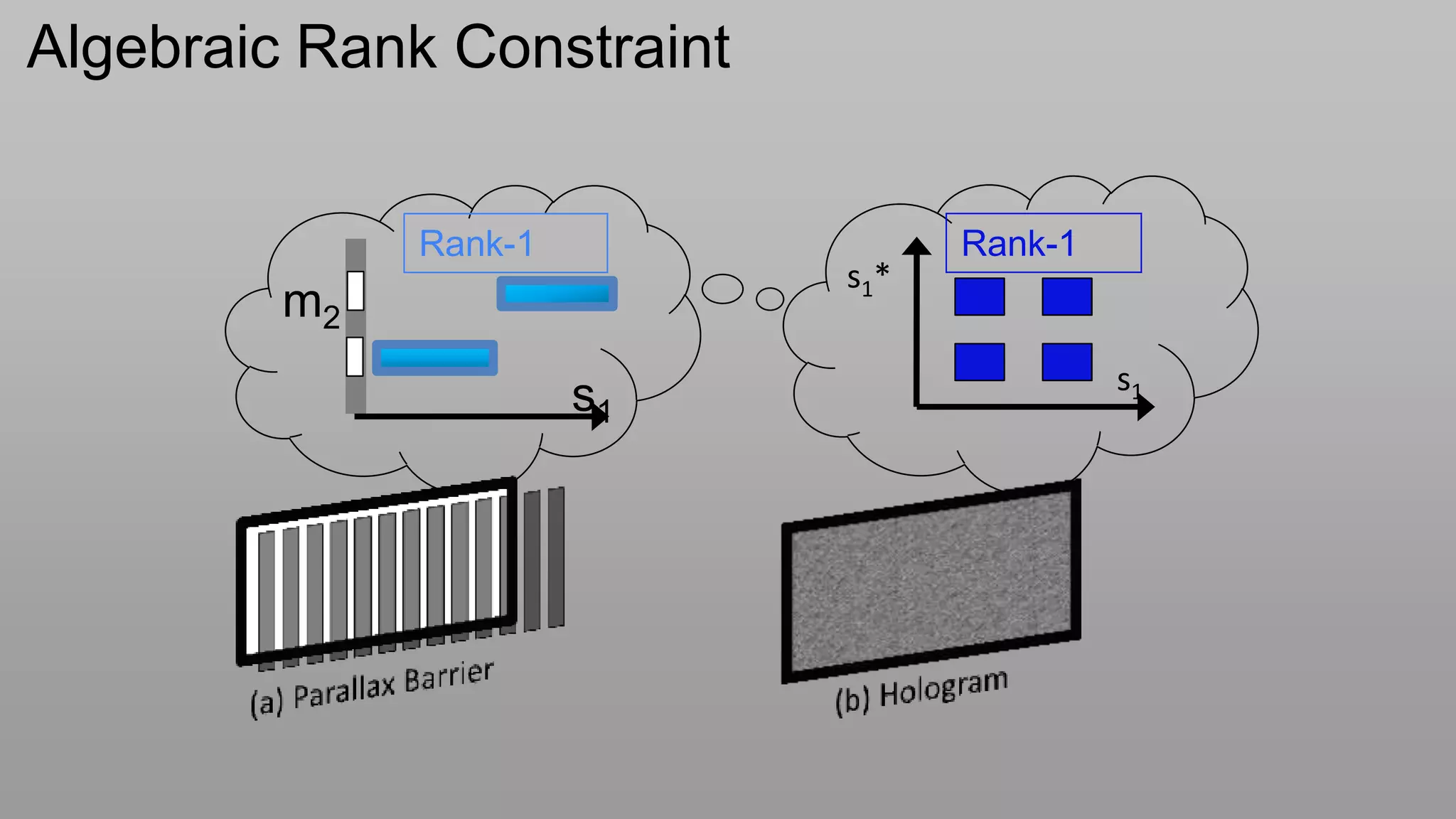
Algebraic Rank Constraint


              Rank-1              Rank-1
                            s1*
         m2
                       s1                  s1
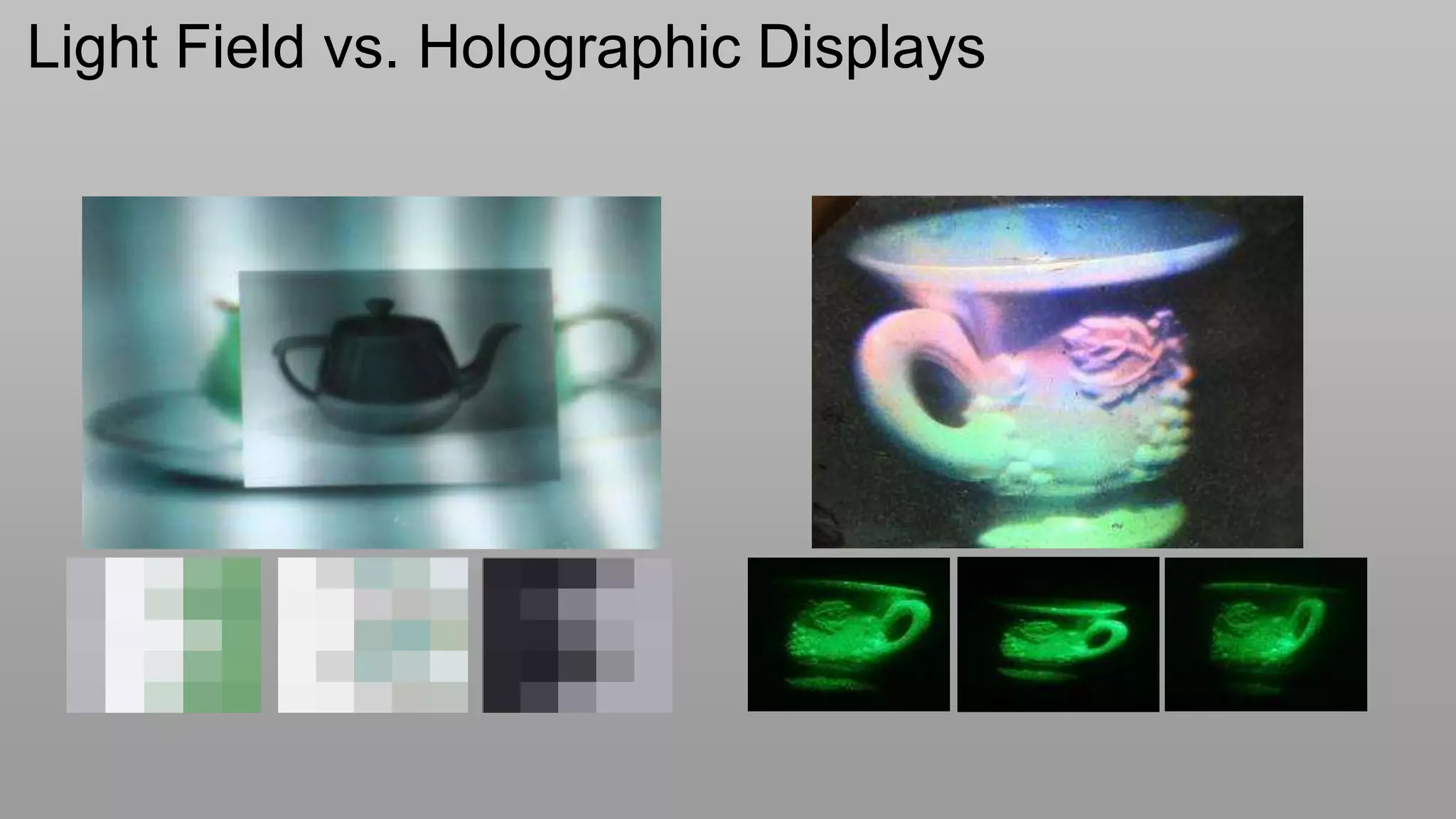
Light Field vs. Holographic Displays
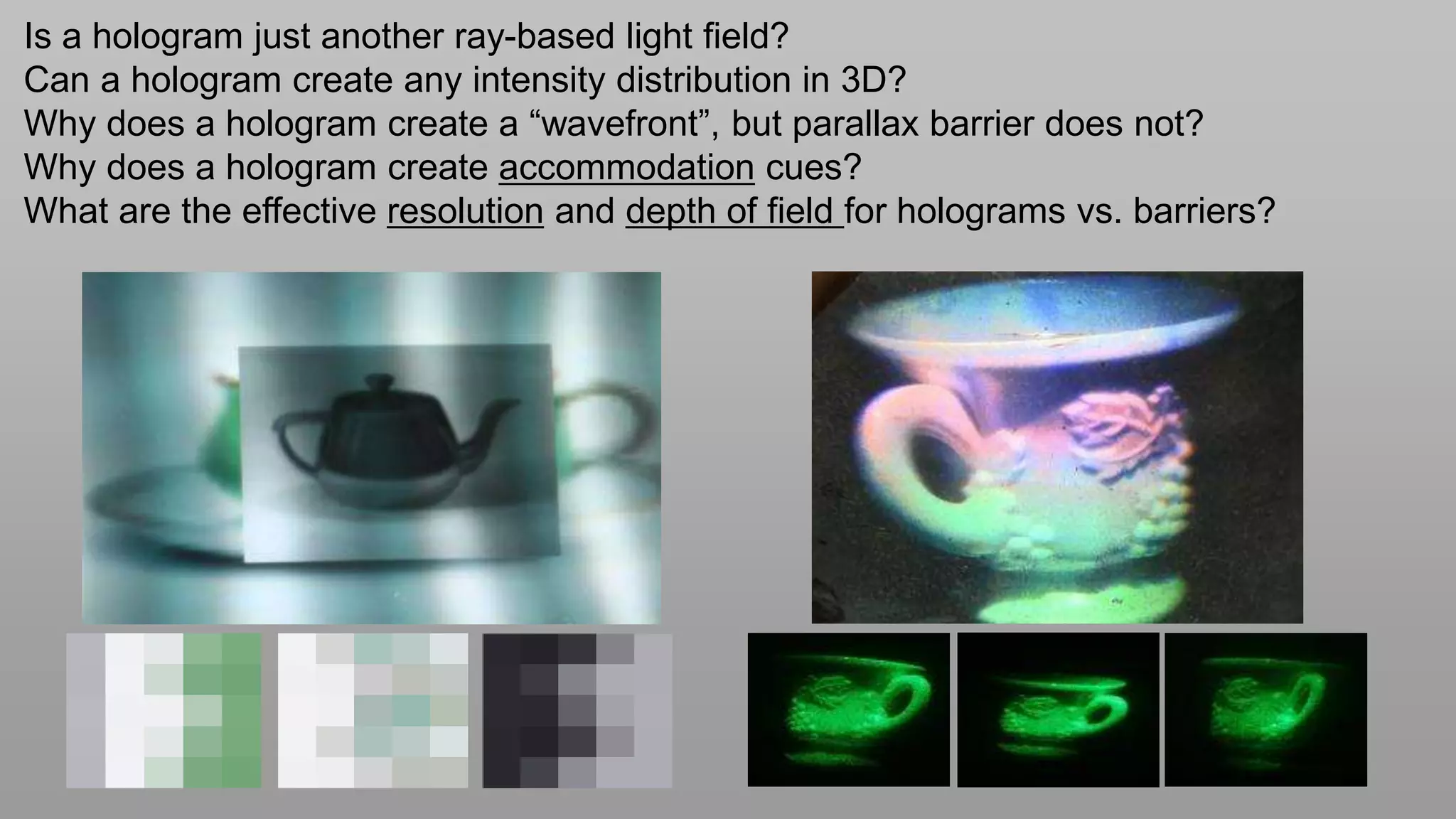
Is a hologram just another ray-based light field?
Can a hologram create any intensity distribution in 3D?
Why does a hologram create a “wavefront”, but parallax barrier does not?
Why does a hologram create accommodation cues?
What are the effective resolution and depth of field for holograms vs. barriers?
Parallax Barrier: Np=103 pix.               Hologram: NH=105 pix.
                 ϕP∝w/d                                            ϕH∝λ/tH
θp=10 pix                                θH =1000 pix


                                          Fourier Patch
   w


                  Horstmeyer, Oh, Cuypers, Barbastathis, Raskar, 2009
Augmented Light Field
                     wave optics based
                     rigorous but cumbersome
                     Wigner
                                                                            WDF
                     Distribution
                     Function                               Augmented LF
       Traditional                                       Traditional
       Light Field                                       Light Field

ray optics based
                                                    Interference & Diffraction
simple and powerful                                 Interaction w/ optical elements

                                    Oh, Raskar, Barbastathis 2009: Augmented Light Field
  34
Glasses-free 3D Displays

  Raw: 600 Gbytes/sec
Compressive: 2 Gbyte/sec
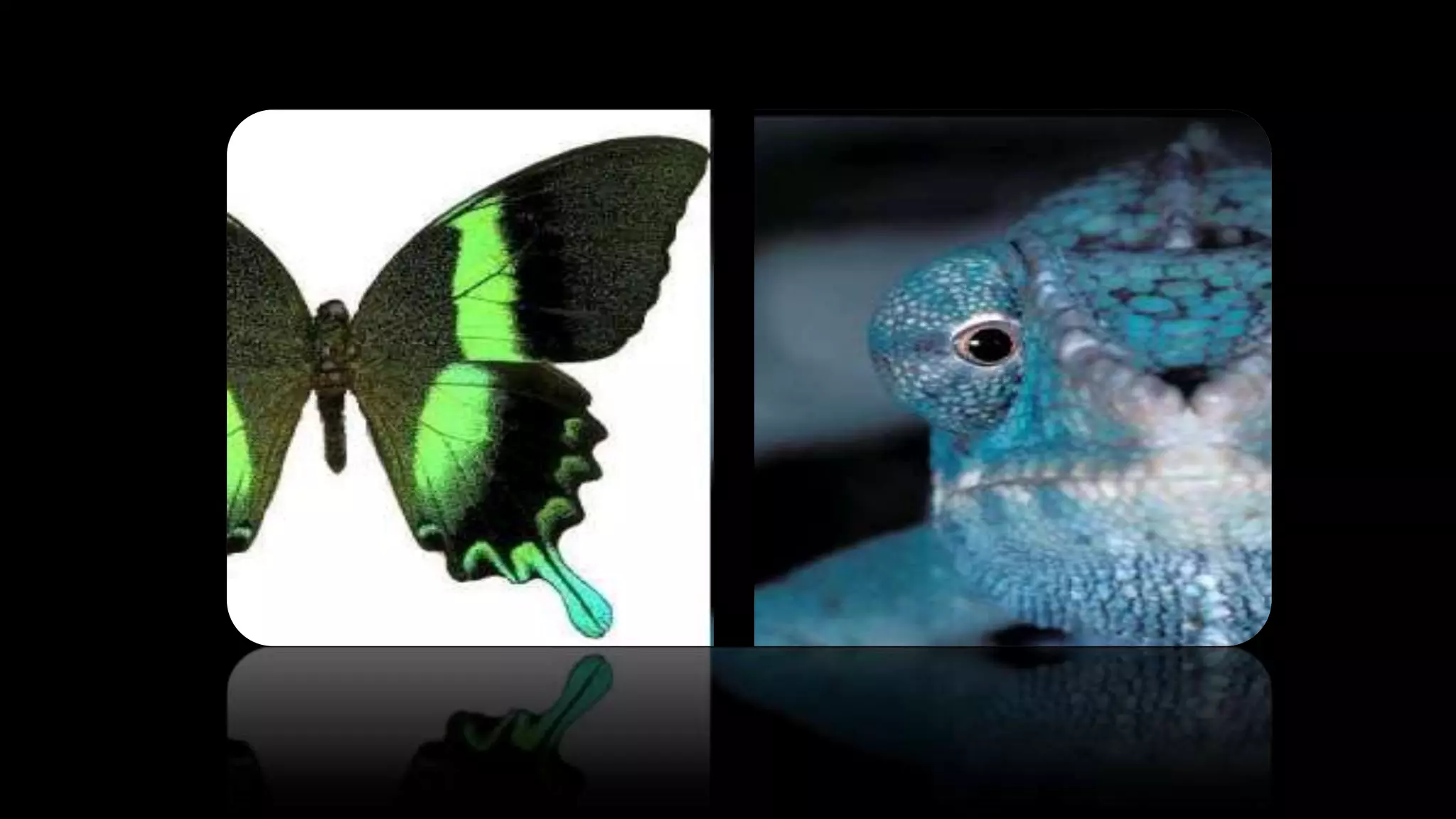
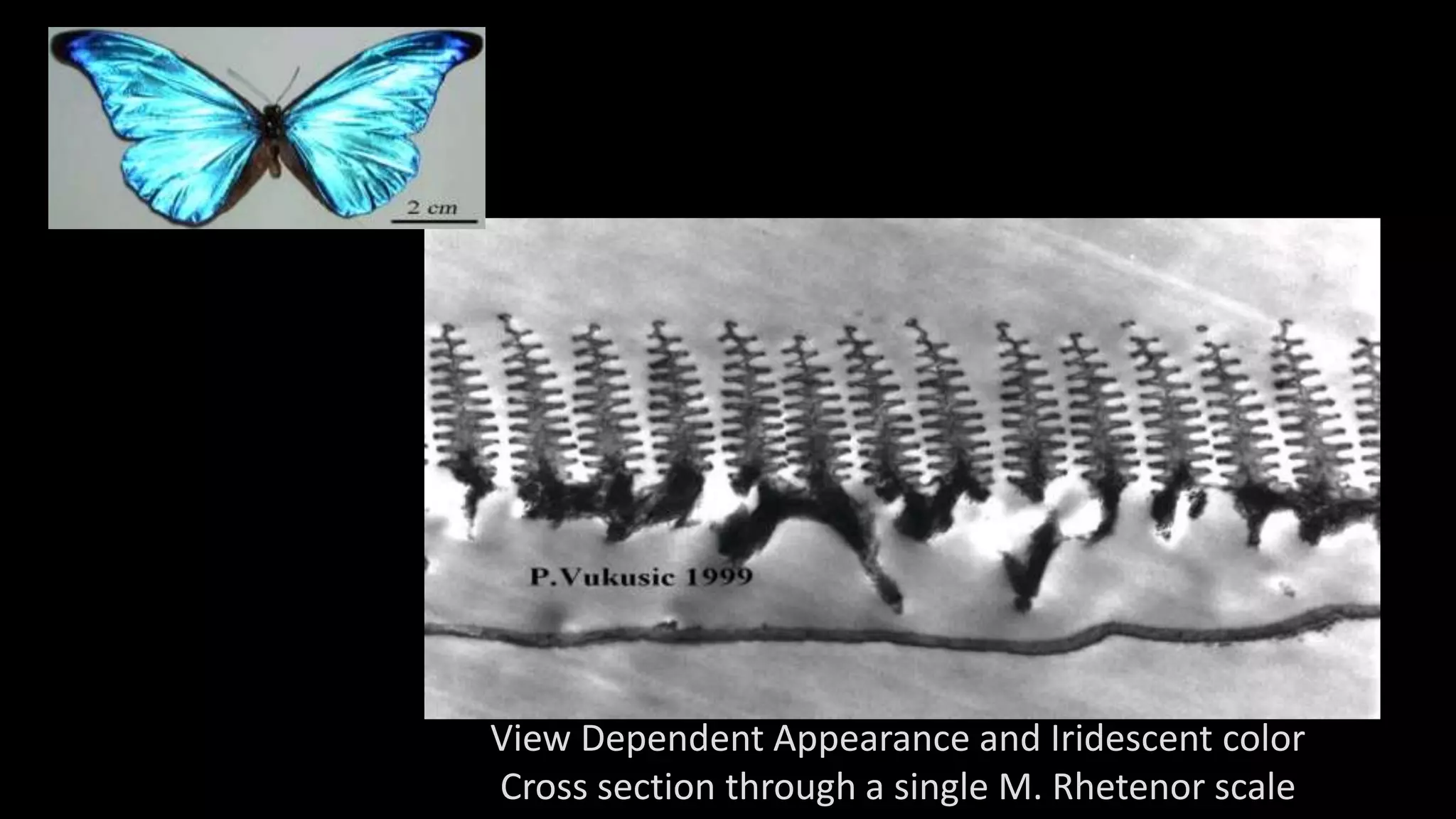
View Dependent Appearance and Iridescent color
Cross section through a single M. Rhetenor scale
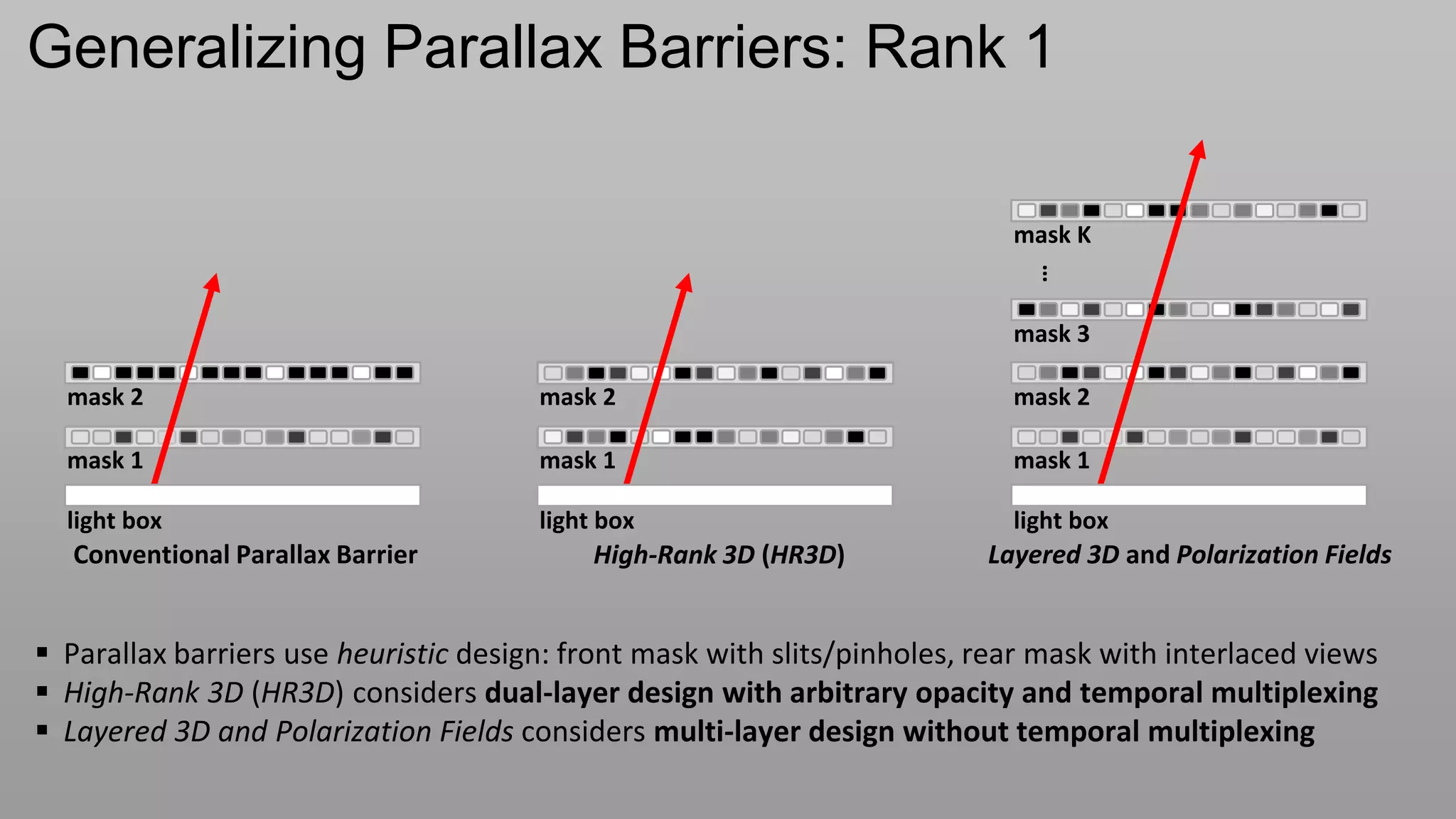
Generalizing Parallax Barriers: Rank 1

                                                                            mask K


                                                                              …
                                                                            mask 3

  mask 2                               mask 2                               mask 2

  mask 1                               mask 1                               mask 1

  light box                            light box                            light box
   Conventional Parallax Barrier            High-Rank 3D (HR3D)           Layered 3D and Polarization Fields


 Parallax barriers use heuristic design: front mask with slits/pinholes, rear mask with interlaced views
 High-Rank 3D (HR3D) considers dual-layer design with arbitrary opacity and temporal multiplexing
 Layered 3D and Polarization Fields considers multi-layer design without temporal multiplexing
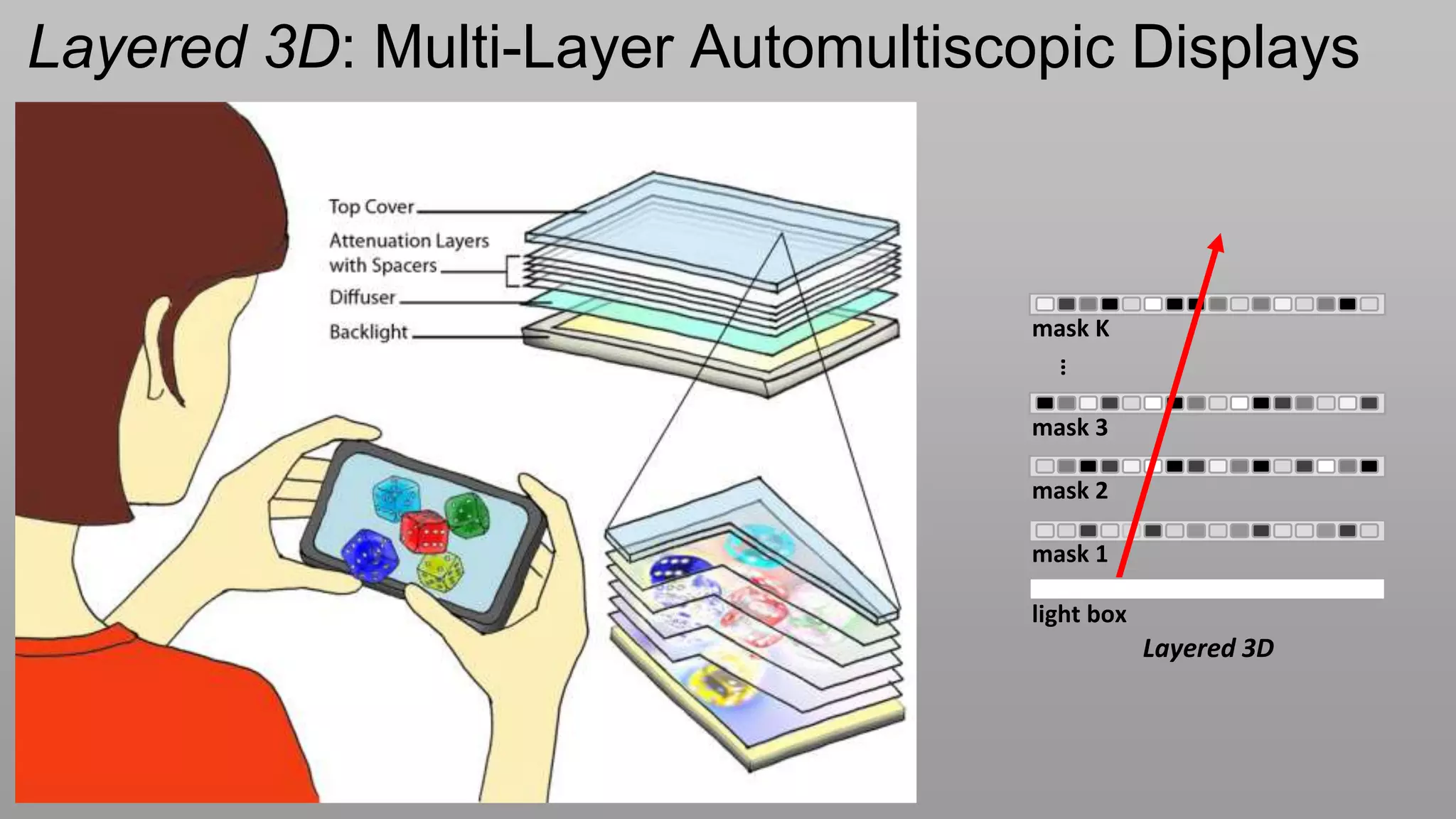
Layered 3D: Multi-Layer Automultiscopic Displays


                                    mask K


                                      …
                                    mask 3

                                    mask 2

                                    mask 1

                                    light box
                                                Layered 3D
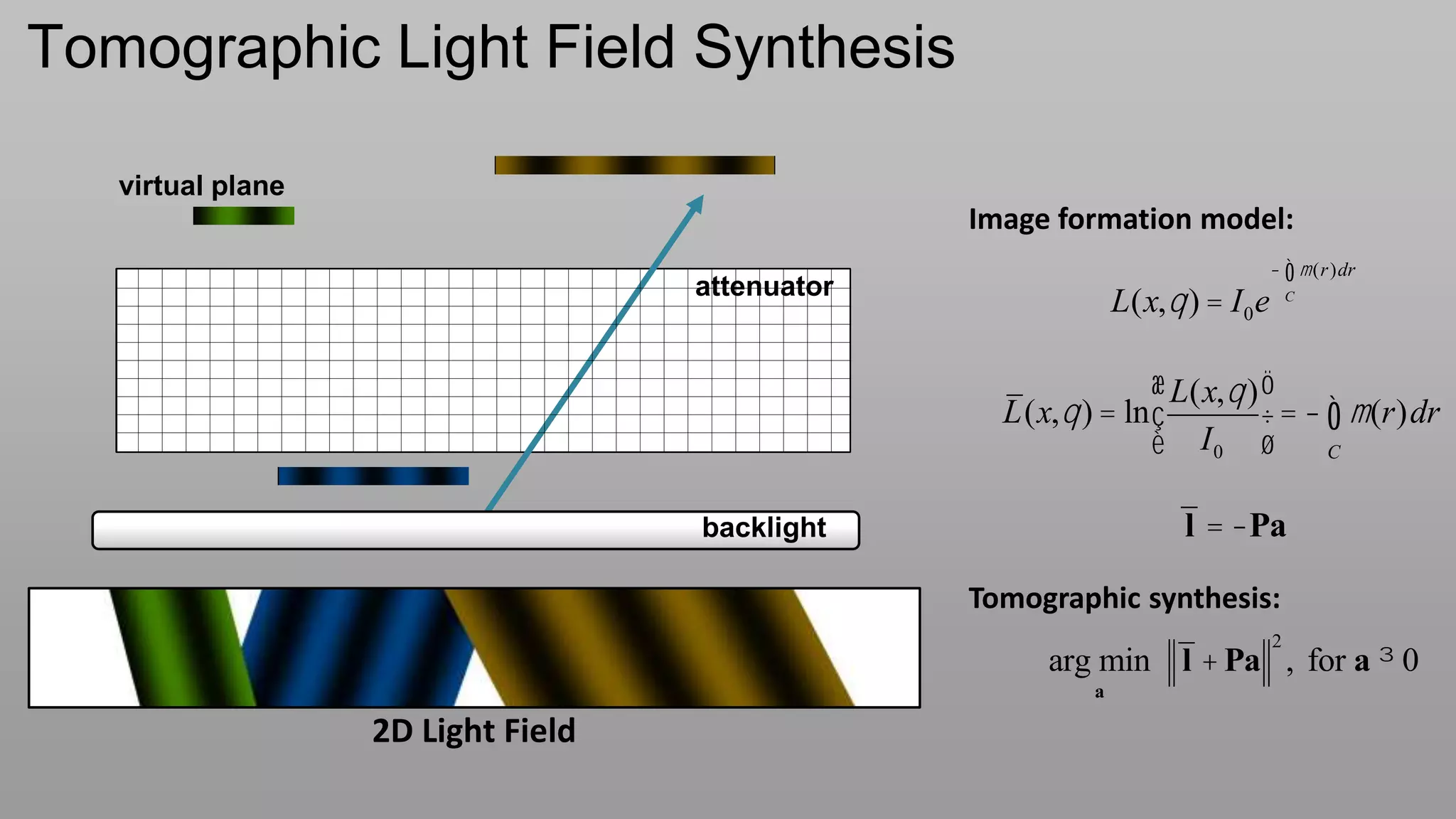
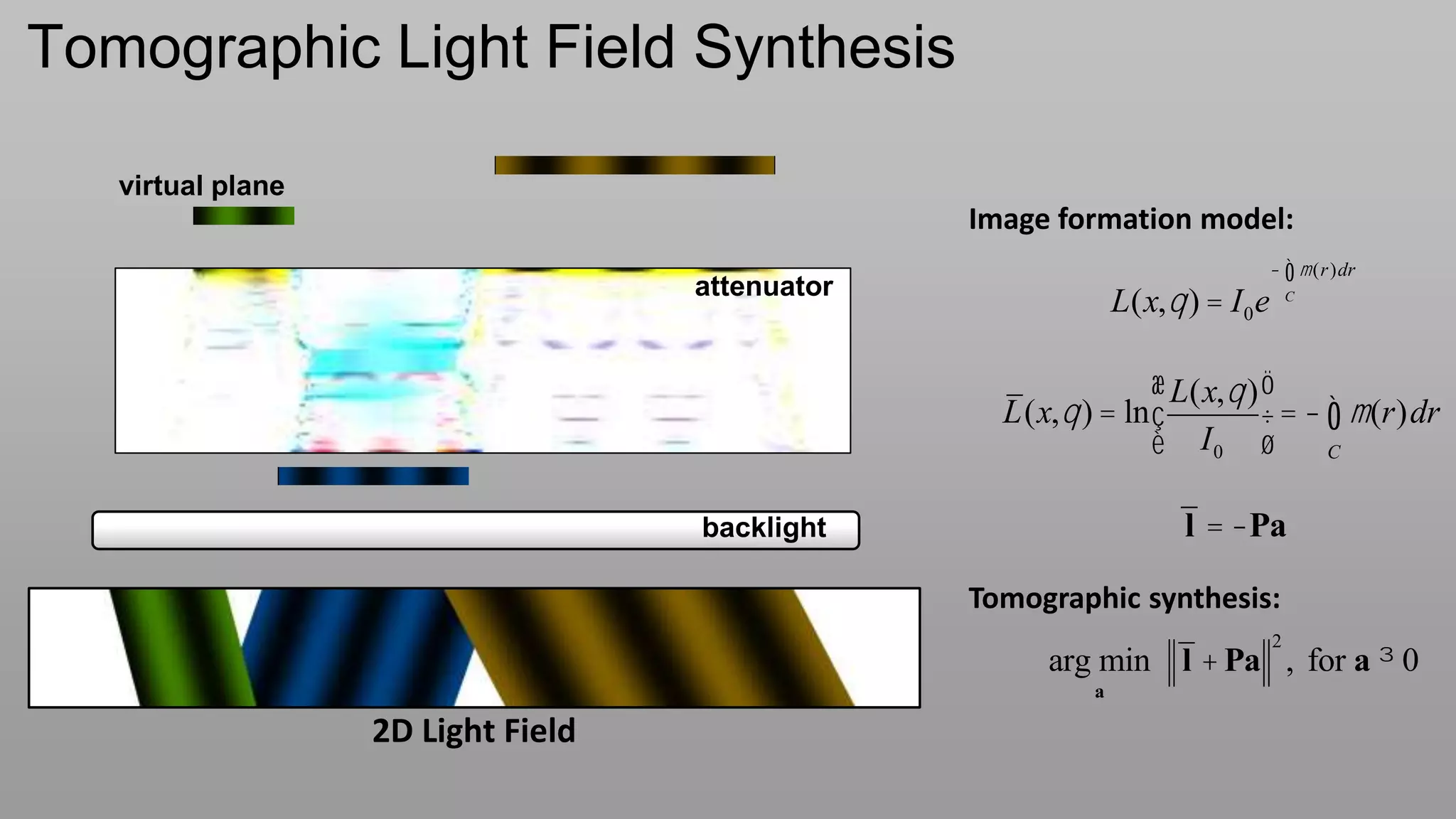
Tomographic Light Field Synthesis

   virtual plane
                                                 Image formation model:

                                    attenuator
                                                                                      ò
                                                                                  - m (r )dr
                                                               L(x, q ) = I 0 e       C


                                                                 æ L(x, q ) ö
                                                   L(x, q ) = ln ç          ÷ = - ò m (r)dr
                                                                 è   I0 ø         C


                                    backlight                         l = -Pa

                                                 Tomographic synthesis:
                                                                                  2
                                                       arg min l + Pa , for a ³ 0
                                                           a

                   2D Light Field
Tomographic Light Field Synthesis

   virtual plane
                                                 Image formation model:

                                    attenuator
                                                                                      ò
                                                                                  - m (r )dr
                                                               L(x, q ) = I 0 e       C


                                                                 æ L(x, q ) ö
                                                   L(x, q ) = ln ç          ÷ = - ò m (r)dr
                                                                 è   I0 ø         C


                                    backlight                         l = -Pa

                                                 Tomographic synthesis:
                                                                                  2
                                                       arg min l + Pa , for a ³ 0
                                                           a

                   2D Light Field
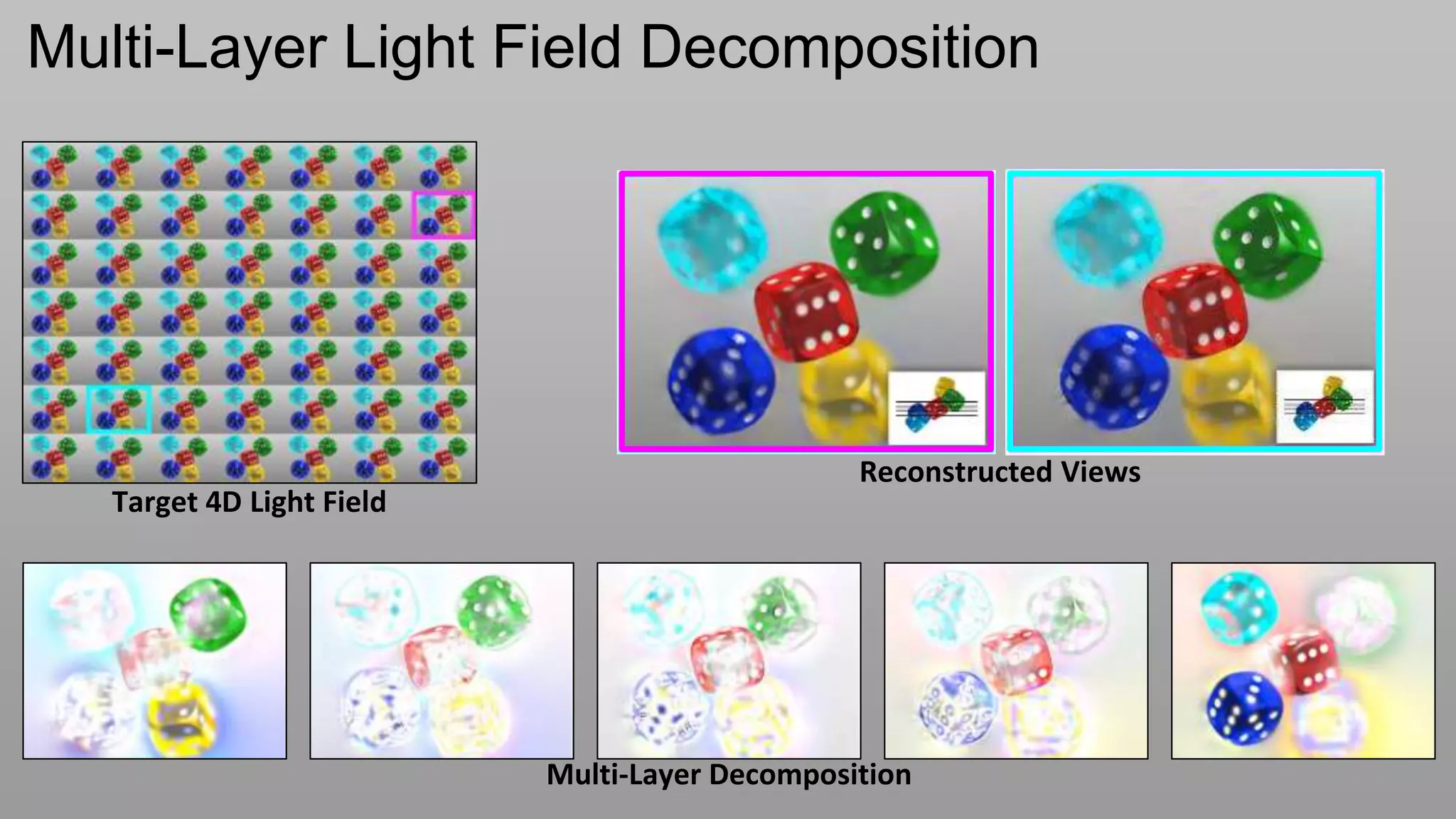
Multi-Layer Light Field Decomposition


                                                Reconstructed Views
   Target 4D Light Field


                           Multi-Layer Decomposition
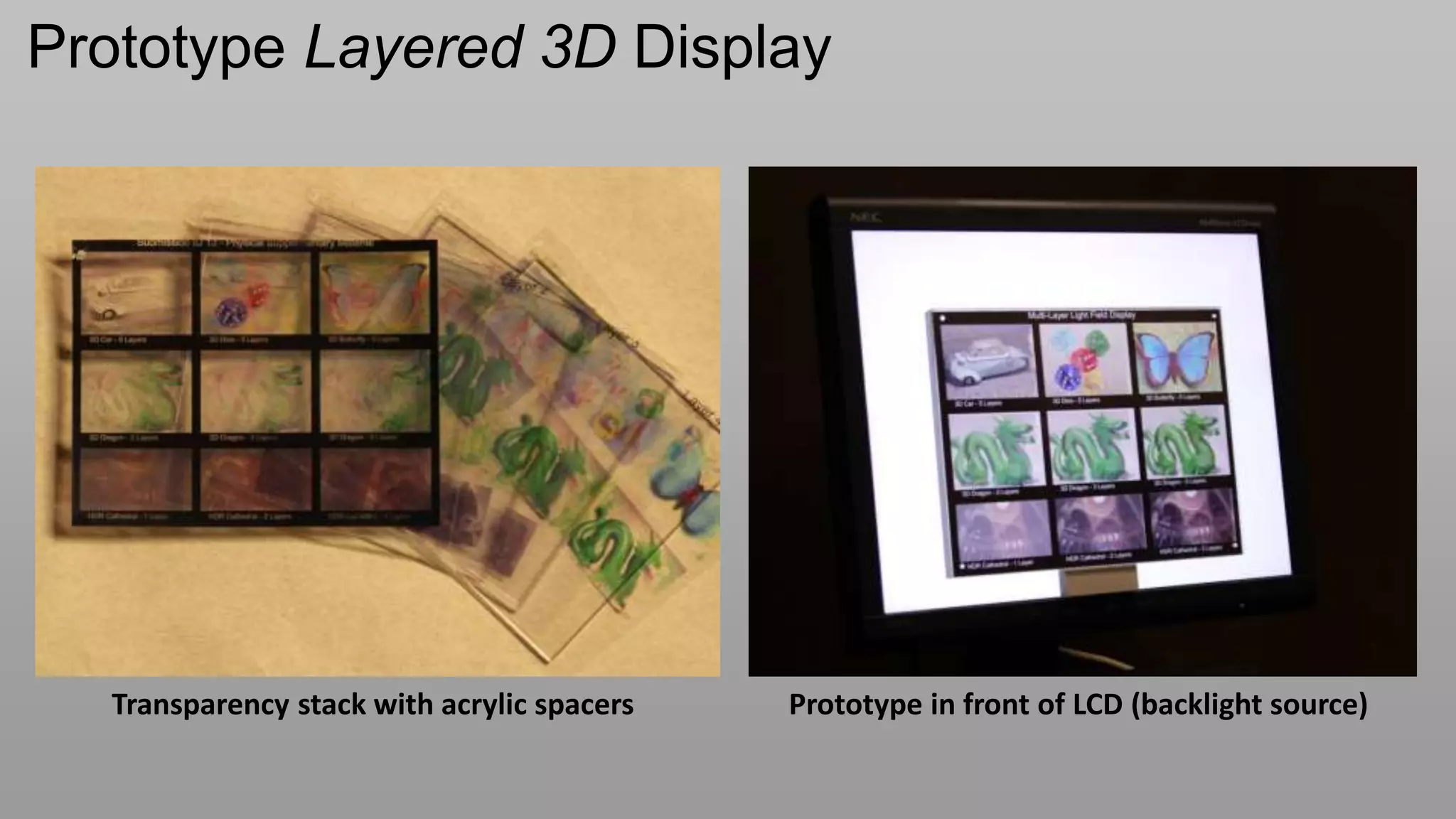
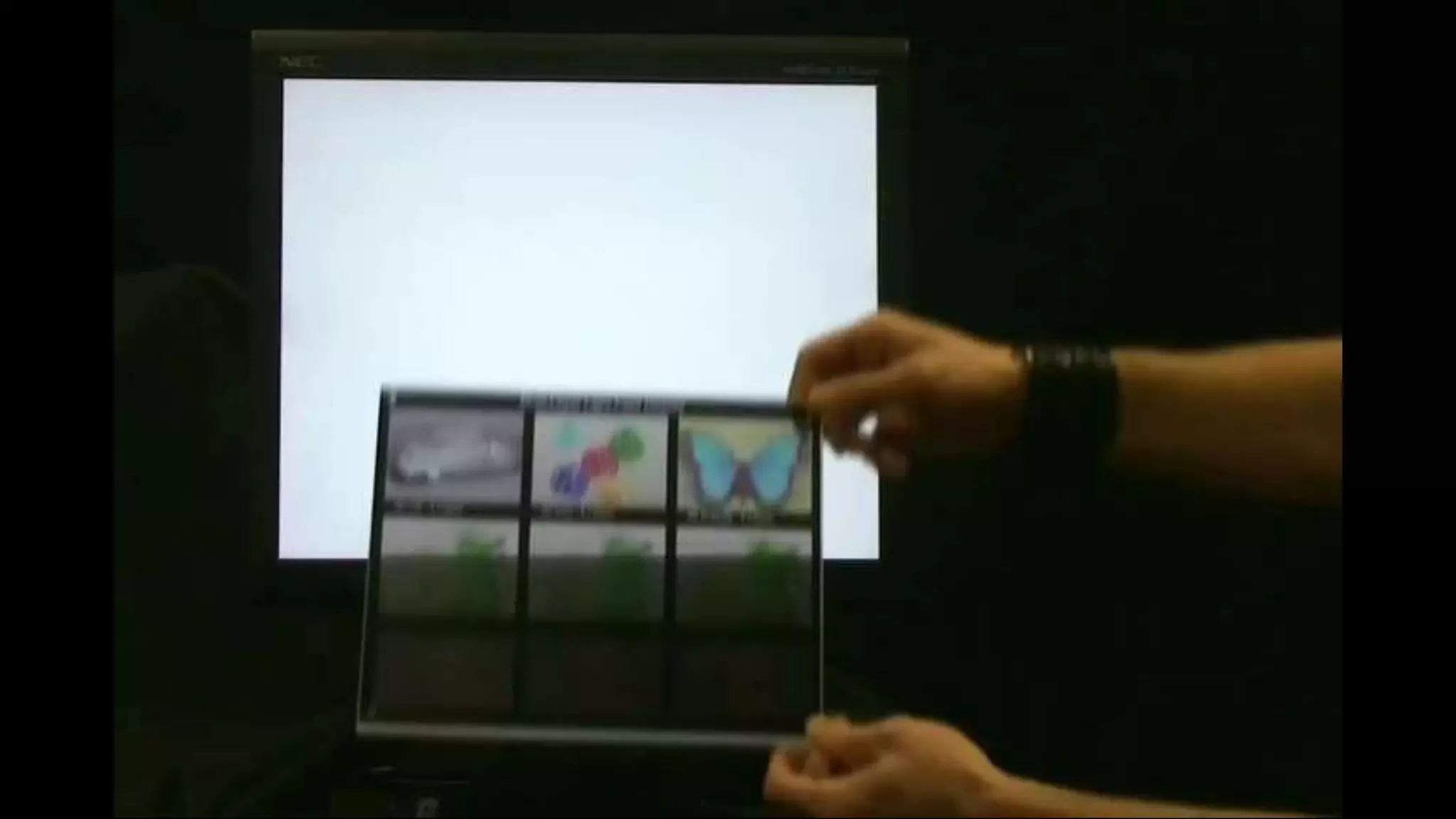
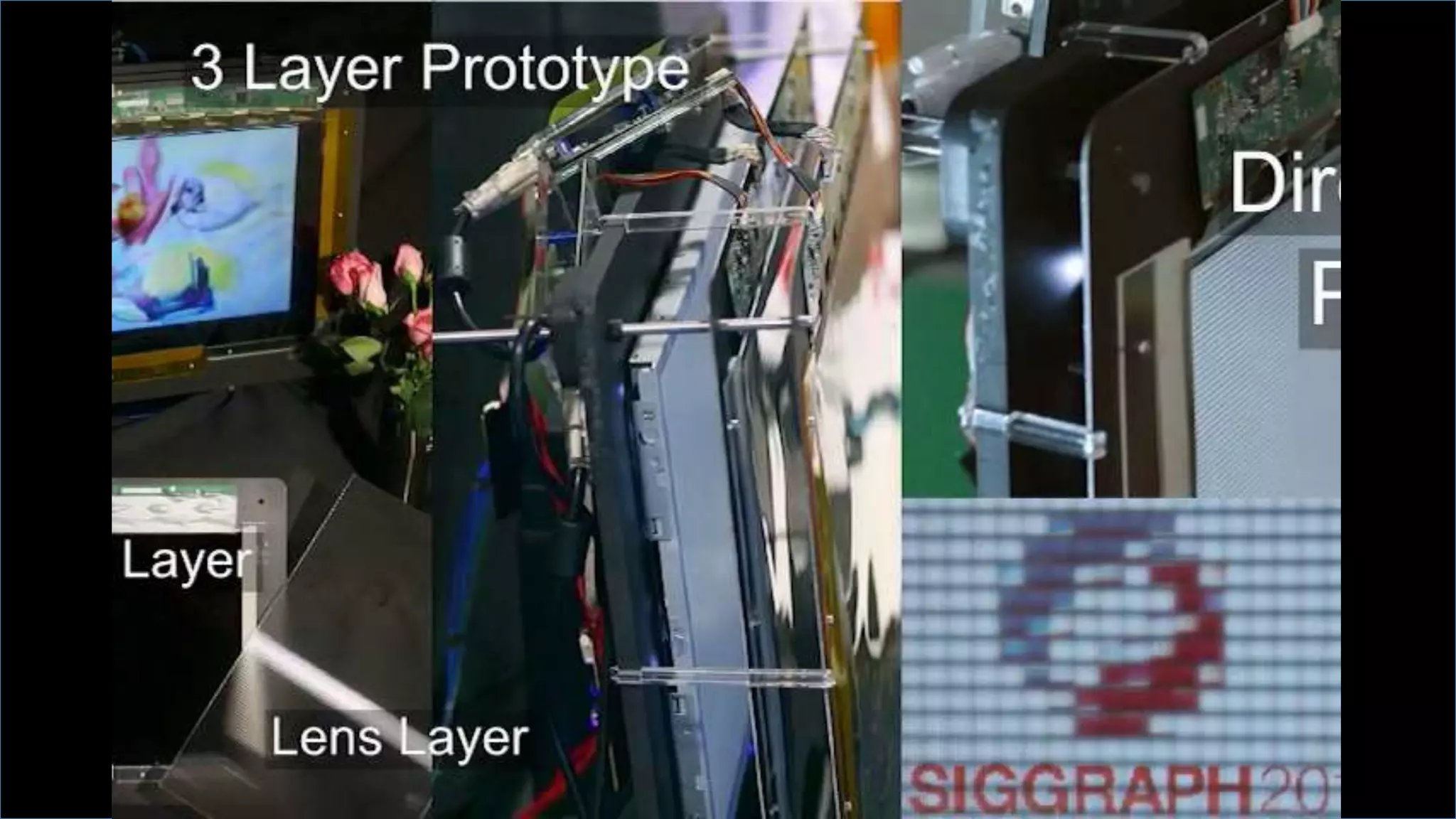
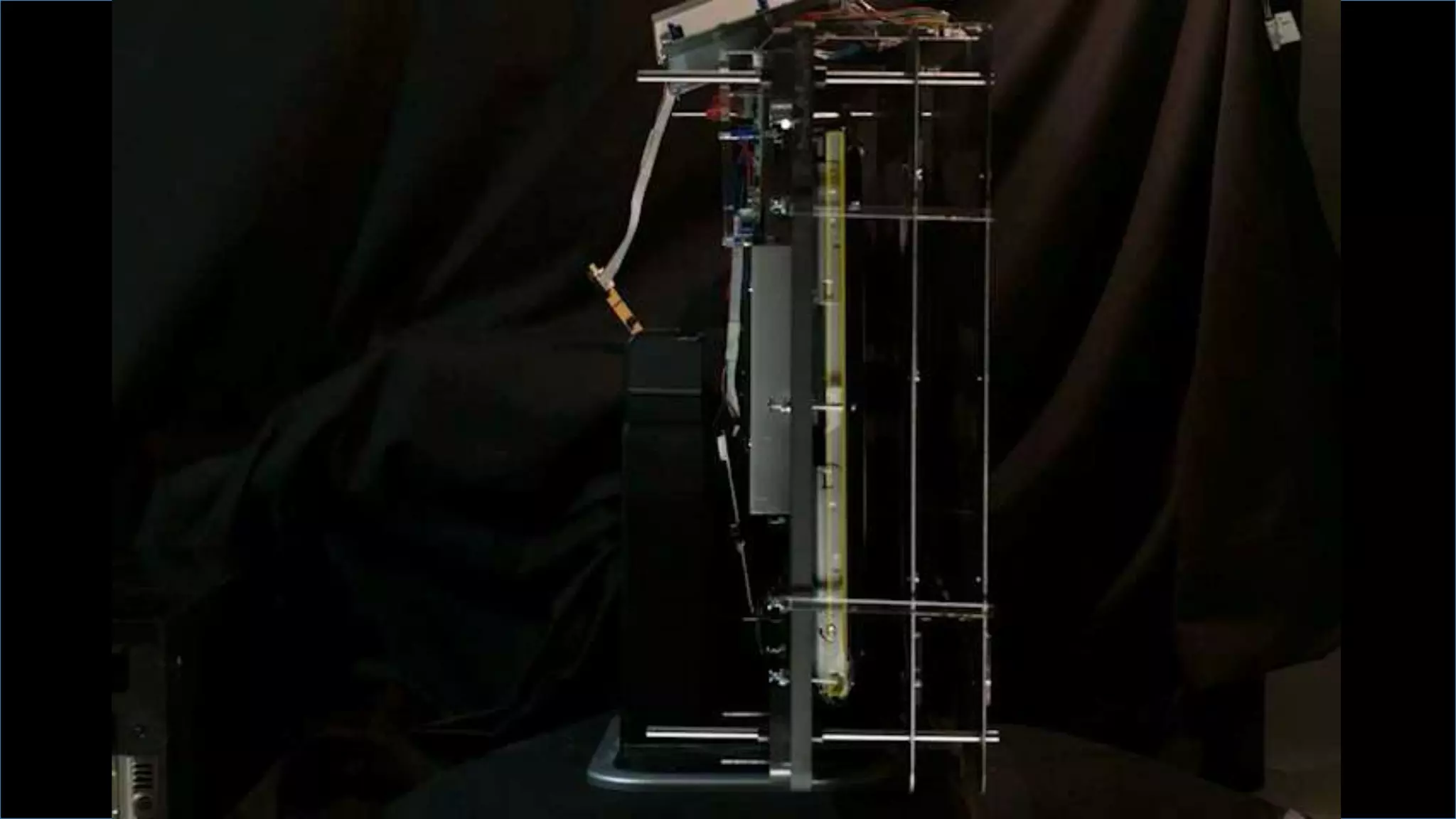
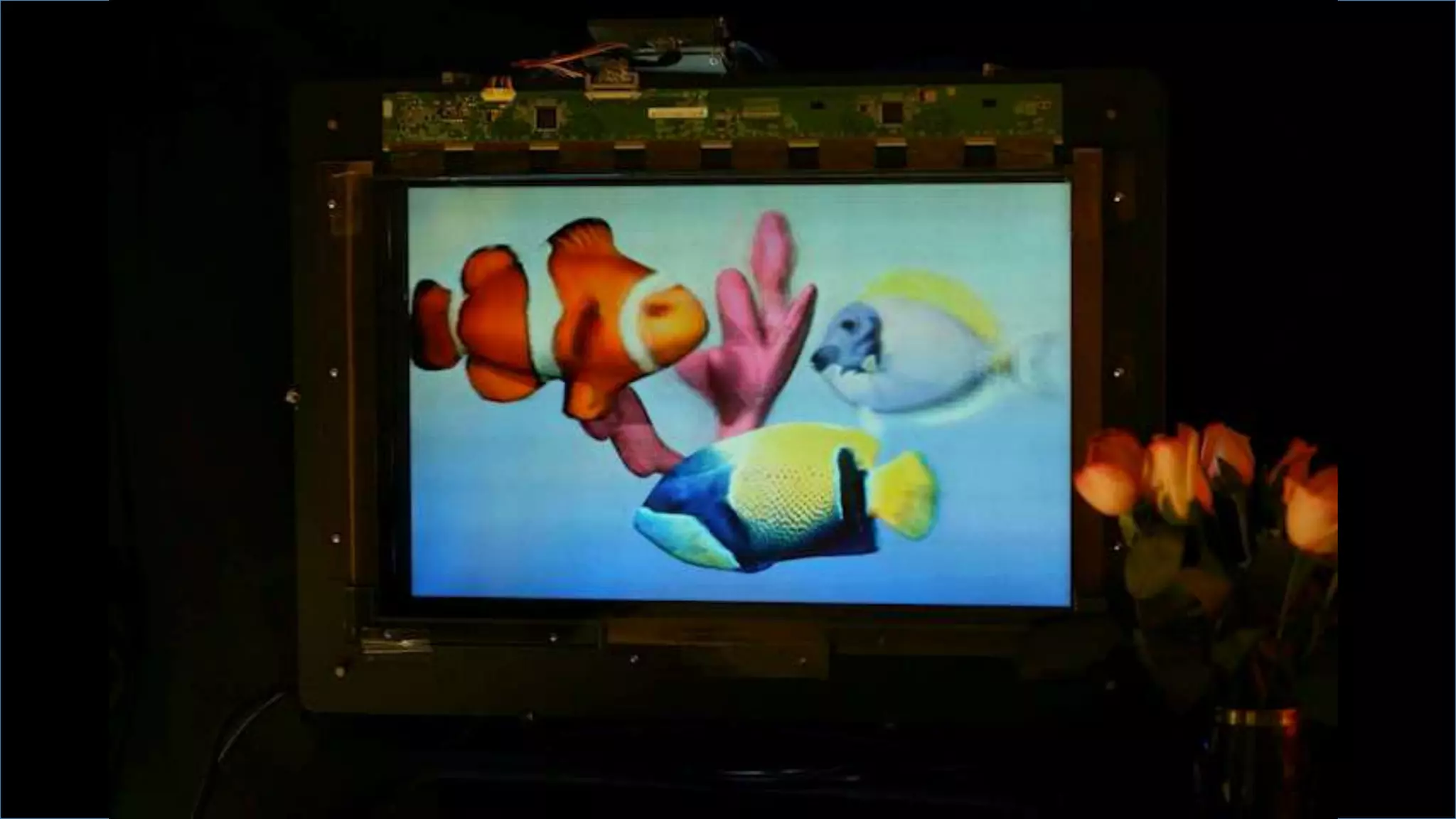
Prototype Layered 3D Display


  Transparency stack with acrylic spacers   Prototype in front of LCD (backlight source)
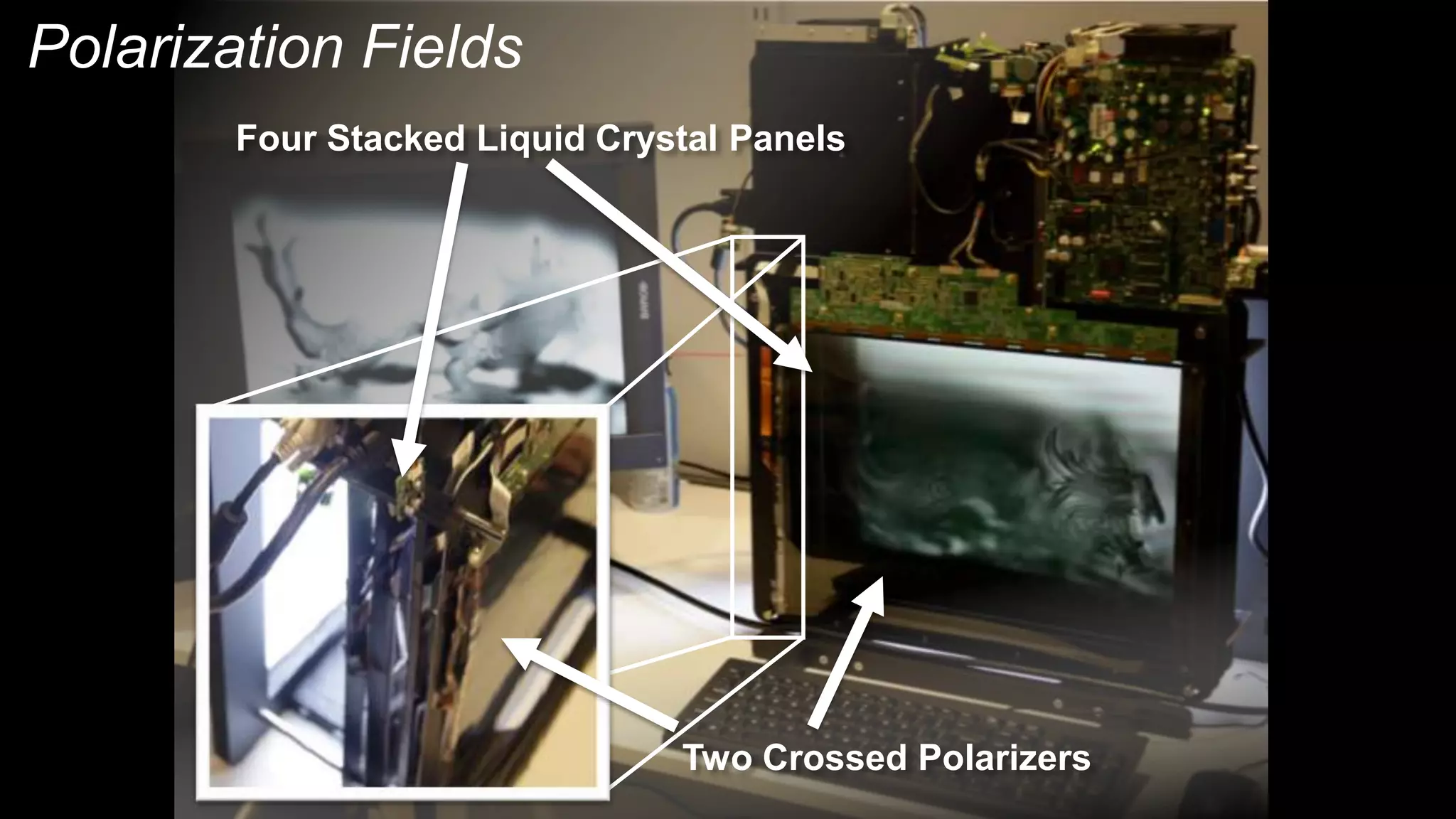
Polarization Fields
        Four Stacked Liquid Crystal Panels


                                Two Crossed Polarizers
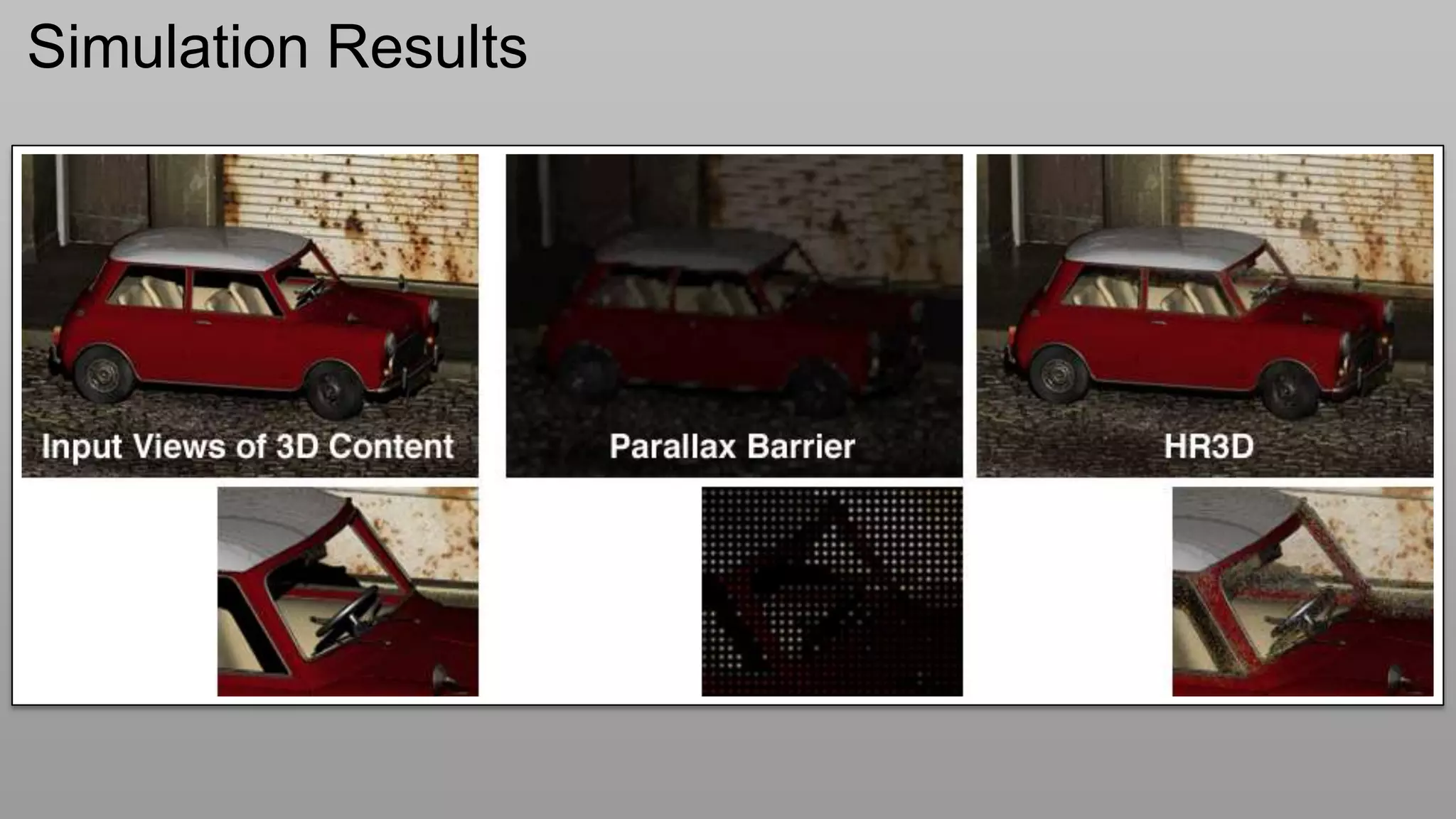
Simulation Results
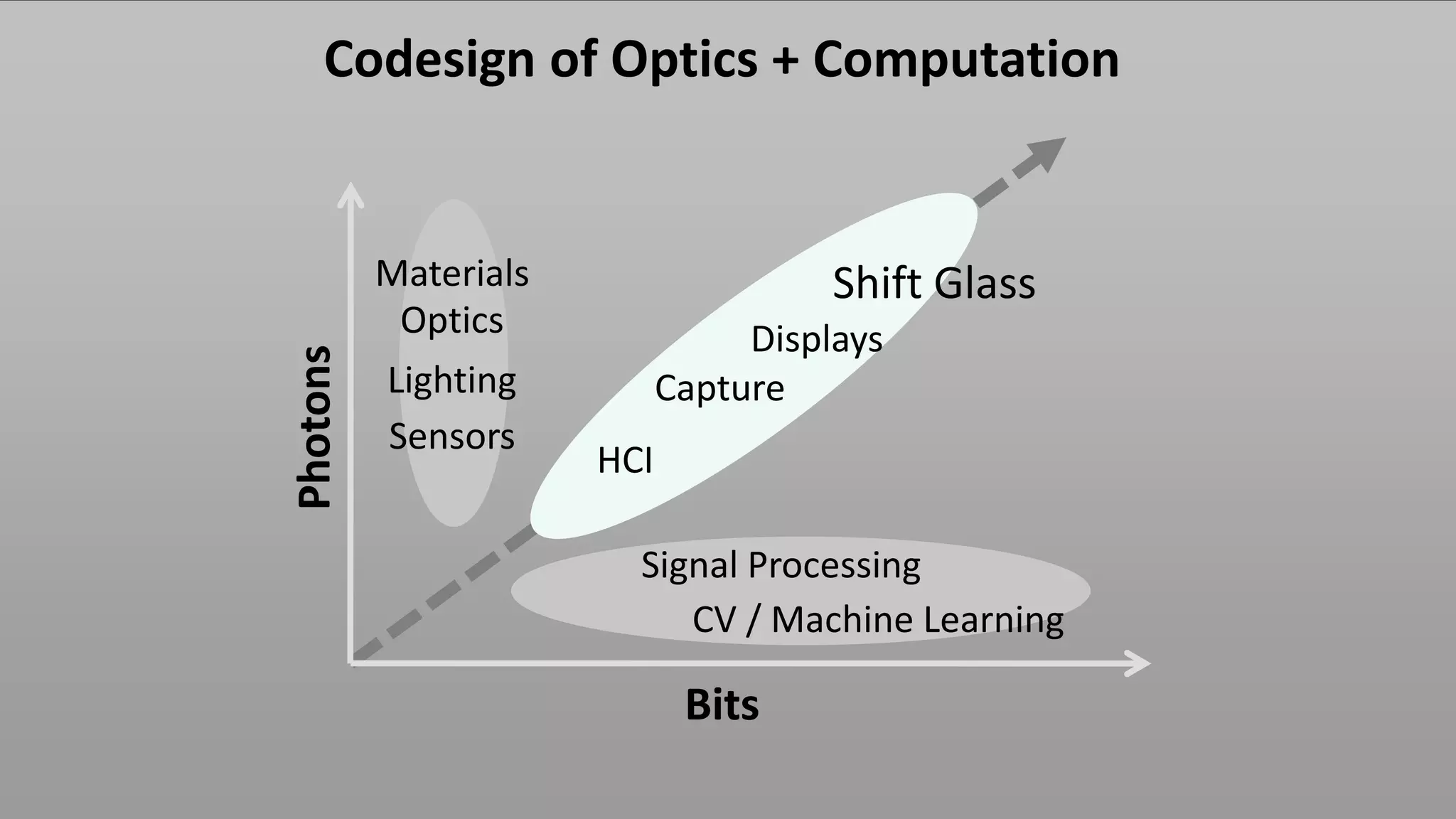
Codesign of Optics + Computation


          Materials                   Shift Glass
Photons    Optics                Displays
          Lighting          Capture
          Sensors
                      HCI

                        Signal Processing
                           CV / Machine Learning

                             Bits
Speed beats Resolution
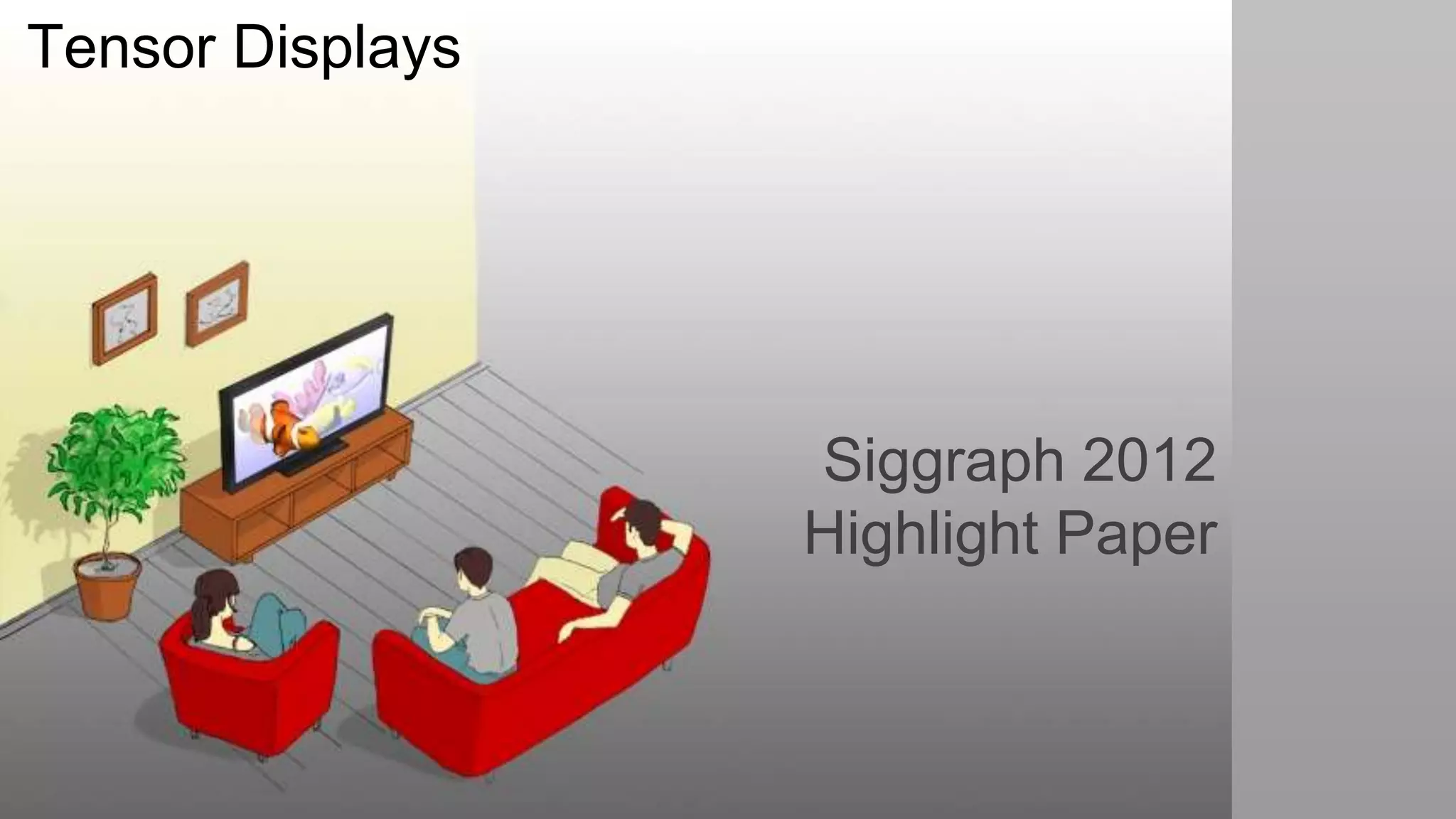
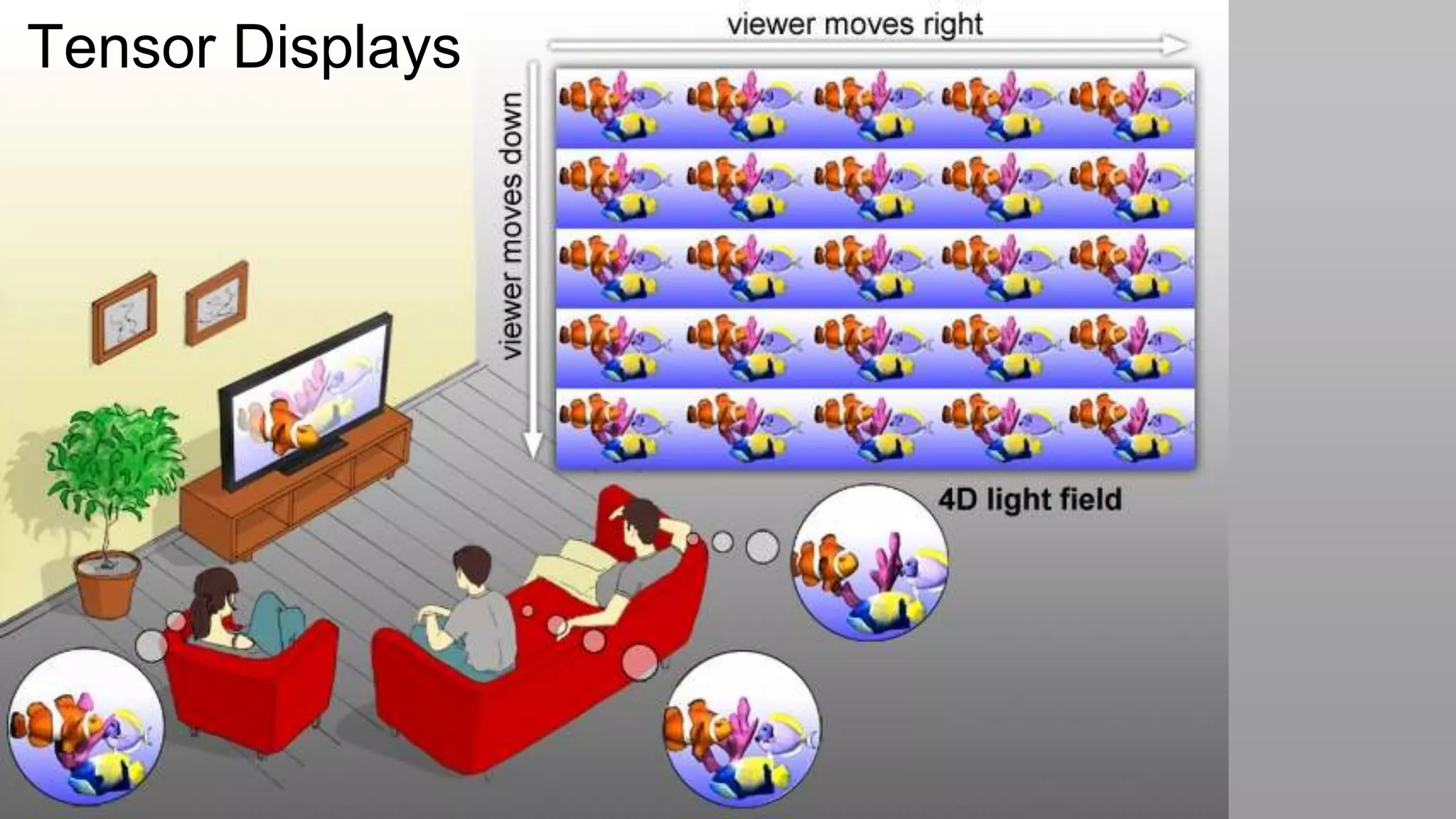
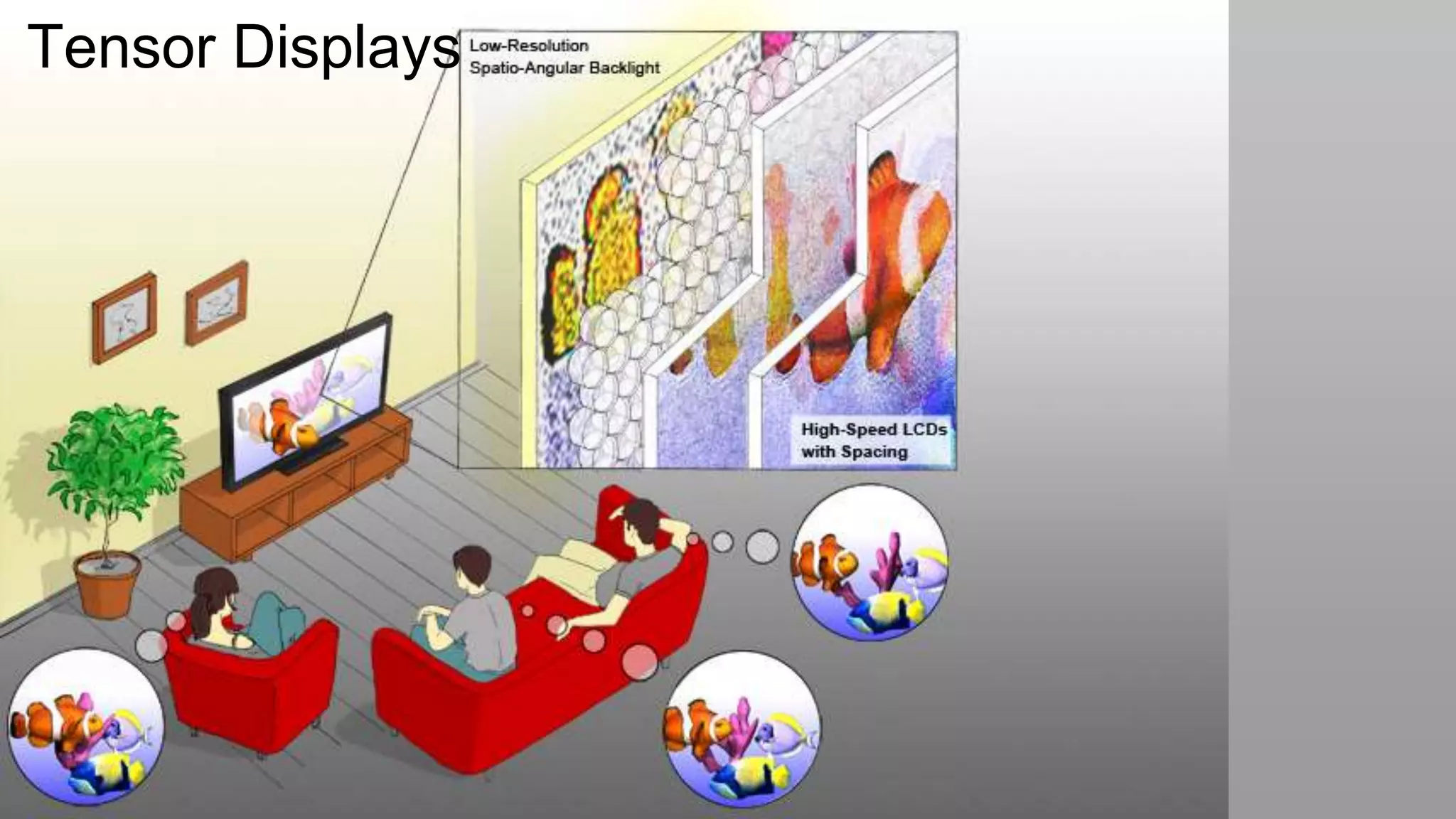
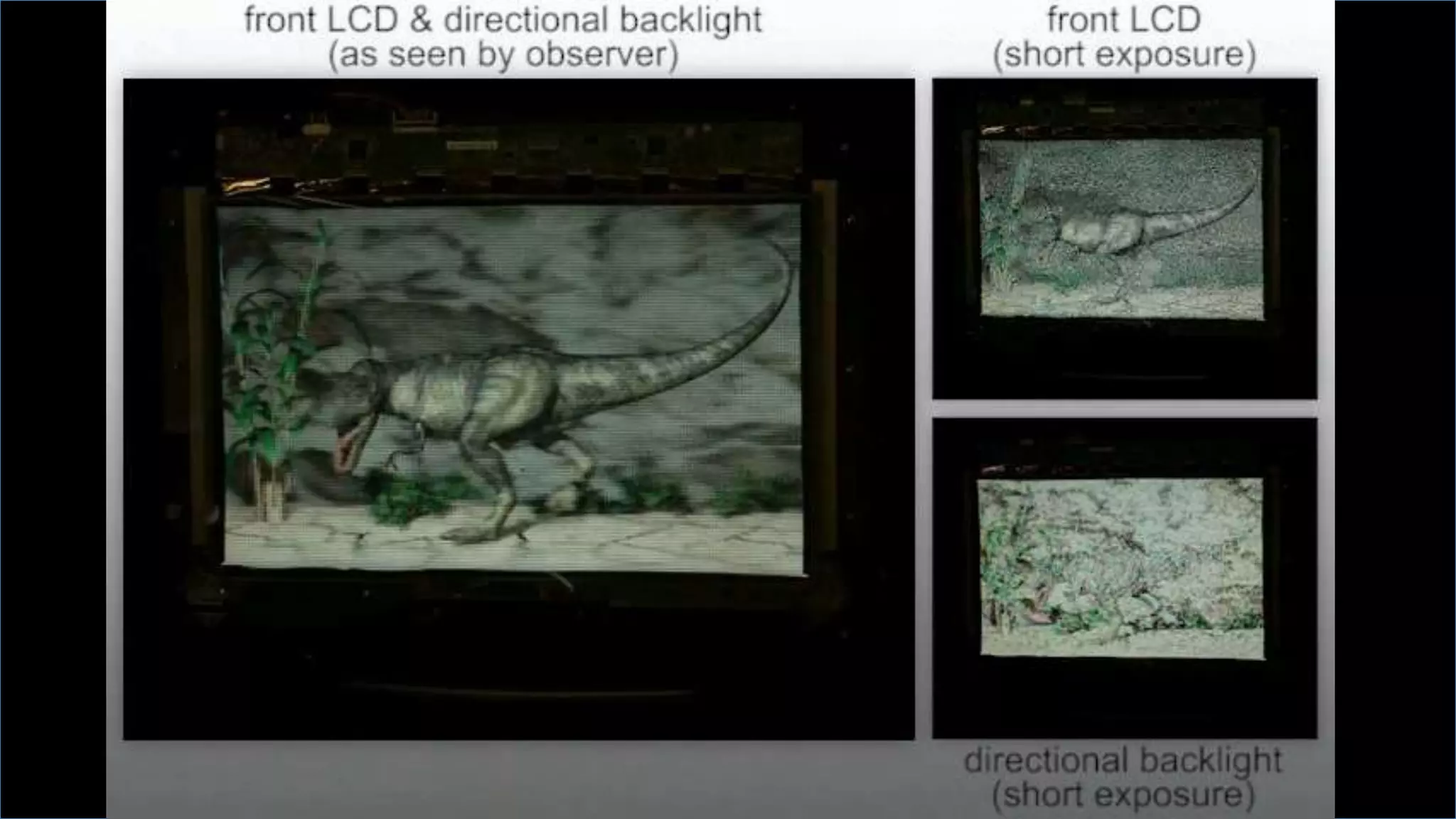
Tensor Displays


                  Siggraph 2012
                  Highlight Paper
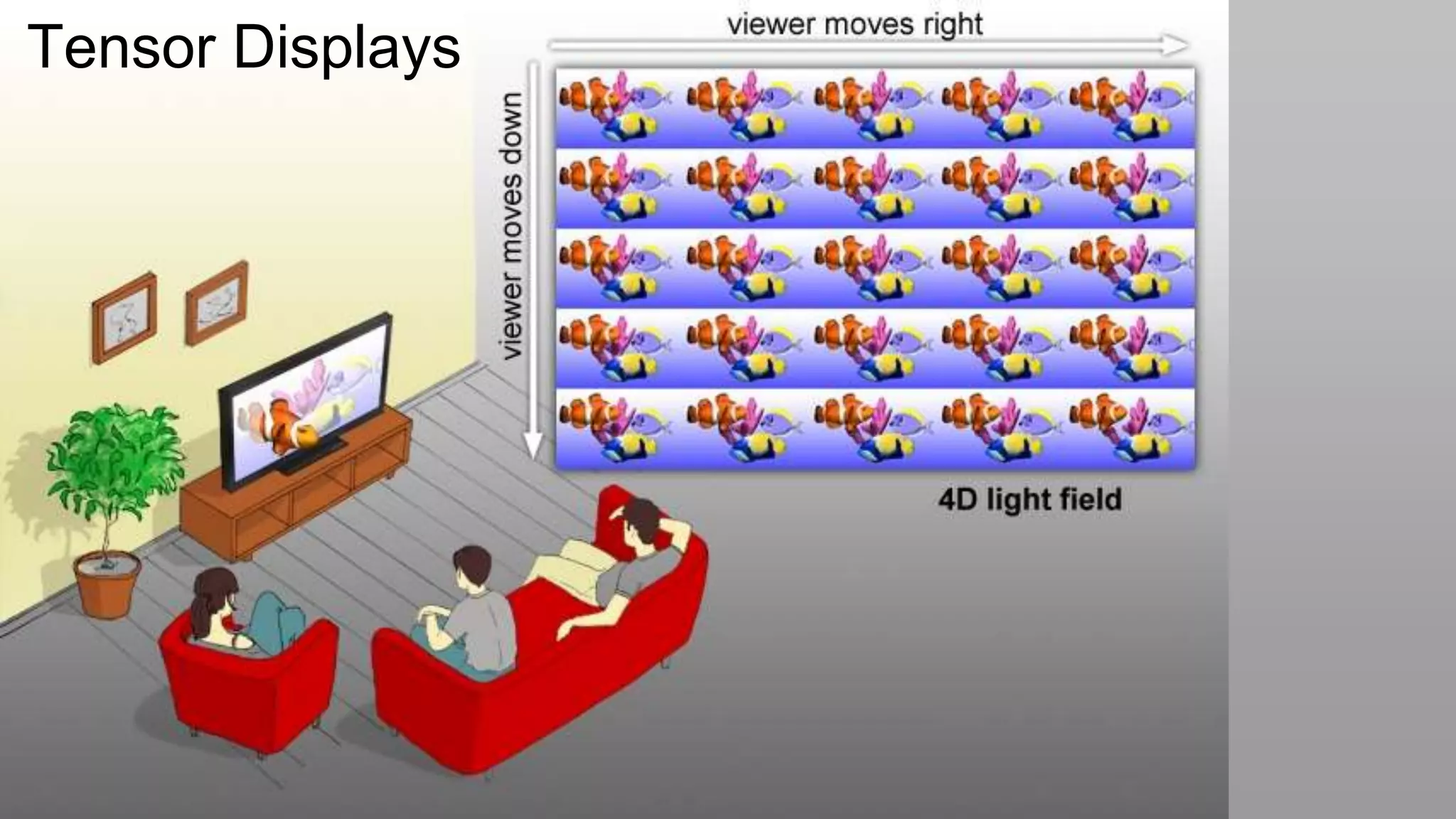
Tensor Displays
Tensor Displays
Tensor Displays
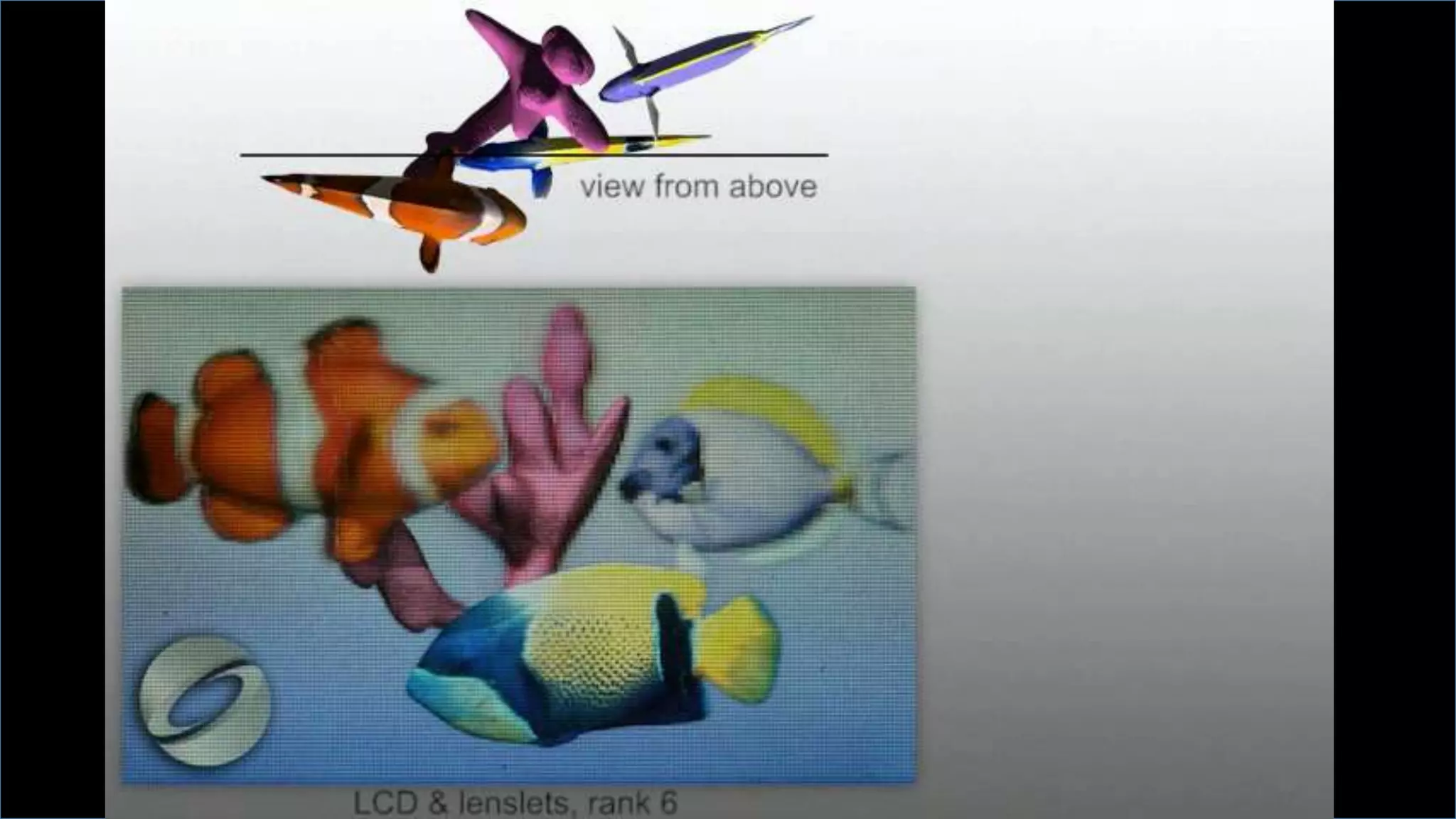
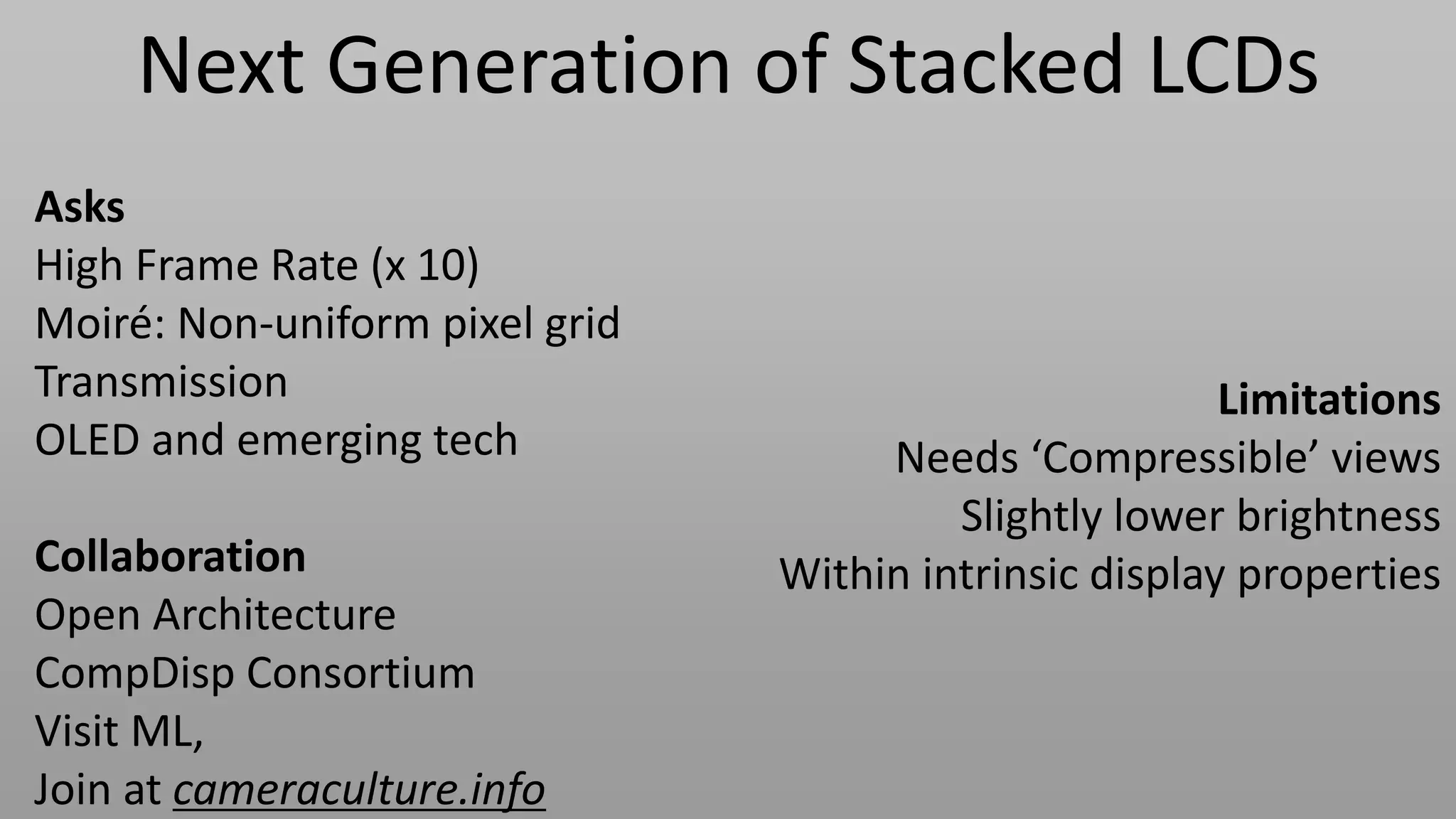
Next Generation of Stacked LCDs
Asks
High Frame Rate (x 10)
Moiré: Non-uniform pixel grid
Transmission                                            Limitations
OLED and emerging tech               Needs ‘Compressible’ views
                                         Slightly lower brightness
Collaboration                   Within intrinsic display properties
Open Architecture
CompDisp Consortium
Visit ML,
Join at cameraculture.info
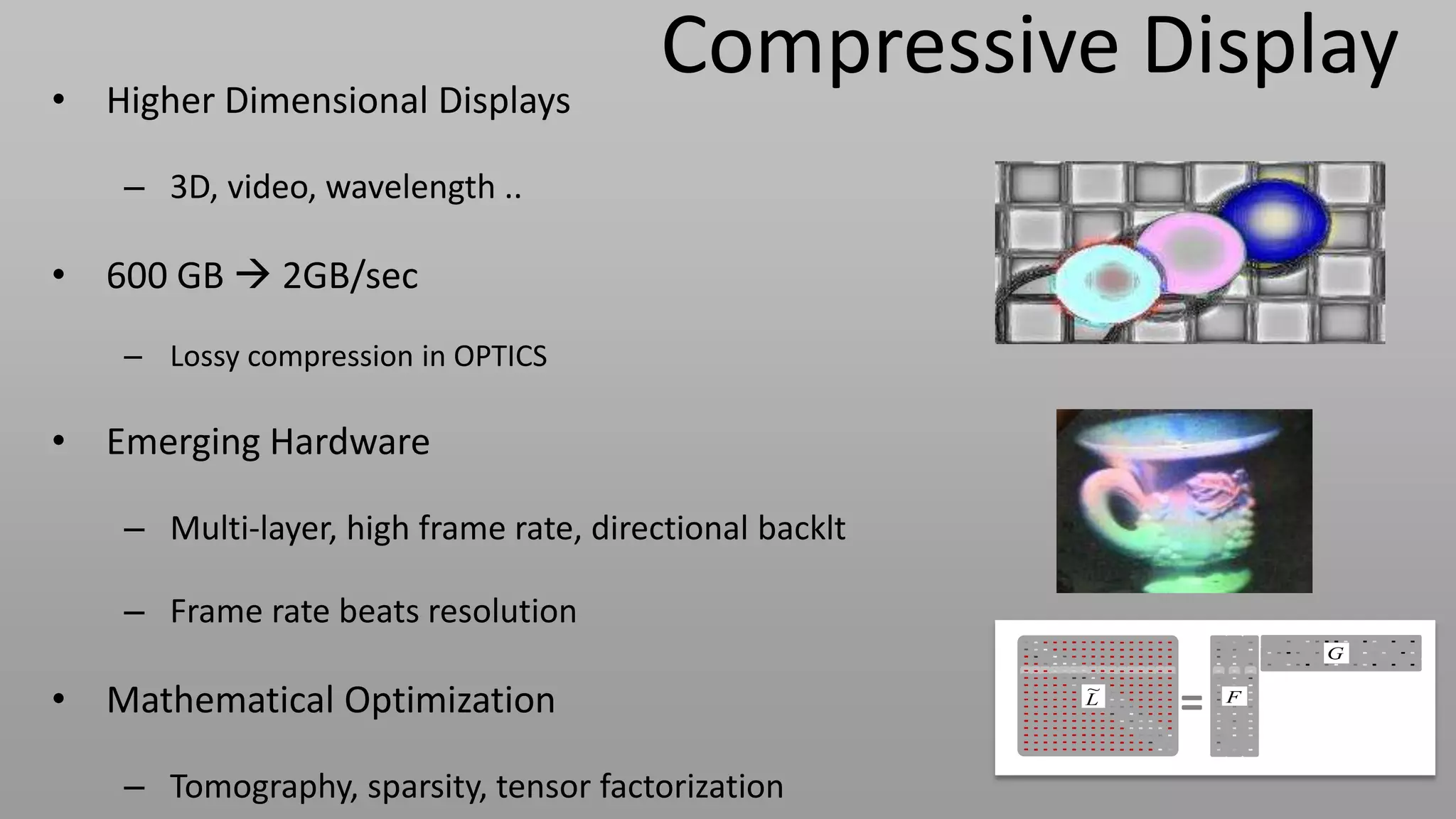
• Higher Dimensional Displays
                                         Compressive Display
    – 3D, video, wavelength ..

• 600 GB  2GB/sec
    – Lossy compression in OPTICS

• Emerging Hardware

    – Multi-layer, high frame rate, directional backlt

    – Frame rate beats resolution
                                                                     G


• Mathematical Optimization                              ~
                                                         `
                                                         L
                                                             =   F


    – Tomography, sparsity, tensor factorization
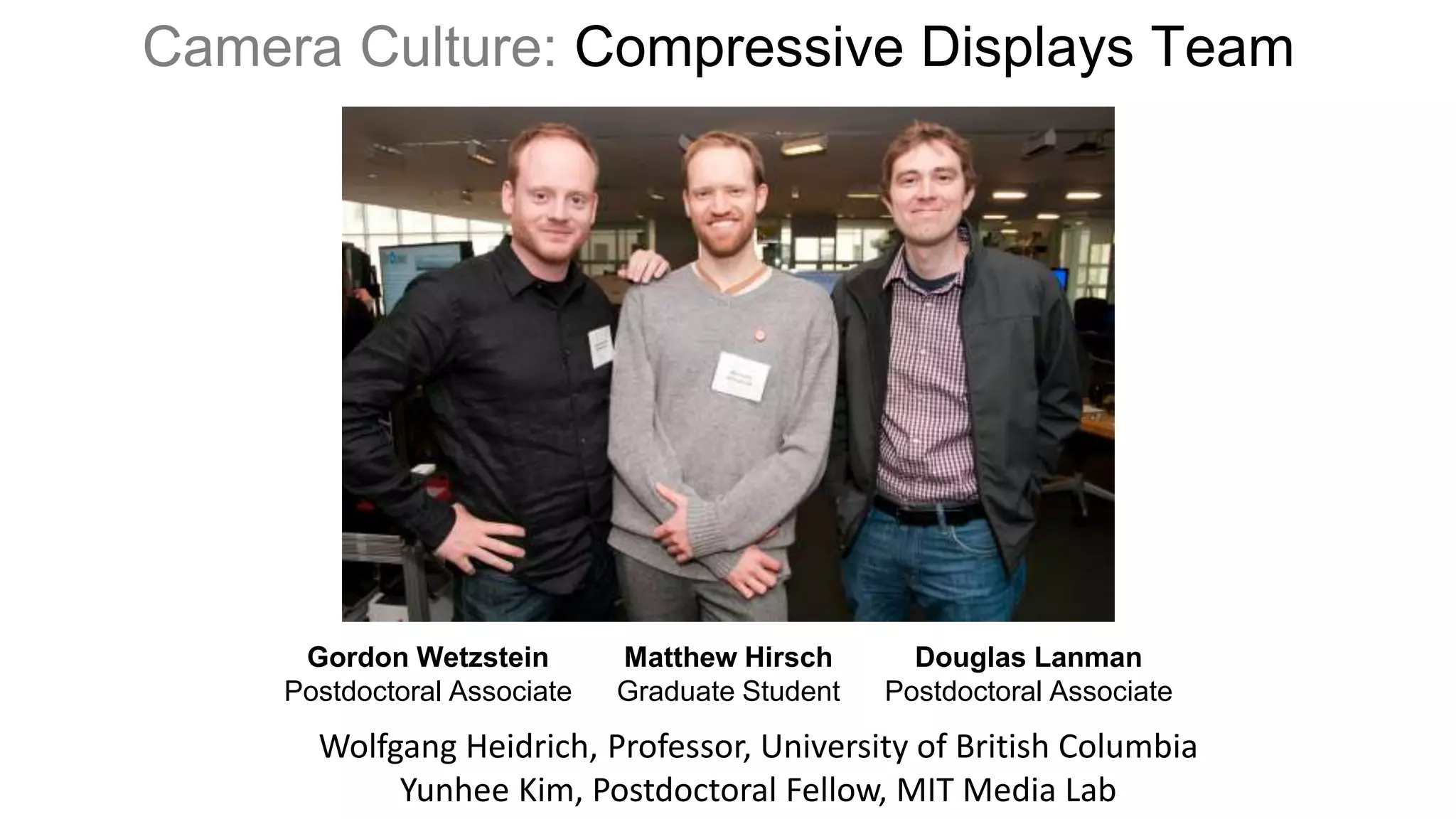
Camera Culture: Compressive Displays Team


      Gordon Wetzstein        Matthew Hirsch       Douglas Lanman
     Postdoctoral Associate   Graduate Student   Postdoctoral Associate
       Wolfgang Heidrich, Professor, University of British Columbia
            Yunhee Kim, Postdoctoral Fellow, MIT Media Lab
Raskar, Lanman, Wetzstein, Hirsch    MIT Media Lab              http://cameraculture.info


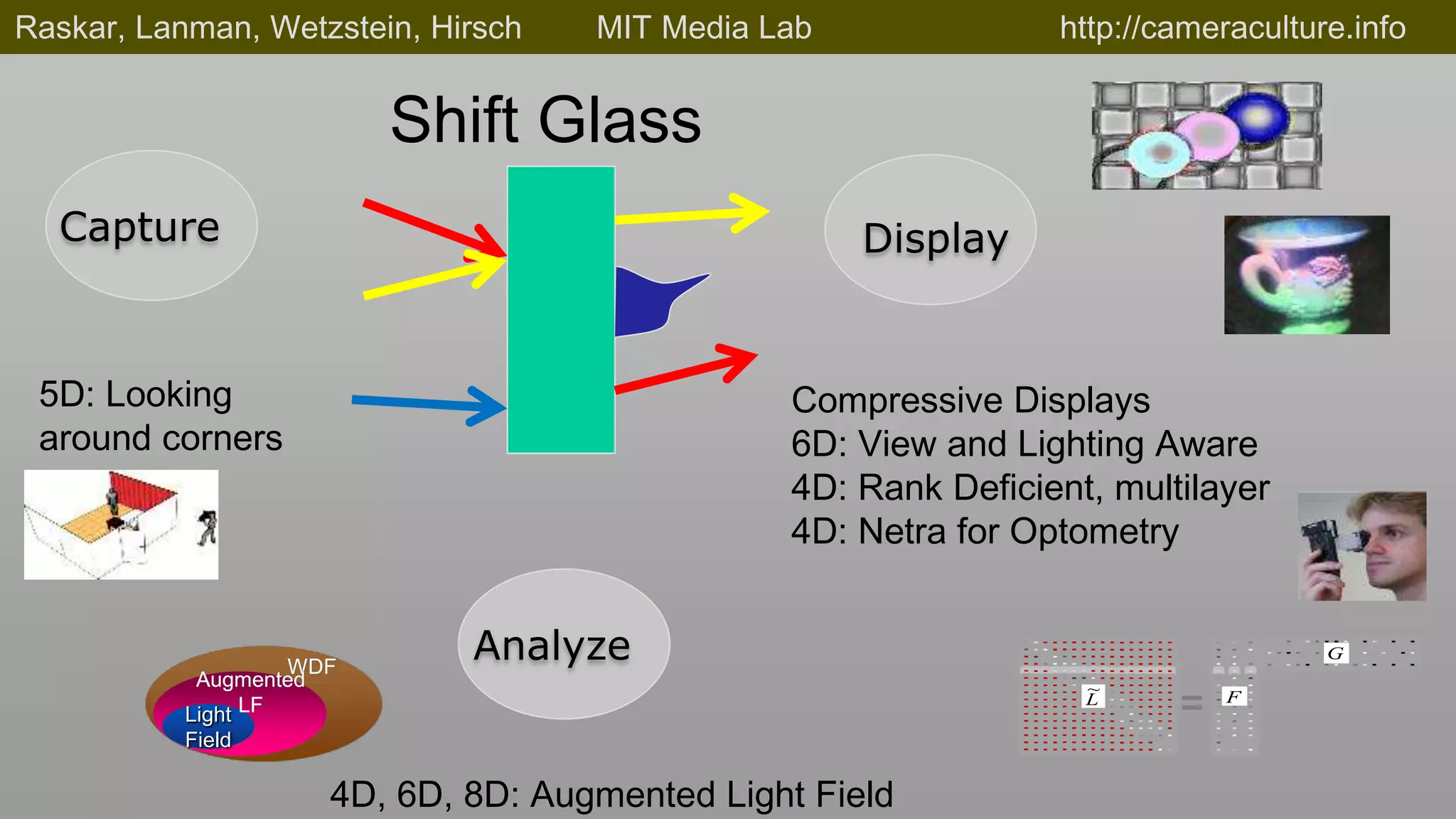
                          Shift Glass
  Capture                                            Display


 5D: Looking                                    Compressive Displays
 around corners                                 6D: View and Lighting Aware
                                                4D: Rank Deficient, multilayer
                                                4D: Netra for Optometry


                    WDF
                              Analyze                                              G
            Augmented
           Light LF
                                                                  ~
                                                                  `
                                                                  L
                                                                        =   F

           Field

                      4D, 6D, 8D: Augmented Light Field
Raskar, Lanman, Wetzstein, Hirsch    MIT Media Lab                  http://cameraculture.info


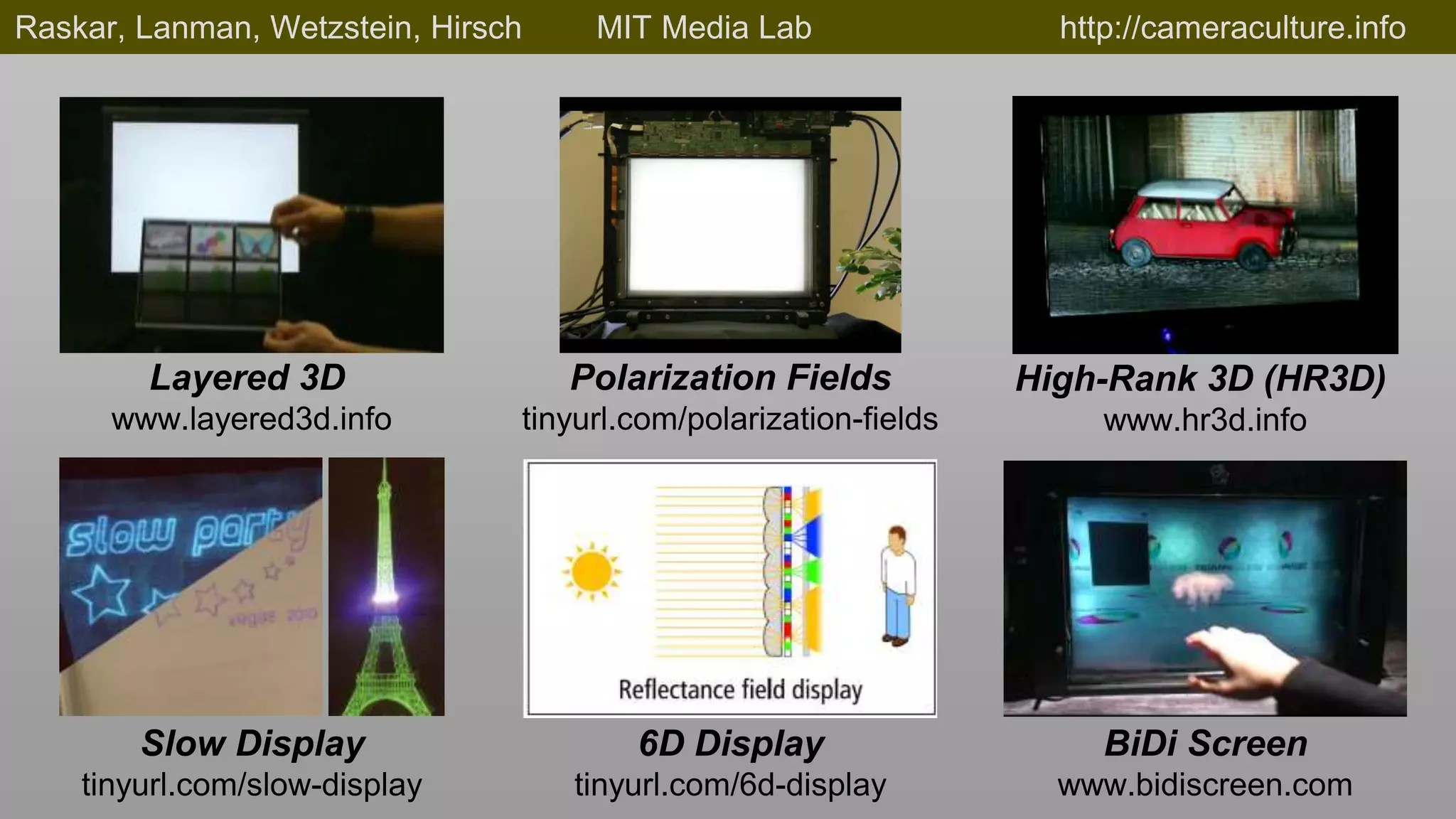
        Layered 3D                  Polarization Fields           High-Rank 3D (HR3D)
      www.layered3d.info        tinyurl.com/polarization-fields        www.hr3d.info


        Slow Display                    6D Display                     BiDi Screen
    tinyurl.com/slow-display        tinyurl.com/6d-display          www.bidiscreen.com
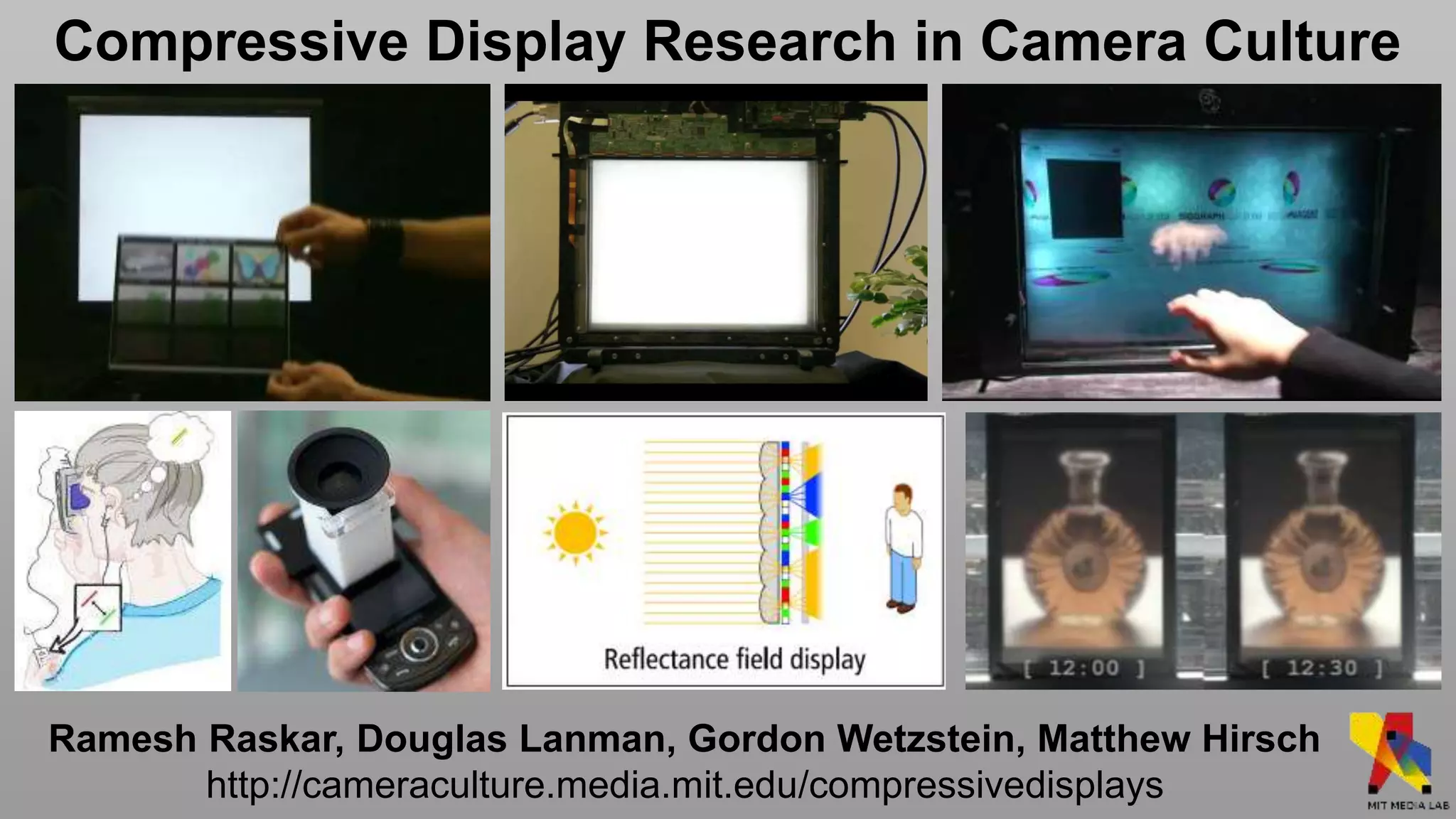
Compressive Display Research in Camera Culture


Ramesh Raskar, Douglas Lanman, Gordon Wetzstein, Matthew Hirsch
       http://cameraculture.media.mit.edu/compressivedisplays
Faster Horse      Car

Compressive DIsplays: SID Keynote by Ramesh Raskar

  • 1.
    Compressive Displays: Managing LightfieldBandwidth with Math + Layered LCDs Ramesh Raskar Asso. Prof. MIT Media Lab http://cameraculture.info
  • 2.
    Slow Glass: TimeShifted Display Light of Other Days by Bob Shaw http://www.fantasticfiction.co.uk/s/bob-shaw/other-days-other-eyes.htm http://baens-universe.com/articles/otherdays
  • 3.
    Shift Glass Space Shifting Angle Shifting Time Shifting Illumination Shifting 4D 4D t 4D 4D
  • 4.
    Motivation: Glasses Free3D Displays Eliminating Eyewear Expanding FoV and DoF for Glasses-free Displays Eliminating Moving Parts Thin Holographic Displays (Preserving Depth Cues) (Developing or Avoiding High-Res SLM) Favarola et al Michael Bove et al
  • 5.
    Glasses-free 3D Displays Bandwidth:600 Gbytes/sec 1M * 60 Hz * 100x100 Views
  • 6.
    Compressive Displays: Lossy Compression in Optics Bandwidth: 600 Gbytes/sec 2 Gbytes/sec
  • 7.
    Opportunities: New Hardware+ New Math Emerging Displays Multilayer High Frame Rate Directional Backlighting Compression and Embedded Processing Non-negative Matrix Factorization (NMF) Non-negative Tensor Factorization (NTF)
  • 8.
    Camera Culture Creating new ways to capture and share visual information MIT Media Lab Ramesh Raskar http://cameraculture.info Facebook.com/cameraculture Computational Photography Femtosecond Imaging 3D Displays 1. Looking around corners 1. Tensor Display 1.Light-Field Camera A family of compressive light field A new camera design exploiting the Using short laser pulses and fast detector, we aim to build a device that can look around corners with no imaging displays comprising all architectures fundamental dictionary of light-fields device in the line of sight using time resolved transient employing a stack of time-multiplexed, for a single-capture capture of light- imaging. light-attenuating layers illuminated by fields with full-resolution refocusing uniform or directional backlighting effects. 2. Layered 3D 2. Color Primaries Tomographic techniques for image A new camera design with synthesis on displays composed of switchable color filter arrays for compact volumes of light-attenuating optimal color fidelity and picture material. Such volumetric attenuators quality on scene geometry, color recreate a 4D light field or high-contrast and illumination. 2D image when illuminated by a uniform 2. Reflectance Recovery backlight. We demonstrate a new technique that allows a camera to 3. Flutter-Shutter rapidly acquire reflectance properties of objects 'in the wild' 3. Glasses-free 3D HDTV A camera that codes the exposure from a single viewpoint, over relatively long distances and Light field displays with increased time with a binary pseudo-sequence without encircling equipment. brightness and refresh rate by stacking a to de-convolve and remove motion pair of modified LCD panels, exploiting blur in textured backgrounds and rank and constraint of 3D displays partial occluders. 3. Trillion Frames per Second Imaging A camera fast enough to capture light pulses moving through objects. We can use such a camera to understand 4. BIDI Screen reflectance, absorption and scattering properties of A thin, depth-sensing LCD for 3D 4. Compressive Capture materials. interaction using light fields which We analyze the gamut of visual supports both 2D multi-touch and signals from low-dimensional unencumbered 3D gestures. images to light-fields and propose non-adaptive projections for efficient sparsity exploiting 5. Living Windows 6D Display reconstruction. A completely passive display that responds to changes in viewpoint and changes in incident light conditions. May 2012
  • 9.
    Health & Wellness Human Computer Interaction Visual Social Computing 1. Retinal Imaging 1. Bokode 1. Photocloud With simplified optics and cleaver Low-cost, passive optical design so A near real-time system for illumination we visualize images of the that bar codes can be shrunk to fewer interactively exploring a collectively retina in a standalone device easily than 3mm and read by ordinary captured moment without explicit 3D operated by the end user. cameras several meters away. reconstruction. 2. NETRA/CATRA Low-cost cell-phone attachments that 2. Specklesense 2. Vision Blocks measures eye-glass prescription and Set of motion-sensing configurations On-demand, in-browser, cataract information from the eye. based on laser speckle sensing . The customizable, computer-vision 3. Cellphone Microscopy underlying principles allow application-building platform for the A platform for computational microscopy interactions to be fast, precise, masses. Without any prior and remote healthcare extremely compact, and low cost. programming experience, users can create and share computer vision 4. High-speed Tomography 3. Sound Around applications. A compact, fast CAT scan machine using Soundaround is a multi-viewer no mechanical moving parts or interactive audio system, designed to synchronization. be integrated into multi-view displays 3. Lenschat presenting localized audio/video LensChat allows users to share 5. Shield Fields channels with no need for glasses or mutual photos with friends or borrow 3D reconstruction of objects from a single headphones. the perspective and abilities of many shot photo using spatial heterodyning. cameras. 6. Second Skin Using 3D motion tracking with real-time Visit us online at vibrotactile feedback aids the correct of movement and position errors to improve motor learning. Cameraculture.info fb.com/cameraculture Light Propagation Theory and Fourier Optics 1. Augmented Light Fields 2. Hologram v Parallax Barrier Expands light field representations to Defines connections between parallax 3. Ray–Based Diffraction Model describe phase and diffraction effects by barrier displays and holographic displays by Simplified capture of diffraction model for using the Wigner Distribution Function analyzing their operations and limitations in computer graphics applications. phase space Post-Doctorial Researchers: Doug Lanman, Gordon Wetzstein, Alex Olwal, Christopher Barsi Research Assistants: Matthew Hirsch, Otkrist Gupta, Nikhil Naik, Jason Boggess, Everett Lawson, Aydın Arpa, Kshitij Marwah Visiting Researchers & Students: Di Wu, Daryl Lim
  • 10.
    Office of theFuture, UNC, 1997
  • 11.
    Pocket Projectors 1999-2004 UNC Chapel Hill and Mitsubishi Electric Research Labs
  • 12.
  • 13.
    Time Illumination Space/Angle Slow Display 6D Display Layered 3D tinyurl.com/slow-display tinyurl.com/6d-display www.layered3d.info High-Rank 3D (HR3D) BiDi Screen Polarization Fields www.hr3d.info www.bidiscreen.com tinyurl.com/polarization-fields
  • 14.
  • 15.
  • 16.
  • 17.
    MIT media lab camera culture EyeNetra.com NETRA: Refractive Error on Mobile Phone Siggraph 2010 Vitor Pamplona Ankit Mohan Manuel Oliveira Ramesh Raskar 18
  • 18.
    6D Display: Respondto View + Ambient Illumination
  • 19.
    Camera Culture: CompressiveDisplays Team Gordon Wetzstein Matthew Hirsch Douglas Lanman Postdoctoral Associate Graduate Student Postdoctoral Associate Wolfgang Heidrich, Professor, University of British Columbia Yunhee Kim, Postdoctoral Fellow, MIT Media Lab
  • 20.
    3D Display: Lightand Rank Deficient Parallax barrier Front Back LCD display
  • 21.
    Input 4D LightField: Horizontal and Vertical Parallax
  • 22.
  • 23.
  • 24.
    Light Field ofParallax Barriers: Rank 1 k L[i,k] i k g[k] i ` f[i] light box L[i, k ]  f [i]  g[k ] L f g
  • 25.
    Dual LCD: Content-AdaptiveParallax Barriers G L[i,k] k g[k] ~ i F L` f[i] light box ~ L  FG
  • 26.
    Dual LCD: Content-AdaptiveParallax Barriers G L[i,k] k g[k] i F ~ f[i] L` light box ~ L  FG Lanman, Hirsch, Kim, Raskar Siggraph Asia 2010
  • 27.
  • 28.
  • 29.
    Algebraic Rank Constraint Rank-1 Rank-1 s1* m2 s1 s1
  • 30.
    Light Field vs.Holographic Displays
  • 31.
    Is a hologramjust another ray-based light field? Can a hologram create any intensity distribution in 3D? Why does a hologram create a “wavefront”, but parallax barrier does not? Why does a hologram create accommodation cues? What are the effective resolution and depth of field for holograms vs. barriers?
  • 32.
    Parallax Barrier: Np=103pix. Hologram: NH=105 pix. ϕP∝w/d ϕH∝λ/tH θp=10 pix θH =1000 pix Fourier Patch w Horstmeyer, Oh, Cuypers, Barbastathis, Raskar, 2009
  • 33.
    Augmented Light Field wave optics based rigorous but cumbersome Wigner WDF Distribution Function Augmented LF Traditional Traditional Light Field Light Field ray optics based Interference & Diffraction simple and powerful Interaction w/ optical elements Oh, Raskar, Barbastathis 2009: Augmented Light Field 34
  • 34.
    Glasses-free 3D Displays Raw: 600 Gbytes/sec Compressive: 2 Gbyte/sec
  • 36.
    View Dependent Appearanceand Iridescent color Cross section through a single M. Rhetenor scale
  • 37.
    Generalizing Parallax Barriers:Rank 1 mask K … mask 3 mask 2 mask 2 mask 2 mask 1 mask 1 mask 1 light box light box light box Conventional Parallax Barrier High-Rank 3D (HR3D) Layered 3D and Polarization Fields  Parallax barriers use heuristic design: front mask with slits/pinholes, rear mask with interlaced views  High-Rank 3D (HR3D) considers dual-layer design with arbitrary opacity and temporal multiplexing  Layered 3D and Polarization Fields considers multi-layer design without temporal multiplexing
  • 38.
    Layered 3D: Multi-LayerAutomultiscopic Displays mask K … mask 3 mask 2 mask 1 light box Layered 3D
  • 39.
    Tomographic Light FieldSynthesis virtual plane Image formation model: attenuator ò - m (r )dr L(x, q ) = I 0 e C æ L(x, q ) ö L(x, q ) = ln ç ÷ = - ò m (r)dr è I0 ø C backlight l = -Pa Tomographic synthesis: 2 arg min l + Pa , for a ³ 0 a 2D Light Field
  • 40.
    Tomographic Light FieldSynthesis virtual plane Image formation model: attenuator ò - m (r )dr L(x, q ) = I 0 e C æ L(x, q ) ö L(x, q ) = ln ç ÷ = - ò m (r)dr è I0 ø C backlight l = -Pa Tomographic synthesis: 2 arg min l + Pa , for a ³ 0 a 2D Light Field
  • 41.
    Multi-Layer Light FieldDecomposition Reconstructed Views Target 4D Light Field Multi-Layer Decomposition
  • 42.
    Prototype Layered 3DDisplay Transparency stack with acrylic spacers Prototype in front of LCD (backlight source)
  • 44.
    Polarization Fields Four Stacked Liquid Crystal Panels Two Crossed Polarizers
  • 46.
  • 47.
    Codesign of Optics+ Computation Materials Shift Glass Photons Optics Displays Lighting Capture Sensors HCI Signal Processing CV / Machine Learning Bits
  • 49.
  • 50.
    Tensor Displays Siggraph 2012 Highlight Paper
  • 51.
  • 52.
  • 53.
  • 59.
    Next Generation ofStacked LCDs Asks High Frame Rate (x 10) Moiré: Non-uniform pixel grid Transmission Limitations OLED and emerging tech Needs ‘Compressible’ views Slightly lower brightness Collaboration Within intrinsic display properties Open Architecture CompDisp Consortium Visit ML, Join at cameraculture.info
  • 60.
    • Higher DimensionalDisplays Compressive Display – 3D, video, wavelength .. • 600 GB  2GB/sec – Lossy compression in OPTICS • Emerging Hardware – Multi-layer, high frame rate, directional backlt – Frame rate beats resolution G • Mathematical Optimization ~ ` L = F – Tomography, sparsity, tensor factorization
  • 61.
    Camera Culture: CompressiveDisplays Team Gordon Wetzstein Matthew Hirsch Douglas Lanman Postdoctoral Associate Graduate Student Postdoctoral Associate Wolfgang Heidrich, Professor, University of British Columbia Yunhee Kim, Postdoctoral Fellow, MIT Media Lab
  • 62.
    Raskar, Lanman, Wetzstein,Hirsch MIT Media Lab http://cameraculture.info Shift Glass Capture Display 5D: Looking Compressive Displays around corners 6D: View and Lighting Aware 4D: Rank Deficient, multilayer 4D: Netra for Optometry WDF Analyze G Augmented Light LF ~ ` L = F Field 4D, 6D, 8D: Augmented Light Field
  • 63.
    Raskar, Lanman, Wetzstein,Hirsch MIT Media Lab http://cameraculture.info Layered 3D Polarization Fields High-Rank 3D (HR3D) www.layered3d.info tinyurl.com/polarization-fields www.hr3d.info Slow Display 6D Display BiDi Screen tinyurl.com/slow-display tinyurl.com/6d-display www.bidiscreen.com
  • 64.
    Compressive Display Researchin Camera Culture Ramesh Raskar, Douglas Lanman, Gordon Wetzstein, Matthew Hirsch http://cameraculture.media.mit.edu/compressivedisplays
  • 65.