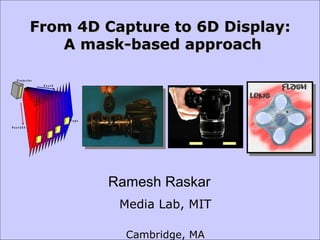
Media Lab, MIT Cambridge, MA From 4D Capture to 6D Display:  A mask-based approach Ramesh Raskar
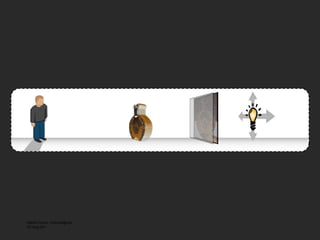
Discussion Topics What is the info content of a 3D scene? Encoding appearance and geometric complexity What are the dimensions beyond viewpt? Lighting? What other optical sensors we can use?
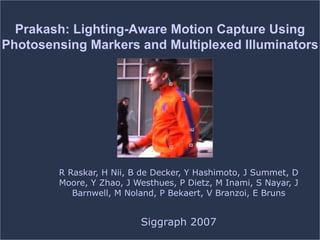
R Raskar, H Nii, B de Decker, Y Hashimoto, J Summet, D Moore, Y Zhao, J Westhues, P Dietz, M Inami, S Nayar, J Barnwell, M Noland, P Bekaert, V Branzoi, E Bruns Siggraph 2007 Prakash: Lighting-Aware Motion Capture Using Photosensing Markers and Multiplexed Illuminators
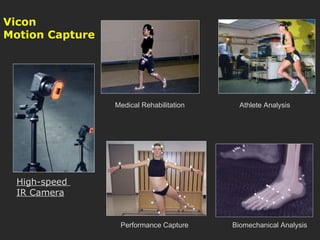
Vicon   Motion Capture High-speed  IR Camera Medical Rehabilitation Athlete Analysis Performance Capture Biomechanical Analysis
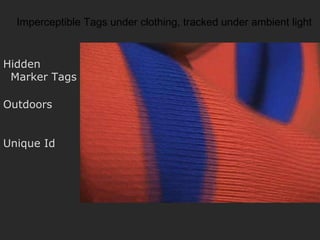
Imperceptible Tags under clothing, tracked under ambient light Hidden    Marker Tags Outdoors Unique Id
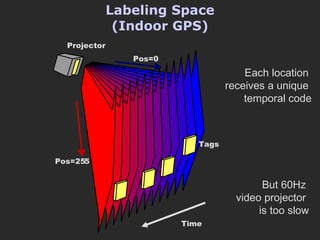
Labeling Space (Indoor GPS) Each location  receives a unique  temporal code But 60Hz  video projector  is too slow Projector Tags Pos=0 Pos=25 5 Time
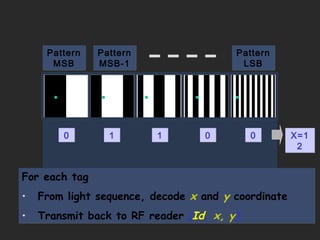
Pattern MSB Pattern MSB-1 Pattern LSB For each tag From light sequence, decode  x   and   y   coordinate Transmit back to RF reader  ( Id ,  x, y ) 0 1 1 0 0 X=12
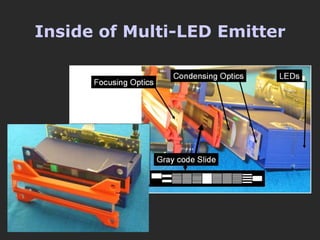
Inside of Multi-LED Emitter
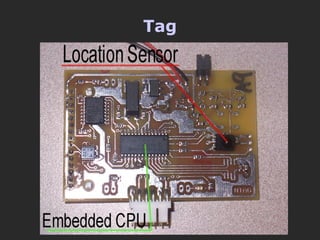
Tag
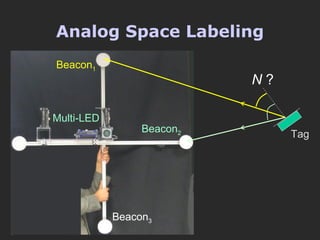
Analog Space Labeling Multi-LED Beacon 1 Beacon 2 Beacon 3 Tag N  ?
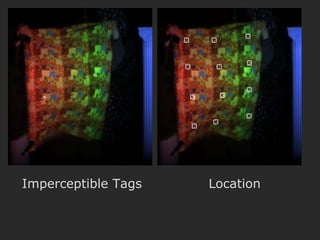
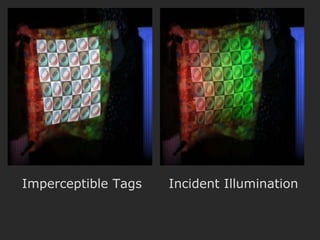
Imperceptible Tags Location
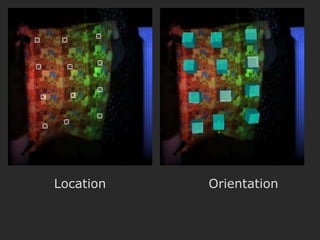
Location Orientation
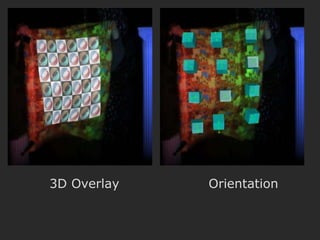
3D Overlay Orientation
Imperceptible Tags Incident Illumination
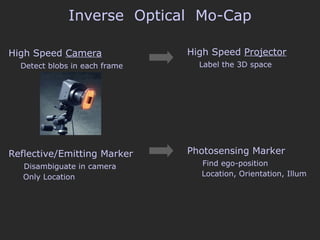
Inverse  Optical  Mo-Cap High Speed  Camera   Detect blobs in each frame Reflective/Emitting Marker   Disambiguate in camera   Only Location High Speed  Projector   Label the 3D space Photosensing Marker   Find ego-position   Location, Orientation, Illum
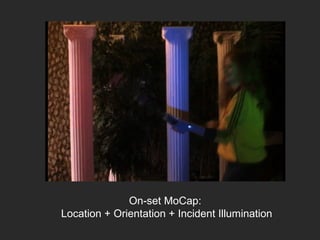
On-set MoCap:  Location + Orientation + Incident Illumination
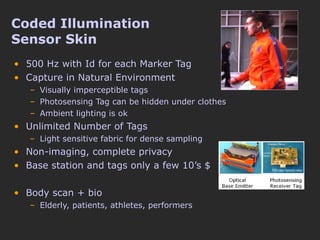
Coded Illumination  Sensor Skin 500 Hz with Id for each Marker Tag Capture in Natural Environment Visually imperceptible tags Photosensing Tag can be hidden under clothes Ambient lighting is ok Unlimited Number of Tags Light sensitive fabric for dense sampling Non-imaging, complete privacy Base station and tags only a few 10’s $ Body scan + bio Elderly, patients, athletes, performers
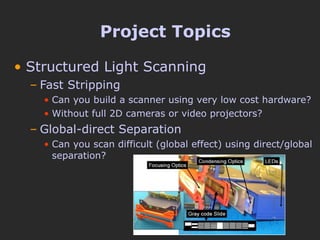
Project Topics Structured Light Scanning Fast Stripping Can you build a scanner using very low cost hardware? Without full 2D cameras or video projectors? Global-direct Separation Can you scan difficult (global effect) using direct/global separation?
Towards a 6D Display Passive Reflectance Field Display Martin Fuchs, Ramesh Raskar, Hans-Peter Seidel, Hendrik P. A. Lensch Siggraph 2008  1 2 1 1 1  MPI Informatik, Germany  2  MIT
Martin Fuchs <mfuchs@mpi-inf.mpg.de>
[Lippman 1908] [Nakajima et al. 2001] ... Martin Fuchs <mfuchs@mpi-inf.mpg.de>
electronic: [Nayar et al. 2004] slit based / different patterns: [Scharstein 1996] Martin Fuchs <mfuchs@mpi-inf.mpg.de>
Martin Fuchs <mfuchs@mpi-inf.mpg.de>
Improved Design Martin Fuchs <mfuchs@mpi-inf.mpg.de>
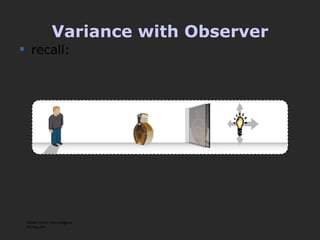
Variance with Observer Martin Fuchs <mfuchs@mpi-inf.mpg.de> recall:
Martin Fuchs <mfuchs@mpi-inf.mpg.de>
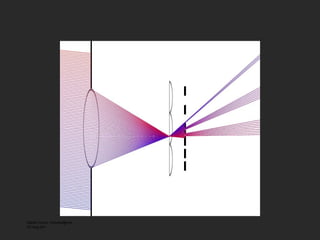
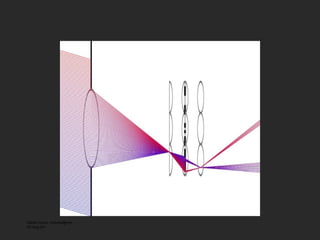
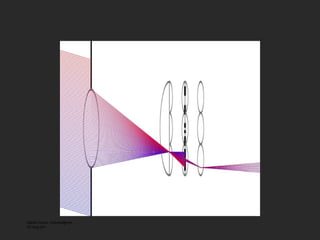
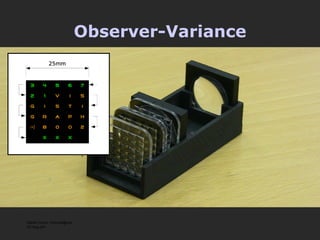
Observer-Variance Martin Fuchs <mfuchs@mpi-inf.mpg.de>
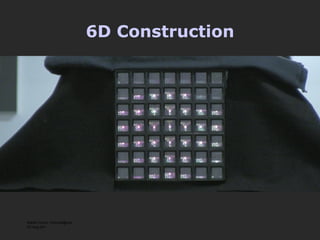
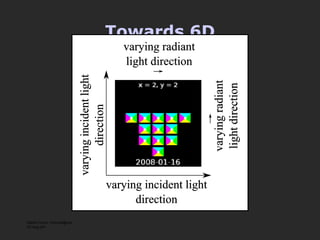
6D Construction Martin Fuchs <mfuchs@mpi-inf.mpg.de>
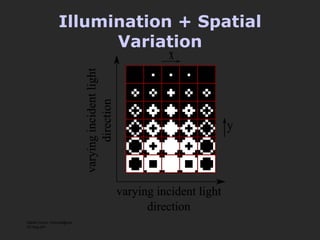
Illumination + Spatial Variation Martin Fuchs <mfuchs@mpi-inf.mpg.de>
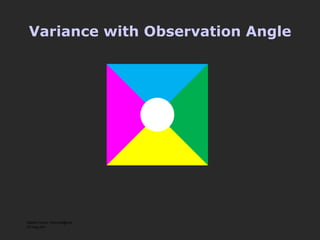
Variance with Observation Angle Martin Fuchs <mfuchs@mpi-inf.mpg.de>
Towards 6D Martin Fuchs <mfuchs@mpi-inf.mpg.de>
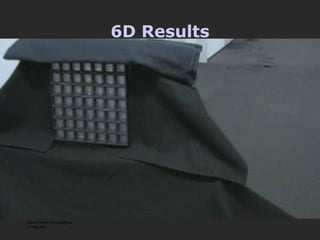
6D Results Martin Fuchs <mfuchs@mpi-inf.mpg.de>
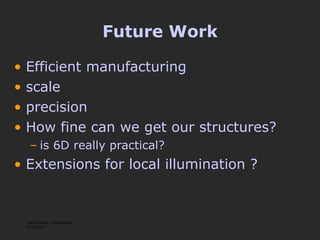
Future Work Efficient manufacturing scale precision How fine can we get our structures?  is 6D really practical? Extensions for local illumination ? Martin Fuchs <mfuchs@mpi-inf.mpg.de>
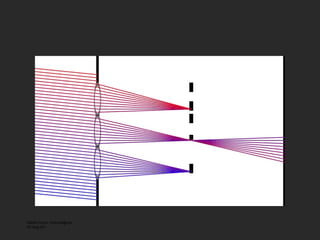
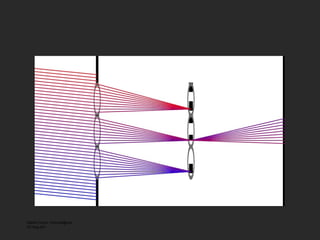
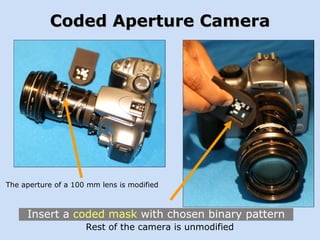
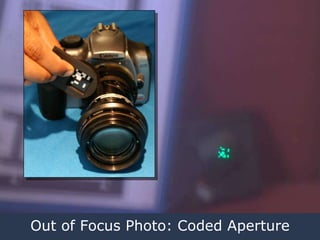
Coded Aperture Camera The aperture of a 100 mm lens is modified Rest of the camera is unmodified Insert a  coded mask  with chosen binary pattern
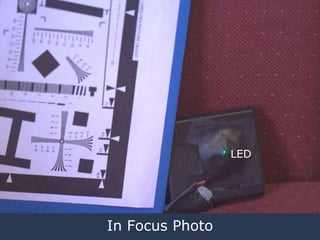
In Focus Photo LED
Out of Focus Photo: Open Aperture
Out of Focus Photo: Coded Aperture
Captured Blurred Photo
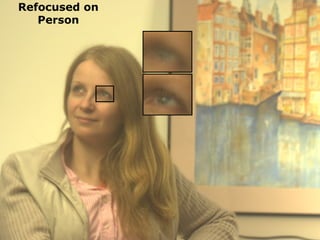
Refocused on Person
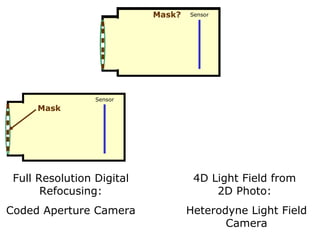
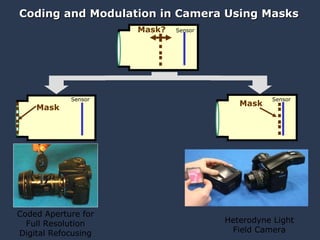
Mask? Sensor 4D Light Field from  2D Photo:  Heterodyne Light Field Camera Full Resolution Digital Refocusing: Coded Aperture Camera Mask? Sensor Mask Sensor Mask? Sensor Mask Sensor
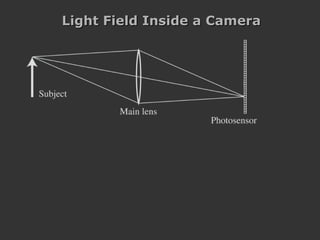
Light Field Inside a Camera
Lenslet-based Light Field camera [Adelson and Wang, 1992, Ng et al. 2005 ] Light Field Inside a Camera
Stanford Plenoptic Camera  [Ng et al 2005] 4000  × 4000 pixels  ÷  292 × 292 lenses  =  14 × 14 pixels per lens Contax medium format camera Kodak 16-megapixel sensor Adaptive Optics microlens array 125 μ  square-sided microlenses
Digital  Refocusing [Ng et al 2005] Can we achieve this with a  Mask  alone?
Mask based Light Field Camera [Veeraraghavan, Raskar, Agrawal, Tumblin, Mohan, Siggraph 2007 ] Mask Sensor
Heterodyne Light Field Camera Scanner sensor Mask [Veeraraghavan, Raskar, Agrawal, Tumblin, Mohan, Siggraph 2007 ] Mask Sensor
How to Capture  4D  Light Field with  2D  Sensor ? What should be the  pattern  of the mask ?
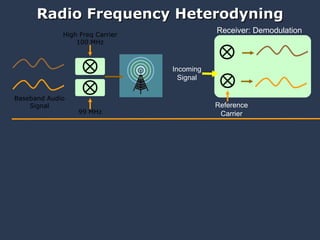
Radio Frequency Heterodyning Receiver: Demodulation High Freq Carrier 100 MHz Reference Carrier Incoming Signal 99 MHz Baseband Audio Signal
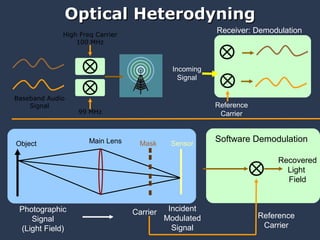
Optical Heterodyning Photographic Signal (Light Field) Carrier  Incident Modulated Signal Reference Carrier Main Lens Object Mask Sensor Recovered Light  Field Software Demodulation Baseband Audio Signal Receiver: Demodulation High Freq Carrier 100 MHz Reference Carrier Incoming Signal 99 MHz
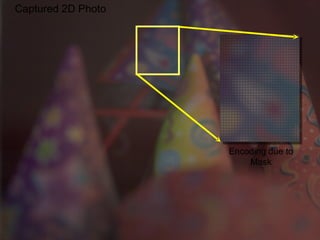
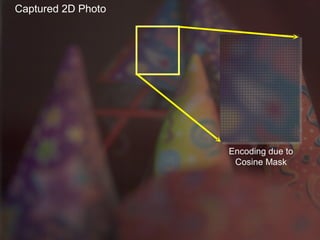
Captured 2D Photo Encoding due to Mask
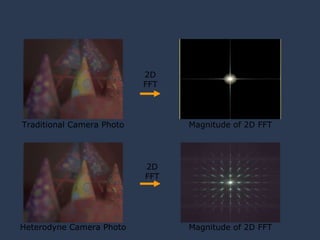
2D FFT Traditional Camera Photo Heterodyne Camera Photo Magnitude of 2D FFT 2D FFT Magnitude of 2D FFT
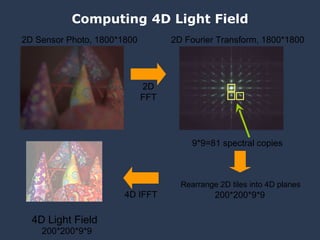
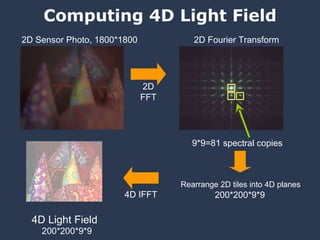
Computing 4D Light Field 2D Sensor Photo, 1800*1800 2D Fourier Transform, 1800*1800 2D FFT Rearrange 2D tiles into 4D planes 200*200*9*9 4D IFFT 4D Light Field 9*9=81 spectral copies 200*200*9*9
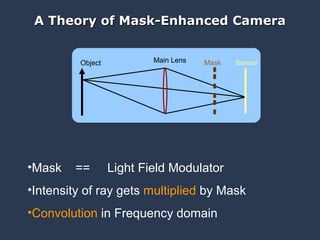
A Theory of Mask-Enhanced Camera Mask  ==  Light Field Modulator Intensity of ray gets  multiplied  by Mask Convolution  in Frequency domain Main Lens Object Mask Sensor
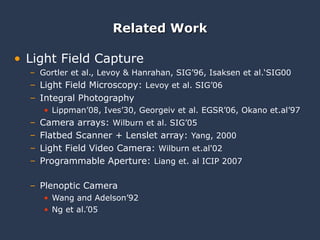
Related Work Light Field Capture Gortler et al., Levoy & Hanrahan, SIG’96, Isaksen et al.‘SIG00 Light Field Microscopy:  Levoy et al. SIG’06 Integral Photography Lippman’08, Ives’30, Georgeiv et al. EGSR’06, Okano et.al’97 Camera arrays:  Wilburn et al. SIG’05 Flatbed Scanner + Lenslet array:  Yang, 2000  Light Field Video Camera:  Wilburn et.al'02 Programmable Aperture:  Liang et. al ICIP 2007  Plenoptic Camera Wang and Adelson’92 Ng et al.’05
f θ f x f θ 0 f x0 Band-limited Light Field Sensor Slice – Fourier Slice Theorem Photo = Slice of Light Field in Fourier Domain  [Ren Ng, SIGGRAPH 2005]
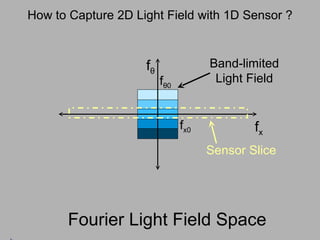
How to Capture 2D Light Field with 1D Sensor ? f θ f x f θ 0 f x0 Band-limited Light Field Sensor Slice Fourier Light Field Space
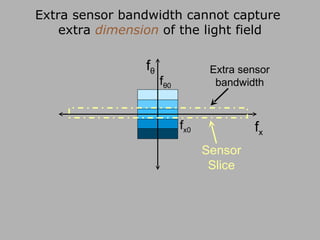
Extra sensor bandwidth cannot capture  extra  dimension  of the light field f θ f x f θ 0 f x0 Sensor Slice Extra sensor bandwidth
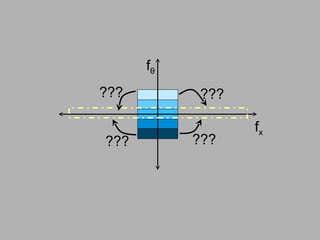
f θ f x ??? ??? ??? ???
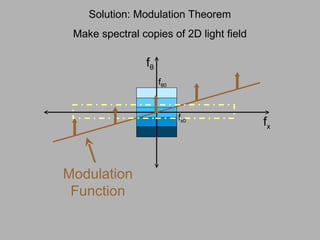
Solution: Modulation Theorem Make spectral copies of 2D light field f θ f x f θ 0 f x0 Modulation Function
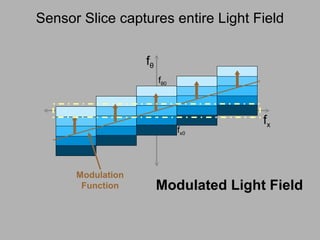
f θ Modulated Light Field f x f θ 0 f x0 Modulation Function Sensor Slice captures entire Light Field
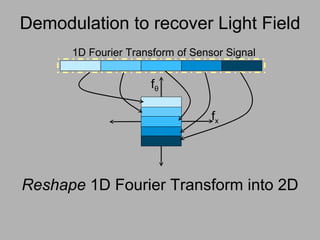
Demodulation to recover Light Field f θ f x Reshape  1D Fourier Transform into 2D 1D Fourier Transform of Sensor Signal
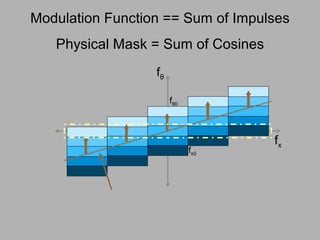
f θ f x f θ 0 f x0 Modulation Function == Sum of Impulses Physical Mask = Sum of Cosines
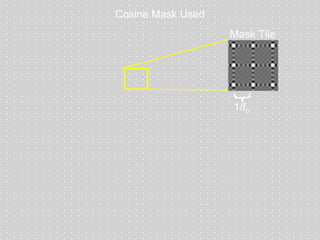
1/f 0 Mask Tile Cosine Mask Used
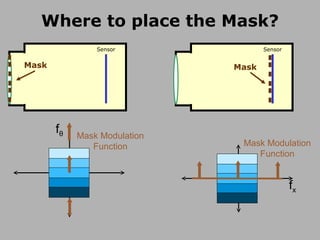
Where to place the Mask? Mask Sensor Mask Modulation Function Mask Modulation Function f x f θ Mask Sensor
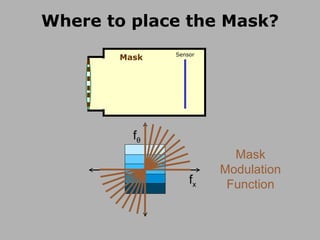
Mask Sensor Where to place the Mask? Mask Modulation Function f x f θ
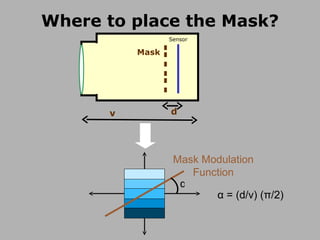
Mask Sensor d v α α  = (d/v) ( π /2) Where to place the Mask? Mask Modulation Function
Captured 2D Photo Encoding due to Cosine Mask
Computing 4D Light Field 2D Sensor Photo, 1800*1800 2D Fourier Transform  2D FFT Rearrange 2D tiles into 4D planes 200*200*9*9 4D IFFT 4D Light Field 9*9=81 spectral copies 200*200*9*9
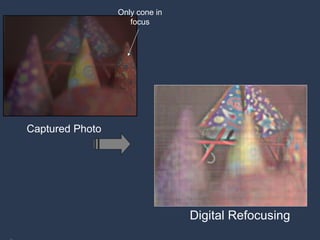
Digital Refocusing Only cone in focus Captured Photo
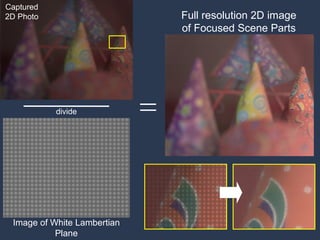
Full resolution 2D image of Focused Scene Parts Captured 2D Photo Image of White Lambertian Plane divide
Coding and Modulation in Camera Using Masks Coded Aperture for Full Resolution Digital Refocusing Heterodyne Light Field Camera Mask? Sensor Mask Sensor Mask Sensor
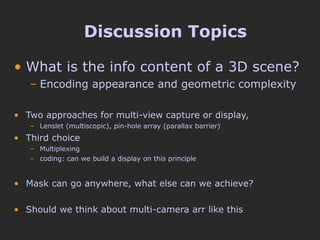
Discussion Topics What is the info content of a 3D scene? Encoding appearance and geometric complexity Two approaches for multi-view capture or display,  Lenslet (multiscopic), pin-hole array (parallax barrier) Third choice  Multiplexing coding: can we build a display on this principle Mask can go anywhere, what else can we achieve? Should we think about multi-camera arr like this
Mask-based Approaches Coded Illumination Motion Capture  [2007] 6D Display Lighting aware  [2008] Optical Heterodyning Light Field Capture  [2007] http://raskar.info
Discussion Topics What is the info content of a 3D scene? Encoding appearance and geometric complexity What are the dimensions beyond viewpt? Lighting? What other optical sensors we can use? What are other display technologies? Materials, configuration

Raskar Banff

  • 1.
    Media Lab, MITCambridge, MA From 4D Capture to 6D Display: A mask-based approach Ramesh Raskar
  • 2.
    Discussion Topics Whatis the info content of a 3D scene? Encoding appearance and geometric complexity What are the dimensions beyond viewpt? Lighting? What other optical sensors we can use?
  • 3.
    R Raskar, HNii, B de Decker, Y Hashimoto, J Summet, D Moore, Y Zhao, J Westhues, P Dietz, M Inami, S Nayar, J Barnwell, M Noland, P Bekaert, V Branzoi, E Bruns Siggraph 2007 Prakash: Lighting-Aware Motion Capture Using Photosensing Markers and Multiplexed Illuminators
  • 4.
    Vicon Motion Capture High-speed IR Camera Medical Rehabilitation Athlete Analysis Performance Capture Biomechanical Analysis
  • 5.
    Imperceptible Tags underclothing, tracked under ambient light Hidden Marker Tags Outdoors Unique Id
  • 6.
    Labeling Space (IndoorGPS) Each location receives a unique temporal code But 60Hz video projector is too slow Projector Tags Pos=0 Pos=25 5 Time
  • 7.
    Pattern MSB PatternMSB-1 Pattern LSB For each tag From light sequence, decode x and y coordinate Transmit back to RF reader ( Id , x, y ) 0 1 1 0 0 X=12
  • 8.
  • 9.
  • 10.
    Analog Space LabelingMulti-LED Beacon 1 Beacon 2 Beacon 3 Tag N ?
  • 11.
  • 12.
  • 13.
  • 14.
  • 15.
    Inverse Optical Mo-Cap High Speed Camera Detect blobs in each frame Reflective/Emitting Marker Disambiguate in camera Only Location High Speed Projector Label the 3D space Photosensing Marker Find ego-position Location, Orientation, Illum
  • 16.
    On-set MoCap: Location + Orientation + Incident Illumination
  • 17.
    Coded Illumination Sensor Skin 500 Hz with Id for each Marker Tag Capture in Natural Environment Visually imperceptible tags Photosensing Tag can be hidden under clothes Ambient lighting is ok Unlimited Number of Tags Light sensitive fabric for dense sampling Non-imaging, complete privacy Base station and tags only a few 10’s $ Body scan + bio Elderly, patients, athletes, performers
  • 18.
    Project Topics StructuredLight Scanning Fast Stripping Can you build a scanner using very low cost hardware? Without full 2D cameras or video projectors? Global-direct Separation Can you scan difficult (global effect) using direct/global separation?
  • 19.
    Towards a 6DDisplay Passive Reflectance Field Display Martin Fuchs, Ramesh Raskar, Hans-Peter Seidel, Hendrik P. A. Lensch Siggraph 2008 1 2 1 1 1 MPI Informatik, Germany 2 MIT
  • 20.
  • 21.
    [Lippman 1908] [Nakajimaet al. 2001] ... Martin Fuchs <mfuchs@mpi-inf.mpg.de>
  • 22.
    electronic: [Nayar etal. 2004] slit based / different patterns: [Scharstein 1996] Martin Fuchs <mfuchs@mpi-inf.mpg.de>
  • 23.
  • 24.
  • 25.
  • 26.
  • 27.
    Improved Design MartinFuchs <mfuchs@mpi-inf.mpg.de>
  • 28.
    Variance with ObserverMartin Fuchs <mfuchs@mpi-inf.mpg.de> recall:
  • 29.
  • 30.
  • 31.
  • 32.
    Observer-Variance Martin Fuchs<mfuchs@mpi-inf.mpg.de>
  • 33.
    6D Construction MartinFuchs <mfuchs@mpi-inf.mpg.de>
  • 34.
    Illumination + SpatialVariation Martin Fuchs <mfuchs@mpi-inf.mpg.de>
  • 35.
    Variance with ObservationAngle Martin Fuchs <mfuchs@mpi-inf.mpg.de>
  • 36.
    Towards 6D MartinFuchs <mfuchs@mpi-inf.mpg.de>
  • 37.
    6D Results MartinFuchs <mfuchs@mpi-inf.mpg.de>
  • 38.
    Future Work Efficientmanufacturing scale precision How fine can we get our structures? is 6D really practical? Extensions for local illumination ? Martin Fuchs <mfuchs@mpi-inf.mpg.de>
  • 39.
    Coded Aperture CameraThe aperture of a 100 mm lens is modified Rest of the camera is unmodified Insert a coded mask with chosen binary pattern
  • 40.
  • 41.
    Out of FocusPhoto: Open Aperture
  • 42.
    Out of FocusPhoto: Coded Aperture
  • 43.
  • 44.
  • 45.
    Mask? Sensor 4DLight Field from 2D Photo: Heterodyne Light Field Camera Full Resolution Digital Refocusing: Coded Aperture Camera Mask? Sensor Mask Sensor Mask? Sensor Mask Sensor
  • 46.
  • 47.
    Lenslet-based Light Fieldcamera [Adelson and Wang, 1992, Ng et al. 2005 ] Light Field Inside a Camera
  • 48.
    Stanford Plenoptic Camera [Ng et al 2005] 4000 × 4000 pixels ÷ 292 × 292 lenses = 14 × 14 pixels per lens Contax medium format camera Kodak 16-megapixel sensor Adaptive Optics microlens array 125 μ square-sided microlenses
  • 49.
    Digital Refocusing[Ng et al 2005] Can we achieve this with a Mask alone?
  • 50.
    Mask based LightField Camera [Veeraraghavan, Raskar, Agrawal, Tumblin, Mohan, Siggraph 2007 ] Mask Sensor
  • 51.
    Heterodyne Light FieldCamera Scanner sensor Mask [Veeraraghavan, Raskar, Agrawal, Tumblin, Mohan, Siggraph 2007 ] Mask Sensor
  • 52.
    How to Capture 4D Light Field with 2D Sensor ? What should be the pattern of the mask ?
  • 53.
    Radio Frequency HeterodyningReceiver: Demodulation High Freq Carrier 100 MHz Reference Carrier Incoming Signal 99 MHz Baseband Audio Signal
  • 54.
    Optical Heterodyning PhotographicSignal (Light Field) Carrier Incident Modulated Signal Reference Carrier Main Lens Object Mask Sensor Recovered Light Field Software Demodulation Baseband Audio Signal Receiver: Demodulation High Freq Carrier 100 MHz Reference Carrier Incoming Signal 99 MHz
  • 55.
    Captured 2D PhotoEncoding due to Mask
  • 56.
    2D FFT TraditionalCamera Photo Heterodyne Camera Photo Magnitude of 2D FFT 2D FFT Magnitude of 2D FFT
  • 57.
    Computing 4D LightField 2D Sensor Photo, 1800*1800 2D Fourier Transform, 1800*1800 2D FFT Rearrange 2D tiles into 4D planes 200*200*9*9 4D IFFT 4D Light Field 9*9=81 spectral copies 200*200*9*9
  • 58.
    A Theory ofMask-Enhanced Camera Mask == Light Field Modulator Intensity of ray gets multiplied by Mask Convolution in Frequency domain Main Lens Object Mask Sensor
  • 59.
    Related Work LightField Capture Gortler et al., Levoy & Hanrahan, SIG’96, Isaksen et al.‘SIG00 Light Field Microscopy: Levoy et al. SIG’06 Integral Photography Lippman’08, Ives’30, Georgeiv et al. EGSR’06, Okano et.al’97 Camera arrays: Wilburn et al. SIG’05 Flatbed Scanner + Lenslet array: Yang, 2000 Light Field Video Camera: Wilburn et.al'02 Programmable Aperture: Liang et. al ICIP 2007 Plenoptic Camera Wang and Adelson’92 Ng et al.’05
  • 60.
    f θ fx f θ 0 f x0 Band-limited Light Field Sensor Slice – Fourier Slice Theorem Photo = Slice of Light Field in Fourier Domain [Ren Ng, SIGGRAPH 2005]
  • 61.
    How to Capture2D Light Field with 1D Sensor ? f θ f x f θ 0 f x0 Band-limited Light Field Sensor Slice Fourier Light Field Space
  • 62.
    Extra sensor bandwidthcannot capture extra dimension of the light field f θ f x f θ 0 f x0 Sensor Slice Extra sensor bandwidth
  • 63.
    f θ fx ??? ??? ??? ???
  • 64.
    Solution: Modulation TheoremMake spectral copies of 2D light field f θ f x f θ 0 f x0 Modulation Function
  • 65.
    f θ ModulatedLight Field f x f θ 0 f x0 Modulation Function Sensor Slice captures entire Light Field
  • 66.
    Demodulation to recoverLight Field f θ f x Reshape 1D Fourier Transform into 2D 1D Fourier Transform of Sensor Signal
  • 67.
    f θ fx f θ 0 f x0 Modulation Function == Sum of Impulses Physical Mask = Sum of Cosines
  • 68.
    1/f 0 MaskTile Cosine Mask Used
  • 69.
    Where to placethe Mask? Mask Sensor Mask Modulation Function Mask Modulation Function f x f θ Mask Sensor
  • 70.
    Mask Sensor Whereto place the Mask? Mask Modulation Function f x f θ
  • 71.
    Mask Sensor dv α α = (d/v) ( π /2) Where to place the Mask? Mask Modulation Function
  • 72.
    Captured 2D PhotoEncoding due to Cosine Mask
  • 73.
    Computing 4D LightField 2D Sensor Photo, 1800*1800 2D Fourier Transform 2D FFT Rearrange 2D tiles into 4D planes 200*200*9*9 4D IFFT 4D Light Field 9*9=81 spectral copies 200*200*9*9
  • 74.
    Digital Refocusing Onlycone in focus Captured Photo
  • 75.
    Full resolution 2Dimage of Focused Scene Parts Captured 2D Photo Image of White Lambertian Plane divide
  • 76.
    Coding and Modulationin Camera Using Masks Coded Aperture for Full Resolution Digital Refocusing Heterodyne Light Field Camera Mask? Sensor Mask Sensor Mask Sensor
  • 77.
    Discussion Topics Whatis the info content of a 3D scene? Encoding appearance and geometric complexity Two approaches for multi-view capture or display, Lenslet (multiscopic), pin-hole array (parallax barrier) Third choice Multiplexing coding: can we build a display on this principle Mask can go anywhere, what else can we achieve? Should we think about multi-camera arr like this
  • 78.
    Mask-based Approaches CodedIllumination Motion Capture [2007] 6D Display Lighting aware [2008] Optical Heterodyning Light Field Capture [2007] http://raskar.info
  • 79.
    Discussion Topics Whatis the info content of a 3D scene? Encoding appearance and geometric complexity What are the dimensions beyond viewpt? Lighting? What other optical sensors we can use? What are other display technologies? Materials, configuration