Introduction to Light Fields
The 5D Plenoptic Function
Q: What is the set of all things that one can ever see?
A: The Plenoptic Function [Adelson and Bergen 1991]
(from plenus, complete or full, and optic)
P(q, f, l, t)
The 5D Plenoptic Function
Q: What is the set of all things that one can ever see?
A: The Plenoptic Function [Adelson and Bergen 1991]
(from plenus, complete or full, and optic)
P(q, f, l, t)
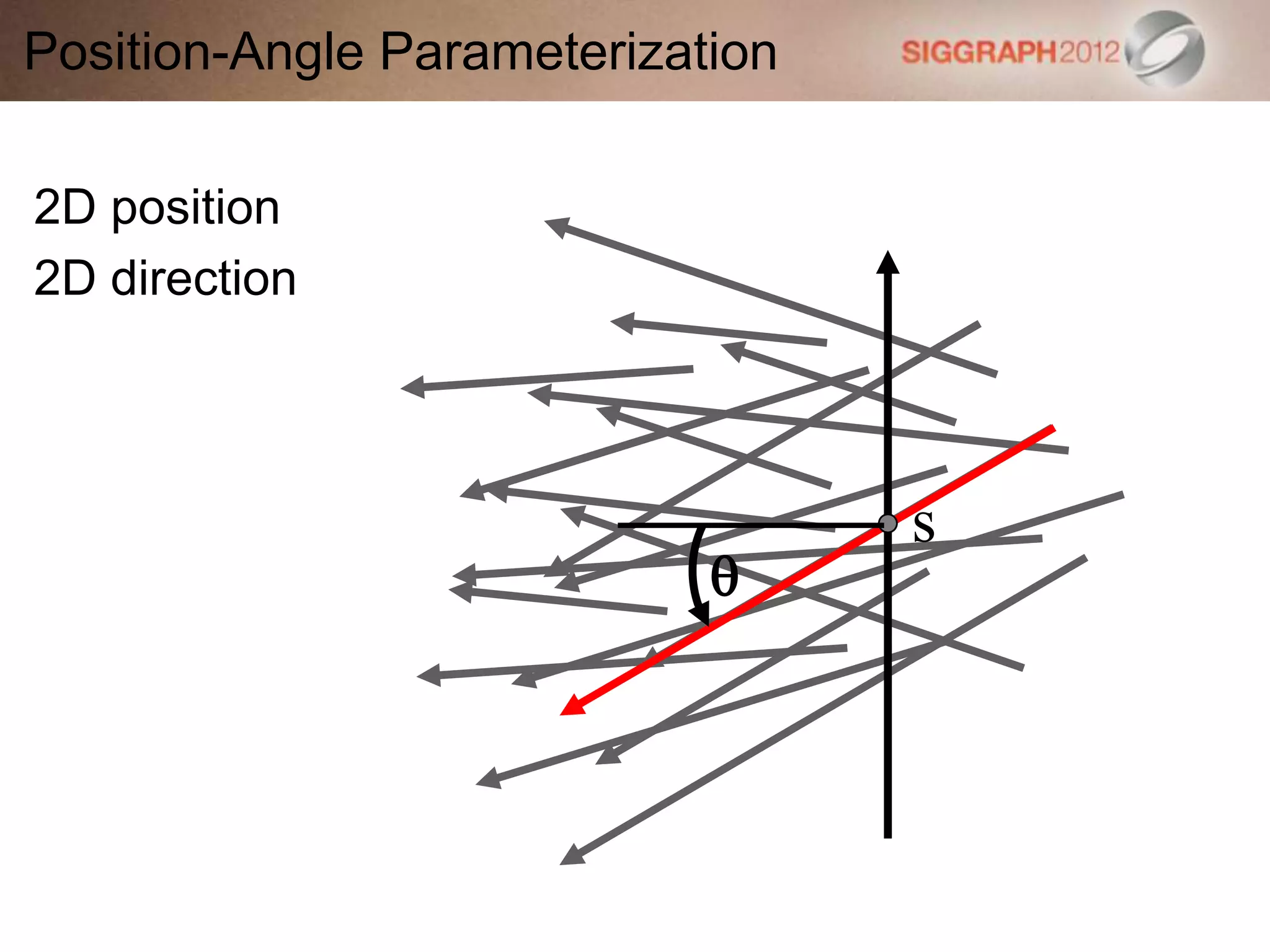
Position-Angle Parameterization
2D position
2D direction
s
q
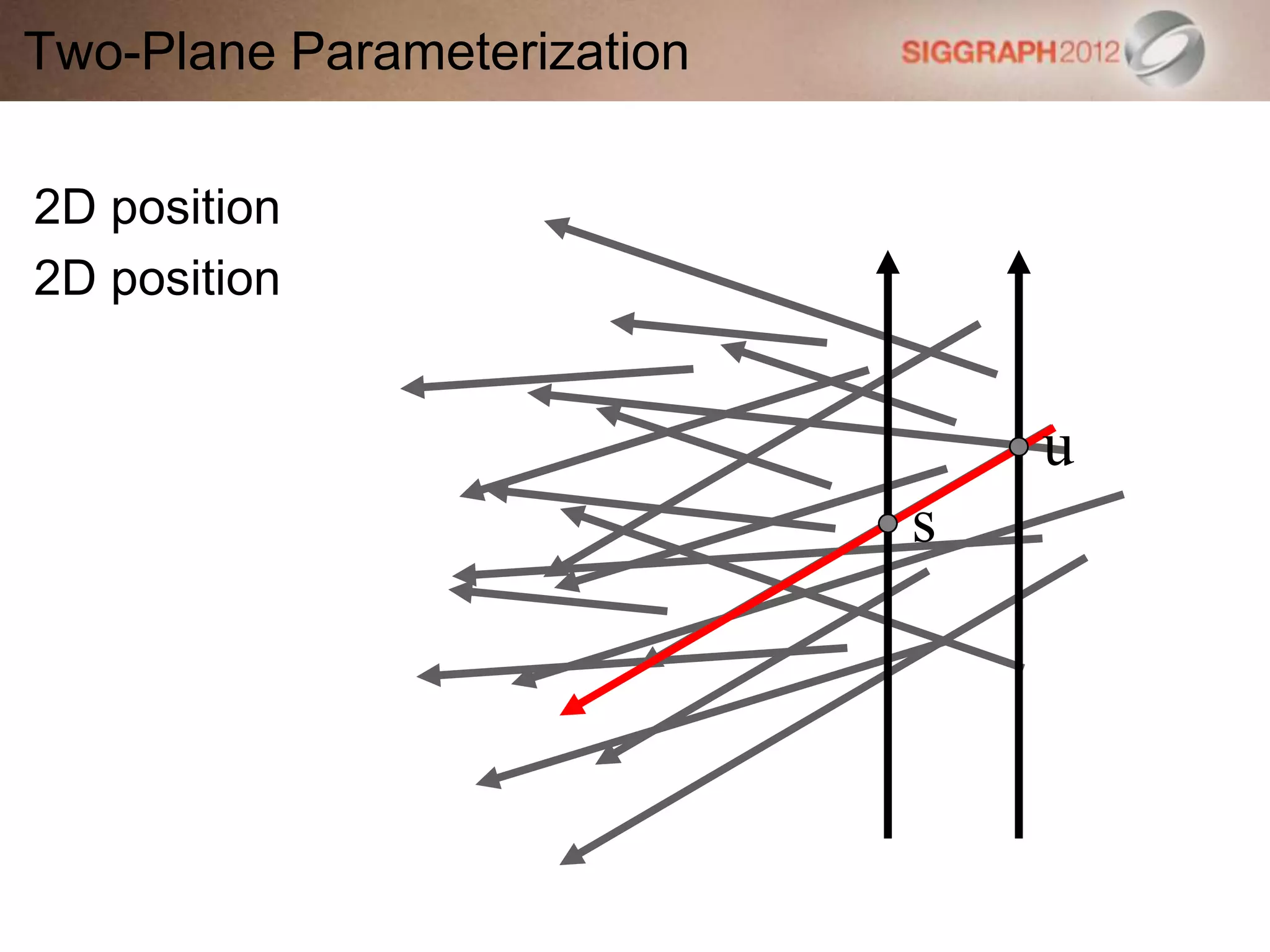
Two-Plane Parameterization
2D position
2D position
s
u
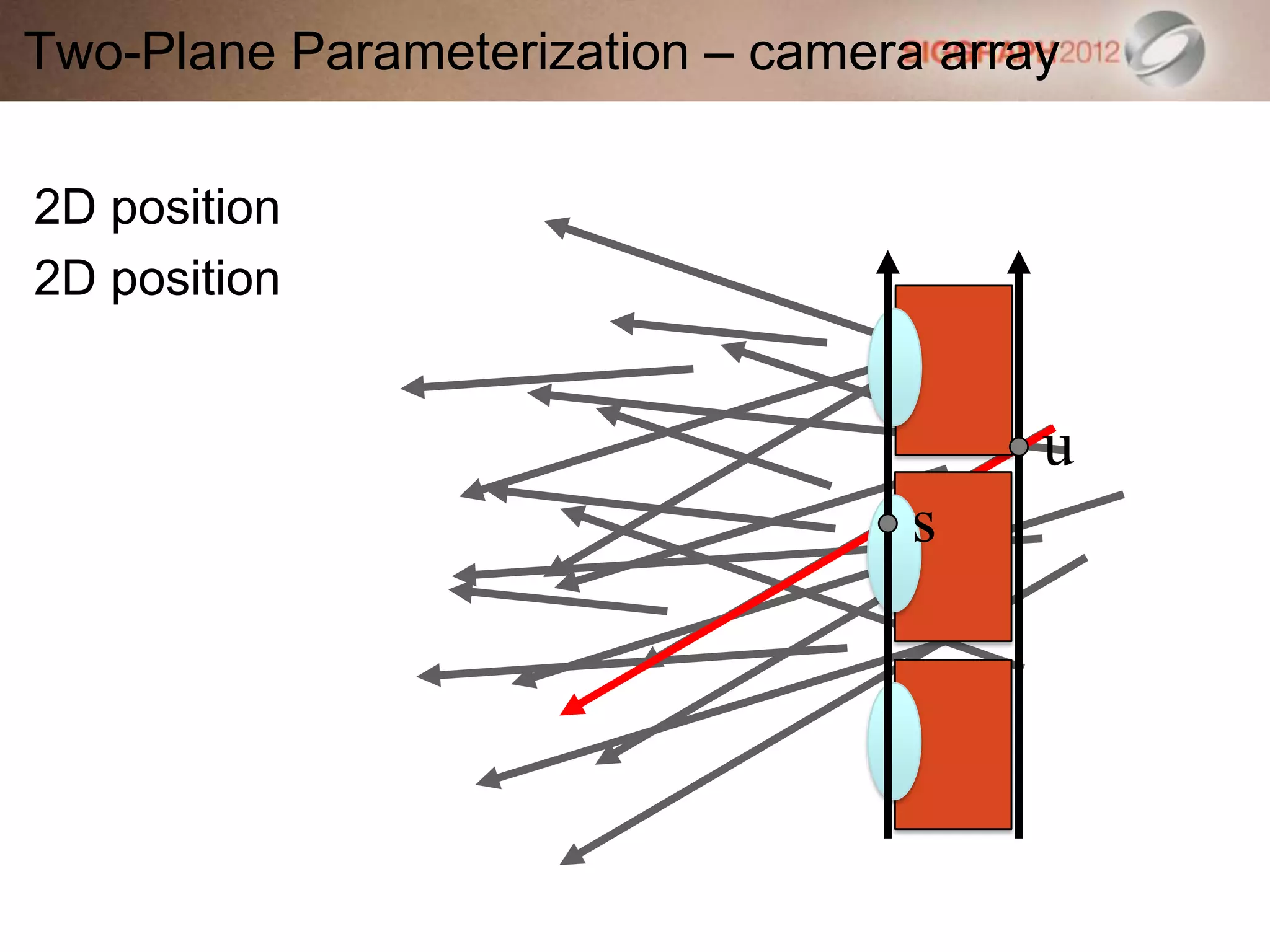
Two-Plane Parameterization – camera array
2D position
2D position
s
u
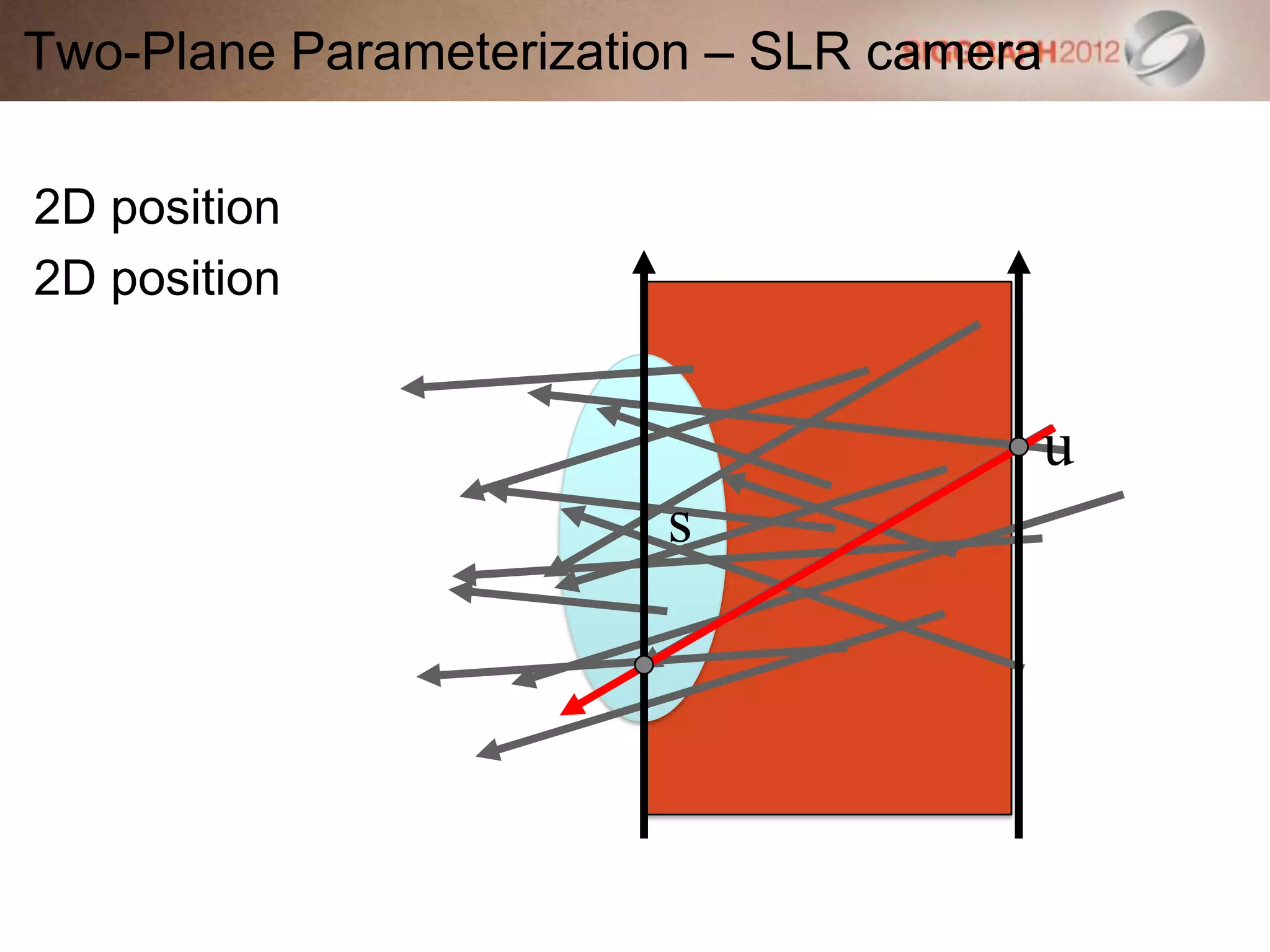
Two-Plane Parameterization – SLR camera
2D position
2D position
s
u
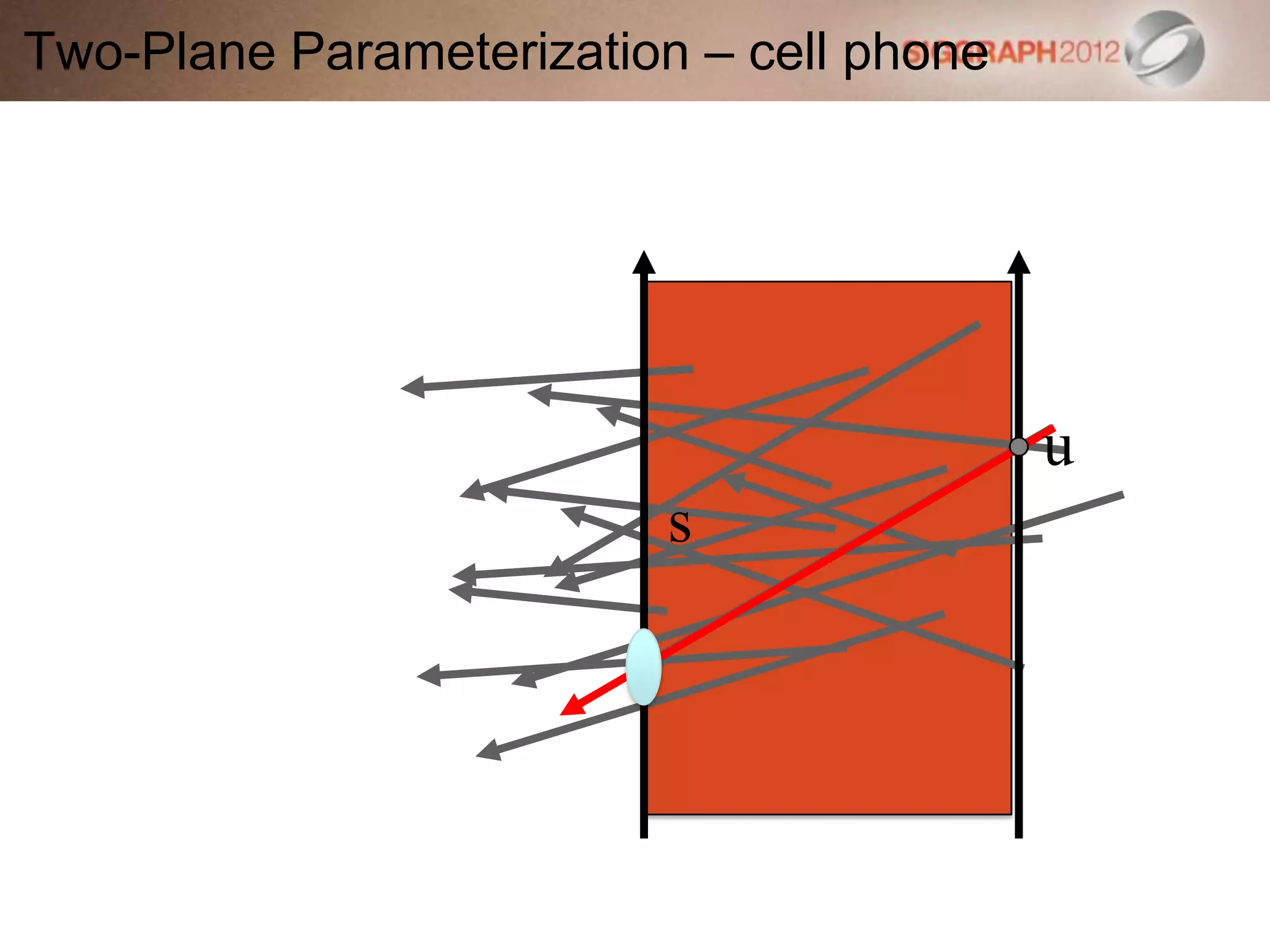
Two-Plane Parameterization – cell phone
s
u
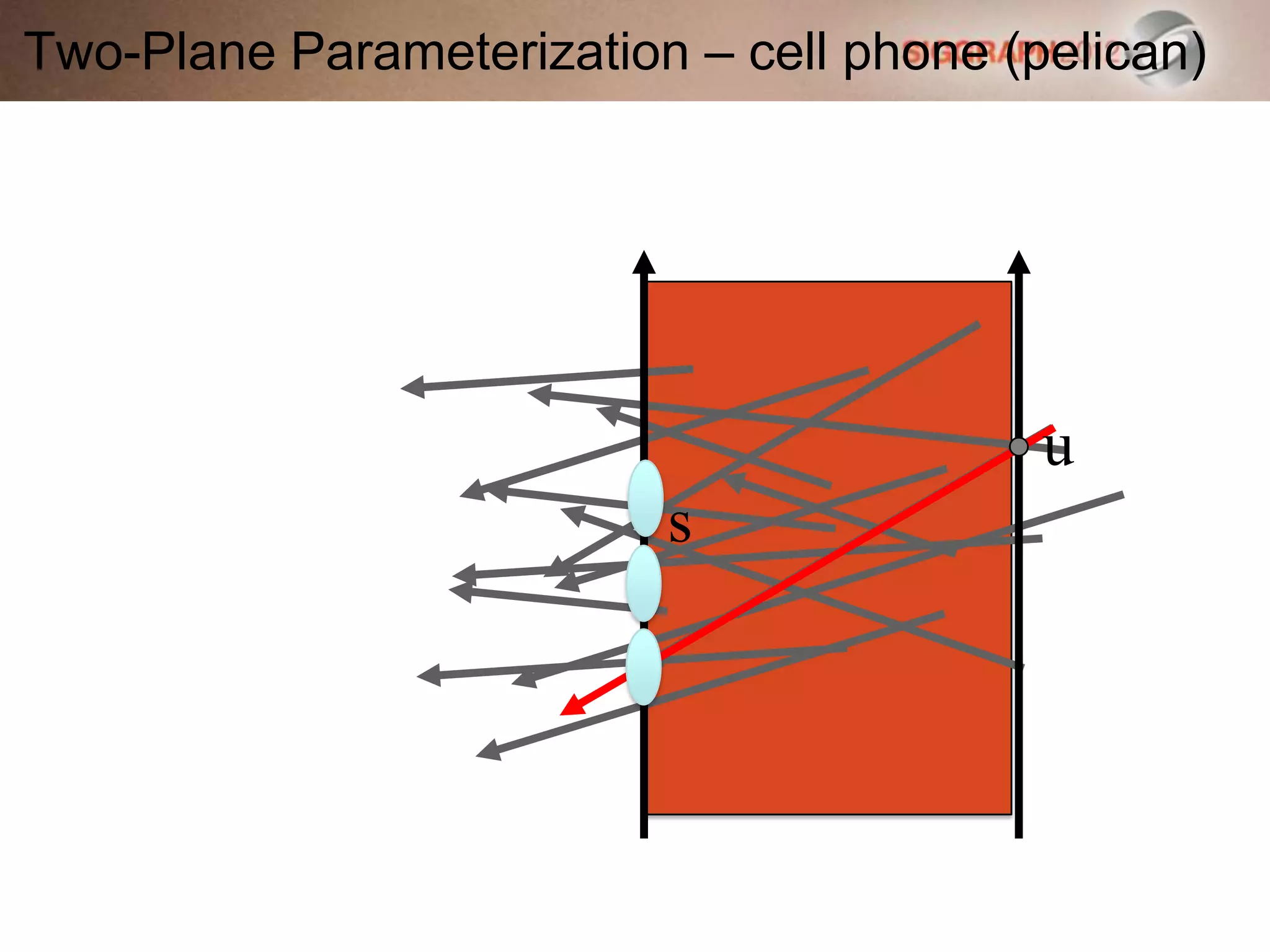
Two-Plane Parameterization – cell phone (pelican)
s
u
Application: Digital Image Refocusing
[Ng 2005]
Kodak 16-megapixel sensor
125μ square-sided microlenses
Application: 3D Displays
Parallax Panoramagram
[Kanolt 1918]
3DTV with Integral Imaging
[Okano et al. 1999]
MERL 3DTV
[Matusik and Pfister 2004]
Multiple Sensors
Static Camera Arrays
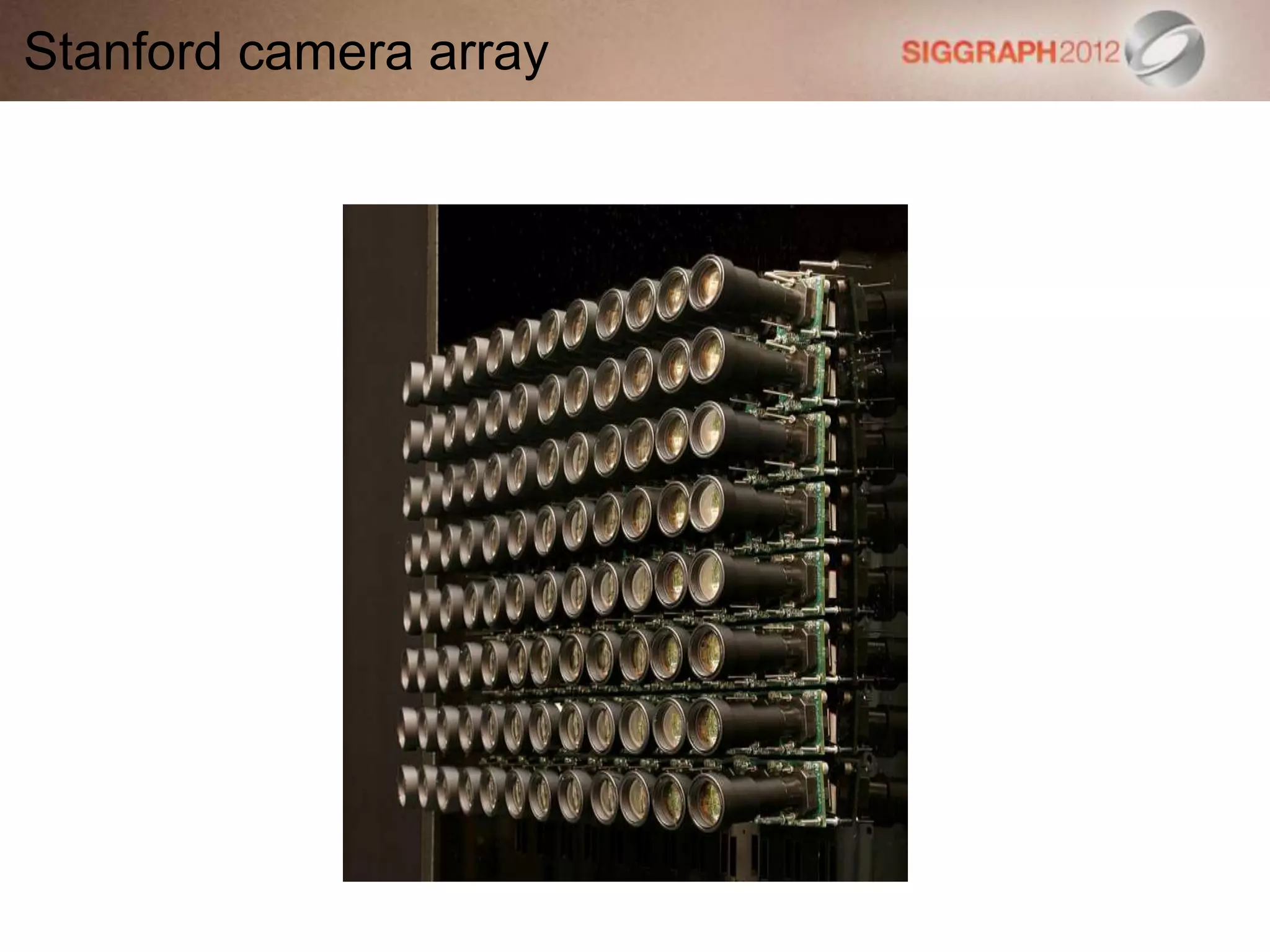
Stanford Multi-Camera Array
125 cameras using custom hardware
[Wilburn et al. 2002, Wilburn et al. 2005]
Distributed Light Field Camera
64 cameras with distributed rendering
[Yang et al. 2002]
Refocus
Temporal Multiplexing
Controlled Camera or Object Motion
Stanford Spherical Gantry
[Levoy and Hanrahan 1996]
Relighting with 4D Incident Light Fields
[Masselus et al. 2003]
Uncontrolled Camera or Object Motion
Unstructured Lumigraph Rendering
[Gortler et al. 1996; Buehler et al. 2001]
Spatial Multiplexing
Parallax Barriers (Pinhole Arrays)
[Ives 1903]
sensor
barrier
Spatially-multiplexed light field capture using masks (i.e., barriers):
• Cause severe attenuation  long exposures or lower SNR
• Impose fixed trade-off between spatial and angular resolution
(unless implemented with programmable masks, e.g. LCDs)
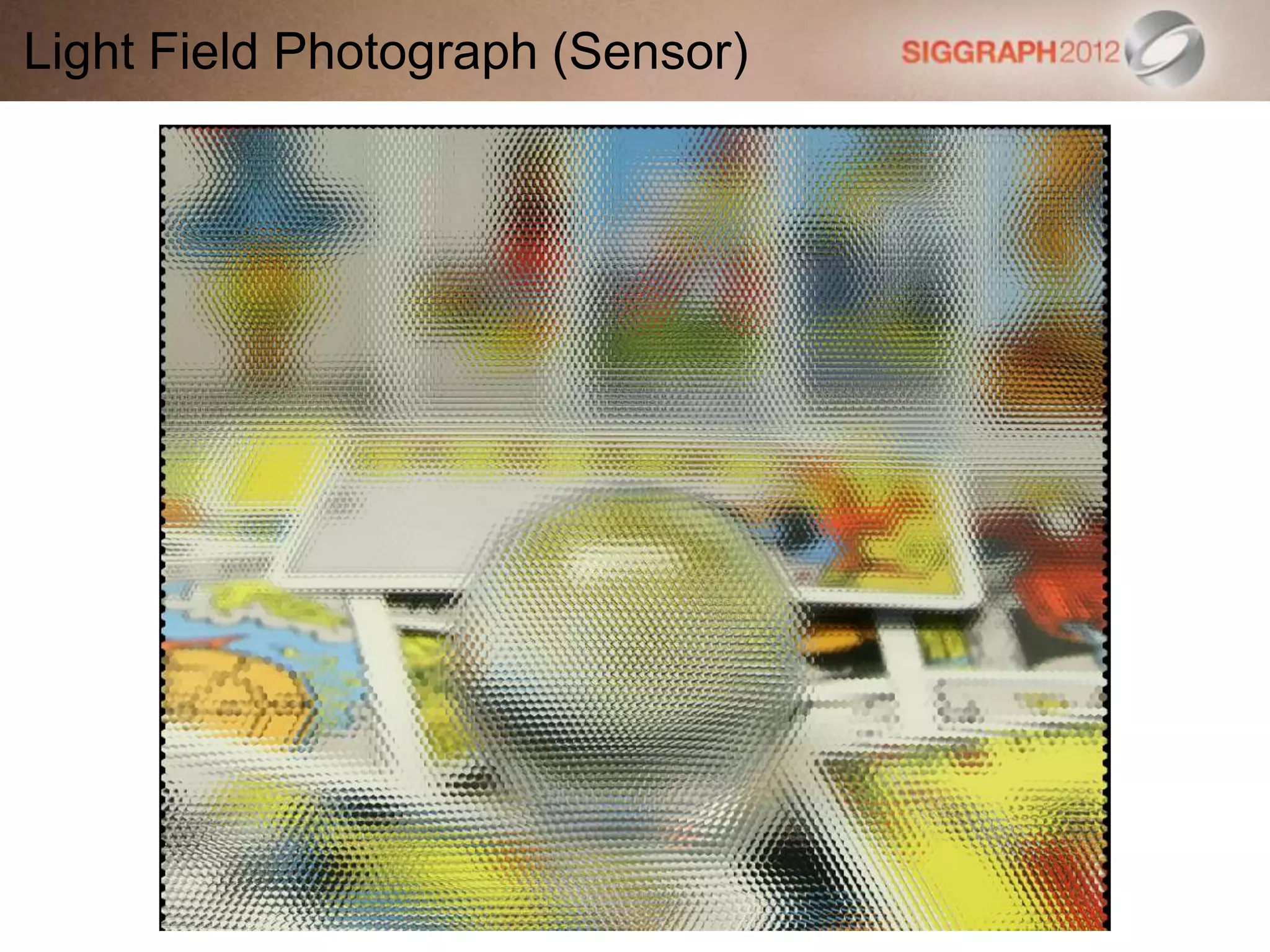
Integral Imaging (“Fly’s Eye” Lenslets)
[Lippmann 1908]
sensor
lenslet
f
Spatially-multiplexed light field capture using lenslets:
• Impose fixed trade-off between spatial and angular resolution
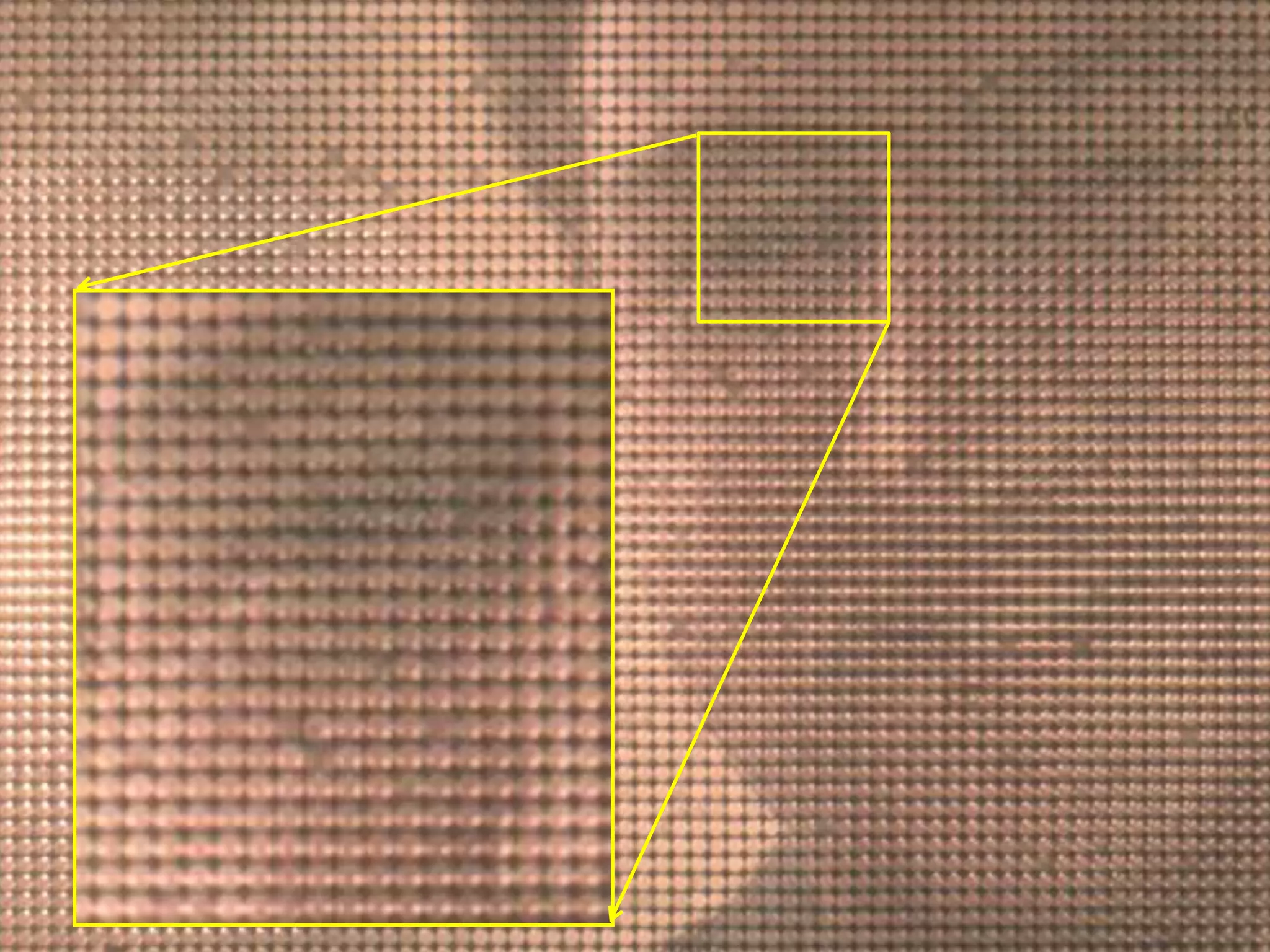
Light Field Photograph (Sensor)
Light Field Photograph (Decoded)
[The (New) Stanford Light Field Archive]
lookingup
looking to the right
Sample Image
DEMO
lenstoys: light field camera
Modern, Digital Implementations
Digital Light Field Photography
• Hand-held plenoptic camera [Ng et al. 2005]
• Heterodyne light field camera [Veeraraghavan et al. 2007]
  Marc Levoy

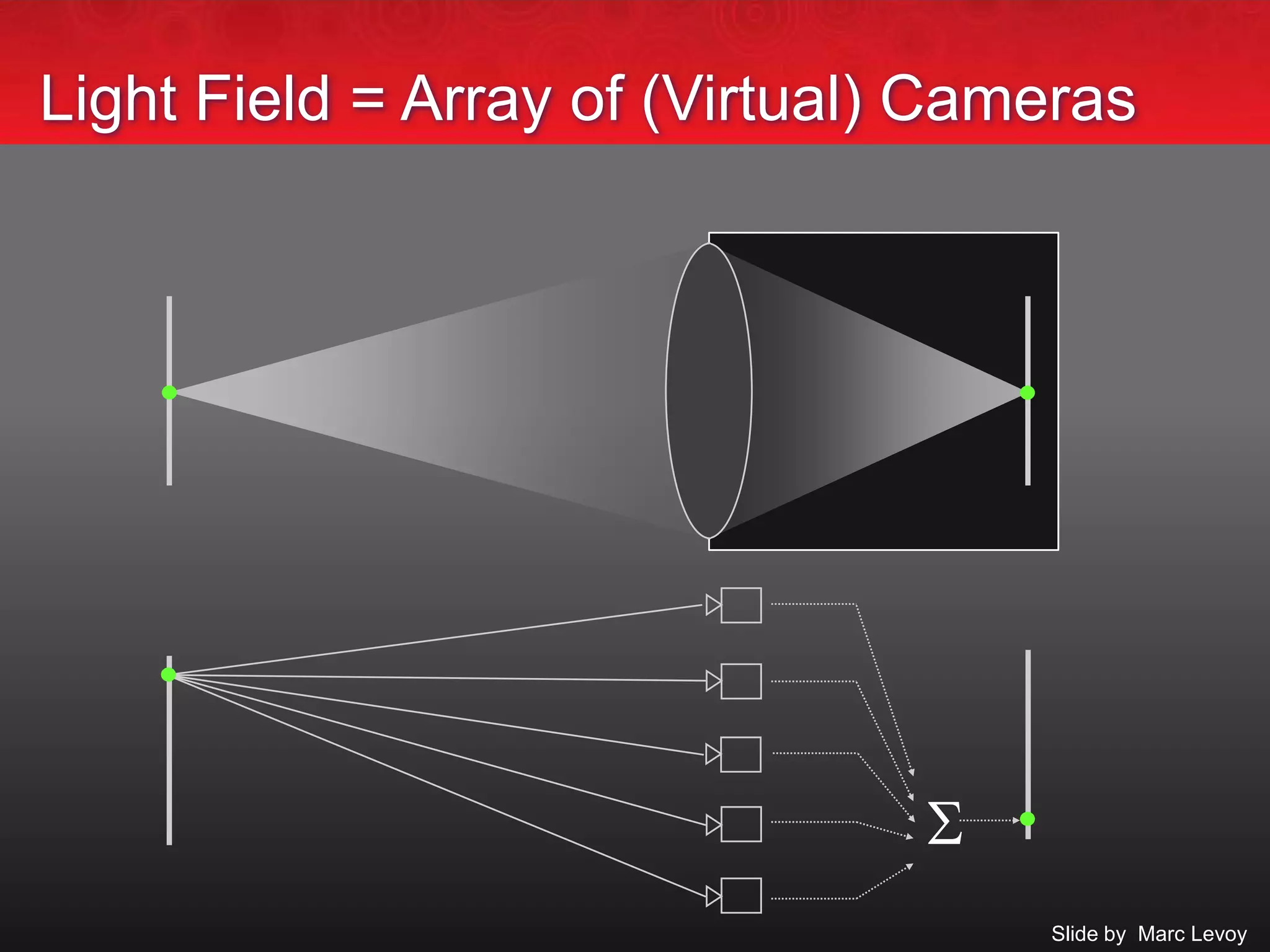
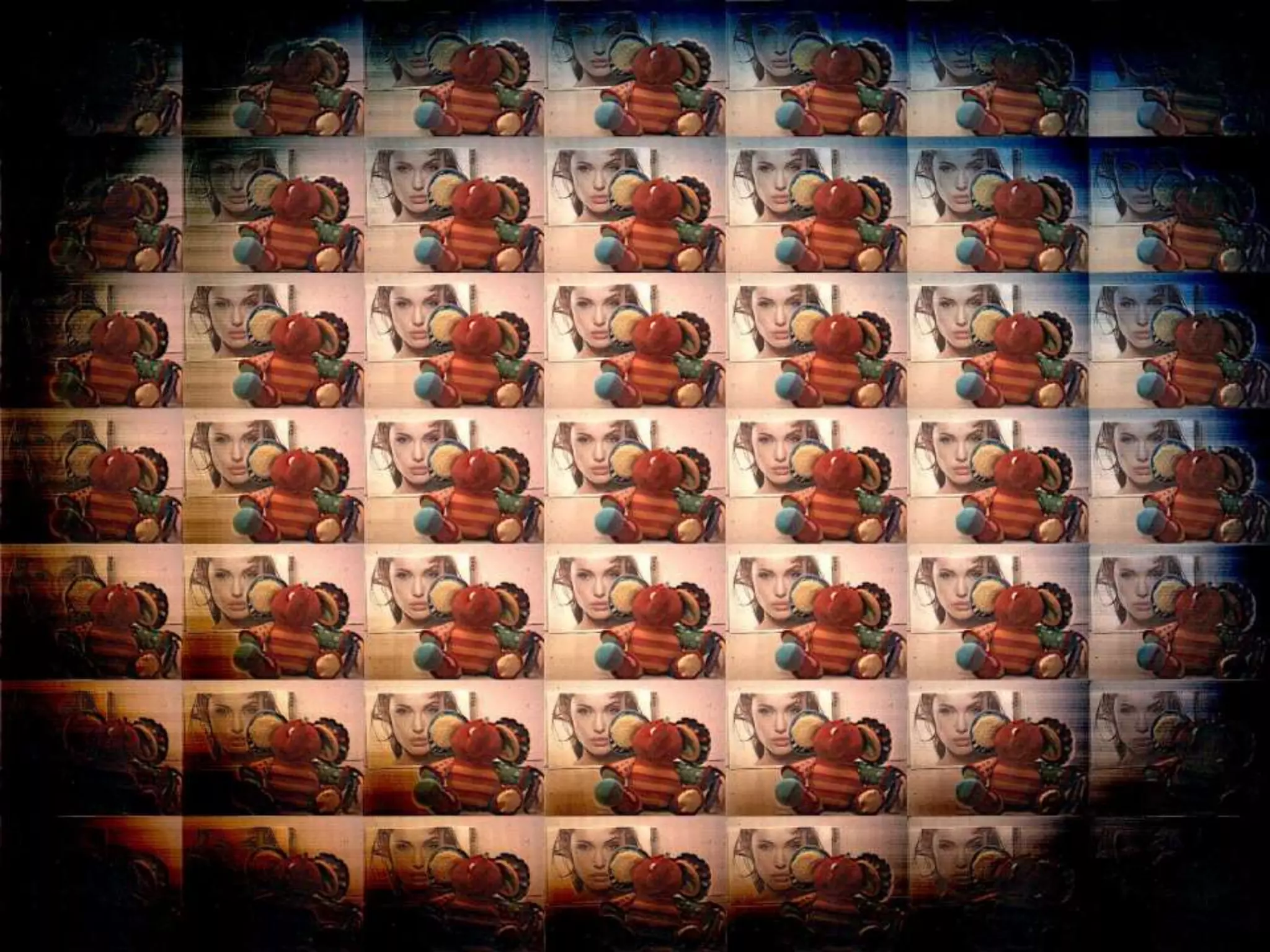
Light Field = Array of (Virtual) Cameras
Slide by Marc Levoy
  Marc Levoy

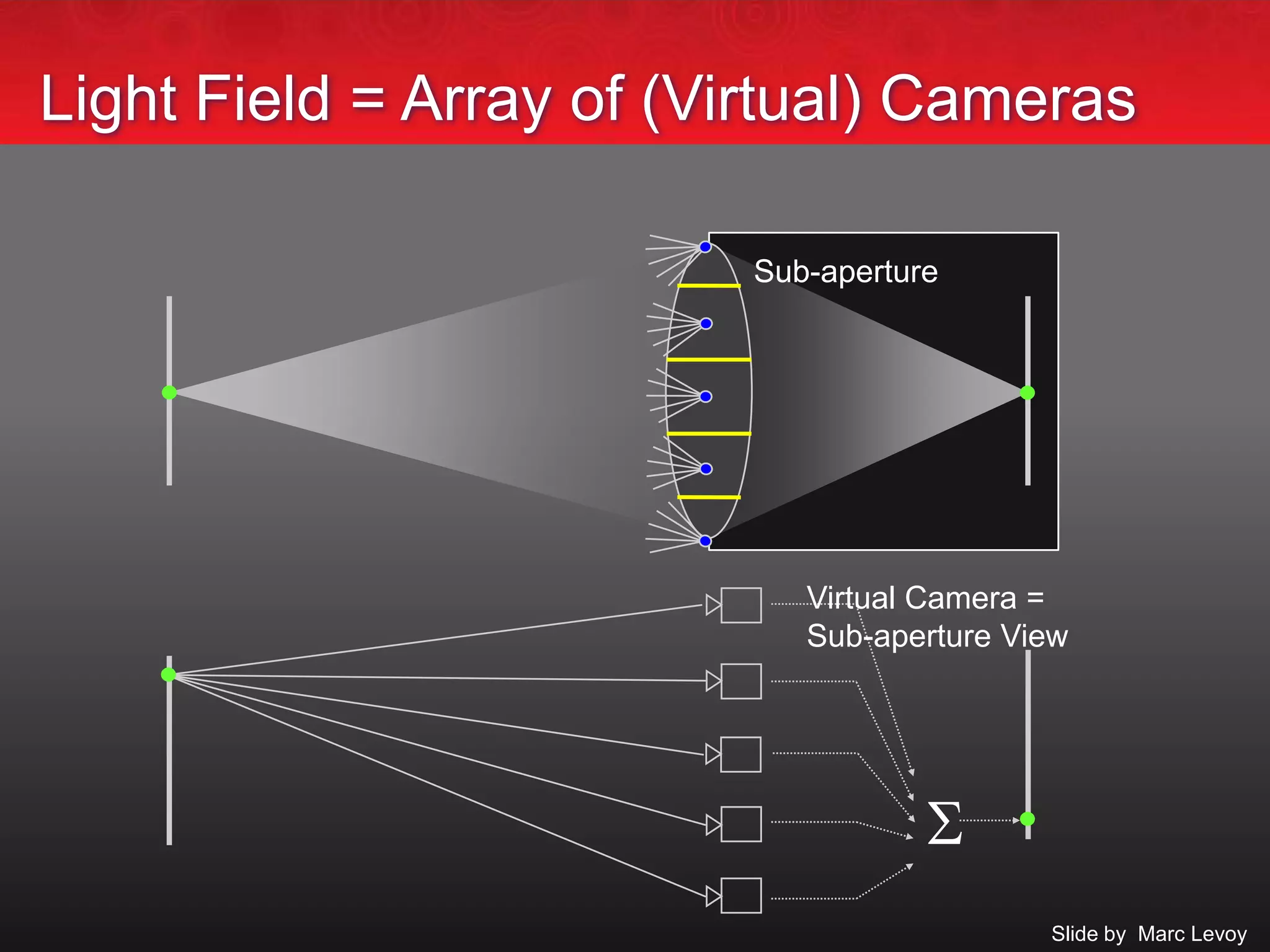
Sub-aperture
Virtual Camera =
Sub-aperture View
Light Field = Array of (Virtual) Cameras
Slide by Marc Levoy
  Marc Levoy

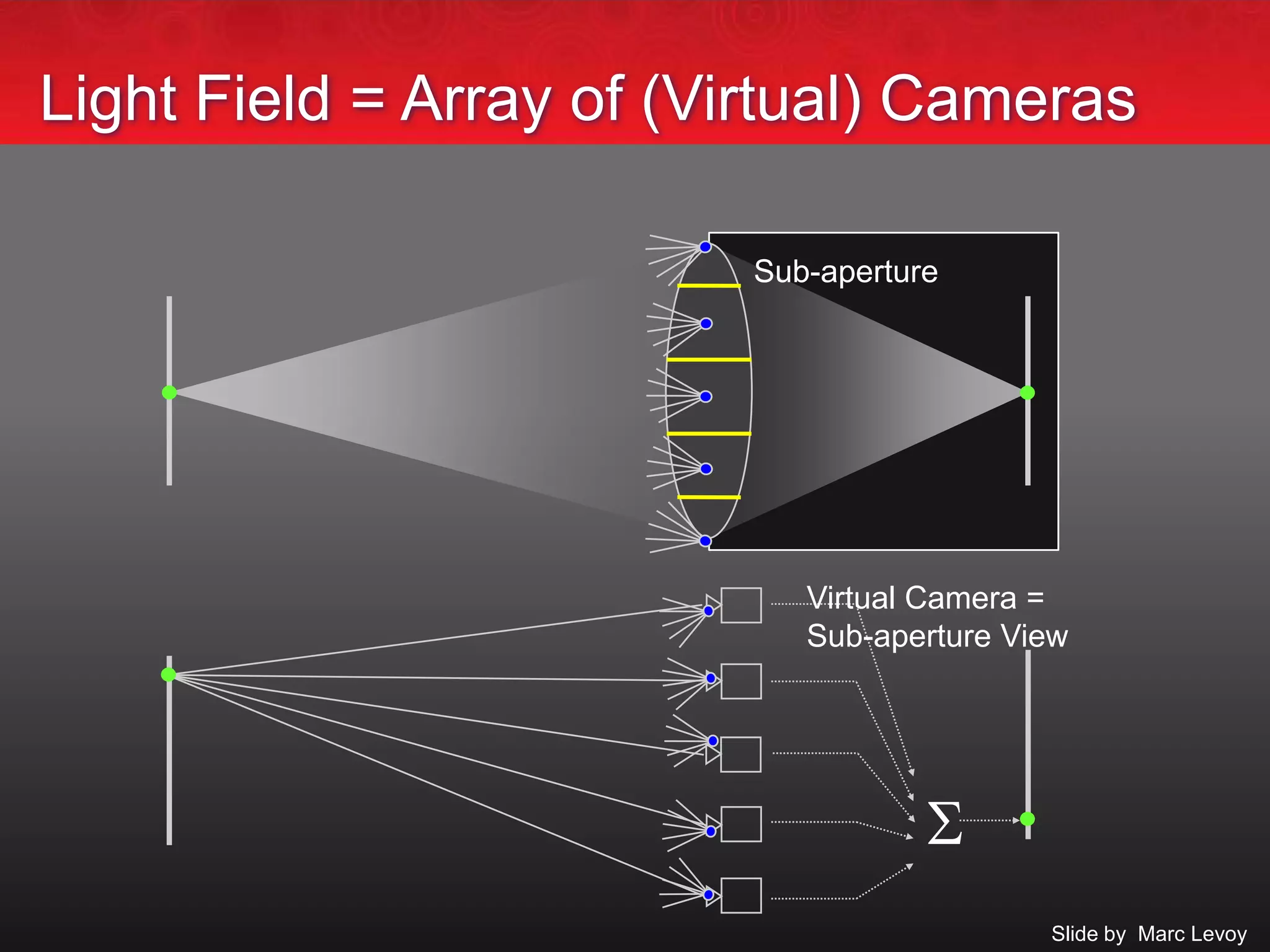
Sub-aperture
Virtual Camera =
Sub-aperture View
Light Field = Array of (Virtual) Cameras
Slide by Marc Levoy
  Marc Levoy
DEMO
http://lightfield.stanford.edu/aperture.swf?lightfield=data/chess_lf/preview.zip&zoom=1
The Lytro Light Field Camera
Stanford camera array
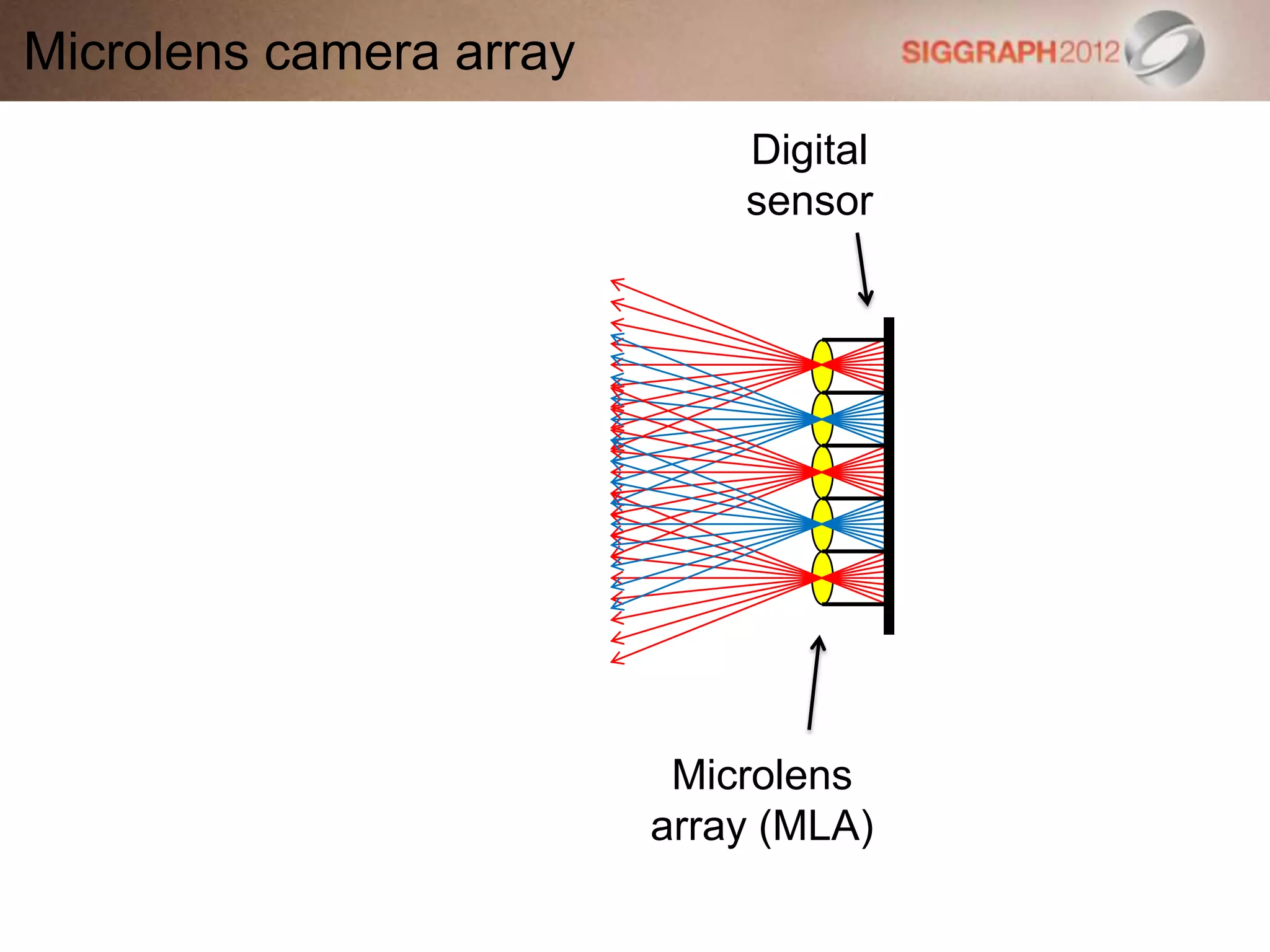
Microlens camera array
Digital
sensor
Microlens
array (MLA)
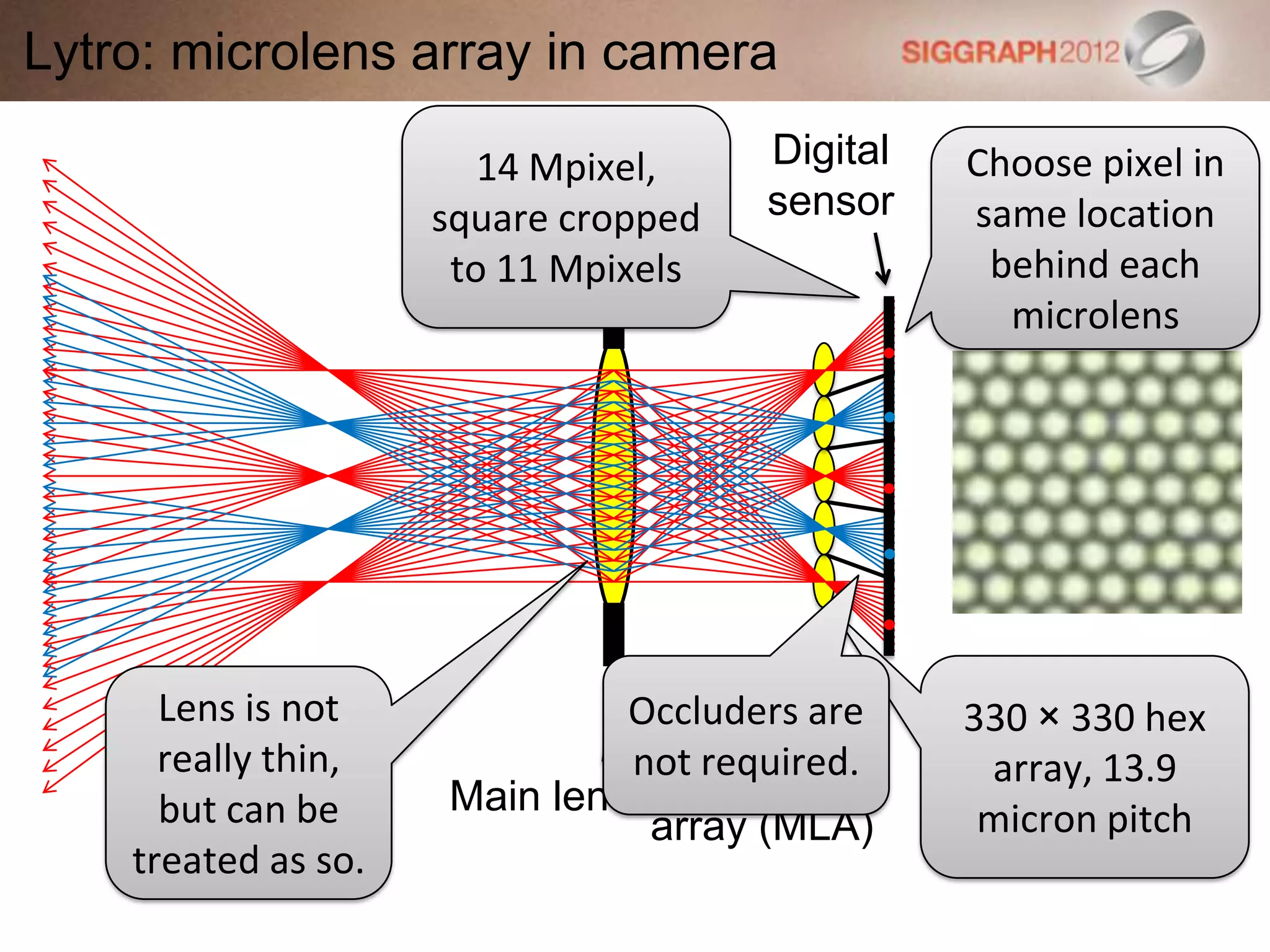
Lytro: microlens array in camera
Main lens
Microlens
array (MLA)
Digital
sensor
Lens is not
really thin,
but can be
treated as so.
330 × 330 hex
array, 13.9
micron pitch
Occluders are
not required.
14 Mpixel,
square cropped
to 11 Mpixels
Choose pixel in
same location
behind each
microlens
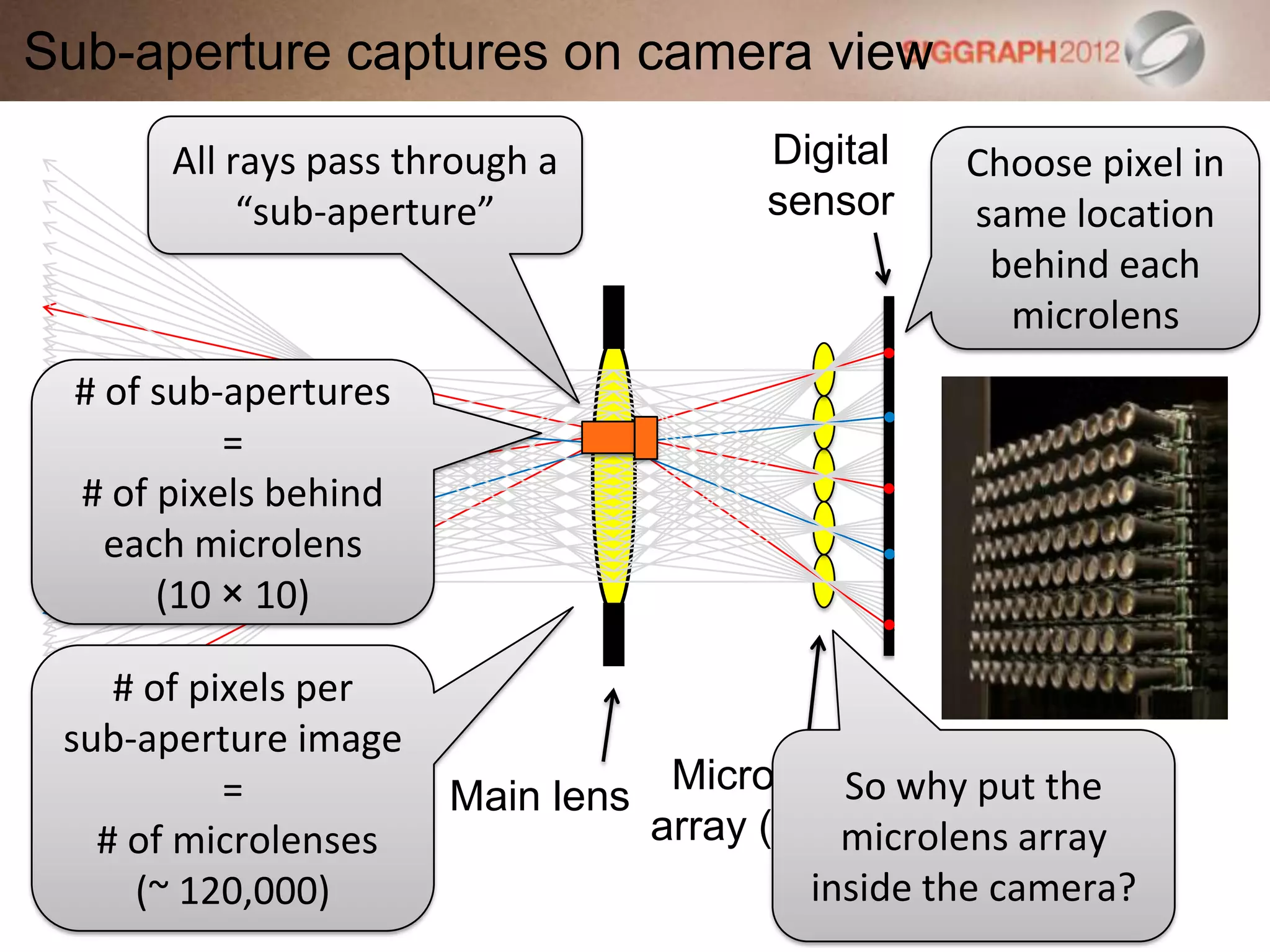
Microlens
array (MLA)
Main lens
Digital
sensor
# of sub-apertures
=
# of pixels behind
each microlens
(10 × 10)
# of pixels per
sub-aperture image
=
# of microlenses
(~ 120,000)
All rays pass through a
“sub-aperture”
Sub-aperture captures on camera view
Choose pixel in
same location
behind each
microlens
So why put the
microlens array
inside the camera?
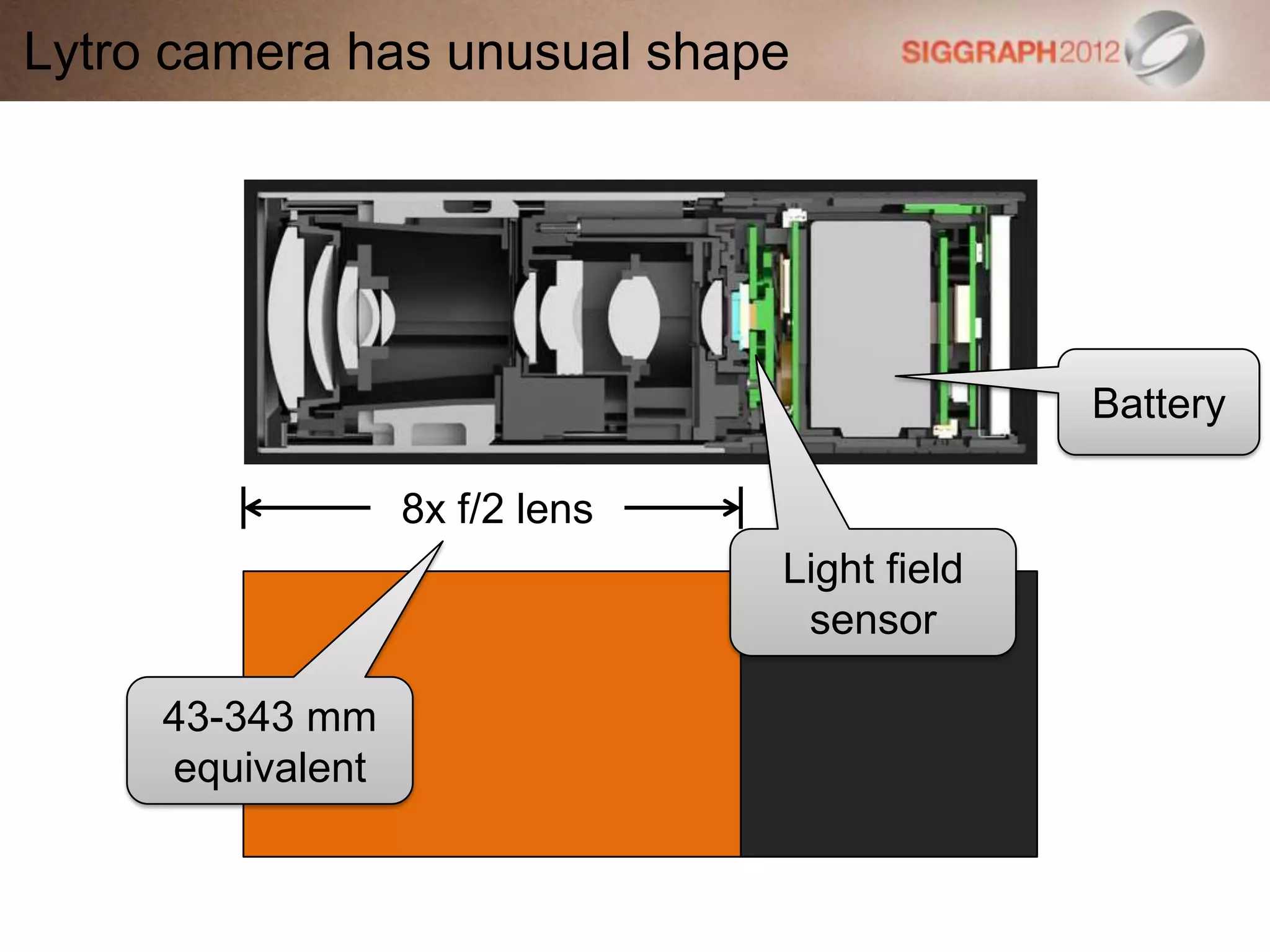
Lytro camera has unusual shape
8x f/2 lens
Light field
sensor
Battery
43-343 mm
equivalent
Other Applications of Light Fields
Lens Glare Reduction
[Raskar, Agrawal, Wilson, Veeraraghavan SIGGRAPH 2008]
Glare/Flare due to camera lenses reduces contrast
MERL, MIT Media Lab Glare Aware Photography: 4D Ray Sampling for Reducing Glare Raskar, Agrawal,
Wilson & Veeraraghavan
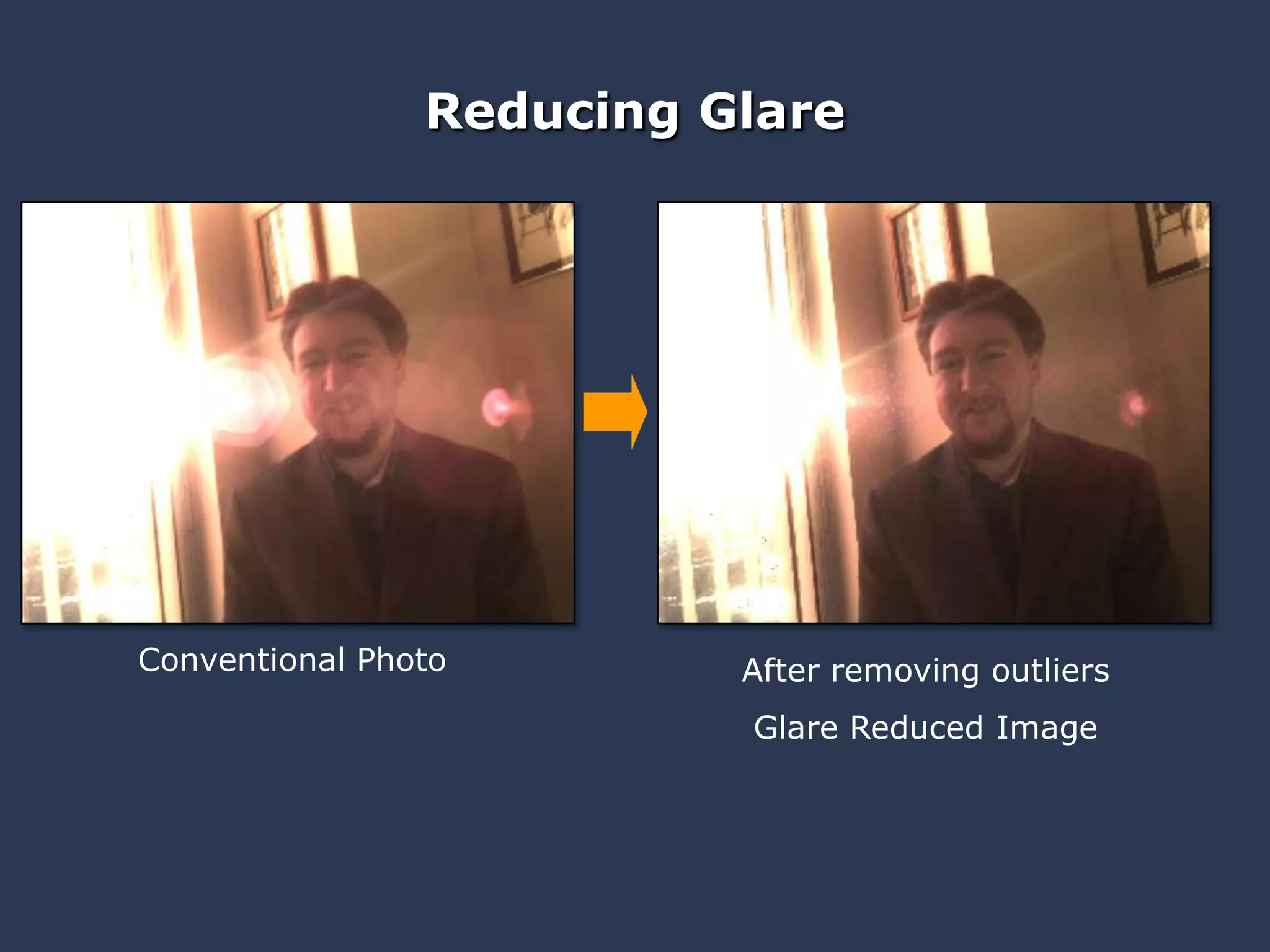
Reducing Glare
Glare Reduced Image
After removing outliersConventional Photo
MERL, MIT Media Lab Glare Aware Photography: 4D Ray Sampling for Reducing Glare Raskar, Agrawal,
Wilson & Veeraraghavan
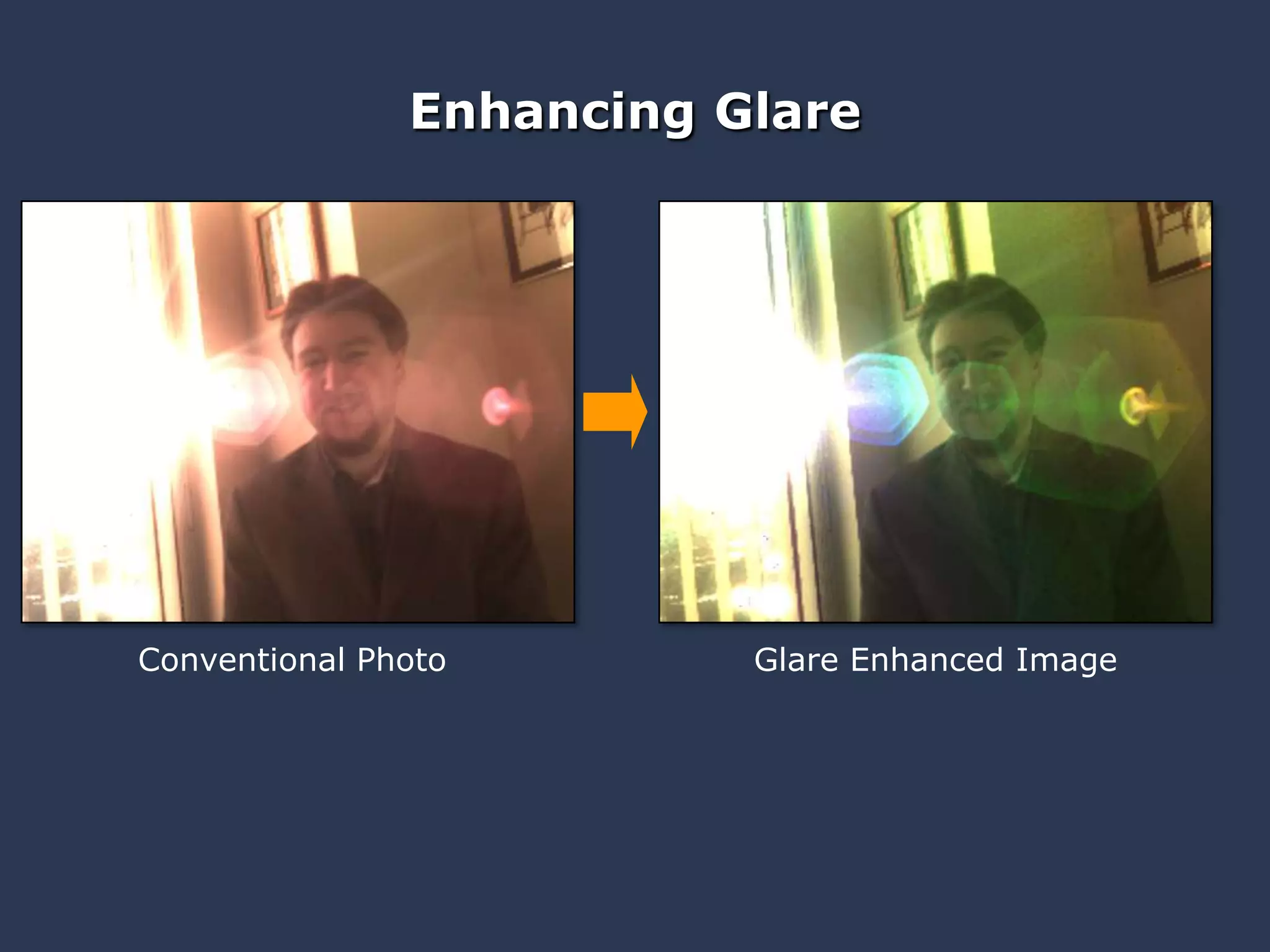
Enhancing Glare
Glare Enhanced ImageConventional Photo
MERL, MIT Media Lab Glare Aware Photography: 4D Ray Sampling for Reducing Glare Raskar, Agrawal,
Wilson & Veeraraghavan
MERL, MIT Media Lab Glare Aware Photography: 4D Ray Sampling for Reducing Glare Raskar, Agrawal,
Wilson & Veeraraghavan
MERL, MIT Media Lab Glare Aware Photography: 4D Ray Sampling for Reducing Glare
Raskar, Agrawal,
Wilson & Veeraraghavan
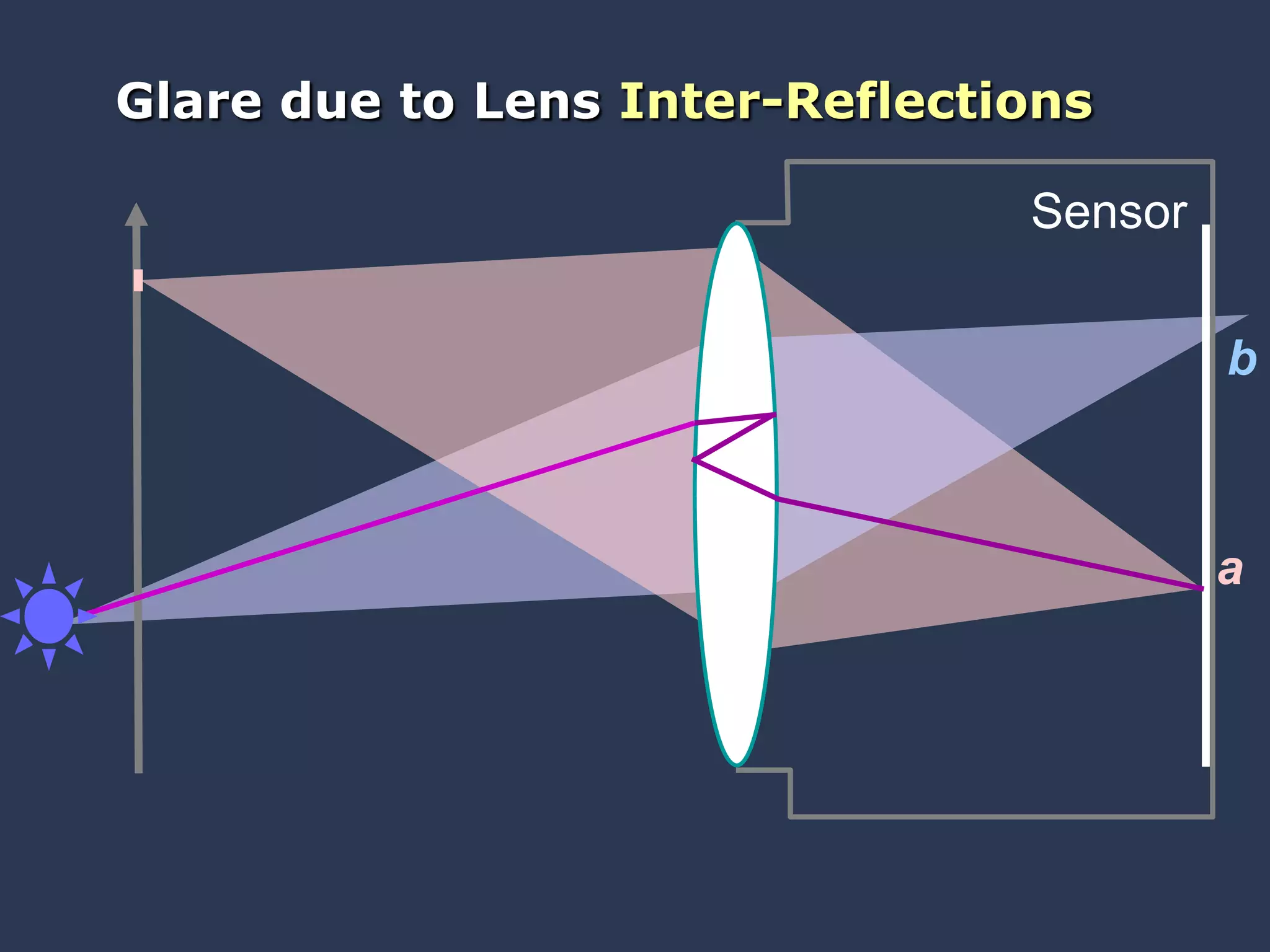
Glare due to Lens Inter-Reflections
a
Sensor
b
MERL, MIT Media Lab Glare Aware Photography: 4D Ray Sampling for Reducing Glare Raskar, Agrawal,
Wilson & Veeraraghavan
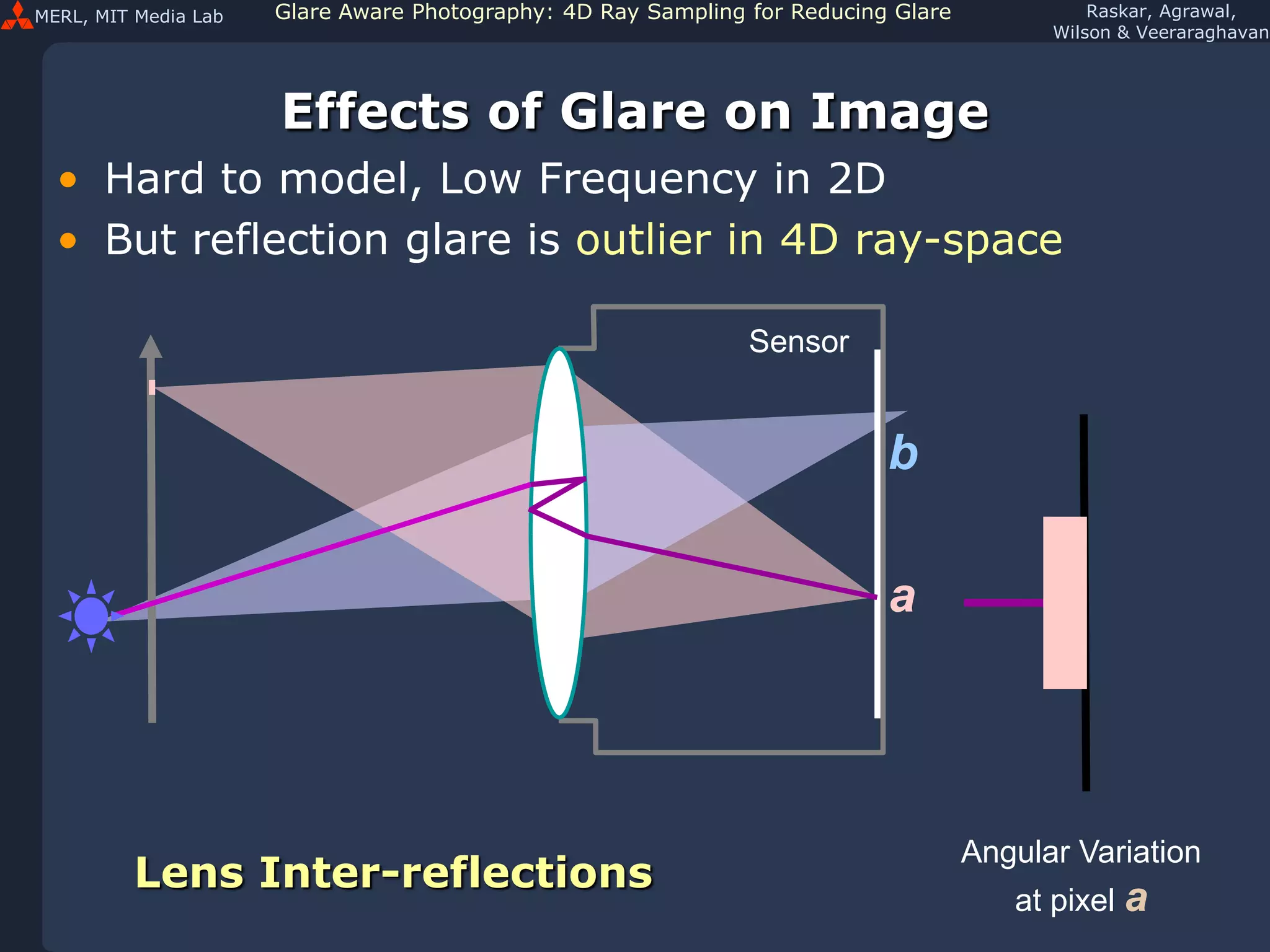
Effects of Glare on Image
• Hard to model, Low Frequency in 2D
• But reflection glare is outlier in 4D ray-space
Angular Variation
at pixel a
Lens Inter-reflections
a
Sensor
b
MERL, MIT Media Lab Glare Aware Photography: 4D Ray Sampling for Reducing Glare Raskar, Agrawal,
Wilson & Veeraraghavan
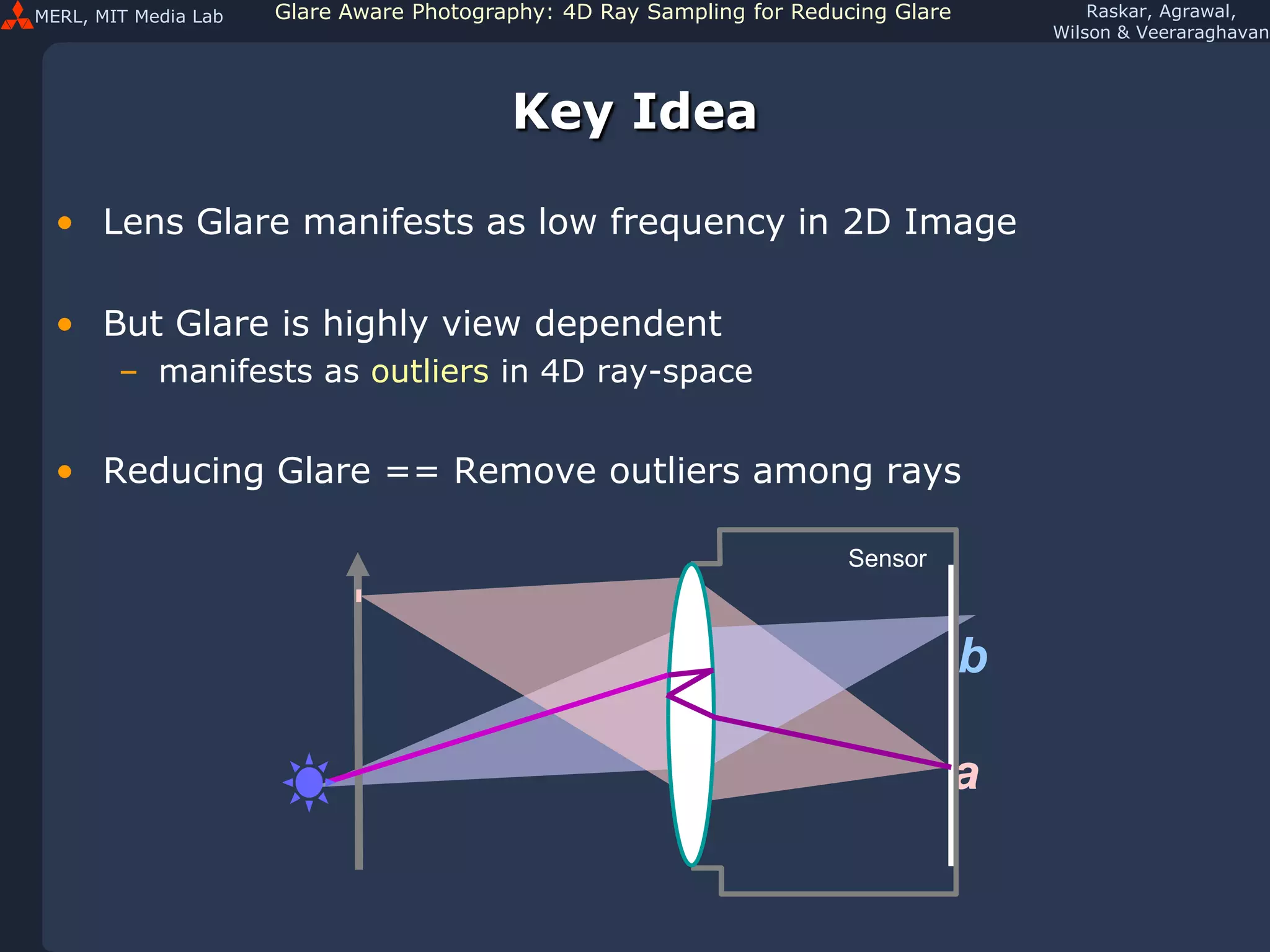
Key Idea
• Lens Glare manifests as low frequency in 2D Image
• But Glare is highly view dependent
– manifests as outliers in 4D ray-space
• Reducing Glare == Remove outliers among rays
a
Sensor
b
MERL, MIT Media Lab Glare Aware Photography: 4D Ray Sampling for Reducing Glare Raskar, Agrawal,
Wilson & Veeraraghavan
Reducing Glare
using
a Light Field Camera
MERL, MIT Media Lab Glare Aware Photography: 4D Ray Sampling for Reducing Glare Raskar, Agrawal,
Wilson & Veeraraghavan
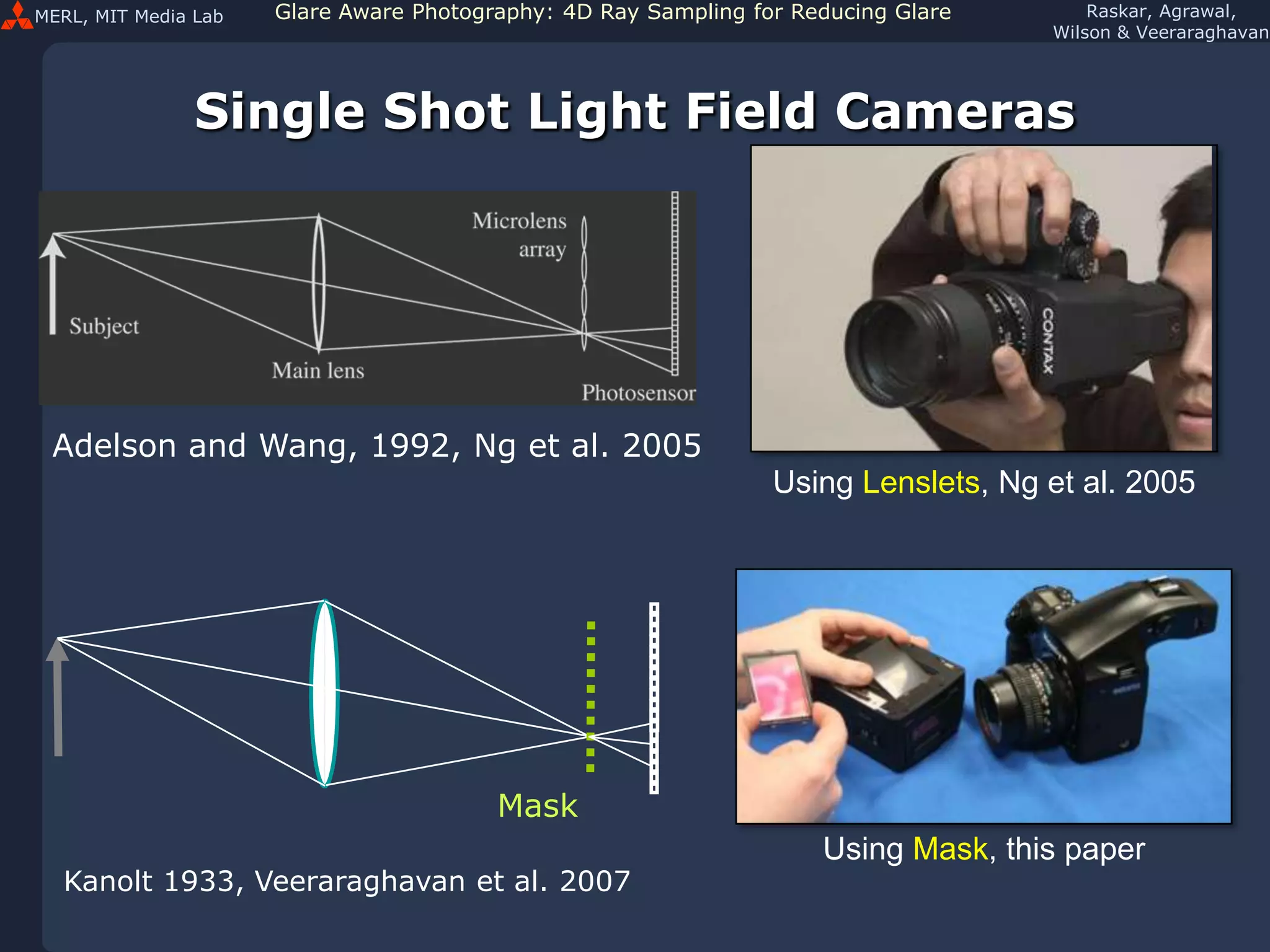
Single Shot Light Field Cameras
Using Mask, this paper
Using Lenslets, Ng et al. 2005
Mask
Adelson and Wang, 1992, Ng et al. 2005
Kanolt 1933, Veeraraghavan et al. 2007
MERL, MIT Media Lab Glare Aware Photography: 4D Ray Sampling for Reducing Glare Raskar, Agrawal,
Wilson & Veeraraghavan
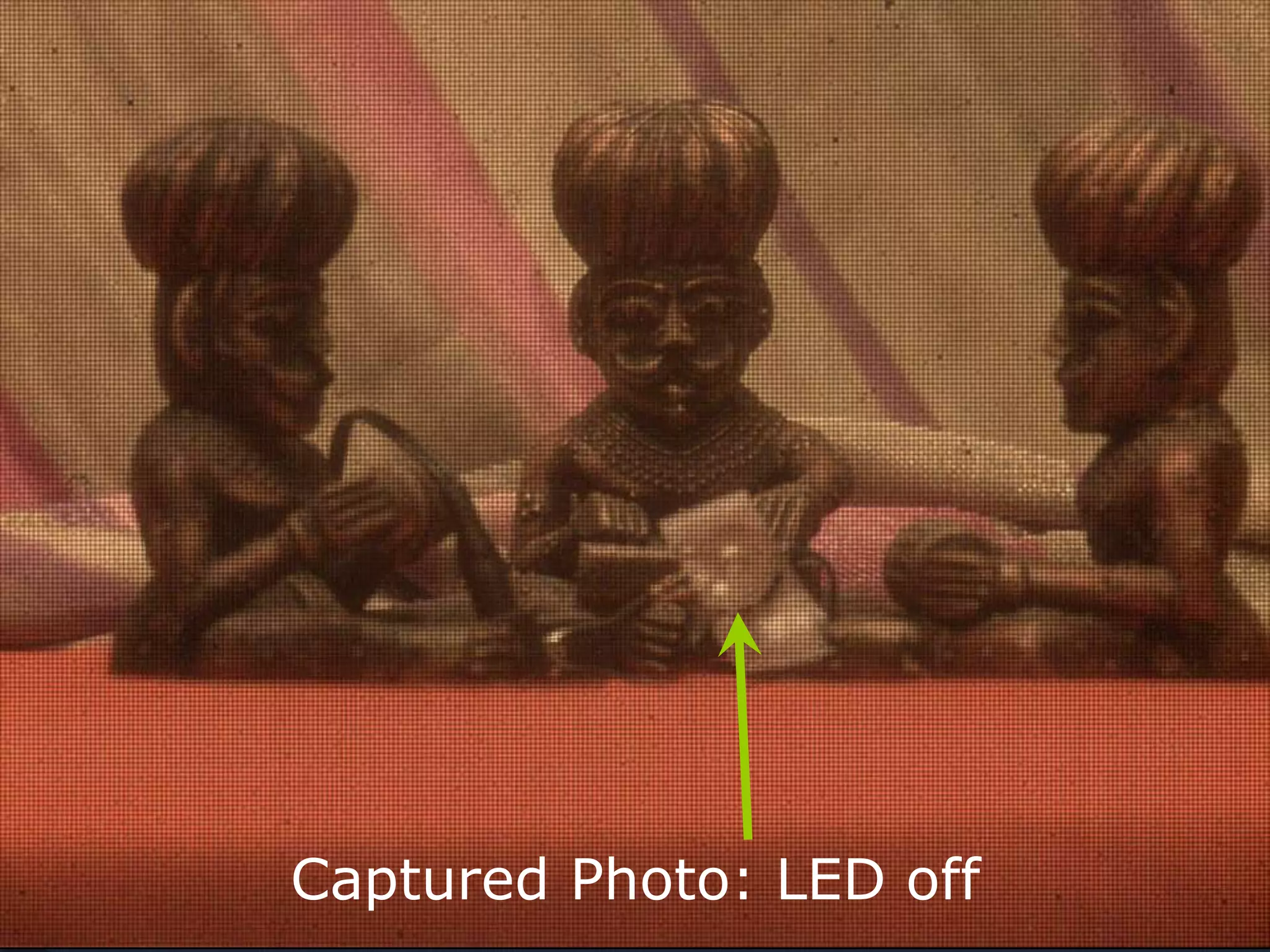
Captured Photo: LED off
MERL, MIT Media Lab Glare Aware Photography: 4D Ray Sampling for Reducing Glare Raskar, Agrawal,
Wilson & Veeraraghavan
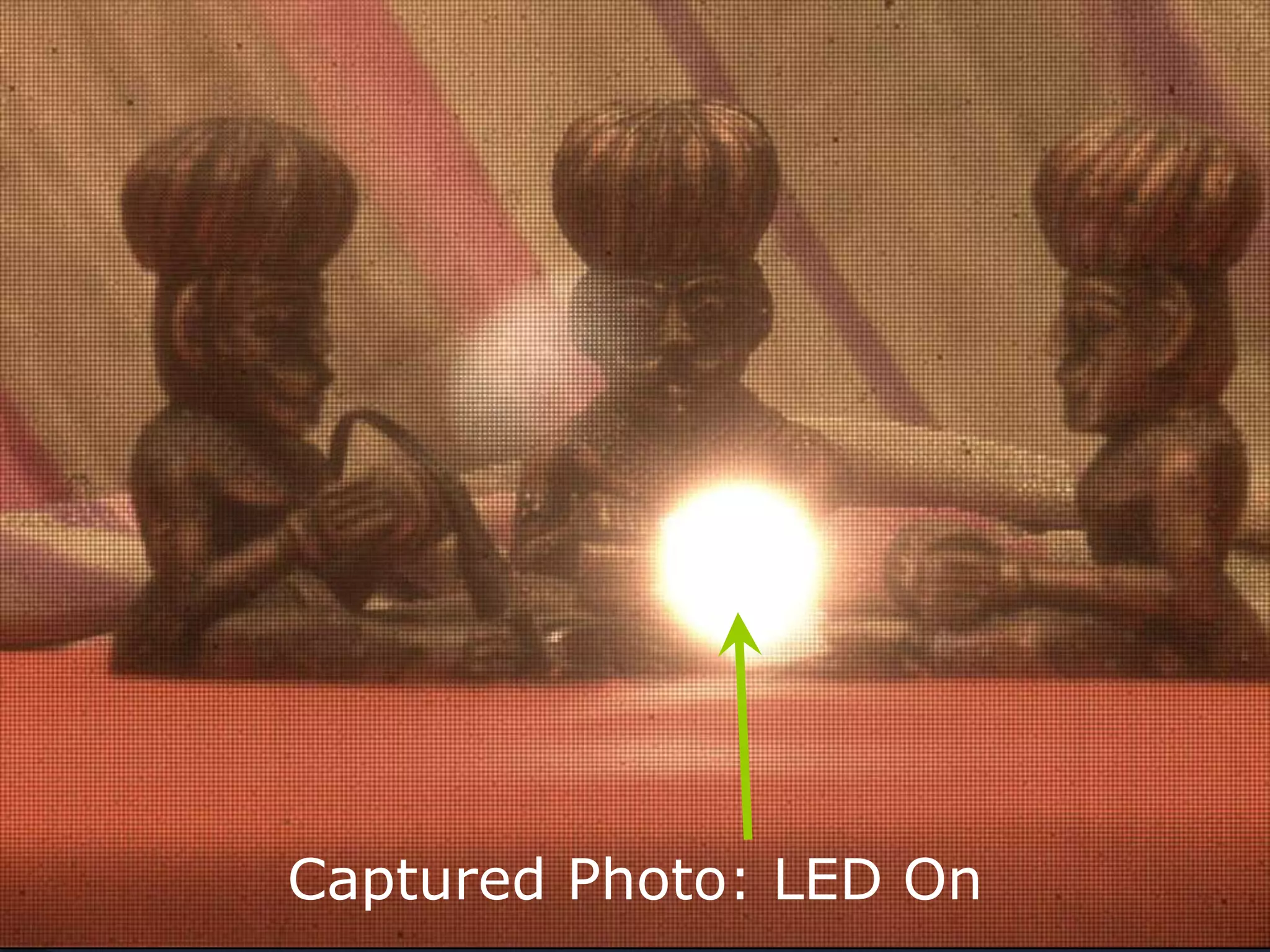
Captured Photo: LED On
MERL, MIT Media Lab Glare Aware Photography: 4D Ray Sampling for Reducing Glare Raskar, Agrawal,
Wilson & Veeraraghavan
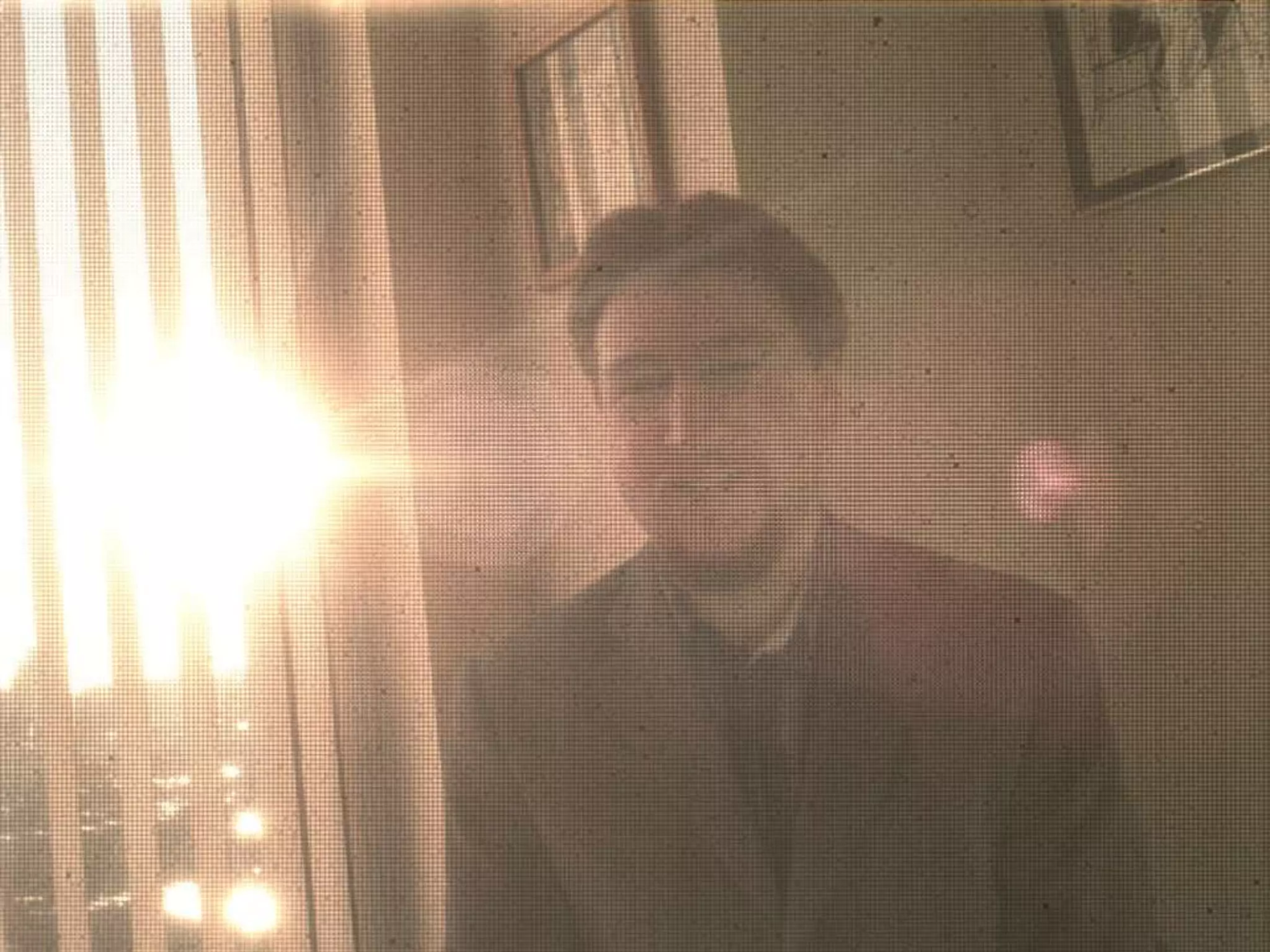
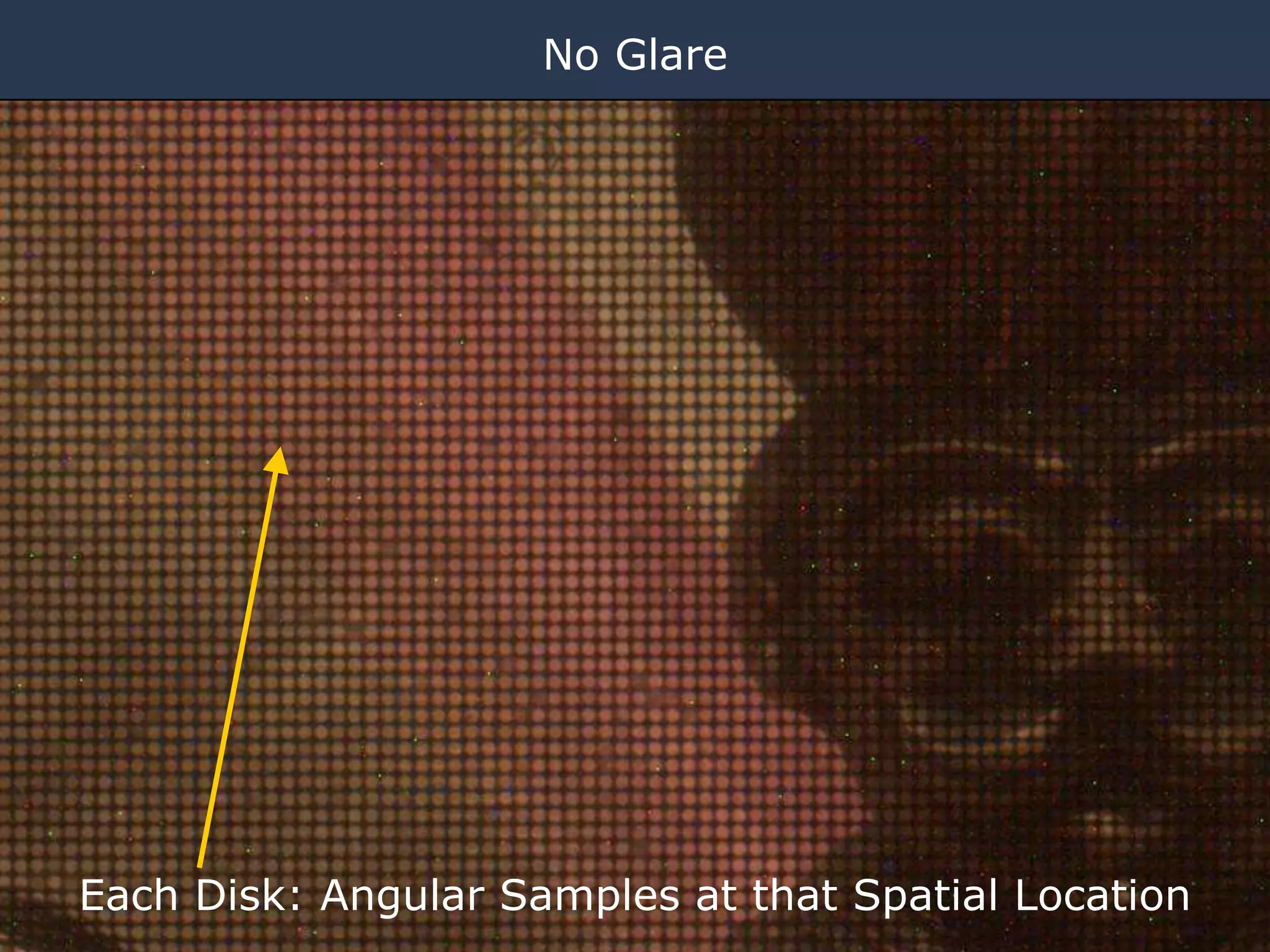
Each Disk: Angular Samples at that Spatial Location
No Glare
MERL, MIT Media Lab Glare Aware Photography: 4D Ray Sampling for Reducing Glare Raskar, Agrawal,
Wilson & Veeraraghavan
With Glare
MERL, MIT Media Lab Glare Aware Photography: 4D Ray Sampling for Reducing Glare Raskar, Agrawal,
Wilson & Veeraraghavan
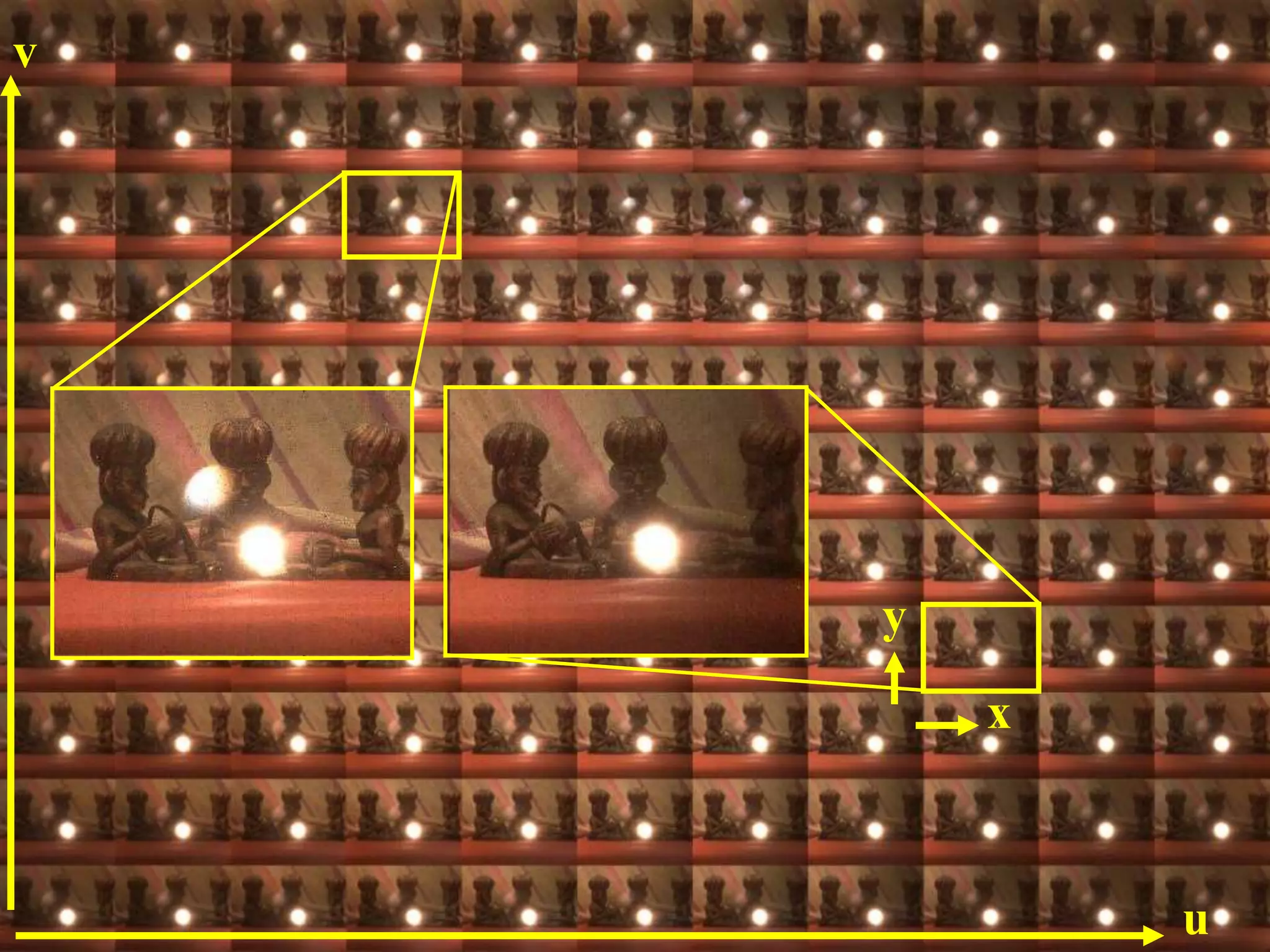
x
y
u
v
MERL, MIT Media Lab Glare Aware Photography: 4D Ray Sampling for Reducing Glare Raskar, Agrawal,
Wilson & Veeraraghavan
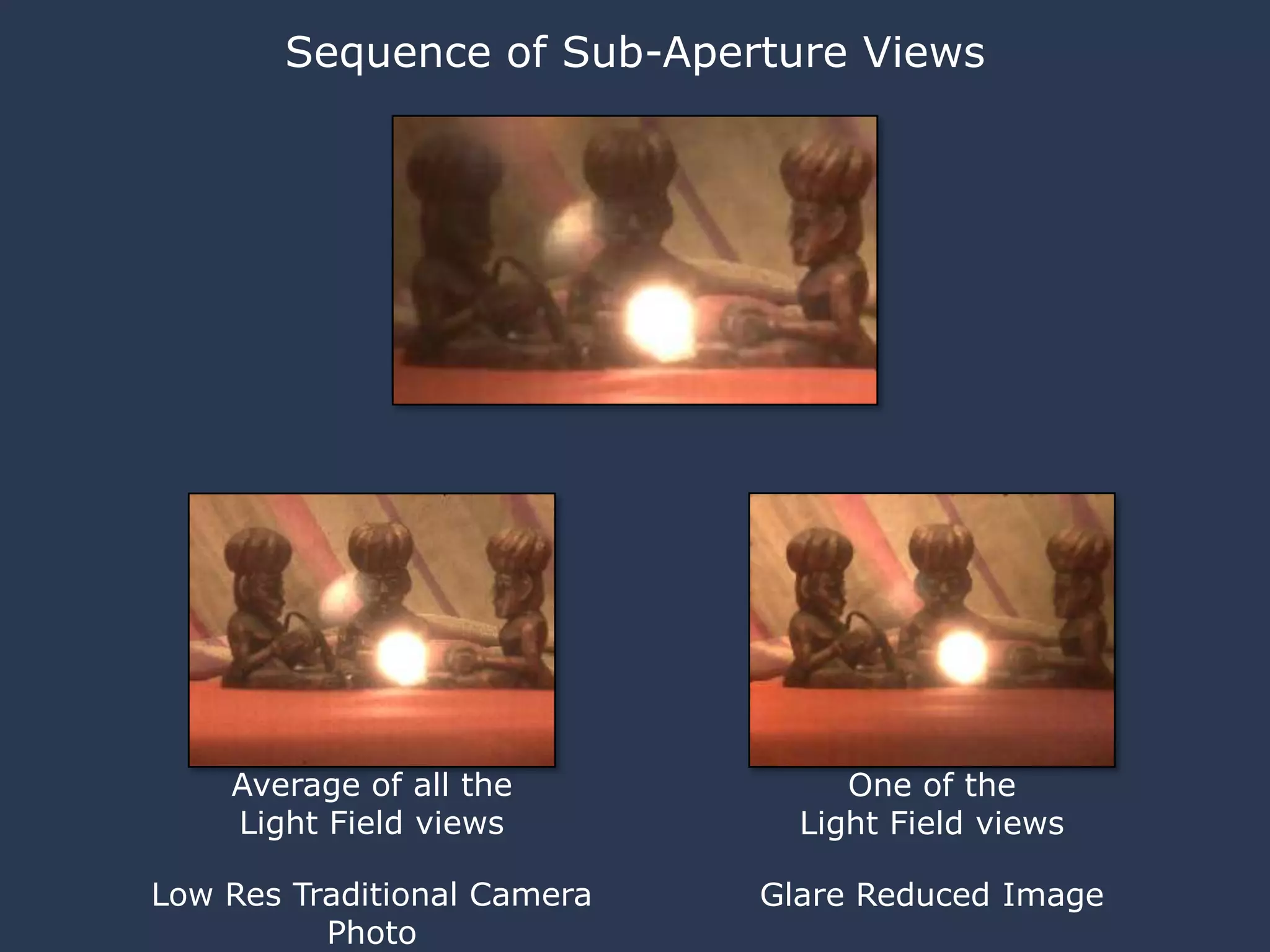
Sequence of Sub-Aperture Views
Average of all the
Light Field views
One of the
Light Field views
Low Res Traditional Camera
Photo
Glare Reduced Image
MERL, MIT Media Lab Glare Aware Photography: 4D Ray Sampling for Reducing Glare Raskar, Agrawal,
Wilson & Veeraraghavan
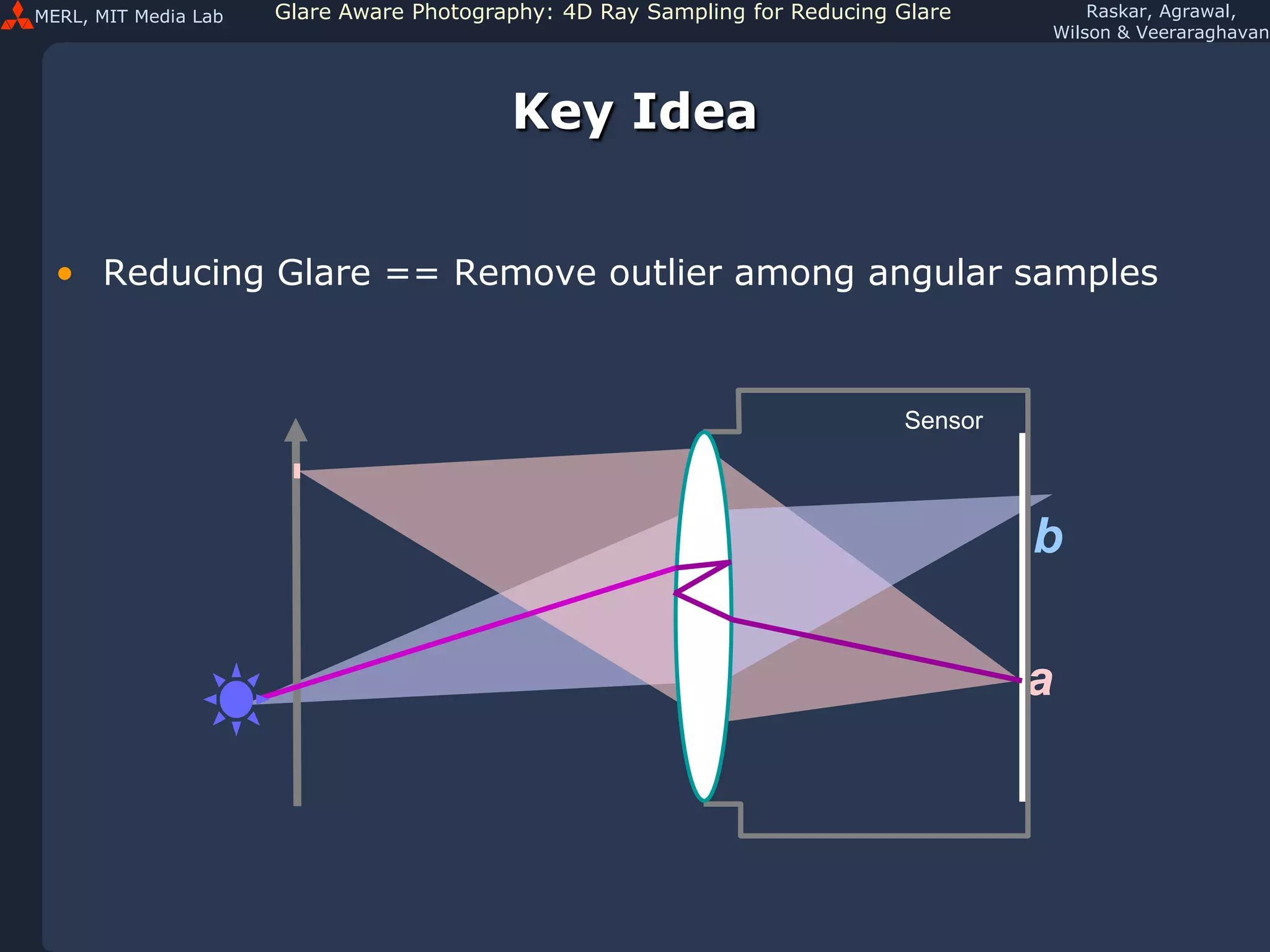
Key Idea
• Reducing Glare == Remove outlier among angular samples
a
Sensor
b
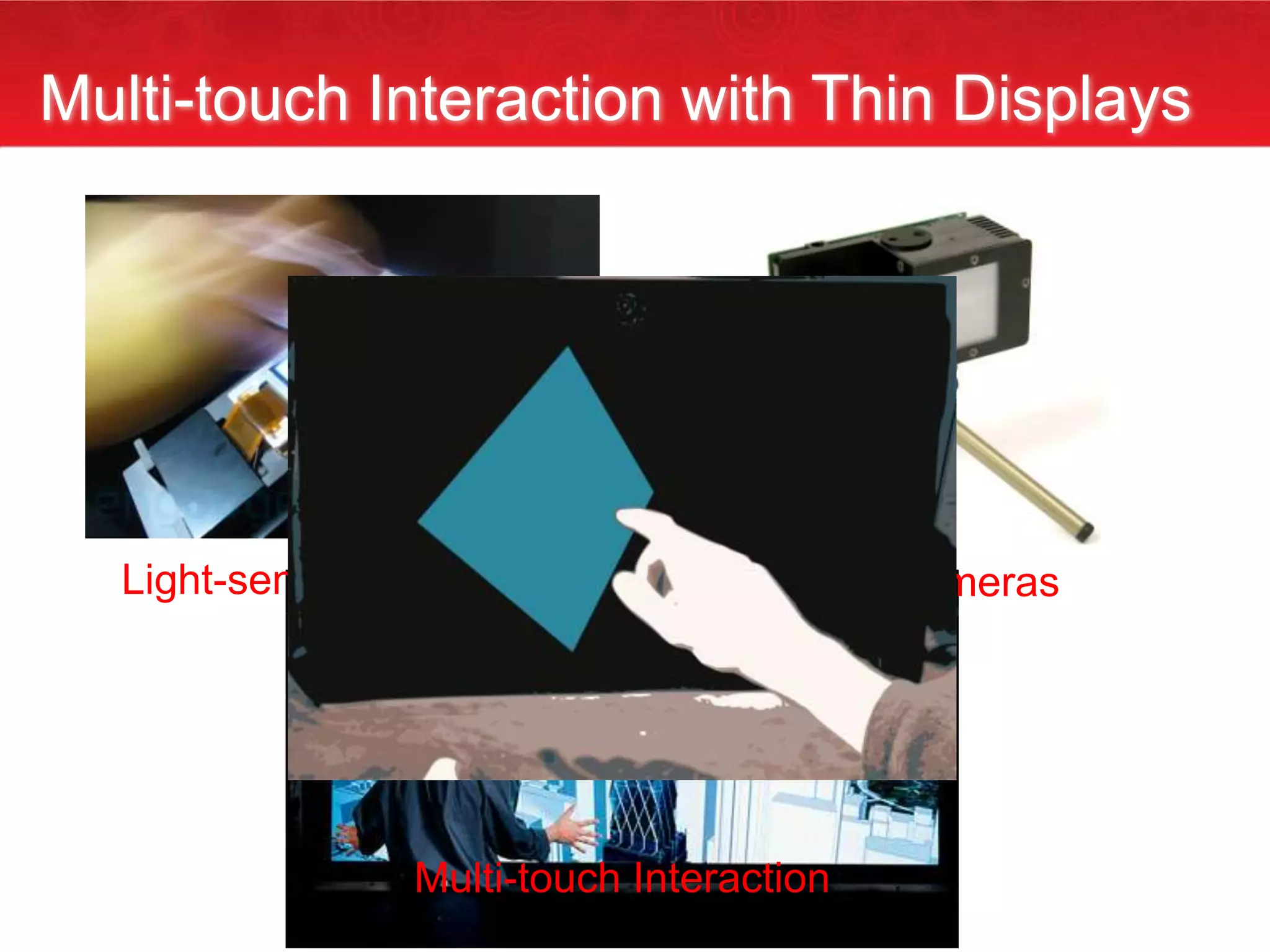
Light-sensitive Displays Depth Cameras
Multi-touch Interaction
Multi-touch Interaction with Thin Displays
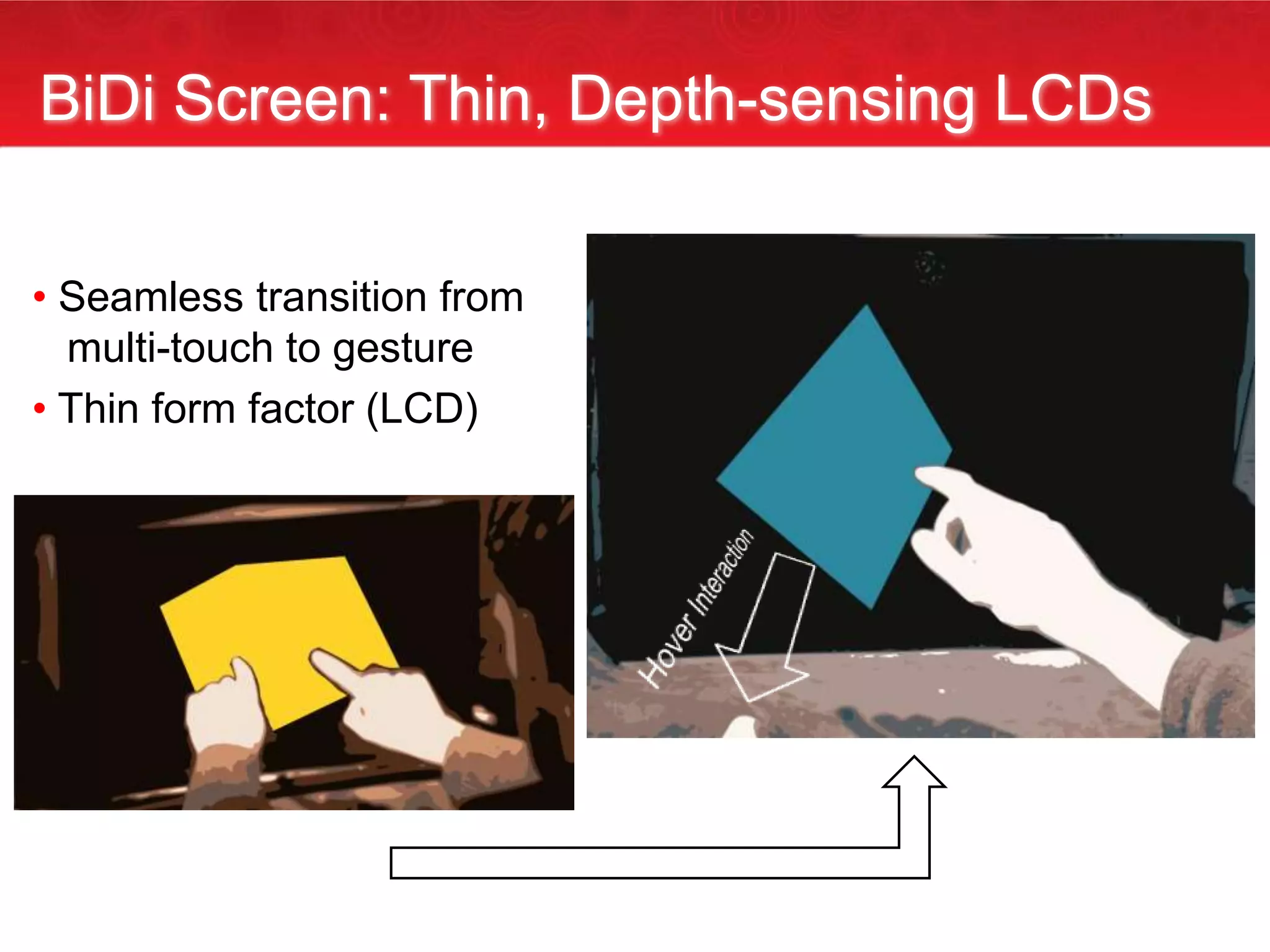
BiDi Screen: Thin, Depth-sensing LCDs
• Seamless transition from
multi-touch to gesture
• Thin form factor (LCD)
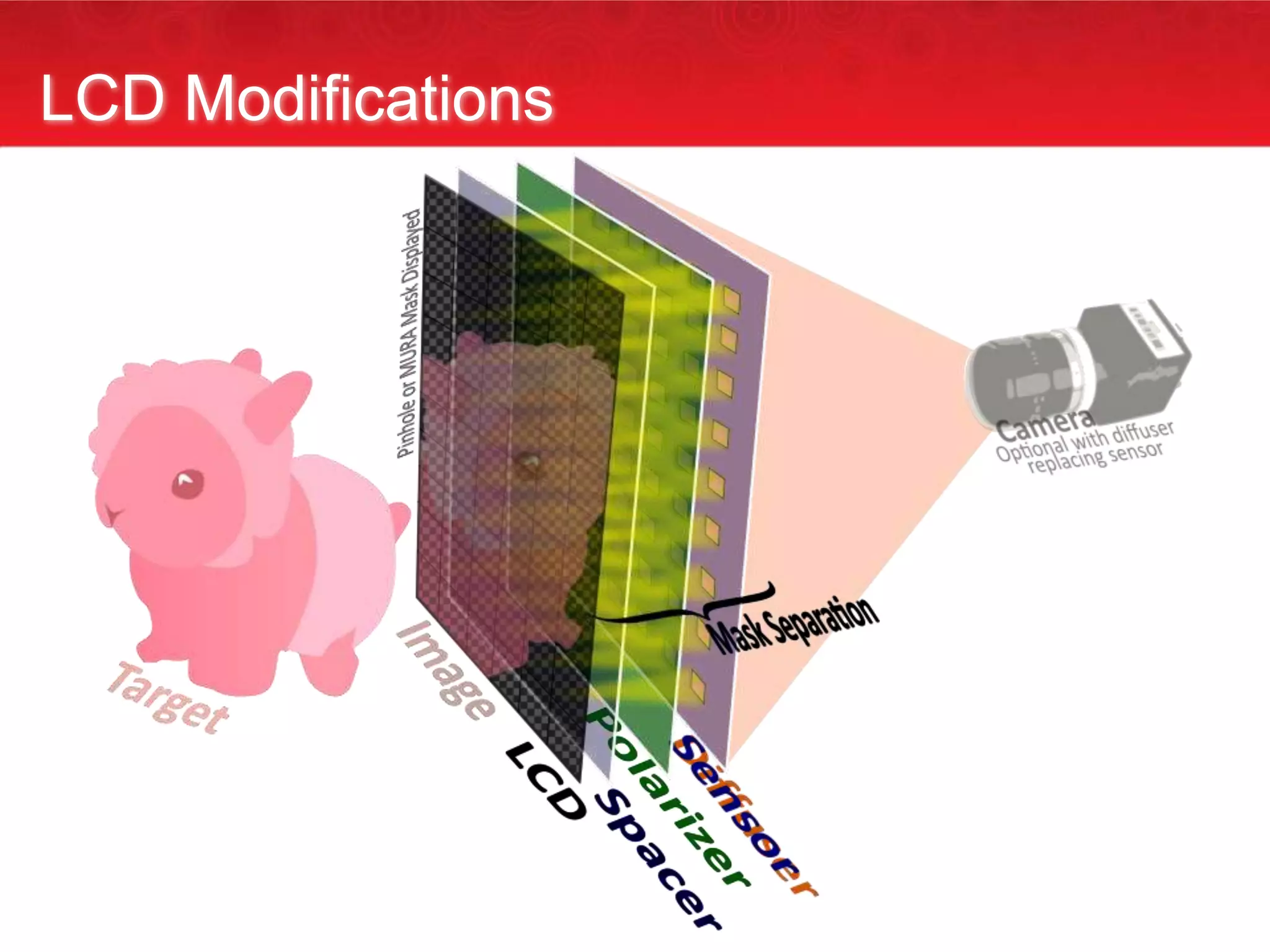
LCD Modifications
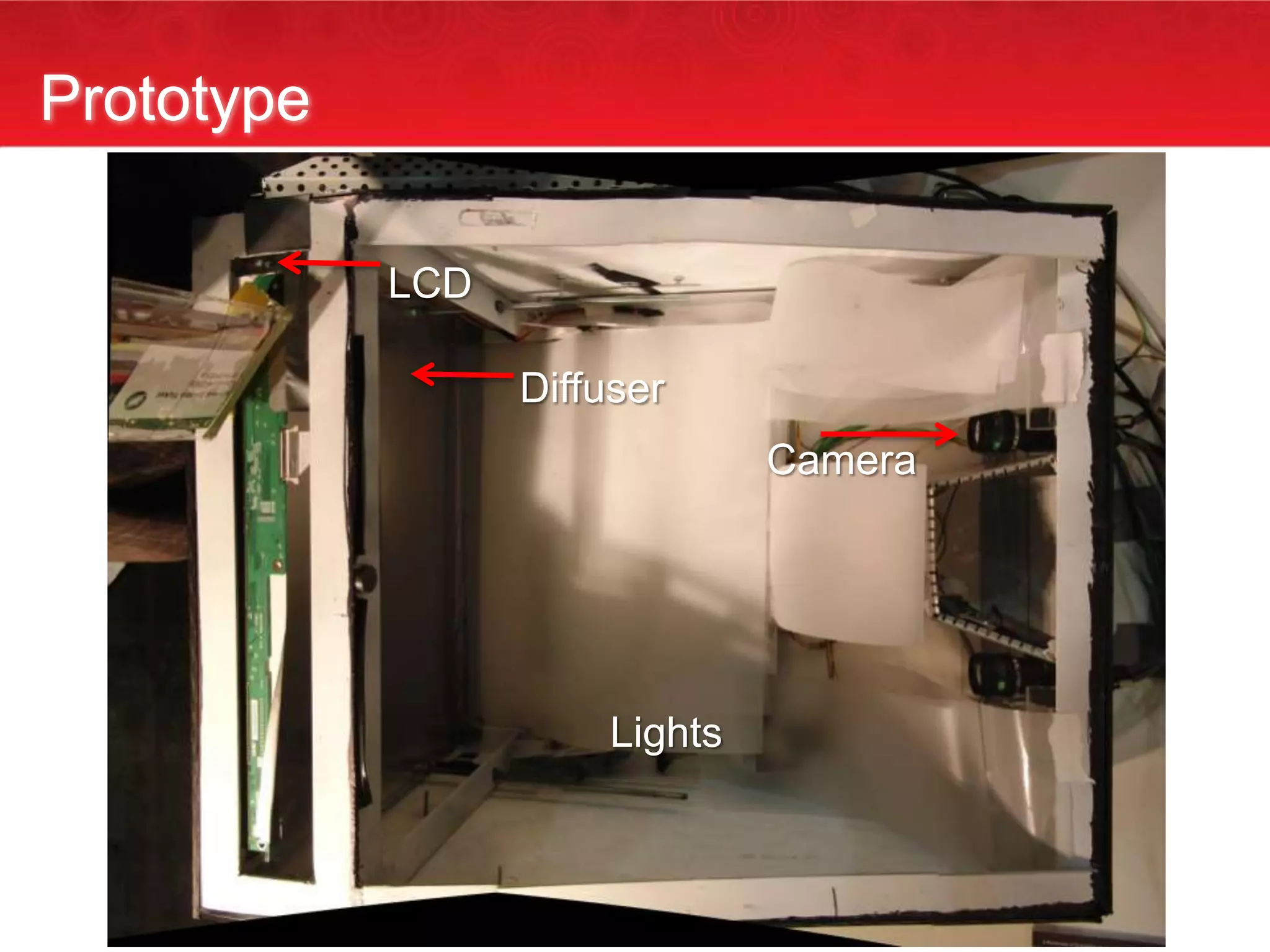
Diffuser
Camera
LCD
Lights
Prototype
Introduction to Light Fields

Introduction to Light Fields

  • 1.
  • 2.
    The 5D PlenopticFunction Q: What is the set of all things that one can ever see? A: The Plenoptic Function [Adelson and Bergen 1991] (from plenus, complete or full, and optic) P(q, f, l, t)
  • 3.
    The 5D PlenopticFunction Q: What is the set of all things that one can ever see? A: The Plenoptic Function [Adelson and Bergen 1991] (from plenus, complete or full, and optic) P(q, f, l, t)
  • 4.
  • 5.
  • 6.
    Two-Plane Parameterization –camera array 2D position 2D position s u
  • 7.
    Two-Plane Parameterization –SLR camera 2D position 2D position s u
  • 8.
  • 9.
    Two-Plane Parameterization –cell phone (pelican) s u
  • 10.
    Application: Digital ImageRefocusing [Ng 2005] Kodak 16-megapixel sensor 125μ square-sided microlenses
  • 11.
    Application: 3D Displays ParallaxPanoramagram [Kanolt 1918] 3DTV with Integral Imaging [Okano et al. 1999] MERL 3DTV [Matusik and Pfister 2004]
  • 12.
  • 13.
    Static Camera Arrays StanfordMulti-Camera Array 125 cameras using custom hardware [Wilburn et al. 2002, Wilburn et al. 2005] Distributed Light Field Camera 64 cameras with distributed rendering [Yang et al. 2002]
  • 14.
  • 15.
  • 16.
    Controlled Camera orObject Motion Stanford Spherical Gantry [Levoy and Hanrahan 1996] Relighting with 4D Incident Light Fields [Masselus et al. 2003]
  • 17.
    Uncontrolled Camera orObject Motion Unstructured Lumigraph Rendering [Gortler et al. 1996; Buehler et al. 2001]
  • 18.
  • 19.
    Parallax Barriers (PinholeArrays) [Ives 1903] sensor barrier Spatially-multiplexed light field capture using masks (i.e., barriers): • Cause severe attenuation  long exposures or lower SNR • Impose fixed trade-off between spatial and angular resolution (unless implemented with programmable masks, e.g. LCDs)
  • 20.
    Integral Imaging (“Fly’sEye” Lenslets) [Lippmann 1908] sensor lenslet f Spatially-multiplexed light field capture using lenslets: • Impose fixed trade-off between spatial and angular resolution
  • 21.
  • 22.
    Light Field Photograph(Decoded) [The (New) Stanford Light Field Archive] lookingup looking to the right Sample Image
  • 23.
  • 24.
    Modern, Digital Implementations DigitalLight Field Photography • Hand-held plenoptic camera [Ng et al. 2005] • Heterodyne light field camera [Veeraraghavan et al. 2007]
  • 25.
      MarcLevoy  Light Field = Array of (Virtual) Cameras Slide by Marc Levoy
  • 26.
      MarcLevoy  Sub-aperture Virtual Camera = Sub-aperture View Light Field = Array of (Virtual) Cameras Slide by Marc Levoy
  • 27.
      MarcLevoy  Sub-aperture Virtual Camera = Sub-aperture View Light Field = Array of (Virtual) Cameras Slide by Marc Levoy
  • 28.
  • 29.
  • 30.
    The Lytro LightField Camera
  • 31.
  • 32.
  • 33.
    Lytro: microlens arrayin camera Main lens Microlens array (MLA) Digital sensor Lens is not really thin, but can be treated as so. 330 × 330 hex array, 13.9 micron pitch Occluders are not required. 14 Mpixel, square cropped to 11 Mpixels Choose pixel in same location behind each microlens
  • 34.
    Microlens array (MLA) Main lens Digital sensor #of sub-apertures = # of pixels behind each microlens (10 × 10) # of pixels per sub-aperture image = # of microlenses (~ 120,000) All rays pass through a “sub-aperture” Sub-aperture captures on camera view Choose pixel in same location behind each microlens So why put the microlens array inside the camera?
  • 35.
    Lytro camera hasunusual shape 8x f/2 lens Light field sensor Battery 43-343 mm equivalent
  • 36.
  • 37.
    Lens Glare Reduction [Raskar,Agrawal, Wilson, Veeraraghavan SIGGRAPH 2008] Glare/Flare due to camera lenses reduces contrast
  • 38.
    MERL, MIT MediaLab Glare Aware Photography: 4D Ray Sampling for Reducing Glare Raskar, Agrawal, Wilson & Veeraraghavan Reducing Glare Glare Reduced Image After removing outliersConventional Photo
  • 39.
    MERL, MIT MediaLab Glare Aware Photography: 4D Ray Sampling for Reducing Glare Raskar, Agrawal, Wilson & Veeraraghavan Enhancing Glare Glare Enhanced ImageConventional Photo
  • 40.
    MERL, MIT MediaLab Glare Aware Photography: 4D Ray Sampling for Reducing Glare Raskar, Agrawal, Wilson & Veeraraghavan
  • 41.
    MERL, MIT MediaLab Glare Aware Photography: 4D Ray Sampling for Reducing Glare Raskar, Agrawal, Wilson & Veeraraghavan
  • 42.
    MERL, MIT MediaLab Glare Aware Photography: 4D Ray Sampling for Reducing Glare Raskar, Agrawal, Wilson & Veeraraghavan Glare due to Lens Inter-Reflections a Sensor b
  • 43.
    MERL, MIT MediaLab Glare Aware Photography: 4D Ray Sampling for Reducing Glare Raskar, Agrawal, Wilson & Veeraraghavan Effects of Glare on Image • Hard to model, Low Frequency in 2D • But reflection glare is outlier in 4D ray-space Angular Variation at pixel a Lens Inter-reflections a Sensor b
  • 44.
    MERL, MIT MediaLab Glare Aware Photography: 4D Ray Sampling for Reducing Glare Raskar, Agrawal, Wilson & Veeraraghavan Key Idea • Lens Glare manifests as low frequency in 2D Image • But Glare is highly view dependent – manifests as outliers in 4D ray-space • Reducing Glare == Remove outliers among rays a Sensor b
  • 45.
    MERL, MIT MediaLab Glare Aware Photography: 4D Ray Sampling for Reducing Glare Raskar, Agrawal, Wilson & Veeraraghavan Reducing Glare using a Light Field Camera
  • 46.
    MERL, MIT MediaLab Glare Aware Photography: 4D Ray Sampling for Reducing Glare Raskar, Agrawal, Wilson & Veeraraghavan Single Shot Light Field Cameras Using Mask, this paper Using Lenslets, Ng et al. 2005 Mask Adelson and Wang, 1992, Ng et al. 2005 Kanolt 1933, Veeraraghavan et al. 2007
  • 47.
    MERL, MIT MediaLab Glare Aware Photography: 4D Ray Sampling for Reducing Glare Raskar, Agrawal, Wilson & Veeraraghavan Captured Photo: LED off
  • 48.
    MERL, MIT MediaLab Glare Aware Photography: 4D Ray Sampling for Reducing Glare Raskar, Agrawal, Wilson & Veeraraghavan Captured Photo: LED On
  • 49.
    MERL, MIT MediaLab Glare Aware Photography: 4D Ray Sampling for Reducing Glare Raskar, Agrawal, Wilson & Veeraraghavan Each Disk: Angular Samples at that Spatial Location No Glare
  • 50.
    MERL, MIT MediaLab Glare Aware Photography: 4D Ray Sampling for Reducing Glare Raskar, Agrawal, Wilson & Veeraraghavan With Glare
  • 51.
    MERL, MIT MediaLab Glare Aware Photography: 4D Ray Sampling for Reducing Glare Raskar, Agrawal, Wilson & Veeraraghavan x y u v
  • 52.
    MERL, MIT MediaLab Glare Aware Photography: 4D Ray Sampling for Reducing Glare Raskar, Agrawal, Wilson & Veeraraghavan Sequence of Sub-Aperture Views Average of all the Light Field views One of the Light Field views Low Res Traditional Camera Photo Glare Reduced Image
  • 53.
    MERL, MIT MediaLab Glare Aware Photography: 4D Ray Sampling for Reducing Glare Raskar, Agrawal, Wilson & Veeraraghavan Key Idea • Reducing Glare == Remove outlier among angular samples a Sensor b
  • 54.
    Light-sensitive Displays DepthCameras Multi-touch Interaction Multi-touch Interaction with Thin Displays
  • 55.
    BiDi Screen: Thin,Depth-sensing LCDs • Seamless transition from multi-touch to gesture • Thin form factor (LCD)
  • 56.
  • 57.

Editor's Notes