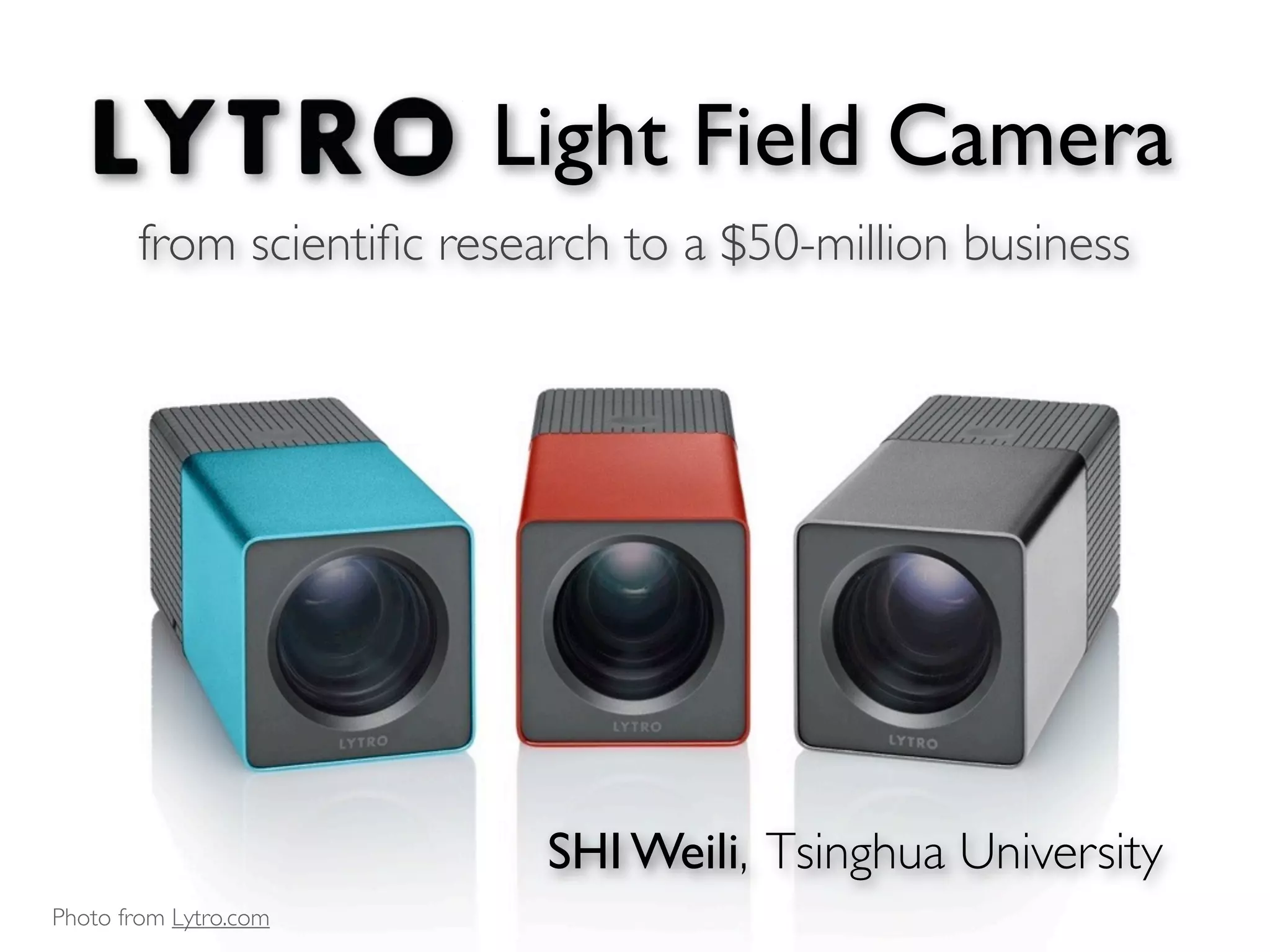
Light Field Camera
       from scientific research to a $50-million business


                           SHI Weili, Tsinghua University
Photo from Lytro.com
With big aperture, DCLRs can achieve shallow focus.
Consumer DCs produce photos with deep focus.
What we’d prefer...
(post-processed with Adobe Photoshop)
But how about
  loss of focus?...
(previously irreparable)
Introducing Lytro: refocus afterwards!


Photos from Lytro.com
Introducing Lytro: refocus afterwards!


Photos from Lytro.com
Technological features

     + Refocusing
+ Extending depth of field
     + 3D images
       + Speed
 + Low-light sensitivity
    + Easy sharing
    - Low resolution
"Our vision is a product
                                     that allows people to
                                     shoot and share very simply."
                                         Ren Ng, founder and CEO of Lytro


Photo and quote from dpreview.com
Industrial design


Photo from Lytro.com
Industrial design


Photo from Lytro.com
Interaction design


Photo from Lytro.com
Interaction design


Image from NewDealDesign
"We worked really hard to
                                    create an iconic design that
                                    really conveys the idea that
                                    this is ‘camera 3.0’."
                                        Ren Ng, founder and CEO of Lytro


Photo and quote from dpreview.com
Depth of field: source of blurriness


Figure from Wikipedia
Depth of field: source of blurriness


Some information is missing:
  If we know the direction of each ray of light,
  we can trace the rays back to their source,
  and don’t have to mix them up.
4D light field


Figures from Ng, R. 2005. Fourier slice photography.
   2D light field study with a linear camerachapter . light fields and photographs


                                  Figure .: Parameterization for the light field flowing into the camera.
                  parameterization for the light field flowing into the camera
                        the photosensor. Let us refer to u as the directional axis, because the u intercept on the lens
                        determines the direction at which the ray strikes the sensor. In addition, let us refer to x as
Figure from Ng, R. 2006. spatial axis. Of course in general the ray exists in d and we would consider intersections
                     the Digital light field photography.
2D light field study with a linear camera
                      .. photograph formation                                                                  


                                         Figure .: The set of all rays flowing into the camera.
                              the set of all rays flowing into the camera
                      of rays in a sampled light field, and it has become very common in the light field literature.


Figure from Ng, R. 2006. Digital light field photography.
                      2.3    Photograph Formation
   2D light field study with a linear camera
                                                                   chapter . light fields and photographs


                              Figure .: The cone of rays summed to produce one pixel in a photograph.
              the cone of rays summed to produce one pixel in a photograph
                       which arrive at the sensor from more oblique angles, contribute less energy to the value of
                       the pixel. Another example is that the photosensitive portion of a pixel in a cmos sensor is
Figure from Ng, R. 2006. Digital light field an overlay of metal wires [Catrysse and Wandell ], so rays from
                     typically obscured by photography.
A photograph is an integral projection
                 of the canonical light field.


Quote from Ng, R. 2006. Digital light field photography.
Refocusing


Figure from Ng, R. 2006. Digital light field photography. and Wikipedia
            (a)                               (b)
A photograph is an integral projection
                 of the canonical light field, where the
                 trajectory of the projection depends on
                 the depth at which the photograph is
                 focused.


Quote from Ng, R. 2006. Digital light field photography.
Recording the light field
                         .. a plenoptic camera records the light field                                           


                              Figure .: Sampling of a photograph’s light field provided by a plenoptic camera.
           sampling of a photograph’s light field provided by a plenoptic camera
                         camera the width of a grid column is the width of a photosensor pixel. In the plenoptic
                         camera, on the other hand, the grid cells are shorter and wider. The column width is the
Figure from Ng, R. 2006. Digital microlens, and the column is vertically divided into the number of pixels across
                      width of a light field photography.
                                                        Recording the light field
                            chapter . recording a photograph’s light field


                                                                                   (z)                    (z

                                                    Figure .: Raw light field photograph read off the photo
                                                    array. The figure shows a crop of approximately one qua
                                                    crolenses are clearly visible in print.


                                                                  (z)              (z)

                         Figure .: Raw light field photograph read off the photosensor underneath th
Figure from Ng, R. 2006. Digital light field photography. a crop of approximately one quarter the full image so
                         array. The figure shows
Recording the light field


                                                                                  (z)                     (z

                                              Figure .: Raw light field photograph read off the photo
                                              array. The figure shows a crop of approximately one qua
                                              crolenses are clearly visible in print.


                                                         (z)                     (z)
    Integrating on each microlen images gives the conventional photography.
                         Figure .: Raw light field photograph read off the photosensor underneath th
Figure from Ng, R. 2006. Digital light field photography. a crop of approximately one quarter the full image so
                         array. The figure shows
Refocusing
               .. image synthesis algorithms                                                         


            Two sub-aperture photographs obtained from a light field by
            extracting the shown pixel under each microlens (depicted on left).
            Note that the images are not the same, but represents different
            viewpoints.


                      (a): No refocus              (b): Refocus closer          (c): Refocus further

               Figure .: Shift-and-add refocus algorithm, illustrated with just two sub-aperture images
Figure from Ng, R. 2006. Digital light field photography.
               for didactic purposes.
. three views of the recorded light field                                           

                                                                                                                Refocusing

                                                                                                                    chapter . light fields and photographs


                                                              (b)


                                                              (b)


                         (a)                                  (b)
                                                                                                  (a)                                     (b)

            Figure .: Overview of processing the recorded light field.   Figure .: The projection of the light field corresponding to focusing further and closer
                                                                           than the chosen x parameterization plane for the light field.
    Figure from Ng, R. 2006. Digital light field photography.
.. image synthesis algorithms
                                                                                                 Refocusing
                                                                                                         


                       (a): No refocus              (b): Refocus closer           (c): Refocus further

                Figure .: Shift-and-add refocus algorithm, illustratedillustratedsub-aperture images
                      Shift-and-add refocus algorithm, with just two with just
                for didactic purposes.
                     two sub-aperture images for didactic purposes.
Figure from Ng,with bothDigital light field photography. from the center of the lens (u, v), and the relative
               R. 2006. the distance of the sub-aperture

                                                                                             Refocusing
                                                                     chapter . digital refocusing


                          (a)                             (a)                       (a)


                          (a)                             (a)                        (b)

            Examples of refocusing (a1–a5) and extended depth of field (b).
                     Figure .: Examples of refocusing (a–a) and extended depth of field (b).
Figure from Ng, R. 2006. Digital light field photography.
Extending the depth of field
               .. image synthesis algorithms                                                         


               The sub-aperture photographs themselves have infinite DOF,
               resulted from the minor aperture.


                      (a): No refocus              (b): Refocus closer          (c): Refocus further
Figure from Ng, R. 2006. Digital light field photography.
               Figure .: Shift-and-add refocus algorithm, illustrated with just two sub-aperture images

                                                   Extending thedigital refocusing field
                                                          chapter .
                                                                     depth of


                   (a): Unrefocused           (b): Sub-aperture image          (c): Extended dof


           Refocusing each pixel gives extended an image with much digitally ex-
            Figure .: Comparison of a sub-aperture image and DOF computed with higher SNR.
             tended depth of field.


Figure from Ng, R. 2006. integration of Equation ., we obtain high snr by combining the contributions
             numerical Digital light field photography.
In the spatial domain, photographs are
                integral projections of the light field.

                In the Fourier domain, photographs are
                just 2D slice in the 4D light field.


Quote from Ng, R. 2005. Fourier slice photography.
Classical Fourier Slice Theorem projection
                  Fourier slice vs. integral


                                                     Integral
                                                    Projection


                         2D Fourier                                1D Fourier
                         Transform                                 Transform


                                                         Slicing


Page from Ng, R. 2006. Digital light field photography.
Classical Fourier Slice Theorem projection
                  Fourier slice vs. integral


                                                     Integral
                                                    Projection


                         2D Fourier                                1D Fourier
                         Transform                                 Transform


                                                         Slicing


Page from Ng, R. 2006. Digital light field photography.
Fourier slice vs. integral projection

                                                          Integral
                                                         Projection


              4D Fourier
              Transform                       Spatial Domain
                                                                       Inverse
                                              Fourier Domain          2D Fourier
                                                                      Transform


                                                          Slicing


Page from Ng, R. 2006. Digital light field photography.
Fourier slice vs. integral projection


Page from Ng, R. 2006. Digital light field photography.
In the Fourier domain, photographs are
              just 2D slice in the 4D light field.

              That’s much simpler than in the spatial
              domain, where photographs are integral
              projections of the light field.


Quote from Ng, R. 2005. Fourier slice photography.
Fourier-domain slicing algorithm
                       Pre-process: O(N4 log N)
                       Refocusing: O(N2 log N)

                    Spatial-domain integration algorithm
                       Refocusing: O(N     4)


Quote from Ng, R. 2005. Fourier slice photography.
Resolution of the light-field sample
                         .. a plenoptic camera records the light field                                           


                              Figure .: Sampling of a photograph’s light field provided by a plenoptic camera.
           sampling of a photograph’s light field provided by a plenoptic camera
                         camera the width of a grid column is the width of a photosensor pixel. In the plenoptic
                         camera, on the other hand, the grid cells are shorter and wider. The column width is the
Figure from Ng, R. 2006. Digital microlens, and the column is vertically divided into the number of pixels across
                      width of a light field photography.
Band-Limited Analysis Band-limited analysis


    Band-width of
  measured light field


                Light field shot
                 with camera

Page from Ng, R. 2006. Digital light field photography.
Band-Limited Analysis Band-limited analysis


Page from Ng, R. 2006. Digital light field photography.
Band-Limited Analysis Band-limited analysis


Page from Ng, R. 2006. Digital light field photography.
Band-Limited Analysis Band-limited analysis


Page from Ng, R. 2006. Digital light field photography.
Ren Ng improved the theory and technology of light field camera
                during his doctoral program.
"It was a scientific breakthrough
                                    we were working towards.
                                    The next step we've been working
                                    on has been making a commercial
                                    breakthrough."
                                         Ren Ng, founder and CEO of Lytro


Photo and quote from dpreview.com
Technological evolution:
                       from research to consumer product


                                               early 2000s
Photo from Lytro.com
Technological evolution:
 rd Tech Report CTSR 2005-02
                                                               from research to consumer product
                                                             Stanford Tech Report CTSR 2005-02


he pinhole
 g because
minate the
 ssing rays
ays do not
 ive image
eriphery.        Figure 8: Top: Exploded view of assembly for attaching the microlens array
                 to the digital back. Bottom: Cross-section through assembled parts.
  Figure 7: Technique for ameliorating vignetting. Top: Moving the pinhole
  observer beyond the bounds shown in Figure 6 results in vignetting because
   Our mi-
 art 0125-
  some required rays are unavailable (shaded gray). Bottom: To eliminate the
 e, square we use the closest available rays, by clamping the missing rays
  vignetting,
 ctor. The
  to the bounds of the aperture (shaded region). Note that these rays do not
number is
  pass through the original pinhole, so the resulting multi-perspective image
 and used
  has a different center of projection for each ray in the corrected periphery.        Figure 8: Top: Exploded view of assembly for attaching the microlens array
 se lenses                                                                             to the digital back. Bottom: Cross-section through assembled parts.
 on tubes
 4 image-
 approximately 4000×4000 pixels that are 9 microns wide. Our mi-
ns holder, array was made by Adaptive Optics Associates (part 0125-
 crolens                                                                                                                                       mid 2000s
photosen-It has 296×296 lenslets that are 125 field camera in use.
 0.5-S).                      Figure 9: Our light microns wide, square
         Figures from Ng,with very close to 100% fill-factor. The
with three and square packed
 shaped,                     R. 2006. Digital light field photography.
 focal length of the microlenses is 500 microns, so their f -number is
Technological evolution:
                        from research to consumer product


                                                2011: Lytro
Images from Lytro.com
Technological evolution:
                        from research to consumer product


                                                2011: Lytro
Figure from Lytro.com
The company was founded in 2006.
It has raised approximately $50 million of venture capital.
     Its first camera went on sale October 19, 2011,
        and began shipping on February 29, 2012,
       starting with a very affordable price of $399.
"At first we'll be making those decisions for
                                    the user - so that we can make the process as
                                    simple as possible but, further down the line,
                                    we'll provide tools to give more control over
                                    the final output.
                                    It's important to understand that Lytro's
                                    camera will record full light fields at day one."

                                           Ren Ng, founder and CEO of Lytro


Photo and quote from dpreview.com
The Lytro Desktop application is required
           to interact with the light field data format
           (.lfp). The Lytro Desktop software comes
           on the Lytro camera. The install window
           will pop up the first time you plug in
           your camera into your computer. You can
           then start the install process. If it doesn’t,
           find the disk image on your desktop to
           start the install.

           2. Unplug and re-plug in the camera.
           After you install the software, you must plug the camera
           back in to prompt an import of your first light field pictures.

           3. Back up process begins.
           A back up process will start after the first time the Lytro Desktop software runs.
           This happens only the first time you plug your camera in and takes about 4-5 minutes.

           Reminder: The minimum spec is Mac OS X 10.6.6 or higher.


Images from Lytro User Manual and Lytro.com
"We're very keen to see light
                                    field images develop through
                                    an ecosystem of software."

                                        Ren Ng, founder and CEO of Lytro


Photo and quote from dpreview.com
Back to its limitation...

     + Refocusing
+ Extending depth of field
     + 3D images
       + Speed
 + Low-light sensitivity
    + Easy sharing
    - Low resolution       Solution:
                             much higher density of
                             microlenses and sensors
"It's not technological limitations that
                                    are defining that figure, it's a
                                    marketing-driven progression.
                                    If you applied the technology being
                                    developed for mobile phone cameras
                                    and applied it to an APS-C sensor, you
                                    could in theory make a sensor with
                                    hundreds of millions of pixels."
                                          Ren Ng, founder and CEO of Lytro


Photo and quote from dpreview.com
Or think about Nokia’s 40-megapixel 808 PureView!
Pictures from Nokia
Revolution led by the crazy one


                            “Lytro is developing a new type of camera
                            that dramatically changes photography
                            for the first time since the 1800s.”
                                                         –TechCrunch
Photo from NewDealDesign
A tribute to Apple?


Photo by Annie Tao
Light Field Camera
       from scientific research to a $50-million business


                           SHI Weili, Tsinghua University
Photo from Lytro.com

Lytro Light Field Camera: from scientific research to a $50-million business

  • 1.
    Light Field Camera from scientific research to a $50-million business SHI Weili, Tsinghua University Photo from Lytro.com
  • 2.
    With big aperture,DCLRs can achieve shallow focus.
  • 3.
    Consumer DCs producephotos with deep focus.
  • 4.
  • 5.
    But how about loss of focus?... (previously irreparable)
  • 6.
    Introducing Lytro: refocusafterwards! Photos from Lytro.com
  • 7.
    Introducing Lytro: refocusafterwards! Photos from Lytro.com
  • 8.
    Technological features + Refocusing + Extending depth of field + 3D images + Speed + Low-light sensitivity + Easy sharing - Low resolution
  • 9.
    "Our vision isa product that allows people to shoot and share very simply." Ren Ng, founder and CEO of Lytro Photo and quote from dpreview.com
  • 10.
  • 11.
  • 12.
  • 13.
  • 14.
    "We worked reallyhard to create an iconic design that really conveys the idea that this is ‘camera 3.0’." Ren Ng, founder and CEO of Lytro Photo and quote from dpreview.com
  • 16.
    Depth of field:source of blurriness Figure from Wikipedia
  • 17.
    Depth of field:source of blurriness Some information is missing: If we know the direction of each ray of light, we can trace the rays back to their source, and don’t have to mix them up.
  • 18.
    4D light field Figuresfrom Ng, R. 2005. Fourier slice photography.
  • 19.
     2D light field study with a linear camerachapter . light fields and photographs Figure .: Parameterization for the light field flowing into the camera. parameterization for the light field flowing into the camera the photosensor. Let us refer to u as the directional axis, because the u intercept on the lens determines the direction at which the ray strikes the sensor. In addition, let us refer to x as Figure from Ng, R. 2006. spatial axis. Of course in general the ray exists in d and we would consider intersections the Digital light field photography.
  • 20.
    2D light fieldstudy with a linear camera .. photograph formation  Figure .: The set of all rays flowing into the camera. the set of all rays flowing into the camera of rays in a sampled light field, and it has become very common in the light field literature. Figure from Ng, R. 2006. Digital light field photography. 2.3 Photograph Formation
  • 21.
     2D light field study with a linear camera chapter . light fields and photographs Figure .: The cone of rays summed to produce one pixel in a photograph. the cone of rays summed to produce one pixel in a photograph which arrive at the sensor from more oblique angles, contribute less energy to the value of the pixel. Another example is that the photosensitive portion of a pixel in a cmos sensor is Figure from Ng, R. 2006. Digital light field an overlay of metal wires [Catrysse and Wandell ], so rays from typically obscured by photography.
  • 22.
    A photograph isan integral projection of the canonical light field. Quote from Ng, R. 2006. Digital light field photography.
  • 23.
    Refocusing Figure from Ng,R. 2006. Digital light field photography. and Wikipedia (a) (b)
  • 24.
    A photograph isan integral projection of the canonical light field, where the trajectory of the projection depends on the depth at which the photograph is focused. Quote from Ng, R. 2006. Digital light field photography.
  • 25.
    Recording the lightfield .. a plenoptic camera records the light field  Figure .: Sampling of a photograph’s light field provided by a plenoptic camera. sampling of a photograph’s light field provided by a plenoptic camera camera the width of a grid column is the width of a photosensor pixel. In the plenoptic camera, on the other hand, the grid cells are shorter and wider. The column width is the Figure from Ng, R. 2006. Digital microlens, and the column is vertically divided into the number of pixels across width of a light field photography.
  • 26.
     Recording the light field chapter . recording a photograph’s light field (z) (z Figure .: Raw light field photograph read off the photo array. The figure shows a crop of approximately one qua crolenses are clearly visible in print. (z) (z) Figure .: Raw light field photograph read off the photosensor underneath th Figure from Ng, R. 2006. Digital light field photography. a crop of approximately one quarter the full image so array. The figure shows
  • 27.
    Recording the lightfield (z) (z Figure .: Raw light field photograph read off the photo array. The figure shows a crop of approximately one qua crolenses are clearly visible in print. (z) (z) Integrating on each microlen images gives the conventional photography. Figure .: Raw light field photograph read off the photosensor underneath th Figure from Ng, R. 2006. Digital light field photography. a crop of approximately one quarter the full image so array. The figure shows
  • 28.
    Refocusing .. image synthesis algorithms  Two sub-aperture photographs obtained from a light field by extracting the shown pixel under each microlens (depicted on left). Note that the images are not the same, but represents different viewpoints. (a): No refocus (b): Refocus closer (c): Refocus further Figure .: Shift-and-add refocus algorithm, illustrated with just two sub-aperture images Figure from Ng, R. 2006. Digital light field photography. for didactic purposes.
  • 29.
    . three viewsof the recorded light field  Refocusing  chapter . light fields and photographs (b) (b) (a) (b) (a) (b) Figure .: Overview of processing the recorded light field. Figure .: The projection of the light field corresponding to focusing further and closer than the chosen x parameterization plane for the light field. Figure from Ng, R. 2006. Digital light field photography.
  • 30.
    .. image synthesisalgorithms Refocusing  (a): No refocus (b): Refocus closer (c): Refocus further Figure .: Shift-and-add refocus algorithm, illustratedillustratedsub-aperture images Shift-and-add refocus algorithm, with just two with just for didactic purposes. two sub-aperture images for didactic purposes. Figure from Ng,with bothDigital light field photography. from the center of the lens (u, v), and the relative R. 2006. the distance of the sub-aperture
  • 31.
     Refocusing chapter . digital refocusing (a) (a) (a) (a) (a) (b) Examples of refocusing (a1–a5) and extended depth of field (b). Figure .: Examples of refocusing (a–a) and extended depth of field (b). Figure from Ng, R. 2006. Digital light field photography.
  • 32.
    Extending the depthof field .. image synthesis algorithms  The sub-aperture photographs themselves have infinite DOF, resulted from the minor aperture. (a): No refocus (b): Refocus closer (c): Refocus further Figure from Ng, R. 2006. Digital light field photography. Figure .: Shift-and-add refocus algorithm, illustrated with just two sub-aperture images
  • 33.
     Extending thedigital refocusing field chapter . depth of (a): Unrefocused (b): Sub-aperture image (c): Extended dof Refocusing each pixel gives extended an image with much digitally ex- Figure .: Comparison of a sub-aperture image and DOF computed with higher SNR. tended depth of field. Figure from Ng, R. 2006. integration of Equation ., we obtain high snr by combining the contributions numerical Digital light field photography.
  • 34.
    In the spatialdomain, photographs are integral projections of the light field. In the Fourier domain, photographs are just 2D slice in the 4D light field. Quote from Ng, R. 2005. Fourier slice photography.
  • 35.
    Classical Fourier SliceTheorem projection Fourier slice vs. integral Integral Projection 2D Fourier 1D Fourier Transform Transform Slicing Page from Ng, R. 2006. Digital light field photography.
  • 36.
    Classical Fourier SliceTheorem projection Fourier slice vs. integral Integral Projection 2D Fourier 1D Fourier Transform Transform Slicing Page from Ng, R. 2006. Digital light field photography.
  • 37.
    Fourier slice vs.integral projection Integral Projection 4D Fourier Transform Spatial Domain Inverse Fourier Domain 2D Fourier Transform Slicing Page from Ng, R. 2006. Digital light field photography.
  • 38.
    Fourier slice vs.integral projection Page from Ng, R. 2006. Digital light field photography.
  • 39.
    In the Fourierdomain, photographs are just 2D slice in the 4D light field. That’s much simpler than in the spatial domain, where photographs are integral projections of the light field. Quote from Ng, R. 2005. Fourier slice photography.
  • 40.
    Fourier-domain slicing algorithm Pre-process: O(N4 log N) Refocusing: O(N2 log N) Spatial-domain integration algorithm Refocusing: O(N 4) Quote from Ng, R. 2005. Fourier slice photography.
  • 41.
    Resolution of thelight-field sample .. a plenoptic camera records the light field  Figure .: Sampling of a photograph’s light field provided by a plenoptic camera. sampling of a photograph’s light field provided by a plenoptic camera camera the width of a grid column is the width of a photosensor pixel. In the plenoptic camera, on the other hand, the grid cells are shorter and wider. The column width is the Figure from Ng, R. 2006. Digital microlens, and the column is vertically divided into the number of pixels across width of a light field photography.
  • 42.
    Band-Limited Analysis Band-limitedanalysis Band-width of measured light field Light field shot with camera Page from Ng, R. 2006. Digital light field photography.
  • 43.
    Band-Limited Analysis Band-limitedanalysis Page from Ng, R. 2006. Digital light field photography.
  • 44.
    Band-Limited Analysis Band-limitedanalysis Page from Ng, R. 2006. Digital light field photography.
  • 45.
    Band-Limited Analysis Band-limitedanalysis Page from Ng, R. 2006. Digital light field photography.
  • 46.
    Ren Ng improvedthe theory and technology of light field camera during his doctoral program.
  • 47.
    "It was ascientific breakthrough we were working towards. The next step we've been working on has been making a commercial breakthrough." Ren Ng, founder and CEO of Lytro Photo and quote from dpreview.com
  • 48.
    Technological evolution: from research to consumer product early 2000s Photo from Lytro.com
  • 49.
    Technological evolution: rdTech Report CTSR 2005-02 from research to consumer product Stanford Tech Report CTSR 2005-02 he pinhole g because minate the ssing rays ays do not ive image eriphery. Figure 8: Top: Exploded view of assembly for attaching the microlens array to the digital back. Bottom: Cross-section through assembled parts. Figure 7: Technique for ameliorating vignetting. Top: Moving the pinhole observer beyond the bounds shown in Figure 6 results in vignetting because Our mi- art 0125- some required rays are unavailable (shaded gray). Bottom: To eliminate the e, square we use the closest available rays, by clamping the missing rays vignetting, ctor. The to the bounds of the aperture (shaded region). Note that these rays do not number is pass through the original pinhole, so the resulting multi-perspective image and used has a different center of projection for each ray in the corrected periphery. Figure 8: Top: Exploded view of assembly for attaching the microlens array se lenses to the digital back. Bottom: Cross-section through assembled parts. on tubes 4 image- approximately 4000×4000 pixels that are 9 microns wide. Our mi- ns holder, array was made by Adaptive Optics Associates (part 0125- crolens mid 2000s photosen-It has 296×296 lenslets that are 125 field camera in use. 0.5-S). Figure 9: Our light microns wide, square Figures from Ng,with very close to 100% fill-factor. The with three and square packed shaped, R. 2006. Digital light field photography. focal length of the microlenses is 500 microns, so their f -number is
  • 50.
    Technological evolution: from research to consumer product 2011: Lytro Images from Lytro.com
  • 51.
    Technological evolution: from research to consumer product 2011: Lytro Figure from Lytro.com
  • 52.
    The company wasfounded in 2006. It has raised approximately $50 million of venture capital. Its first camera went on sale October 19, 2011, and began shipping on February 29, 2012, starting with a very affordable price of $399.
  • 53.
    "At first we'llbe making those decisions for the user - so that we can make the process as simple as possible but, further down the line, we'll provide tools to give more control over the final output. It's important to understand that Lytro's camera will record full light fields at day one." Ren Ng, founder and CEO of Lytro Photo and quote from dpreview.com
  • 54.
    The Lytro Desktopapplication is required to interact with the light field data format (.lfp). The Lytro Desktop software comes on the Lytro camera. The install window will pop up the first time you plug in your camera into your computer. You can then start the install process. If it doesn’t, find the disk image on your desktop to start the install. 2. Unplug and re-plug in the camera. After you install the software, you must plug the camera back in to prompt an import of your first light field pictures. 3. Back up process begins. A back up process will start after the first time the Lytro Desktop software runs. This happens only the first time you plug your camera in and takes about 4-5 minutes. Reminder: The minimum spec is Mac OS X 10.6.6 or higher. Images from Lytro User Manual and Lytro.com
  • 55.
    "We're very keento see light field images develop through an ecosystem of software." Ren Ng, founder and CEO of Lytro Photo and quote from dpreview.com
  • 56.
    Back to itslimitation... + Refocusing + Extending depth of field + 3D images + Speed + Low-light sensitivity + Easy sharing - Low resolution Solution: much higher density of microlenses and sensors
  • 57.
    "It's not technologicallimitations that are defining that figure, it's a marketing-driven progression. If you applied the technology being developed for mobile phone cameras and applied it to an APS-C sensor, you could in theory make a sensor with hundreds of millions of pixels." Ren Ng, founder and CEO of Lytro Photo and quote from dpreview.com
  • 58.
    Or think aboutNokia’s 40-megapixel 808 PureView! Pictures from Nokia
  • 59.
    Revolution led bythe crazy one “Lytro is developing a new type of camera that dramatically changes photography for the first time since the 1800s.” –TechCrunch Photo from NewDealDesign
  • 60.
    A tribute toApple? Photo by Annie Tao
  • 61.
    Light Field Camera from scientific research to a $50-million business SHI Weili, Tsinghua University Photo from Lytro.com