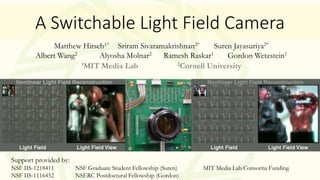







A Switchable Light Field Camera
Using Angle Sensitive Pixels and
Dictionary-based Space Coding
Matthew Hirsch1* Sriram Sivaramakrishnan2* Suren Jayasuriya2*
Albert Wang2 Alyosha Molnar2 Ramesh Raskar1 Gordon Wetzstein1
1MIT Media Lab 2Cornell University
*Shared first-authorship
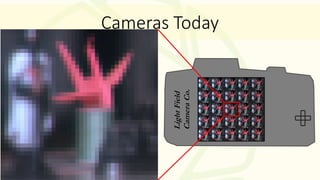
Cameras Today2DCameraCo.
LightField
CameraCo.
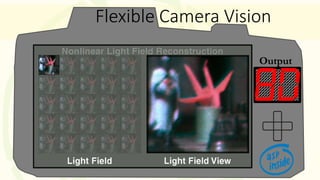
FlexibleCamera!
Flexible Camera Vision
Output
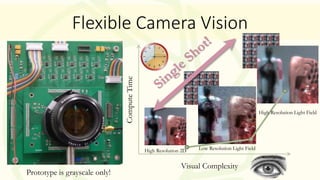
Flexible Camera Vision
Visual Complexity
ComputeTime
High Resolution 2D Low Resolution Light Field
High Resolution Light Field
Prototype is grayscale only!
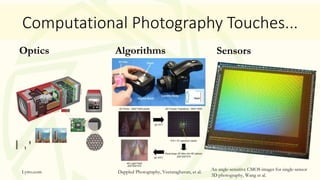
Computational Photography Touches...
Optics Algorithms Sensors
Lytro.com Dappled Photography, Veeraraghavan, et al.
?An angle-sensitive CMOS imager for single-sensor
3D photography, Wang et al.
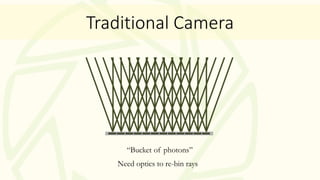
Traditional Camera
“Bucket of photons”
Need optics to re-bin rays
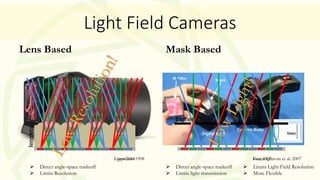
Light Field Cameras
Lens Based Mask Based
barrier
lenslets
Veeraraghavan et al. 2007Ives, 1905Lippmann 1908Lytro 2014
 Direct angle-space tradeoff
 Limits Resolution
 Direct angle-space tradeoff
 Limits light transmission
 Limits Light Field Resolution
 More Flexible
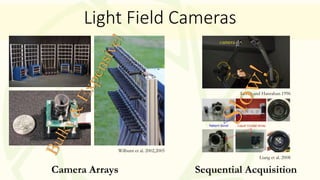
Camera Arrays
Light Field Cameras
Sequential Acquisition
Wilburn et al. 2002,2005
Levoy and Hanrahan 1996
Liang et al. 2008
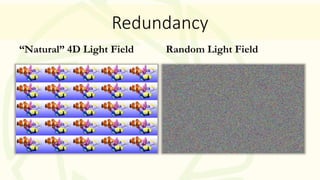
Redundancy
“Natural” 4D Light Field Random Light Field
Captured2DImage4DReconstruction
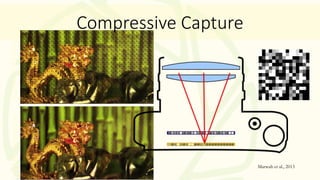
Compressive Capture
Marwah et al., 2013
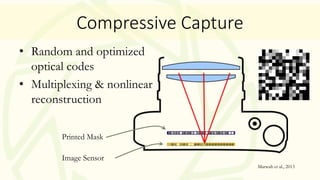
Compressive Capture
• Random and optimized
optical codes
• Multiplexing & nonlinear
reconstruction
Marwah et al., 2013
Image Sensor
Printed Mask
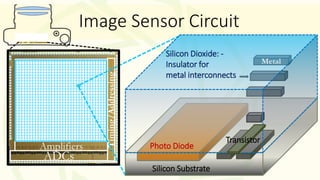
Image Sensor Circuit
Pixel Array Timing/Addressing
Amplifiers
ADCs
Silicon Dioxide: -
Insulator for
metal interconnects
Photo Diode
Silicon Substrate
Metal
Transistor
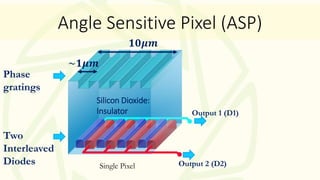
Angle Sensitive Pixel (ASP)
Phase
gratings
Two
Interleaved
Diodes
𝟏𝟎𝝁𝒎
~𝟏𝝁𝒎
Single Pixel
Silicon Dioxide:
Insulator Output 1 (D1)
Output 2 (D2)
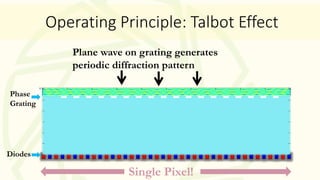
Plane wave on grating generates
periodic diffraction pattern
Operating Principle: Talbot Effect
Single Pixel!
Phase
Grating
Diodes
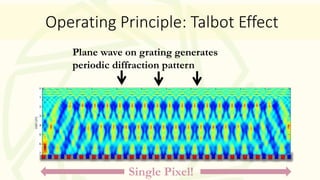
Plane wave on grating generates
periodic diffraction pattern
Operating Principle: Talbot Effect
Single Pixel!
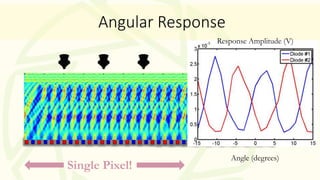
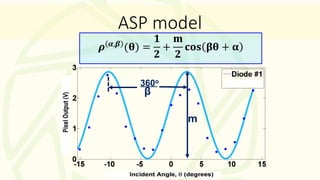
Angular Response
Angle (degrees)
Response Amplitude (V)
Single Pixel!
ASP model
𝝆 𝜶,𝜷
(𝛉) =
𝟏
𝟐
+
𝐦
𝟐
𝐜𝐨𝐬 𝛃𝛉 + 𝛂
m
360o
β
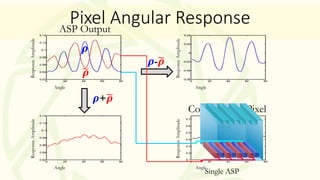
Pixel Angular ResponseASP Output
Conventional Pixel
𝝆- 𝝆
𝝆
𝝆+ 𝝆
𝝆
Angle
Angle
Angle
Angle
ResponseAmplitudeResponseAmplitude
Single ASP
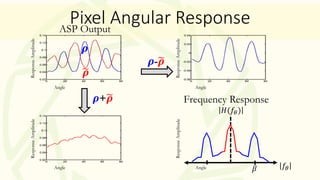
Pixel Angular ResponseASP Output
𝝆- 𝝆
𝝆
𝝆+ 𝝆
𝝆
𝐻 𝑓𝜃
𝑓𝜃𝛽
Frequency Response
Angle Angle
ResponseAmplitudeResponseAmplitude
Angle Angle
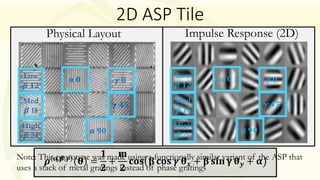
2D ASP Tile
𝝆 𝜶,𝜷,𝜸
(𝛉) =
𝟏
𝟐
+
𝐦
𝟐
𝐜𝐨𝐬 𝛃 𝐜𝐨𝐬 𝜸 𝛉 𝒙 + 𝛃 𝐬𝐢𝐧 𝛄 𝛉 𝒚 + 𝛂
Physical Layout Impulse Response (2D)
Low
𝜷 𝟏𝟐
Med
𝜷 18
High
𝜷 24
Low
𝜷 𝟏𝟐
Med
𝜷 18
High
𝜷 24
𝜸 𝟎 𝜸 𝟎
𝜸 𝟒𝟓 𝜸 𝟒𝟓
𝜶 𝟎 𝜶 𝟎
𝜶 𝟗𝟎 𝜶 𝟗𝟎
Note: This prototype was made using a functionally similar variant of the ASP that
uses a stack of metal gratings instead of phase gratings
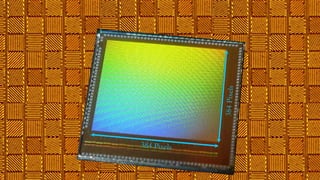
ASP Sensor
ASP Sensor
8
8x
+
-
+
+
8
8x
+
-
+
+
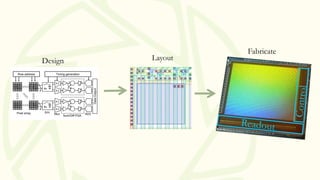
Row address Timing generation
DataOutput
4:1
4:1
4:1
4:1
Pixel array S/H Mux
Sum/Diff PGA
ADC
Design Layout
Fabricate
INTUITION FROM SIGNAL PROCESSING
A Fast Linear Reconstruction Method
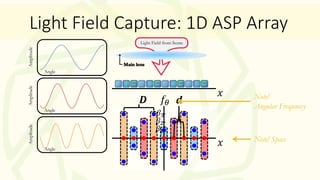
Light Field Capture: 1D ASP Array
𝑓𝜃
𝑥
𝑫 𝒅
𝛽1
𝛽2
𝛽3
𝑥
Angle
Amplitude
Angle
Amplitude
Angle
Amplitude
Note! Space
Note!
Angular Frequnecy
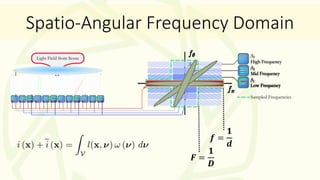
Spatio-Angular Frequency Domain
𝒇 =
𝟏
𝒅
𝑭 =
𝟏
𝑫
LINEAR RECONSTRUCTION
A Fast and Simple Reconstruction Algorithm
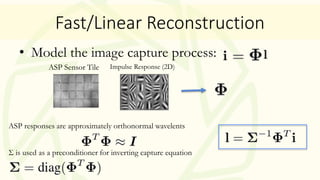
Fast/Linear Reconstruction
ASP responses are approximately orthonormal wavelents
Σ is used as a preconditioner for inverting capture equation
• Model the image capture process:
ASP Sensor Tile Impulse Response (2D)
NONLINEAR RECONSTRUCTION
High Resolution Light Fields from a Single Photo
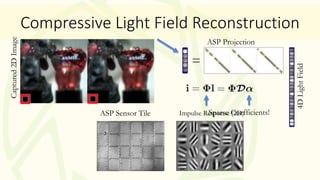
Captured2DImage
=
ASP Projection
4DLightField
Sparse Coefficients!
Compressive Light Field Reconstruction
ASP Sensor Tile Impulse Response (2D)
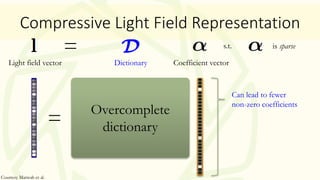
Overcomplete
dictionary=
Light field vector
=
Coefficient vector
s.t. is sparse
Can lead to fewer
non-zero coefficients
Dictionary
Compressive Light Field Representation
Courtesy Marwah et al.
Training light field
= is sparse
Sample 1,000,000 random 4D patches from training light fields
i i i
for all iCoefficient vectorDictionary
s.t.
Dictionary Learning
Courtesy Marwah et al.
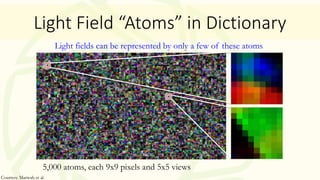
Light Field “Atoms” in Dictionary
5,000 atoms, each 9x9 pixels and 5x5 views
Light fields can be represented by only a few of these atoms
Courtesy Marwah et al.
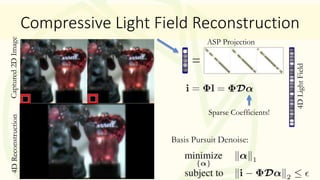
Captured2DImage4DReconstruction
=
ASP Projection
4DLightField
Basis Pursuit Denoise:
Sparse Coefficients!
Compressive Light Field Reconstruction
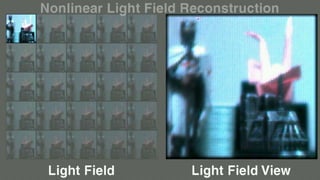
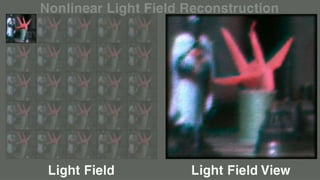
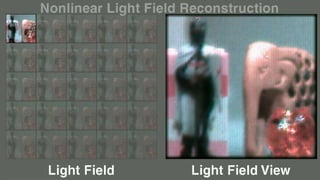
RESULTS
Simulated and Live Results from a Prototype Camera
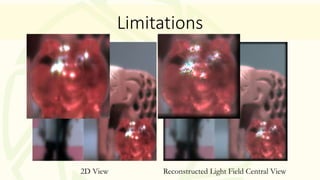
Limitations
2D View Reconstructed Light Field Central View
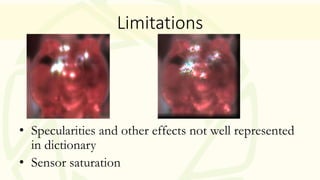
Limitations
• Specularities and other effects not well represented
in dictionary
• Sensor saturation
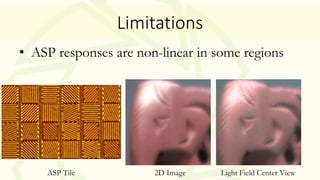
Limitations
• ASP responses are non-linear in some regions
ASP Tile 2D Image Light Field Center View
ANALYSIS
Depth-of-Field, Noise, Resolution, and Failure Cases
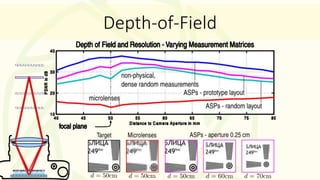
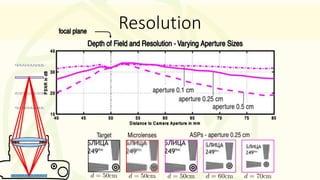
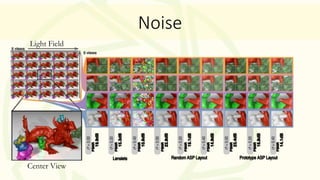
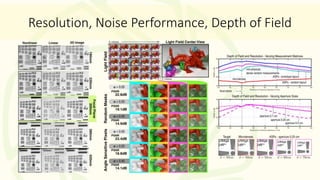
Resolution, Noise Performance, Depth of Field
Conclusion
• We built a custom, ASP sensor
• New sensors, new opportunities
– Shoot now compute later!
– [Computation in] [quality out]
• Seeking new problems
– e.g. Illumination Multiplexing, Time of Flight
Support provided by:
NSF IIS-1218411 NSF Graduate Student Fellowship (Suren) MIT Media Lab Consortia Funding
NSF IIS-1116452 NSERC Postdoctural Fellowship (Gordon)
Matthew Hirsch1* Sriram Sivaramakrishnan2* Suren Jayasuriya2*
Albert Wang2 Alyosha Molnar2 Ramesh Raskar1 Gordon Wetzstein1
1MIT Media Lab 2Cornell University
A Switchable Light Field Camera
Depth-of-Field
? ? ? ? ? ? ? ? ? ? ? ?
Resolution
Noise
Light Field
Center View

>A Switchable Light Field Camera Architecture with Angle SEnsitive Pixels and Dictionary-based Sparse Coding