







Compression
stuart.jones3@southwales.ac.uk
www.stuartjones.org
Compression
Introduction
Compression Systems
Peak/RMS
Circuit Types
Controls:
Threshold
Attack
Release
Ratio
Knee
Stereo Link
Compression Meters
References
Appendix
Agenda
Compression
Introduction
Compression
One way of controlling dynamics is to adjust the recording level during the performance using the faders
(known as fader or gain riding). This requires very careful and quick response to changes.
A more effective remedy is to reduce the dynamic range of a signal by use of compression (dynamic
range compression)
Introduction
Compression
A Compressor is an amplifier, whose gain decreases as its input level is increased.
Introduction
Compression
As an audio processing tool, compressors can be protective or creative.
Introduction
Protective - The dynamic range of an audio signal can be reduced to prevent overload of sound desks or
tape saturation, so reducing the risk of distortion.
Creative - In a studio, compressors can be used creatively to reduce the dynamic range of audio signals so
as to produce a more evenly controlled or differently balanced sound (i.e. altering the natural dynamics of an
instrument or voice).
Compression
Compression Systems
Compression
Side Chain
Audio In Audio Out
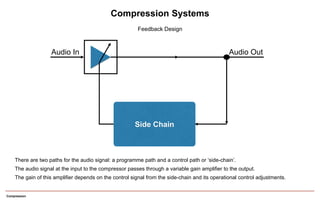
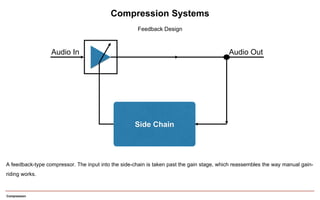
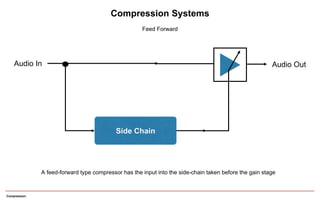
There are two paths for the audio signal: a programme path and a control path or ‘side-chain’.
The audio signal at the input to the compressor passes through a variable gain amplifier to the output.
The gain of this amplifier depends on the control signal from the side-chain and its operational control adjustments.
Compression Systems
Feedback Design
Compression
Side Chain
Audio In Audio Out
A feedback-type compressor. The input into the side-chain is taken past the gain stage, which reassembles the way manual gain-
riding works.
Compression Systems
Feedback Design
Compression
Side Chain
Audio In Audio Out
A feed-forward type compressor has the input into the side-chain taken before the gain stage
Compression Systems
Feed Forward
Compression
Side Chain
Audio In Audio Out
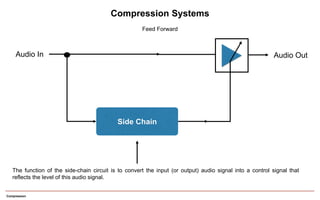
The function of the side-chain circuit is to convert the input (or output) audio signal into a control signal that
reflects the level of this audio signal.
Compression Systems
Feed Forward
Compression Systems
Feed Forward
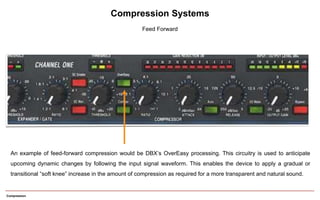
An example of feed-forward compression would be DBX’s OverEasy processing. This circuitry is used to anticipate
upcoming dynamic changes by following the input signal waveform. This enables the device to apply a gradual or
transitional “soft knee” increase in the amount of compression as required for a more transparent and natural sound.
Compression
Compression
Peak/RMS
Peak/RMS
It is the job of the side chain to measure how big the signal is, so that it knows when it needs compressing.
The compressor will behave differently, depending on whether the side chain responds to average signal levels
(Root Means Square) or to absolute signal peaks (Peak).
Compression
Compression
Circuit Types
Compression
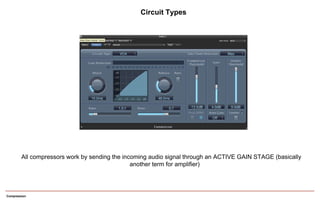
All compressors work by sending the incoming audio signal through an ACTIVE GAIN STAGE (basically
another term for amplifier)
Circuit Types
Compression
Compression Circuit Types
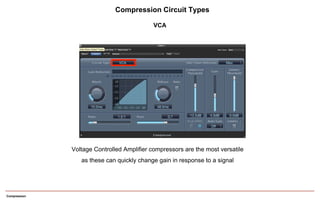
Voltage Controlled Amplifier compressors are the most versatile
as these can quickly change gain in response to a signal
VCA
Compression
Compression Circuit Types
VCA Application
Use where you want strict control over level and dynamics. For example:
• Vocals
• Drums
• Bass
• Guitar
• Synth
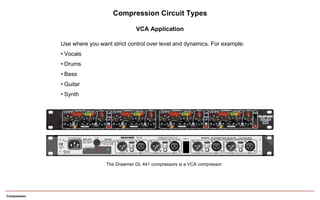
The Drawmer DL 441 compressors is a VCA compressor
Compression
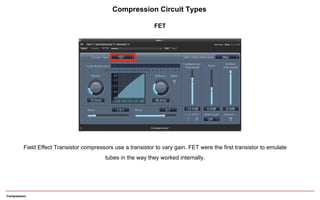
Field Effect Transistor compressors use a transistor to vary gain. FET were the first transistor to emulate
tubes in the way they worked internally.
Compression Circuit Types
FET
Compression
Compression Circuit Types
FET Application
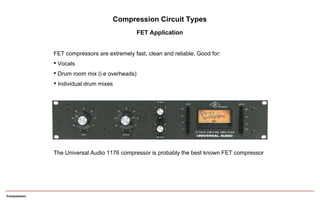
The Universal Audio 1176 compressor is probably the best known FET compressor
FET compressors are extremely fast, clean and reliable. Good for:
• Vocals
• Drum room mix (i.e overheads)
• Individual drum mixes
Compression
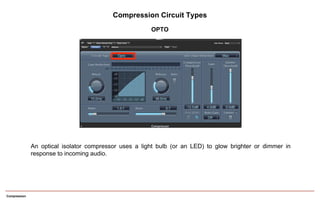
An optical isolator compressor uses a light bulb (or an LED) to glow brighter or dimmer in
response to incoming audio.
OPTO
Compression Circuit Types
Compression
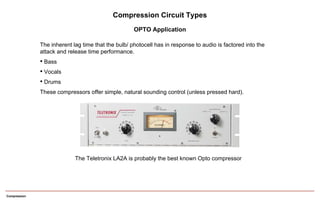
The Teletronix LA2A is probably the best known Opto compressor
OPTO Application
Compression Circuit Types
The inherent lag time that the bulb/ photocell has in response to audio is factored into the
attack and release time performance.
• Bass
• Vocals
• Drums
These compressors offer simple, natural sounding control (unless pressed hard).
Compression
Threshold
Compression
Threshold
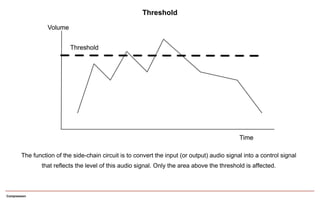
The function of the side-chain circuit is to convert the input (or output) audio signal into a control signal
that reflects the level of this audio signal. Only the area above the threshold is affected.
Compression
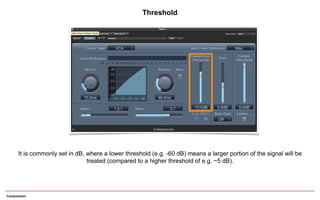
It is commonly set in dB, where a lower threshold (e.g. -60 dB) means a larger portion of the signal will be
treated (compared to a higher threshold of e.g. −5 dB).
Threshold
Compression
Attack
Compression
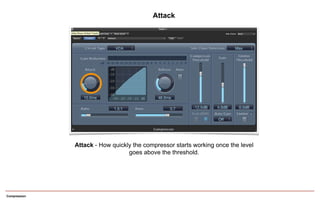
Attack - How quickly the compressor starts working once the level
goes above the threshold.
Attack
Compression
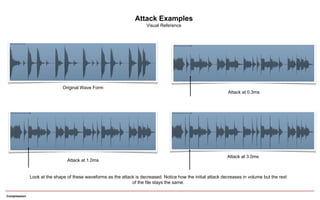
Attack Examples
Visual Reference
Look at the shape of these waveforms as the attack is decreased. Notice how the initial attack decreases in volume but the rest
of the file stays the same.
Original Wave Form
Attack at 3.0ms
Attack at 1.0ms
Attack at 0.3ms
Compression
Release
Compression
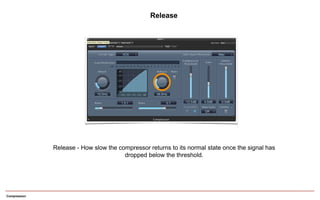
Release - How slow the compressor returns to its normal state once the signal has
dropped below the threshold.
Release
Compression
Attack & Release
If the combination of attack and release time is not ideal for the rhythm of the music, the sound will be
“squashed”, louder than the source, but “wimpy loud’ instead of “punchy loud”
The Secret of the Mastering Engineer by Bob Katz
Compression
Ratio
Compression
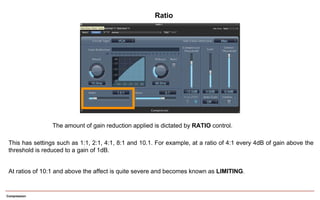
The amount of gain reduction applied is dictated by RATIO control.
This has settings such as 1:1, 2:1, 4:1, 8:1 and 10.1. For example, at a ratio of 4:1 every 4dB of gain above the
threshold is reduced to a gain of 1dB.
At ratios of 10:1 and above the affect is quite severe and becomes known as LIMITING.
Ratio
Compression
Knee
Compression
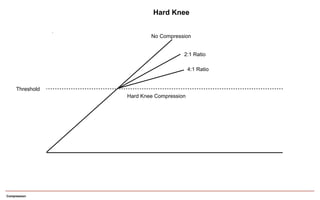
Hard Knee
Threshold
No Compression
2:1 Ratio
4:1 Ratio
Hard Knee Compression
Compression
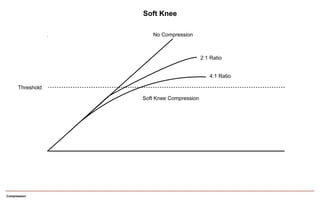
Soft Knee
Threshold
No Compression
Soft Knee Compression
2:1 Ratio
4:1 Ratio
Compression
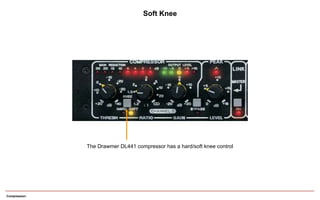
The Drawmer DL441 compressor has a hard/soft knee control
Soft Knee
Compression
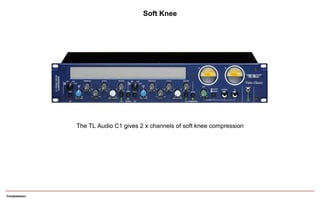
The TL Audio C1 gives 2 x channels of soft knee compression
Soft Knee
Compression
Stereo Link
Compression
Stereo Link
A compressor in stereo linking mode applies the same amount of gain reduction to both the left and right
channels
This is done to prevent image shifting that can occur if both channels are compressed individually.
http://en.wikipedia.org/wiki/Dynamic_range_compression#Stereo_Li
nking
Compression
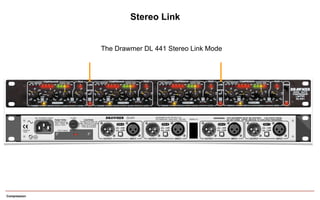
The Drawmer DL 441 Stereo Link Mode
Stereo Link
Compression
Compression Metering
Compression
Metering
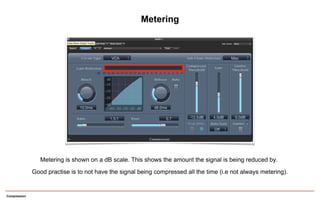
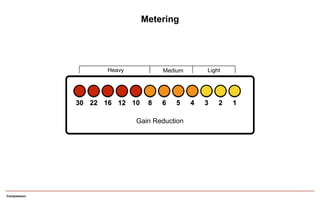
Metering is shown on a dB scale. This shows the amount the signal is being reduced by.
Good practise is to not have the signal being compressed all the time (i.e not always metering).
Compression
Metering
30 22 16 12 10 8 6 5 4 3 2 1
Gain Reduction
Heavy Medium Light
Compression
Other Dynamic Processes
Compression
0dB
+20dB
+40dB
-20dB
-40dB
-40dB -20dB 0dB +20dB +40dB
OutputdB
Input dB
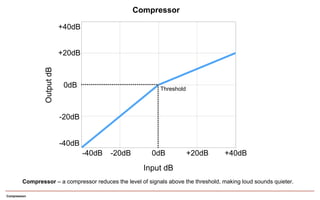
Compressor – a compressor reduces the level of signals above the threshold, making loud sounds quieter.
Threshold
Compressor
Compression
0dB
+20dB
+40dB
-20dB
-40dB
-40dB -20dB 0dB +20dB +40dB
OutputdB
Input dB
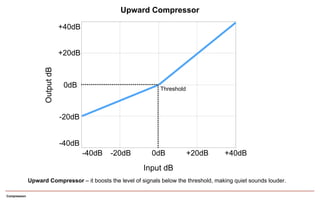
Upward Compressor – it boosts the level of signals below the threshold, making quiet sounds louder.
Threshold
Upward Compressor
Compression
0dB
+20dB
+40dB
-20dB
-40dB
-40dB -20dB 0dB +20dB +40dB
OutputdB
Input dB
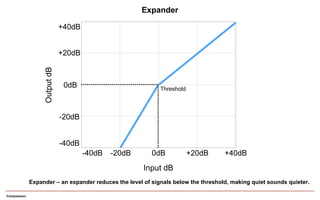
Expander – an expander reduces the level of signals below the threshold, making quiet sounds quieter.
Threshold
Expander
Compression
0dB
+20dB
+40dB
-20dB
-40dB
-40dB -20dB 0dB +20dB +40dB
OutputdB
Input dB
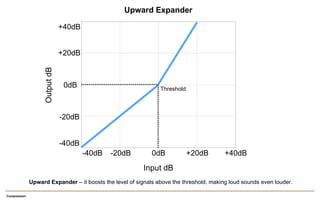
Upward Expander – it boosts the level of signals above the threshold, making loud sounds even louder.
Threshold
Upward Expander
Compression
0dB
+20dB
+40dB
-20dB
-40dB
-40dB -20dB 0dB +20dB +40dB
OutputdB
Input dB
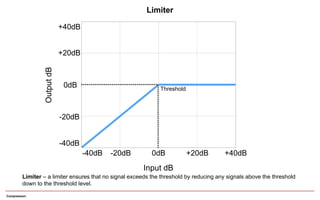
Limiter – a limiter ensures that no signal exceeds the threshold by reducing any signals above the threshold
down to the threshold level.
Threshold
Limiter
Compression
References
Books
• Izhaki, R. “Mixing Audio, Concepts, Practices & Tools”, Focal Press, 2008, U.S
• Katz, B. “The Secret of the Mastering Engineer” TC Electronic, 2001, USA
• Shea, M. “Studio Recording Procedures-How to Record Any Instrument”, McGraw-Hill, 2005, USA
Articles
• (ebook) Sound Engineering Tutorials From Sound On Sound -- Technique - How & When To Use Mix Compression,
http://www.soundonsound.com/sos/jun99/articles/mixcomp.htm Accessed Aug 2012
• (ebook) Sound Engineering Tutorials From Sound On Sound -- Technique - Advanced Compression - 1 & 2.
http://www.soundonsound.com/sos/dec00/articles/adcompression.htm - Accessed Aug 2012
Web
• Understanding Audio Compressors and Audio Compression by Barry Rudolph. http://www.barryrudolph.com - Accessed Aug 2012
• http://www.popmusic.dk/links-us.html. SSL 4000 G presets for Logic's Compressor (download) - Accessed Aug 2012
• http://en.wikipedia.org/wiki/Dynamic_range_compression#Stereo_Linking - Accessed Aug 2012
• Audient Studio How to Guide - Patching Inserts -
http://www.youtube.com/watch?v=HjP2Pc33hl0&list=PL83AA8CC2E6E3BD9F&index=14&feature=plcp - Accessed Aug 2012
• http://www.uaudio.com/blog/analog-obsession-1176-history/ - Accessed Aug 2012
• http://www.uaudio.com/media/assetlibrary/u/a/uadmanual.pdf - Accessed Aug 2012
• VCA: Uses a Voltage Controlled Amplifier. Known for their fast gain-reduction abilities, examples include SSL's famous
bus compressor and the Dbx 160.
• FET: Uses Field Effect Transistors. Compressors based on these designs have a 'valvey' sound, but are also capable of
pretty fast response times. Examples include the Universal Audio/UREI 1176.
• Opto: Uses a lamp and photoresistor. By their nature, optical compressors react quite slowly to transients, which can be
a good thing in some cases! Examples include Teletronix's LA2A and the Joe Meek/Ted Fletcher designs.
• Platinum: This is Logic Pro's original compressor 'model' and it can still be useful in some situations, as it has a fairly
transparent quality.
• ClassA_R & ClassA_U: Quite what these emulations are based on is anyone's guess, but the names suggest variable
'mu' devices combined with Class-A amplification, similar to devices from Manley Labs.
Appendix
Logic Compressor Circuit Types
Compression
Compression
stuart.jones3@southwales.ac.uk
www.stuartjones.org

Compression

  • 1.
  • 2.
  • 3.
  • 4.
    Compression One way ofcontrolling dynamics is to adjust the recording level during the performance using the faders (known as fader or gain riding). This requires very careful and quick response to changes. A more effective remedy is to reduce the dynamic range of a signal by use of compression (dynamic range compression) Introduction
  • 5.
    Compression A Compressor isan amplifier, whose gain decreases as its input level is increased. Introduction
  • 6.
    Compression As an audioprocessing tool, compressors can be protective or creative. Introduction Protective - The dynamic range of an audio signal can be reduced to prevent overload of sound desks or tape saturation, so reducing the risk of distortion. Creative - In a studio, compressors can be used creatively to reduce the dynamic range of audio signals so as to produce a more evenly controlled or differently balanced sound (i.e. altering the natural dynamics of an instrument or voice).
  • 7.
  • 8.
    Compression Side Chain Audio InAudio Out There are two paths for the audio signal: a programme path and a control path or ‘side-chain’. The audio signal at the input to the compressor passes through a variable gain amplifier to the output. The gain of this amplifier depends on the control signal from the side-chain and its operational control adjustments. Compression Systems Feedback Design
  • 9.
    Compression Side Chain Audio InAudio Out A feedback-type compressor. The input into the side-chain is taken past the gain stage, which reassembles the way manual gain- riding works. Compression Systems Feedback Design
  • 10.
    Compression Side Chain Audio InAudio Out A feed-forward type compressor has the input into the side-chain taken before the gain stage Compression Systems Feed Forward
  • 11.
    Compression Side Chain Audio InAudio Out The function of the side-chain circuit is to convert the input (or output) audio signal into a control signal that reflects the level of this audio signal. Compression Systems Feed Forward
  • 12.
    Compression Systems Feed Forward Anexample of feed-forward compression would be DBX’s OverEasy processing. This circuitry is used to anticipate upcoming dynamic changes by following the input signal waveform. This enables the device to apply a gradual or transitional “soft knee” increase in the amount of compression as required for a more transparent and natural sound. Compression
  • 13.
  • 14.
    Peak/RMS It is thejob of the side chain to measure how big the signal is, so that it knows when it needs compressing. The compressor will behave differently, depending on whether the side chain responds to average signal levels (Root Means Square) or to absolute signal peaks (Peak). Compression
  • 15.
  • 16.
    Compression All compressors workby sending the incoming audio signal through an ACTIVE GAIN STAGE (basically another term for amplifier) Circuit Types
  • 17.
    Compression Compression Circuit Types VoltageControlled Amplifier compressors are the most versatile as these can quickly change gain in response to a signal VCA
  • 18.
    Compression Compression Circuit Types VCAApplication Use where you want strict control over level and dynamics. For example: • Vocals • Drums • Bass • Guitar • Synth The Drawmer DL 441 compressors is a VCA compressor
  • 19.
    Compression Field Effect Transistorcompressors use a transistor to vary gain. FET were the first transistor to emulate tubes in the way they worked internally. Compression Circuit Types FET
  • 20.
    Compression Compression Circuit Types FETApplication The Universal Audio 1176 compressor is probably the best known FET compressor FET compressors are extremely fast, clean and reliable. Good for: • Vocals • Drum room mix (i.e overheads) • Individual drum mixes
  • 21.
    Compression An optical isolatorcompressor uses a light bulb (or an LED) to glow brighter or dimmer in response to incoming audio. OPTO Compression Circuit Types
  • 22.
    Compression The Teletronix LA2Ais probably the best known Opto compressor OPTO Application Compression Circuit Types The inherent lag time that the bulb/ photocell has in response to audio is factored into the attack and release time performance. • Bass • Vocals • Drums These compressors offer simple, natural sounding control (unless pressed hard).
  • 23.
  • 24.
    Compression Threshold The function ofthe side-chain circuit is to convert the input (or output) audio signal into a control signal that reflects the level of this audio signal. Only the area above the threshold is affected.
  • 25.
    Compression It is commonlyset in dB, where a lower threshold (e.g. -60 dB) means a larger portion of the signal will be treated (compared to a higher threshold of e.g. −5 dB). Threshold
  • 26.
  • 27.
    Compression Attack - Howquickly the compressor starts working once the level goes above the threshold. Attack
  • 28.
    Compression Attack Examples Visual Reference Lookat the shape of these waveforms as the attack is decreased. Notice how the initial attack decreases in volume but the rest of the file stays the same. Original Wave Form Attack at 3.0ms Attack at 1.0ms Attack at 0.3ms
  • 29.
  • 30.
    Compression Release - Howslow the compressor returns to its normal state once the signal has dropped below the threshold. Release
  • 31.
    Compression Attack & Release Ifthe combination of attack and release time is not ideal for the rhythm of the music, the sound will be “squashed”, louder than the source, but “wimpy loud’ instead of “punchy loud” The Secret of the Mastering Engineer by Bob Katz
  • 32.
  • 33.
    Compression The amount ofgain reduction applied is dictated by RATIO control. This has settings such as 1:1, 2:1, 4:1, 8:1 and 10.1. For example, at a ratio of 4:1 every 4dB of gain above the threshold is reduced to a gain of 1dB. At ratios of 10:1 and above the affect is quite severe and becomes known as LIMITING. Ratio
  • 34.
  • 35.
    Compression Hard Knee Threshold No Compression 2:1Ratio 4:1 Ratio Hard Knee Compression
  • 36.
    Compression Soft Knee Threshold No Compression SoftKnee Compression 2:1 Ratio 4:1 Ratio
  • 37.
    Compression The Drawmer DL441compressor has a hard/soft knee control Soft Knee
  • 38.
    Compression The TL AudioC1 gives 2 x channels of soft knee compression Soft Knee
  • 39.
  • 40.
    Compression Stereo Link A compressorin stereo linking mode applies the same amount of gain reduction to both the left and right channels This is done to prevent image shifting that can occur if both channels are compressed individually. http://en.wikipedia.org/wiki/Dynamic_range_compression#Stereo_Li nking
  • 41.
    Compression The Drawmer DL441 Stereo Link Mode Stereo Link
  • 42.
  • 43.
    Compression Metering Metering is shownon a dB scale. This shows the amount the signal is being reduced by. Good practise is to not have the signal being compressed all the time (i.e not always metering).
  • 44.
    Compression Metering 30 22 1612 10 8 6 5 4 3 2 1 Gain Reduction Heavy Medium Light
  • 45.
  • 46.
    Compression 0dB +20dB +40dB -20dB -40dB -40dB -20dB 0dB+20dB +40dB OutputdB Input dB Compressor – a compressor reduces the level of signals above the threshold, making loud sounds quieter. Threshold Compressor
  • 47.
    Compression 0dB +20dB +40dB -20dB -40dB -40dB -20dB 0dB+20dB +40dB OutputdB Input dB Upward Compressor – it boosts the level of signals below the threshold, making quiet sounds louder. Threshold Upward Compressor
  • 48.
    Compression 0dB +20dB +40dB -20dB -40dB -40dB -20dB 0dB+20dB +40dB OutputdB Input dB Expander – an expander reduces the level of signals below the threshold, making quiet sounds quieter. Threshold Expander
  • 49.
    Compression 0dB +20dB +40dB -20dB -40dB -40dB -20dB 0dB+20dB +40dB OutputdB Input dB Upward Expander – it boosts the level of signals above the threshold, making loud sounds even louder. Threshold Upward Expander
  • 50.
    Compression 0dB +20dB +40dB -20dB -40dB -40dB -20dB 0dB+20dB +40dB OutputdB Input dB Limiter – a limiter ensures that no signal exceeds the threshold by reducing any signals above the threshold down to the threshold level. Threshold Limiter
  • 51.
    Compression References Books • Izhaki, R.“Mixing Audio, Concepts, Practices & Tools”, Focal Press, 2008, U.S • Katz, B. “The Secret of the Mastering Engineer” TC Electronic, 2001, USA • Shea, M. “Studio Recording Procedures-How to Record Any Instrument”, McGraw-Hill, 2005, USA Articles • (ebook) Sound Engineering Tutorials From Sound On Sound -- Technique - How & When To Use Mix Compression, http://www.soundonsound.com/sos/jun99/articles/mixcomp.htm Accessed Aug 2012 • (ebook) Sound Engineering Tutorials From Sound On Sound -- Technique - Advanced Compression - 1 & 2. http://www.soundonsound.com/sos/dec00/articles/adcompression.htm - Accessed Aug 2012 Web • Understanding Audio Compressors and Audio Compression by Barry Rudolph. http://www.barryrudolph.com - Accessed Aug 2012 • http://www.popmusic.dk/links-us.html. SSL 4000 G presets for Logic's Compressor (download) - Accessed Aug 2012 • http://en.wikipedia.org/wiki/Dynamic_range_compression#Stereo_Linking - Accessed Aug 2012 • Audient Studio How to Guide - Patching Inserts - http://www.youtube.com/watch?v=HjP2Pc33hl0&list=PL83AA8CC2E6E3BD9F&index=14&feature=plcp - Accessed Aug 2012 • http://www.uaudio.com/blog/analog-obsession-1176-history/ - Accessed Aug 2012 • http://www.uaudio.com/media/assetlibrary/u/a/uadmanual.pdf - Accessed Aug 2012
  • 52.
    • VCA: Usesa Voltage Controlled Amplifier. Known for their fast gain-reduction abilities, examples include SSL's famous bus compressor and the Dbx 160. • FET: Uses Field Effect Transistors. Compressors based on these designs have a 'valvey' sound, but are also capable of pretty fast response times. Examples include the Universal Audio/UREI 1176. • Opto: Uses a lamp and photoresistor. By their nature, optical compressors react quite slowly to transients, which can be a good thing in some cases! Examples include Teletronix's LA2A and the Joe Meek/Ted Fletcher designs. • Platinum: This is Logic Pro's original compressor 'model' and it can still be useful in some situations, as it has a fairly transparent quality. • ClassA_R & ClassA_U: Quite what these emulations are based on is anyone's guess, but the names suggest variable 'mu' devices combined with Class-A amplification, similar to devices from Manley Labs. Appendix Logic Compressor Circuit Types Compression
  • 53.

Editor's Notes

  • #17 Here we see logic compressor with a circuit type emulation control
  • #18 VCA • Voltage Controlled Amplifier compressors are the most versatile of all and so are the greatest in number. The VCA can quickly change gain in response to many different detectors looking at the same signal. i.e VCA circuits respond quickly to a incoming signal.
  • #19 no absolute rules with compression application
  • #20 FET Field Effect Transistor compressors use a special transistor to vary gain. FETs were the first transistor to emulate tubes in the way they worked internally. Inherently a high-impedance device, the FET compressor sounds like no other box. An FET compressor is capable of low-distortion performance, hence a ‘clean’ rather than ‘warm’ sound.
  • #21 FET compressors are extremely fast, clean and reliable. Vocals where a good amount of compression sounds good or better than the same amount with another unit, and on drums for room mics or individual drum mics.
  • #22 Optical Isolators • The optical isolator section of compressors uses a light bulb (or an LED) to glow brighter or dimmer in response to incoming audio. A photocell (or phototransistor) is used to track the varying brightness of the bulb and change gain accordingly. This is a good example of an average responding detector. The inherent lag time that the bulb/photocell has in response to audio is factored into the attack and release time performance.
  • #23 The Universal Audio LA 2A Classic Leveling Amplifier and the transistorized UREI or Universal Audio LA-3 leveling amps are examples of this type of compressor. Compressors using this method are used a lot for bass guitar, vocals, program mix and drums. These compressors offer simple, natural sounding control (unless pressed hard).
  • #28 Ratio can be compared to gravity. Gravity affects the extent by which objects are forced down to ground. Mixing Audio Concepts, Practices and Tools page 278
  • #29 All waveforms after the initial transient look the same. It is the initial ‘hit’ which looks different in all If the attack time is too short, the initial transient of the instrument could be softened, losing the main accent and defeating the whole purpose of compression.
  • #31 Ratio can be compared to gravity. Gravity affects the extent by which objects are forced down to ground. Mixing Audio Concepts, Practices and Tools page 278 If the Release time is too slow, the compressor won’t recover fast enough from the gain reduction of the main accent to bring up the sub accent. If the Release time is too fast, the sound will begin to distort.
  • #32 If the combination of attack and release time is not ideal for the rhythm of the music, the sound will be “squashed”, louder than the source, but “wimpy loud’ instead of “punchy loud” The Secret of the Mastering Engineer by Bob Katz.
  • #34 Ratio can be compared to gravity. Gravity affects the extent by which objects are forced down to ground.
  • #36 A basic compressor does nothing to the input signal until it reaches the threshold, then the full amount of gain reduction is applied as fast as the attack time will let it. This is good for assertive level control, but can be a little too obvious when a lot of compression is being applied to critical sounds within a mix — or to complete mixes for that matter.
  • #37 A gentler-sounding compression can be achieved by using a so-called soft-knee compressor, where the compression ratio increases gradually as the signal approaches the threshold. Once the signal passes the threshold, the full ratio as set by the user is applied, but, because some compression is applied to signals approaching the threshold, the transition from no gain reduction to full gain reduction is far smoother.
  • #39 A gentler-sounding compression can be achieved by using a so-called soft-knee compressor, where the compression ratio increases gradually as the signal approaches the threshold. Once the signal passes the threshold, the full ratio as set by the user is applied, but, because some compression is applied to signals approaching the threshold, the transition from no gain reduction to full gain reduction is far smoother.
  • #52 Please try to access these articles.