Equalizers
Equalization
 An equalizer can be defined as a frequency selective
amplifier.
 It is a device that can alter the spectral content of a
signal that passes though it.
 It is used to compensate for variations or
discrepancies in frequencies present in audio signal.
 Equalizer allows the engineer to accentuate or
attenuate (cut or boost in simplified terms) any
frequency or group of frequencies within the audio
spectrum.
Frequency Response
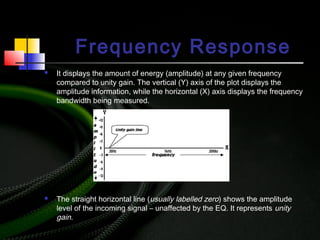
 It displays the amount of energy (amplitude) at any given frequency
compared to unity gain. The vertical (Y) axis of the plot displays the
amplitude information, while the horizontal (X) axis displays the frequency
bandwidth being measured.
 The straight horizontal line (usually labelled zero) shows the amplitude
level of the incoming signal – unaffected by the EQ. It represents unity
gain.
Bandwidth
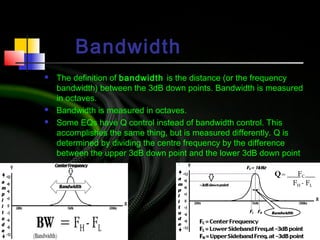
 The definition of bandwidth is the distance (or the frequency
bandwidth) between the 3dB down points. Bandwidth is measured
in octaves.
 Bandwidth is measured in octaves.
 Some EQs have Q control instead of bandwidth control. This
accomplishes the same thing, but is measured differently. Q is
determined by dividing the centre frequency by the difference
between the upper 3dB down point and the lower 3dB down point
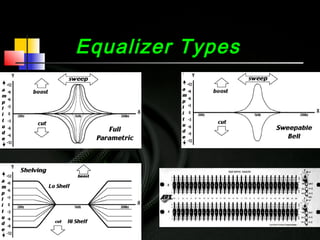
Equalizer Types
 Parametric Equalizers
 Bell Curve (Peaking EQ)
 Shelving EQ
 Graphic Equalizer
Parametric Equalizers
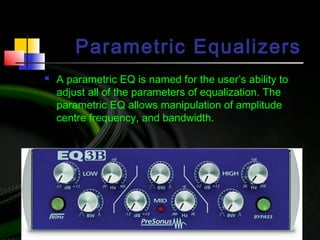
 A parametric EQ is named for the user’s ability to
adjust all of the parameters of equalization. The
parametric EQ allows manipulation of amplitude
centre frequency, and bandwidth.
Parametric Equalizers
 In true parametric EQ, all four bands will have
continuously variable amplitude (cut/boost)
frequency, and bandwidth controls.
 Amplitude (Cut/Boost) : The amplitude controls provide
a certain amount of cut or boost at the selected frequency
range, usually affecting the centre frequency by ±12dB to
±18dB.
 Frequency : The frequency control allows the engineer to
tune in to a particular centre frequency. Each band provides
a sweepable range that overlaps its neighboring bands.
 Bandwidth : The bandwidth control determines what
frequencies below and above the centre frequency will also
be affected by the cutting or boosting process.
Bell Curve (Peaking EQ)
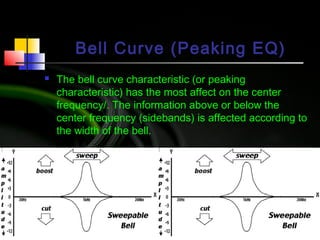
 The bell curve characteristic (or peaking
characteristic) has the most affect on the center
frequency/. The information above or below the
center frequency (sidebands) is affected according to
the width of the bell.
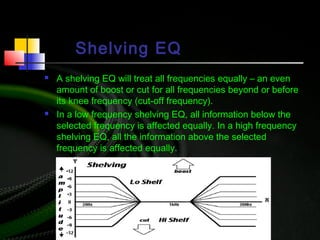
Shelving EQ
 A shelving EQ will treat all frequencies equally – an even
amount of boost or cut for all frequencies beyond or before
its knee frequency (cut-off frequency).
 In a low frequency shelving EQ, all information below the
selected frequency is affected equally. In a high frequency
shelving EQ, all the information above the selected
frequency is affected equally.
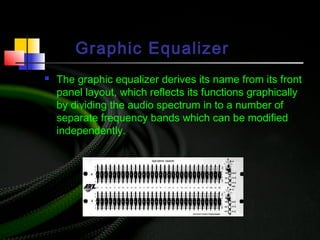
Graphic Equalizer
 The graphic equalizer derives its name from its front
panel layout, which reflects its functions graphically
by dividing the audio spectrum in to a number of
separate frequency bands which can be modified
independently.
Equalizer Types
Understanding EQ and its Effects on
Signals
 Vocals
 The speech spectrum may be divided into three main frequency
bands corresponding to the speech components known as
fundamentals (formants), vowels, and consonants.
 Speech fundamentals occur over a fairly limited range between
about 125Hz and 250Hz. The fundamental region is important
in that it allows us to tell who is speaking, and its clear
transmission is therefore essential as far as voice quality is
concerned.
 Vowels essentially contain the maximum energy and power of
the voice, occurring over the range of 350Hz to 2000Hz.
Consonants occurring over the range of 1500Hz to 4000Hz
contain little energy but are essential to intelligibility.
 80Hz to 125Hz Sense of power in some
outstanding bass singers.
 160Hz to 250Hz Voice fundamentals
 315Hz to 500Hz Important to voice quality
 630Hz to 1kHz Important for a natural sound. Too
much boost in the range produces a honky,
telephone-like quality.
 1.25kHz to 4kHz Accentuation of vocals
 5kHz to 8kHz Important to vocal intelligibility.
 5kHz to16kHz Too much in this area can cause
sibilance.
Filters
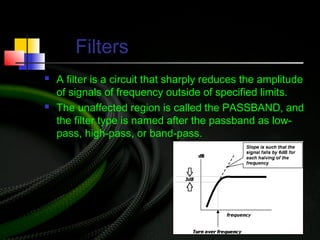
 A filter is a circuit that sharply reduces the amplitude
of signals of frequency outside of specified limits.
 The unaffected region is called the PASSBAND, and
the filter type is named after the passband as low-
pass, high-pass, or band-pass.
Types Of Filters
 Hi Pass [Low Cut]
 Low Pass [Hi Cut]
 Band Pass
 Notch
 Hi Pass [Low Cut]
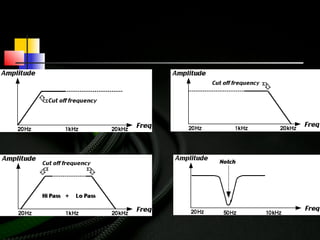
 Attenuates frequencies below the cut off
frequency. Suitable for rolling off low frequency
rumble in the signal source.
 Low Pass [Hi Cut]
 Attenuates frequencies above the cut off frequency. Suitable
for rolling off higher frequency content of the signal which is
unwanted (i.e. hi frequency rings, etc.)
 Band Pass
 Attenuates frequencies below andabove the cut off
frequencies to create a bandwidth limiting filter This design
can be achieved by combining a hi-pass and a lo pass filter.
 Notch
 A very high Q attenuating filter which attenuates a
narrow range of frequencies for a specific
frequency centre. Examples of its use is to remove
obtrusiveelectrical hums and groundloops.
Equalization

Equalization

  • 1.
  • 2.
    Equalization  An equalizercan be defined as a frequency selective amplifier.  It is a device that can alter the spectral content of a signal that passes though it.  It is used to compensate for variations or discrepancies in frequencies present in audio signal.  Equalizer allows the engineer to accentuate or attenuate (cut or boost in simplified terms) any frequency or group of frequencies within the audio spectrum.
  • 3.
    Frequency Response  Itdisplays the amount of energy (amplitude) at any given frequency compared to unity gain. The vertical (Y) axis of the plot displays the amplitude information, while the horizontal (X) axis displays the frequency bandwidth being measured.  The straight horizontal line (usually labelled zero) shows the amplitude level of the incoming signal – unaffected by the EQ. It represents unity gain.
  • 4.
    Bandwidth  The definitionof bandwidth is the distance (or the frequency bandwidth) between the 3dB down points. Bandwidth is measured in octaves.  Bandwidth is measured in octaves.  Some EQs have Q control instead of bandwidth control. This accomplishes the same thing, but is measured differently. Q is determined by dividing the centre frequency by the difference between the upper 3dB down point and the lower 3dB down point
  • 5.
    Equalizer Types  ParametricEqualizers  Bell Curve (Peaking EQ)  Shelving EQ  Graphic Equalizer
  • 6.
    Parametric Equalizers  Aparametric EQ is named for the user’s ability to adjust all of the parameters of equalization. The parametric EQ allows manipulation of amplitude centre frequency, and bandwidth.
  • 7.
    Parametric Equalizers  Intrue parametric EQ, all four bands will have continuously variable amplitude (cut/boost) frequency, and bandwidth controls.  Amplitude (Cut/Boost) : The amplitude controls provide a certain amount of cut or boost at the selected frequency range, usually affecting the centre frequency by ±12dB to ±18dB.  Frequency : The frequency control allows the engineer to tune in to a particular centre frequency. Each band provides a sweepable range that overlaps its neighboring bands.  Bandwidth : The bandwidth control determines what frequencies below and above the centre frequency will also be affected by the cutting or boosting process.
  • 8.
    Bell Curve (PeakingEQ)  The bell curve characteristic (or peaking characteristic) has the most affect on the center frequency/. The information above or below the center frequency (sidebands) is affected according to the width of the bell.
  • 9.
    Shelving EQ  Ashelving EQ will treat all frequencies equally – an even amount of boost or cut for all frequencies beyond or before its knee frequency (cut-off frequency).  In a low frequency shelving EQ, all information below the selected frequency is affected equally. In a high frequency shelving EQ, all the information above the selected frequency is affected equally.
  • 10.
    Graphic Equalizer  Thegraphic equalizer derives its name from its front panel layout, which reflects its functions graphically by dividing the audio spectrum in to a number of separate frequency bands which can be modified independently.
  • 11.
  • 12.
    Understanding EQ andits Effects on Signals  Vocals  The speech spectrum may be divided into three main frequency bands corresponding to the speech components known as fundamentals (formants), vowels, and consonants.  Speech fundamentals occur over a fairly limited range between about 125Hz and 250Hz. The fundamental region is important in that it allows us to tell who is speaking, and its clear transmission is therefore essential as far as voice quality is concerned.  Vowels essentially contain the maximum energy and power of the voice, occurring over the range of 350Hz to 2000Hz. Consonants occurring over the range of 1500Hz to 4000Hz contain little energy but are essential to intelligibility.
  • 13.
     80Hz to125Hz Sense of power in some outstanding bass singers.  160Hz to 250Hz Voice fundamentals  315Hz to 500Hz Important to voice quality  630Hz to 1kHz Important for a natural sound. Too much boost in the range produces a honky, telephone-like quality.  1.25kHz to 4kHz Accentuation of vocals  5kHz to 8kHz Important to vocal intelligibility.  5kHz to16kHz Too much in this area can cause sibilance.
  • 14.
    Filters  A filteris a circuit that sharply reduces the amplitude of signals of frequency outside of specified limits.  The unaffected region is called the PASSBAND, and the filter type is named after the passband as low- pass, high-pass, or band-pass.
  • 15.
    Types Of Filters Hi Pass [Low Cut]  Low Pass [Hi Cut]  Band Pass  Notch
  • 16.
     Hi Pass[Low Cut]  Attenuates frequencies below the cut off frequency. Suitable for rolling off low frequency rumble in the signal source.  Low Pass [Hi Cut]  Attenuates frequencies above the cut off frequency. Suitable for rolling off higher frequency content of the signal which is unwanted (i.e. hi frequency rings, etc.)
  • 17.
     Band Pass Attenuates frequencies below andabove the cut off frequencies to create a bandwidth limiting filter This design can be achieved by combining a hi-pass and a lo pass filter.  Notch  A very high Q attenuating filter which attenuates a narrow range of frequencies for a specific frequency centre. Examples of its use is to remove obtrusiveelectrical hums and groundloops.