DEPARTMENT OF ELECTRONICS AND TELECOMMUNICATION ENGINEERING
(2015-2016)
TAE- 2
PowerPoint Presentation
Digital Signal Processing and Applications
Subject:
Digital Signal Processing
“Audio and Video Compression”
Year/Semester: 3rd Year | 6th Sem | Section: ‘C’
Submitted By:
Akash J. Shahu(27)
Ashish M. Pandey (30)
Submitted To:
Prof. Kiran Bondre,
G.H.R.C.E., Nagpur.
WHAT IS COMPRESSION?
Compression is a reduction in the number
of bits needed to represent data.
Compressing data can save storage capacity,
speed file transfer, and decrease costs for
storage hardware and network bandwidth.
Compression is performed by a program that
uses a formula or algorithm to determine how
to shrink the size of the data.
COMPRESSION
Audio Compression
1. Audio data compression:
 Lossless Audio Compression.
 Lossy Audio Compression.
2. Audio level compression
Video Compression
1. Lossy Video Compression
2. Lossless Video Compression
AUDIO COMPRESSION
Audio compression is a form of data
compression designed to reduce the size of
audio data files.
Audio compression can mean Two things:
 Audio data compression
 Audio level compression
AUDIO DATA COMPRESSION
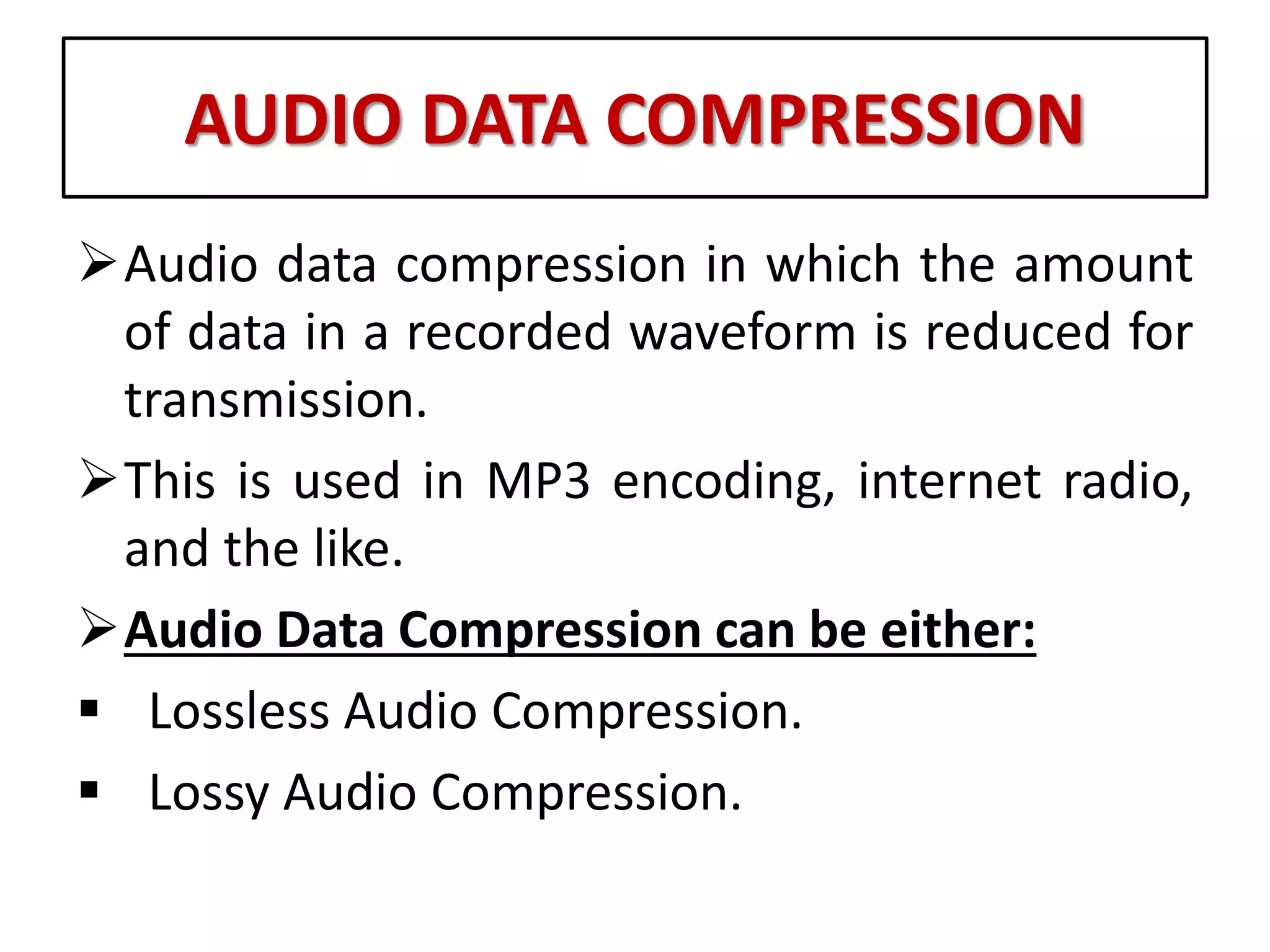
Audio data compression in which the amount
of data in a recorded waveform is reduced for
transmission.
This is used in MP3 encoding, internet radio,
and the like.
Audio Data Compression can be either:
 Lossless Audio Compression.
 Lossy Audio Compression.
AUDIO DATA COMPRESSION
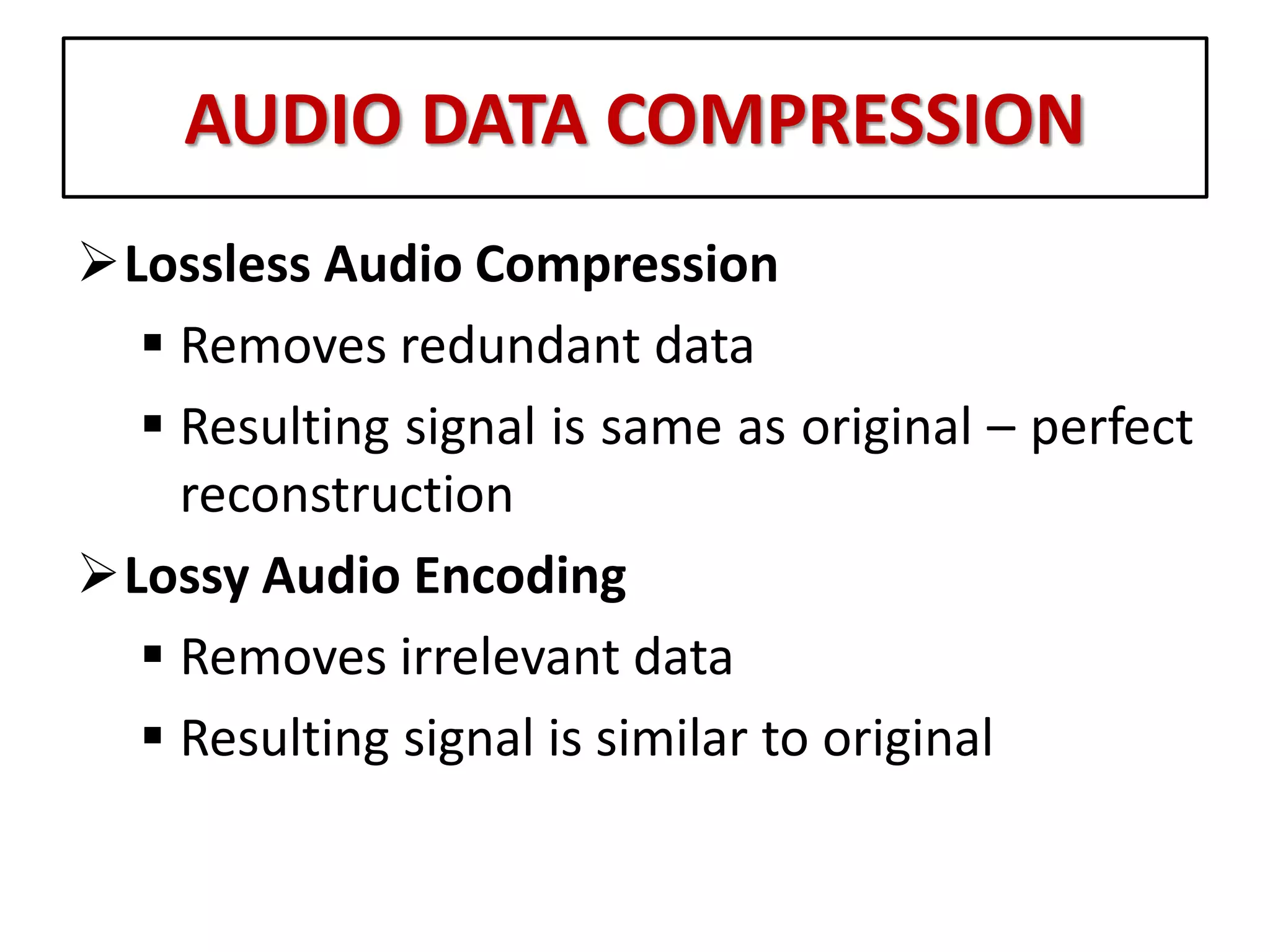
Lossless Audio Compression
 Removes redundant data
 Resulting signal is same as original – perfect
reconstruction
Lossy Audio Encoding
 Removes irrelevant data
 Resulting signal is similar to original
AUDIO LEVEL COMPRESSION
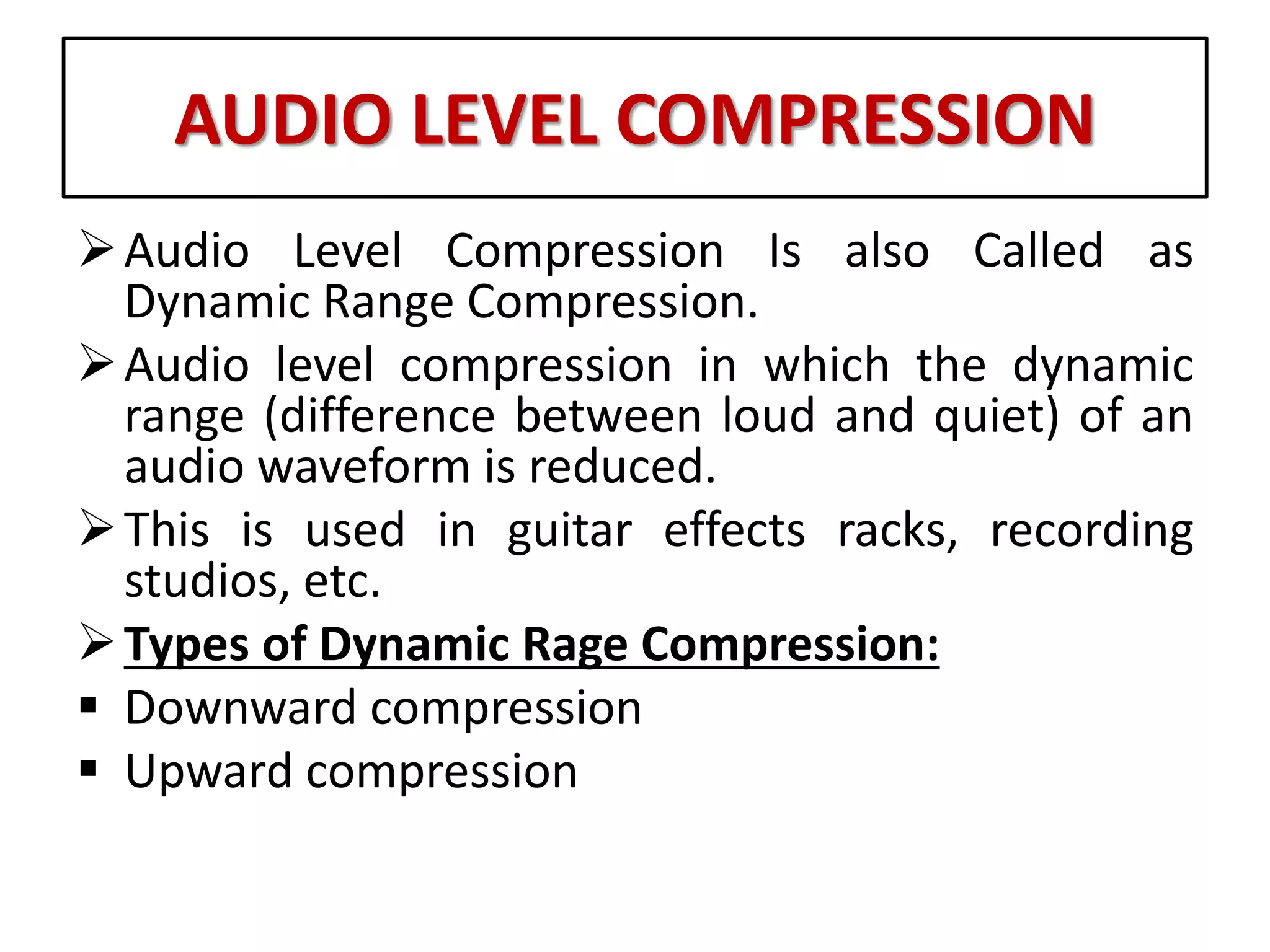
Audio Level Compression Is also Called as
Dynamic Range Compression.
Audio level compression in which the dynamic
range (difference between loud and quiet) of an
audio waveform is reduced.
This is used in guitar effects racks, recording
studios, etc.
Types of Dynamic Rage Compression:
 Downward compression
 Upward compression
AUDIO LEVEL COMPRESSION
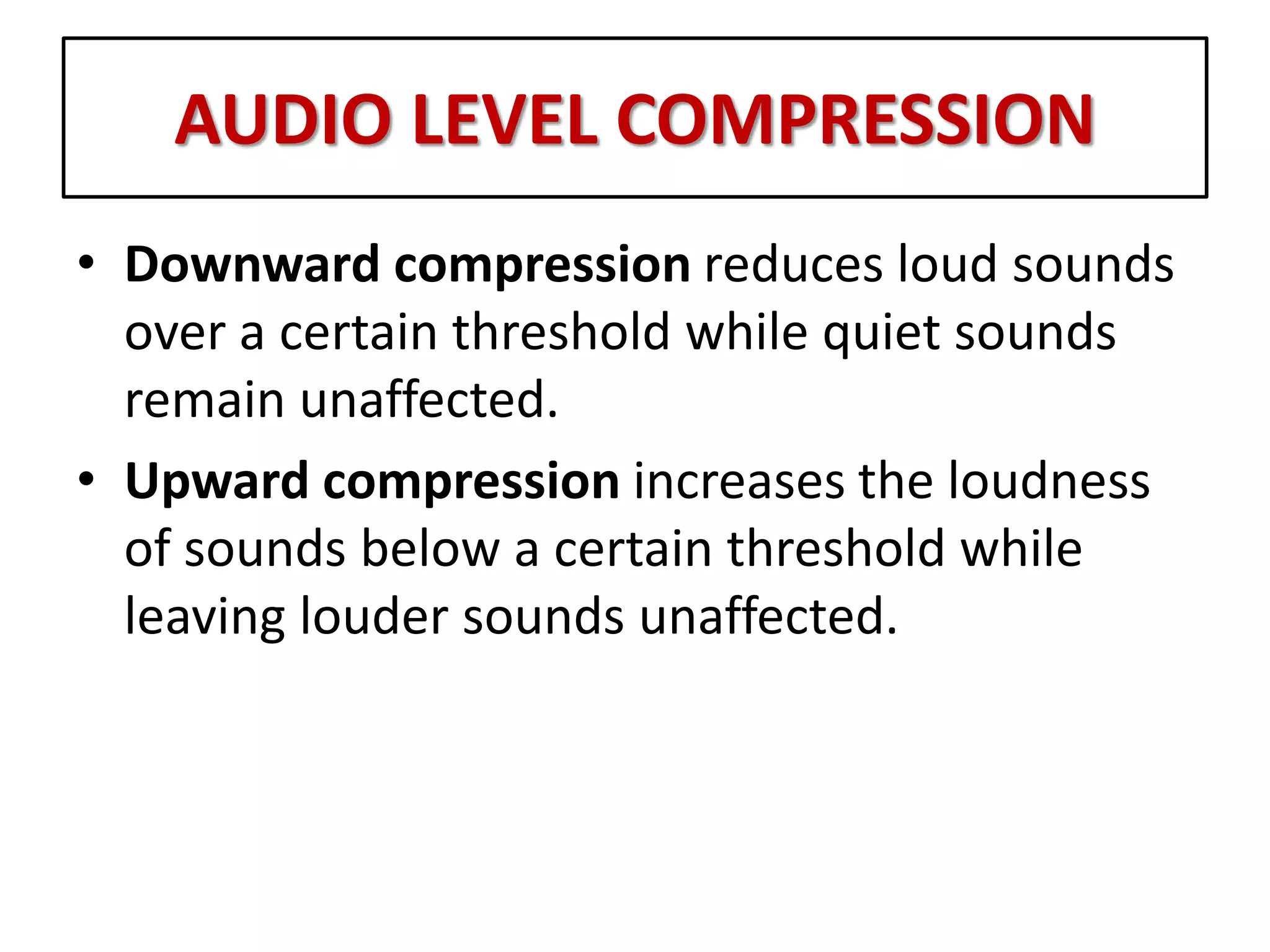
• Downward compression reduces loud sounds
over a certain threshold while quiet sounds
remain unaffected.
• Upward compression increases the loudness
of sounds below a certain threshold while
leaving louder sounds unaffected.
ADVANTAGES OF AUDIO
COMPRESSION
Faster transmission time.
Reduced transmission costs.
Smaller size.
Reduced bandwidth due to Smaller Size
DISADVANTAGES OF AUDIO
COMPRESSION
Compression can only be used if both the
transmitting and receiving modems support
the same compression procedure.
Needs processing both for encoding and
decoding.
if a lossy compression method is used, the
quality is reduced.
Lossless compression methods exist and they
achieve about 50% reduction in size.
VIDEO COMPRESSION
 Video compression uses modern coding techniques to
reduce redundancy in video data.
 Video takes up a lot of space. Uncompressed footage
from a camcorder takes up about 17MB per second of
video.
 Because it takes up so much space, video must be
compressed before it is put on the web. “Compressed”
just means that the information is packed into a
smaller space.
 There are two kinds of compression:
 Lossy Video Compression
 Lossless Video Compression
LOSSY VIDEO COMPRESSION
Lossy compression means that the compressed
file has less data in it than the original file.
 Lossy compression makes up for the loss in
quality by producing comparatively small files.
 For example:
 DVDs are compressed using the MPEG-2 format,
which can make files 15 to 30 times smaller, but
we still tend to perceive DVDs as having high-
quality picture.
LOSSLESS VIDEO COMPRESSION
 Lossless compression is exactly what it sounds
like, compression where none of the
information is lost.
 lossless compression will result in a perfect-
quality picture even if file size is not an issue.
 For example:
 A video editor transferring files from one
computer to another using a hard drive might
choose to use lossless compression to preserve
quality while he or she is working.
ADVANTAGES OF VIDEO
COMPRESSION
Occupies less disk space.
Reading and writing is faster.
File transferring is faster.
The order of bytes is independent.
DISADVANTAGES OF VIDEO
COMPRESSION
Compilation need to be done again for
compression.
Errors may occur while transmitting data.
The byte / pixel relationship is unknown
Has to decompress the previous data.
REFERENCE
• www.axis.com/products/video/about_networ
kvideo/compression
• https://en.wikipedia.org
• http://www.uaudio.com
• http://desktopvideo.about.com
• https://documentation.apple.com
Audio and Video Compression

Audio and Video Compression

  • 1.
    DEPARTMENT OF ELECTRONICSAND TELECOMMUNICATION ENGINEERING (2015-2016) TAE- 2 PowerPoint Presentation Digital Signal Processing and Applications Subject: Digital Signal Processing “Audio and Video Compression” Year/Semester: 3rd Year | 6th Sem | Section: ‘C’ Submitted By: Akash J. Shahu(27) Ashish M. Pandey (30) Submitted To: Prof. Kiran Bondre, G.H.R.C.E., Nagpur.
  • 2.
    WHAT IS COMPRESSION? Compressionis a reduction in the number of bits needed to represent data. Compressing data can save storage capacity, speed file transfer, and decrease costs for storage hardware and network bandwidth. Compression is performed by a program that uses a formula or algorithm to determine how to shrink the size of the data.
  • 3.
    COMPRESSION Audio Compression 1. Audiodata compression:  Lossless Audio Compression.  Lossy Audio Compression. 2. Audio level compression Video Compression 1. Lossy Video Compression 2. Lossless Video Compression
  • 4.
    AUDIO COMPRESSION Audio compressionis a form of data compression designed to reduce the size of audio data files. Audio compression can mean Two things:  Audio data compression  Audio level compression
  • 5.
    AUDIO DATA COMPRESSION Audiodata compression in which the amount of data in a recorded waveform is reduced for transmission. This is used in MP3 encoding, internet radio, and the like. Audio Data Compression can be either:  Lossless Audio Compression.  Lossy Audio Compression.
  • 6.
    AUDIO DATA COMPRESSION LosslessAudio Compression  Removes redundant data  Resulting signal is same as original – perfect reconstruction Lossy Audio Encoding  Removes irrelevant data  Resulting signal is similar to original
  • 7.
    AUDIO LEVEL COMPRESSION AudioLevel Compression Is also Called as Dynamic Range Compression. Audio level compression in which the dynamic range (difference between loud and quiet) of an audio waveform is reduced. This is used in guitar effects racks, recording studios, etc. Types of Dynamic Rage Compression:  Downward compression  Upward compression
  • 8.
    AUDIO LEVEL COMPRESSION •Downward compression reduces loud sounds over a certain threshold while quiet sounds remain unaffected. • Upward compression increases the loudness of sounds below a certain threshold while leaving louder sounds unaffected.
  • 9.
    ADVANTAGES OF AUDIO COMPRESSION Fastertransmission time. Reduced transmission costs. Smaller size. Reduced bandwidth due to Smaller Size
  • 10.
    DISADVANTAGES OF AUDIO COMPRESSION Compressioncan only be used if both the transmitting and receiving modems support the same compression procedure. Needs processing both for encoding and decoding. if a lossy compression method is used, the quality is reduced. Lossless compression methods exist and they achieve about 50% reduction in size.
  • 11.
    VIDEO COMPRESSION  Videocompression uses modern coding techniques to reduce redundancy in video data.  Video takes up a lot of space. Uncompressed footage from a camcorder takes up about 17MB per second of video.  Because it takes up so much space, video must be compressed before it is put on the web. “Compressed” just means that the information is packed into a smaller space.  There are two kinds of compression:  Lossy Video Compression  Lossless Video Compression
  • 12.
    LOSSY VIDEO COMPRESSION Lossycompression means that the compressed file has less data in it than the original file.  Lossy compression makes up for the loss in quality by producing comparatively small files.  For example:  DVDs are compressed using the MPEG-2 format, which can make files 15 to 30 times smaller, but we still tend to perceive DVDs as having high- quality picture.
  • 13.
    LOSSLESS VIDEO COMPRESSION Lossless compression is exactly what it sounds like, compression where none of the information is lost.  lossless compression will result in a perfect- quality picture even if file size is not an issue.  For example:  A video editor transferring files from one computer to another using a hard drive might choose to use lossless compression to preserve quality while he or she is working.
  • 14.
    ADVANTAGES OF VIDEO COMPRESSION Occupiesless disk space. Reading and writing is faster. File transferring is faster. The order of bytes is independent.
  • 15.
    DISADVANTAGES OF VIDEO COMPRESSION Compilationneed to be done again for compression. Errors may occur while transmitting data. The byte / pixel relationship is unknown Has to decompress the previous data.
  • 16.
    REFERENCE • www.axis.com/products/video/about_networ kvideo/compression • https://en.wikipedia.org •http://www.uaudio.com • http://desktopvideo.about.com • https://documentation.apple.com