IS IT POSSIBLE TO CONFINE
SOUND TO A SMALL AREA ?
YES. It is possible!!
through…
AUDIO SPOTLIGHTING
What is Audio spotlight?
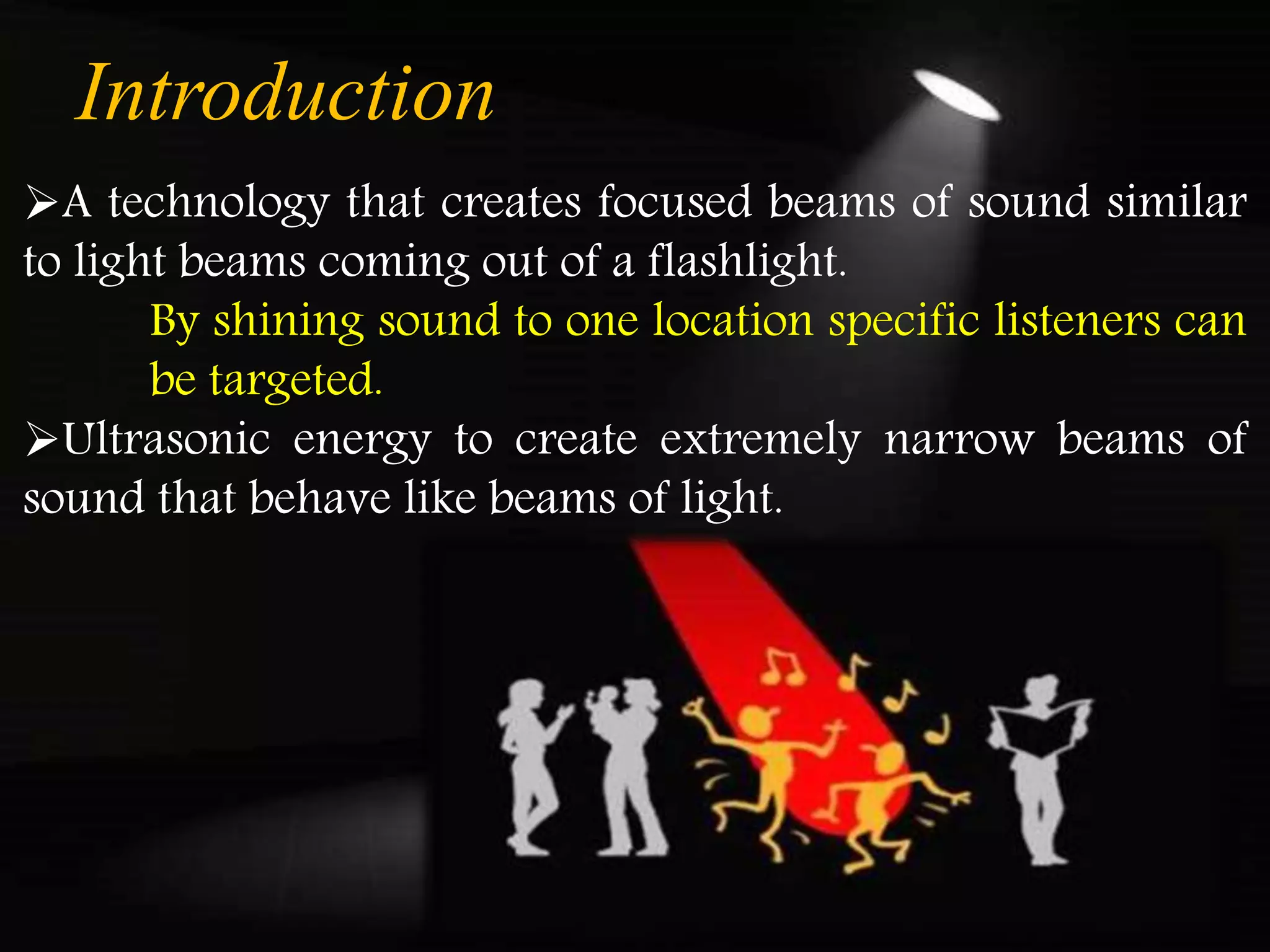
A technology that creates focused beams of sound similar
to light beams coming out of a flashlight.
By shining sound to one location specific listeners can
be targeted.
Ultrasonic energy to create extremely narrow beams of
sound that behave like beams of light.
Introduction
History
 Invented by the founder of Holosonics Labs, Dr. F.
Joseph Pompei of MIT.
 First attempts created a single tone (1975).
 Audio tone made directive using a transducer array by
Ricoh, Japan (1983).
 Commercially available in 2000 by the company
Holosonics.
 Disney was amongst the first major corporations to
adopt it for use.
AUDIO SPOTLIGHT looks like a disk-shaped
loudspeaker trailing a wire with a small laser guide beam
mounted in the middle
 When one points the
flat side of the disk in
your direction, you
here whatever sound
one’s chosen for you.
Basic Principle
works by emitting harmless high frequency ultrasonic
tones that human ear cannot hear.
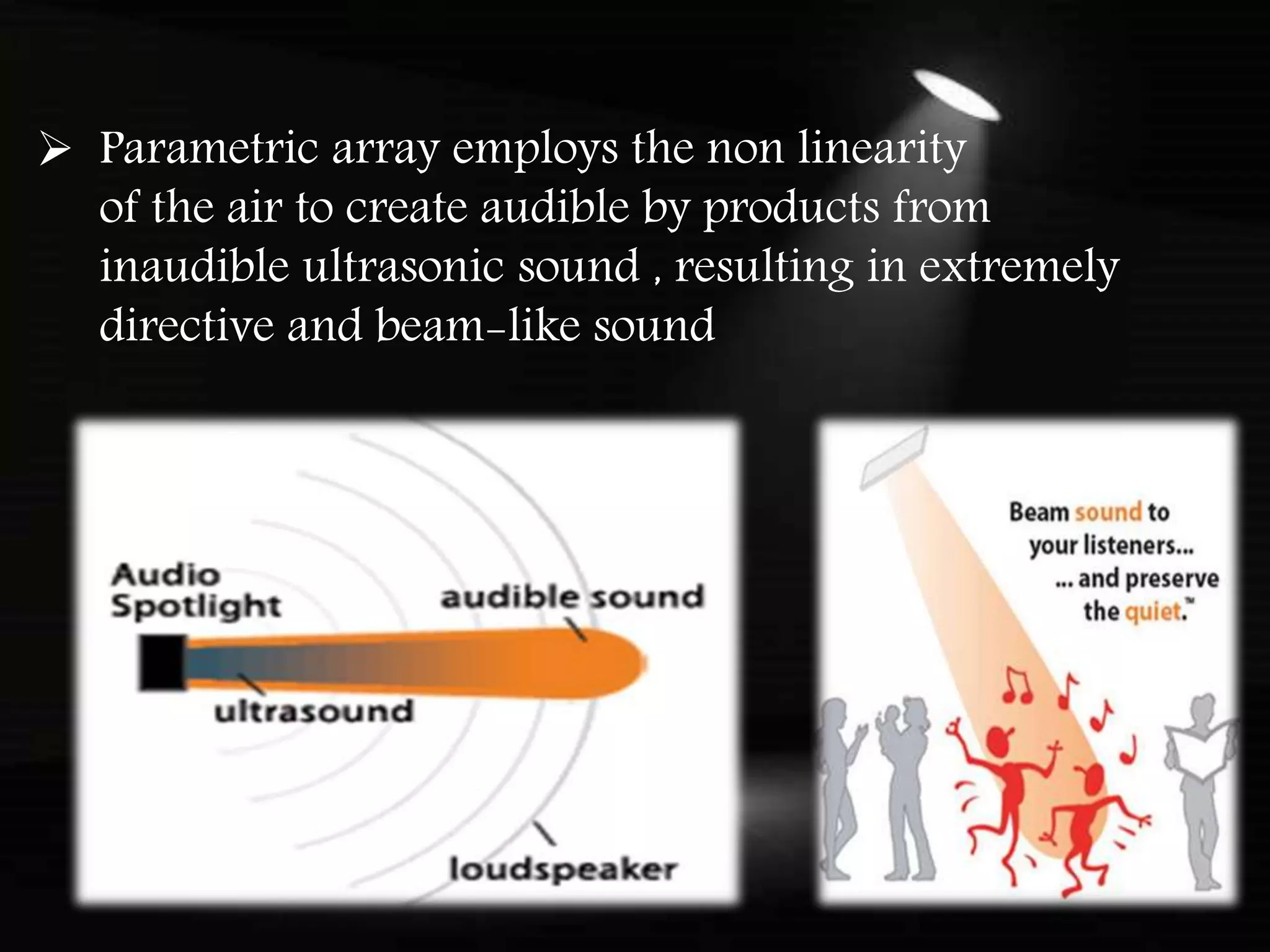
 Parametric array employs the non linearity
of the air to create audible by products from
inaudible ultrasonic sound , resulting in extremely
directive and beam-like sound
PARAMETRIC LOUDSPEAKER- AMAZING AUDIO
SPOTLIGHT
 Low Beam Angle is required to focus the sound.
Beam angle of audible sound is very wide,
about 360°
 The smaller the wave length ,the lesser the Beam
angle.
 Another way to focus sound is to use loudspeaker
with larger Aperture size.
But….
A few conditions are to be satisfied
Working
 The original low frequency sound wave such as human
speech or music is applied into an audio spotlight emitter
device.
 This low frequency signal is frequency
modulated with ultrasonic frequencies.
 Since the wavelength is smaller the beam angle will be
around 3 degree, as a result the sound beam will be a
narrow one with a small dispersion.
AUDIO SPOTLIGHTING EMITTER
Modulated signal travels through the air.
Due to the nonlinearity property of air new sounds
are formed within the wave.
 The new frequencies will be added into the sound
wave by the air itself.
 frequency in the range of 20 Hz to 20 KHz .
 Since we cannot hear the ultrasonic sound, we
only hear the new sounds that are formed by the
nonlinear action of the air
RANGE OF HEARING
 Human ear - 20 Hz to20,000Hz.
 No single loud speaker can operate efficiently
over such wide range of frequencies.
 By using this technology it is possible to design
a perfect transducer which can work over a
wide range of frequency which is audible to the
human ear.
CONVENTIONAL LOUD SPEAKER
Vs AUDIO SPOTLIGHT
• CONVENTIONAL
SPEAKERS
• AUDIO-SPOTLIGHTG
COMPONENTS OF AUDIO SPOTLIGHTING
SYSTEM
 Power Supply.
 Frequency oscillator.
 Modulator.
 Audio signal processor.
 Microcontroller.
 Ultrasonic amplifier.
 Transducer.
BLOCK DIAGRAM
HOW TO USE AUDIO SPOTLIGHT ?
There are two ways to use Audio Spotlight.
First it can direct sound at a specific target creating
a contained area of listening space which is called
“Direct Audio”.
Second it can bounce off of a second object
creating an audio image which is called the “Projected
Audio” or the Virtual mode.
Direct Mode:
Requires a clear line of approach from the
sound system unit to the point where the listener can hear the
audio. To restrict the audio in a specific area this method
is appropriate.
Projected or Virtual mode:
For this mode of operation the sound beam from an emitte
r is made to reflect from a reflecting surface.
A virtual sound source creates an illusion of sound source that
emanates from a surface.
This method is appropriate when we want to
send the information to a large number of people.
Features
 Can focus sound only at the specific place one’s
want.
 Sharper directivity than conventional
loudspeakers.
 Uses non-linearity of air for demodulation.
 Focused or directed sound travel much faster.
 Highly cost effective.
 No lag in reproducing the sound & requires low
power.
 Small size
 Single source
 Ultimate control in audio placement
 Minimizes noise pollution
 Ease of installation
 Lowest maintenance cost
 Reduced feedback
ADVANTAGES
DISADVANTAGES
 Lack of mass production. i.e, each unit
must be hand made.
 The most common form of distortion
is clipping.
APPLICATIONS
AUTOMOBILES RETAIL SALES
PUBLIC ANNOUNCEMENT MUSEUMS
MILITARY APPLICATIONSENTERTAINMENT SYSTEMS
two persons can hear different sound
standing close to each other
Audio Spotlight speakers allow
visitor to enjoy music while other
read nearby peace & quiet
Audio/video conferencing
Sound Bullets
THE FUTURE OF AUDIO SPOT
LIGHTING
 Holds the promise of replacing conventional
speakers.
 It allows the user to control the
direction of propagation of sound. Will force the
people to rethink their relationship with the sound.
 It really
“Puts the sound where you want it”.
 Audio spotlighting is really going to make a
revolution in sound transmission and the user
can decide the path in which audio signal
should propagate.
 Due to the unidirectional
propagation it finds application in large number of
fields.
 Audio spotlighting system is
going to shape the future of sound and will serve
our ears with magical experience..
CONCLUSION
“A REAL BOON TO THE FUTURE”
Audio Spotlight

Audio Spotlight

  • 2.
    IS IT POSSIBLETO CONFINE SOUND TO A SMALL AREA ? YES. It is possible!! through… AUDIO SPOTLIGHTING
  • 3.
    What is Audiospotlight?
  • 4.
    A technology thatcreates focused beams of sound similar to light beams coming out of a flashlight. By shining sound to one location specific listeners can be targeted. Ultrasonic energy to create extremely narrow beams of sound that behave like beams of light. Introduction
  • 5.
    History  Invented bythe founder of Holosonics Labs, Dr. F. Joseph Pompei of MIT.  First attempts created a single tone (1975).  Audio tone made directive using a transducer array by Ricoh, Japan (1983).  Commercially available in 2000 by the company Holosonics.  Disney was amongst the first major corporations to adopt it for use.
  • 6.
    AUDIO SPOTLIGHT lookslike a disk-shaped loudspeaker trailing a wire with a small laser guide beam mounted in the middle  When one points the flat side of the disk in your direction, you here whatever sound one’s chosen for you.
  • 7.
    Basic Principle works byemitting harmless high frequency ultrasonic tones that human ear cannot hear.
  • 8.
     Parametric arrayemploys the non linearity of the air to create audible by products from inaudible ultrasonic sound , resulting in extremely directive and beam-like sound
  • 9.
  • 10.
     Low BeamAngle is required to focus the sound. Beam angle of audible sound is very wide, about 360°  The smaller the wave length ,the lesser the Beam angle.  Another way to focus sound is to use loudspeaker with larger Aperture size. But…. A few conditions are to be satisfied
  • 11.
    Working  The originallow frequency sound wave such as human speech or music is applied into an audio spotlight emitter device.  This low frequency signal is frequency modulated with ultrasonic frequencies.  Since the wavelength is smaller the beam angle will be around 3 degree, as a result the sound beam will be a narrow one with a small dispersion.
  • 12.
  • 13.
    Modulated signal travelsthrough the air. Due to the nonlinearity property of air new sounds are formed within the wave.  The new frequencies will be added into the sound wave by the air itself.  frequency in the range of 20 Hz to 20 KHz .  Since we cannot hear the ultrasonic sound, we only hear the new sounds that are formed by the nonlinear action of the air
  • 14.
    RANGE OF HEARING Human ear - 20 Hz to20,000Hz.  No single loud speaker can operate efficiently over such wide range of frequencies.  By using this technology it is possible to design a perfect transducer which can work over a wide range of frequency which is audible to the human ear.
  • 15.
    CONVENTIONAL LOUD SPEAKER VsAUDIO SPOTLIGHT • CONVENTIONAL SPEAKERS • AUDIO-SPOTLIGHTG
  • 16.
    COMPONENTS OF AUDIOSPOTLIGHTING SYSTEM  Power Supply.  Frequency oscillator.  Modulator.  Audio signal processor.  Microcontroller.  Ultrasonic amplifier.  Transducer.
  • 17.
  • 18.
    HOW TO USEAUDIO SPOTLIGHT ? There are two ways to use Audio Spotlight. First it can direct sound at a specific target creating a contained area of listening space which is called “Direct Audio”. Second it can bounce off of a second object creating an audio image which is called the “Projected Audio” or the Virtual mode.
  • 19.
    Direct Mode: Requires aclear line of approach from the sound system unit to the point where the listener can hear the audio. To restrict the audio in a specific area this method is appropriate. Projected or Virtual mode: For this mode of operation the sound beam from an emitte r is made to reflect from a reflecting surface. A virtual sound source creates an illusion of sound source that emanates from a surface. This method is appropriate when we want to send the information to a large number of people.
  • 21.
    Features  Can focussound only at the specific place one’s want.  Sharper directivity than conventional loudspeakers.  Uses non-linearity of air for demodulation.  Focused or directed sound travel much faster.  Highly cost effective.  No lag in reproducing the sound & requires low power.
  • 22.
     Small size Single source  Ultimate control in audio placement  Minimizes noise pollution  Ease of installation  Lowest maintenance cost  Reduced feedback ADVANTAGES
  • 23.
    DISADVANTAGES  Lack ofmass production. i.e, each unit must be hand made.  The most common form of distortion is clipping.
  • 24.
  • 25.
  • 26.
  • 27.
    two persons canhear different sound standing close to each other Audio Spotlight speakers allow visitor to enjoy music while other read nearby peace & quiet Audio/video conferencing Sound Bullets
  • 28.
    THE FUTURE OFAUDIO SPOT LIGHTING  Holds the promise of replacing conventional speakers.  It allows the user to control the direction of propagation of sound. Will force the people to rethink their relationship with the sound.  It really “Puts the sound where you want it”.
  • 29.
     Audio spotlightingis really going to make a revolution in sound transmission and the user can decide the path in which audio signal should propagate.  Due to the unidirectional propagation it finds application in large number of fields.  Audio spotlighting system is going to shape the future of sound and will serve our ears with magical experience.. CONCLUSION “A REAL BOON TO THE FUTURE”