By Chris
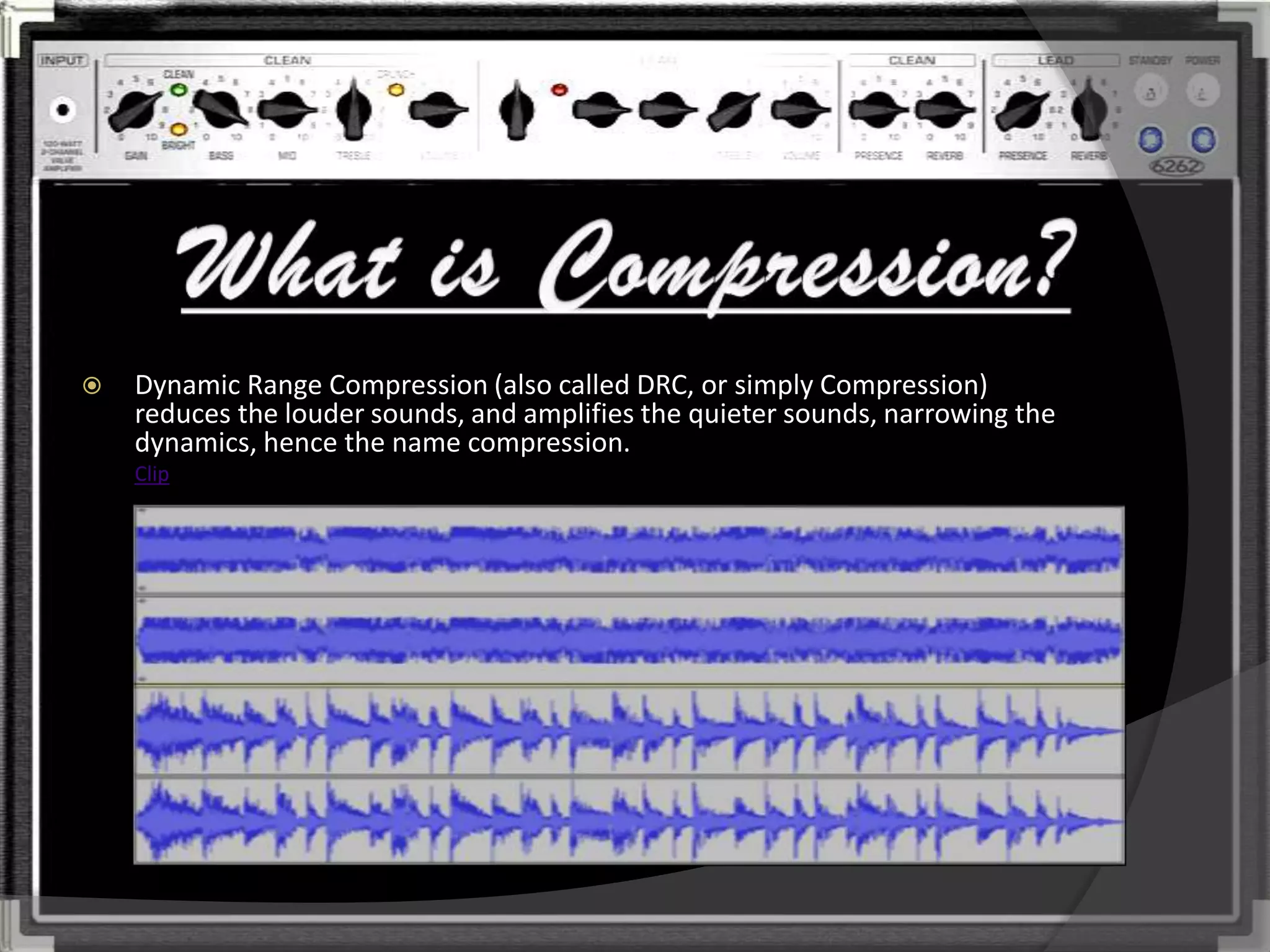
   Dynamic Range Compression (also called DRC, or simply Compression)
    reduces the louder sounds, and amplifies the quieter sounds, narrowing the
    dynamics, hence the name compression.
    Clip
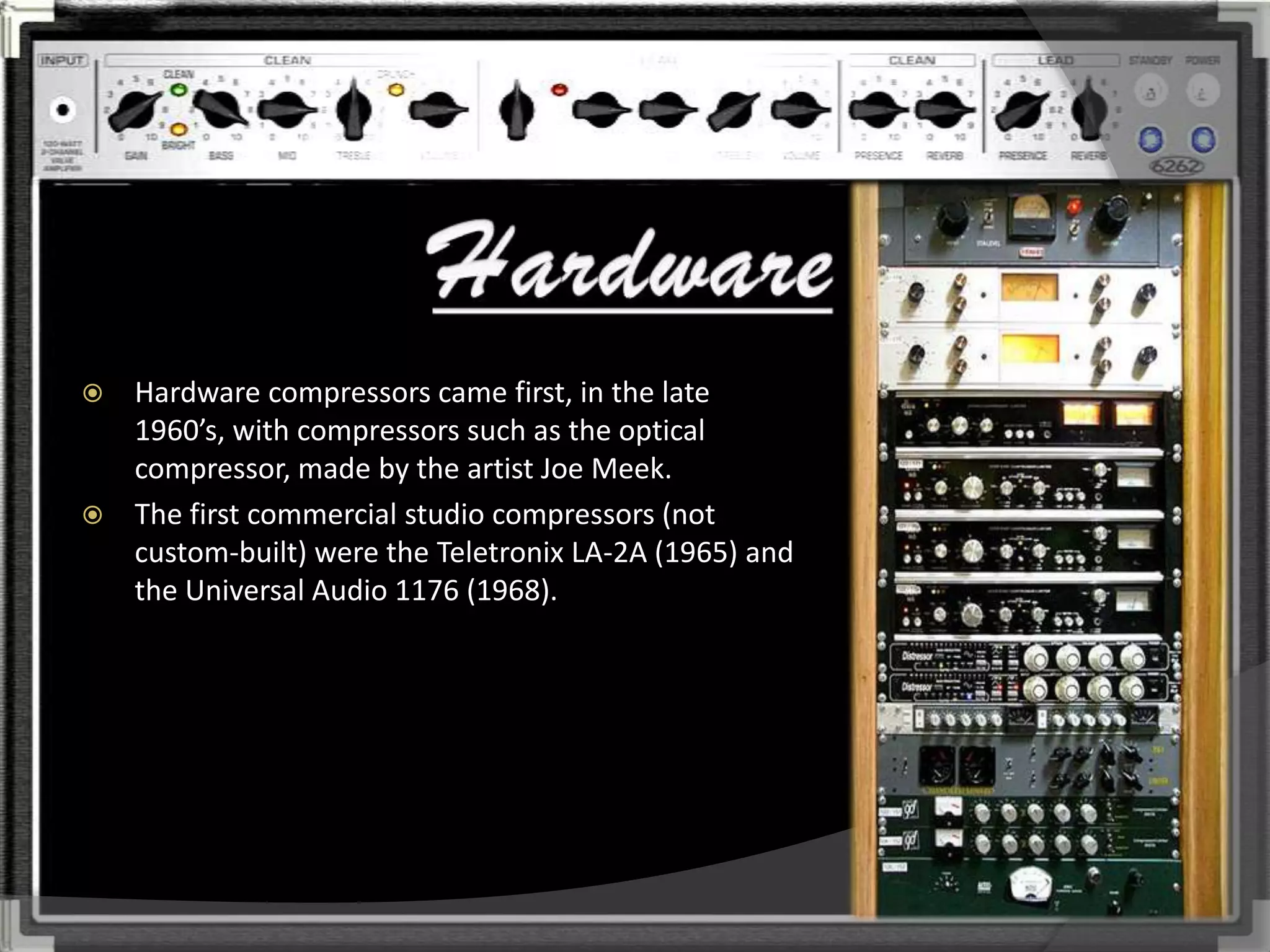
 Hardware compressors came first, in the late
  1960’s, with compressors such as the optical
  compressor, made by the artist Joe Meek.
 The first commercial studio compressors (not
  custom-built) were the Teletronix LA-2A (1965) and
  the Universal Audio 1176 (1968).
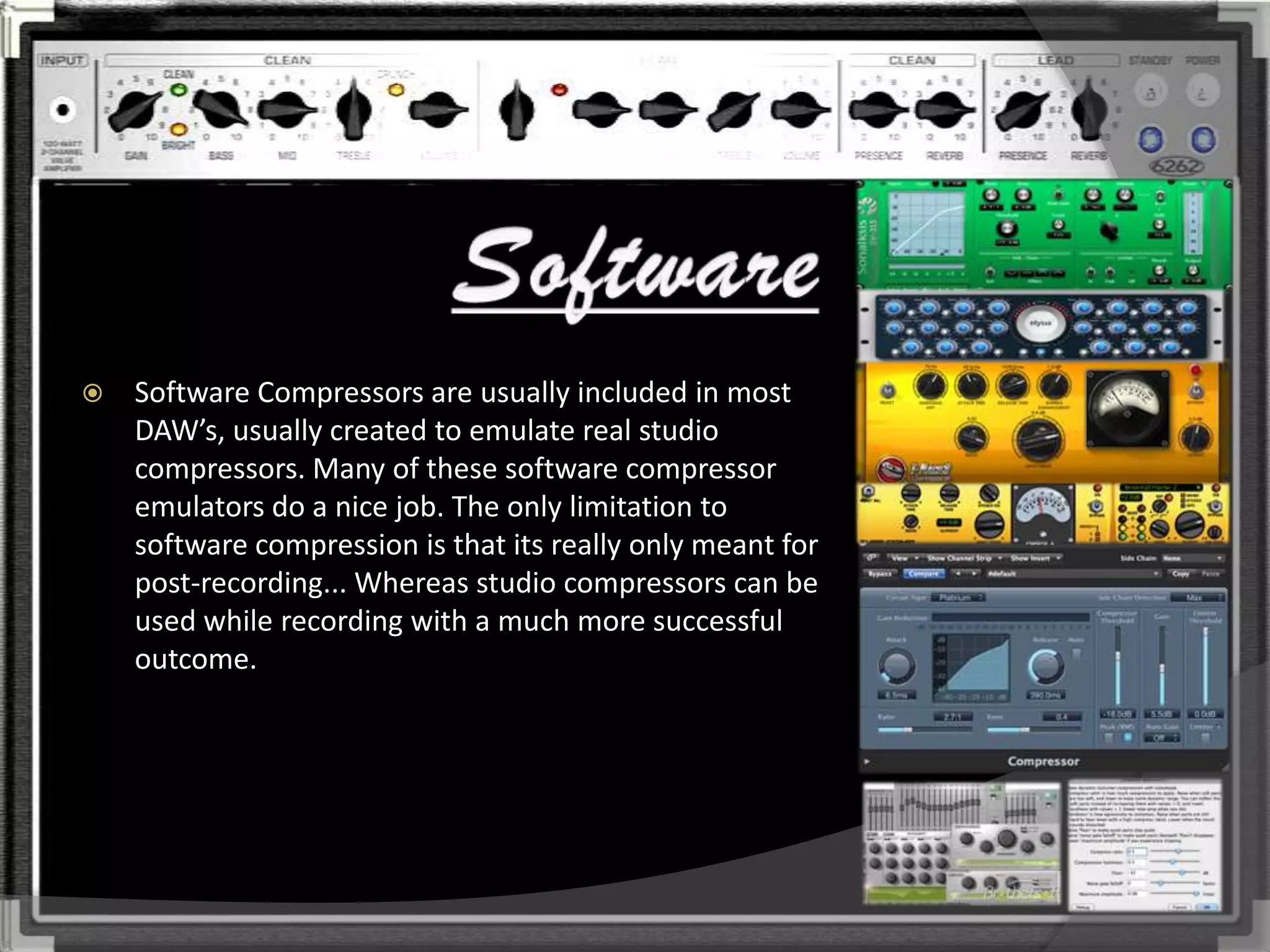
   Software Compressors are usually included in most
    DAW’s, usually created to emulate real studio
    compressors. Many of these software compressor
    emulators do a nice job. The only limitation to
    software compression is that its really only meant for
    post-recording... Whereas studio compressors can be
    used while recording with a much more successful
    outcome.
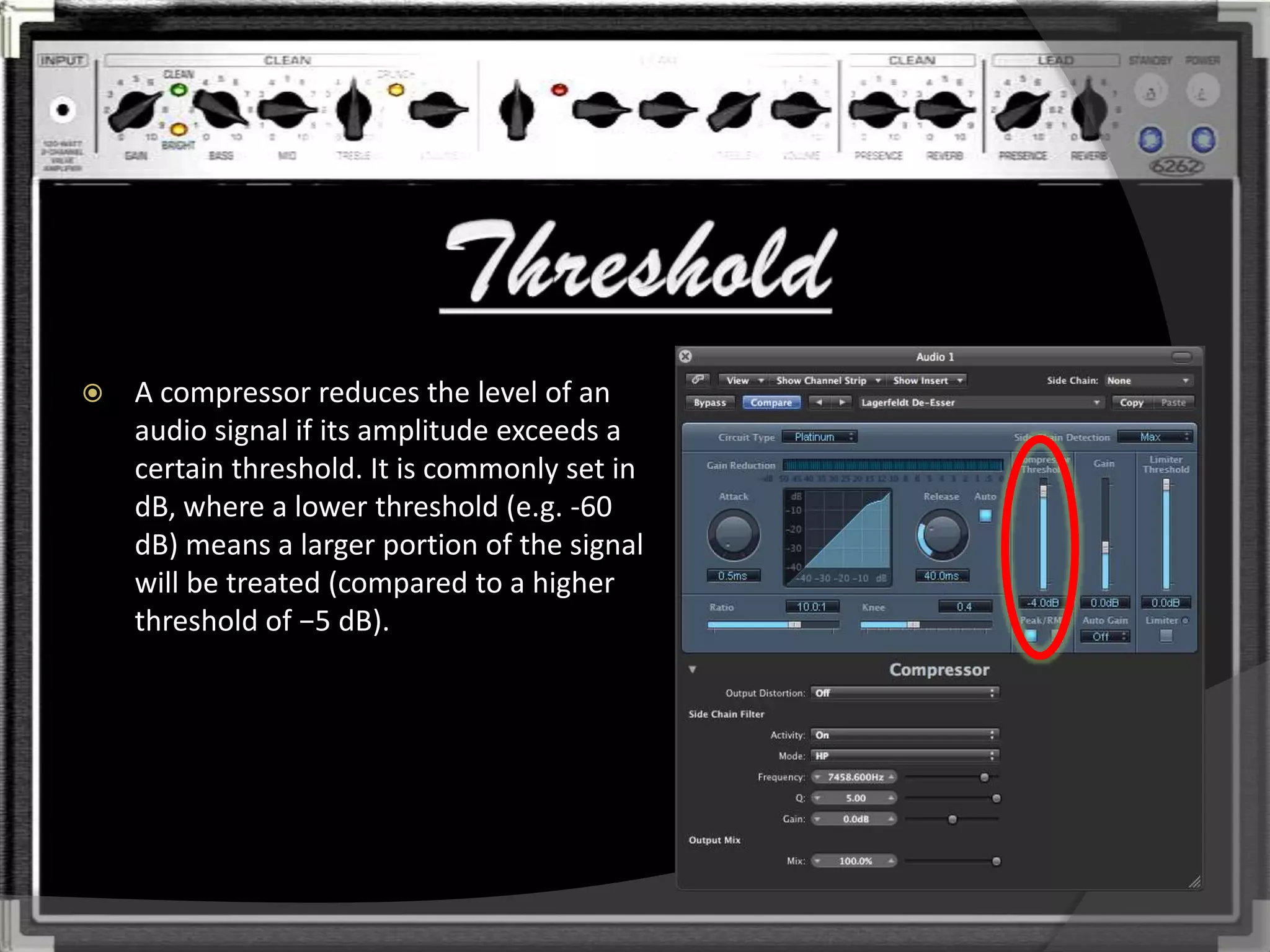
   A compressor reduces the level of an
    audio signal if its amplitude exceeds a
    certain threshold. It is commonly set in
    dB, where a lower threshold (e.g. -60
    dB) means a larger portion of the signal
    will be treated (compared to a higher
    threshold of −5 dB).
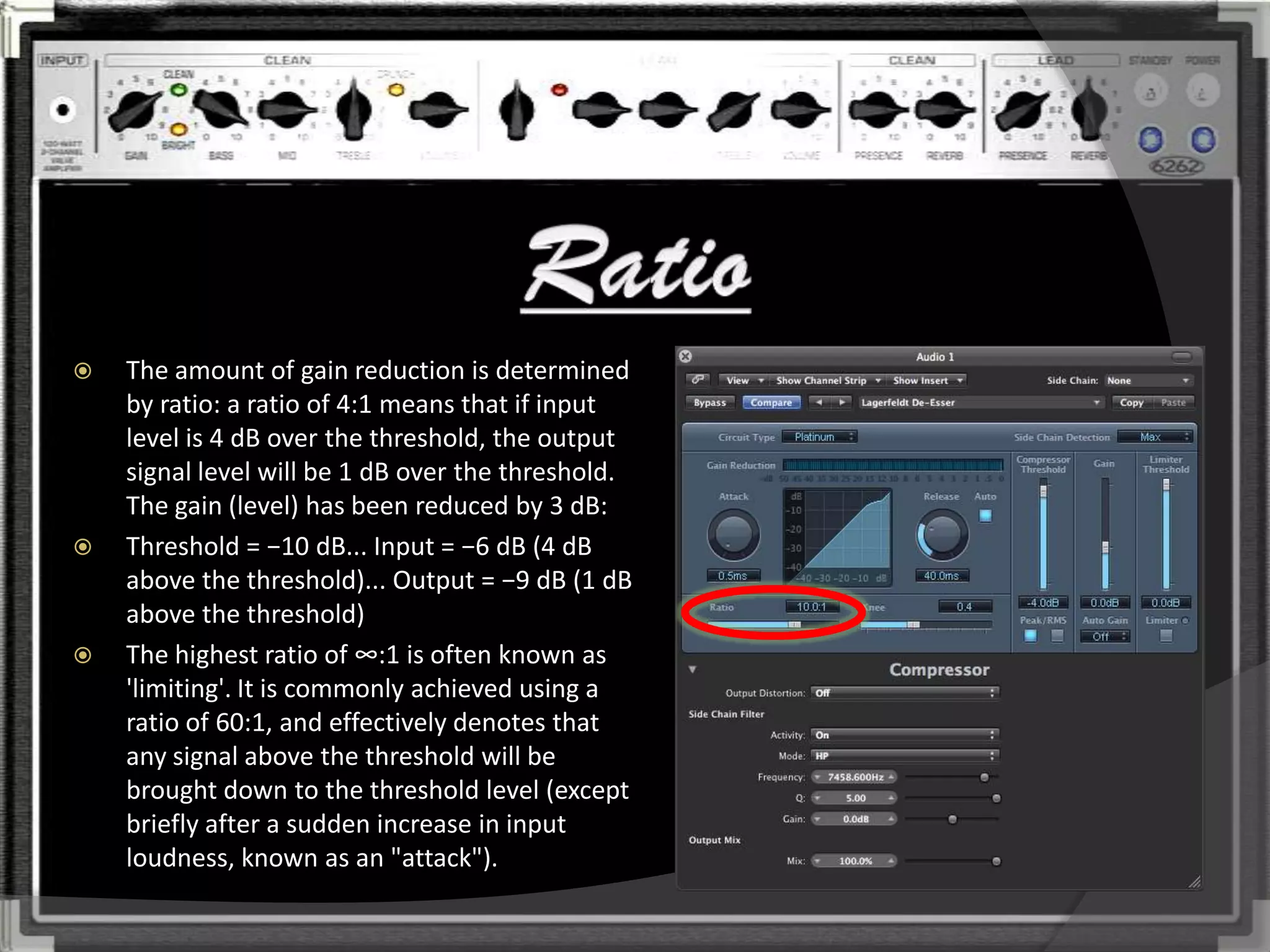
   The amount of gain reduction is determined
    by ratio: a ratio of 4:1 means that if input
    level is 4 dB over the threshold, the output
    signal level will be 1 dB over the threshold.
    The gain (level) has been reduced by 3 dB:
   Threshold = −10 dB... Input = −6 dB (4 dB
    above the threshold)... Output = −9 dB (1 dB
    above the threshold)
   The highest ratio of ∞:1 is often known as
    'limiting'. It is commonly achieved using a
    ratio of 60:1, and effectively denotes that
    any signal above the threshold will be
    brought down to the threshold level (except
    briefly after a sudden increase in input
    loudness, known as an "attack").
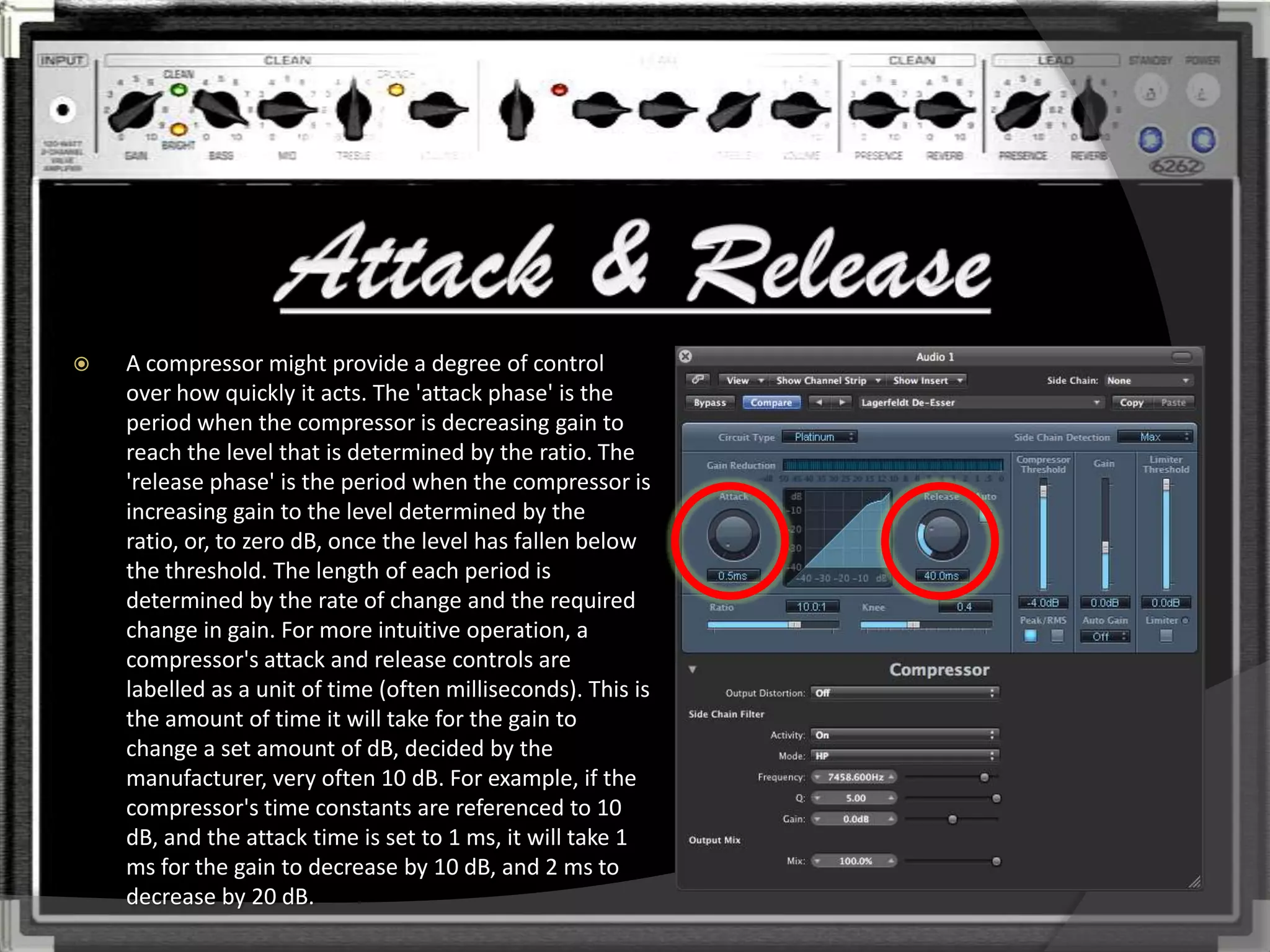
   A compressor might provide a degree of control
    over how quickly it acts. The 'attack phase' is the
    period when the compressor is decreasing gain to
    reach the level that is determined by the ratio. The
    'release phase' is the period when the compressor is
    increasing gain to the level determined by the
    ratio, or, to zero dB, once the level has fallen below
    the threshold. The length of each period is
    determined by the rate of change and the required
    change in gain. For more intuitive operation, a
    compressor's attack and release controls are
    labelled as a unit of time (often milliseconds). This is
    the amount of time it will take for the gain to
    change a set amount of dB, decided by the
    manufacturer, very often 10 dB. For example, if the
    compressor's time constants are referenced to 10
    dB, and the attack time is set to 1 ms, it will take 1
    ms for the gain to decrease by 10 dB, and 2 ms to
    decrease by 20 dB.
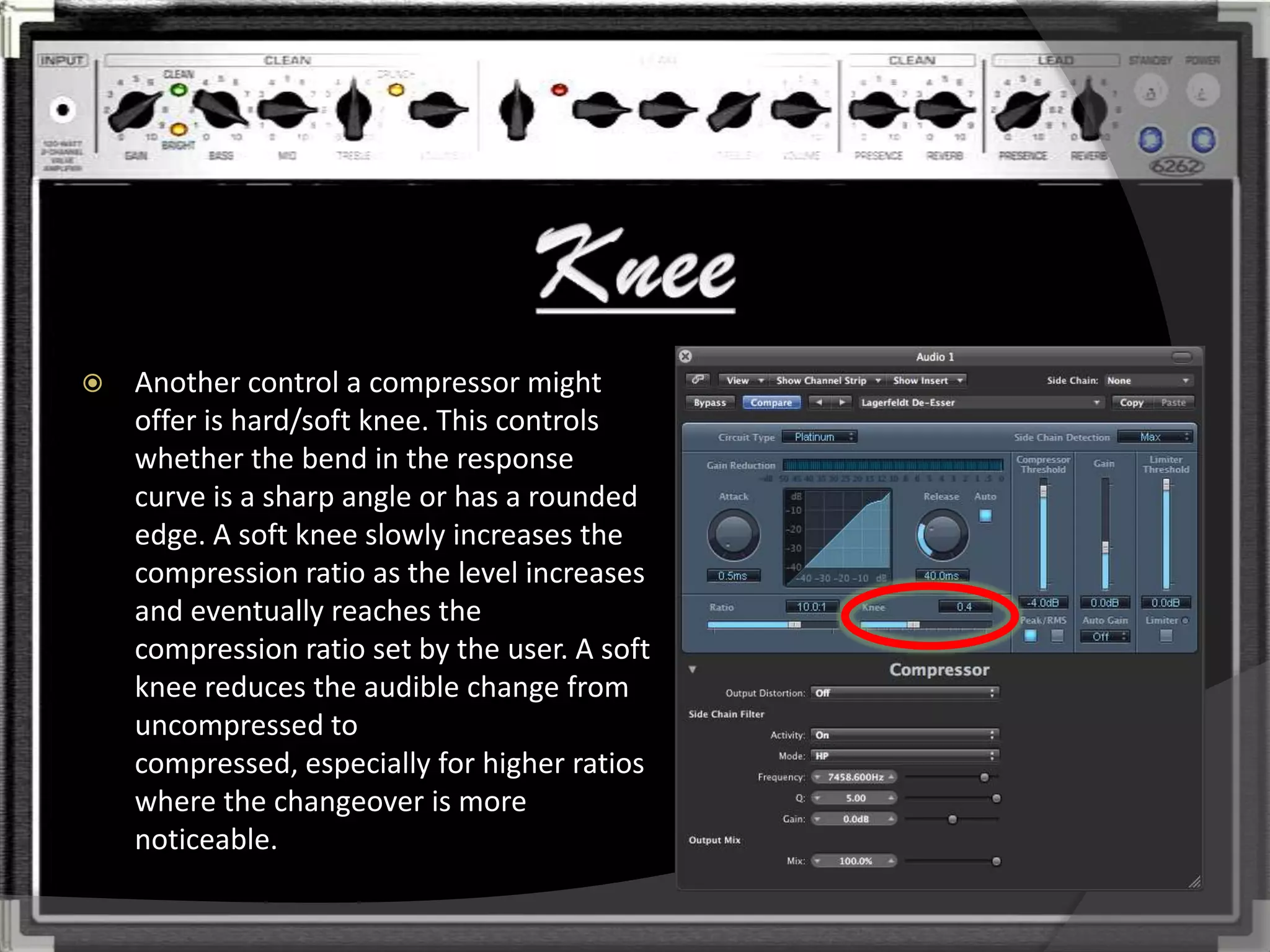
   Another control a compressor might
    offer is hard/soft knee. This controls
    whether the bend in the response
    curve is a sharp angle or has a rounded
    edge. A soft knee slowly increases the
    compression ratio as the level increases
    and eventually reaches the
    compression ratio set by the user. A soft
    knee reduces the audible change from
    uncompressed to
    compressed, especially for higher ratios
    where the changeover is more
    noticeable.
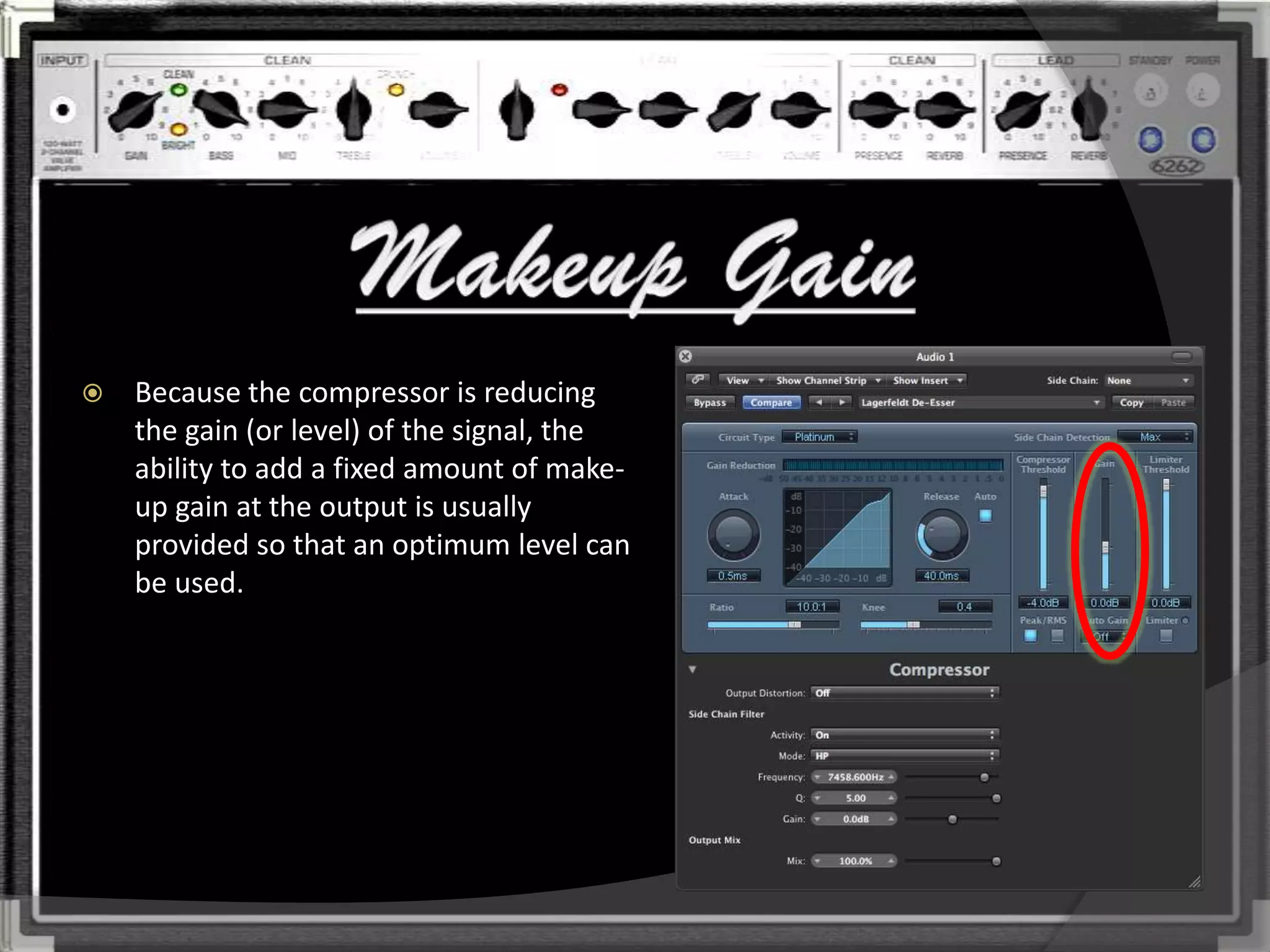
   Because the compressor is reducing
    the gain (or level) of the signal, the
    ability to add a fixed amount of make-
    up gain at the output is usually
    provided so that an optimum level can
    be used.
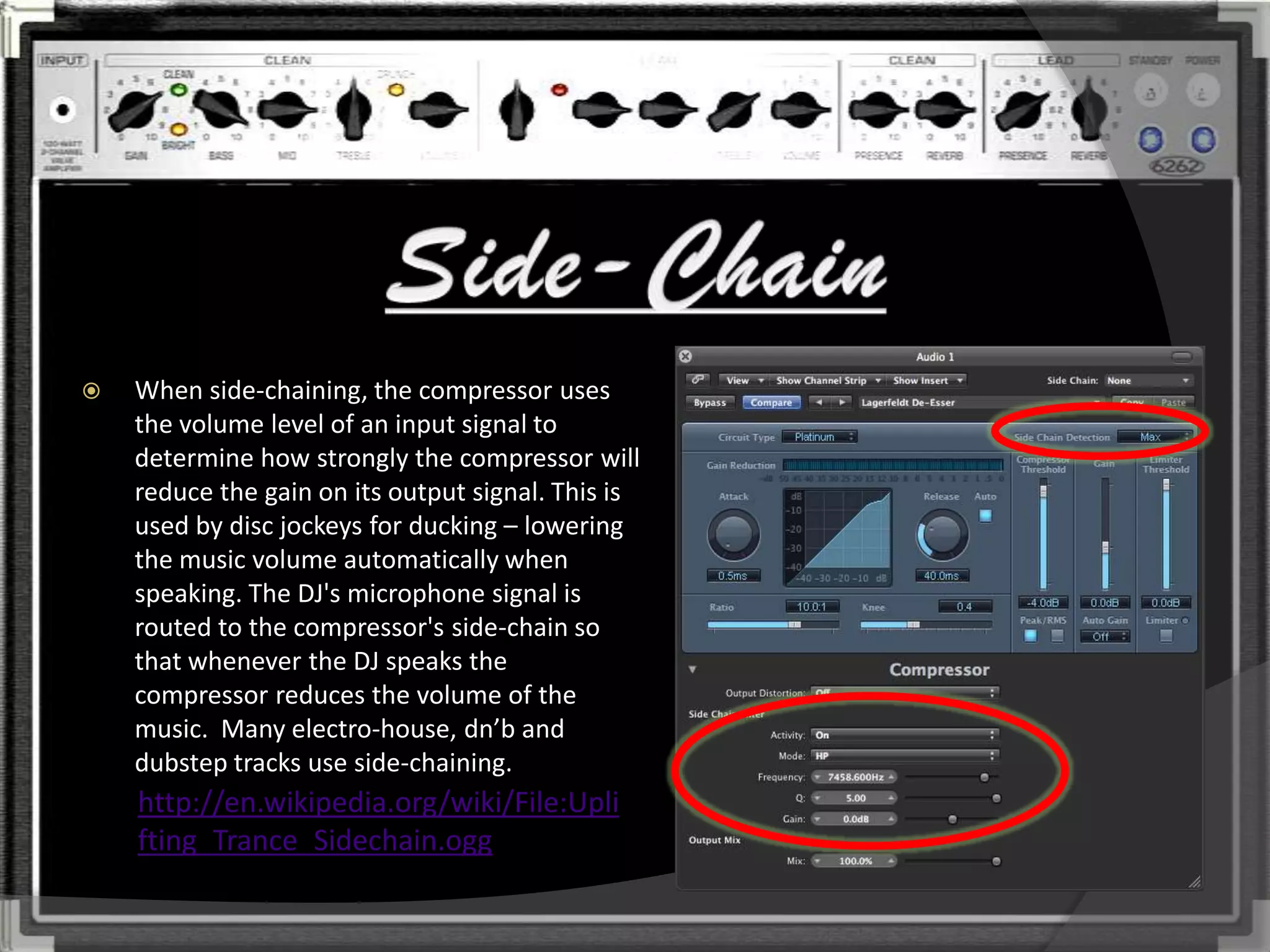
   When side-chaining, the compressor uses
    the volume level of an input signal to
    determine how strongly the compressor will
    reduce the gain on its output signal. This is
    used by disc jockeys for ducking – lowering
    the music volume automatically when
    speaking. The DJ's microphone signal is
    routed to the compressor's side-chain so
    that whenever the DJ speaks the
    compressor reduces the volume of the
    music. Many electro-house, dn’b and
    dubstep tracks use side-chaining.
    http://en.wikipedia.org/wiki/File:Upli
    fting_Trance_Sidechain.ogg
 http://www.youtube.com/watch?v=3TlQo9
  k827c&feature=related
 Here is a fairly biased view on the loudness
  war... I personally don’t see a massive
  problem with it, as now-a-days quite a lot of
  the music we listen to actually sounds quite
  good when compressed a lot.
   http://bit.ly/I4f8Aj
    (http://www.sae.edu/reference_material/a
    udio/pages/Compression.htm)

Dynamic range compression

  • 1.
  • 2.
    Dynamic Range Compression (also called DRC, or simply Compression) reduces the louder sounds, and amplifies the quieter sounds, narrowing the dynamics, hence the name compression. Clip
  • 3.
     Hardware compressorscame first, in the late 1960’s, with compressors such as the optical compressor, made by the artist Joe Meek.  The first commercial studio compressors (not custom-built) were the Teletronix LA-2A (1965) and the Universal Audio 1176 (1968).
  • 5.
    Software Compressors are usually included in most DAW’s, usually created to emulate real studio compressors. Many of these software compressor emulators do a nice job. The only limitation to software compression is that its really only meant for post-recording... Whereas studio compressors can be used while recording with a much more successful outcome.
  • 6.
    A compressor reduces the level of an audio signal if its amplitude exceeds a certain threshold. It is commonly set in dB, where a lower threshold (e.g. -60 dB) means a larger portion of the signal will be treated (compared to a higher threshold of −5 dB).
  • 7.
    The amount of gain reduction is determined by ratio: a ratio of 4:1 means that if input level is 4 dB over the threshold, the output signal level will be 1 dB over the threshold. The gain (level) has been reduced by 3 dB:  Threshold = −10 dB... Input = −6 dB (4 dB above the threshold)... Output = −9 dB (1 dB above the threshold)  The highest ratio of ∞:1 is often known as 'limiting'. It is commonly achieved using a ratio of 60:1, and effectively denotes that any signal above the threshold will be brought down to the threshold level (except briefly after a sudden increase in input loudness, known as an "attack").
  • 8.
    A compressor might provide a degree of control over how quickly it acts. The 'attack phase' is the period when the compressor is decreasing gain to reach the level that is determined by the ratio. The 'release phase' is the period when the compressor is increasing gain to the level determined by the ratio, or, to zero dB, once the level has fallen below the threshold. The length of each period is determined by the rate of change and the required change in gain. For more intuitive operation, a compressor's attack and release controls are labelled as a unit of time (often milliseconds). This is the amount of time it will take for the gain to change a set amount of dB, decided by the manufacturer, very often 10 dB. For example, if the compressor's time constants are referenced to 10 dB, and the attack time is set to 1 ms, it will take 1 ms for the gain to decrease by 10 dB, and 2 ms to decrease by 20 dB.
  • 9.
    Another control a compressor might offer is hard/soft knee. This controls whether the bend in the response curve is a sharp angle or has a rounded edge. A soft knee slowly increases the compression ratio as the level increases and eventually reaches the compression ratio set by the user. A soft knee reduces the audible change from uncompressed to compressed, especially for higher ratios where the changeover is more noticeable.
  • 10.
    Because the compressor is reducing the gain (or level) of the signal, the ability to add a fixed amount of make- up gain at the output is usually provided so that an optimum level can be used.
  • 11.
    When side-chaining, the compressor uses the volume level of an input signal to determine how strongly the compressor will reduce the gain on its output signal. This is used by disc jockeys for ducking – lowering the music volume automatically when speaking. The DJ's microphone signal is routed to the compressor's side-chain so that whenever the DJ speaks the compressor reduces the volume of the music. Many electro-house, dn’b and dubstep tracks use side-chaining. http://en.wikipedia.org/wiki/File:Upli fting_Trance_Sidechain.ogg
  • 12.
     http://www.youtube.com/watch?v=3TlQo9 k827c&feature=related  Here is a fairly biased view on the loudness war... I personally don’t see a massive problem with it, as now-a-days quite a lot of the music we listen to actually sounds quite good when compressed a lot.
  • 13.
    http://bit.ly/I4f8Aj (http://www.sae.edu/reference_material/a udio/pages/Compression.htm)