1
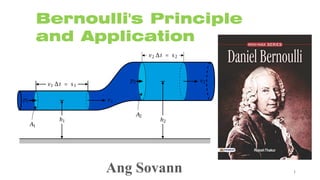
Bernoulli's Principle
and Application
Ang Sovann
2
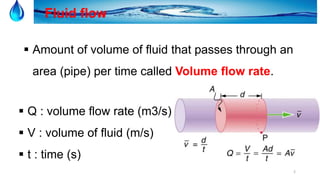
Fluid flow
 Amount of volume of fluid that passes through an
area (pipe) per time called Volume flow rate.
 Q : volume flow rate (m3/s)
 V : volume of fluid (m/s)
 t : time (s)
3
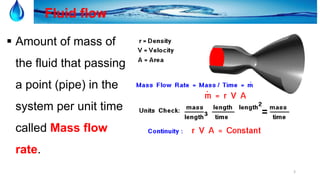
Fluid flow
 Amount of mass of
the fluid that passing
a point (pipe) in the
system per unit time
called Mass flow
rate.
4
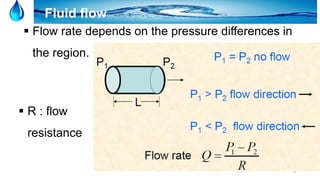
Fluid flow
 Flow rate depends on the pressure differences in
the region.
 R : flow
resistance
5
Fluid flow
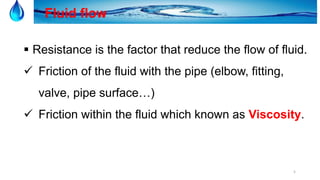
 Resistance is the factor that reduce the flow of fluid.
 Friction of the fluid with the pipe (elbow, fitting,
valve, pipe surface…)
 Friction within the fluid which known as Viscosity.
6
Viscosity
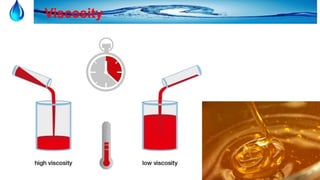
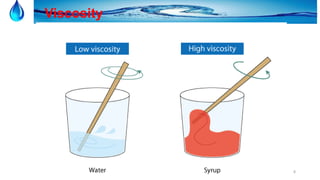
 Viscosity is a measure of a fluid's resistance to flow.
 It describes the internal friction of a moving fluid.
 Viscosity means friction between the molecules of
fluid.
7
Viscosity
8
Viscosity
9
Fluid flow characteristic
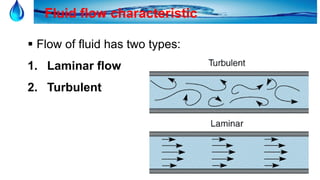
 Flow of fluid has two types:
1. Laminar flow
2. Turbulent
10
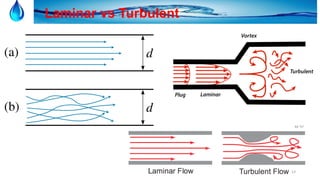
Laminar flow
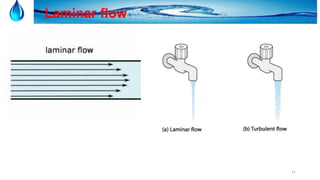
 fluid follows a smooth path, paths which never
interfere with one another (parallel).
 The velocity of the fluid is constant at any point in
the fluid.
11
Laminar flow
12
Turbulent flow
 Irregular flow that is characterized by tiny whirlpool
regions.
 The velocity of this fluid is definitely not constant at
every point
13
Laminar vs Turbulent
14
Continuity equation
 Liquids must maintain their volume as they flow in a
pipe since they are nearly incompressible.
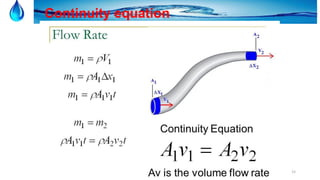
 Volume of liquid that flows into a pipe in a given
amount of time must equal the volume of liquid that
flows out of a pipe in the same amount of time.
15
Continuity equation
16
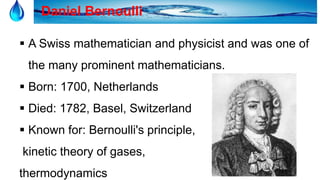
Daniel Bernoulli
 A Swiss mathematician and physicist and was one of
the many prominent mathematicians.
 Born: 1700, Netherlands
 Died: 1782, Basel, Switzerland
 Known for: Bernoulli's principle,
kinetic theory of gases,
thermodynamics
17
Daniel Bernoulli ‘s principle
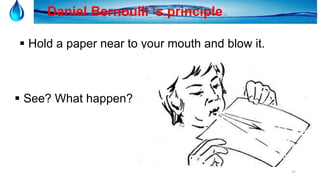
 Hold a paper near to your mouth and blow it.
 See? What happen?
18
Daniel Bernoulli ‘s principle
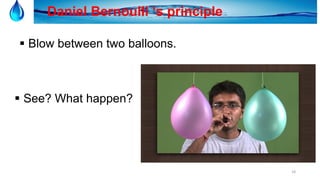
 Blow between two balloons.
 See? What happen?
19
Daniel Bernoulli ‘s principle
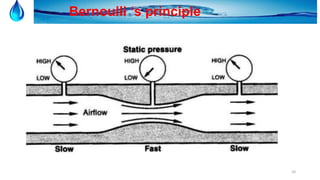
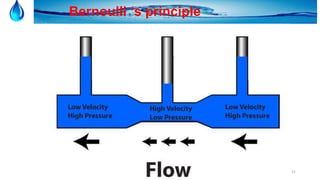
 Bernoulli stated that
“ In a horizontal flow of fluid, the highest fluid pressure
is in the section where the flow speed is the lowest,
and the lowest pressure is at the section where the
flow speed is the biggest ”.
20
Bernoulli ‘s principle
21
Bernoulli ‘s principle
22
Bernoulli ‘s principle
 Within a horizontal water pipe that changes
diameter, regions where the water is moving fast will
be under less pressure than regions where the water
is moving slow.
23
Bernoulli ‘s equation
24
Bernoulli ‘s equation
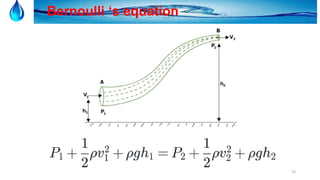
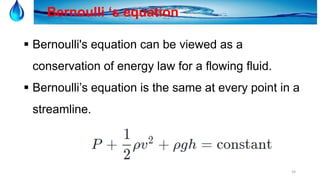
 Bernoulli's equation can be viewed as a
conservation of energy law for a flowing fluid.
 Bernoulli’s equation is the same at every point in a
streamline.
25
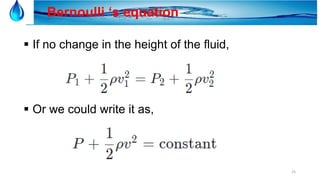
 If no change in the height of the fluid,
 Or we could write it as,
Bernoulli ‘s equation
26
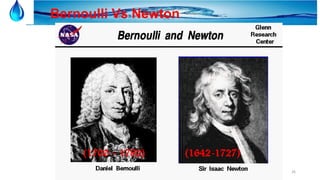
Bernoulli Vs Newton
(1642-1727)(1700 – 1782)
27
Application
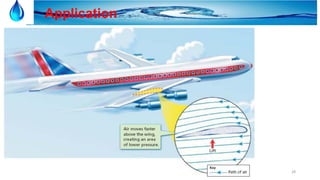
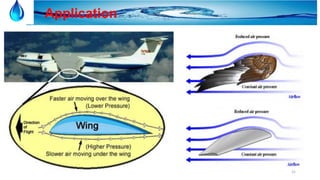
 Bernoulli’s principle is what allows birds and planes
to fly.
28
Application
29
Application
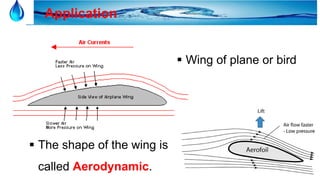
 Wing of plane or bird
 The shape of the wing is
called Aerodynamic.
30
Bernoulli ‘s equation
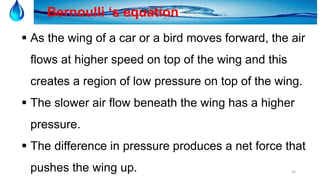
 As the wing of a car or a bird moves forward, the air
flows at higher speed on top of the wing and this
creates a region of low pressure on top of the wing.
 The slower air flow beneath the wing has a higher
pressure.
 The difference in pressure produces a net force that
pushes the wing up.
31
Application
32
Application
33
Application
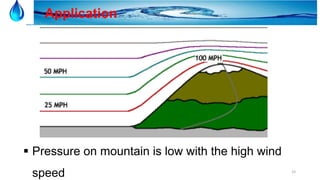
 Pressure on mountain is low with the high wind
speed
34
Application
35
Application
36
Application
37
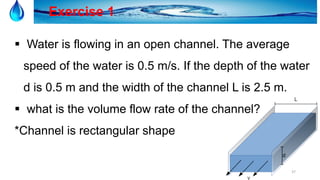
Exercise 1
 Water is flowing in an open channel. The average
speed of the water is 0.5 m/s. If the depth of the water
d is 0.5 m and the width of the channel L is 2.5 m.
 what is the volume flow rate of the channel?
*Channel is rectangular shape
38
Exercise 2
 How many cubic meters of blood does the heart pump
in a 75-year lifetime, assuming the average flow rate is
5.00 L/min?
39
Exercise 3
 In a pipe that has a cross-sectional area of 0.5 m2
and a flow rate of 1.5 m3/s.
 What is the average speed of the fluid carried by the
pipe?
40
Exercise 4
 Suppose that water flows from a pipe with a
diameter of 1m into another pipe of diameter 0.5m.
 If the speed of water in the first pipe is 5m/s.
 what is the speed in the second pipe?
41
Exercise 5
 A diameter garden hose with a diameter of 3cm
sprays water travels through a hose at 1m/s.
 At the end of the garden hose, the diameter reduces
to 1.5cm.
 What is the speed of the water coming out at the
end?
42
Exercise 6
 A house is supplied water from the overhead tank
with a with cross sectional area of 36cm^2 and the
speed of water is 0.48m/s. the pipe is connected to a
faucet with area of 12cm^2 in the kitchen.
 What is the speed of water when exit from the
faucet?
43
Exercise 7
 A pipe with a radius of 0.1 m used to drain an entire
full water tank within one hour. The tank is a cylinder
with a height (h) of 3 meters and a diameter of 5
meters.
 How fast will the water need to move through the
pipe?
44
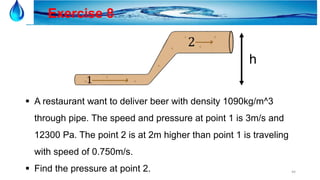
Exercise 8
 A restaurant want to deliver beer with density 1090kg/m^3
through pipe. The speed and pressure at point 1 is 3m/s and
12300 Pa. The point 2 is at 2m higher than point 1 is traveling
with speed of 0.750m/s.
 Find the pressure at point 2.
h
45
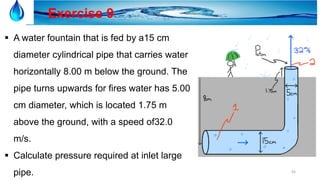
Exercise 9
 A water fountain that is fed by a15 cm
diameter cylindrical pipe that carries water
horizontally 8.00 m below the ground. The
pipe turns upwards for fires water has 5.00
cm diameter, which is located 1.75 m
above the ground, with a speed of32.0
m/s.
 Calculate pressure required at inlet large
pipe.

Bernoulli's principle

  • 1.
  • 2.
    2 Fluid flow  Amountof volume of fluid that passes through an area (pipe) per time called Volume flow rate.  Q : volume flow rate (m3/s)  V : volume of fluid (m/s)  t : time (s)
  • 3.
    3 Fluid flow  Amountof mass of the fluid that passing a point (pipe) in the system per unit time called Mass flow rate.
  • 4.
    4 Fluid flow  Flowrate depends on the pressure differences in the region.  R : flow resistance
  • 5.
    5 Fluid flow  Resistanceis the factor that reduce the flow of fluid.  Friction of the fluid with the pipe (elbow, fitting, valve, pipe surface…)  Friction within the fluid which known as Viscosity.
  • 6.
    6 Viscosity  Viscosity isa measure of a fluid's resistance to flow.  It describes the internal friction of a moving fluid.  Viscosity means friction between the molecules of fluid.
  • 7.
  • 8.
  • 9.
    9 Fluid flow characteristic Flow of fluid has two types: 1. Laminar flow 2. Turbulent
  • 10.
    10 Laminar flow  fluidfollows a smooth path, paths which never interfere with one another (parallel).  The velocity of the fluid is constant at any point in the fluid.
  • 11.
  • 12.
    12 Turbulent flow  Irregularflow that is characterized by tiny whirlpool regions.  The velocity of this fluid is definitely not constant at every point
  • 13.
  • 14.
    14 Continuity equation  Liquidsmust maintain their volume as they flow in a pipe since they are nearly incompressible.  Volume of liquid that flows into a pipe in a given amount of time must equal the volume of liquid that flows out of a pipe in the same amount of time.
  • 15.
  • 16.
    16 Daniel Bernoulli  ASwiss mathematician and physicist and was one of the many prominent mathematicians.  Born: 1700, Netherlands  Died: 1782, Basel, Switzerland  Known for: Bernoulli's principle, kinetic theory of gases, thermodynamics
  • 17.
    17 Daniel Bernoulli ‘sprinciple  Hold a paper near to your mouth and blow it.  See? What happen?
  • 18.
    18 Daniel Bernoulli ‘sprinciple  Blow between two balloons.  See? What happen?
  • 19.
    19 Daniel Bernoulli ‘sprinciple  Bernoulli stated that “ In a horizontal flow of fluid, the highest fluid pressure is in the section where the flow speed is the lowest, and the lowest pressure is at the section where the flow speed is the biggest ”.
  • 20.
  • 21.
  • 22.
    22 Bernoulli ‘s principle Within a horizontal water pipe that changes diameter, regions where the water is moving fast will be under less pressure than regions where the water is moving slow.
  • 23.
  • 24.
    24 Bernoulli ‘s equation Bernoulli's equation can be viewed as a conservation of energy law for a flowing fluid.  Bernoulli’s equation is the same at every point in a streamline.
  • 25.
    25  If nochange in the height of the fluid,  Or we could write it as, Bernoulli ‘s equation
  • 26.
  • 27.
    27 Application  Bernoulli’s principleis what allows birds and planes to fly.
  • 28.
  • 29.
    29 Application  Wing ofplane or bird  The shape of the wing is called Aerodynamic.
  • 30.
    30 Bernoulli ‘s equation As the wing of a car or a bird moves forward, the air flows at higher speed on top of the wing and this creates a region of low pressure on top of the wing.  The slower air flow beneath the wing has a higher pressure.  The difference in pressure produces a net force that pushes the wing up.
  • 31.
  • 32.
  • 33.
    33 Application  Pressure onmountain is low with the high wind speed
  • 34.
  • 35.
  • 36.
  • 37.
    37 Exercise 1  Wateris flowing in an open channel. The average speed of the water is 0.5 m/s. If the depth of the water d is 0.5 m and the width of the channel L is 2.5 m.  what is the volume flow rate of the channel? *Channel is rectangular shape
  • 38.
    38 Exercise 2  Howmany cubic meters of blood does the heart pump in a 75-year lifetime, assuming the average flow rate is 5.00 L/min?
  • 39.
    39 Exercise 3  Ina pipe that has a cross-sectional area of 0.5 m2 and a flow rate of 1.5 m3/s.  What is the average speed of the fluid carried by the pipe?
  • 40.
    40 Exercise 4  Supposethat water flows from a pipe with a diameter of 1m into another pipe of diameter 0.5m.  If the speed of water in the first pipe is 5m/s.  what is the speed in the second pipe?
  • 41.
    41 Exercise 5  Adiameter garden hose with a diameter of 3cm sprays water travels through a hose at 1m/s.  At the end of the garden hose, the diameter reduces to 1.5cm.  What is the speed of the water coming out at the end?
  • 42.
    42 Exercise 6  Ahouse is supplied water from the overhead tank with a with cross sectional area of 36cm^2 and the speed of water is 0.48m/s. the pipe is connected to a faucet with area of 12cm^2 in the kitchen.  What is the speed of water when exit from the faucet?
  • 43.
    43 Exercise 7  Apipe with a radius of 0.1 m used to drain an entire full water tank within one hour. The tank is a cylinder with a height (h) of 3 meters and a diameter of 5 meters.  How fast will the water need to move through the pipe?
  • 44.
    44 Exercise 8  Arestaurant want to deliver beer with density 1090kg/m^3 through pipe. The speed and pressure at point 1 is 3m/s and 12300 Pa. The point 2 is at 2m higher than point 1 is traveling with speed of 0.750m/s.  Find the pressure at point 2. h
  • 45.
    45 Exercise 9  Awater fountain that is fed by a15 cm diameter cylindrical pipe that carries water horizontally 8.00 m below the ground. The pipe turns upwards for fires water has 5.00 cm diameter, which is located 1.75 m above the ground, with a speed of32.0 m/s.  Calculate pressure required at inlet large pipe.