Identifying Optimal Locations and
Evaluating Storage Potential for
Underwater Compressed Air Energy
Storage in the Gulf of Maine
Gabriel E. Colón Reyes, REU Undergraduate Student
Universidad de Puerto Rico, Mayagüez
University of Massachusetts, Amherst
Wednesday, June 24th, 2015
Introduction
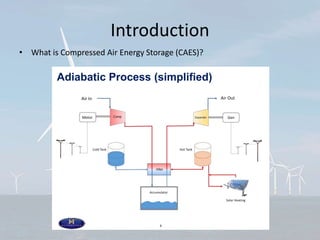
• What is Compressed Air Energy Storage (CAES)?
Adiabatic Process (simplified)
4
Air In Air Out
Introduction cont.
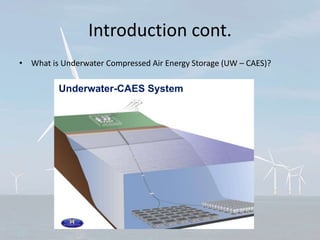
• What is Underwater Compressed Air Energy Storage (UW – CAES)?
Underwater-CAES System
3
Why Study UW – CAES?
• Intermittency of renewable energy sources
• Storing renewable energy efficiently
• Geographic limitations of CAES
• One of the most efficient storage methods:
More depth, more storage potential per cubic
meter
• Potential to complement offshore wind
Why Study Locating UW – CAES?
• Not just a matter of saying “there”
• Stakeholders impacted by location (e.g.
fishermen, commercial sea-traffic lanes,
marine life, etc.)
Methodology
• Research – Parameters of locations (e.g. soil
structure, electrical connections, storage
potential, etc.)
• Implementation – ArcGIS
• Spatial Analysis
• Results
Expectations
• Find the most feasible location for UW – CAES
• Evaluate storage potential with parameters
Acknowledgements/References
• Carson Pete, Ph.D. Student, Mentor
• Dr. Jon McGowan, Professor Advisor
• Hydrostor
• http://energystorage.org/compressed-air-
energy-storage-caes
• http://revolution-green.com/hydrostor-
underwater-compressed-air-electrical-
storage/
THANK YOU FOR YOUR
ATTENTION!
Questions???????

REU Presentation

  • 1.
    Identifying Optimal Locationsand Evaluating Storage Potential for Underwater Compressed Air Energy Storage in the Gulf of Maine Gabriel E. Colón Reyes, REU Undergraduate Student Universidad de Puerto Rico, Mayagüez University of Massachusetts, Amherst Wednesday, June 24th, 2015
  • 2.
    Introduction • What isCompressed Air Energy Storage (CAES)? Adiabatic Process (simplified) 4 Air In Air Out
  • 3.
    Introduction cont. • Whatis Underwater Compressed Air Energy Storage (UW – CAES)? Underwater-CAES System 3
  • 4.
    Why Study UW– CAES? • Intermittency of renewable energy sources • Storing renewable energy efficiently • Geographic limitations of CAES • One of the most efficient storage methods: More depth, more storage potential per cubic meter • Potential to complement offshore wind
  • 5.
    Why Study LocatingUW – CAES? • Not just a matter of saying “there” • Stakeholders impacted by location (e.g. fishermen, commercial sea-traffic lanes, marine life, etc.)
  • 6.
    Methodology • Research –Parameters of locations (e.g. soil structure, electrical connections, storage potential, etc.) • Implementation – ArcGIS • Spatial Analysis • Results
  • 7.
    Expectations • Find themost feasible location for UW – CAES • Evaluate storage potential with parameters
  • 8.
    Acknowledgements/References • Carson Pete,Ph.D. Student, Mentor • Dr. Jon McGowan, Professor Advisor • Hydrostor • http://energystorage.org/compressed-air- energy-storage-caes • http://revolution-green.com/hydrostor- underwater-compressed-air-electrical- storage/
  • 9.
    THANK YOU FORYOUR ATTENTION! Questions???????

Editor's Notes

  • #3 Newest, state of the art
  • #5 (Leakage? What happens when your discharge stored air? Is any lost?)
  • #7 Spatial Analysis - Implement thermodynamic equations to determine energy storage potential