Compressed Air Energy
Storage
An Overview by DREAMS Ltd
20/08/2013
Overview
 DREAMS Ltd
 CAES Operation
 CAES Examples
 Huntorf, Germany
 McIntosh, Alabama
 Current worldwide CAES Projects
 ADELE Adiabatic Energy Storage Project
 Advantages of CAES
 Conclusions
20/08/2013 2
DREAMS Ltd
20/08/2013 3
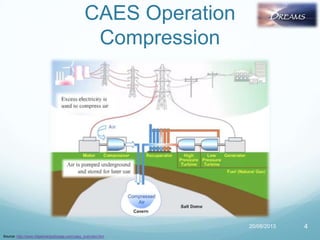
CAES Operation
Compression
20/08/2013 4
Source: http://www.ridgeenergystorage.com/caes_overview.htm
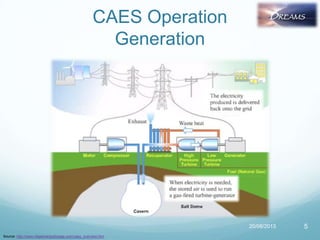
CAES Operation
Generation
20/08/2013 5
Source: http://www.ridgeenergystorage.com/caes_overview.htm
Huntorf CAES Plant
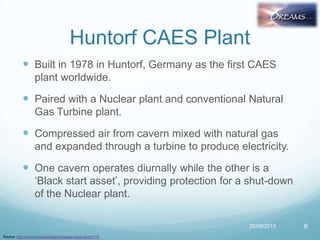
 Built in 1978 in Huntorf, Germany as the first CAES
plant worldwide.
 Paired with a Nuclear plant and conventional Natural
Gas Turbine plant.
 Compressed air from cavern mixed with natural gas
and expanded through a turbine to produce electricity.
 One cavern operates diurnally while the other is a
„Black start asset‟, providing protection for a shut-down
of the Nuclear plant.
20/08/2013 6
Source: http://www.energystorageexchange.org/projects/116
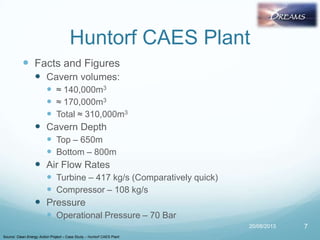
Huntorf CAES Plant
 Facts and Figures
 Cavern volumes:
 ≈ 140,000m3
 ≈ 170,000m3
 Total ≈ 310,000m3
 Cavern Depth
 Top – 650m
 Bottom – 800m
 Air Flow Rates
 Turbine – 417 kg/s (Comparatively quick)
 Compressor – 108 kg/s
 Pressure
 Operational Pressure – 70 Bar
20/08/2013 7
Source: Clean Energy Action Project – Case Study – Huntorf CAES Plant
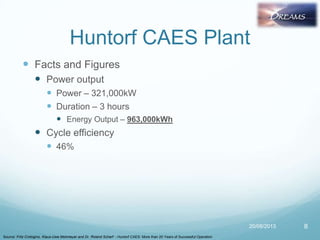
Huntorf CAES Plant
 Facts and Figures
 Power output
 Power – 321,000kW
 Duration – 3 hours
 Energy Output – 963,000kWh
 Cycle efficiency
 46%
20/08/2013 8
Source: Fritz Crotogino, Klaus-Uwe Mohmeyer and Dr. Roland Scharf - Huntorf CAES: More than 20 Years of Successful Operation
McIntosh CAES Plant
 Built in 1992 in McIntosh, Alabama.
 Part of a factory consisting of two conventional gas
turbines.
 Start-up time of 14 minutes when first built.
 Dresser-rand now boast 10 minutes to full power
generation (5 minutes in emergency) and only 4 minutes
to full compression operation.
20/08/2013
Source: Dresser-Rand - CAES
9
McIntosh CAES Plant
 Facts and Figures
 Cavern volume:
 ≈ 580,000m3
 Cavern Depth
 Top – 450m
 Bottom – 750m
 Pressure
 Operational Pressure – 70 Bar
 Cost
 1991 - $65million = £43million
 Today ≈ $108million = £71million
20/08/2013
Source: Dresser-Rand - CAES
10
McIntosh CAES Plant
 Facts and Figures
 Power Output
 Power – 110MW
 Duration – 26 hours
 Energy Output – 2,860,000kWh
 Cycle Efficiency
 54%
20/08/2013
Source: Clean Energy Action Project – McIntosh Case Study
11
ADELE Adiabatic
Storage Project
 Problem:
 Temperature of the air following compression vastly increases, up
to around 600°C which must be dissipated.
 Conversely, thermal energy is lost following air expansion and
hence air must absorb heat before entering the turbine.
 RWE Power, General Electric, Züblin and DLR are currently
researching possible ways to absorb, store and then reuse the
thermal energy in the compressed air.
 They are proposing highly insulated thermal towers made up
stone, gravel and ceramics through which the newly compressed
air will travel, exchanging its thermal energy.
 Before the air from the ground passes into the turbine, it will pass
through this tower absorbing some of the thermal energy, in a pre-
heat operation.
20/08/2013 12
ADELE Adiabatic
Storage Project
20/08/2013 13
ADELE Adiabatic
Storage Project
 Estimated to increase efficiency up to 70%.
 Take the compressed air at 600°C and store the
thermal energy in towers up to 40m high.
 Now delayed pilot plant to be built capable of:
 Storing – 360MWh
 Generating – 360MW electricity
 The equivalent to 50 ultra-modern wind turbines spinning for
4 hours.
20/08/2013 14
Dresser-Rand
 Dresser-Rand have recently been awarded the contract
to proved the equipment for a 317MW CAES system in
Texas, working in partnership with Apex.
 Dresser-Rand also supplied the turboexpander turbines
for the McIntosh CAES plant.
20/08/2013 15
General
Compression Technology
 Have researched and designed the General
Compression Advanced Energy Storage (GCAESTM)
system1.
 Based on reversible thermodynamics, they claim a near-
isothermal process, covering both the compression and
expansion stages.
 Efficiency – 75%
 Cost – $800 - $1000/kW2
 Have a fully operational 100kW multi-stage plant in
Watertown, Massachusetts.
 Construction of second generation GCAES, 2MW, 500MWh
system with wind turbine integration now underway in Texas.
20/08/2013 16
[1] Source: General Compression – Who We Are
[2] Source: General Compression - Fuel-Free Geologic Compressed Air Energy Storage From Renewable Power - Task #1 Deliverable Report
Iowa Stored
Energy Park
 Planned project studied for 8 years to store wind
energy through compression of air in sandstone
aquifers below the ground.
 Power Output: 270MW
 $400million4
 Project terminated in 2011 due to geology reasons.
20/08/2013 17
[4] Source: Sandia Report – Lessons from Iowa
Larne, Ireland
 A planned gas storage system by InfraStrata and North
East Storage that was subject to heavy opposition due
to the disposal of brine in the sea, amongst many other
safety concerns3.
 Gaelectric have now carried out tests to determine the
feasibility of the area for CEAS.
 £175million project
 £10million set aside for feasibility study
 Power Output: 140 - 300MW
20/08/2013 18
[3] Source: Larne Times – Test Data will Provide Data on Wind-Energy Storage Potential
New York Power
Authority Research
 Provide around 25% of the energy requirements of
New York State, and are looking to supply renewable
energy options to all their customers.
 Mission statement:
 “to advance the generation and utilization of renewable
energy through project implementation, research and
technology transfer”8
20/08/2013 19
[8] Source: New York Power Authority - Energy Storage Activities at New York Power Authorities
 Underground CAES feasibility study8
 Power Output: 300MW
 Compressor Power: 215MW
 Storage Capacity: 10 hours
 Cost: $700/kWh
 Above ground CAES feasibility study
 3 foot diameter 2 mile pipework
 Power Output: 10MW
 Storage Capacity: 2hours
20/08/2013 20
New York Power
Authority Research
[8] Source: New York Power Authority - Energy Storage Activities at New York Power Authorities
Norton, Ohio CAES
Project
 This project has been researched for over a decade
now, changing company hands with current owners
First Energy.
 The proposal7:
 CAES in a disused Limestone mine
 Power Output: 270MW initially rising to 2700MW as more
and more phases are built.
20/08/2013 21
[7] Source: First Energy Corporation – Alternative and Renewable Energy
San Joaquin County
CAES Site Testing
 Pacific Gas & Electric Company (PG&E) spent three
weeks conducting tests on a depleted natural gas
reservoir, capable of storing 300MW of power lasting
10 hours5.
 Engineers and geologists have been studying 10m
sections of rock in order to determine the feasibility of
CAES, as has to be the case with all CAES projects6.
 Results are yet to be published.
20/08/2013 22
[5] Source: Energy Storage Exchange - Advanced Underground CAES Project w/Saline Porous Rock Formation
[6] Source: PGE Currents- Electricity Out of Thin Air? PG&E Exploring New Type of Clean Energy
SustainX CAES
Demonstration Project
 Small start-up company who raised $14.4million and
received a grant from US DoE of $5.39million,
highlighting the recognition for such projects to be
developed9.
 A 50kW plant has already been built and now
construction has begun on a 1MW, 4MWh plant10.
 Built using SustainX‟s patented Isothermal technology,
boasting the lack of fuel and secondary heat sources
involved.
 95% efficiency in both compression and expansion.
20/08/2013 23
[9] Source: Gigaom - SustainX Raises $14.4M for Air Energy Storage
[10] Source: US DoE – SistainX Inc - Isothermal Compressed Air Energy Storage
Advantages of CAES
 Reduces the costs in having no storage at all, thus reducing
wind curtailment.
 In 2011, wind farms were paid £25million to not produce
electricity due to extortionately high costs set by the wind farm
operators1.
 This money could be spent on installing CAES systems and so
the turbines would be able to store the energy produced, thus
eliminating costs for shut-down.
 Reduced emissions associated with the energy produced by
conventional methods.
 Storing energy that would otherwise be wasted results in a
reduction in emissions due to needless further production.
20/08/2013 24
[1] Source: Daily Mail – “Wind farms paid £25million NOT to produce electricity when it is blustery - and YOU pay”
Advantages of CAES
 Quick start-up time.
 0%-100% can be achieved in 10 minutes.
 50%-100% can be achieved in 15 seconds2.
 Vast areas in which the system could be implemented
 80% of US territory has geology suitable for CAES3.
 There just needs to be a proven technology with high
efficiency that could be applied to the possible sites.
20/08/2013 25
[2] Source: Arizona Research Institute for Solar Energy
[3] Source: Boise State University - “Overview of Compress Air Energy Storage”
Advantages of CAES
 Shift of cheap off-peak energy to expensive peak
energy.
 CAES uses excess energy at off-peak times to compress
air.
 It then generates electricity at times of peak demand,
when electricity prices can be 4 or 5 times as high.
 It is this difference in electricity price that generates income
for the cavern operators.
20/08/2013 26
Advantages of CAES
Using Salt Caverns
 Flexibility4
 Operate under very high pressure and so can very quickly
accept or deliver large amounts of air and hence can cope with
the intermittency of generation requirements caused by
renewable sources.
 Cycling
 Traditional gas caverns can traditionally only inject in the
summer and withdraw in the winter
 Base Gas
 Caverns must be primed with a base pressure of gas, which is
lower in salt caverns than it is with typical caverns, resulting in a
higher proportion of working gas from the cavern.
20/08/2013 27
[4] Source: EIA – “Salt caverns account for 23% of U.S. underground natural gas storage daily deliverability”
Conclusions
 As can be seen through the examples provided
throughout this presentation, compressed air energy
storage is an area of heavy research with projects
being set up by a number of companies.
 The original technology is already proven by the plants
at Huntorf and McIntosh, and now with advancements
in technology far greater efficiencies can be achieved.
 CAES systems provide an area of Engineering that
could become the focal-point for many years to come,
with investments richly rewarding.
20/08/2013 28
Thank you
20/08/2013 29Compressed Air Energy Storage Systems Worldwide

Overall presentation

  • 1.
    Compressed Air Energy Storage AnOverview by DREAMS Ltd 20/08/2013
  • 2.
    Overview  DREAMS Ltd CAES Operation  CAES Examples  Huntorf, Germany  McIntosh, Alabama  Current worldwide CAES Projects  ADELE Adiabatic Energy Storage Project  Advantages of CAES  Conclusions 20/08/2013 2
  • 3.
  • 4.
    CAES Operation Compression 20/08/2013 4 Source:http://www.ridgeenergystorage.com/caes_overview.htm
  • 5.
    CAES Operation Generation 20/08/2013 5 Source:http://www.ridgeenergystorage.com/caes_overview.htm
  • 6.
    Huntorf CAES Plant Built in 1978 in Huntorf, Germany as the first CAES plant worldwide.  Paired with a Nuclear plant and conventional Natural Gas Turbine plant.  Compressed air from cavern mixed with natural gas and expanded through a turbine to produce electricity.  One cavern operates diurnally while the other is a „Black start asset‟, providing protection for a shut-down of the Nuclear plant. 20/08/2013 6 Source: http://www.energystorageexchange.org/projects/116
  • 7.
    Huntorf CAES Plant Facts and Figures  Cavern volumes:  ≈ 140,000m3  ≈ 170,000m3  Total ≈ 310,000m3  Cavern Depth  Top – 650m  Bottom – 800m  Air Flow Rates  Turbine – 417 kg/s (Comparatively quick)  Compressor – 108 kg/s  Pressure  Operational Pressure – 70 Bar 20/08/2013 7 Source: Clean Energy Action Project – Case Study – Huntorf CAES Plant
  • 8.
    Huntorf CAES Plant Facts and Figures  Power output  Power – 321,000kW  Duration – 3 hours  Energy Output – 963,000kWh  Cycle efficiency  46% 20/08/2013 8 Source: Fritz Crotogino, Klaus-Uwe Mohmeyer and Dr. Roland Scharf - Huntorf CAES: More than 20 Years of Successful Operation
  • 9.
    McIntosh CAES Plant Built in 1992 in McIntosh, Alabama.  Part of a factory consisting of two conventional gas turbines.  Start-up time of 14 minutes when first built.  Dresser-rand now boast 10 minutes to full power generation (5 minutes in emergency) and only 4 minutes to full compression operation. 20/08/2013 Source: Dresser-Rand - CAES 9
  • 10.
    McIntosh CAES Plant Facts and Figures  Cavern volume:  ≈ 580,000m3  Cavern Depth  Top – 450m  Bottom – 750m  Pressure  Operational Pressure – 70 Bar  Cost  1991 - $65million = £43million  Today ≈ $108million = £71million 20/08/2013 Source: Dresser-Rand - CAES 10
  • 11.
    McIntosh CAES Plant Facts and Figures  Power Output  Power – 110MW  Duration – 26 hours  Energy Output – 2,860,000kWh  Cycle Efficiency  54% 20/08/2013 Source: Clean Energy Action Project – McIntosh Case Study 11
  • 12.
    ADELE Adiabatic Storage Project Problem:  Temperature of the air following compression vastly increases, up to around 600°C which must be dissipated.  Conversely, thermal energy is lost following air expansion and hence air must absorb heat before entering the turbine.  RWE Power, General Electric, Züblin and DLR are currently researching possible ways to absorb, store and then reuse the thermal energy in the compressed air.  They are proposing highly insulated thermal towers made up stone, gravel and ceramics through which the newly compressed air will travel, exchanging its thermal energy.  Before the air from the ground passes into the turbine, it will pass through this tower absorbing some of the thermal energy, in a pre- heat operation. 20/08/2013 12
  • 13.
  • 14.
    ADELE Adiabatic Storage Project Estimated to increase efficiency up to 70%.  Take the compressed air at 600°C and store the thermal energy in towers up to 40m high.  Now delayed pilot plant to be built capable of:  Storing – 360MWh  Generating – 360MW electricity  The equivalent to 50 ultra-modern wind turbines spinning for 4 hours. 20/08/2013 14
  • 15.
    Dresser-Rand  Dresser-Rand haverecently been awarded the contract to proved the equipment for a 317MW CAES system in Texas, working in partnership with Apex.  Dresser-Rand also supplied the turboexpander turbines for the McIntosh CAES plant. 20/08/2013 15
  • 16.
    General Compression Technology  Haveresearched and designed the General Compression Advanced Energy Storage (GCAESTM) system1.  Based on reversible thermodynamics, they claim a near- isothermal process, covering both the compression and expansion stages.  Efficiency – 75%  Cost – $800 - $1000/kW2  Have a fully operational 100kW multi-stage plant in Watertown, Massachusetts.  Construction of second generation GCAES, 2MW, 500MWh system with wind turbine integration now underway in Texas. 20/08/2013 16 [1] Source: General Compression – Who We Are [2] Source: General Compression - Fuel-Free Geologic Compressed Air Energy Storage From Renewable Power - Task #1 Deliverable Report
  • 17.
    Iowa Stored Energy Park Planned project studied for 8 years to store wind energy through compression of air in sandstone aquifers below the ground.  Power Output: 270MW  $400million4  Project terminated in 2011 due to geology reasons. 20/08/2013 17 [4] Source: Sandia Report – Lessons from Iowa
  • 18.
    Larne, Ireland  Aplanned gas storage system by InfraStrata and North East Storage that was subject to heavy opposition due to the disposal of brine in the sea, amongst many other safety concerns3.  Gaelectric have now carried out tests to determine the feasibility of the area for CEAS.  £175million project  £10million set aside for feasibility study  Power Output: 140 - 300MW 20/08/2013 18 [3] Source: Larne Times – Test Data will Provide Data on Wind-Energy Storage Potential
  • 19.
    New York Power AuthorityResearch  Provide around 25% of the energy requirements of New York State, and are looking to supply renewable energy options to all their customers.  Mission statement:  “to advance the generation and utilization of renewable energy through project implementation, research and technology transfer”8 20/08/2013 19 [8] Source: New York Power Authority - Energy Storage Activities at New York Power Authorities
  • 20.
     Underground CAESfeasibility study8  Power Output: 300MW  Compressor Power: 215MW  Storage Capacity: 10 hours  Cost: $700/kWh  Above ground CAES feasibility study  3 foot diameter 2 mile pipework  Power Output: 10MW  Storage Capacity: 2hours 20/08/2013 20 New York Power Authority Research [8] Source: New York Power Authority - Energy Storage Activities at New York Power Authorities
  • 21.
    Norton, Ohio CAES Project This project has been researched for over a decade now, changing company hands with current owners First Energy.  The proposal7:  CAES in a disused Limestone mine  Power Output: 270MW initially rising to 2700MW as more and more phases are built. 20/08/2013 21 [7] Source: First Energy Corporation – Alternative and Renewable Energy
  • 22.
    San Joaquin County CAESSite Testing  Pacific Gas & Electric Company (PG&E) spent three weeks conducting tests on a depleted natural gas reservoir, capable of storing 300MW of power lasting 10 hours5.  Engineers and geologists have been studying 10m sections of rock in order to determine the feasibility of CAES, as has to be the case with all CAES projects6.  Results are yet to be published. 20/08/2013 22 [5] Source: Energy Storage Exchange - Advanced Underground CAES Project w/Saline Porous Rock Formation [6] Source: PGE Currents- Electricity Out of Thin Air? PG&E Exploring New Type of Clean Energy
  • 23.
    SustainX CAES Demonstration Project Small start-up company who raised $14.4million and received a grant from US DoE of $5.39million, highlighting the recognition for such projects to be developed9.  A 50kW plant has already been built and now construction has begun on a 1MW, 4MWh plant10.  Built using SustainX‟s patented Isothermal technology, boasting the lack of fuel and secondary heat sources involved.  95% efficiency in both compression and expansion. 20/08/2013 23 [9] Source: Gigaom - SustainX Raises $14.4M for Air Energy Storage [10] Source: US DoE – SistainX Inc - Isothermal Compressed Air Energy Storage
  • 24.
    Advantages of CAES Reduces the costs in having no storage at all, thus reducing wind curtailment.  In 2011, wind farms were paid £25million to not produce electricity due to extortionately high costs set by the wind farm operators1.  This money could be spent on installing CAES systems and so the turbines would be able to store the energy produced, thus eliminating costs for shut-down.  Reduced emissions associated with the energy produced by conventional methods.  Storing energy that would otherwise be wasted results in a reduction in emissions due to needless further production. 20/08/2013 24 [1] Source: Daily Mail – “Wind farms paid £25million NOT to produce electricity when it is blustery - and YOU pay”
  • 25.
    Advantages of CAES Quick start-up time.  0%-100% can be achieved in 10 minutes.  50%-100% can be achieved in 15 seconds2.  Vast areas in which the system could be implemented  80% of US territory has geology suitable for CAES3.  There just needs to be a proven technology with high efficiency that could be applied to the possible sites. 20/08/2013 25 [2] Source: Arizona Research Institute for Solar Energy [3] Source: Boise State University - “Overview of Compress Air Energy Storage”
  • 26.
    Advantages of CAES Shift of cheap off-peak energy to expensive peak energy.  CAES uses excess energy at off-peak times to compress air.  It then generates electricity at times of peak demand, when electricity prices can be 4 or 5 times as high.  It is this difference in electricity price that generates income for the cavern operators. 20/08/2013 26
  • 27.
    Advantages of CAES UsingSalt Caverns  Flexibility4  Operate under very high pressure and so can very quickly accept or deliver large amounts of air and hence can cope with the intermittency of generation requirements caused by renewable sources.  Cycling  Traditional gas caverns can traditionally only inject in the summer and withdraw in the winter  Base Gas  Caverns must be primed with a base pressure of gas, which is lower in salt caverns than it is with typical caverns, resulting in a higher proportion of working gas from the cavern. 20/08/2013 27 [4] Source: EIA – “Salt caverns account for 23% of U.S. underground natural gas storage daily deliverability”
  • 28.
    Conclusions  As canbe seen through the examples provided throughout this presentation, compressed air energy storage is an area of heavy research with projects being set up by a number of companies.  The original technology is already proven by the plants at Huntorf and McIntosh, and now with advancements in technology far greater efficiencies can be achieved.  CAES systems provide an area of Engineering that could become the focal-point for many years to come, with investments richly rewarding. 20/08/2013 28
  • 29.
    Thank you 20/08/2013 29CompressedAir Energy Storage Systems Worldwide

Editor's Notes

  • #7 http://www.energystorageexchange.org/projects/116
  • #8 http://cleanenergyactionproject.com/CleanEnergyActionProject/Energy_Storage_Case_Studies_files/Huntorf%20Compressed%20Air%20Energy%20Storage%20(AES).pdf
  • #9 http://www.uni-saarland.de/fak7/fze/AKE_Archiv/AKE2003H/AKE2003H_Vortraege/AKE2003H03c_Crotogino_ea_HuntorfCAES_CompressedAirEnergyStorage.pdf
  • #10 http://www.dresser-rand.com/literature/general/85164-10-CAES.pdf
  • #12 http://www.cleanenergyactionproject.com/CleanEnergyActionProject/Energy_Storage_Case_Studies_files/MacIntosh%20Compressed%20Air%20Energy%20Storage%20Facility.pdf
  • #14 Picture: http://www.rwe.com/web/cms/en/364260/rwe-power-ag/innovations/adele/
  • #15 http://www.rwe.com/web/cms/mediablob/en/391748/data/364260/1/rwe-power-ag/innovations/adele/Brochure-ADELE.pdf
  • #19 http://www.gaelectric.ie/index.php/energy-storage/
  • #22 https://www.firstenergycorp.com/content/fecorp/environmental/environmental_stewardship/alternative_renewableenergy.html