Directed by :
#Elita Angela
#Weni Siti
Anantasari
#Shovalina Helka
The Analysis of Word Structure…
 In Lingustics, morphology is the identification,
analysis, and description of the structure of a given
language and other linguistic units, refer to the part
of the grammar that is concerned with words and
word formation. as we will see, the study of
morphology offers important insights into how
language works, revealing the need for different
categories of words, the presence of word-internal
structure and the existence of operations that create
and modify words in various ways.
 Words and Word Structure
 Derivation
 Compounding
 Inflection
 Other Morphological Phenomena
 Morphophonemics
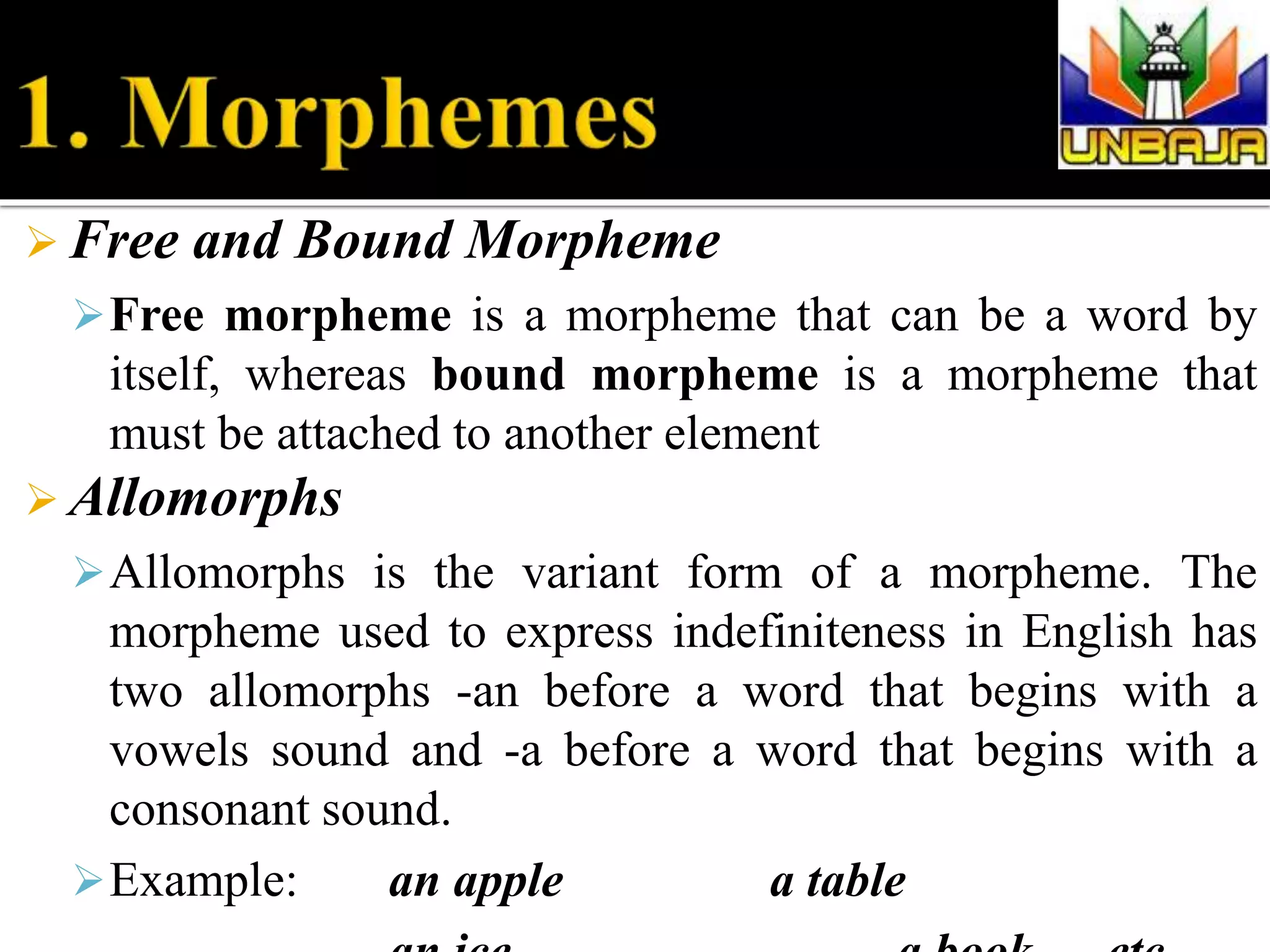
 Free and Bound Morpheme
Free morpheme is a morpheme that can be a word by
itself, whereas bound morpheme is a morpheme that
must be attached to another element
 Allomorphs
Allomorphs is the variant form of a morpheme. The
morpheme used to express indefiniteness in English has
two allomorphs -an before a word that begins with a
vowels sound and -a before a word that begins with a
consonant sound.
Example: an apple a table
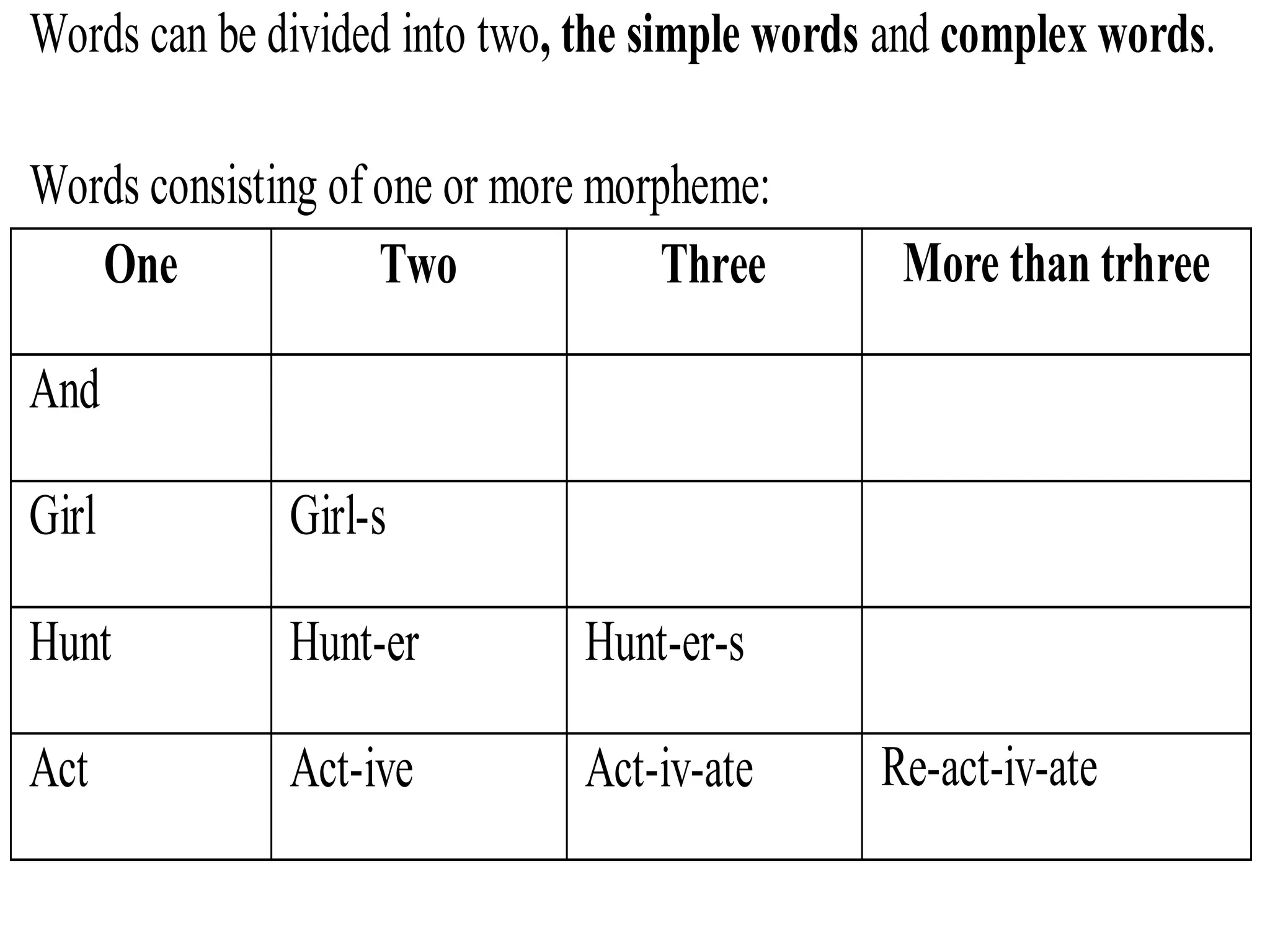
Words can be divided into two, the simple words and complex words.
Words consisting of one or more morpheme:
One Two Three More than trhree
And
Girl Girl-s
Hunt Hunt-er Hunt-er-s
Act Act-ive Act-iv-ate Re-act-iv-ate
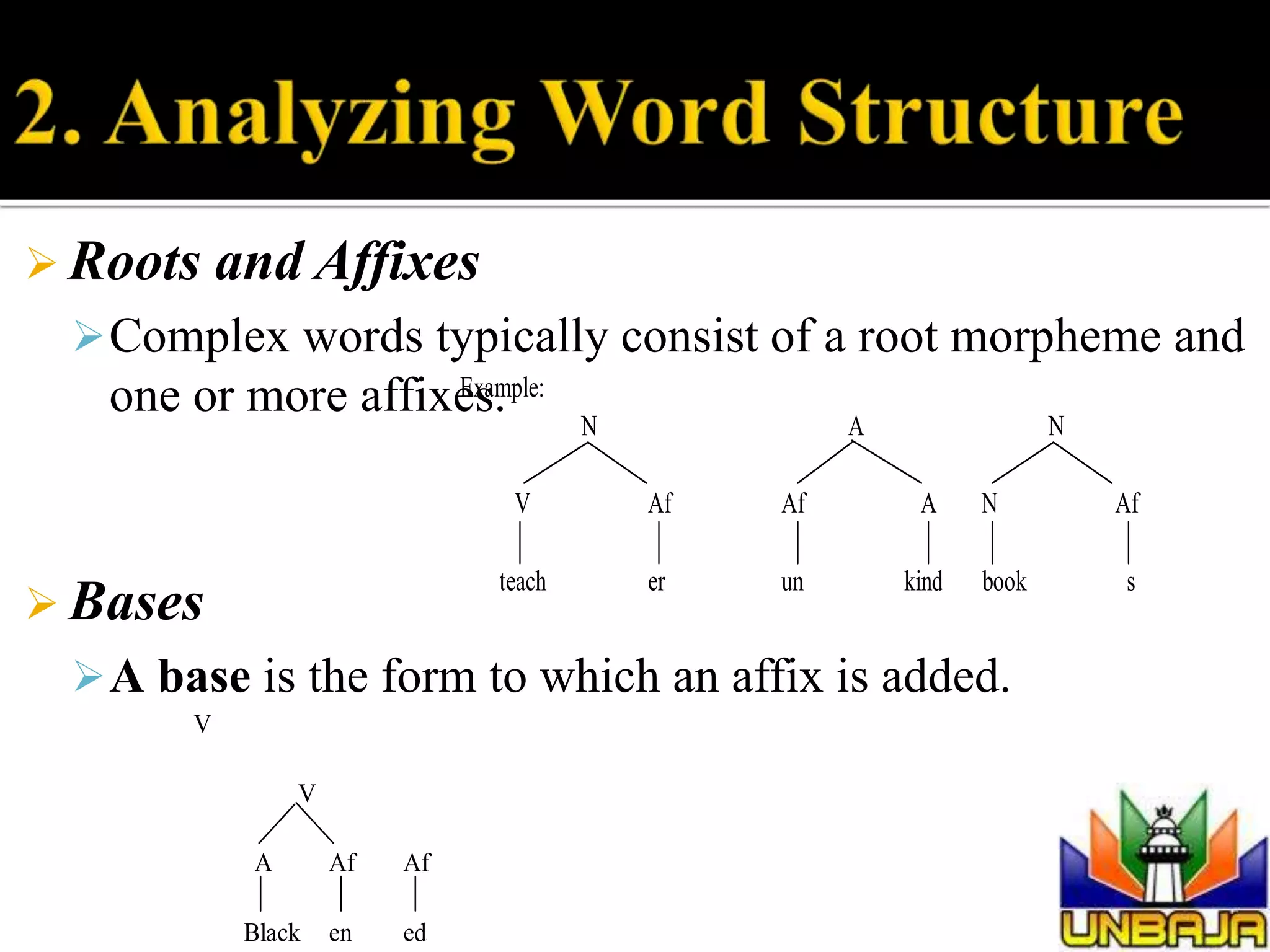
 Roots and Affixes
Complex words typically consist of a root morpheme and
one or more affixes.
 Bases
A base is the form to which an affix is added.
Example:
N A N
V Af Af A N Af
teach er un kind book s
V
V
A Af Af
Black en ed
Is an affixional process that forms a word with a
meaning and / or category distinct from that of
its base.
 Some English Derivational Affixes
A partial list of English derivational affixes, along with
information about the catagory of their usual base and
of the resulting new word.
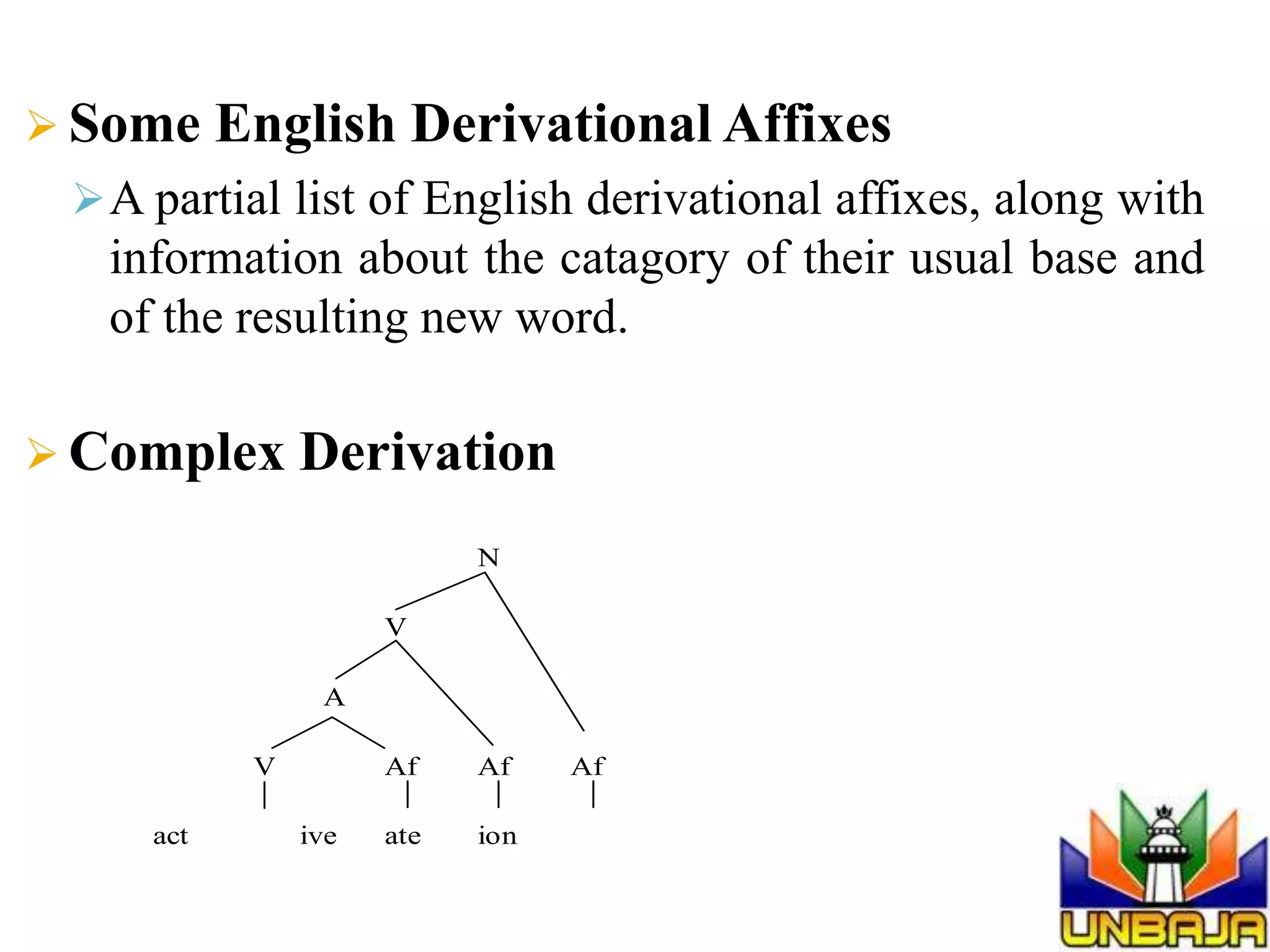
 Complex Derivation
N
V
A
V Af Af Af
act ive ate ion
Affix Change Example
Suffixes
-able V A Fix-able
-ment V N Protect-ion
-ful N A Treat-ment
-ize1 N V Hope-ful
-ish A N Vapor-ize
-ate A V Tall-ish
-ly A Adv Activ-ate
-ness A N Slow-ly
Preffixes
ex- N N Ex-wife
re- V V Re-state
in- A A In-complete
The combination of two already existent words. With
very few exceptions, the resulting compound words is
a noun, a verb, or an adjective.
Noun Compounds Verb Compounds Adjective Compounds
N V A
N N N V N A
Fire Engine Spoon Feed Nation Wide
Oil Well Steam Roll Sky Blue
Compounds Non-Compounds
Greenhouse(aglass-enclosedgarden) greenhouse(ahousepaintedgreen)
Blackboard(achalkboard) blackboard(aboardthatisblack)
The modification of a word’s form to indicate
grammatical information of various shorts.
 For nouns, verbs and adjectives the set of inflected
forms often help us identify the word class
 􀂃 E.g. noun ‘cat’: singular cat, plural cats
 Plural form (only for count nouns, i.e. nouns
denoting things that can be counted like cats, e not
mass terms such as water)
 􀂃 cats, criteria, knives, teeth, sheep
Regular verbs
walk
walks
sing
sing
Irregular verbs
walking
walked
singing
sang
 Adjective comparative superlative
Green greener greenest
Happy happier happiest
 However, some adjectives do not take these
endings:
curious more curious, most curious
foolish more foolish, most foolish
 Adverbs can often be recognized as being derived
from adjectives by adding –ly (curiously, foolishly)
 But they don’t have any other regular forms and
are not inflected themselves
 Prepositions don’t take any special form and don’t
inflect
 You can use, High Tone is assosiated with the past
tense, and low tone with the future.
 Words can be divided into word classes.
 We can broadly distinguish lexical from function
words.
 The major word classes in lexical words are nouns,
verbs, prepositions, adjectives and adverbs.
Thank You Very
Much

Morphology 1

  • 1.
    Directed by : #ElitaAngela #Weni Siti Anantasari #Shovalina Helka
  • 2.
    The Analysis ofWord Structure…
  • 3.
     In Lingustics,morphology is the identification, analysis, and description of the structure of a given language and other linguistic units, refer to the part of the grammar that is concerned with words and word formation. as we will see, the study of morphology offers important insights into how language works, revealing the need for different categories of words, the presence of word-internal structure and the existence of operations that create and modify words in various ways.
  • 4.
     Words andWord Structure  Derivation  Compounding  Inflection  Other Morphological Phenomena  Morphophonemics
  • 6.
     Free andBound Morpheme Free morpheme is a morpheme that can be a word by itself, whereas bound morpheme is a morpheme that must be attached to another element  Allomorphs Allomorphs is the variant form of a morpheme. The morpheme used to express indefiniteness in English has two allomorphs -an before a word that begins with a vowels sound and -a before a word that begins with a consonant sound. Example: an apple a table
  • 7.
    Words can bedivided into two, the simple words and complex words. Words consisting of one or more morpheme: One Two Three More than trhree And Girl Girl-s Hunt Hunt-er Hunt-er-s Act Act-ive Act-iv-ate Re-act-iv-ate
  • 8.
     Roots andAffixes Complex words typically consist of a root morpheme and one or more affixes.  Bases A base is the form to which an affix is added. Example: N A N V Af Af A N Af teach er un kind book s V V A Af Af Black en ed
  • 9.
    Is an affixionalprocess that forms a word with a meaning and / or category distinct from that of its base.
  • 10.
     Some EnglishDerivational Affixes A partial list of English derivational affixes, along with information about the catagory of their usual base and of the resulting new word.  Complex Derivation N V A V Af Af Af act ive ate ion
  • 11.
    Affix Change Example Suffixes -ableV A Fix-able -ment V N Protect-ion -ful N A Treat-ment -ize1 N V Hope-ful -ish A N Vapor-ize -ate A V Tall-ish -ly A Adv Activ-ate -ness A N Slow-ly Preffixes ex- N N Ex-wife re- V V Re-state in- A A In-complete
  • 12.
    The combination oftwo already existent words. With very few exceptions, the resulting compound words is a noun, a verb, or an adjective.
  • 13.
    Noun Compounds VerbCompounds Adjective Compounds N V A N N N V N A Fire Engine Spoon Feed Nation Wide Oil Well Steam Roll Sky Blue Compounds Non-Compounds Greenhouse(aglass-enclosedgarden) greenhouse(ahousepaintedgreen) Blackboard(achalkboard) blackboard(aboardthatisblack)
  • 14.
    The modification ofa word’s form to indicate grammatical information of various shorts.
  • 15.
     For nouns,verbs and adjectives the set of inflected forms often help us identify the word class  􀂃 E.g. noun ‘cat’: singular cat, plural cats  Plural form (only for count nouns, i.e. nouns denoting things that can be counted like cats, e not mass terms such as water)  􀂃 cats, criteria, knives, teeth, sheep
  • 16.
  • 17.
     Adjective comparativesuperlative Green greener greenest Happy happier happiest  However, some adjectives do not take these endings: curious more curious, most curious foolish more foolish, most foolish
  • 18.
     Adverbs canoften be recognized as being derived from adjectives by adding –ly (curiously, foolishly)  But they don’t have any other regular forms and are not inflected themselves  Prepositions don’t take any special form and don’t inflect  You can use, High Tone is assosiated with the past tense, and low tone with the future.
  • 21.
     Words canbe divided into word classes.  We can broadly distinguish lexical from function words.  The major word classes in lexical words are nouns, verbs, prepositions, adjectives and adverbs.
  • 22.