Blending and compounding
Arrange by:
1. Putri Ayu Septiningsih (E1D111106)
2. Taufan Handika Putra (E1D111132)
3. Teguh Iman Pribadi (E1D111133)
4. Taopan Ali (E1D111131)
Class: 5D
BLENDING
Blending is compounding by means of curtailed words.
(Marchand, 1960: 367)
A blend is a new lexeme formed from parts of two or more other
lexemes. (Bauer, 1988: 238)
A blend is a word made by joining two or more forms but
omitting at least part of one. (Algeo, 1991: 10)
Blends is a combination of the first part of the one word with the
second part of another (Booij, 2007 : 20)
Examples:
Falloween < fall + halloween
Metrosexual < metrocity + homosexual
Pedlock < pedestrian + gridlock
Bollywood < Bombay + Hollywood
Bacronym < back + acronym
Movies < moving + pictures
Brunch < breakfast + lunch
Motel < motor + hotel
Most blends are formed by the following
methods:
The beginning of one word is added to the end of the
other
Ex.: brunch = breakfast + lunch
The beginnings of two words are combined.
Ex.: cyborg, which is a blend of cybernetic and
organism.
Two words are blended around a common sequence of
sounds.
Ex.: Californication, from a song by the Red Hot Chili
Peppers, which is a blend of California and fornication.
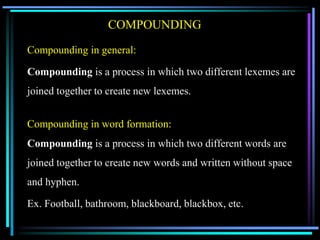
COMPOUNDING
Compounding in general:
Compounding is a process in which two different lexemes are
joined together to create new lexemes.
Compounding in word formation:
Compounding is a process in which two different words are
joined together to create new words and written without space
and hyphen.
Ex. Football, bathroom, blackboard, blackbox, etc.
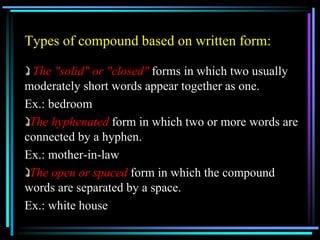
Types of compound based on written form:
The "solid" or "closed" forms in which two usually
moderately short words appear together as one.
Ex.: bedroom
The hyphenated form in which two or more words are
connected by a hyphen.
Ex.: mother-in-law
The open or spaced form in which the compound
words are separated by a space.
Ex.: white house
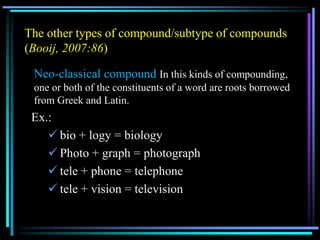
The other types of compound/subtype of compounds
(Booij, 2007:86)
Neo-classical compound In this kinds of compounding,
one or both of the constituents of a word are roots borrowed
from Greek and Latin.
Ex.:
 bio + logy = biology
 Photo + graph = photograph
 tele + phone = telephone
 tele + vision = television
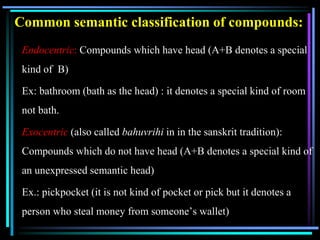
Common semantic classification of compounds:
Endocentric: Compounds which have head (A+B denotes a special
kind of B)
Ex: bathroom (bath as the head) : it denotes a special kind of room
not bath.
Exocentric (also called bahuvrihi in in the sanskrit tradition):
Compounds which do not have head (A+B denotes a special kind of
an unexpressed semantic head)
Ex.: pickpocket (it is not kind of pocket or pick but it denotes a
person who steal money from someone’s wallet)
Copulative: Compounds which have two semantic heads (A+B
denotes ‘the sum’ of what A and B)
Ex: bittersweet (it is kind of something whose taste is bitter and
sweet)
Appositive (also called dvandva in in the sanskrit tradition):
Compounds refer to lexemes that have two (contrary) attributes
which classify the compound (A+B provide different descriptions
for the same reference)
Ex.: maidservant (it denotes people who work as maid and
servant)
Source / link:
Booij, geert. 2007. An introduction to Linguistic Morphology
http://en.wikipedia.org/wiki/Blend Access on November 23, 2013
Words in English public websiteLing/Engl 215 course information
Rice University Prof. S. Kemmer Access on November 23, 2013
www.wordspy.com
https://www.google.co.id/#q=compare+and+contrast+blendin
+and+compounding+in+english+semantics Access on December 5, 2013
http://www.brighthubeducation.com/esl-lesson-plans/59679 forming-new-words-
compounds-clipping-and-blends/ Access on December 5, 2013
http://www.tlumaczenia-angielski.info/linguistics/word-formation.htm Access on
December 6, 2013
http://en.wikipedia.org/wiki/English_compound Access on December 6,
2013
promethee.philo.ulg.ac.be/.../doc/compounds.pdf
Access on December 6, 2013
http://answers.yahoo.com/question/index?qid=20080113170221AAukiWn
Access on December 7, 2013
http://www.manythings.org/vocabulary/lists/a/words.php?f=compou
nd_words Access on December 7, 2013
http://www.englishclub.com/grammar/nouns-compound.htm Access
on December 7, 2013

Blending and Compounding

  • 1.
    Blending and compounding Arrangeby: 1. Putri Ayu Septiningsih (E1D111106) 2. Taufan Handika Putra (E1D111132) 3. Teguh Iman Pribadi (E1D111133) 4. Taopan Ali (E1D111131) Class: 5D
  • 2.
    BLENDING Blending is compoundingby means of curtailed words. (Marchand, 1960: 367) A blend is a new lexeme formed from parts of two or more other lexemes. (Bauer, 1988: 238) A blend is a word made by joining two or more forms but omitting at least part of one. (Algeo, 1991: 10) Blends is a combination of the first part of the one word with the second part of another (Booij, 2007 : 20)
  • 3.
    Examples: Falloween < fall+ halloween Metrosexual < metrocity + homosexual Pedlock < pedestrian + gridlock Bollywood < Bombay + Hollywood Bacronym < back + acronym Movies < moving + pictures Brunch < breakfast + lunch Motel < motor + hotel
  • 4.
    Most blends areformed by the following methods: The beginning of one word is added to the end of the other Ex.: brunch = breakfast + lunch The beginnings of two words are combined. Ex.: cyborg, which is a blend of cybernetic and organism. Two words are blended around a common sequence of sounds. Ex.: Californication, from a song by the Red Hot Chili Peppers, which is a blend of California and fornication.
  • 5.
    COMPOUNDING Compounding in general: Compoundingis a process in which two different lexemes are joined together to create new lexemes. Compounding in word formation: Compounding is a process in which two different words are joined together to create new words and written without space and hyphen. Ex. Football, bathroom, blackboard, blackbox, etc.
  • 6.
    Types of compoundbased on written form: The "solid" or "closed" forms in which two usually moderately short words appear together as one. Ex.: bedroom The hyphenated form in which two or more words are connected by a hyphen. Ex.: mother-in-law The open or spaced form in which the compound words are separated by a space. Ex.: white house
  • 7.
    The other typesof compound/subtype of compounds (Booij, 2007:86) Neo-classical compound In this kinds of compounding, one or both of the constituents of a word are roots borrowed from Greek and Latin. Ex.:  bio + logy = biology  Photo + graph = photograph  tele + phone = telephone  tele + vision = television
  • 8.
    Common semantic classificationof compounds: Endocentric: Compounds which have head (A+B denotes a special kind of B) Ex: bathroom (bath as the head) : it denotes a special kind of room not bath. Exocentric (also called bahuvrihi in in the sanskrit tradition): Compounds which do not have head (A+B denotes a special kind of an unexpressed semantic head) Ex.: pickpocket (it is not kind of pocket or pick but it denotes a person who steal money from someone’s wallet)
  • 9.
    Copulative: Compounds whichhave two semantic heads (A+B denotes ‘the sum’ of what A and B) Ex: bittersweet (it is kind of something whose taste is bitter and sweet) Appositive (also called dvandva in in the sanskrit tradition): Compounds refer to lexemes that have two (contrary) attributes which classify the compound (A+B provide different descriptions for the same reference) Ex.: maidservant (it denotes people who work as maid and servant)
  • 10.
    Source / link: Booij,geert. 2007. An introduction to Linguistic Morphology http://en.wikipedia.org/wiki/Blend Access on November 23, 2013 Words in English public websiteLing/Engl 215 course information Rice University Prof. S. Kemmer Access on November 23, 2013 www.wordspy.com https://www.google.co.id/#q=compare+and+contrast+blendin +and+compounding+in+english+semantics Access on December 5, 2013 http://www.brighthubeducation.com/esl-lesson-plans/59679 forming-new-words- compounds-clipping-and-blends/ Access on December 5, 2013 http://www.tlumaczenia-angielski.info/linguistics/word-formation.htm Access on December 6, 2013
  • 11.
    http://en.wikipedia.org/wiki/English_compound Access onDecember 6, 2013 promethee.philo.ulg.ac.be/.../doc/compounds.pdf Access on December 6, 2013 http://answers.yahoo.com/question/index?qid=20080113170221AAukiWn Access on December 7, 2013 http://www.manythings.org/vocabulary/lists/a/words.php?f=compou nd_words Access on December 7, 2013 http://www.englishclub.com/grammar/nouns-compound.htm Access on December 7, 2013