rickmwacha100@gmail.com
FACULTY : EDUCATION
DEPARTMENT : LANGUAGES AND LINGUISTICS
COURSE TITLE : ENGLISH SYNTAX
COURSE CODE : LL 214
STREAM : BAED 2A
Name of collogue : MWACHA, ERICK C.
i
Table of contents
SENSE RELATIONS ..................................................................................................................... 1
SENSE OF RELATIONS OF INCLUSIONS AND IDENTITY................................................... 1
SENSE RELATION OF EXCLUSION AND OPPOSITION........................................................ 5
OTHER TYPES OF SENSE RELATIONS ................................................................................... 5
REFERENCES ............................................................................................................................... 7
1
SENSE RELATIONS
According to Mathew (1997), sense relations refer to any relation between lexical units within
the semantic system of a language. This means that it has to be a relation in meaning between
lexical units of a language. It does not matter if this relation expresses some kinds of identity or
non-identity.
Sense relation is relations of meaning between words, as expressed in synonymy, hyponymy, and
antonym. Thus, sense relation can be seen from the similarity of meaning as in synonymy, the
inclusion of meaning as in hyponymy, and oppositeness of meaning as in Antonymy (Kreidler,
1998).
Hence, sense relation can be defined as the relations between words or predicates in which a
linguistic units enters through being contrasted or substitutable in a particular environment with
other similar units so as an individual lexical unit can be replaced by another.
Classes of sense relation
Cruse (2004) classified sense relations into two classes which are:-
i. Those that express identity between word meanings.
ii. Those that express opposition and exclusion.
SENSE OF RELATIONS OF INCLUSIONS AND IDENTITY
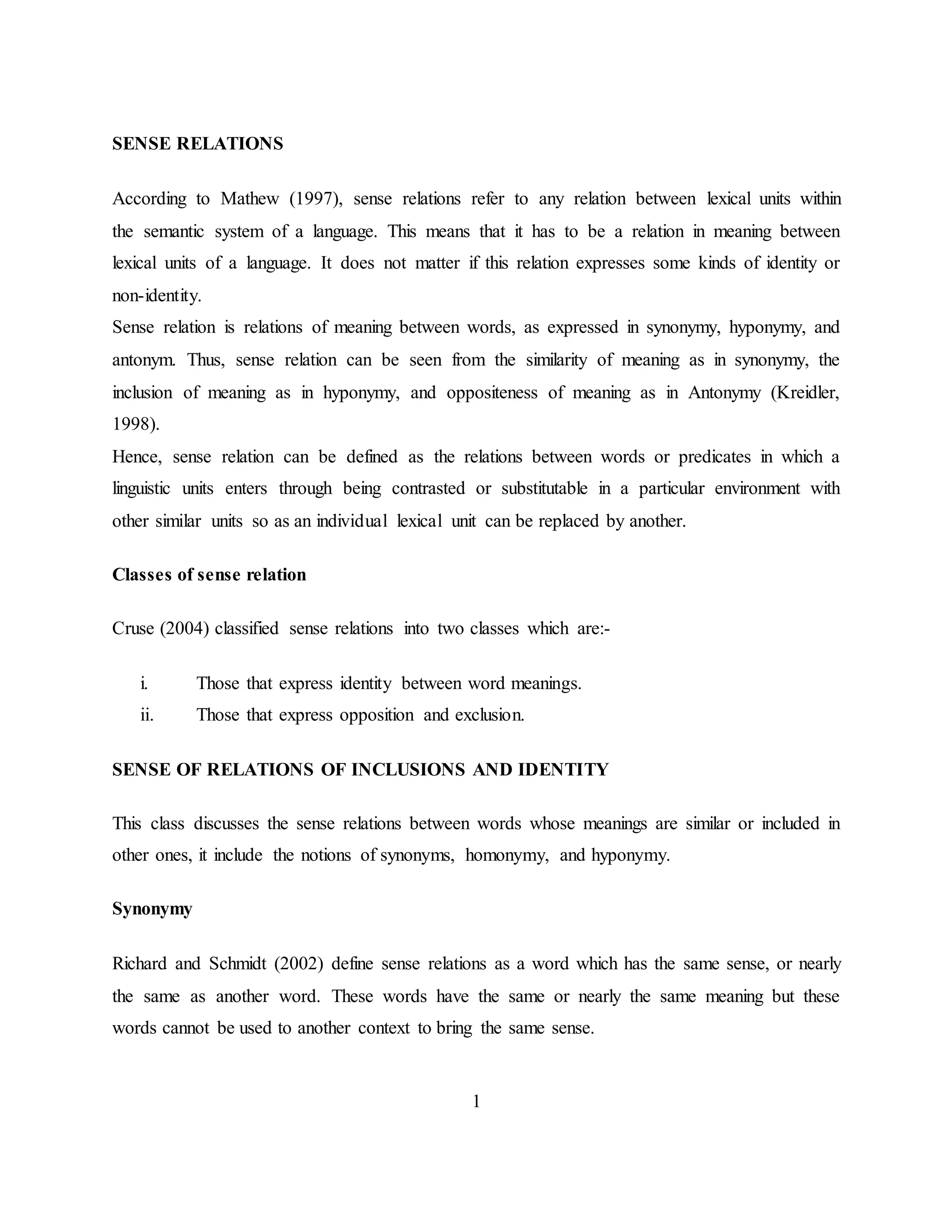
This class discusses the sense relations between words whose meanings are similar or included in
other ones, it include the notions of synonyms, homonymy, and hyponymy.
Synonymy
Richard and Schmidt (2002) define sense relations as a word which has the same sense, or nearly
the same as another word. These words have the same or nearly the same meaning but these
words cannot be used to another context to bring the same sense.
2
For example
i. The student speaks with a broad British accent.
ii. The student speaks with a wide British accent.
Hence they have the same or nearly the same sense but not in the other contexts to mean the
same. However this kind of sense relation means “word of the same meaning” (Leech, 1981).
Synonym is a condition in which two lexemes or words have more or less the same lexical
meaning. This condition results from the contiguity or sameness in meaning between two
lexemes or word.
Example;
Small – little.
Big – large.
Politician – statesman.
Homonymy
Homonyms are generally defined as words different in meaning but either identical both in sound
and spelling or identical only in sound or spelling. Homonym’s words are written the same way
and sound alike but which have different meanings.
For example
i. Our house is on the West bank of the river
ii. I want to save my money in the bank.
Polysemy
Are the words with the same form and related meanings. Polysemy are the words with one form
(written or spoken) having multiple meanings that are all related by extension (Yule, 2006:107).
3
For example, the word ‘head’ it is used to refer to the object on top of the body or on top of a
glass of beer. It is also used to refer to a person at the top of the company or department.
According to James and Malande (2010:112), argue that polysemy is also called radiation or
multiplication. This simply happens when lexeme acquires a wider range of meanings.
This sense relation exists where there is a lexeme in one language which has more than one
meaning. Lyons (1977) mentions that it is difficult to differentiate when two or meanings may be
associated with homonymous lexemes in one language but not in the other. By definition,
polysemy is a kind of sense relation where a lexeme has more than one meaning.
For example:
“Mouth” of a river and of animal (clearly related by the concepts of an opening from the interior
of something to outside).
Bank - financial institution.
- Riverside.
Wood - a piece of a tree.
- A geographical area with many trees.
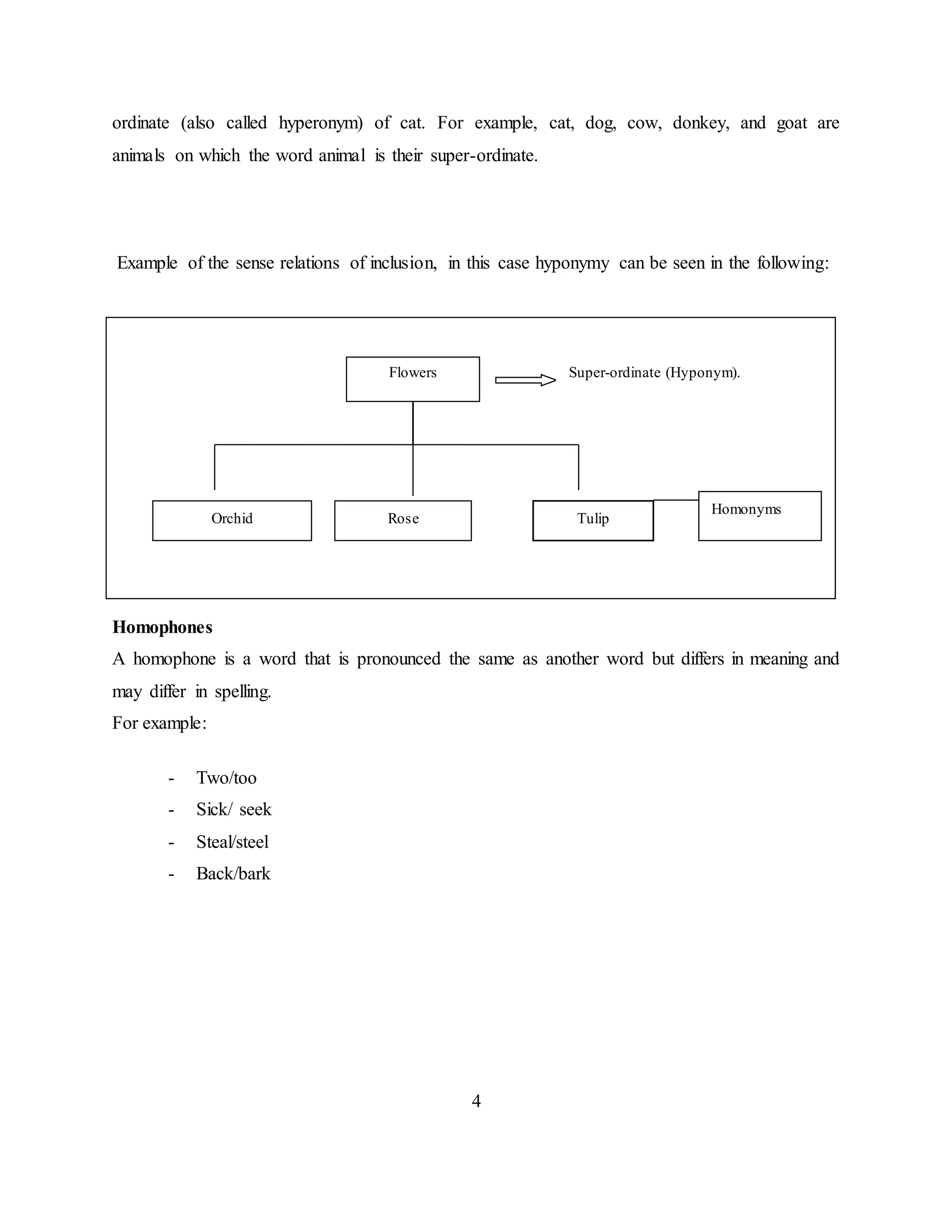
Hyponymy
According to Richard and Schmidt (2002) hyponymy is the relationship between two words in
which the meaning of one of the word includes the meaning of other words. For instance, this
can be seen in the relationship between cat and animal, pigeon and bird, orchid and flower. In
these examples cat is said to be a hyponymy of animal, pigeon is said to be the hyponymy of
bird, and orchid is said to be the hyponymy of flower. Therefore, animal is said to be the super
4
ordinate (also called hyperonym) of cat. For example, cat, dog, cow, donkey, and goat are
animals on which the word animal is their super-ordinate.
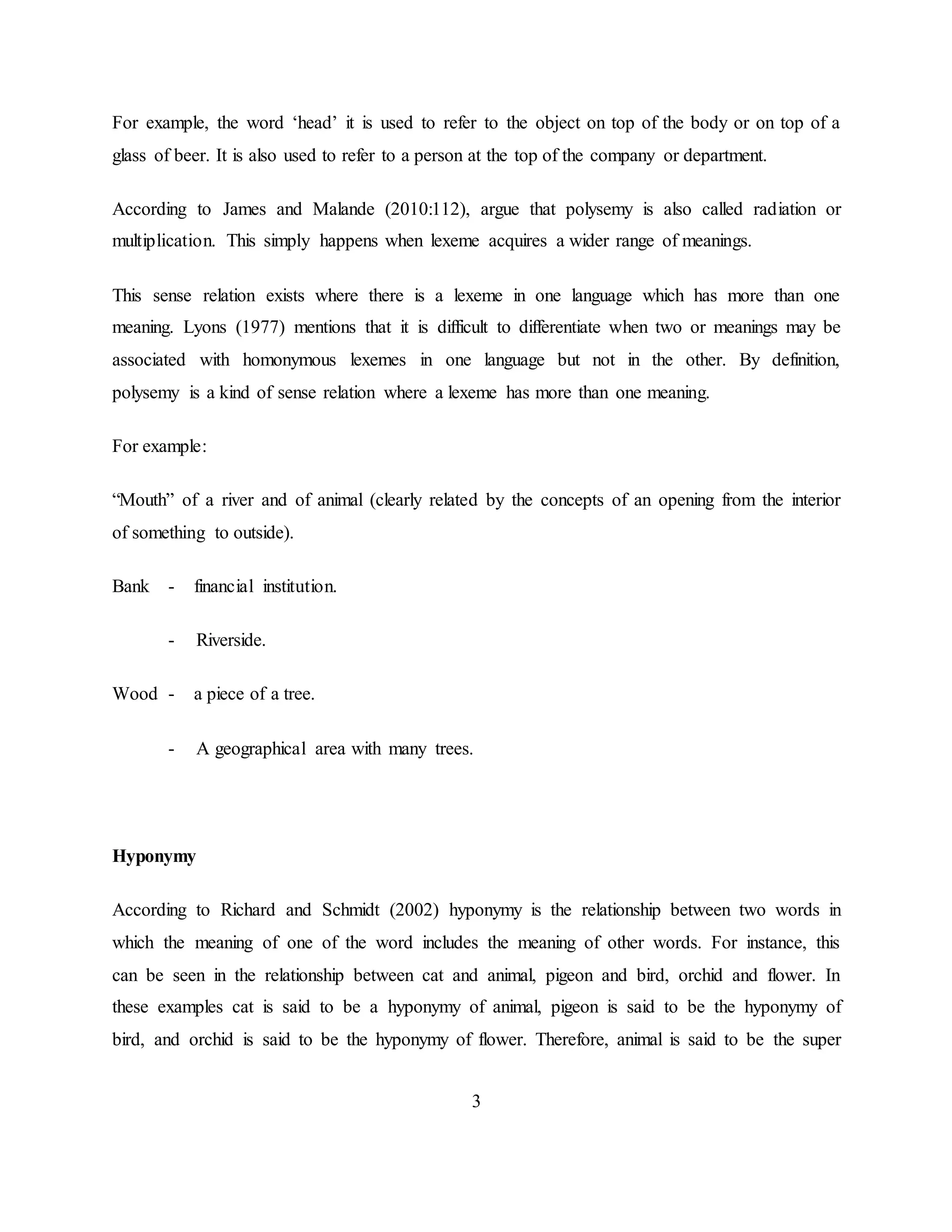
Example of the sense relations of inclusion, in this case hyponymy can be seen in the following:
Homophones
A homophone is a word that is pronounced the same as another word but differs in meaning and
may differ in spelling.
For example:
- Two/too
- Sick/ seek
- Steal/steel
- Back/bark
Flowers
Orchid Rose Tulip
Super-ordinate (Hyponym).
Homonyms
5
SENSE RELATION OF EXCLUSION AND OPPOSITION
Antonymy
This is the sense relation whereby words are related by having opposite meaning. According to
Leech, (1981), antonymy is the standard technical term for opposite meaning between lexemes.
There are three types of antonyms (Cruse, 2004:164-5).
i. Polar antonyms
This is the type of oppositeness which can be easily modified with degree modifiers such as
very, rather, quite, slightly, extremely, and the like.
Example: The essay is very long.
The test is quite easy.
His performance is not extremely bad.
ii. Equipollent antonyms
This type of antonym refers to subjective sensation as hot: cold, bitter: sweet, painful:
pleasurable, or emotions as happy: sad, proud of: ashamed of.
iii. Overlapping Antonyms
Kind of antonym where by pairs have an evaluative polarity as part of their meaning as good:
bad, cruel: kind and clever: dull. Cruse (2004) generally explains the words which have opposite
meaning hence it is quite meaningful connection to the definition given by Leech (1981) which
is that antonym is the sense relation whereby words are related by having opposite meaning. By
considering their idea, antonym concerns words or pairs of opposite meaning.
OTHER TYPES OF SENSE RELATIONS
Paraphrase; O’Grady & Dobrovosky (1989) explains paraphrase as the relation of two
sentences with identical meanings.
6
Example:
a. I gave the summons to Erine.
I gave Erine the summons.
b. The police chased the burglar.
The burglar was chased by the police.
Therefore, paraphrase means two sentences with same meaning or identical meaning as for
instance to say that “I gave summons to Erin” is alike to say “I gave Erin the summons”.
Homographs
Is where the standard spelling is the same, but the pronunciation differs, as in wind (air
movement or bend) or refuse (“rubbish or “disallow”) stress falls on first and second syllable,
respectively (Moses, 2010).
Generally, homographs are words with different pronunciation, meaning and origins but the
same spelling. They are not to be confused with homonyms, homophones, and heteronyms. In
order to work out which pronunciation and which meaning is appropriate, you need to be aware
of the context.
Here are few homographs and their meaning
 Agape – with open or love.
 Down – a lower place or soft fluff on a bird.
 Minute – tiny or unit of time.
 Wound – past tense of wind or to injure.
Entailment
Is a relation in which the truth of one sentence necessary implies the truth of another.
Example; The police injured the burglar.
The burglar is injured.
Therefore, this means that two different sentences construct a single or the same meaning or
thought.
Contradiction
This is the relation in which the truth of one sentence entails the falsity of another (O’Grady &
Dobrovosky, 1989).
7
Example – Charles is a bachelor.
Charles is married.
Sense relations are one of important elements with regard to learning semantics, the study of
language meaning. The sense of a word can be understood from its similarity with other words,
on the other hand it can also be learned from its oppositeness with other words.
REFERENCES
8
Cruse, D. A. (1995). Lexical Semantics. Cambridge: Cambridge University Press.
Horford, J. Heasley, B. & Smith, M. (2007). Semantics: A Course book 2nd ed. Cambridge:
Cambridge University Press.
James, M. & Olenyo, M. (2010). An Introduction to Language and Linguistics Theory. Mwanza:
Serengeti Educational Publishers Ltd.
Kreidler, Charles W. (1998). Introducing English Semantics. London: Routledge.
Mathew, N. (1997). An Introduction. USA: Texas: Honston Headache Clinic.
O’Grady, W. & Dobrovosky, M. (1989). Contemporary Linguistics. Ney York: St. Martin’s
Press.
Richards, J. & Schimidt, R. (2002). Longman Dictionary of Language Teaching and Applied
Linguistics 3rd ed. London: Pearson Educational Limited.
Saeed, John, L. (2005). Semantics 2nd Ed. Oxford: Blackwell Publishing.
Todd, L. (1987). An Introduction to Linguistics. Singapore: Longman York Press.
Wehmeir, S. (2005). Oxford Advanced Learner’s Dictionary 7th ed. Oxford: Oxford University
Press.
Yule, G. (2006). The Study of Language. New York: Cambridge University Press.

Sense relations (linguistics)

  • 1.
    rickmwacha100@gmail.com FACULTY : EDUCATION DEPARTMENT: LANGUAGES AND LINGUISTICS COURSE TITLE : ENGLISH SYNTAX COURSE CODE : LL 214 STREAM : BAED 2A Name of collogue : MWACHA, ERICK C.
  • 2.
    i Table of contents SENSERELATIONS ..................................................................................................................... 1 SENSE OF RELATIONS OF INCLUSIONS AND IDENTITY................................................... 1 SENSE RELATION OF EXCLUSION AND OPPOSITION........................................................ 5 OTHER TYPES OF SENSE RELATIONS ................................................................................... 5 REFERENCES ............................................................................................................................... 7
  • 3.
    1 SENSE RELATIONS According toMathew (1997), sense relations refer to any relation between lexical units within the semantic system of a language. This means that it has to be a relation in meaning between lexical units of a language. It does not matter if this relation expresses some kinds of identity or non-identity. Sense relation is relations of meaning between words, as expressed in synonymy, hyponymy, and antonym. Thus, sense relation can be seen from the similarity of meaning as in synonymy, the inclusion of meaning as in hyponymy, and oppositeness of meaning as in Antonymy (Kreidler, 1998). Hence, sense relation can be defined as the relations between words or predicates in which a linguistic units enters through being contrasted or substitutable in a particular environment with other similar units so as an individual lexical unit can be replaced by another. Classes of sense relation Cruse (2004) classified sense relations into two classes which are:- i. Those that express identity between word meanings. ii. Those that express opposition and exclusion. SENSE OF RELATIONS OF INCLUSIONS AND IDENTITY This class discusses the sense relations between words whose meanings are similar or included in other ones, it include the notions of synonyms, homonymy, and hyponymy. Synonymy Richard and Schmidt (2002) define sense relations as a word which has the same sense, or nearly the same as another word. These words have the same or nearly the same meaning but these words cannot be used to another context to bring the same sense.
  • 4.
    2 For example i. Thestudent speaks with a broad British accent. ii. The student speaks with a wide British accent. Hence they have the same or nearly the same sense but not in the other contexts to mean the same. However this kind of sense relation means “word of the same meaning” (Leech, 1981). Synonym is a condition in which two lexemes or words have more or less the same lexical meaning. This condition results from the contiguity or sameness in meaning between two lexemes or word. Example; Small – little. Big – large. Politician – statesman. Homonymy Homonyms are generally defined as words different in meaning but either identical both in sound and spelling or identical only in sound or spelling. Homonym’s words are written the same way and sound alike but which have different meanings. For example i. Our house is on the West bank of the river ii. I want to save my money in the bank. Polysemy Are the words with the same form and related meanings. Polysemy are the words with one form (written or spoken) having multiple meanings that are all related by extension (Yule, 2006:107).
  • 5.
    3 For example, theword ‘head’ it is used to refer to the object on top of the body or on top of a glass of beer. It is also used to refer to a person at the top of the company or department. According to James and Malande (2010:112), argue that polysemy is also called radiation or multiplication. This simply happens when lexeme acquires a wider range of meanings. This sense relation exists where there is a lexeme in one language which has more than one meaning. Lyons (1977) mentions that it is difficult to differentiate when two or meanings may be associated with homonymous lexemes in one language but not in the other. By definition, polysemy is a kind of sense relation where a lexeme has more than one meaning. For example: “Mouth” of a river and of animal (clearly related by the concepts of an opening from the interior of something to outside). Bank - financial institution. - Riverside. Wood - a piece of a tree. - A geographical area with many trees. Hyponymy According to Richard and Schmidt (2002) hyponymy is the relationship between two words in which the meaning of one of the word includes the meaning of other words. For instance, this can be seen in the relationship between cat and animal, pigeon and bird, orchid and flower. In these examples cat is said to be a hyponymy of animal, pigeon is said to be the hyponymy of bird, and orchid is said to be the hyponymy of flower. Therefore, animal is said to be the super
  • 6.
    4 ordinate (also calledhyperonym) of cat. For example, cat, dog, cow, donkey, and goat are animals on which the word animal is their super-ordinate. Example of the sense relations of inclusion, in this case hyponymy can be seen in the following: Homophones A homophone is a word that is pronounced the same as another word but differs in meaning and may differ in spelling. For example: - Two/too - Sick/ seek - Steal/steel - Back/bark Flowers Orchid Rose Tulip Super-ordinate (Hyponym). Homonyms
  • 7.
    5 SENSE RELATION OFEXCLUSION AND OPPOSITION Antonymy This is the sense relation whereby words are related by having opposite meaning. According to Leech, (1981), antonymy is the standard technical term for opposite meaning between lexemes. There are three types of antonyms (Cruse, 2004:164-5). i. Polar antonyms This is the type of oppositeness which can be easily modified with degree modifiers such as very, rather, quite, slightly, extremely, and the like. Example: The essay is very long. The test is quite easy. His performance is not extremely bad. ii. Equipollent antonyms This type of antonym refers to subjective sensation as hot: cold, bitter: sweet, painful: pleasurable, or emotions as happy: sad, proud of: ashamed of. iii. Overlapping Antonyms Kind of antonym where by pairs have an evaluative polarity as part of their meaning as good: bad, cruel: kind and clever: dull. Cruse (2004) generally explains the words which have opposite meaning hence it is quite meaningful connection to the definition given by Leech (1981) which is that antonym is the sense relation whereby words are related by having opposite meaning. By considering their idea, antonym concerns words or pairs of opposite meaning. OTHER TYPES OF SENSE RELATIONS Paraphrase; O’Grady & Dobrovosky (1989) explains paraphrase as the relation of two sentences with identical meanings.
  • 8.
    6 Example: a. I gavethe summons to Erine. I gave Erine the summons. b. The police chased the burglar. The burglar was chased by the police. Therefore, paraphrase means two sentences with same meaning or identical meaning as for instance to say that “I gave summons to Erin” is alike to say “I gave Erin the summons”. Homographs Is where the standard spelling is the same, but the pronunciation differs, as in wind (air movement or bend) or refuse (“rubbish or “disallow”) stress falls on first and second syllable, respectively (Moses, 2010). Generally, homographs are words with different pronunciation, meaning and origins but the same spelling. They are not to be confused with homonyms, homophones, and heteronyms. In order to work out which pronunciation and which meaning is appropriate, you need to be aware of the context. Here are few homographs and their meaning  Agape – with open or love.  Down – a lower place or soft fluff on a bird.  Minute – tiny or unit of time.  Wound – past tense of wind or to injure. Entailment Is a relation in which the truth of one sentence necessary implies the truth of another. Example; The police injured the burglar. The burglar is injured. Therefore, this means that two different sentences construct a single or the same meaning or thought. Contradiction This is the relation in which the truth of one sentence entails the falsity of another (O’Grady & Dobrovosky, 1989).
  • 9.
    7 Example – Charlesis a bachelor. Charles is married. Sense relations are one of important elements with regard to learning semantics, the study of language meaning. The sense of a word can be understood from its similarity with other words, on the other hand it can also be learned from its oppositeness with other words. REFERENCES
  • 10.
    8 Cruse, D. A.(1995). Lexical Semantics. Cambridge: Cambridge University Press. Horford, J. Heasley, B. & Smith, M. (2007). Semantics: A Course book 2nd ed. Cambridge: Cambridge University Press. James, M. & Olenyo, M. (2010). An Introduction to Language and Linguistics Theory. Mwanza: Serengeti Educational Publishers Ltd. Kreidler, Charles W. (1998). Introducing English Semantics. London: Routledge. Mathew, N. (1997). An Introduction. USA: Texas: Honston Headache Clinic. O’Grady, W. & Dobrovosky, M. (1989). Contemporary Linguistics. Ney York: St. Martin’s Press. Richards, J. & Schimidt, R. (2002). Longman Dictionary of Language Teaching and Applied Linguistics 3rd ed. London: Pearson Educational Limited. Saeed, John, L. (2005). Semantics 2nd Ed. Oxford: Blackwell Publishing. Todd, L. (1987). An Introduction to Linguistics. Singapore: Longman York Press. Wehmeir, S. (2005). Oxford Advanced Learner’s Dictionary 7th ed. Oxford: Oxford University Press. Yule, G. (2006). The Study of Language. New York: Cambridge University Press.