Lexicon. Characteristics of word formation in English. Prefixation, suffixation and compounding . Unit 10
1. Lexicon 1.1. Lexicography. 1.2.The Evolution of the modern dictionary.
Types of Lexicography Alphabetical lexicography Thematic Lexicography
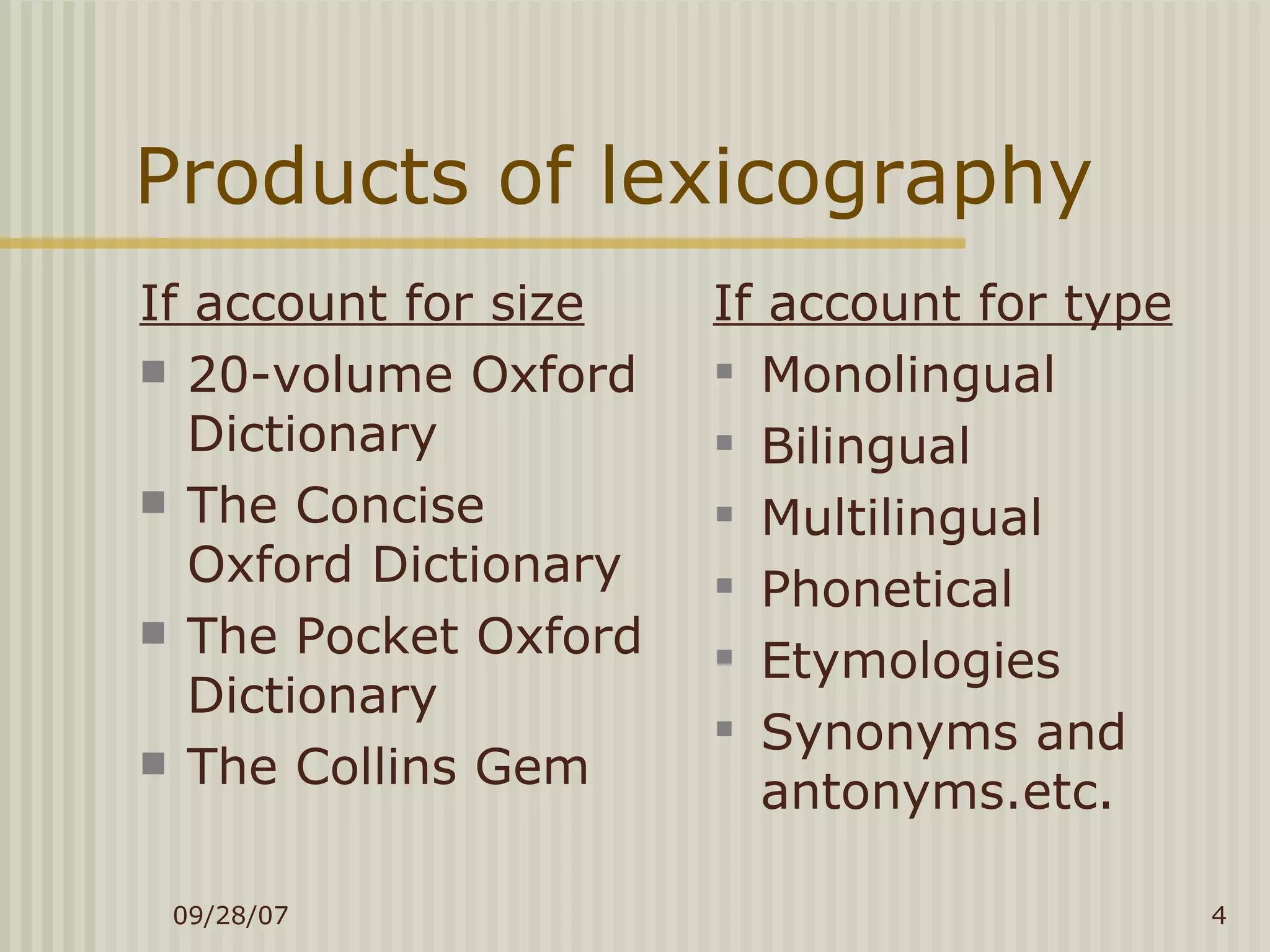
Products of lexicography If account for size 20-volume Oxford Dictionary The Concise Oxford Dictionary The Pocket Oxford Dictionary The Collins Gem If account for type Monolingual Bilingual Multilingual Phonetical Etymologies Synonyms and antonyms.etc.
The evolution of modern dictionaries. First English to English word list “ A Table Alphabeticall” by Robert Cawdrey  1603. It contained 2,500 words. By the 50´s of XVII Century  “Etylomologies”  were  Included in dictionaries as well
In 1700,  John Kersey   dares to add frequent  words in dictionaries. The gratest figure in English lexicography in  the XVIII was  Samuel Johnson. The gratest lexicographical effort ever made was  The  Oxford   English Dictionary.
Dictionaries in America Noah Webster  is the great pioneer in lexicography. His dictonary published in 1828 had the title  “An American Dictionary of the English Language”
English word formation Affixation. Compounding. Conversion. Other devices: reduplication, clipping, blending, acronyms.
Prefixation Characteristics of prefixes Generally they do not alter the word class of the base. The are normally written together with the base as a single word. Main stress falls normally on the base. They can be grouped according to their meaning.
Negative Prefixes “ un-”  unfair, unadorned, unfortunately. “ non-”  non-conformist, non-existent. “ in-”  invisible, illogical, impossible, irresponsible. “ a(n)-”  amoral, atheist. “ dis-”  disloyal, disobey, disfavour
Reversible Prefixes “ un-”  undo, undress, unhorse. “ de-”  defrost, depoliticize. “ dis-”  discouraging, disheartened,desinterested.
Pejorative Prefixes “ mis-”  mishear, misconduct, misleading, misrepresentation. “ mal-”  maltreat, malformed, malfunction. “ pseudo-”  pseudo-scientific,  pseudo- classicism.
Prefixes of degree and size “ arch-”  archduke, archenemy. “ super-”  supermarket, superman. “ out-”  outlive, outdo, outrun. “ sur-”  surcharge,  “ sub-”  subnormal, substandard. “ over-”/under-”  overdo, undertook “ hyper-/ultra-”  hypersensitive. “ mini-/macro-/micro-”  microwave.
Prefixes of attitude “ co-”  cooperative, cohabit, co-director, co-proprietor. “ counter-”  counter-espionage, counter-attack. “ anti-/pro-”  anti-nuclear, anti-democracy.
Locative Prefixes “ super-”  super-structure. “ sub-”  subway, subconscious, subdivide. “ inter-”  international, intermarry, interwave, interplay. “ trans-”  transatlantic, transplant.
Prefixes of time and order “ fore-”  foretell, foreman, forewarn. “ pre-/post-”  pre-historial, pre-marital. “ ex-”  ex-minister, ex-wife. “ re-”  rebuild, relocation, re-elegible.
Number Prefixes “ uni-/mono-”  monosyllable, unilateral. “ bi-/di-”  dichotomy, bifocal. “ multi-/poly-/pluri”  multiracial
Conversion prefixes “ be-”  bewigged, bewitch, bedazzle,    befriend ( a dog ). “ en-/em-”  endanger, empower. “ a-”  afloat.
To Summarize Negative Prefixes. Reversible Prefixes. Pejorative Prefixes. Prefixes of degree and size. Prefixes of attitude. Locative prefixes. Prefixes of time and order. Number Prefixes. Conversion Prefixes.
Suffixation Characteristics of suffixes. They normally alter the word type of the base. Suffixes rarely have a distinct meaning on their own. The change the word into which they are included into another part of speech. The can be classified according to the speech part they form, or according to the type of base the are added to.
Noun suffixes Occupational. “ -eer”  engineer, auctitioneer. “ -ster”  gangster, gamester, trickster. “ -er”  Londoner, banker
Noun Suffixes Diminutive and femenine. “ -let”  booklet, owlet, piglet. “ -ette”  cigarrette, kitchenette. “ -ess”  countess, hostess. “ -y”  Johnny, daddy, pussy
Noun Suffixes ( Abstract ) Status, domain, etc. “ -hood”  boyhood, brotherhood, flasehood, likelihood. “ -ship”  friendship, companionship “ -dom”,”-ocracy”, “-ery/-ry”.
Noun Suffixes Quantity. “ -ful”  handful, spoonful
Noun/adjective suffixes “ -ite”  Israelite, Rafaelite. “ -(i)an”  Shakespearian, Elizabethan. “ -ese”  Japanese. “ -ist”  novelist, violinist, typist. “ -ism”  Cummunism, Imperialistm.
De-verbal suffixes “ -er”  worker, onlooker, drinker. “ -ant”  inhabitant, occupant. “ -ation”  operation, exploration. “ -ment”  arrangement, argument. “ -al”  approval, refusal “ -ing”  swimming, living, painting, building. “ -age”  package, peerage, shortage. “ -ee”  trainee, employee.
De-adjectival suffixes “ -ness”  goodness, happiness, selfishness. “ -ity”/”-able”/”-ible”/”-al”  readable, readability, sentimental, sentimentality.
Verb suffixes “ -ify”  certify, identify. “ -ize”  scandalize, organise. “ -en”  blacken, sadden.
Adjective Suffixes “ -able”  readable, drinkable. “ -al”  chemical, criminal, special. “ -ful”  beautiful, plentiful. “ -ed”  blue-eyed, odd-shaped. “ -en”  wooden, leaden. “ -ic”  Germanic, specific. “ -ish”  foolish, boyish, snobbish. “ -less”  helpless, hopeless. “ -like”  friendly, child-like
Adverb suffixes “ -ly”  happily, freely, instantly. “ -wards”  onwards, eastwards. “ -wise”  clockwise.
To Summarize Suffixes Noun Suffixes. Noun/Adjective suffixes. De-verbal suffixes. De-adjectival suffixes. Verb suffixes. Adjective suffixes. Adverb suffixes.
Compounding. Oil paper Paperclip Paper aeroplane (to)wallpaper Wastepaper Wastepaper basket
Characteristics of compounds. The can be written together, (solid) separately or with a hyphen. Phonologically are identified as for having the main stress on the first element. blackbird   ´_____,_____ a species of bird. blackbird  _____ ´_____ a bird which is back They can consist of two or three words. sister-in-law, baby-sitter, air-conditioner.
Other compound nouns come from... Verb + Noun. pickpoket. Verb + Verb. make-belive. Adjective + Noun. fast-food. Particle + Noun overkill. Adverb + Noun. new generation Verb + Particle press down Phrase compounds Whisky and soda
Groups of compound nouns. Compound nouns can be countable, uncountable, singular or plural and grouped like that.
Common countable compound nouns. Address book Air conditioner Air raid Baby-sitter Bank account Brother-in-law Bus-stop Can opener Heart attack High school Human being Letter-box Passer-by Pen-friend Polar bear Police station.
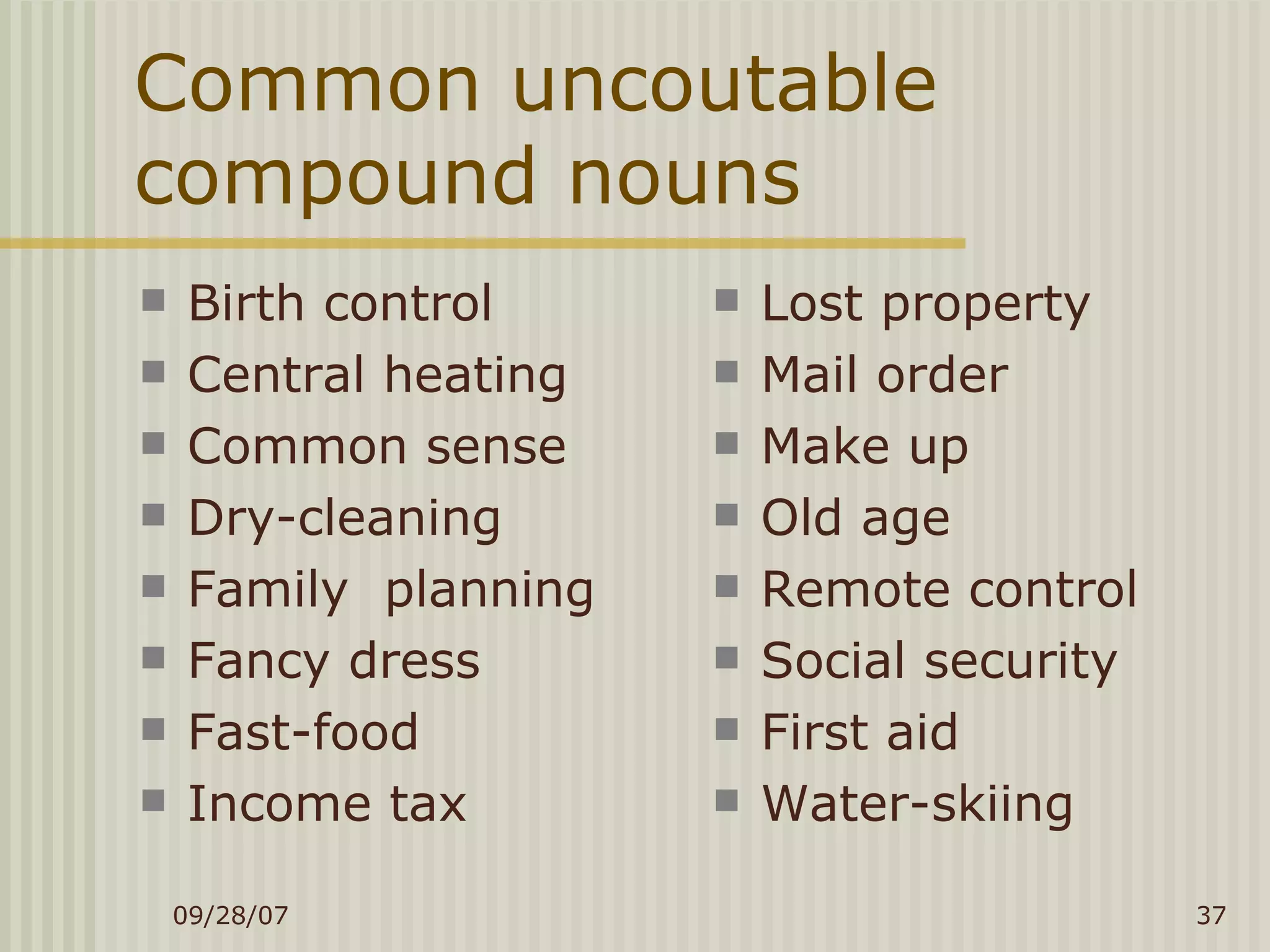
Common uncoutable compound nouns Birth control Central heating Common sense Dry-cleaning Family  planning Fancy dress Fast-food Income tax Lost property Mail order Make up Old age Remote control Social security First aid Water-skiing
Common singular compound nouns Cost of living Fire brigade Generation gap Human race Mother-tongue Public sector Solar system Welfare state.
Common plural compound nouns. Armed forces Civil rights High heels Human rights Luxury goods Road works Social services Winter sports Yellow pages
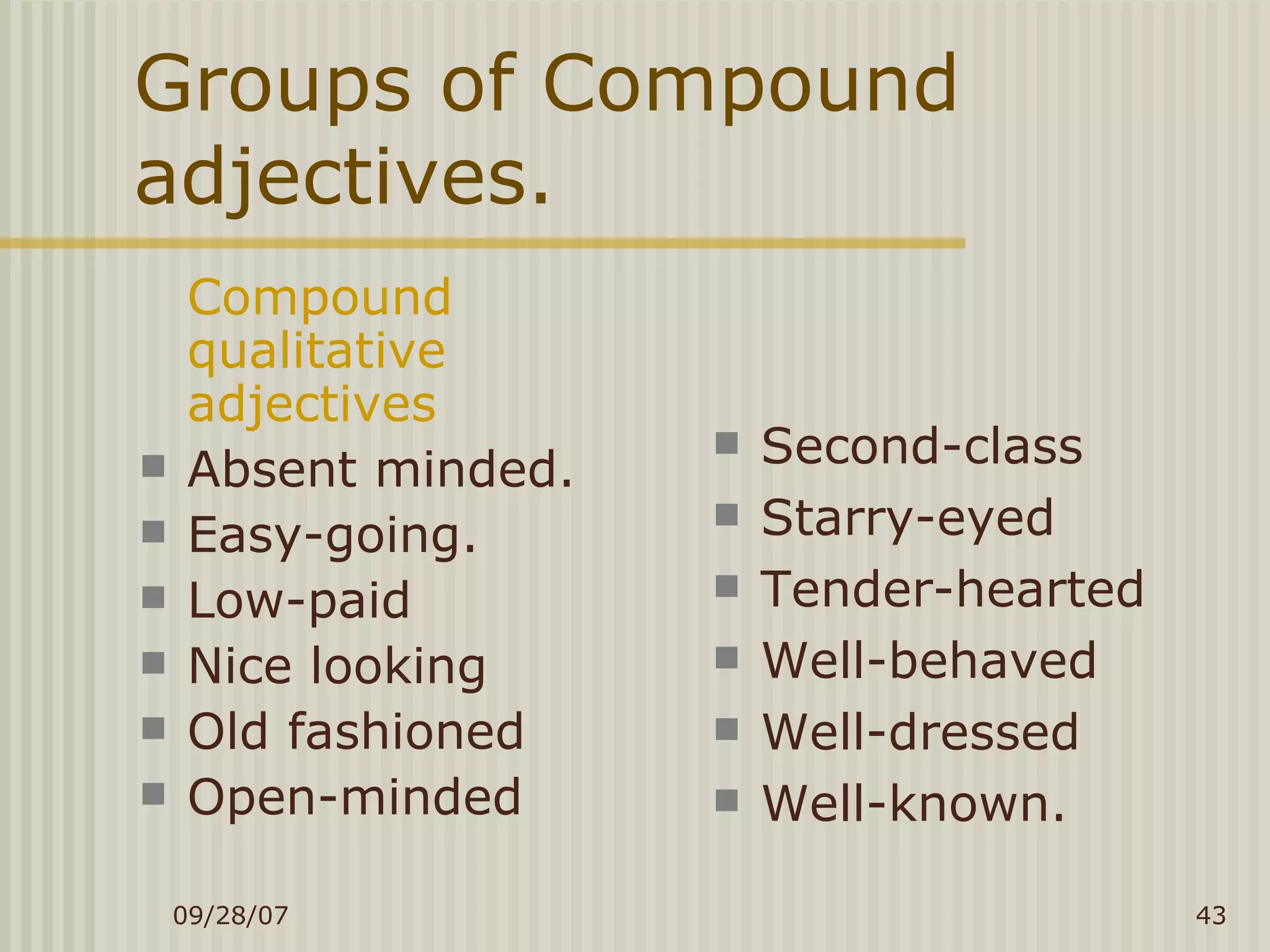
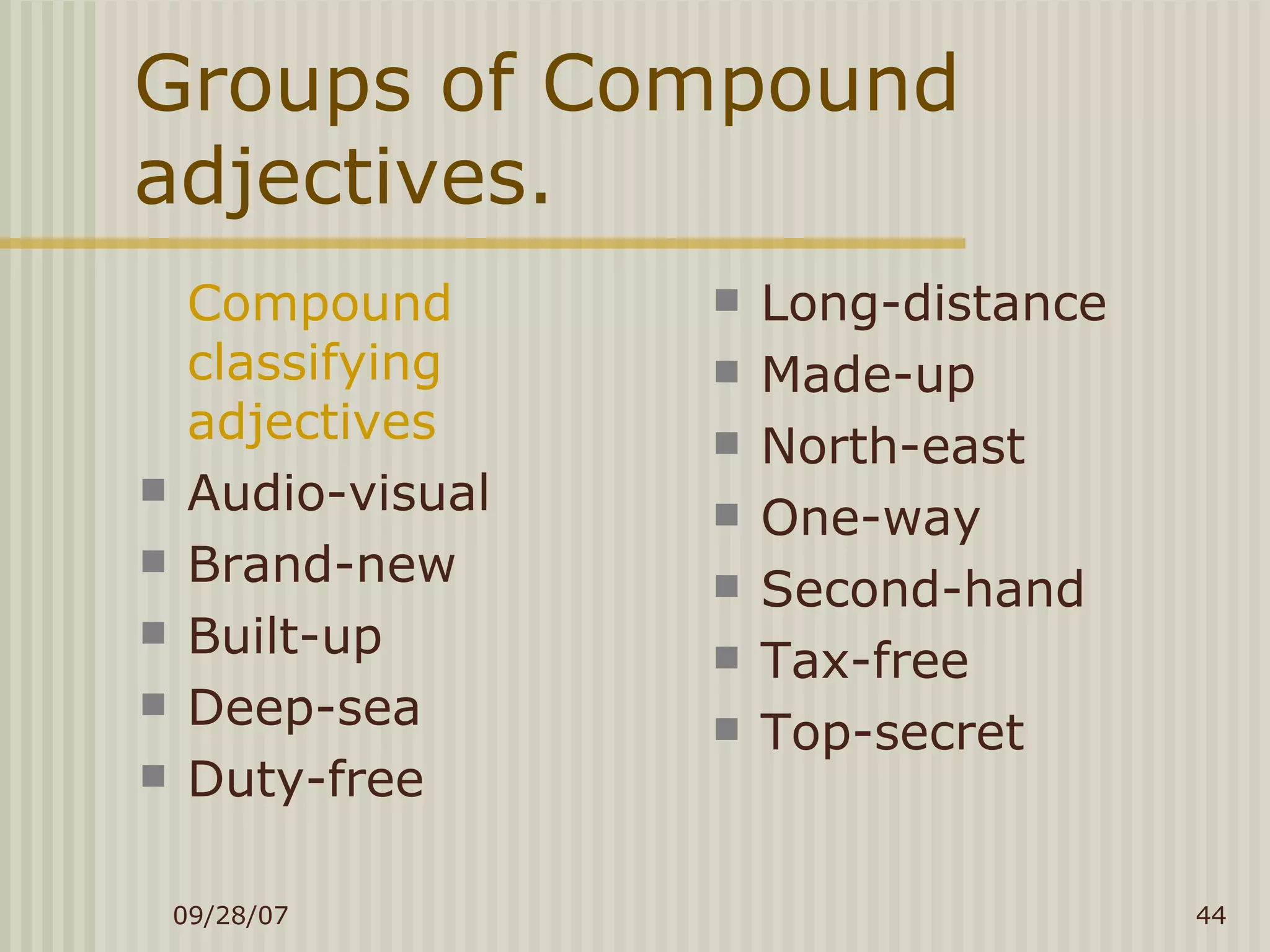
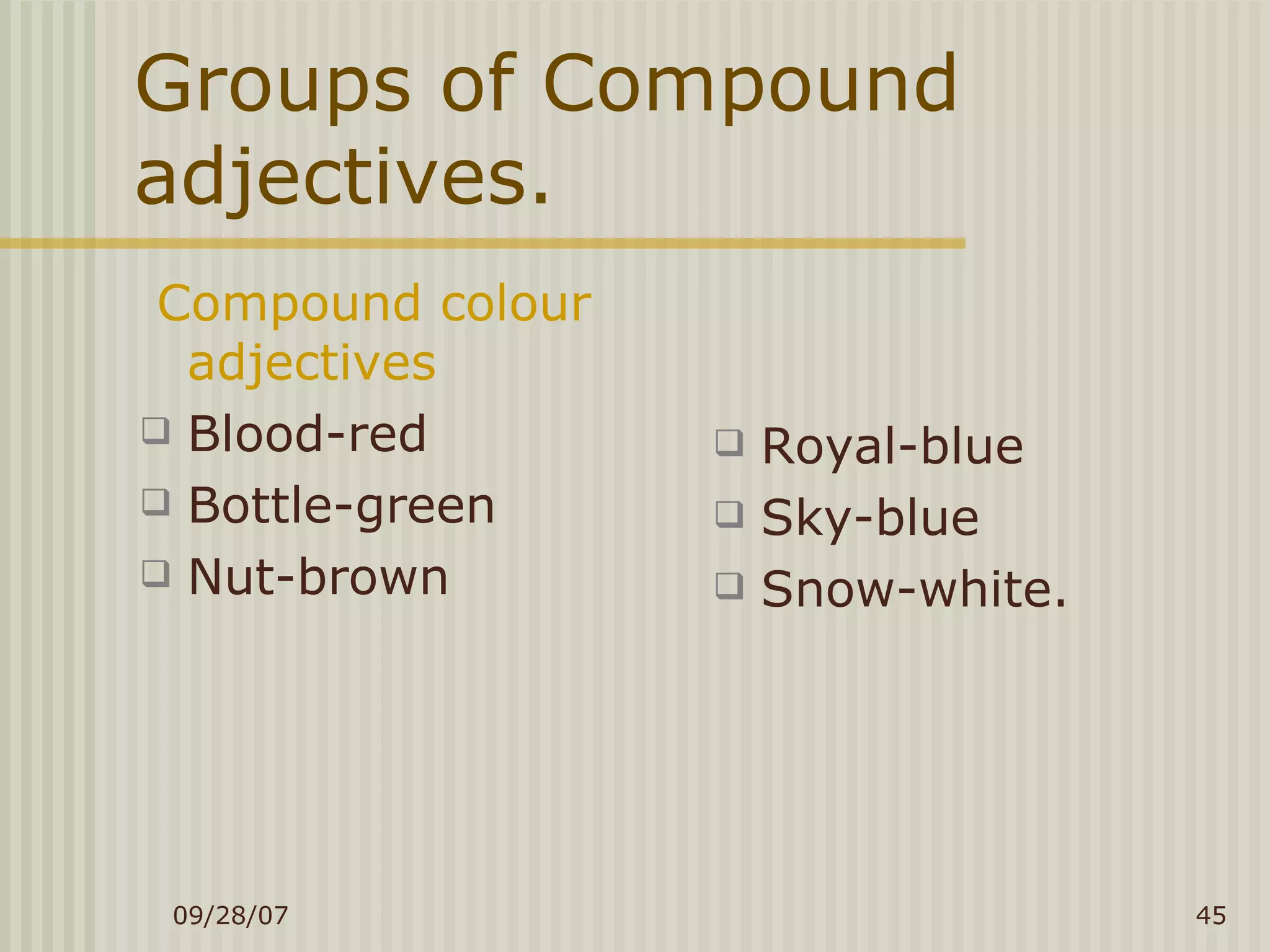
Compound adjectives. They are made up of two or more words, usually written with hyphens between them. They may be  qualitative classifying or colour adjectives.
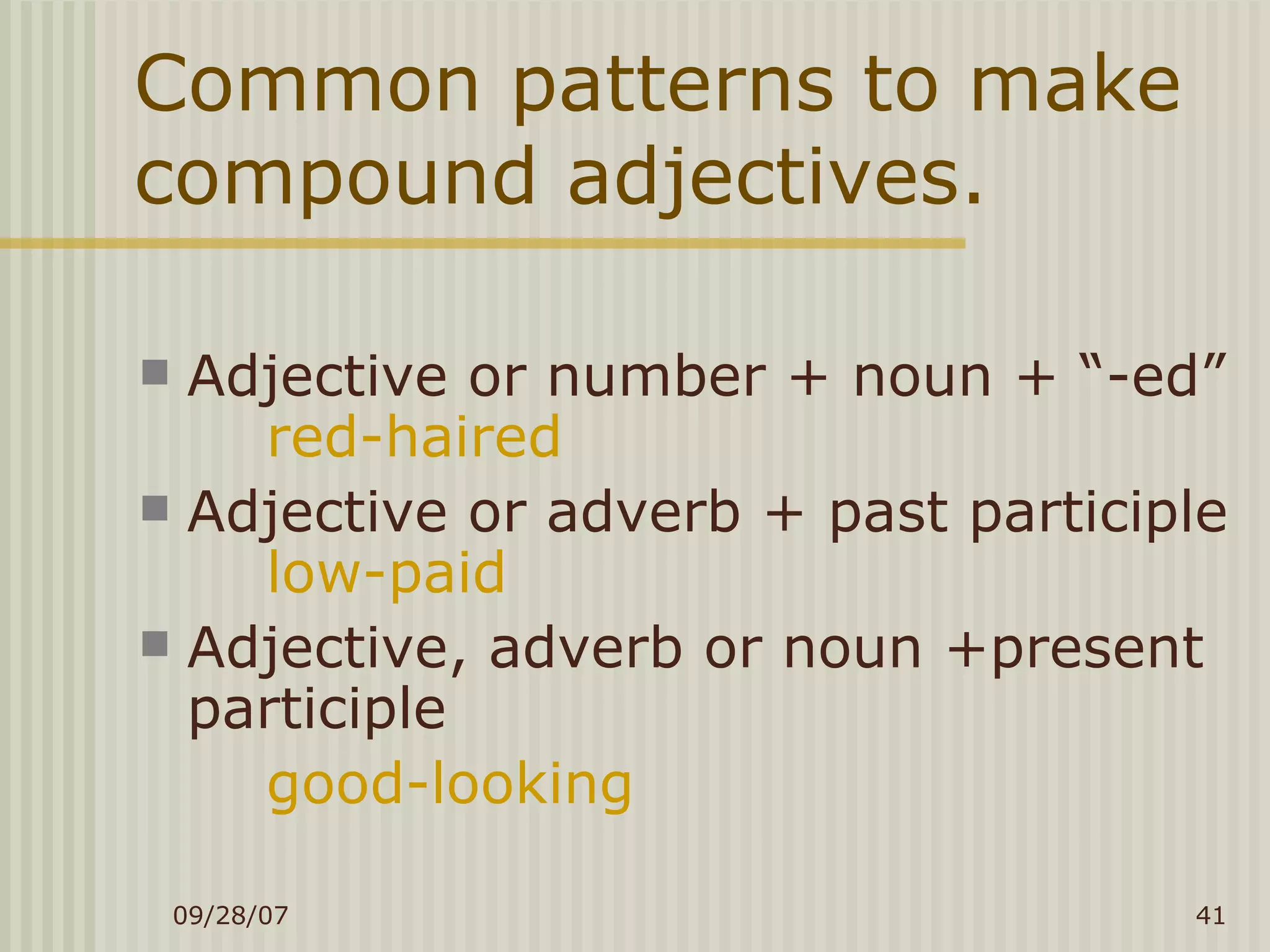
Common patterns to make compound adjectives. Adjective or number + noun + “-ed” red-haired Adjective or adverb + past participle low-paid Adjective, adverb or noun +present participle good-looking
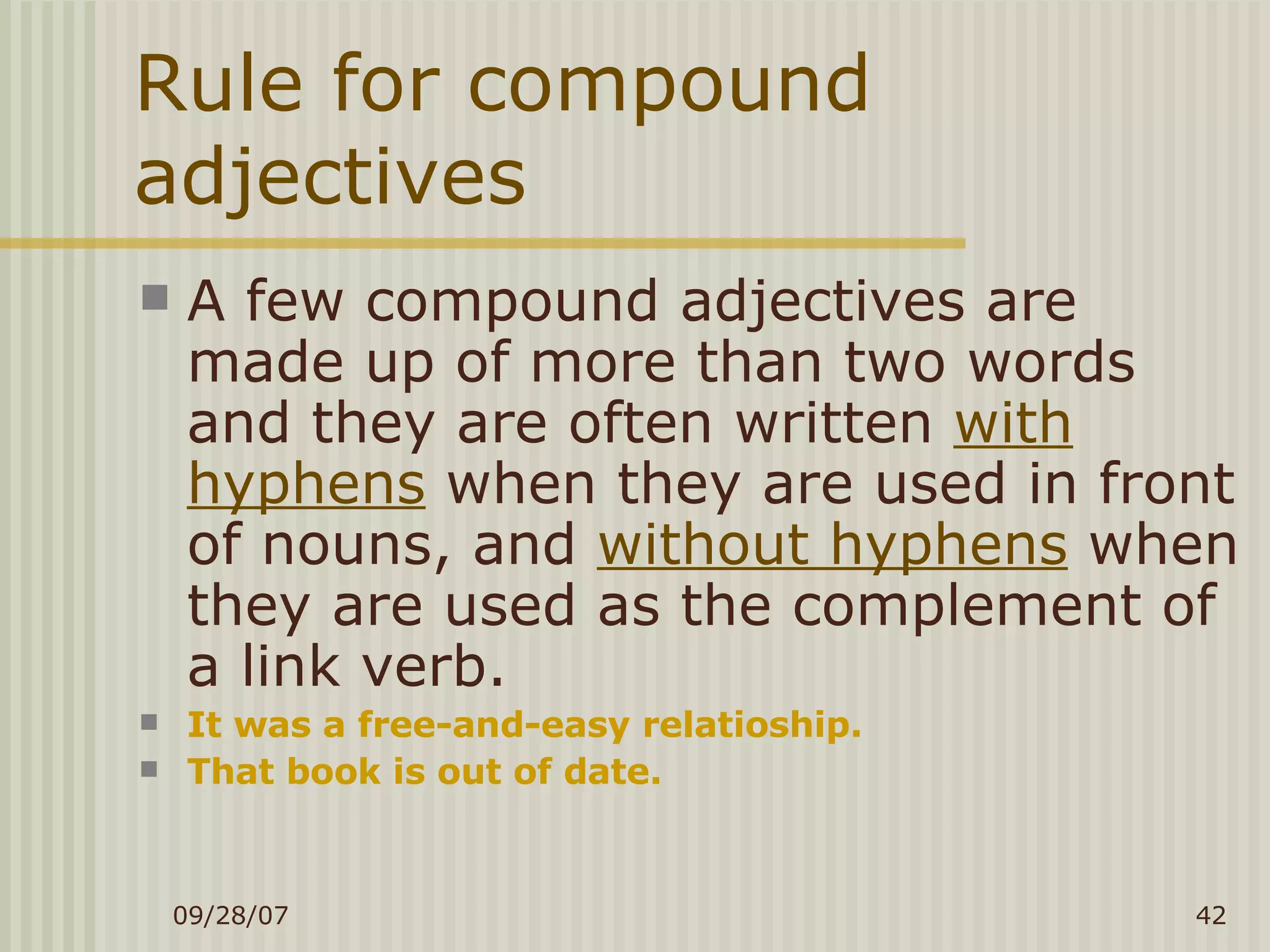
Rule for compound adjectives A few compound adjectives are made up of more than two words and they are often written  with hyphens  when they are used in front of nouns, and  without hyphens  when they are used as the complement of a link verb. It was a free-and-easy relatioship. That book is out of date.
Groups of Compound adjectives. Compound qualitative adjectives Absent minded. Easy-going. Low-paid Nice looking Old fashioned Open-minded Second-class Starry-eyed Tender-hearted Well-behaved Well-dressed Well-known.
Groups of Compound adjectives. Compound classifying adjectives Audio-visual Brand-new Built-up Deep-sea Duty-free Long-distance Made-up North-east One-way Second-hand Tax-free Top-secret
Groups of Compound adjectives. Compound colour adjectives Blood-red Bottle-green Nut-brown Royal-blue Sky-blue Snow-white.
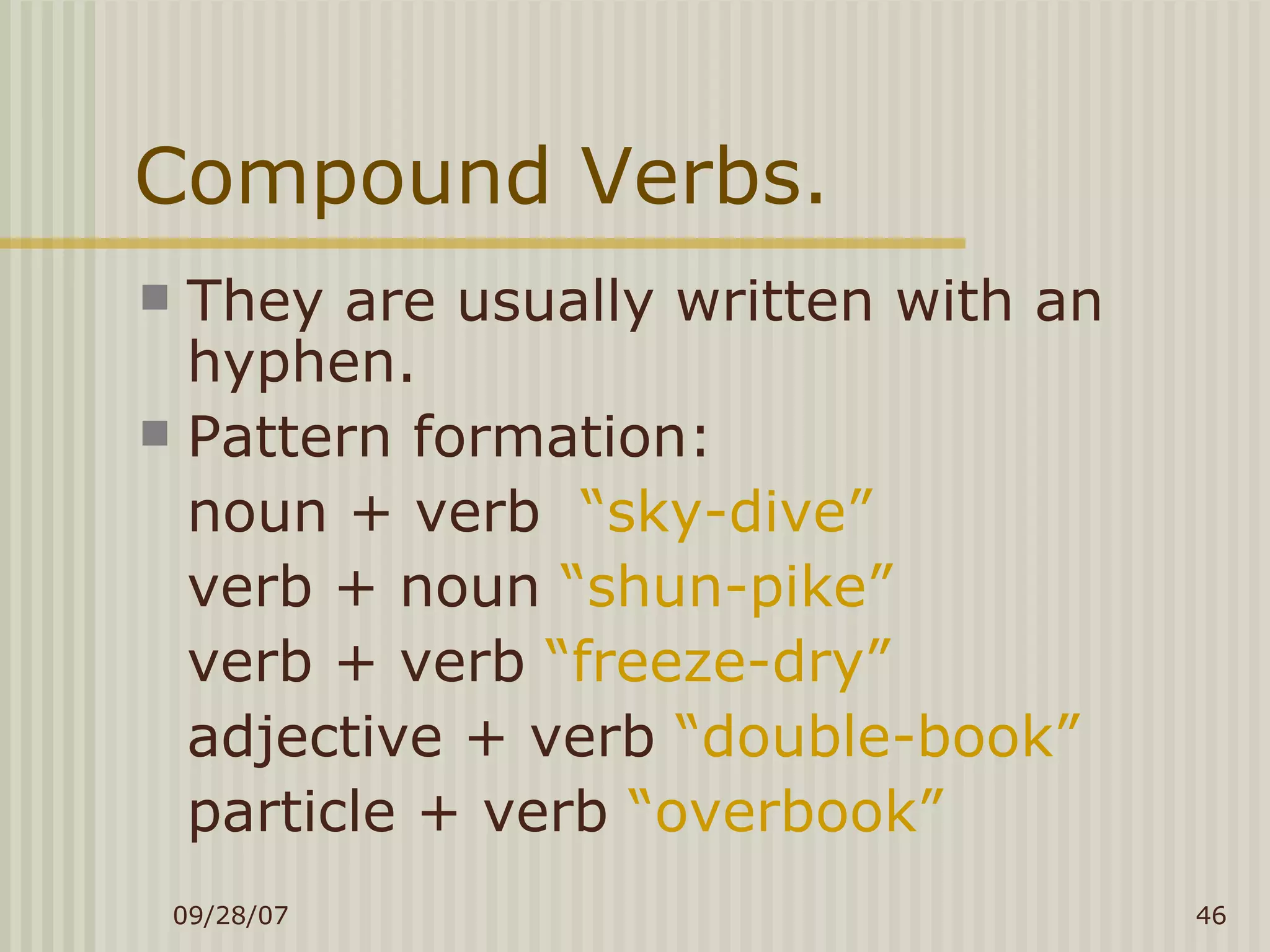
Compound Verbs. They are usually written with an hyphen. Pattern formation: noun + verb  “sky-dive” verb + noun  “shun-pike” verb + verb  “freeze-dry” adjective + verb  “double-book” particle + verb  “overbook”
Groups of compound verbs Intransitive compound verbs: Baby-sit hitch-hike Ice-skate roller-skate Water-ski window-shop Transitive  compound verbs: Back-comb ill-treat Dry-clean tape record Compound verbs used in transitive or intransitive  clauses: Bottle-feed sight-read Mass-produce spring-clean Shrt-circuit tie-dye

Word Formation in English

  • 1.
    Lexicon. Characteristics ofword formation in English. Prefixation, suffixation and compounding . Unit 10
  • 2.
    1. Lexicon 1.1.Lexicography. 1.2.The Evolution of the modern dictionary.
  • 3.
    Types of LexicographyAlphabetical lexicography Thematic Lexicography
  • 4.
    Products of lexicographyIf account for size 20-volume Oxford Dictionary The Concise Oxford Dictionary The Pocket Oxford Dictionary The Collins Gem If account for type Monolingual Bilingual Multilingual Phonetical Etymologies Synonyms and antonyms.etc.
  • 5.
    The evolution ofmodern dictionaries. First English to English word list “ A Table Alphabeticall” by Robert Cawdrey 1603. It contained 2,500 words. By the 50´s of XVII Century “Etylomologies” were Included in dictionaries as well
  • 6.
    In 1700, John Kersey dares to add frequent words in dictionaries. The gratest figure in English lexicography in the XVIII was Samuel Johnson. The gratest lexicographical effort ever made was The Oxford English Dictionary.
  • 7.
    Dictionaries in AmericaNoah Webster is the great pioneer in lexicography. His dictonary published in 1828 had the title “An American Dictionary of the English Language”
  • 8.
    English word formationAffixation. Compounding. Conversion. Other devices: reduplication, clipping, blending, acronyms.
  • 9.
    Prefixation Characteristics ofprefixes Generally they do not alter the word class of the base. The are normally written together with the base as a single word. Main stress falls normally on the base. They can be grouped according to their meaning.
  • 10.
    Negative Prefixes “un-” unfair, unadorned, unfortunately. “ non-” non-conformist, non-existent. “ in-” invisible, illogical, impossible, irresponsible. “ a(n)-” amoral, atheist. “ dis-” disloyal, disobey, disfavour
  • 11.
    Reversible Prefixes “un-” undo, undress, unhorse. “ de-” defrost, depoliticize. “ dis-” discouraging, disheartened,desinterested.
  • 12.
    Pejorative Prefixes “mis-” mishear, misconduct, misleading, misrepresentation. “ mal-” maltreat, malformed, malfunction. “ pseudo-” pseudo-scientific, pseudo- classicism.
  • 13.
    Prefixes of degreeand size “ arch-” archduke, archenemy. “ super-” supermarket, superman. “ out-” outlive, outdo, outrun. “ sur-” surcharge, “ sub-” subnormal, substandard. “ over-”/under-” overdo, undertook “ hyper-/ultra-” hypersensitive. “ mini-/macro-/micro-” microwave.
  • 14.
    Prefixes of attitude“ co-” cooperative, cohabit, co-director, co-proprietor. “ counter-” counter-espionage, counter-attack. “ anti-/pro-” anti-nuclear, anti-democracy.
  • 15.
    Locative Prefixes “super-” super-structure. “ sub-” subway, subconscious, subdivide. “ inter-” international, intermarry, interwave, interplay. “ trans-” transatlantic, transplant.
  • 16.
    Prefixes of timeand order “ fore-” foretell, foreman, forewarn. “ pre-/post-” pre-historial, pre-marital. “ ex-” ex-minister, ex-wife. “ re-” rebuild, relocation, re-elegible.
  • 17.
    Number Prefixes “uni-/mono-” monosyllable, unilateral. “ bi-/di-” dichotomy, bifocal. “ multi-/poly-/pluri” multiracial
  • 18.
    Conversion prefixes “be-” bewigged, bewitch, bedazzle, befriend ( a dog ). “ en-/em-” endanger, empower. “ a-” afloat.
  • 19.
    To Summarize NegativePrefixes. Reversible Prefixes. Pejorative Prefixes. Prefixes of degree and size. Prefixes of attitude. Locative prefixes. Prefixes of time and order. Number Prefixes. Conversion Prefixes.
  • 20.
    Suffixation Characteristics ofsuffixes. They normally alter the word type of the base. Suffixes rarely have a distinct meaning on their own. The change the word into which they are included into another part of speech. The can be classified according to the speech part they form, or according to the type of base the are added to.
  • 21.
    Noun suffixes Occupational.“ -eer” engineer, auctitioneer. “ -ster” gangster, gamester, trickster. “ -er” Londoner, banker
  • 22.
    Noun Suffixes Diminutiveand femenine. “ -let” booklet, owlet, piglet. “ -ette” cigarrette, kitchenette. “ -ess” countess, hostess. “ -y” Johnny, daddy, pussy
  • 23.
    Noun Suffixes (Abstract ) Status, domain, etc. “ -hood” boyhood, brotherhood, flasehood, likelihood. “ -ship” friendship, companionship “ -dom”,”-ocracy”, “-ery/-ry”.
  • 24.
    Noun Suffixes Quantity.“ -ful” handful, spoonful
  • 25.
    Noun/adjective suffixes “-ite” Israelite, Rafaelite. “ -(i)an” Shakespearian, Elizabethan. “ -ese” Japanese. “ -ist” novelist, violinist, typist. “ -ism” Cummunism, Imperialistm.
  • 26.
    De-verbal suffixes “-er” worker, onlooker, drinker. “ -ant” inhabitant, occupant. “ -ation” operation, exploration. “ -ment” arrangement, argument. “ -al” approval, refusal “ -ing” swimming, living, painting, building. “ -age” package, peerage, shortage. “ -ee” trainee, employee.
  • 27.
    De-adjectival suffixes “-ness” goodness, happiness, selfishness. “ -ity”/”-able”/”-ible”/”-al” readable, readability, sentimental, sentimentality.
  • 28.
    Verb suffixes “-ify” certify, identify. “ -ize” scandalize, organise. “ -en” blacken, sadden.
  • 29.
    Adjective Suffixes “-able” readable, drinkable. “ -al” chemical, criminal, special. “ -ful” beautiful, plentiful. “ -ed” blue-eyed, odd-shaped. “ -en” wooden, leaden. “ -ic” Germanic, specific. “ -ish” foolish, boyish, snobbish. “ -less” helpless, hopeless. “ -like” friendly, child-like
  • 30.
    Adverb suffixes “-ly” happily, freely, instantly. “ -wards” onwards, eastwards. “ -wise” clockwise.
  • 31.
    To Summarize SuffixesNoun Suffixes. Noun/Adjective suffixes. De-verbal suffixes. De-adjectival suffixes. Verb suffixes. Adjective suffixes. Adverb suffixes.
  • 32.
    Compounding. Oil paperPaperclip Paper aeroplane (to)wallpaper Wastepaper Wastepaper basket
  • 33.
    Characteristics of compounds.The can be written together, (solid) separately or with a hyphen. Phonologically are identified as for having the main stress on the first element. blackbird ´_____,_____ a species of bird. blackbird _____ ´_____ a bird which is back They can consist of two or three words. sister-in-law, baby-sitter, air-conditioner.
  • 34.
    Other compound nounscome from... Verb + Noun. pickpoket. Verb + Verb. make-belive. Adjective + Noun. fast-food. Particle + Noun overkill. Adverb + Noun. new generation Verb + Particle press down Phrase compounds Whisky and soda
  • 35.
    Groups of compoundnouns. Compound nouns can be countable, uncountable, singular or plural and grouped like that.
  • 36.
    Common countable compoundnouns. Address book Air conditioner Air raid Baby-sitter Bank account Brother-in-law Bus-stop Can opener Heart attack High school Human being Letter-box Passer-by Pen-friend Polar bear Police station.
  • 37.
    Common uncoutable compoundnouns Birth control Central heating Common sense Dry-cleaning Family planning Fancy dress Fast-food Income tax Lost property Mail order Make up Old age Remote control Social security First aid Water-skiing
  • 38.
    Common singular compoundnouns Cost of living Fire brigade Generation gap Human race Mother-tongue Public sector Solar system Welfare state.
  • 39.
    Common plural compoundnouns. Armed forces Civil rights High heels Human rights Luxury goods Road works Social services Winter sports Yellow pages
  • 40.
    Compound adjectives. Theyare made up of two or more words, usually written with hyphens between them. They may be qualitative classifying or colour adjectives.
  • 41.
    Common patterns tomake compound adjectives. Adjective or number + noun + “-ed” red-haired Adjective or adverb + past participle low-paid Adjective, adverb or noun +present participle good-looking
  • 42.
    Rule for compoundadjectives A few compound adjectives are made up of more than two words and they are often written with hyphens when they are used in front of nouns, and without hyphens when they are used as the complement of a link verb. It was a free-and-easy relatioship. That book is out of date.
  • 43.
    Groups of Compoundadjectives. Compound qualitative adjectives Absent minded. Easy-going. Low-paid Nice looking Old fashioned Open-minded Second-class Starry-eyed Tender-hearted Well-behaved Well-dressed Well-known.
  • 44.
    Groups of Compoundadjectives. Compound classifying adjectives Audio-visual Brand-new Built-up Deep-sea Duty-free Long-distance Made-up North-east One-way Second-hand Tax-free Top-secret
  • 45.
    Groups of Compoundadjectives. Compound colour adjectives Blood-red Bottle-green Nut-brown Royal-blue Sky-blue Snow-white.
  • 46.
    Compound Verbs. Theyare usually written with an hyphen. Pattern formation: noun + verb “sky-dive” verb + noun “shun-pike” verb + verb “freeze-dry” adjective + verb “double-book” particle + verb “overbook”
  • 47.
    Groups of compoundverbs Intransitive compound verbs: Baby-sit hitch-hike Ice-skate roller-skate Water-ski window-shop Transitive compound verbs: Back-comb ill-treat Dry-clean tape record Compound verbs used in transitive or intransitive clauses: Bottle-feed sight-read Mass-produce spring-clean Shrt-circuit tie-dye

Editor's Notes

  • #2 Word formation is of great interest for linguists as it sheds light on other aspects of language. There is not, though, no single “theory of word formation” The way words are constructed are interesting for linguists in the sense that it help them to classify the grammar group of words. Word formation process is a good indicator to trace back the most productive means of creating words within a language. Rinaissance and neoclacissicism have been vital for the borrowing of Latin and Greek affixes into English, especially when we talk about the fields of science, technology and medicine.