Dr. Mumux Mirani
M.P.T. Sports
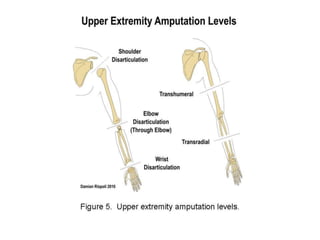
 Amputation - Removal of the limb through a
part of the bone.
 Or all of a limb
 Or some other outgrowth of the body.
 Disarticulation – removal of the limb through
the joint.
 Lower limb Amputation are more common than upper
limb amputation.
But,
 Upper limb amputation causes greater functional loss
because it is used more commonly.
Amputation → considered to be a
treatment of last resort when other methods like,
revascularization or reattachment have failed or
not suitable.
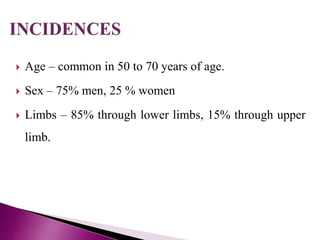
 Age – common in 50 to 70 years of age.
 Sex – 75% men, 25 % women
 Limbs – 85% through lower limbs, 15% through upper
limb.
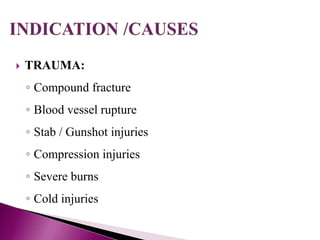
 TRAUMA:
◦ Compound fracture
◦ Blood vessel rupture
◦ Stab / Gunshot injuries
◦ Compression injuries
◦ Severe burns
◦ Cold injuries
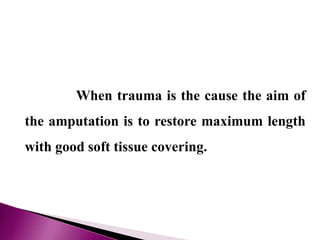
When trauma is the cause the aim of
the amputation is to restore maximum length
with good soft tissue covering.
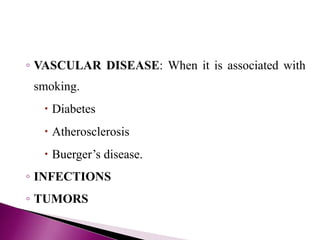
◦ VASCULAR DISEASE: When it is associated with
smoking.
 Diabetes
 Atherosclerosis
 Buerger’s disease.
◦ INFECTIONS
◦ TUMORS
 NEUROLOGICAL DISORDERS
◦ Anesthetic limb
◦ Eg. Complete plexus avulsion.
 CONGENITAL DEFORMITY:
◦ Partial / Full absence of limb
◦ Amputation for cosmetic reason.
 Eg. Extra digit.
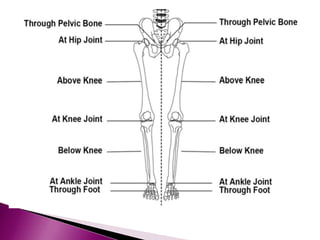
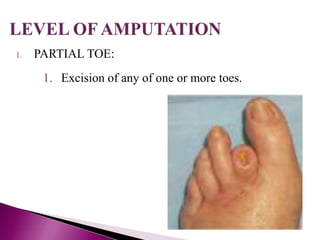
1. PARTIAL TOE:
1. Excision of any of one or more toes.
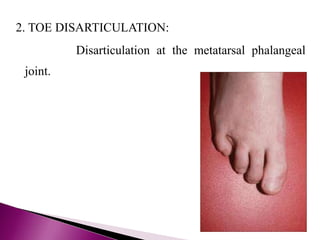
2. TOE DISARTICULATION:
Disarticulation at the metatarsal phalangeal
joint.
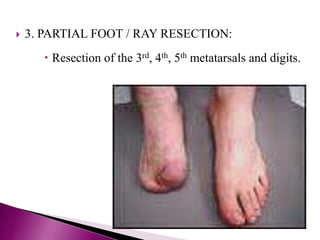
 3. PARTIAL FOOT / RAY RESECTION:
 Resection of the 3rd, 4th, 5th metatarsals and digits.
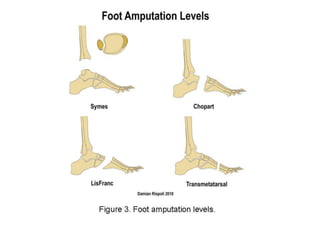
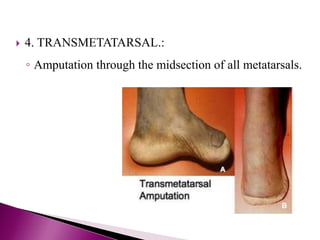
 4. TRANSMETATARSAL.:
◦ Amputation through the midsection of all metatarsals.
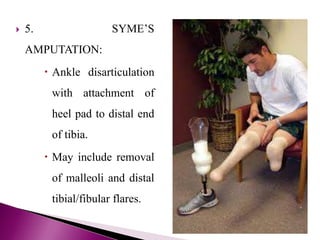
 5. SYME’S
AMPUTATION:
 Ankle disarticulation
with attachment of
heel pad to distal end
of tibia.
 May include removal
of malleoli and distal
tibial/fibular flares.
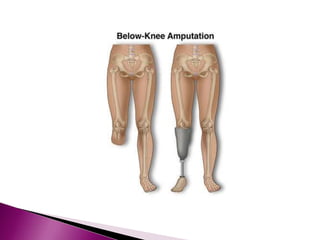
 6. LONG TRANSTIBIAL [BELOW KNEE]
 More than 50% tibial length.
 7. TRANSTIBIAL [BELOW KNEE]:
 Between 20 and 50% of tibial length.
 8. SHORT TRANSTIBIAL:
◦ Less than 20% tibial length.
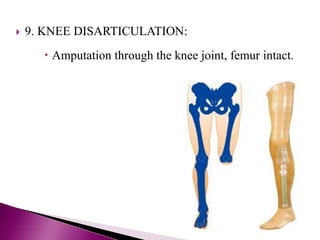
 9. KNEE DISARTICULATION:
 Amputation through the knee joint, femur intact.
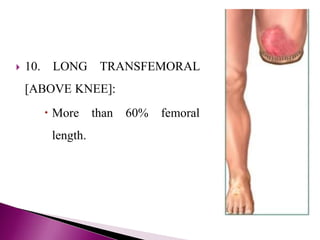
 10. LONG TRANSFEMORAL
[ABOVE KNEE]:
 More than 60% femoral
length.
 11. TRANSFEMORL [ABOVE KNEE]:
 Between 35 and 60% femoral length.
 12. SHORT TRANSFEMORAL [ABOVE KNEE]:
 Less than 35% femoral length.
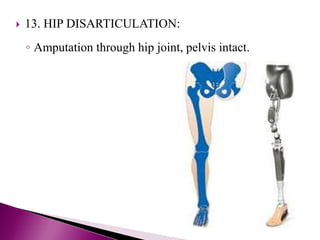
 13. HIP DISARTICULATION:
◦ Amputation through hip joint, pelvis intact.
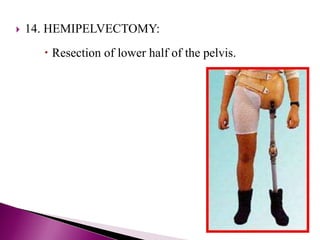
 14. HEMIPELVECTOMY:
 Resection of lower half of the pelvis.
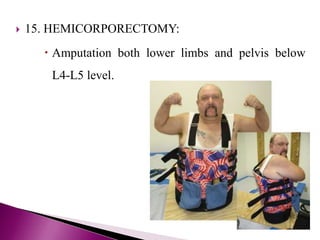
 15. HEMICORPORECTOMY:
 Amputation both lower limbs and pelvis below
L4-L5 level.
 Type of surgery depends upon the status of extremity at
the time of amputation.
 The surgeon must remove the part of the limb that must
be eliminated, allow for primary or secondary wound
healing.
 Construct the residual limb for optimal prosthetic fitting
and function.
 Conservation of residual limb length and uncomplicated
wound healing.
 Skin flaps are as broad as possible.
 Scar should be pliable, painless and non adherent.
 For transfemoral and transtibial amputation, equal
length anterior and posterior flaps are used, placing the
scar at the end of the bone.
 Long posterior flaps are often used in dysvascular
transtibial amputation because the posterior tissue have
a better blood supply than anterior skin.
 Care must be taken to ensure that the scar does not
become adherent to the bone.
 The skew flaps is an angular medial- lateral incision
that places the scar away from bony prominences, a
problem with the long posterior flaps.
 Stabilization of major muscles allows for maximum
retention of function.
 Muscle stabilization may be achieved by myofascial
closure, myoplasty, myodesis or tenodesis.
 In most transtibial and transfemoral amputation, a
combination of myoplasty [muscle to muscle closure]
and myofascial closure is used to ensure that the
muscles are properly stabilized and do not slide over the
end of the bone.
 Myodesis [muscle attached to periosteum or bone] is
employed particularly in transtibial amputations.
 Tenodesis [tendon attached to bone] may be used for
muscle stabilization.
 Severe peripheral nerves from neuromas [collection of
nerve bundles] in the residual limb.
 The neuroma must be well surrounded by soft tissue so
as not cause pain and interfere with prosthetic wear.
 Neuromas that form close to scar tissue or bone
generally cause pain and may require later resection or
revision.
 Hemostasis is achieved by ligating major veins and
arteries.
 Care must be taken not to compromise circulation to
distal tissues, particularly the skin flaps.
 Bones are sectioned at a length to allow wound closure
without excessive redundant tissue at the end of the
residual limb without placing incision under great
tension..
 Sharp bone are smoothed and rounded; in transtibial
amputation, the anterior portion of the distal tibia is
beveled to reduce the pressure between the end of the
bone and the prosthetic socket.
 Tissue layers are approximated under normal
physiological tension and incision is closed.
 In traumatic amputation, the surgeon attempts to save as
much bone length and viable skin as possible and
preserve proximal joints while providing for appropriate
healing of tissue without secondary complications such
as infection.
 In potentially “dirty” [involving foreign body]
amputations, the incision may be left open with the
proximal joint immobilized in a functional position for
5 to 9 days to prevent invasive infections.
 Secondary closure also allows the surgeon to shape the
residual limb appropriately for prosthetic rehabilitation.
 Infection : internal or external sources.
 Individual with contaminated wounds from injury,
infected foot ulcer or other causes are at greater risk of
infection.
 Smoking is a major deterrent to wound healing.
 Severity of the vascular problems
 Diabetes
 Renal disease
 Other physiological problems such as cardiac disease.
 It mainly includes,
 Post surgical cardiopulmonary and general
physiological function
 Ability to be mobile
 The condition of the remaining LE.
 Her feeling about the amputation
 Patient demographics
 Family and social data
 Preamputation status
 Work
 Activity level
 Independence
 Financial status
 Causes of amputation
◦ Disease
◦ Tumor
◦ Trauma
◦ Congenital
 Associated disease or symptoms:
◦ Neuropathy
◦ Visual disturbance
◦ Cardiopulmonary disease
◦ Renal failure
◦ Congenital anomalies.
 Skin examination:
◦ Scar [healed, adherent, invaginated , flat]
◦ Other lesions [size, shape, open, scar tissue]
◦ Moisture [moist, dry, scaly]
◦ Sensation [absent, diminished, hyperesthesia]
◦ Graft [location, type and healing]
◦ Dermatological lesions [psoriasis, eczema, cysts]
 Residual limb length:
◦ Bone length
 Transtibial limbs measured from medial tibial
plateau
 Transfemoral limbs measured from ischial
tuberosity or greater trochanter.
 Residual limb shape:
◦ Cylindrical
◦ Conical
◦ Bulbous end
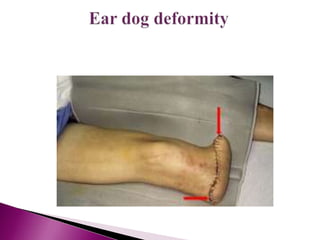
 Abnormalities :
◦ Dog ear
◦ Adductor roll
 Emotional status:
 Acceptance
 Body images
 Vascularity : [both limb if amputation cause is
vascularity]
◦ Pulses
 Femoral
 Popliteal
 Dorsalis pedis
 Posterior tibial
◦ Color : red or cyanotic
◦ Temperature
◦ Edema
 Circumference measurement
 Water displacement
◦ Pain
 Type
 Location
 Duration
 Intensity
◦ Trophic changes
 Range of Motion:
◦ Residual limb [Specific for remaining joints]
◦ Other lower extremity [gross for major joints]
 Muscle Strength:
◦ Residual limb [specific for major muscle group]
◦ Other extremities [gross for necessary function]
 Neurological:
 Pain
 Phantom pain
 Differentiate between sensation or pain
 Neuroma
 Incisional
 From other causes
 Functional Patient:
 Transfers [bed to chair, to toilet, to car]
 Mobility [necessary support, supervision]
 Home/ family situation, supervision, caregiver
 Activities of daily living [bathing , dressing]
 Instrumental activities of daily living [cooking,
cleaning]
 Circumference measurement of the residual limb are
taken as soon as the dressing will allow.
 Circumference measurement of the transtibial or symes
residual limb are started at the medial tibial plateau and
taken every 5 to 8 cm depending on the length of the
limb.
 Length of the residual limb is measured from the medial
tibial plateau to the end of the bone.
 For transfemoral circumference taken from the ischial
tuberosity or greater trochanter and taken every 8 to 10
cm.
 Length is measured from the ischial tuberosity or the
greater trochanter to the end of the bone.
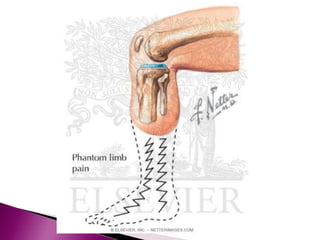
 Phantom is the sensation of the limb that is no longer
there.
 It occurs initially immediately after surgery and is
described as a tingling, numbness, itching or pressure
sensation.
 The distal part of the extremity is most frequently felt
although, on occasion, the person will feel the whole
extremity.
 The sensation is responsive to external stimuli such as
bandaging or rigid dressing; it may dissipate over time
or person may be have the sensation throughout life.
 It is important for the patient to understand that the
feeling is quite normal.
 It usually not interfere with prosthetic rehabilitation.
 It is important to differentiate phantom pain from non
painful phantom sensation, residual limb pain and non
residual limb pain.
 Phantom pain – cramping or squeezing sensation or
shooting or burning pain.
◦ It may be localized / diffuse
◦ May be continuous or intermittent and triggered by
some external stimuli.
 In the presence of trigger points, injection with steroids
or local anesthesia will reduce the pain temporarily.
 Non invasive pain such as,
◦ TENS
◦ Icing
◦ Ultrasound
◦ Massage
◦ Biofeedback
◦ Guided imagery
 Initial reaction to the loss of limb is usually grief and
depressive.
 If the amputation was traumatic, the immediate reaction
may include disbelief.
 Person may experience insomnia, restlessness, difficulty
in concentrating.
 In early stages, person’s grief may alternate with feeling
of hopelessness, despondency, bitterness and anger.
 Socially the patient may feel lonely, isolated and object
of pity.
 Long term adjustment depends to a great extent on,
 Individual’s basic personality
 Structure
 Sense of accomplishment
 Place in the family
 Community
 World
 Persons not fitted with a rigid dressing or a temporary
prosthesis use elastic wrap or shrinkers to reduce the
size of the residual limbs.
 Removable rigid dressing for use with transtibial
amputation are available and may be alternative to the
elastic wrap.
 Edema :
◦ Edema in the residual limb is often difficult to control
owing to complication of diabetes, cardiovascular
disease or hypertension.
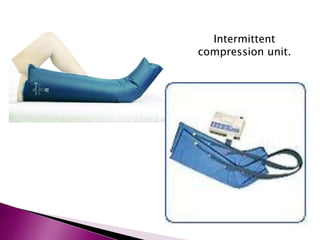
◦ Inntermittent compression unit also can be used to
reduce edema on the temporary basis.
Intermittent
compression unit.
 Transfemoral and transtibial sleeves are commercially
available.
 Proper hygiene and skin care are important.
 Once the incision is healed and sutures removed, the
person can bath normally.
 Residual limb must be kept clean and dry.
 Individual with dry skin may use good skin lotion.
 Care must be taken to avoid abrasions, cuts and other
skin problems.
 Friction massage in which layers of skin, subcutaneous
tissue can be used to prevent or mobilize the scar tissue.
 Massage is done gently after the wound is healed and
when no infection is present.
 It is also used to help decrease hypersensitivity of the
residual limb to touch and pressure.
 Patient is taught to inspect the residual limb with a hand
held mirror each night to make sure that there is no
sores or impending problems, especially in the area not
readily visible.
 If the person has diminished sensation, careful
inspection is important.
 Because the residual limb tends to become a bit
edematous after bathing as a reaction to the warm water,
nightly bathing is recommended. [this will help to
minimize swelling and allows the natural skin oils to be
replaced overnight ]
 The elastic bandage, shrinker or removable rigid
dressing is reapplied after bathing.
 Skin of the residual limb may be affected by variety of
dermatological problems such as eczema, psoriasis or
radiation burns.
 Treatment may includes,
 Ultraviolet irradiation
 Whirlpool bath
 Medication
 In case of dysvascular disease ultraviolet is used.
 The whirlpool bath not used as it increase circulation
and edema in the part under treatment.
 The advantage of whirlpool as a cleaning agent for skin
problems, infected wounds or incidence of delayed
healing must be balanced against its disadvantage.
 Patient tend to wrap their own residual limb in a
circular manner, often creating a tourniquet which may
compromise healing and may cause the development of
a bulbous end.
 An effective bandage should be,
◦ Smooth
◦ Wrinkle free
◦ Emphasizes angular turns
◦ Provides pressure distally
◦ Encourage proximal joint extension.
 The end of bandages are fastened with tape, safety pins
or Velcro rather than clips, which can cut the skin and
do not anchor well.
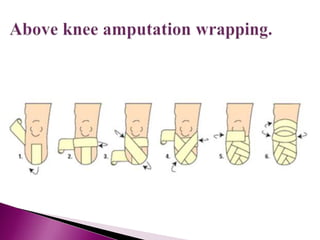
 A system of wrapping that uses mostly angular or figure
of eight turns.
 The transtibial Bandage:
 Two 4 inch bandages are usually enough to wrap
most transtibial residual limb.
 Very large residual limbs may require three
bandages.
 Elastic wrap does not provide as much as a rigid
dressing, the postsurgical edema must be reduced as
much as possible.
 Therefore a firm, even pressure against soft tissue is
desirable.
 First bandage is started at either the medial or lateral
tibial condyle.
 Brought diagonally over the anterior surface of the limb
to the distal end.
 The bandage is continued diagonally over the posterior
surface then back over the beginning turns as an anchor.
 At this point, there is a choice, the bandage may be
brought directly over the beginning point as indicated or
it may be brought across the front of the residual limb
in an X design.
 Second bandage is wrapped like the first, except that it
is started at the opposite tibial condyle from first
bandage.
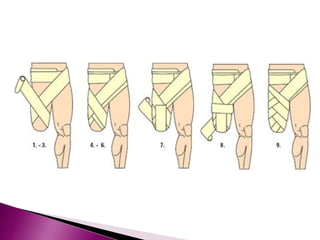
 The Transfemoral Bandage:
 For most residual limbs two 6 inch and one 4 inch
bandage can be used together end to end taking care
not to create a heavy seam.
 The 6 inch bandages are used first.
 The first bandage is started in the groin and brought
diagonally over the anterior surface to the distal
lateral corner, around the end of the residual limb.
◦ Diagonally up the posterior side to the iliac crest and
around the hips in a spica..
◦ The bandage is started medially so that the hip wrap
[spica] will encourage extension.
◦ The second 6 inch bandage is wrapped like a first but
is started a bit more laterally.
◦ Any areas not covered with the first bandage must be
covered at this time.
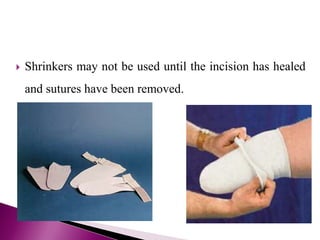
 The transtibial shrinker is rolled over the residual limb
to mid thigh and is designed to be self suspending.
 Shrinkers are easier to apply than elastic bandage and
may be better alternatives.
 Specially for transfemoral residual limb.
 Shrinkers are more expensive to use than elastic wrap.
 Initial cost is greater, then new shrinkers of small size
must to be purchased as the limb volume decresed.
 Shrinkers may not be used until the incision has healed
and sutures have been removed.
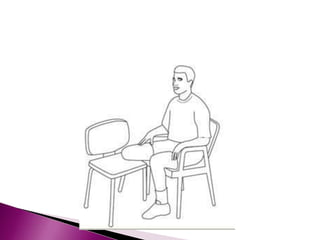
 Most deterrent to functional prosthetic rehabilitation is
contracture of the hip and knee.
 Contracture can develop as a result of,
◦ Muscle imbalance or fascial tightness
◦ Loss of plantar stimulation in extension
◦ Faulty positioning.
◦ Prolonged sitting
◦ Placing residual limb on pillow.
Patient should understand the
importance of proper positioning and regular
exercise in preparing for eventual prosthetic fit and
ambulation.
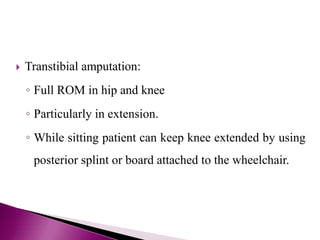
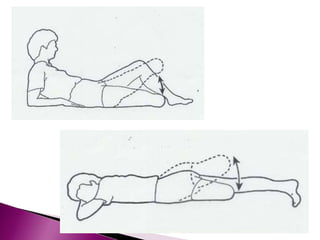
 Transtibial amputation:
◦ Full ROM in hip and knee
◦ Particularly in extension.
◦ While sitting patient can keep knee extended by using
posterior splint or board attached to the wheelchair.
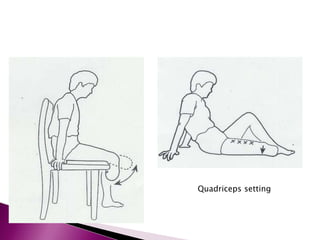
Quadriceps setting
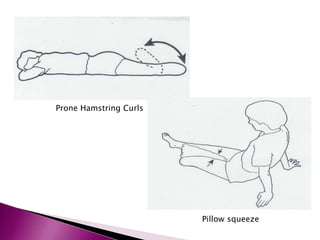
Prone Hamstring Curls
Pillow squeeze
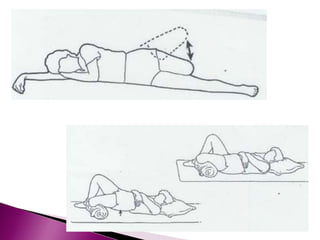
 Transfemoral amputation:
◦ Full ROM in the hip particularly in extension and
adduction.
◦ Prolonged sitting to be avoided.
◦ Some time each day should be spent in prone position.
◦ Elevation of transfemoral or transtibial residual limb
amputation can lead to development of hip flexion
contracture, that should be avoided.
 Mild contracture may respond to manual mobilization
and active exercise
 Moderate to severe contracture by manual stretching,
specially hip flexion contracture.
 Holding the extremity in a stretched position with
weight for considerable length of time.
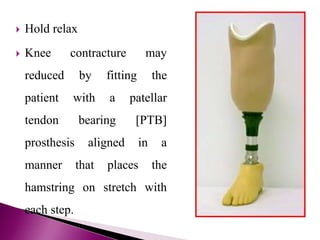
 Hold relax
 Knee contracture may
reduced by fitting the
patient with a patellar
tendon bearing [PTB]
prosthesis aligned in a
manner that places the
hamstring on stretch with
each step.
 It includes,
 Strengthening
 Balance
 Co-ordination activities