By:
Dr Bhaskar Borgohain
MBBS (AMC), MS Ortho (Delhi Univ.), DNB Ortho (NAMS),
AO Trauma Fellow, (Germany), Arthroplasty Fellow (Computer
Navigation)
Professor & HoD, Orthopaedics
NEIGRIHMS Shillong
www.neigrihms.gov.in
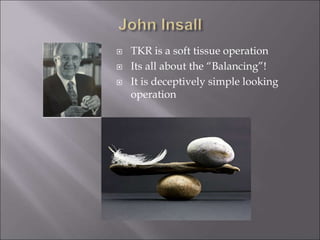
 TKR is a soft tissue operation
 Its all about the “Balancing”!
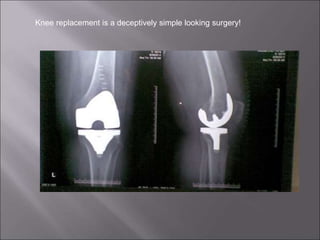
 It is deceptively simple looking
operation
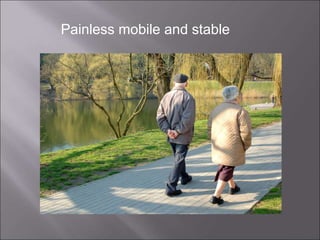
Painless mobile and stable
Knee replacement is a deceptively simple looking surgery!
 Knee is that largest joint in the body
 Hyaline type cartilage ends
 Femur & tibia are joined by a complex ligaments,
muscle-tendon units
 Patella: serves as a bony fulcrum for to slide over
and amplify strength and torque
 Complex hinge joint: Knee can not only bend and
flex, it can twist and rotate
 Total knee replacement (TKR) is one of the
most successful surgeries of modern time in
Orthopaedics.
 The goals of the surgery are complete pain
relief and improve function of the affected
joint.
 Deformity correction, increase bending of the
knee joint due to improved range of motion,
besides pain relief is also possible.
 The NEIGRIHMS orthopaedic department
started performing Total hip replacements
since 2007 and Total knee replacements since
2010.
 Since then, these state of the art surgeries are
being performed successfully and with
negligible infection rates.
 We do both cemented (traditional) as well as
cemmentless (advanced) total hip replacement
and time tested fixed bearing total knee
replacements.
 These surgeries are first of its kind in the state
of Meghalaya and some of these are performed
even for the very first time in North-East India.
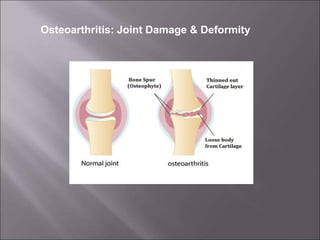
 Osteoarthritis causes pain, deformity and loss of
function.
 Usually done > 65 years so that single surgery serves
the lifetime of a person.
 TKR is indicated in advanced osteoarthritis of knee,
which can be primary or secondary to rheumatoid
arthritis, gout, post-traumatic degenerative arthritis
and rarely in painful but healed tubercular arthritis etc.
 TKR is indicated when the pain is severe enough to
affect the activities of daily living (ADL) significantly
requiring regular painkiller.
Osteoarthritis: Joint Damage & Deformity
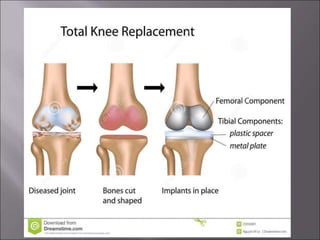
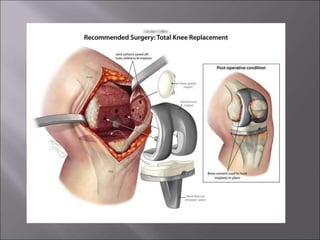
 Replace with appropriate sized metallic components.
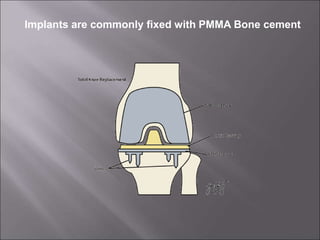
 The metallic implants are held secured to the bones
by using PMMA bone cement.
 The implants are metal alloys and a polyethylene
insert is inserted in-between the metals to reduce
friction during movements of walking.
 Tight ligaments are released to correct any deformity.
 Sometimes the undersurface of the patella also needs
replacement
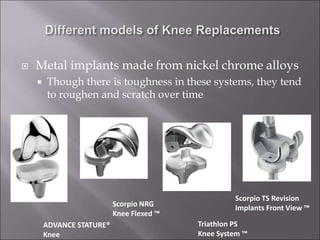
 Metal implants made from nickel chrome alloys
 Though there is toughness in these systems, they tend
to roughen and scratch over time
Scorpio NRG
Knee Flexed ™
Triathlon PS
Knee System ™
Scorpio TS Revision
Implants Front View ™
ADVANCE STATURE®
Knee
Implants are commonly fixed with PMMA Bone cement
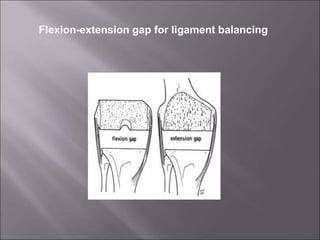
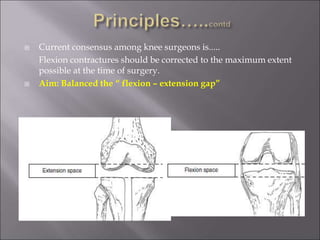
Flexion-extension gap for ligament balancing
 Current consensus among knee surgeons is.....
Flexion contractures should be corrected to the maximum extent
possible at the time of surgery.
 Aim: Balanced the “ flexion – extension gap”
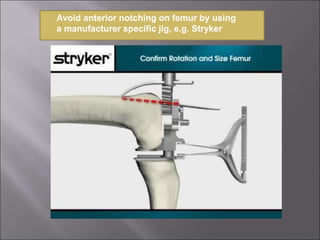
Avoid anterior notching on femur by using
a manufacturer specific jig, e.g. Stryker
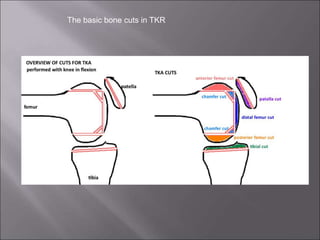
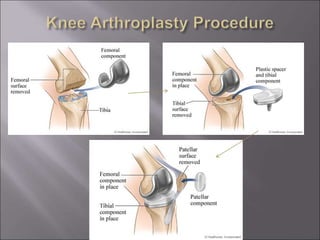
The basic bone cuts in TKR
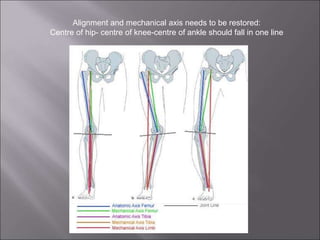
Alignment and mechanical axis needs to be restored:
Centre of hip- centre of knee-centre of ankle should fall in one line
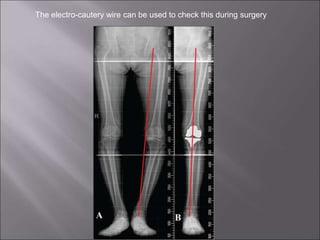
The electro-cautery wire can be used to check this during surgery
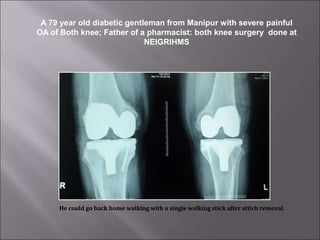
A 79 year old diabetic gentleman from Manipur with severe painful
OA of Both knee; Father of a pharmacist: both knee surgery done at
NEIGRIHMS
He could go back home walking with a single walking stick after stitch removal.
 The artificial components inserted into the knee are not
linked to each other
 Rely exclusively on the body’s muscles, ligaments, and
tendons to keep the kneecap in place.
 no stability built into the system.
 Most common type of replacement
 Many patients can walk a bit by second or third day
with support from the trained physiotherapist.
 Most patients have an uneventful post operative
period.
 But certain patients have a higher risk of post operative
wound complications like patients with diabetes
mellitus, rheumatoid arthritis, malnutrition and elderly
etc.
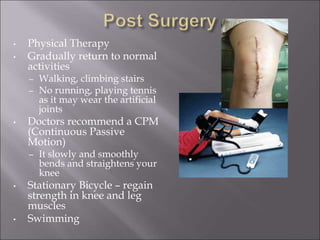
• Physical Therapy
• Gradually return to normal
activities
– Walking, climbing stairs
– No running, playing tennis
as it may wear the artificial
joints
• Doctors recommend a CPM
(Continuous Passive
Motion)
– It slowly and smoothly
bends and straightens your
knee
• Stationary Bicycle – regain
strength in knee and leg
muscles
• Swimming
 Early active quadriceps strengthening
 Aggressive full extension of knee
 3-4 sessions of stretching recommended/day as many of these
patients were accustomed to maintain the knee in a flexed
position prior to surgery.
 Discourage patient from putting pillow behind knee/ sitting in
reclined chairs
 Knee immobiliser/ night splints for those who lack extension,
obese patients and those who sleep in fetal position with knees
flexed
 Evaluation for ROM at 6 weeks, 3 months and 1 year – slow
progressers may require MUA
 Excellent post-op analgesia
• Used when the knee is highly unstable : the person's
ligaments unable to maintain stability
• Severely damaged knees
• The two metalic pieces are connected with a hinge-like
device that keeps the joint in-line & support proper
alignment for function.
– Though It doesn’t last as long as the other knee
replacements
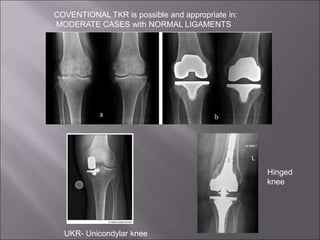
COVENTIONAL TKR is possible and appropriate in:
MODERATE CASES with NORMAL LIGAMENTS
UKR- Unicondylar knee
Hinged
knee
• Used when the knee is highly unstable : the person's
ligaments unable to maintain stability
• Severely damaged knees
• The two metalic pieces are connected with a hinge-like
device that keeps the joint in-line & support proper
alignment for function.
– Though It doesn’t last as long as the other knee
replacements
 It is performed if the damage is limited to one
side of the joint only with the remaining part of
the knee joint being relatively spared
 The incision is only three inches compared to 8
inches for a total knee replacement
 Less invasive and more successful
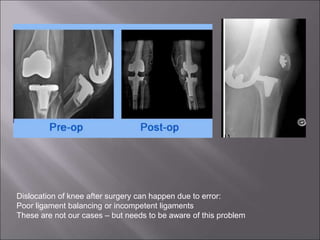
Dislocation of knee after surgery can happen due to error:
Poor ligament balancing or incompetent ligaments
These are not our cases – but needs to be aware of this problem
 postoperative infection
 With more awareness among people about TKR
number of patients is bound to increase
 Overall high cost of the implants / accessories until
recent NPPA Guidelines, only limited the number of
beneficiaries.
 With increasing coverage under various health
schemes like RANS / Government sponsored health
insurances, more and more elderly with painful
arthritis are likely to get benefits of TKR in the future.
 All OT staff, Nursing personnel in successfully
conducting successful surgeries
 Anesthesia team for their support
 Physiotherapy unit
 NEIGRIHMS Admin
 Faculty colleagues
 All SRDs, orthopaedics
Total Knee Replacement (TKR) in advanced arthritis

Total Knee Replacement (TKR) in advanced arthritis

  • 1.
    By: Dr Bhaskar Borgohain MBBS(AMC), MS Ortho (Delhi Univ.), DNB Ortho (NAMS), AO Trauma Fellow, (Germany), Arthroplasty Fellow (Computer Navigation) Professor & HoD, Orthopaedics NEIGRIHMS Shillong www.neigrihms.gov.in
  • 2.
     TKR isa soft tissue operation  Its all about the “Balancing”!  It is deceptively simple looking operation
  • 3.
  • 4.
    Knee replacement isa deceptively simple looking surgery!
  • 5.
     Knee isthat largest joint in the body  Hyaline type cartilage ends  Femur & tibia are joined by a complex ligaments, muscle-tendon units  Patella: serves as a bony fulcrum for to slide over and amplify strength and torque  Complex hinge joint: Knee can not only bend and flex, it can twist and rotate
  • 6.
     Total kneereplacement (TKR) is one of the most successful surgeries of modern time in Orthopaedics.  The goals of the surgery are complete pain relief and improve function of the affected joint.  Deformity correction, increase bending of the knee joint due to improved range of motion, besides pain relief is also possible.
  • 7.
     The NEIGRIHMSorthopaedic department started performing Total hip replacements since 2007 and Total knee replacements since 2010.  Since then, these state of the art surgeries are being performed successfully and with negligible infection rates.
  • 8.
     We doboth cemented (traditional) as well as cemmentless (advanced) total hip replacement and time tested fixed bearing total knee replacements.  These surgeries are first of its kind in the state of Meghalaya and some of these are performed even for the very first time in North-East India.
  • 9.
     Osteoarthritis causespain, deformity and loss of function.  Usually done > 65 years so that single surgery serves the lifetime of a person.  TKR is indicated in advanced osteoarthritis of knee, which can be primary or secondary to rheumatoid arthritis, gout, post-traumatic degenerative arthritis and rarely in painful but healed tubercular arthritis etc.  TKR is indicated when the pain is severe enough to affect the activities of daily living (ADL) significantly requiring regular painkiller.
  • 10.
  • 11.
     Replace withappropriate sized metallic components.  The metallic implants are held secured to the bones by using PMMA bone cement.  The implants are metal alloys and a polyethylene insert is inserted in-between the metals to reduce friction during movements of walking.  Tight ligaments are released to correct any deformity.  Sometimes the undersurface of the patella also needs replacement

  • 13.
     Metal implantsmade from nickel chrome alloys  Though there is toughness in these systems, they tend to roughen and scratch over time Scorpio NRG Knee Flexed ™ Triathlon PS Knee System ™ Scorpio TS Revision Implants Front View ™ ADVANCE STATURE® Knee
  • 14.
    Implants are commonlyfixed with PMMA Bone cement
  • 15.
    Flexion-extension gap forligament balancing
  • 16.
     Current consensusamong knee surgeons is..... Flexion contractures should be corrected to the maximum extent possible at the time of surgery.  Aim: Balanced the “ flexion – extension gap”
  • 17.
    Avoid anterior notchingon femur by using a manufacturer specific jig, e.g. Stryker
  • 18.
    The basic bonecuts in TKR
  • 21.
    Alignment and mechanicalaxis needs to be restored: Centre of hip- centre of knee-centre of ankle should fall in one line
  • 22.
    The electro-cautery wirecan be used to check this during surgery
  • 24.
    A 79 yearold diabetic gentleman from Manipur with severe painful OA of Both knee; Father of a pharmacist: both knee surgery done at NEIGRIHMS He could go back home walking with a single walking stick after stitch removal.
  • 25.
     The artificialcomponents inserted into the knee are not linked to each other  Rely exclusively on the body’s muscles, ligaments, and tendons to keep the kneecap in place.  no stability built into the system.  Most common type of replacement
  • 26.
     Many patientscan walk a bit by second or third day with support from the trained physiotherapist.  Most patients have an uneventful post operative period.  But certain patients have a higher risk of post operative wound complications like patients with diabetes mellitus, rheumatoid arthritis, malnutrition and elderly etc.
  • 27.
    • Physical Therapy •Gradually return to normal activities – Walking, climbing stairs – No running, playing tennis as it may wear the artificial joints • Doctors recommend a CPM (Continuous Passive Motion) – It slowly and smoothly bends and straightens your knee • Stationary Bicycle – regain strength in knee and leg muscles • Swimming
  • 28.
     Early activequadriceps strengthening  Aggressive full extension of knee  3-4 sessions of stretching recommended/day as many of these patients were accustomed to maintain the knee in a flexed position prior to surgery.  Discourage patient from putting pillow behind knee/ sitting in reclined chairs  Knee immobiliser/ night splints for those who lack extension, obese patients and those who sleep in fetal position with knees flexed  Evaluation for ROM at 6 weeks, 3 months and 1 year – slow progressers may require MUA  Excellent post-op analgesia
  • 29.
    • Used whenthe knee is highly unstable : the person's ligaments unable to maintain stability • Severely damaged knees • The two metalic pieces are connected with a hinge-like device that keeps the joint in-line & support proper alignment for function. – Though It doesn’t last as long as the other knee replacements
  • 30.
    COVENTIONAL TKR ispossible and appropriate in: MODERATE CASES with NORMAL LIGAMENTS UKR- Unicondylar knee Hinged knee
  • 31.
    • Used whenthe knee is highly unstable : the person's ligaments unable to maintain stability • Severely damaged knees • The two metalic pieces are connected with a hinge-like device that keeps the joint in-line & support proper alignment for function. – Though It doesn’t last as long as the other knee replacements
  • 32.
     It isperformed if the damage is limited to one side of the joint only with the remaining part of the knee joint being relatively spared  The incision is only three inches compared to 8 inches for a total knee replacement  Less invasive and more successful
  • 33.
    Dislocation of kneeafter surgery can happen due to error: Poor ligament balancing or incompetent ligaments These are not our cases – but needs to be aware of this problem
  • 34.
     postoperative infection With more awareness among people about TKR number of patients is bound to increase  Overall high cost of the implants / accessories until recent NPPA Guidelines, only limited the number of beneficiaries.  With increasing coverage under various health schemes like RANS / Government sponsored health insurances, more and more elderly with painful arthritis are likely to get benefits of TKR in the future.
  • 35.
     All OTstaff, Nursing personnel in successfully conducting successful surgeries  Anesthesia team for their support  Physiotherapy unit  NEIGRIHMS Admin  Faculty colleagues  All SRDs, orthopaedics