AMPUTATION
PRESENTED BY :
MRS,RAMYA.V,
TUTOR.
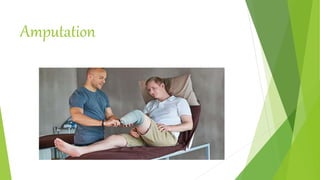
Amputation
Amputation
Amputation is the removal of a body
part, often a digit or limb.
The consequences of vascular disease,
such as diabetes ,accounts for 54% of
amputations, and trauma accounts for
45% of amputations.
CAUSES
 Traumatic injury such as motor vehicle accident (MVA) and
pedestrian injury (PI) are the main causes of amputation.
 Both MVA (amputation rate = 63.2%, OR = 2.1) and PI
(amputation rate = 40%, OR = 2.4) were highly associated with
amputation.

 Further more found that the most common cause of amputation
was trauma (70.3%), the second most common cause being
peripheral vascular disease.
 Lower limb amputation, more common than amputation at the
upper limb, accounted for 94.8% of all amputations.
AMPUTATION
 Amputation is used to relieve symptoms, to improve
function, and to save or improve the patient's quality of
life.
 If the health care team communicates a positive attitude,
the patient adjusts to the amputation more readily and
actively participates in the rehabilitative plan, learning
how to modify activities and how to use assistive
devices for ADLs and mobility.
Levels of Amputation
 Amputation is performed at the most distal point that
will heal successfully.
 The site and extent of amputation is determined by
circulation in the area (and whether or not necrosis is
present) and functional usefulness ( for the use of a
prosthesis).
 If the cause for amputation is dictated by the
requirement to fully excise the tumor .
Levels of Amputation
 The circulatory status of the limb is evaluated through
physical examination and diagnostic studies.
 Muscle and skin perfusion is important for healing.
 Doppler flow studies with duplex ultrasound segmental
blood pressure determinations, and transcutaneous
partial pressure of arterial Oxygen (Pa02) of the limb
are valuable diagnostic aids.
 Angiography is performed if revascularization is
considered an option.
Levels of Amputation
 The objective of surgery is to as much limb
length as needed to preserve function and
possibly to achieve a good prosthetic fit .
 Preservation of knee and elbow joints is
desirable .
 Most amputations involving limbs eventually can
be fitted a prosthesis.
Levels of Amputation
 The amputation of toes and portions of the foot can cause
changes in gait and balance.
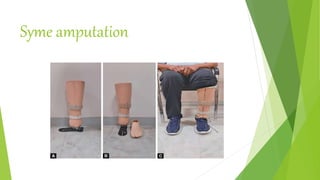
 A Syme amputation (modified ankle disarticulation amputation)
is performed most frequently for extensive foot trauma and aims
to produce a durable residual limb that can withstand full weight
bearing.
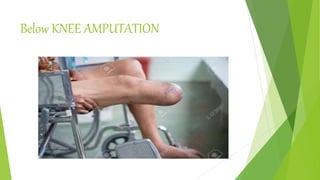
 Below-knee amputation (BKA) is preferred to above-knee
amputation (AKA) because of the importance of the knee joint
and the energy requirements for walking.
Syme amputation
Levels of Amputation
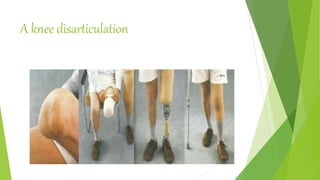
 A knee disarticulation (i.e., amputation through the
joint) is most successful with : young, active patient
who can develop precise control of the prosthesis.
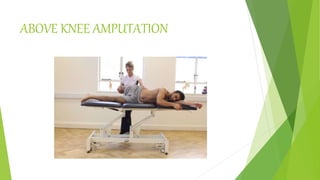
 When AKA are performed, all possible length is
preserved, muscles are stabilized and shaped, and hip
contractures are prevented to maximize ambulatory
potential.
 Most people who have a hip disarticulation amputation
must rely on a wheelchair for mobility
A knee disarticulation
ABOVE KNEE AMPUTATION
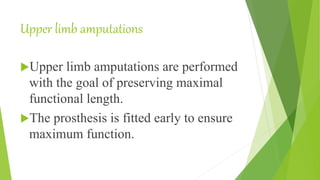
Upper limb amputations
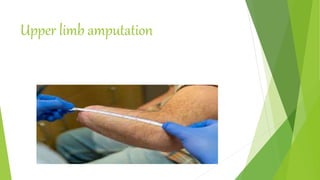
Upper limb amputations are performed
with the goal of preserving maximal
functional length.
The prosthesis is fitted early to ensure
maximum function.
Upper limb amputation
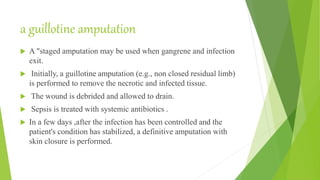
a guillotine amputation
 A "staged amputation may be used when gangrene and infection
exit.
 Initially, a guillotine amputation (e.g., non closed residual limb)
is performed to remove the necrotic and infected tissue.
 The wound is debrided and allowed to drain.
 Sepsis is treated with systemic antibiotics .
 In a few days ,after the infection has been controlled and the
patient's condition has stabilized, a definitive amputation with
skin closure is performed.
Below KNEE AMPUTATION
Complications
 Complications that may occur with amputation
Hemorrhage, infection, skin breakdown, phantom limb
pain, and joint contracture,.
 Because major blood vessels have been severed,
Hemorrhage may occur.
 Infection is a risk with all surgical procedures.
 The risk of infection increases with contaminated
wounds after traumatic amputation.

Complications
 Skin irritation caused by the prosthesis may result in
skin breakdown.
 Phantom limb pain (pain perceived in the amputated
section) is caused by the severing of peripheral nerves.
 Joint contracture is caused by positioning and a
protective flexion withdrawal pattern associated with
pain and muscle imbalance
Medical Management
 The objective of treatment is to achieve healing of the
amputation wound, the result being a non tender
residual limb with healthy skin for prosthetic use.
 Healing is enhanced by gentle handling of the residual
limb, control of residual limb edema through rigid or
soft compression dressings, and the use of aseptic
technique in wound care to avoid infection
Medical Management
A rigid cast dressing, removable rigid
dressing, or an elastic residual limb
shrinker that covers the residual limb may
be used to provide uniform compression, to
support soft tissues, to control pain and
edema, and to prevent joint contractures
Medical Management
 The rigid dressing is removed several days after surgery
for wound inspection and is then replaced to control
edema.
 However, edema is better controlled with semi-rigid
dressings for certain types of amputations
(e.g., transtibial ) and may facilitate earlier ambulation
and improved readiness for prosthesis .
 The dressing facilitates residual limb shaping.
Medical Management
 A soft dressing with or without compression may be
used if there is significant wound drainage and frequent
inspection of the residual limb is required.
 An immobilizing splint may be incorporated in the
dressing.
 Residual limb wound hematomas can be controlled
with wound drainage devices.
Rehabilitation
 The multidisciplinary rehabilitation team (patient, nurse,
physician, social worker, physical therapist,
occupational therapist, psychologist, prosthetist,
vocational rehabilitation worker) helps the patient
achieve the highest possible level of function and
participation in life activities .
 Prosthetic clinics and support groups for people with
amputations facilitate this rehabilitation process.
Rehabilitation
Patients who undergo amputation
need support as they grieve the loss
and change in body image.
 Their reactions can include anger,
bitterness, and hostility.
Rehabilitation
 Psychological issues (eg., denial, anxiety, avoidance)
may be influenced by the type of support the patient
receives from the rehabilitation team, the effectiveness
of pain management, and by how quickly ADLs and the
use of the prosthesis are learned.
 Knowing the full options and capabilities available with
the various prosthetic devices can give the patient a
sense of control over the resulting disability .
Rehabilitation
 Patients who require amputation because of severe
trauma can be young and healthy.
 These patients heal rapidly and are physically able to
participate in a vigorous rehabilitation program.
 Because the amputation is the result of an injury, the
patient needs psychological support in accepting the
sudden change in body image and in dealing with the
stresses of hospitalization, long-term rehabilitation, and
modification of lifestyle.
Rehabilitation
Many patients with amputations receive
prostheses soon after surgery and begin
learning how to use them with the help and
support of the rehabilitation team, which
includes nurses, physicians, physical
therapists, and others.
BIBLIOGRAPHY
 Brunner and Suddarth’s Textbook of Medical- Surgical Nursing
,South Asian
 Edition , Volume II , Published by Wolters Kluwer . Page reffered
to 1530- 1531
 https://www.slideshare.net/orthoprince/amputations-34251922
 https://www.slideshare.net/prkhuman/amputations-24685849
 https://www.slideshare.net/Vimscopt/amputation-93695801
Amputation.pptx

Amputation.pptx

  • 1.
  • 2.
  • 3.
    Amputation Amputation is theremoval of a body part, often a digit or limb. The consequences of vascular disease, such as diabetes ,accounts for 54% of amputations, and trauma accounts for 45% of amputations.
  • 4.
    CAUSES  Traumatic injurysuch as motor vehicle accident (MVA) and pedestrian injury (PI) are the main causes of amputation.  Both MVA (amputation rate = 63.2%, OR = 2.1) and PI (amputation rate = 40%, OR = 2.4) were highly associated with amputation.  Further more found that the most common cause of amputation was trauma (70.3%), the second most common cause being peripheral vascular disease.  Lower limb amputation, more common than amputation at the upper limb, accounted for 94.8% of all amputations.
  • 5.
    AMPUTATION  Amputation isused to relieve symptoms, to improve function, and to save or improve the patient's quality of life.  If the health care team communicates a positive attitude, the patient adjusts to the amputation more readily and actively participates in the rehabilitative plan, learning how to modify activities and how to use assistive devices for ADLs and mobility.
  • 6.
    Levels of Amputation Amputation is performed at the most distal point that will heal successfully.  The site and extent of amputation is determined by circulation in the area (and whether or not necrosis is present) and functional usefulness ( for the use of a prosthesis).  If the cause for amputation is dictated by the requirement to fully excise the tumor .
  • 7.
    Levels of Amputation The circulatory status of the limb is evaluated through physical examination and diagnostic studies.  Muscle and skin perfusion is important for healing.  Doppler flow studies with duplex ultrasound segmental blood pressure determinations, and transcutaneous partial pressure of arterial Oxygen (Pa02) of the limb are valuable diagnostic aids.  Angiography is performed if revascularization is considered an option.
  • 8.
    Levels of Amputation The objective of surgery is to as much limb length as needed to preserve function and possibly to achieve a good prosthetic fit .  Preservation of knee and elbow joints is desirable .  Most amputations involving limbs eventually can be fitted a prosthesis.
  • 9.
    Levels of Amputation The amputation of toes and portions of the foot can cause changes in gait and balance.  A Syme amputation (modified ankle disarticulation amputation) is performed most frequently for extensive foot trauma and aims to produce a durable residual limb that can withstand full weight bearing.  Below-knee amputation (BKA) is preferred to above-knee amputation (AKA) because of the importance of the knee joint and the energy requirements for walking.
  • 10.
  • 11.
    Levels of Amputation A knee disarticulation (i.e., amputation through the joint) is most successful with : young, active patient who can develop precise control of the prosthesis.  When AKA are performed, all possible length is preserved, muscles are stabilized and shaped, and hip contractures are prevented to maximize ambulatory potential.  Most people who have a hip disarticulation amputation must rely on a wheelchair for mobility
  • 12.
  • 13.
  • 14.
    Upper limb amputations Upperlimb amputations are performed with the goal of preserving maximal functional length. The prosthesis is fitted early to ensure maximum function.
  • 15.
  • 16.
    a guillotine amputation A "staged amputation may be used when gangrene and infection exit.  Initially, a guillotine amputation (e.g., non closed residual limb) is performed to remove the necrotic and infected tissue.  The wound is debrided and allowed to drain.  Sepsis is treated with systemic antibiotics .  In a few days ,after the infection has been controlled and the patient's condition has stabilized, a definitive amputation with skin closure is performed.
  • 17.
  • 18.
    Complications  Complications thatmay occur with amputation Hemorrhage, infection, skin breakdown, phantom limb pain, and joint contracture,.  Because major blood vessels have been severed, Hemorrhage may occur.  Infection is a risk with all surgical procedures.  The risk of infection increases with contaminated wounds after traumatic amputation.
  • 19.
    Complications  Skin irritationcaused by the prosthesis may result in skin breakdown.  Phantom limb pain (pain perceived in the amputated section) is caused by the severing of peripheral nerves.  Joint contracture is caused by positioning and a protective flexion withdrawal pattern associated with pain and muscle imbalance
  • 20.
    Medical Management  Theobjective of treatment is to achieve healing of the amputation wound, the result being a non tender residual limb with healthy skin for prosthetic use.  Healing is enhanced by gentle handling of the residual limb, control of residual limb edema through rigid or soft compression dressings, and the use of aseptic technique in wound care to avoid infection
  • 21.
    Medical Management A rigidcast dressing, removable rigid dressing, or an elastic residual limb shrinker that covers the residual limb may be used to provide uniform compression, to support soft tissues, to control pain and edema, and to prevent joint contractures
  • 22.
    Medical Management  Therigid dressing is removed several days after surgery for wound inspection and is then replaced to control edema.  However, edema is better controlled with semi-rigid dressings for certain types of amputations (e.g., transtibial ) and may facilitate earlier ambulation and improved readiness for prosthesis .  The dressing facilitates residual limb shaping.
  • 23.
    Medical Management  Asoft dressing with or without compression may be used if there is significant wound drainage and frequent inspection of the residual limb is required.  An immobilizing splint may be incorporated in the dressing.  Residual limb wound hematomas can be controlled with wound drainage devices.
  • 24.
    Rehabilitation  The multidisciplinaryrehabilitation team (patient, nurse, physician, social worker, physical therapist, occupational therapist, psychologist, prosthetist, vocational rehabilitation worker) helps the patient achieve the highest possible level of function and participation in life activities .  Prosthetic clinics and support groups for people with amputations facilitate this rehabilitation process.
  • 25.
    Rehabilitation Patients who undergoamputation need support as they grieve the loss and change in body image.  Their reactions can include anger, bitterness, and hostility.
  • 26.
    Rehabilitation  Psychological issues(eg., denial, anxiety, avoidance) may be influenced by the type of support the patient receives from the rehabilitation team, the effectiveness of pain management, and by how quickly ADLs and the use of the prosthesis are learned.  Knowing the full options and capabilities available with the various prosthetic devices can give the patient a sense of control over the resulting disability .
  • 27.
    Rehabilitation  Patients whorequire amputation because of severe trauma can be young and healthy.  These patients heal rapidly and are physically able to participate in a vigorous rehabilitation program.  Because the amputation is the result of an injury, the patient needs psychological support in accepting the sudden change in body image and in dealing with the stresses of hospitalization, long-term rehabilitation, and modification of lifestyle.
  • 28.
    Rehabilitation Many patients withamputations receive prostheses soon after surgery and begin learning how to use them with the help and support of the rehabilitation team, which includes nurses, physicians, physical therapists, and others.
  • 29.
    BIBLIOGRAPHY  Brunner andSuddarth’s Textbook of Medical- Surgical Nursing ,South Asian  Edition , Volume II , Published by Wolters Kluwer . Page reffered to 1530- 1531  https://www.slideshare.net/orthoprince/amputations-34251922  https://www.slideshare.net/prkhuman/amputations-24685849  https://www.slideshare.net/Vimscopt/amputation-93695801