OUTLINE
• Introduction
• History
•Epidemiology
• Aetiology
• Indication
• Types
• Surgical Techniques
• Signs and symptoms
• Investigations
• Post op management
• Complications
• Conclusion
3.
INTRODUCTION
• Amputation isthe surgical removal of a limb or a part of a
limb, usually as a result of injury, disease, or congenital
condition.
• It is a complex and multifaceted surgical procedure that
requires careful consideration of indications, surgical
techniques, and postoperative care.
• It could also be the severance of a limb or part of a limb
through a bone or multiple bones
• The removal of a whole limb or part of a limb through a
joint is called Disarticulation.
4.
HISTORY
• Amputation isderived from the latin word
"amputare" which means cutting around.
• The English word "amputation" was first applied to
surgery in the 17th century.
• Amputation has been performed for thousands of
years, with evidence of ancient civilizations such as
the Egyptians and Greeks performing amputations.
Over time, surgical techniques and prosthetic devices
have evolved significantly, improving outcomes and
quality of life for individuals with amputations.
5.
EPIDEMIOLOGY
• According toa study published in the African
Health Sciences journal, the prevalence of
amputation in Nigeria is significant, with trauma
being the leading cause, followed by diabetic foot
gangrene .
• The study found that the majority of amputations
(84.8%) were performed on the lower limb, while
15.2% were performed on the upper limb.
• Amputation is commoner in males than females.
6.
AETIOLOGY
• The primarycauses of amputation include:
• Trauma: Industrial and motor vehicle accidents can
lead to traumatic limb loss.(leading cause in
Nigeria)
• Peripheral vascular disease (PVD): The leading
indication for limb amputation in the United States,
primarily in elderly persons with diabetes mellitus.
(2nd
leading cause in nigeria)
7.
• Tumors: Malignantbone tumors can require
amputation.
• Infection: Sepsis and gangrene can necessitate
amputation.
• Congenital limb deficiency
• A small percentage of amputations are performed
due to congenital absence or limb malformations.
8.
INDICATIONS
• 1.Trauma: Severeinjury to a limb.
• 2.Infection: Severe infection, such as gangrene, to
prevent the spread of infection.
• 3.Tumors: Malignant tumors, such as osteosarcoma.
• 4.Vascular disease: Severe peripheral artery disease
(PAD) may require amputation.
• 5.Congenital conditions: Certain congenital
conditions like fibular hemimelia.
9.
TYPES OF AMPUTATIONS
UPPERLIMB AMPUTATIONS
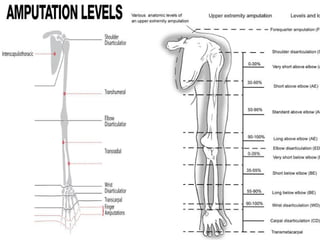
• Forequarter amputation: Removal of the entire
arm, including the shoulder joint.
• Shoulder disarticulation: Removal of the arm at the
shoulder joint.
• Transhumeral amputation: Removal of the arm
below the elbow.
• Transradial amputation: Removal of the arm
below the wrist.
10.
TYPES OF AMPUTATIONS
LOWERLIMB AMPUTATIONS
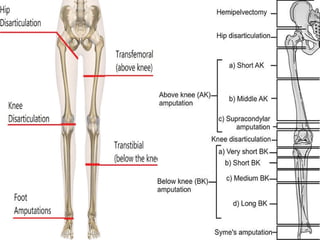
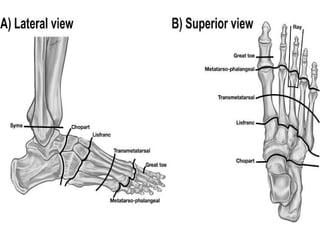
• Hemipelvectomy: Removal of the entire leg,
including the hip joint.
• Hip disarticulation: Removal of the leg at the hip
joint.
• Transfemoral amputation: Removal of the leg
below the knee.
• Transtibial amputation: Removal of the leg below
the ankle.
14.
SURGICAL TECHNIQUE
• 1.Guillotineamputation: A rapid and simple
technique used in emergency situations in severely
infected limb.
• 2.Open amputation: A more controlled technique
used in elective situations.
• The stump is not closed with skin flap immediately
rather it is left open allowing the wound to drain as
soon as infection is completely eradicated, the
stump is then closed.
15.
SURGICAL TECHNIQUE
• 3.Closedamputation: A technique used in
situations where the amputation is performed at a
site with minimal tissue damage.
• Here, the stump is closed with the flap of the skin
and sutured.
16.
PRINCIPLES
• Tourniquet -is used except in ischaemic limb
• Skin - should be large enough for muscle coverage and tension
free closure
• Muscles - are sutured to the periosteum in myodesis or to
opposing muscle groups in myoplasty
• Nerves - are transected proximal to the cut end of the bone
• Blood vessels - major vessels are double ligated and cut while
small vessels are coagulated.the tourniquet is then released and
hemostasis is complete
• Bone - is cut down perpendicularly with a gigli/bone saw proximal
to muscle section
• Drains - used and removed 48 - 72 hours after surgery
17.
Early Signs andSymptoms
• Infection: Redness, swelling, warmth, and drainage
from the amputation site.
• Wound dehiscence: Opening of the wound edges.
• Flap necrosis: Death of the skin flap.
• Nerve damage: Numbness, tingling, or weakness in
the affected limb.
• Phantom limb pain: Pain perceived in the missing
limb.
18.
Late Signs andSymptoms
• Chronic pain: Ongoing pain at the amputation site.
• Stump pain: Pain at the amputation site due to
bone spurs or nerve damage.
• Prosthetic complications: Problems with the
prosthetic device, such as skin irritation or pain.
• Psychological complications: Depression, anxiety, or
post-traumatic stress disorder (PTSD).
• Social complications: Social isolation or stigma
19.
• Neurological Signsand Symptoms:
• Numbness or tingling, Weakness, Paresthesia,
Hyperesthesia (Increased sensitivity ).
• Psychological Signs and Symptoms:
• Depression, Anxiety, Post-traumatic stress disorder
(PTSD) & Body image disturbance.
20.
INVESTIGATIONS.
• Pre-Amputation Investigations
•Imaging studies: X-rays, CT scans, or MRI scans to
evaluate the extent of injury or disease.
• Angiography: To assess blood flow to the affected
limb.
• Laboratory tests: Blood tests to evaluate electrolyte
levels, kidney function, and full blood counts.
• Neurological examination*: To assess nerve
function and sensation in the affected limb
21.
INVESTIGATIONS.
• Post-Amputation Investigations
•Wound swabs*: To assess for infection and guide
antibiotic therapy.
• Imaging studies*: X-rays, CT scans, or MRI scans to
evaluate the amputation site and surrounding tissues.
• Laboratory tests*: Blood tests to monitor electrolyte
levels, kidney function, and blood counts.
• Pain assessment*: To evaluate the level of pain and
guide pain management. (Phantom limb pain*: Pain
perceived in the missing limb)
22.
POST-OP MANAGEMENT
PAIN MANAGEMENT
•Pain management: Multimodal analgesia, including
opioids, NSAIDs, and regional anesthesia.
• Wound care: Debridement, dressing changes, and
antibiotic therapy as needed.
• Rehabilitation: Early mobilization, physical therapy,
and occupational therapy to promote functional
recovery.
• Prosthetics and Rehabilitation: Customized
prosthetic fitting to promote functional recovery.
23.
POST-OP MANAGEMENT
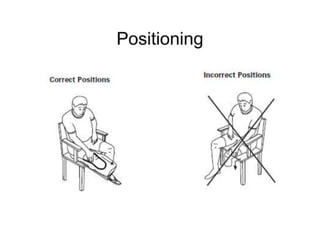
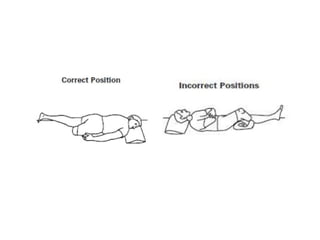
• Elevationof the limb for 1 or 2 hours, 2 - 3 times
each day to reduce local edema thereby limiting
pain.
• Compressive elastic bandages can be worn on the
stump to control swelling
• Mechanical stimulation, including massage, tapping
reduces local limb sensitivity.
• Ultrasound, warm compresses, ice packs, and TENS
(transcutaneous electrical nerve stimulation) are
also very useful in managing residual pain.
24.
• PSYCHOLOGICAL SUPPORT- should be offered by
therapists,family members and support groups to help in
adjusting to the new reality.
CONCLUSION
• Amputation isa complex and multifaceted surgical
procedure that requires careful consideration of
indications, surgical techniques, and postoperative
care.
• A comprehensive approach to amputation,
including prosthetic fitting and rehabilitation, is
essential to promote optimal functional recovery
and quality of life.
30.
REFERENCES
• Medscape: Amputation.[Updated 2022 Feb 22].
• ResearchGate: Amputation: A Review of the Literature. [Published 2020].
• Browse NL. Amputation. In: Browse NL, ed. Textbook of Surgery. 2nd ed. London: Hodder
Arnold; 2005: 355-365.
• - American Academy of Orthopaedic Surgeons (AAOS). Amputation. [Updated 2022].
• - National Institute of Neurological Disorders and Stroke (NINDS). Phantom Limb Pain.
[Updated 2022].
• - Centers for Disease Control and Prevention (CDC). Limb Loss. [Updated 2022].
• - Journal of the American Medical Association (JAMA). Amputation. [Published 2020].
• - New England Journal of Medicine (NEJM). Amputation. [Published 2020]
• Ndukwu, Chibuzo, and Chigozie Muoneme. "Prevalence and pattern of major extremity
amputation in a tertiary Hospital in Nnewi, South East Nigeria." Tropical Journal of
Medical Research, vol. 18, no. 2, July-Dec. 2015, p. 104. Gale Academic OneFile,
link.gale.com/apps/doc/A418181940/AONE?
u=anon~78ab0757&sid=googleScholar&xid=d9ac37af. Accessed 5 Dec. 2024.



![REFERENCES
• Medscape: Amputation. [Updated 2022 Feb 22].
• ResearchGate: Amputation: A Review of the Literature. [Published 2020].
• Browse NL. Amputation. In: Browse NL, ed. Textbook of Surgery. 2nd ed. London: Hodder
Arnold; 2005: 355-365.
• - American Academy of Orthopaedic Surgeons (AAOS). Amputation. [Updated 2022].
• - National Institute of Neurological Disorders and Stroke (NINDS). Phantom Limb Pain.
[Updated 2022].
• - Centers for Disease Control and Prevention (CDC). Limb Loss. [Updated 2022].
• - Journal of the American Medical Association (JAMA). Amputation. [Published 2020].
• - New England Journal of Medicine (NEJM). Amputation. [Published 2020]
• Ndukwu, Chibuzo, and Chigozie Muoneme. "Prevalence and pattern of major extremity
amputation in a tertiary Hospital in Nnewi, South East Nigeria." Tropical Journal of
Medical Research, vol. 18, no. 2, July-Dec. 2015, p. 104. Gale Academic OneFile,
link.gale.com/apps/doc/A418181940/AONE?
u=anon~78ab0757&sid=googleScholar&xid=d9ac37af. Accessed 5 Dec. 2024.](https://image.slidesharecdn.com/amputationaugustus-250507131757-c43d77de/85/AMPUTATION-orthopedic-surgery-augustus-pptx-30-320.jpg)