DEFORMATION OF SOLIDS
BY- Virendra Vaishnav
B.Pharmacy 4th Sem
Apollo College of Pharmacy, Durg
Deformation of Solids
 DEFORMATION- Change in size & Shape of Object
 STRESS - Force per unit area that applies to an object to deform it
 TENSILE STRESS – Tensile Force acting per unit area of the body
 COMPRESSIVE STRESS – Compressive force acting per unit area of the
body
 SHEAR STRESS – Shear force acting per unit area of the body
 TENSILE STRAIN – Ratio of incease in length to original length of Bar
 COMPRESSIVE STRAIN – Ratio of decease in length to original length of
Bar
 ELASTIC MODULUS – Ratio of (Stress to Strain)
DEFINITION-
 ELASTIC DEFORMATION – Process in which the material return to its
original shape when force is removed
 PLASTIC DEFORMATION – Process in which the material does not return
to its original shape when force is removed
 CREEP – Progressive , Permanent Deformation under constant load is
called Creep.
DEFORMATION
Change in size & Shape of the object.
When Loads are applied to body there is change in dimension.
STRESS APPLIED DEFORMATION
REMOVAL OF
STRESS
ELASTIC DEFORMATION
(Original State regain)
PLASTIC
DEFORMATION(Original
state lost)
ELASTIC DEFORMATION
 When a load applied or removed , no permanent deformation has occurred
 The material will return its original when force is removed .
 In Metals, ceramics, rubbers & Polymers.
 Elastic deformation in a solid can take place due to change in pressure or by an
application of force or load
 The Elasticity depend on both CHEMICAL BONDING & STRUCTURE OF SOLID
 Which takes place instaneously upon force & disappear completely on removal of
the force or load
 It obey’ s Hooke’s Law
IDEAL DEFORMATION
PLASTIC DEFORMATION
 The Material does not return to its original shape when force is removed
 Plastic deformation in solid does not obeys’ s Hooke’s Law
 Progressive, permanent deformation under constant load is called CREEP
FOR VISCOELASTIC MATERIALS
 Both recoverable and permanent deformationa occur together which are
dependent on time
 When force is applied to material it experience elastic, deformation followe by
plastic deformation
 Transition from elastic to plastic is characterized by yield strength of the
material
Force acting per unit area to an object to deform it.
Stress = Force / Area
Unit – Nm-2 or Pascal
Stress (σ)
There are 3 types of stress-
 DIRECT STRESS – These stress are produced under direct loading condition
Based on the type of force acting on the body it may be-:
a) TENSILE STRESS – It is defined as tensile force acting per unit area of the
body . This force produce elongation of dimension and increase in length of
the body (Ratio of change in length to original length)
b) COMPRESSIVE STRESS – It is defined as compressive force acting per unit
area area of the body. The force is applied opposite to each other and
compress the dimension of the body
c) SHEAR STRESS- Shear force acting per unit area of the body . Load is
applied on the surface of the body .Develops a resistive paralle to opposite to
direction of force applied
 INDIRECT STRESS- These stress occur due to torque produced in the body
 COMBINED STRESS- These stress are the combination of Direct & Indirect
Stress.
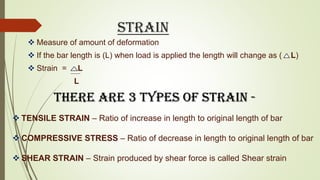
STRAIN
 Measure of amount of deformation
 If the bar length is (L) when load is applied the length will change as ( L)
 Strain = L
L
There are 3 types of strain -
 TENSILE STRAIN – Ratio of increase in length to original length of bar
 COMPRESSIVE STRESS – Ratio of decrease in length to original length of bar
 SHEAR STRAIN – Strain produced by shear force is called Shear strain
ELASTIC MODULUS
 Ratio of stress to strain
 Elastic modulus = Stress / Strain
 The constant of proportionality depends on the material being
deformed and the nature of the deformation is called ELASTIC
MODULUS.
 Elastic Modulus determines the amount of force required per unit
deformation
 Long elastic modulus material is difficult to deform
 Small elastic modulus is easy to deform
Deformation of Solid

Deformation of Solid

  • 1.
    DEFORMATION OF SOLIDS BY-Virendra Vaishnav B.Pharmacy 4th Sem Apollo College of Pharmacy, Durg
  • 2.
    Deformation of Solids DEFORMATION- Change in size & Shape of Object  STRESS - Force per unit area that applies to an object to deform it  TENSILE STRESS – Tensile Force acting per unit area of the body  COMPRESSIVE STRESS – Compressive force acting per unit area of the body  SHEAR STRESS – Shear force acting per unit area of the body  TENSILE STRAIN – Ratio of incease in length to original length of Bar  COMPRESSIVE STRAIN – Ratio of decease in length to original length of Bar  ELASTIC MODULUS – Ratio of (Stress to Strain) DEFINITION-
  • 3.
     ELASTIC DEFORMATION– Process in which the material return to its original shape when force is removed  PLASTIC DEFORMATION – Process in which the material does not return to its original shape when force is removed  CREEP – Progressive , Permanent Deformation under constant load is called Creep.
  • 4.
    DEFORMATION Change in size& Shape of the object. When Loads are applied to body there is change in dimension. STRESS APPLIED DEFORMATION REMOVAL OF STRESS ELASTIC DEFORMATION (Original State regain) PLASTIC DEFORMATION(Original state lost)
  • 5.
    ELASTIC DEFORMATION  Whena load applied or removed , no permanent deformation has occurred  The material will return its original when force is removed .  In Metals, ceramics, rubbers & Polymers.  Elastic deformation in a solid can take place due to change in pressure or by an application of force or load  The Elasticity depend on both CHEMICAL BONDING & STRUCTURE OF SOLID  Which takes place instaneously upon force & disappear completely on removal of the force or load  It obey’ s Hooke’s Law IDEAL DEFORMATION
  • 6.
    PLASTIC DEFORMATION  TheMaterial does not return to its original shape when force is removed  Plastic deformation in solid does not obeys’ s Hooke’s Law  Progressive, permanent deformation under constant load is called CREEP FOR VISCOELASTIC MATERIALS  Both recoverable and permanent deformationa occur together which are dependent on time  When force is applied to material it experience elastic, deformation followe by plastic deformation  Transition from elastic to plastic is characterized by yield strength of the material
  • 7.
    Force acting perunit area to an object to deform it. Stress = Force / Area Unit – Nm-2 or Pascal Stress (σ)
  • 8.
    There are 3types of stress-  DIRECT STRESS – These stress are produced under direct loading condition Based on the type of force acting on the body it may be-: a) TENSILE STRESS – It is defined as tensile force acting per unit area of the body . This force produce elongation of dimension and increase in length of the body (Ratio of change in length to original length) b) COMPRESSIVE STRESS – It is defined as compressive force acting per unit area area of the body. The force is applied opposite to each other and compress the dimension of the body c) SHEAR STRESS- Shear force acting per unit area of the body . Load is applied on the surface of the body .Develops a resistive paralle to opposite to direction of force applied  INDIRECT STRESS- These stress occur due to torque produced in the body  COMBINED STRESS- These stress are the combination of Direct & Indirect Stress.
  • 9.
    STRAIN  Measure ofamount of deformation  If the bar length is (L) when load is applied the length will change as ( L)  Strain = L L There are 3 types of strain -  TENSILE STRAIN – Ratio of increase in length to original length of bar  COMPRESSIVE STRESS – Ratio of decrease in length to original length of bar  SHEAR STRAIN – Strain produced by shear force is called Shear strain
  • 10.
    ELASTIC MODULUS  Ratioof stress to strain  Elastic modulus = Stress / Strain  The constant of proportionality depends on the material being deformed and the nature of the deformation is called ELASTIC MODULUS.  Elastic Modulus determines the amount of force required per unit deformation  Long elastic modulus material is difficult to deform  Small elastic modulus is easy to deform