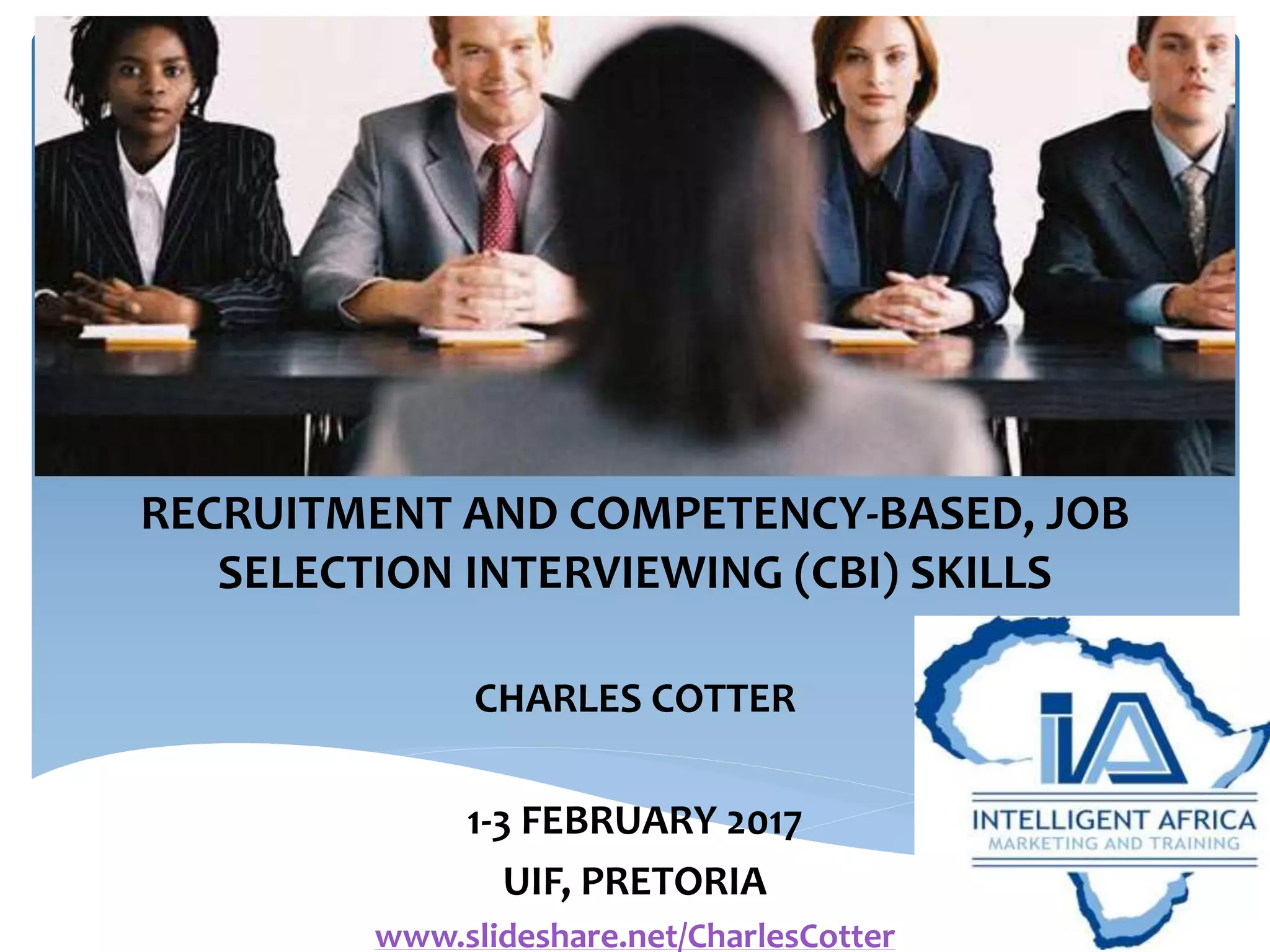
RECRUITMENT AND COMPETENCY-BASED, JOB
SELECTION INTERVIEWING (CBI) SKILLS
CHARLES COTTER
1-3 FEBRUARY 2017
UIF, PRETORIA
www.slideshare.net/CharlesCotter
 HR Planning – principles and process
 Recruitment – principles and process
 Employee Selection principles and practice
 Competency-based Job Selection Interviewing (CBI) skills –
theory and practical
 Employment contract negotiations – theory and practical
3-DAY, TRAINING PROGRAMME
OVERVIEW
 Individual activity:
 Complete the statement by inserting one (1) word only. In order
to be an effective, competency-based recruiter at UIF, I need
to/to be .…………………………………..
 Now find other learners with the same word as you.
 Jot these words down on the flip-chart.
 Each learner will have the opportunity to elaborate on their
chosen word.
INTRODUCTORY ACTIVITY
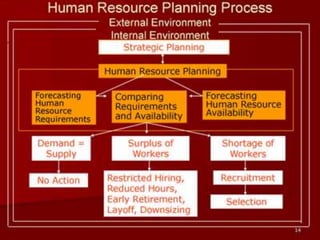
DEFINING HR PLANNING
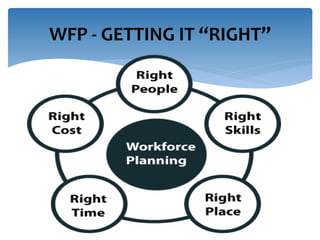
WFP - GETTING IT “RIGHT”
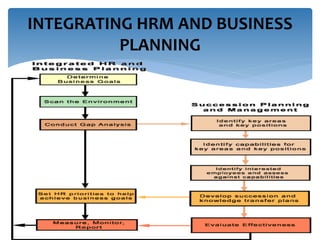
INTEGRATING HRM AND BUSINESS
PLANNING
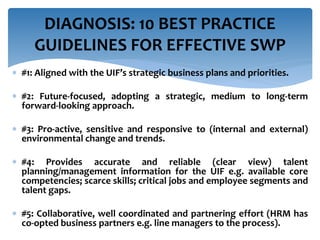
 #1: Aligned with the UIF’s strategic business plans and priorities.
 #2: Future-focused, adopting a strategic, medium to long-term
forward-looking approach.
 #3: Pro-active, sensitive and responsive to (internal and external)
environmental change and trends.
 #4: Provides accurate and reliable (clear view) talent
planning/management information for the UIF e.g. available core
competencies; scarce skills; critical jobs and employee segments and
talent gaps.
 #5: Collaborative, well coordinated and partnering effort (HRM has
co-opted business partners e.g. line managers to the process).
DIAGNOSIS: 10 BEST PRACTICE
GUIDELINES FOR EFFECTIVE SWP
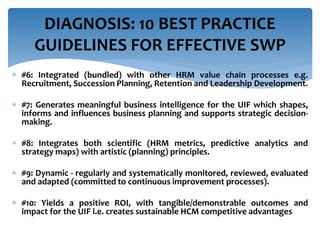
 #6: Integrated (bundled) with other HRM value chain processes e.g.
Recruitment, Succession Planning, Retention and Leadership Development.
 #7: Generates meaningful business intelligence for the UIF which shapes,
informs and influences business planning and supports strategic decision-
making.
 #8: Integrates both scientific (HRM metrics, predictive analytics and
strategy maps) with artistic (planning) principles.
 #9: Dynamic - regularly and systematically monitored, reviewed, evaluated
and adapted (committed to continuous improvement processes).
 #10: Yields a positive ROI, with tangible/demonstrable outcomes and
impact for the UIF i.e. creates sustainable HCM competitive advantages
DIAGNOSIS: 10 BEST PRACTICE
GUIDELINES FOR EFFECTIVE SWP
 Individual Activity:
 Diagnose your current Workforce Planning practices against
the ten (10) best practice criteria.
 Group Discussion:
 Identify gaps and recommend improvement strategies.
LEARNING ACTIVITY 1
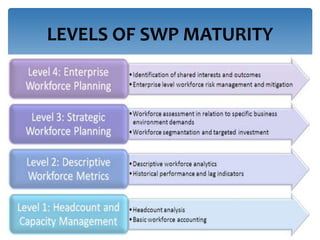
LEVELS OF SWP MATURITY
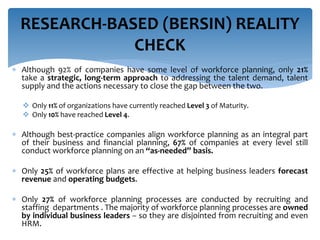
 Although 92% of companies have some level of workforce planning, only 21%
take a strategic, long-term approach to addressing the talent demand, talent
supply and the actions necessary to close the gap between the two.
 Only 11% of organizations have currently reached Level 3 of Maturity.
 Only 10% have reached Level 4.
 Although best-practice companies align workforce planning as an integral part
of their business and financial planning, 67% of companies at every level still
conduct workforce planning on an “as-needed” basis.
 Only 25% of workforce plans are effective at helping business leaders forecast
revenue and operating budgets.
 Only 27% of workforce planning processes are conducted by recruiting and
staffing departments . The majority of workforce planning processes are owned
by individual business leaders – so they are disjointed from recruiting and even
HRM.
RESEARCH-BASED (BERSIN) REALITY
CHECK
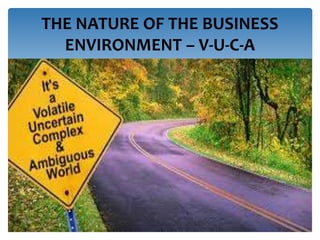
THE NATURE OF THE BUSINESS
ENVIRONMENT – V-U-C-A
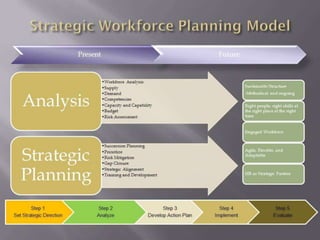
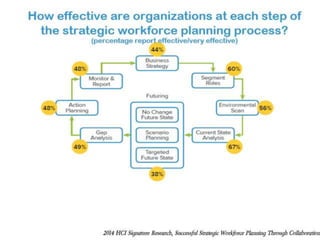
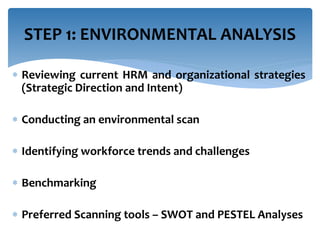
 Reviewing current HRM and organizational strategies
(Strategic Direction and Intent)
 Conducting an environmental scan
 Identifying workforce trends and challenges
 Benchmarking
 Preferred Scanning tools – SWOT and PESTEL Analyses
STEP 1: ENVIRONMENTAL ANALYSIS
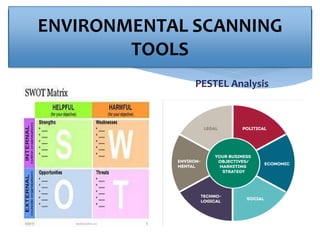
ENVIRONMENTAL SCANNING
TOOLS
PESTEL Analysis
STEP 2: FORECASTING HR DEMAND
(FUTURING)
 Forecasting should consider the past and the present
requirements as well as future organizational direction/s
Number of employees
Type of employees
Skills requirements of these employees
 Consider and assess the challenges and constraints
 Preferred Scanning tools –”What If” and Scenario Planning
FORECASTING HR DEMAND
 "Futuring is the field of using a systematic process for thinking about,
picturing possible outcomes, and planning for the future. Futurists are
people who actively view the present world as a window on possible
future outcomes. They watch trends and try to envision what might
happen.“ (Kirkwood, 2011)
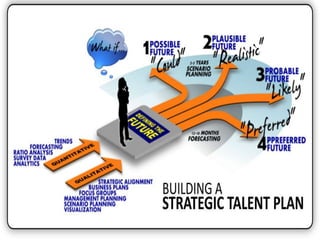
 Futuring is a broader concept than the forecasting traditionally done
in Workforce Planning and enables organizations to look at the future
in four different ways (Cillie-Schmidt, 2013):
The possible future - what could happen?
The plausible future - what could realistically happen?
The probable future - what is likely to happen?
The preferred future - what we want to happen?
FUTURING
 Assess the current HR capacity of the organization by means of
the Skill inventories/audits method
The knowledge, skills and abilities of your current staff need to be
identified
Employee experience, education and special skills
Certificates or additional training should also be included
 A forecast of the supply of employees projected to join the
organization from outside sources
 HRM indicators, metrics and indices e.g. turnover rates
STEP 3: MEASURING CURRENT
SUPPLY
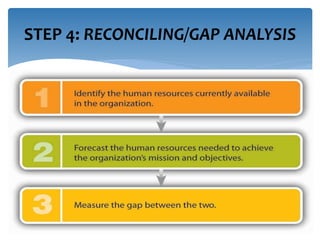
STEP 4: RECONCILING/GAP ANALYSIS
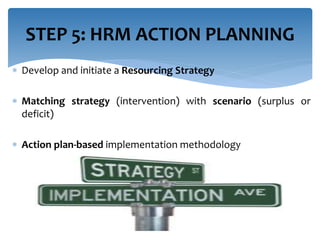
 Develop and initiate a Resourcing Strategy
 Matching strategy (intervention) with scenario (surplus or
deficit)
 Action plan-based implementation methodology
STEP 5: HRM ACTION PLANNING
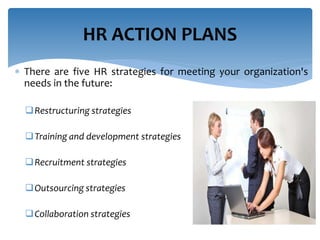
 There are five HR strategies for meeting your organization's
needs in the future:
Restructuring strategies
Training and development strategies
Recruitment strategies
Outsourcing strategies
Collaboration strategies
HR ACTION PLANS
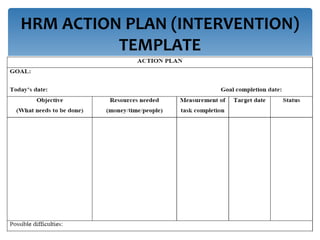
HRM ACTION PLAN (INTERVENTION)
TEMPLATE
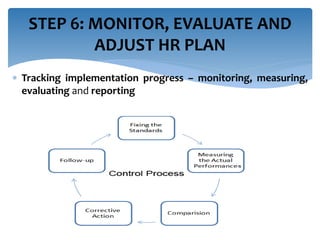
 Tracking implementation progress – monitoring, measuring,
evaluating and reporting
STEP 6: MONITOR, EVALUATE AND
ADJUST HR PLAN
 Group Discussion:
 Apply the 6-step, HR Planning process in the context of the
UIF.
 Outcome: Identify a key position at the UIF that needs to be
filled in the short-term.
LEARNING ACTIVITY 2
 Group Discussion:
 Review the efficiency and effectiveness of current UIF
Recruitment policy, procedure and process. Also evaluate the
degree of compliance with labour legislation.
 Identify gaps and recommend improvement strategies.
LEARNING ACTIVITY 3
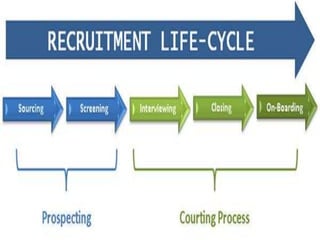
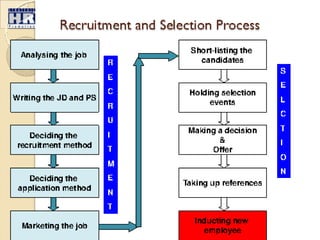
RECRUITMENT PROCESS
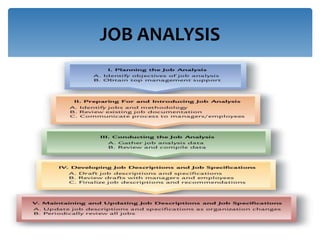
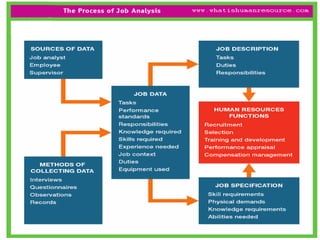
 Defining the role (Job Analysis)
 Job Specification
 Job Description
 Attracting applications
 Recruitment methods (internal and external)
 Employee value proposition (EVP)
 Managing the application and selection process
 Making the appointment
JOB ANALYSIS
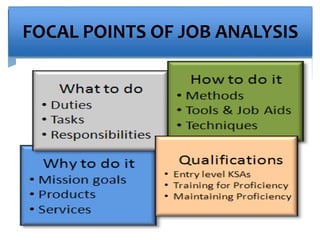
FOCAL POINTS OF JOB ANALYSIS
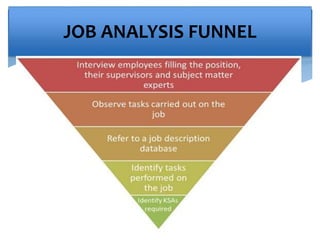
JOB ANALYSIS FUNNEL
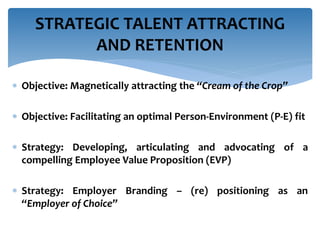
 Objective: Magnetically attracting the “Cream of the Crop”
 Objective: Facilitating an optimal Person-Environment (P-E) fit
 Strategy: Developing, articulating and advocating of a
compelling Employee Value Proposition (EVP)
 Strategy: Employer Branding – (re) positioning as an
“Employer of Choice”
STRATEGIC TALENT ATTRACTING
AND RETENTION
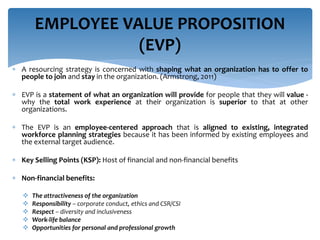
 A resourcing strategy is concerned with shaping what an organization has to offer to
people to join and stay in the organization. (Armstrong, 2011)
 EVP is a statement of what an organization will provide for people that they will value -
why the total work experience at their organization is superior to that at other
organizations.
 The EVP is an employee-centered approach that is aligned to existing, integrated
workforce planning strategies because it has been informed by existing employees and
the external target audience.
 Key Selling Points (KSP): Host of financial and non-financial benefits
 Non-financial benefits:
 The attractiveness of the organization
 Responsibility – corporate conduct, ethics and CSR/CSI
 Respect – diversity and inclusiveness
 Work-life balance
 Opportunities for personal and professional growth
EMPLOYEE VALUE PROPOSITION
(EVP)
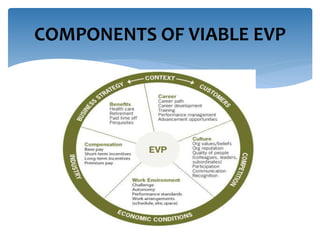
COMPONENTS OF VIABLE EVP
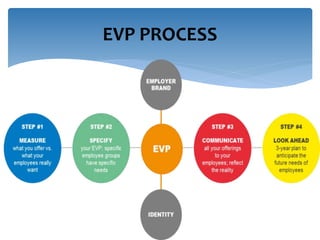
EVP PROCESS
 Unique Selling Points (USP) - Employer brand that is unique
and special
 Creation of a Brand image of the organization for prospective
employees
 Influenced by the reputation of the organization
 Creating an Employer Branding strategy
EMPLOYER BRANDING
 Group Discussion:
Refer to the identified key position at UIF (Learning Activity 1) to develop a
recruitment Strategy for this specific position/job. Focus on the following
key components:
Defining the role (Job Analysis):
 Job description
 Job specification
Attracting applicants:
 Recruitment methods (internal and/or external)
 Develop a job advertisement for the identified, key position/job
 Develop an EVP for the UIF
LEARNING ACTIVITY 4
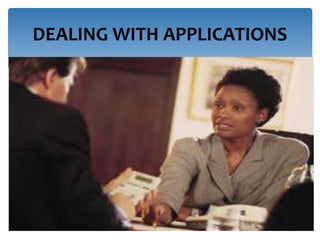
DEALING WITH APPLICATIONS
MANAGING THE APPLICATION AND
SELECTION PROCESS
 The Curriculum Vitae (CV) or
 The application form
 Dealing with applications
 The ‘candidate experience’
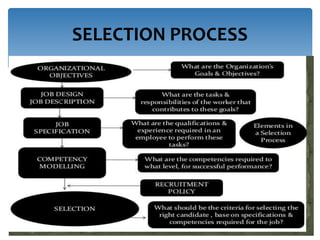
SELECTION PROCESS
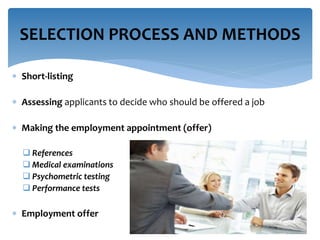
 Short-listing
 Assessing applicants to decide who should be offered a job
 Making the employment appointment (offer)
 References
 Medical examinations
 Psychometric testing
 Performance tests
 Employment offer
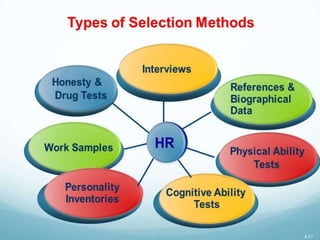
SELECTION PROCESS AND METHODS
 Group Discussion:
 Develop a Selection Strategy for the UIF. Focus on the following key
components:
 Process
 Selection methods


LEARNING ACTIVITY 5
10 MISTAKES JOB INTERVIEWERS MAKE
- ARTICLE
 LEARNING ACTIVITY 6
 Refer to pages 49-51
 Identify some of the key lessons/learning points from the
article.
 Describe how these lessons can be applied to the UIF’s
competency-based job selection interview (CBI) process.
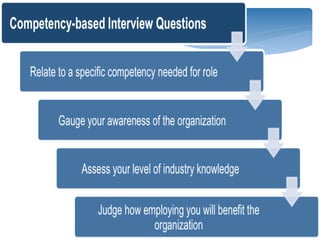
DEFINING COMPETENCY-BASED
INTERVIEWS
 Competency-based interviews (also called structured
interviews) are interviews where each question is designed to
test one or more specific skills.
 The answer is then matched against pre-decided criteria and
marked accordingly.
 For example, the interviewers may want to test the candidate's
ability to deal with stress by asking first how the candidate
generally handles stress and then asking the candidate to
provide an example of a situation where he worked under
pressure.
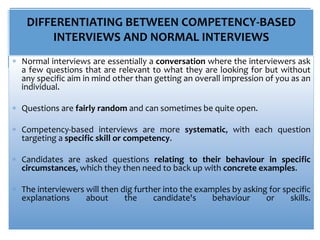
DIFFERENTIATING BETWEEN COMPETENCY-BASED
INTERVIEWS AND NORMAL INTERVIEWS
 Normal interviews are essentially a conversation where the interviewers ask
a few questions that are relevant to what they are looking for but without
any specific aim in mind other than getting an overall impression of you as an
individual.
 Questions are fairly random and can sometimes be quite open.
 Competency-based interviews are more systematic, with each question
targeting a specific skill or competency.
 Candidates are asked questions relating to their behaviour in specific
circumstances, which they then need to back up with concrete examples.
 The interviewers will then dig further into the examples by asking for specific
explanations about the candidate's behaviour or skills.
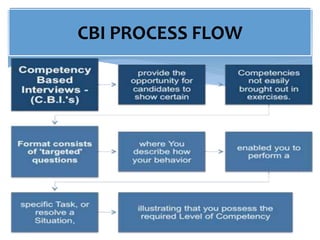
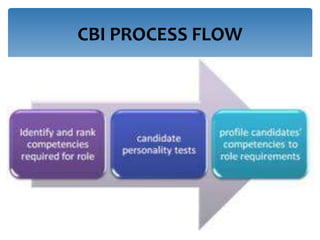
CBI PROCESS FLOW
CBI PROCESS FLOW
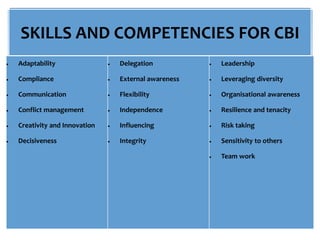
SKILLS AND COMPETENCIES FOR CBI
 Adaptability
 Compliance
 Communication
 Conflict management
 Creativity and Innovation
 Decisiveness
 Delegation
 External awareness
 Flexibility
 Independence
 Influencing
 Integrity
 Leadership
 Leveraging diversity
 Organisational awareness
 Resilience and tenacity
 Risk taking
 Sensitivity to others
 Team work
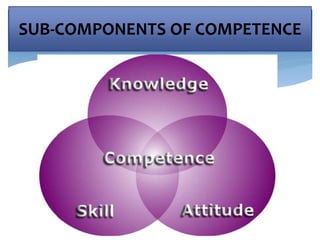
SUB-COMPONENTS OF COMPETENCE
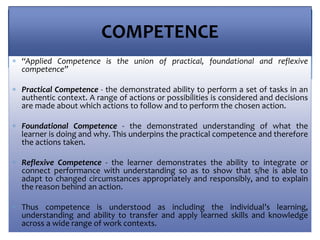
COMPETENCE
 “Applied Competence is the union of practical, foundational and reflexive
competence”
 Practical Competence - the demonstrated ability to perform a set of tasks in an
authentic context. A range of actions or possibilities is considered and decisions
are made about which actions to follow and to perform the chosen action.
 Foundational Competence - the demonstrated understanding of what the
learner is doing and why. This underpins the practical competence and therefore
the actions taken.
 Reflexive Competence - the learner demonstrates the ability to integrate or
connect performance with understanding so as to show that s/he is able to
adapt to changed circumstances appropriately and responsibly, and to explain
the reason behind an action.
 Thus competence is understood as including the individual’s learning,
understanding and ability to transfer and apply learned skills and knowledge
across a wide range of work contexts.
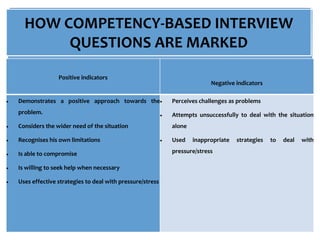
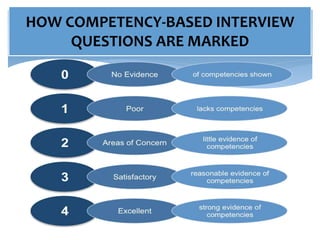
HOW COMPETENCY-BASED INTERVIEW
QUESTIONS ARE MARKED
Positive indicators
Negative indicators
 Demonstrates a positive approach towards the
problem.
 Considers the wider need of the situation
 Recognises his own limitations
 Is able to compromise
 Is willing to seek help when necessary
 Uses effective strategies to deal with pressure/stress
 Perceives challenges as problems
 Attempts unsuccessfully to deal with the situation
alone
 Used inappropriate strategies to deal with
pressure/stress
HOW COMPETENCY-BASED INTERVIEW
QUESTIONS ARE MARKED
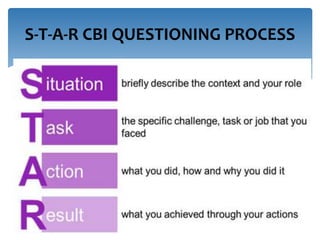
S-T-A-R CBI QUESTIONING PROCESS
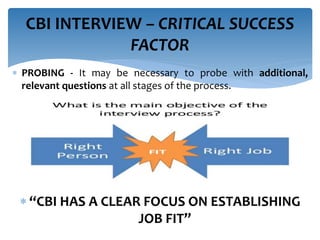
 PROBING - It may be necessary to probe with additional,
relevant questions at all stages of the process.
 “CBI HAS A CLEAR FOCUS ON ESTABLISHING
JOB FIT”
CBI INTERVIEW – CRITICAL SUCCESS
FACTOR
CBI CHECKLIST
 Prepare for the interview
 Follow a logical sequence
 Create a proper environment
 Relax the candidate
 Let the candidate do the talking
 Perfect your questioning
CBI CHECKLIST
 Become a better listener
 Keep your reactions to yourself
 Stay in control
 Take notes
 Sell but don’t oversell the position
 Conclude on a proper note
HOW TO MASTER ASKING BEHAVIOURAL
INTERVIEW QUESTIONS - ARTICLE
 LEARNING ACTIVITY 7
 Refer to pages 61-64
 Identify some of the key lessons/learning points from the
article.
 Describe how these lessons can be applied to the UIF’s
competency-based job selection interview (CBI) process.
LEARNING ACTIVITY 8
Role Play:
Divide into syndicate groups. Conduct a competency-based job
selection interview with a prospective job applicant. Each group
member will play a defined role.
De-briefing:
Review and evaluate the efficiency and effectiveness of this
competency-based job interview. Identify improvement areas and
recommend strategies to improve future interviews at the UIF.
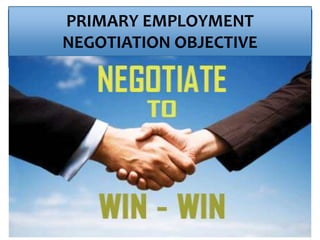
PRIMARY EMPLOYMENT
NEGOTIATION OBJECTIVE
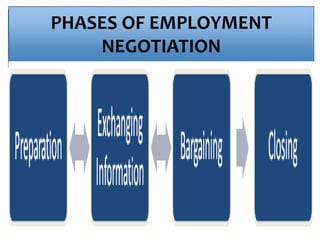
PHASES OF EMPLOYMENT
NEGOTIATION
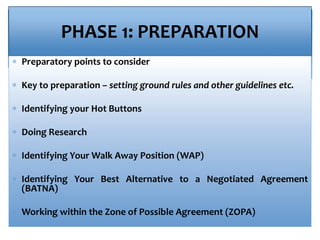
PHASE 1: PREPARATION
 Preparatory points to consider
 Key to preparation – setting ground rules and other guidelines etc.
 Identifying your Hot Buttons
 Doing Research
 Identifying Your Walk Away Position (WAP)
 Identifying Your Best Alternative to a Negotiated Agreement
(BATNA)
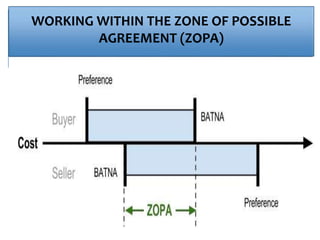
 Working within the Zone of Possible Agreement (ZOPA)
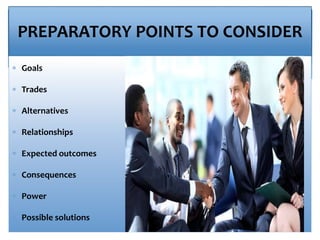
PREPARATORY POINTS TO CONSIDER
 Goals
 Trades
 Alternatives
 Relationships
 Expected outcomes
 Consequences
 Power
 Possible solutions
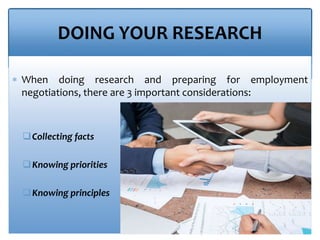
DOING YOUR RESEARCH
 When doing research and preparing for employment
negotiations, there are 3 important considerations:
Collecting facts
Knowing priorities
Knowing principles
WORKING WITHIN THE ZONE OF POSSIBLE
AGREEMENT (ZOPA)
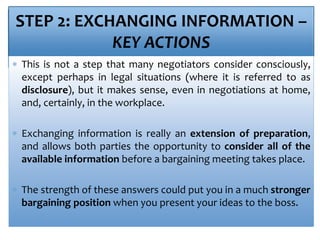
STEP 2: EXCHANGING INFORMATION –
KEY ACTIONS
 This is not a step that many negotiators consider consciously,
except perhaps in legal situations (where it is referred to as
disclosure), but it makes sense, even in negotiations at home,
and, certainly, in the workplace.
 Exchanging information is really an extension of preparation,
and allows both parties the opportunity to consider all of the
available information before a bargaining meeting takes place.
 The strength of these answers could put you in a much stronger
bargaining position when you present your ideas to the boss.
STEP 3: BARGAINING
 Responding to Challenges
 Creating win-win solutions
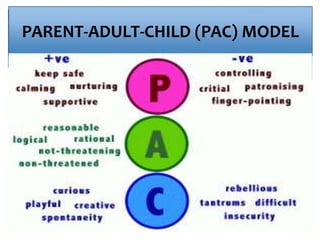
PARENT-ADULT-CHILD (PAC) MODEL
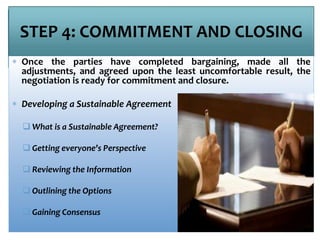
STEP 4: COMMITMENT AND CLOSING
 Once the parties have completed bargaining, made all the
adjustments, and agreed upon the least uncomfortable result, the
negotiation is ready for commitment and closure.
 Developing a Sustainable Agreement
 What is a Sustainable Agreement?
 Getting everyone’s Perspective
 Reviewing the Information
 Outlining the Options
 Gaining Consensus
DEFINING A SUSTAINABLE
AGREEMENT
 A sustainable agreement can be said to reflect the reality of the business i.e. the reality of
business and economic cycles, industries, and real issues that people face.
 It must also reflect the multiple aspects of the stakeholders who both provide input, and
are affected by the results.
 In developing a sustainable agreement, the partners must ensure that:
 #1: The organizations that they negotiate on behalf of are interested in having an agreement
 #2: The negotiating organizations will enforce and take part in the terms of that agreement.
 If the agreement cannot stand on its own, and the parties who sign it refuse to use it,
then the paper it is printed on is useless.
 An agreement also cannot focus on one aspect of the business when the business
impacts other industries, cultures, or linguistic groups.
REACHING CONSENSUS
REACHING CONSENSUS
 Before an agreement is signed, it is important to have consensus for agreement among
the parties.
 Consensus can be difficult during tough negotiations; generally, the more stakeholders
taking part in the process, the more difficult it is to reach consensus.
 Persuasion, that ability to have people recognize the value in what we are saying, is an
exceptionally valuable communication skill for a negotiator.
 One way to secure commitment is to ask the other party to summarize their
understanding of the agreement, and to get it in writing. To clarify, it can help to ask them
three questions:
 Please explain what we have agreed to.
 Do you agree with what we have agreed to?
 Are you committed to carry out the agreement? If not, what factors need to be clarified?
LEARNING ACTIVITY 9
Role Play:
 Divide into syndicate groups. Refer to Learning Activity 8.
Conduct employment contract negotiations with the selected
job applicant. Each group member will play a defined role.
De-briefing:
 Review and evaluate the efficiency and effectiveness of this
employment contract negotiation. Identify improvement
areas and recommend strategies to improve future interviews
at UIF.
CONCLUSION
Key points
Summary
Questions
CONTACT DETAILS
 Charles Cotter
 (+27) 84 562 9446
 charlescot@polka.co.za
 LinkedIn
 Twitter: @Charles_Cotter
 http://www.slideshare.net/CharlesCotter

Competency-based Recruitment and Selection Interviewing (CBI) Skills

  • 1.
    RECRUITMENT AND COMPETENCY-BASED,JOB SELECTION INTERVIEWING (CBI) SKILLS CHARLES COTTER 1-3 FEBRUARY 2017 UIF, PRETORIA www.slideshare.net/CharlesCotter
  • 2.
     HR Planning– principles and process  Recruitment – principles and process  Employee Selection principles and practice  Competency-based Job Selection Interviewing (CBI) skills – theory and practical  Employment contract negotiations – theory and practical 3-DAY, TRAINING PROGRAMME OVERVIEW
  • 3.
     Individual activity: Complete the statement by inserting one (1) word only. In order to be an effective, competency-based recruiter at UIF, I need to/to be .…………………………………..  Now find other learners with the same word as you.  Jot these words down on the flip-chart.  Each learner will have the opportunity to elaborate on their chosen word. INTRODUCTORY ACTIVITY
  • 5.
  • 6.
    WFP - GETTINGIT “RIGHT”
  • 9.
    INTEGRATING HRM ANDBUSINESS PLANNING
  • 10.
     #1: Alignedwith the UIF’s strategic business plans and priorities.  #2: Future-focused, adopting a strategic, medium to long-term forward-looking approach.  #3: Pro-active, sensitive and responsive to (internal and external) environmental change and trends.  #4: Provides accurate and reliable (clear view) talent planning/management information for the UIF e.g. available core competencies; scarce skills; critical jobs and employee segments and talent gaps.  #5: Collaborative, well coordinated and partnering effort (HRM has co-opted business partners e.g. line managers to the process). DIAGNOSIS: 10 BEST PRACTICE GUIDELINES FOR EFFECTIVE SWP
  • 11.
     #6: Integrated(bundled) with other HRM value chain processes e.g. Recruitment, Succession Planning, Retention and Leadership Development.  #7: Generates meaningful business intelligence for the UIF which shapes, informs and influences business planning and supports strategic decision- making.  #8: Integrates both scientific (HRM metrics, predictive analytics and strategy maps) with artistic (planning) principles.  #9: Dynamic - regularly and systematically monitored, reviewed, evaluated and adapted (committed to continuous improvement processes).  #10: Yields a positive ROI, with tangible/demonstrable outcomes and impact for the UIF i.e. creates sustainable HCM competitive advantages DIAGNOSIS: 10 BEST PRACTICE GUIDELINES FOR EFFECTIVE SWP
  • 12.
     Individual Activity: Diagnose your current Workforce Planning practices against the ten (10) best practice criteria.  Group Discussion:  Identify gaps and recommend improvement strategies. LEARNING ACTIVITY 1
  • 13.
    LEVELS OF SWPMATURITY
  • 14.
     Although 92%of companies have some level of workforce planning, only 21% take a strategic, long-term approach to addressing the talent demand, talent supply and the actions necessary to close the gap between the two.  Only 11% of organizations have currently reached Level 3 of Maturity.  Only 10% have reached Level 4.  Although best-practice companies align workforce planning as an integral part of their business and financial planning, 67% of companies at every level still conduct workforce planning on an “as-needed” basis.  Only 25% of workforce plans are effective at helping business leaders forecast revenue and operating budgets.  Only 27% of workforce planning processes are conducted by recruiting and staffing departments . The majority of workforce planning processes are owned by individual business leaders – so they are disjointed from recruiting and even HRM. RESEARCH-BASED (BERSIN) REALITY CHECK
  • 18.
    THE NATURE OFTHE BUSINESS ENVIRONMENT – V-U-C-A
  • 19.
     Reviewing currentHRM and organizational strategies (Strategic Direction and Intent)  Conducting an environmental scan  Identifying workforce trends and challenges  Benchmarking  Preferred Scanning tools – SWOT and PESTEL Analyses STEP 1: ENVIRONMENTAL ANALYSIS
  • 20.
  • 21.
    STEP 2: FORECASTINGHR DEMAND (FUTURING)
  • 22.
     Forecasting shouldconsider the past and the present requirements as well as future organizational direction/s Number of employees Type of employees Skills requirements of these employees  Consider and assess the challenges and constraints  Preferred Scanning tools –”What If” and Scenario Planning FORECASTING HR DEMAND
  • 24.
     "Futuring isthe field of using a systematic process for thinking about, picturing possible outcomes, and planning for the future. Futurists are people who actively view the present world as a window on possible future outcomes. They watch trends and try to envision what might happen.“ (Kirkwood, 2011)  Futuring is a broader concept than the forecasting traditionally done in Workforce Planning and enables organizations to look at the future in four different ways (Cillie-Schmidt, 2013): The possible future - what could happen? The plausible future - what could realistically happen? The probable future - what is likely to happen? The preferred future - what we want to happen? FUTURING
  • 26.
     Assess thecurrent HR capacity of the organization by means of the Skill inventories/audits method The knowledge, skills and abilities of your current staff need to be identified Employee experience, education and special skills Certificates or additional training should also be included  A forecast of the supply of employees projected to join the organization from outside sources  HRM indicators, metrics and indices e.g. turnover rates STEP 3: MEASURING CURRENT SUPPLY
  • 27.
  • 29.
     Develop andinitiate a Resourcing Strategy  Matching strategy (intervention) with scenario (surplus or deficit)  Action plan-based implementation methodology STEP 5: HRM ACTION PLANNING
  • 30.
     There arefive HR strategies for meeting your organization's needs in the future: Restructuring strategies Training and development strategies Recruitment strategies Outsourcing strategies Collaboration strategies HR ACTION PLANS
  • 31.
    HRM ACTION PLAN(INTERVENTION) TEMPLATE
  • 32.
     Tracking implementationprogress – monitoring, measuring, evaluating and reporting STEP 6: MONITOR, EVALUATE AND ADJUST HR PLAN
  • 33.
     Group Discussion: Apply the 6-step, HR Planning process in the context of the UIF.  Outcome: Identify a key position at the UIF that needs to be filled in the short-term. LEARNING ACTIVITY 2
  • 37.
     Group Discussion: Review the efficiency and effectiveness of current UIF Recruitment policy, procedure and process. Also evaluate the degree of compliance with labour legislation.  Identify gaps and recommend improvement strategies. LEARNING ACTIVITY 3
  • 38.
    RECRUITMENT PROCESS  Definingthe role (Job Analysis)  Job Specification  Job Description  Attracting applications  Recruitment methods (internal and external)  Employee value proposition (EVP)  Managing the application and selection process  Making the appointment
  • 39.
  • 41.
    FOCAL POINTS OFJOB ANALYSIS
  • 42.
  • 43.
     Objective: Magneticallyattracting the “Cream of the Crop”  Objective: Facilitating an optimal Person-Environment (P-E) fit  Strategy: Developing, articulating and advocating of a compelling Employee Value Proposition (EVP)  Strategy: Employer Branding – (re) positioning as an “Employer of Choice” STRATEGIC TALENT ATTRACTING AND RETENTION
  • 44.
     A resourcingstrategy is concerned with shaping what an organization has to offer to people to join and stay in the organization. (Armstrong, 2011)  EVP is a statement of what an organization will provide for people that they will value - why the total work experience at their organization is superior to that at other organizations.  The EVP is an employee-centered approach that is aligned to existing, integrated workforce planning strategies because it has been informed by existing employees and the external target audience.  Key Selling Points (KSP): Host of financial and non-financial benefits  Non-financial benefits:  The attractiveness of the organization  Responsibility – corporate conduct, ethics and CSR/CSI  Respect – diversity and inclusiveness  Work-life balance  Opportunities for personal and professional growth EMPLOYEE VALUE PROPOSITION (EVP)
  • 45.
  • 46.
  • 47.
     Unique SellingPoints (USP) - Employer brand that is unique and special  Creation of a Brand image of the organization for prospective employees  Influenced by the reputation of the organization  Creating an Employer Branding strategy EMPLOYER BRANDING
  • 48.
     Group Discussion: Referto the identified key position at UIF (Learning Activity 1) to develop a recruitment Strategy for this specific position/job. Focus on the following key components: Defining the role (Job Analysis):  Job description  Job specification Attracting applicants:  Recruitment methods (internal and/or external)  Develop a job advertisement for the identified, key position/job  Develop an EVP for the UIF LEARNING ACTIVITY 4
  • 49.
  • 50.
    MANAGING THE APPLICATIONAND SELECTION PROCESS  The Curriculum Vitae (CV) or  The application form  Dealing with applications  The ‘candidate experience’
  • 51.
  • 52.
     Short-listing  Assessingapplicants to decide who should be offered a job  Making the employment appointment (offer)  References  Medical examinations  Psychometric testing  Performance tests  Employment offer SELECTION PROCESS AND METHODS
  • 55.
     Group Discussion: Develop a Selection Strategy for the UIF. Focus on the following key components:  Process  Selection methods   LEARNING ACTIVITY 5
  • 56.
    10 MISTAKES JOBINTERVIEWERS MAKE - ARTICLE  LEARNING ACTIVITY 6  Refer to pages 49-51  Identify some of the key lessons/learning points from the article.  Describe how these lessons can be applied to the UIF’s competency-based job selection interview (CBI) process.
  • 58.
    DEFINING COMPETENCY-BASED INTERVIEWS  Competency-basedinterviews (also called structured interviews) are interviews where each question is designed to test one or more specific skills.  The answer is then matched against pre-decided criteria and marked accordingly.  For example, the interviewers may want to test the candidate's ability to deal with stress by asking first how the candidate generally handles stress and then asking the candidate to provide an example of a situation where he worked under pressure.
  • 60.
    DIFFERENTIATING BETWEEN COMPETENCY-BASED INTERVIEWSAND NORMAL INTERVIEWS  Normal interviews are essentially a conversation where the interviewers ask a few questions that are relevant to what they are looking for but without any specific aim in mind other than getting an overall impression of you as an individual.  Questions are fairly random and can sometimes be quite open.  Competency-based interviews are more systematic, with each question targeting a specific skill or competency.  Candidates are asked questions relating to their behaviour in specific circumstances, which they then need to back up with concrete examples.  The interviewers will then dig further into the examples by asking for specific explanations about the candidate's behaviour or skills.
  • 61.
  • 62.
  • 63.
    SKILLS AND COMPETENCIESFOR CBI  Adaptability  Compliance  Communication  Conflict management  Creativity and Innovation  Decisiveness  Delegation  External awareness  Flexibility  Independence  Influencing  Integrity  Leadership  Leveraging diversity  Organisational awareness  Resilience and tenacity  Risk taking  Sensitivity to others  Team work
  • 64.
  • 65.
    COMPETENCE  “Applied Competenceis the union of practical, foundational and reflexive competence”  Practical Competence - the demonstrated ability to perform a set of tasks in an authentic context. A range of actions or possibilities is considered and decisions are made about which actions to follow and to perform the chosen action.  Foundational Competence - the demonstrated understanding of what the learner is doing and why. This underpins the practical competence and therefore the actions taken.  Reflexive Competence - the learner demonstrates the ability to integrate or connect performance with understanding so as to show that s/he is able to adapt to changed circumstances appropriately and responsibly, and to explain the reason behind an action.  Thus competence is understood as including the individual’s learning, understanding and ability to transfer and apply learned skills and knowledge across a wide range of work contexts.
  • 66.
    HOW COMPETENCY-BASED INTERVIEW QUESTIONSARE MARKED Positive indicators Negative indicators  Demonstrates a positive approach towards the problem.  Considers the wider need of the situation  Recognises his own limitations  Is able to compromise  Is willing to seek help when necessary  Uses effective strategies to deal with pressure/stress  Perceives challenges as problems  Attempts unsuccessfully to deal with the situation alone  Used inappropriate strategies to deal with pressure/stress
  • 68.
  • 69.
  • 70.
     PROBING -It may be necessary to probe with additional, relevant questions at all stages of the process.  “CBI HAS A CLEAR FOCUS ON ESTABLISHING JOB FIT” CBI INTERVIEW – CRITICAL SUCCESS FACTOR
  • 71.
    CBI CHECKLIST  Preparefor the interview  Follow a logical sequence  Create a proper environment  Relax the candidate  Let the candidate do the talking  Perfect your questioning
  • 72.
    CBI CHECKLIST  Becomea better listener  Keep your reactions to yourself  Stay in control  Take notes  Sell but don’t oversell the position  Conclude on a proper note
  • 74.
    HOW TO MASTERASKING BEHAVIOURAL INTERVIEW QUESTIONS - ARTICLE  LEARNING ACTIVITY 7  Refer to pages 61-64  Identify some of the key lessons/learning points from the article.  Describe how these lessons can be applied to the UIF’s competency-based job selection interview (CBI) process.
  • 75.
    LEARNING ACTIVITY 8 RolePlay: Divide into syndicate groups. Conduct a competency-based job selection interview with a prospective job applicant. Each group member will play a defined role. De-briefing: Review and evaluate the efficiency and effectiveness of this competency-based job interview. Identify improvement areas and recommend strategies to improve future interviews at the UIF.
  • 76.
  • 77.
  • 78.
    PHASE 1: PREPARATION Preparatory points to consider  Key to preparation – setting ground rules and other guidelines etc.  Identifying your Hot Buttons  Doing Research  Identifying Your Walk Away Position (WAP)  Identifying Your Best Alternative to a Negotiated Agreement (BATNA)  Working within the Zone of Possible Agreement (ZOPA)
  • 79.
    PREPARATORY POINTS TOCONSIDER  Goals  Trades  Alternatives  Relationships  Expected outcomes  Consequences  Power  Possible solutions
  • 80.
    DOING YOUR RESEARCH When doing research and preparing for employment negotiations, there are 3 important considerations: Collecting facts Knowing priorities Knowing principles
  • 81.
    WORKING WITHIN THEZONE OF POSSIBLE AGREEMENT (ZOPA)
  • 83.
    STEP 2: EXCHANGINGINFORMATION – KEY ACTIONS  This is not a step that many negotiators consider consciously, except perhaps in legal situations (where it is referred to as disclosure), but it makes sense, even in negotiations at home, and, certainly, in the workplace.  Exchanging information is really an extension of preparation, and allows both parties the opportunity to consider all of the available information before a bargaining meeting takes place.  The strength of these answers could put you in a much stronger bargaining position when you present your ideas to the boss.
  • 84.
    STEP 3: BARGAINING Responding to Challenges  Creating win-win solutions
  • 85.
  • 87.
    STEP 4: COMMITMENTAND CLOSING  Once the parties have completed bargaining, made all the adjustments, and agreed upon the least uncomfortable result, the negotiation is ready for commitment and closure.  Developing a Sustainable Agreement  What is a Sustainable Agreement?  Getting everyone’s Perspective  Reviewing the Information  Outlining the Options  Gaining Consensus
  • 88.
    DEFINING A SUSTAINABLE AGREEMENT A sustainable agreement can be said to reflect the reality of the business i.e. the reality of business and economic cycles, industries, and real issues that people face.  It must also reflect the multiple aspects of the stakeholders who both provide input, and are affected by the results.  In developing a sustainable agreement, the partners must ensure that:  #1: The organizations that they negotiate on behalf of are interested in having an agreement  #2: The negotiating organizations will enforce and take part in the terms of that agreement.  If the agreement cannot stand on its own, and the parties who sign it refuse to use it, then the paper it is printed on is useless.  An agreement also cannot focus on one aspect of the business when the business impacts other industries, cultures, or linguistic groups.
  • 89.
  • 90.
    REACHING CONSENSUS  Beforean agreement is signed, it is important to have consensus for agreement among the parties.  Consensus can be difficult during tough negotiations; generally, the more stakeholders taking part in the process, the more difficult it is to reach consensus.  Persuasion, that ability to have people recognize the value in what we are saying, is an exceptionally valuable communication skill for a negotiator.  One way to secure commitment is to ask the other party to summarize their understanding of the agreement, and to get it in writing. To clarify, it can help to ask them three questions:  Please explain what we have agreed to.  Do you agree with what we have agreed to?  Are you committed to carry out the agreement? If not, what factors need to be clarified?
  • 91.
    LEARNING ACTIVITY 9 RolePlay:  Divide into syndicate groups. Refer to Learning Activity 8. Conduct employment contract negotiations with the selected job applicant. Each group member will play a defined role. De-briefing:  Review and evaluate the efficiency and effectiveness of this employment contract negotiation. Identify improvement areas and recommend strategies to improve future interviews at UIF.
  • 93.
  • 94.
    CONTACT DETAILS  CharlesCotter  (+27) 84 562 9446  charlescot@polka.co.za  LinkedIn  Twitter: @Charles_Cotter  http://www.slideshare.net/CharlesCotter