EMPLOYEE RESOURCING
EMPLOYEE RESOURCING
Employee resourcing involves:
• Workforce planning
• Developing the organization’s employee value
proposition and its employer brand
• Recruitment and selection
• Talent management
• Retention
EMPLOYEE RESOURCING
Employee resourcing involves:
• Workforce planning, alternatively called human resource
planning, as workforce planning) - assessing future
business needs and deciding on deciding on the numbers
and types of people required.
• Developing the organization’s employee value
proposition and its employer brand – the employee value
proposition is what an organization has to offer which
prospective or existing employees would value and which
would help to persuade them to join or remain with the
business; employer brand is the image presented by an
organization as a good employer.
EMPLOYEE RESOURCING
Employee resourcing involves:
• Resourcing plans – preparing plans for finding people
from within the organization and/or for learning and
development programmes to help people learn new skills.
If needs cannot be satisfied from within the
organization, it involves preparing longer-term plans
for ensuring that recruitment and selection processes
will satisfy them
• Retention – preparing plans for retaining the people
the organization needs.
• Flexibility – planning for increased flexibility in the
use of human resources to enable the organization to
EMPLOYEE RESOURCING
Employee resourcing involves:
• Talent management - ensuring that the organization has
the talented people it requires to provide for
management succession and meet present and future
business needs.
WORKFORCE PLANNING DEFINED
Workforce planning is a core process of human
resource management that is shaped by the
organizational strategy and ensures the right number of
people with the right skills, in the right place at the
right time to deliver short- and long-term
organizational objectives.
CIPD (2010)
INCIDENCE OF WORKFORCE PLANNING
The CIPD (2010) research revealed that the top five
planning activities were:
• succession planning - 62%
• flexible working – 53%
• demand supply forecasting – 53%
• skills audit/gap analysis – 49%
LINK TO BUSINESS PLANNING
Workforce planning is an integral part of business
planning.
• The strategic planning process defines projected
changes in the types of activities carried out by the
organization and the scale of those activities. It
identifies the core competencies the organization needs
to achieve its goals and therefore its skill and
behavioural requirements.
• Workforce planning interprets these plans in terms of
people requirements. But it may influence the business
strategy by drawing attention to ways in which people
could be developed and deployed more effectively to
further the achievement of business goals as well as
focusing on any problems that might have to be resolved
THE RATIONALE FOR WORKFORCE
PLANNING
Workforce planning provides the basis for a
systematic approach to assessing the number and
type of people needed by an organization.
WORKFORCE PLANNING ISSUES
The impact of change and the difficulty of predicting
the future.
• It can be very hard to forecast the demand for or
supply of people with any accuracy.
• The tendency in many organizations is therefore to
adopt a short-term approach and deal with deficits or
surpluses of people as they arise.
• It sounds like a good idea to adopt an integrated
approach to workforce and business planning but it
won’t work well if business plans are vague, misleading
or non-existent, as they easily can be.
• This problem will not be so acute in a stable market
place, with largely passive (and static) customers, and
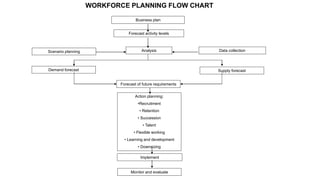
Forecast activity levels
Analysis
Scenario planning Data collection
Demand forecast Supply forecast
Forecast of future requirements
Action planning:
•Recruitment
• Retention
• Succession
• Talent
• Flexible working
• Learning and development
• Downsizing
Implement
Monitor and evaluate
Business plan
WORKFORCE PLANNING FLOW CHART
RECRUITMENT AND SELECTION: SESSION PLAN
1. The recruitment and selection process
2. Defining requirements
3. Person specification headings
4. Analyze recruitment strengths and weaknesses
5. Sources of candidates
6. Types of interviews
THE RECRUITMENT AND SELECTION PROCESS
The eight stages of recruitment and selection are:
1. Defining requirements
2. Attracting candidates
3. Sifting applications
4. Interviewing
5. Testing
6. Assessing candidates
7. Obtaining references
8. Checking applications
9. Offering employment
10.Following up
DEFINING REQUIREMENTS
Requirements are set out in the form of role
profiles and person specifications.
DEFINING REQUIREMENTS
• Role profiles
Role profiles define the overall purpose of the
role, its reporting relationships and the key
result areas. For recruiting purposes, the
profile is extended to include information on
terms and conditions (pay, benefits, and hours
of work), special requirements such as mobility,
travelling or unsocial hours, and learning,
development and career opportunities. The
recruitment role profile provides the basis for
a person specification.
DEFINING REQUIREMENTS
• Person specification
A person specification, also known as a
recruitment or job specification, defines the
knowledge, skills and abilities (KSAs) required
to carry out the role, the types of behaviour
expected from role holders (behavioural
competencies) and the education, qualifications,
training and experience needed to acquire the
necessary KSAs.
PERSON SPECIFICATION HEADINGS
• Knowledge
• Skills and abilities
• Behavioural competencies
• Qualifications and training
• Experience Specific demands
• Special requirements
PERSON SPECIFICATION HEADINGS
• A person specification, also known as a recruitment or
job specification, defines the knowledge, skills and
abilities (KSAs) required to carry out the role, the
types of behaviour expected from role holders
(behavioural competencies) and the education,
qualifications, training and experience needed to
acquire the necessary KSAs.
The specification is set out under the following
headings:
• Knowledge – what the individual needs to know to carry
out the role.
• Skills and abilities - what the individual has to be
able to do to carry out the role.
PERSON SPECIFICATION HEADINGS
• Behavioural competencies – the types of behaviour
required for successful performance of the role. These
should be role-specific, ideally based on an analysis
of employees who are carrying out their roles
effectively. The behaviours should also be linked to
the core values and competency framework of the
organization to help in ensuring that candidates will
fit and support the organization’s culture.
• Qualifications and training – the professional,
technical or academic qualifications required or the
training that the candidate should have undertaken.
• Experience - the types of achievements and activities
which would be likely to predict success.
PERSON SPECIFICATION HEADINGS
• Specific demands - anything that the role holder will
be expected to achieve in specified areas, eg develop
new markets or products, improve sales, productivity
or levels of customer service, introduce new systems or
processes
• Special requirements – travelling, unsocial hours,
mobility etc.
ANALYSE RECRUITMENT STRENGTHS AND
WEAKNESSES
• Attracting candidates is primarily a matter of
identifying, evaluating and using the most
appropriate sources of applicants.
• However, in cases where difficulties in
attracting or retaining candidates are being
met or anticipated, it may be necessary to
carry out a study of the factors that are
likely to attract or repel candidates - the
strengths and weakness of the organization as
an employer.
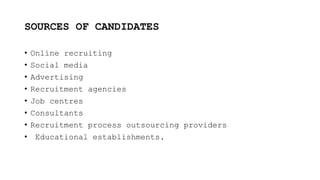
SOURCES OF CANDIDATES
• Online recruiting
• Social media
• Advertising
• Recruitment agencies
• Job centres
• Consultants
• Recruitment process outsourcing providers
• Educational establishments.
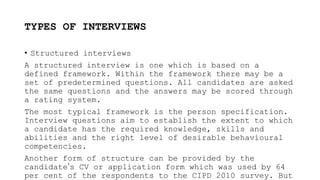
TYPES OF INTERVIEWS
• Structured interviews
A structured interview is one which is based on a
defined framework. Within the framework there may be a
set of predetermined questions. All candidates are asked
the same questions and the answers may be scored through
a rating system.
The most typical framework is the person specification.
Interview questions aim to establish the extent to which
a candidate has the required knowledge, skills and
abilities and the right level of desirable behavioural
competencies.
Another form of structure can be provided by the
candidate’s CV or application form which was used by 64
per cent of the respondents to the CIPD 2010 survey. But
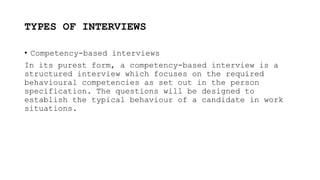
TYPES OF INTERVIEWS
• Competency-based interviews
In its purest form, a competency-based interview is a
structured interview which focuses on the required
behavioural competencies as set out in the person
specification. The questions will be designed to
establish the typical behaviour of a candidate in work
situations.
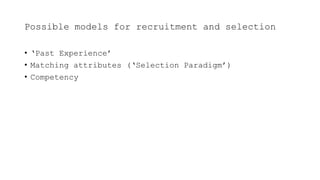
Possible models for recruitment and selection
• ‘Past Experience’
• Matching attributes (‘Selection Paradigm’)
• Competency
Past Experience
• An experienced hire is someone who has experience
working in the role you’re hiring for.
“Ever seen a job ad that asked for three, five, ten
years’ experience in a certain role, or field? They’re
looking for experienced hires”.
Past Experience
• The benefits of experienced hires over graduates
• Right mix of experience & energy: Grads might have all the
youthful enthusiasm in the world, but they’ll rarely bring any
experience to the table. On the other hand, anyone who’s been
in their field for 3-15 years will often offer the same
enthusiasm, the same energy, paired with useful knowledge that
they’re keen to contribute.
• They know what they like: With experienced hires, job
preference is less of an issue. They’ve spent time in their
industry, they know what they want, and they’re well on their
way down the career path they’ve chosen. This makes turnover
less likely.
• Hitting the ground running: take less time to settle in a new
role. They’ve got the knowledge to make an impact sooner than
their younger peers, and are often more self-aware when it
comes to gaps in their expertise.
Past Experience
• The drawbacks of experienced hires
• Experience & future potential: Academic research shows that
there’s no link between past experience and future performance.
So an experienced hire isn’t guaranteed to be a successful one.
• Cultural fit: Experienced hires will have come up in different
cultures, and will have learnt some behaviours that help them
thrive there. But these might not be your behaviours.
• Cost: Then there’s the elephant in the room – salary.
Experienced hires naturally cost more, but do they actually
bring more value?
Matching attributes
• A series of assessments is used to evaluate candidates
across multiple competencies that are relevant to and
predictive of success on the job. The results from
these assessments are combined into one score to help
recruiters make efficient and objective decisions about
candidates.
• You can effectively identify which candidates to move
forward in the recruitment process and which candidates
are likely not going to be successful on the job and
therefore should not be interviewed.
• Basically, matching technology does the hard work for
you so all you need to do is evaluate the candidate’s
score to see how well they fit your open role.
Why should you use matching technology?
• Faster candidate screening. Because you don’t need to
manually evaluate each candidate, you can weed through
hundreds of applicants quickly and easily––setting your
initial stages of the recruitment process off on the
right foot.
• Thorough analysis. It thoroughly evaluates each new
hire based on job-related criteria so you can make your
process more predictive of what success on the job
looks like.
Why should you use matching technology?
• Ensuring high performance. When you’re hiring the right
people for the job, you’re better ensuring that each
hire is capable of performing as best as possible in
their role.
• Consistent hiring decisions. When combined with the
standardized interview process, matching technology
enables you to make consistently stronger hiring
decisions across your entire organization and reduce
bias in your recruitment process.
Matching Technology
• In the matching process, candidates go through the
assessments for skills you’ve determined are important
through the job analysis, and their results are
compared to the benchmarks you’ve set.
• Matching technology allows you to make data-driven,
consistent, objective, and fair hiring decisions every
time––and without compromising on the quality of your
new employees.
• Although matching technology might not be right for
every single hiring situation, the skills and
competency-based approach can make your recruitment
processes overall more efficient.
Competency-based approach
• Also known as structured, behavioural or situational
interviews they are designed to test one or more skills
or competencies.
• With the competency-based approach, the criteria for
selection are objectively stated and the process is
systematic and disciplined.
• The goal of the interviews is to determine whether
individuals possess the competencies necessary to
achieve exemplary work results.
Competency-based approach
• This may be done by requesting work samples from
experienced applicants or examining work histories for
the behavioral anchors associated with the desired
competencies.
• Consequently, selections are based on data rather than
opinions.
• HR practitioners frequently comment that competency-
based selection is probably one of the fairest and
therefore most defensible approaches their
organizations have used.
Competency-based approach
• Selection methods generally fall into two categories.
• assessing the individual's ability to perform the
work. Methods in this category are competency based.
(One example might be job applications that seek
information about individual competencies instead of
work history or credentials that may not be directly
related to proven performance)
Competency-based approach
• Selection methods generally fall into two categories.
• preparation of structured interview guides to
solicit information about competencies linked to
successful or exemplary performance and the
behavioral indicators associated with them.
(Methods in the second category address the
individual's fitness to perform and take into
consideration additional requirements, such as drug
tests and medical examinations, that are peripheral to
an applicant's ability to perform).
Competency-based Human Resource management
• ‘ … using the notion of competency and the
results of competency analysis to inform
and improve the processes of performance
management, recruitment and selection,
learning and development, performance,
employee development and employee reward’.
Armstrong (2014; p.86 )
SELECTION TESTS
Selection tests are used to provide valid and
reliable evidence of levels of abilities, intelligence,
personality characteristics, aptitudes and attainments.
SELECTION TESTS
• Psychological or psychometric tests
Psychological or psychometric tests measure or assess
intelligence or personality. They use systematic and
standardized procedures to measure differences in
individual characteristics thus enabling selectors to
gain a greater understanding of candidates to help in
predicting the extent to which they will be successful
in a job. Psychological tests are measuring instruments,
which is why they are often referred to as psychometric
tests. ‘Psychometric’ literally means mental measurement.
• Intelligence tests
Intelligence tests measure a range of mental abilities
which enable a person to succeed at a variety of
intellectual tasks using the faculties of abstract
SELECTION TESTS
• Ability tests
Ability tests establish what people are capable of
knowing or doing.
• Personality tests
Personality tests attempt to assess the personality of
candidates in order to make predictions about their
likely behaviour in a role.
• Aptitude tests
Aptitude tests are occupational or job-related tests
that assess the extent to which people can do the work.
Recruitment and selection
• False positives – erroneous acceptances
where candidates are selected but prove to
perform inadequately
• False negatives – erroneous rejections
where applicants who would have performed
competently are rejected
• Raising the criteria for selection reduces
the chance of false positives but
increases the chance of false negatives
Strategic Selection
• A diverse workforce – more talent but
need for equality and for legal
compliance
• Increasing the need for more highly
educated and trained employees
• The need for a close relationship between
HRM strategy and corporate strategy
• Organizations are now more likely to use
sophisticated techniques for recruitment
and selection for all employees
Common Selection Techniques
• Information from application forms, CVs
and references
• Interviews
• Tests including psychometric tests and
personality profiles
• ‘E-recruitment’ – the use of new
technology including social media
• Assessment Centres
Limitations of Interviews
• Interviewers:
• pay too much attention to first
impressions.
• tend to compare candidates to
stereotypes.
• are prone to falling for contrast
effects.
• are liable to be influenced by halo
effects.
• tend to make decisions very early in the
interview.
Psychological testing
• Three main categories:
• intelligence tests
• ability and aptitude tests
• personality tests
• Controversial (especially personality
assessment) but increasingly popular
• To be useful, tests must be properly
designed, administered and interpreted
Psychometric testing
• Psychometric intelligence tests seek to measure:
− IQ (intelligence quotient).
− Learning capacity.
− The application of new knowledge.
− Specific analysis and synthesis skills.
− The capacity and facility for decision-making.
− Initiative and proactivity in problem-solving.
− Adaptation to changes.
Assessment Centres
• Use multiple assessment techniques
• Observation by multiple observers
• Trained assessors
• Separation of observation and evaluation
• Are particularly successful in evaluation
of management potential
Effectiveness of selection techniques
• No single method is simultaneously high on
validity, fairness and applicability and
low on cost: so trade-offs are needed.
• Biographical data is high on validity and
applicability and low on cost, but only
moderate on fairness.
• Assessment centres, work samples and
biographical information score highest on
validity.
• Interviewing is low on validity, moderate
on fairness, high on applicability and low
on cost.
• Personality tests are moderate on validity,
high on fairness, low on applicability and
moderate on cost.
• Assessment centres are high on validity,
DEALING WITH RECRUITMENT PROBLEMS
• Ensure that all the possible sources of candidates have
been used.
• Consider any ways in which the advertisement or website
entry could be made more attractive.
• Check that the person specification is realistic
• Consider whether it might be necessary to improve the
package offered to candidates
• Examine the possibility of reshaping the role to
increase its attractiveness.
• Consider alternative ways of carrying out the work
involved with existing staff.
CHARACTERISTICS OF A GOOD TEST
A good test is one that provides valid data
which enable reliable predictions of behaviour
or performance to be made and therefore assists
in the process of making objective and reasoned
decisions when selecting people for jobs.
A good test will be based on research that has
produced standardized criteria derived by using
the same measure to test a number of
representative people to produce a set of
‘norms’ for comparison purposes. The test should
be capable of being objectively scored by
CHARACTERISTICS OF A GOOD TEST
The two key characteristics of a good test are
that:
1.It is reliable in the sense that it always
measures the same thing. A test aimed at
measuring a particular characteristic, such as
intelligence, should measure the same
characteristic when applied to different people
at the same or a different time or to the same
person at different times.
2.It is valid in the sense that it measures the
characteristic the test is intended to measure.
Thus, an intelligence test should measure
intelligence (however defined) and not simply
TALENT MANAGEMENT DEFINED
Talent management is the process of ensuring
that the organization has the talented people
it needs to attain its business goals.
WHAT IS TALENT?
Talent is what people have when they
possess the skills, abilities and
aptitudes which enable them to perform
effectively in their roles.
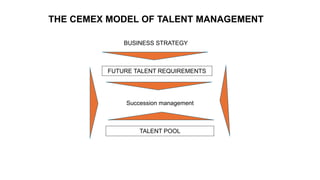
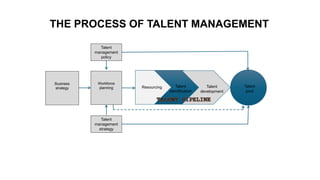
FUTURE TALENT REQUIREMENTS
TALENT POOL
BUSINESS STRATEGY
Succession management
THE CEMEX MODEL OF TALENT MANAGEMENT
Business
strategy
Workforce
planning Resourcing Talent
identification
Talent
development
Talent
pool
Talent
management
policy
Talent
management
strategy
THE PROCESS OF TALENT MANAGEMENT
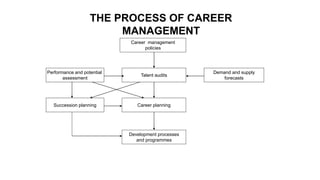
Talent audits
Career management
policies
Career planning
Development processes
and programmes
Performance and potential
assessment
Succession planning
Demand and supply
forecasts
THE PROCESS OF CAREER
MANAGEMENT
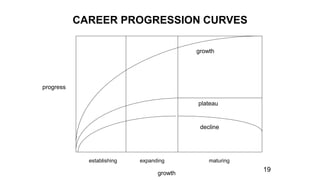
growth
plateau
decline
progress
growth
establishing expanding maturing
CAREER PROGRESSION CURVES
19
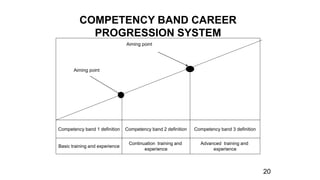
Competency band 1 definition Competency band 2 definition Competency band 3 definition
Basic training and experience
Continuation training and
experience
Advanced training and
experience
Aiming point
Aiming point
COMPETENCY BAND CAREER
PROGRESSION SYSTEM
20
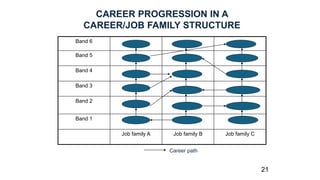
Band 6
Band 5
Band 4
Band 3
Band 2
Band 1
Job family A Job family B Job family C
Career path
CAREER PROGRESSION IN A
CAREER/JOB FAMILY STRUCTURE
21
EMPLOYEE TURNOVER
Employee turnover (sometimes known as ‘labour
turnover, ‘wastage’ or ‘attrition’) is the rate at which
people leave an organization.
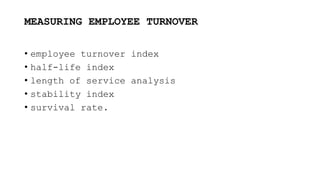
MEASURING EMPLOYEE TURNOVER
• employee turnover index
• half-life index
• length of service analysis
• stability index
• survival rate.
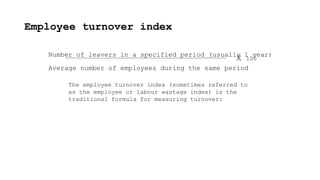
Employee turnover index
Number of leavers in a specified period (usually 1 year)
Average number of employees during the same period
X 100
The employee turnover index (sometimes referred to
as the employee or labour wastage index) is the
traditional formula for measuring turnover:
Half-Life Index
The half-life index measures the average length of time an employee stays
with the organization before leaving. It's calculated by dividing the number of
employees who left during the period by the number of employees at the
start of the period, then multiplying by the length of the period. This gives an
indication of the turnover rate over time.
Length of Service Analysis
This method analyzes the distribution of employee tenure within the
organization. It involves categorizing employees based on the length of their
service (e.g., less than one year, 1-5 years, 5-10 years, etc.) to understand
patterns of retention and turnover.
Stability Index
The stability index measures the proportion of employees who have
remained with the organization for a certain period, often expressed as a
percentage. It provides insights into the organization's ability to retain
employees over time.
Survival Rate
Survival rate refers to the percentage of employees who remain with the
organization for a specified period, typically expressed as the percentage of
employees who stay beyond their first year of employment. It's a measure of
retention and can help identify factors influencing employee turnover.
THE COST OF EMPLOYEE TURNOVER
The cost of employee turnover can be considerable.
The CIPD 2008 survey established that the average cost
per employee was £5,800, rising to £20,000 for senior
managers or directors.
FACTORS AFFECTING
RETENTION
Retention strategies should be based on an
understanding of the factors that affect
whether or not employees leave or stay. These
include:
• company image (the employer brand)
• the employee value proposition – what the
employer offers in the shape of terms and
conditions of employment
• the effectiveness of recruitment, selection
and deployment (fitting people into jobs
that suit them
• leadership – ‘employees join companies and
leave managers’
• social factors (the extent to which
RISK OF LEAVING ANALYSIS
Risk analysis can be carried out by initially
identifying potential risk areas – the key
people who may leave and, for each of them,
as individuals or groups, estimate:
• the likelihood of this occurring
• how serious the effects of a loss would be
on the business
• the ease with which a replacement could be
made and the replacement costs
ANALYSIS OF REASONS FOR LEAVING
An analysis of leaving interviews can provide
information on reasons for leaving, for
example:
• more pay
• better prospects (career move;
• more security
• more opportunity to develop skills
• unable to cope with job
• better working conditions
• poor relationships with manager/team leade;
• poor relationships with colleagues
• bullying or harassment
• personal – pregnancy, illness, moving away
from area, etc
AREAS FOR ACTION
Depending on the outcome of the risk and reasons for
leaving analyses the possible actions that can be taken
are:
• Ensure that selection and promotion procedures match
the capacities of individuals to the demands of the
work they have to do.
• Reduce the losses of people who cannot adjust to
their new job – the ‘induction crisis’ – by giving
them proper training and support when they join the
organization.
• Design jobs to maximize skill variety, task
significance, autonomy, control over work and
feedback, and ensure that they provide opportunities
for learning and growth.
• Deal with uncompetitive, inequitable or unfair pay
systems.
• Encourage the development of social ties within the
company.
• Take steps to improve work–life balance.

5-Employee Resourcing .ppt...........................

  • 1.
  • 2.
    EMPLOYEE RESOURCING Employee resourcinginvolves: • Workforce planning • Developing the organization’s employee value proposition and its employer brand • Recruitment and selection • Talent management • Retention
  • 3.
    EMPLOYEE RESOURCING Employee resourcinginvolves: • Workforce planning, alternatively called human resource planning, as workforce planning) - assessing future business needs and deciding on deciding on the numbers and types of people required. • Developing the organization’s employee value proposition and its employer brand – the employee value proposition is what an organization has to offer which prospective or existing employees would value and which would help to persuade them to join or remain with the business; employer brand is the image presented by an organization as a good employer.
  • 4.
    EMPLOYEE RESOURCING Employee resourcinginvolves: • Resourcing plans – preparing plans for finding people from within the organization and/or for learning and development programmes to help people learn new skills. If needs cannot be satisfied from within the organization, it involves preparing longer-term plans for ensuring that recruitment and selection processes will satisfy them • Retention – preparing plans for retaining the people the organization needs. • Flexibility – planning for increased flexibility in the use of human resources to enable the organization to
  • 5.
    EMPLOYEE RESOURCING Employee resourcinginvolves: • Talent management - ensuring that the organization has the talented people it requires to provide for management succession and meet present and future business needs.
  • 6.
    WORKFORCE PLANNING DEFINED Workforceplanning is a core process of human resource management that is shaped by the organizational strategy and ensures the right number of people with the right skills, in the right place at the right time to deliver short- and long-term organizational objectives. CIPD (2010)
  • 7.
    INCIDENCE OF WORKFORCEPLANNING The CIPD (2010) research revealed that the top five planning activities were: • succession planning - 62% • flexible working – 53% • demand supply forecasting – 53% • skills audit/gap analysis – 49%
  • 8.
    LINK TO BUSINESSPLANNING Workforce planning is an integral part of business planning. • The strategic planning process defines projected changes in the types of activities carried out by the organization and the scale of those activities. It identifies the core competencies the organization needs to achieve its goals and therefore its skill and behavioural requirements. • Workforce planning interprets these plans in terms of people requirements. But it may influence the business strategy by drawing attention to ways in which people could be developed and deployed more effectively to further the achievement of business goals as well as focusing on any problems that might have to be resolved
  • 9.
    THE RATIONALE FORWORKFORCE PLANNING Workforce planning provides the basis for a systematic approach to assessing the number and type of people needed by an organization.
  • 10.
    WORKFORCE PLANNING ISSUES Theimpact of change and the difficulty of predicting the future. • It can be very hard to forecast the demand for or supply of people with any accuracy. • The tendency in many organizations is therefore to adopt a short-term approach and deal with deficits or surpluses of people as they arise. • It sounds like a good idea to adopt an integrated approach to workforce and business planning but it won’t work well if business plans are vague, misleading or non-existent, as they easily can be. • This problem will not be so acute in a stable market place, with largely passive (and static) customers, and
  • 11.
    Forecast activity levels Analysis Scenarioplanning Data collection Demand forecast Supply forecast Forecast of future requirements Action planning: •Recruitment • Retention • Succession • Talent • Flexible working • Learning and development • Downsizing Implement Monitor and evaluate Business plan WORKFORCE PLANNING FLOW CHART
  • 12.
    RECRUITMENT AND SELECTION:SESSION PLAN 1. The recruitment and selection process 2. Defining requirements 3. Person specification headings 4. Analyze recruitment strengths and weaknesses 5. Sources of candidates 6. Types of interviews
  • 13.
    THE RECRUITMENT ANDSELECTION PROCESS The eight stages of recruitment and selection are: 1. Defining requirements 2. Attracting candidates 3. Sifting applications 4. Interviewing 5. Testing 6. Assessing candidates 7. Obtaining references 8. Checking applications 9. Offering employment 10.Following up
  • 14.
    DEFINING REQUIREMENTS Requirements areset out in the form of role profiles and person specifications.
  • 15.
    DEFINING REQUIREMENTS • Roleprofiles Role profiles define the overall purpose of the role, its reporting relationships and the key result areas. For recruiting purposes, the profile is extended to include information on terms and conditions (pay, benefits, and hours of work), special requirements such as mobility, travelling or unsocial hours, and learning, development and career opportunities. The recruitment role profile provides the basis for a person specification.
  • 16.
    DEFINING REQUIREMENTS • Personspecification A person specification, also known as a recruitment or job specification, defines the knowledge, skills and abilities (KSAs) required to carry out the role, the types of behaviour expected from role holders (behavioural competencies) and the education, qualifications, training and experience needed to acquire the necessary KSAs.
  • 17.
    PERSON SPECIFICATION HEADINGS •Knowledge • Skills and abilities • Behavioural competencies • Qualifications and training • Experience Specific demands • Special requirements
  • 18.
    PERSON SPECIFICATION HEADINGS •A person specification, also known as a recruitment or job specification, defines the knowledge, skills and abilities (KSAs) required to carry out the role, the types of behaviour expected from role holders (behavioural competencies) and the education, qualifications, training and experience needed to acquire the necessary KSAs. The specification is set out under the following headings: • Knowledge – what the individual needs to know to carry out the role. • Skills and abilities - what the individual has to be able to do to carry out the role.
  • 19.
    PERSON SPECIFICATION HEADINGS •Behavioural competencies – the types of behaviour required for successful performance of the role. These should be role-specific, ideally based on an analysis of employees who are carrying out their roles effectively. The behaviours should also be linked to the core values and competency framework of the organization to help in ensuring that candidates will fit and support the organization’s culture. • Qualifications and training – the professional, technical or academic qualifications required or the training that the candidate should have undertaken. • Experience - the types of achievements and activities which would be likely to predict success.
  • 20.
    PERSON SPECIFICATION HEADINGS •Specific demands - anything that the role holder will be expected to achieve in specified areas, eg develop new markets or products, improve sales, productivity or levels of customer service, introduce new systems or processes • Special requirements – travelling, unsocial hours, mobility etc.
  • 21.
    ANALYSE RECRUITMENT STRENGTHSAND WEAKNESSES • Attracting candidates is primarily a matter of identifying, evaluating and using the most appropriate sources of applicants. • However, in cases where difficulties in attracting or retaining candidates are being met or anticipated, it may be necessary to carry out a study of the factors that are likely to attract or repel candidates - the strengths and weakness of the organization as an employer.
  • 22.
    SOURCES OF CANDIDATES •Online recruiting • Social media • Advertising • Recruitment agencies • Job centres • Consultants • Recruitment process outsourcing providers • Educational establishments.
  • 23.
    TYPES OF INTERVIEWS •Structured interviews A structured interview is one which is based on a defined framework. Within the framework there may be a set of predetermined questions. All candidates are asked the same questions and the answers may be scored through a rating system. The most typical framework is the person specification. Interview questions aim to establish the extent to which a candidate has the required knowledge, skills and abilities and the right level of desirable behavioural competencies. Another form of structure can be provided by the candidate’s CV or application form which was used by 64 per cent of the respondents to the CIPD 2010 survey. But
  • 24.
    TYPES OF INTERVIEWS •Competency-based interviews In its purest form, a competency-based interview is a structured interview which focuses on the required behavioural competencies as set out in the person specification. The questions will be designed to establish the typical behaviour of a candidate in work situations.
  • 25.
    Possible models forrecruitment and selection • ‘Past Experience’ • Matching attributes (‘Selection Paradigm’) • Competency
  • 26.
    Past Experience • Anexperienced hire is someone who has experience working in the role you’re hiring for. “Ever seen a job ad that asked for three, five, ten years’ experience in a certain role, or field? They’re looking for experienced hires”.
  • 27.
    Past Experience • Thebenefits of experienced hires over graduates • Right mix of experience & energy: Grads might have all the youthful enthusiasm in the world, but they’ll rarely bring any experience to the table. On the other hand, anyone who’s been in their field for 3-15 years will often offer the same enthusiasm, the same energy, paired with useful knowledge that they’re keen to contribute. • They know what they like: With experienced hires, job preference is less of an issue. They’ve spent time in their industry, they know what they want, and they’re well on their way down the career path they’ve chosen. This makes turnover less likely. • Hitting the ground running: take less time to settle in a new role. They’ve got the knowledge to make an impact sooner than their younger peers, and are often more self-aware when it comes to gaps in their expertise.
  • 28.
    Past Experience • Thedrawbacks of experienced hires • Experience & future potential: Academic research shows that there’s no link between past experience and future performance. So an experienced hire isn’t guaranteed to be a successful one. • Cultural fit: Experienced hires will have come up in different cultures, and will have learnt some behaviours that help them thrive there. But these might not be your behaviours. • Cost: Then there’s the elephant in the room – salary. Experienced hires naturally cost more, but do they actually bring more value?
  • 29.
    Matching attributes • Aseries of assessments is used to evaluate candidates across multiple competencies that are relevant to and predictive of success on the job. The results from these assessments are combined into one score to help recruiters make efficient and objective decisions about candidates. • You can effectively identify which candidates to move forward in the recruitment process and which candidates are likely not going to be successful on the job and therefore should not be interviewed. • Basically, matching technology does the hard work for you so all you need to do is evaluate the candidate’s score to see how well they fit your open role.
  • 30.
    Why should youuse matching technology? • Faster candidate screening. Because you don’t need to manually evaluate each candidate, you can weed through hundreds of applicants quickly and easily––setting your initial stages of the recruitment process off on the right foot. • Thorough analysis. It thoroughly evaluates each new hire based on job-related criteria so you can make your process more predictive of what success on the job looks like.
  • 31.
    Why should youuse matching technology? • Ensuring high performance. When you’re hiring the right people for the job, you’re better ensuring that each hire is capable of performing as best as possible in their role. • Consistent hiring decisions. When combined with the standardized interview process, matching technology enables you to make consistently stronger hiring decisions across your entire organization and reduce bias in your recruitment process.
  • 32.
    Matching Technology • Inthe matching process, candidates go through the assessments for skills you’ve determined are important through the job analysis, and their results are compared to the benchmarks you’ve set. • Matching technology allows you to make data-driven, consistent, objective, and fair hiring decisions every time––and without compromising on the quality of your new employees. • Although matching technology might not be right for every single hiring situation, the skills and competency-based approach can make your recruitment processes overall more efficient.
  • 33.
    Competency-based approach • Alsoknown as structured, behavioural or situational interviews they are designed to test one or more skills or competencies. • With the competency-based approach, the criteria for selection are objectively stated and the process is systematic and disciplined. • The goal of the interviews is to determine whether individuals possess the competencies necessary to achieve exemplary work results.
  • 34.
    Competency-based approach • Thismay be done by requesting work samples from experienced applicants or examining work histories for the behavioral anchors associated with the desired competencies. • Consequently, selections are based on data rather than opinions. • HR practitioners frequently comment that competency- based selection is probably one of the fairest and therefore most defensible approaches their organizations have used.
  • 35.
    Competency-based approach • Selectionmethods generally fall into two categories. • assessing the individual's ability to perform the work. Methods in this category are competency based. (One example might be job applications that seek information about individual competencies instead of work history or credentials that may not be directly related to proven performance)
  • 36.
    Competency-based approach • Selectionmethods generally fall into two categories. • preparation of structured interview guides to solicit information about competencies linked to successful or exemplary performance and the behavioral indicators associated with them. (Methods in the second category address the individual's fitness to perform and take into consideration additional requirements, such as drug tests and medical examinations, that are peripheral to an applicant's ability to perform).
  • 37.
    Competency-based Human Resourcemanagement • ‘ … using the notion of competency and the results of competency analysis to inform and improve the processes of performance management, recruitment and selection, learning and development, performance, employee development and employee reward’. Armstrong (2014; p.86 )
  • 38.
    SELECTION TESTS Selection testsare used to provide valid and reliable evidence of levels of abilities, intelligence, personality characteristics, aptitudes and attainments.
  • 39.
    SELECTION TESTS • Psychologicalor psychometric tests Psychological or psychometric tests measure or assess intelligence or personality. They use systematic and standardized procedures to measure differences in individual characteristics thus enabling selectors to gain a greater understanding of candidates to help in predicting the extent to which they will be successful in a job. Psychological tests are measuring instruments, which is why they are often referred to as psychometric tests. ‘Psychometric’ literally means mental measurement. • Intelligence tests Intelligence tests measure a range of mental abilities which enable a person to succeed at a variety of intellectual tasks using the faculties of abstract
  • 40.
    SELECTION TESTS • Abilitytests Ability tests establish what people are capable of knowing or doing. • Personality tests Personality tests attempt to assess the personality of candidates in order to make predictions about their likely behaviour in a role. • Aptitude tests Aptitude tests are occupational or job-related tests that assess the extent to which people can do the work.
  • 41.
    Recruitment and selection •False positives – erroneous acceptances where candidates are selected but prove to perform inadequately • False negatives – erroneous rejections where applicants who would have performed competently are rejected • Raising the criteria for selection reduces the chance of false positives but increases the chance of false negatives
  • 42.
    Strategic Selection • Adiverse workforce – more talent but need for equality and for legal compliance • Increasing the need for more highly educated and trained employees • The need for a close relationship between HRM strategy and corporate strategy • Organizations are now more likely to use sophisticated techniques for recruitment and selection for all employees
  • 43.
    Common Selection Techniques •Information from application forms, CVs and references • Interviews • Tests including psychometric tests and personality profiles • ‘E-recruitment’ – the use of new technology including social media • Assessment Centres
  • 44.
    Limitations of Interviews •Interviewers: • pay too much attention to first impressions. • tend to compare candidates to stereotypes. • are prone to falling for contrast effects. • are liable to be influenced by halo effects. • tend to make decisions very early in the interview.
  • 45.
    Psychological testing • Threemain categories: • intelligence tests • ability and aptitude tests • personality tests • Controversial (especially personality assessment) but increasingly popular • To be useful, tests must be properly designed, administered and interpreted
  • 46.
    Psychometric testing • Psychometricintelligence tests seek to measure: − IQ (intelligence quotient). − Learning capacity. − The application of new knowledge. − Specific analysis and synthesis skills. − The capacity and facility for decision-making. − Initiative and proactivity in problem-solving. − Adaptation to changes.
  • 47.
    Assessment Centres • Usemultiple assessment techniques • Observation by multiple observers • Trained assessors • Separation of observation and evaluation • Are particularly successful in evaluation of management potential
  • 48.
    Effectiveness of selectiontechniques • No single method is simultaneously high on validity, fairness and applicability and low on cost: so trade-offs are needed. • Biographical data is high on validity and applicability and low on cost, but only moderate on fairness. • Assessment centres, work samples and biographical information score highest on validity. • Interviewing is low on validity, moderate on fairness, high on applicability and low on cost. • Personality tests are moderate on validity, high on fairness, low on applicability and moderate on cost. • Assessment centres are high on validity,
  • 49.
    DEALING WITH RECRUITMENTPROBLEMS • Ensure that all the possible sources of candidates have been used. • Consider any ways in which the advertisement or website entry could be made more attractive. • Check that the person specification is realistic • Consider whether it might be necessary to improve the package offered to candidates • Examine the possibility of reshaping the role to increase its attractiveness. • Consider alternative ways of carrying out the work involved with existing staff.
  • 50.
    CHARACTERISTICS OF AGOOD TEST A good test is one that provides valid data which enable reliable predictions of behaviour or performance to be made and therefore assists in the process of making objective and reasoned decisions when selecting people for jobs. A good test will be based on research that has produced standardized criteria derived by using the same measure to test a number of representative people to produce a set of ‘norms’ for comparison purposes. The test should be capable of being objectively scored by
  • 51.
    CHARACTERISTICS OF AGOOD TEST The two key characteristics of a good test are that: 1.It is reliable in the sense that it always measures the same thing. A test aimed at measuring a particular characteristic, such as intelligence, should measure the same characteristic when applied to different people at the same or a different time or to the same person at different times. 2.It is valid in the sense that it measures the characteristic the test is intended to measure. Thus, an intelligence test should measure intelligence (however defined) and not simply
  • 52.
    TALENT MANAGEMENT DEFINED Talentmanagement is the process of ensuring that the organization has the talented people it needs to attain its business goals.
  • 53.
    WHAT IS TALENT? Talentis what people have when they possess the skills, abilities and aptitudes which enable them to perform effectively in their roles.
  • 54.
    FUTURE TALENT REQUIREMENTS TALENTPOOL BUSINESS STRATEGY Succession management THE CEMEX MODEL OF TALENT MANAGEMENT
  • 55.
  • 56.
    Talent audits Career management policies Careerplanning Development processes and programmes Performance and potential assessment Succession planning Demand and supply forecasts THE PROCESS OF CAREER MANAGEMENT
  • 57.
  • 58.
    Competency band 1definition Competency band 2 definition Competency band 3 definition Basic training and experience Continuation training and experience Advanced training and experience Aiming point Aiming point COMPETENCY BAND CAREER PROGRESSION SYSTEM 20
  • 59.
    Band 6 Band 5 Band4 Band 3 Band 2 Band 1 Job family A Job family B Job family C Career path CAREER PROGRESSION IN A CAREER/JOB FAMILY STRUCTURE 21
  • 60.
    EMPLOYEE TURNOVER Employee turnover(sometimes known as ‘labour turnover, ‘wastage’ or ‘attrition’) is the rate at which people leave an organization.
  • 61.
    MEASURING EMPLOYEE TURNOVER •employee turnover index • half-life index • length of service analysis • stability index • survival rate.
  • 62.
    Employee turnover index Numberof leavers in a specified period (usually 1 year) Average number of employees during the same period X 100 The employee turnover index (sometimes referred to as the employee or labour wastage index) is the traditional formula for measuring turnover:
  • 63.
    Half-Life Index The half-lifeindex measures the average length of time an employee stays with the organization before leaving. It's calculated by dividing the number of employees who left during the period by the number of employees at the start of the period, then multiplying by the length of the period. This gives an indication of the turnover rate over time.
  • 64.
    Length of ServiceAnalysis This method analyzes the distribution of employee tenure within the organization. It involves categorizing employees based on the length of their service (e.g., less than one year, 1-5 years, 5-10 years, etc.) to understand patterns of retention and turnover.
  • 65.
    Stability Index The stabilityindex measures the proportion of employees who have remained with the organization for a certain period, often expressed as a percentage. It provides insights into the organization's ability to retain employees over time.
  • 66.
    Survival Rate Survival raterefers to the percentage of employees who remain with the organization for a specified period, typically expressed as the percentage of employees who stay beyond their first year of employment. It's a measure of retention and can help identify factors influencing employee turnover.
  • 67.
    THE COST OFEMPLOYEE TURNOVER The cost of employee turnover can be considerable. The CIPD 2008 survey established that the average cost per employee was £5,800, rising to £20,000 for senior managers or directors.
  • 68.
    FACTORS AFFECTING RETENTION Retention strategiesshould be based on an understanding of the factors that affect whether or not employees leave or stay. These include: • company image (the employer brand) • the employee value proposition – what the employer offers in the shape of terms and conditions of employment • the effectiveness of recruitment, selection and deployment (fitting people into jobs that suit them • leadership – ‘employees join companies and leave managers’ • social factors (the extent to which
  • 69.
    RISK OF LEAVINGANALYSIS Risk analysis can be carried out by initially identifying potential risk areas – the key people who may leave and, for each of them, as individuals or groups, estimate: • the likelihood of this occurring • how serious the effects of a loss would be on the business • the ease with which a replacement could be made and the replacement costs
  • 70.
    ANALYSIS OF REASONSFOR LEAVING An analysis of leaving interviews can provide information on reasons for leaving, for example: • more pay • better prospects (career move; • more security • more opportunity to develop skills • unable to cope with job • better working conditions • poor relationships with manager/team leade; • poor relationships with colleagues • bullying or harassment • personal – pregnancy, illness, moving away from area, etc
  • 71.
    AREAS FOR ACTION Dependingon the outcome of the risk and reasons for leaving analyses the possible actions that can be taken are: • Ensure that selection and promotion procedures match the capacities of individuals to the demands of the work they have to do. • Reduce the losses of people who cannot adjust to their new job – the ‘induction crisis’ – by giving them proper training and support when they join the organization. • Design jobs to maximize skill variety, task significance, autonomy, control over work and feedback, and ensure that they provide opportunities for learning and growth. • Deal with uncompetitive, inequitable or unfair pay systems. • Encourage the development of social ties within the company. • Take steps to improve work–life balance.