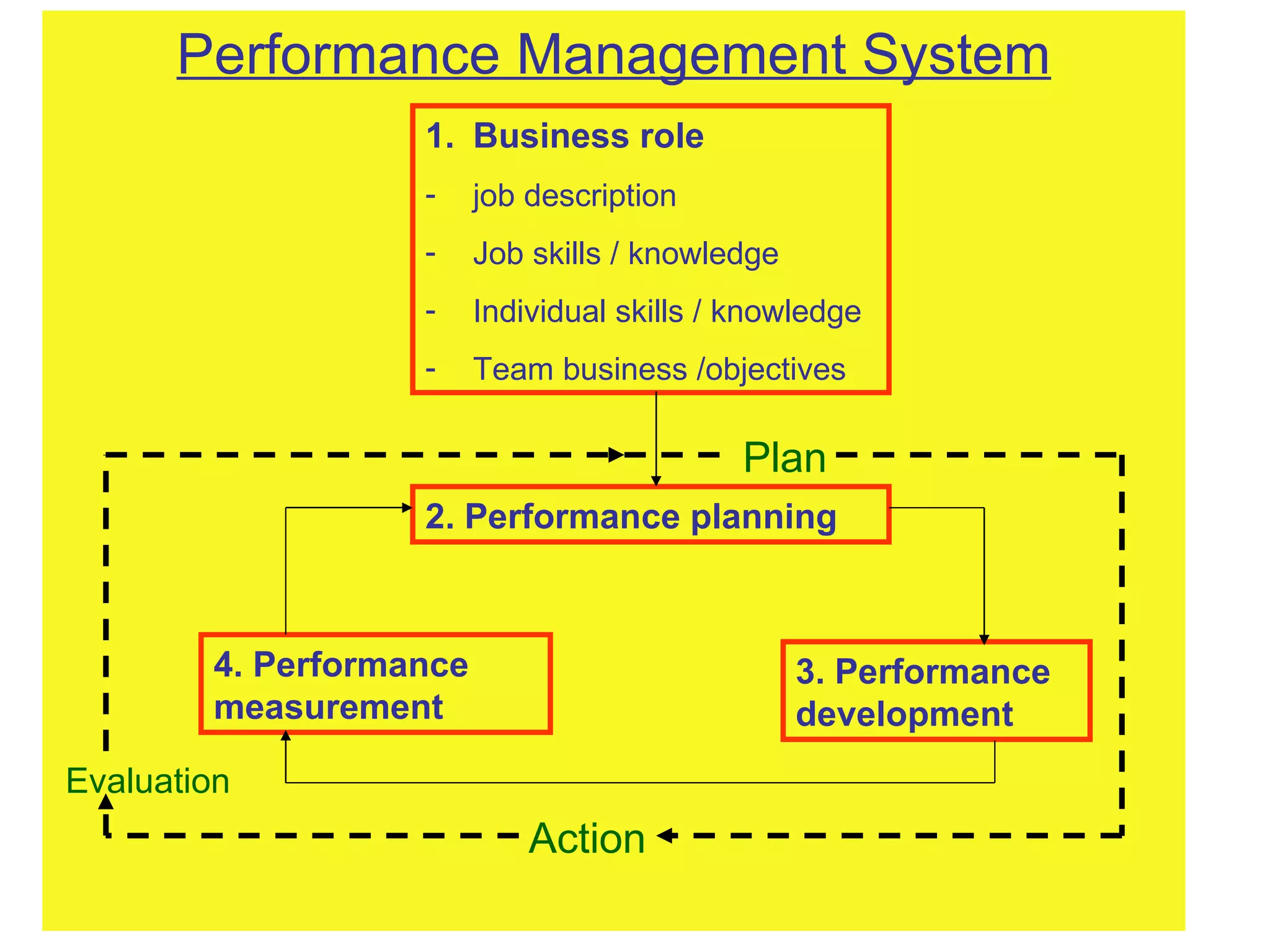
Performance Management System Business role job description Job skills / knowledge Individual skills / knowledge Team business /objectives 2. Performance planning  3. Performance development 4. Performance measurement Plan  Action Evaluation
Performance Management ‘ A process that significantly affects organizational success by having managers and employees work together to set expectations, review results, and reward performance.’ ‘ A means whereby employees’ work behaviours are aligned with the organization’s goals.’
Performance appraisal ‘ A formal system of periodic review and evaluation of an individual’s or team’s job performance.’ Source: Mondy, W., Noe,R.,and Premeaux,S.,(2002) ‘Human Resource Management’, Prentice Hall ‘ the process by which an employee’s contribution to the organization during a specified period of time is assessed.’ Fisher, C., Schoenfeldt,L., and Shaw,J., ‘Human Resource Management’,(1996),pp. 450, Houghton Mifflin Company
Performance appraisal and performance management One current problem which performance appraisal faces is that the term is often used synonymously with that of "performance management” (NHS Scotland,1993). Yet performance management is clearly more than a new name for performance appraisal.  Fletcher defines  performance management  as: ‘ an approach to creating a shared vision of the purpose and aims of the organisation, helping each individual employee understand and recognise their part in contributing to them, and in so doing manage and enhance the performance of both individuals and the organization.’
performance management therefore implies the integration, at both conceptual and practical levels, of what are experienced currently as a series of quite diverse initiatives. These include:  business planning;  benchmarking;  non-pay rewards;  competence-based education and training;  clinical audit;  performance-related pay;  performance indicators;  use of assessment and development centres.  Plus, of course, performance appraisal.
Most appraisal processes have three parts: Defining performance- it is preferable to link individual performance to organizational objectives Measuring performance: this may include multiple types of performance criteria. Feedback and coaching: employees need feedback on their past performance and help to meet the next performance targets.
Purpose  of performance appraisal improvement in the communication between boss and subordinate through the use of feedback between them   Aids human resource planning Performance assessments may be useful in predicting the performance of job applicants Identifies training needs Aids career planning and development Employed to determine reward and remuneration Linked to employee relations decisions Assess employee potential
Performance appraisal methods 360-degree feedback – A multirater evaluation that involves input from multiple levels within the firm and external sources as well. 2. Rating scales – Employees are rated according to defined factors. 3. Critical incident – consists of a written record of highly favourable and highly unfavourable employee work. 4. Essay – the rater records a brief narrative describing an employee’s performance. 5. Work standards – employee’s performance is compared to a predetermined standard level of output.
Performance appraisal methods 1. Ranking [alternation] – the rater places the appraisees in rank order of overall performance. 2. Paired comparison – every employee to be rated is paired with and compared to every other subordinate on each trait. 3. Forced distribution – the rater is required to assign individuals in a work group to a limited number of categories similar to a normal frequency distribution. 4. Forced-choice – the rater is given a series of statements about an individual and indicates which items are most or least descriptive of the employee.
5.  360-degree feedback – A multirater evaluation that involves input from multiple levels within the firm and external sources as well. 6. Behaviourally Anchored Rating Scales – this combines elements of the traditional rating scale and critical incident methods. 7. Results based systems [Management by Objectives (MBO)] – the manager and the subordinate jointly agree on objectives for the next appraisal period. 8. Assessment centres -
Problems in Performance appraisal Lack of objectivity Halo error Leniency / strictness Central tendency Recent behaviour bias Personal bias Manipulating the evaluation
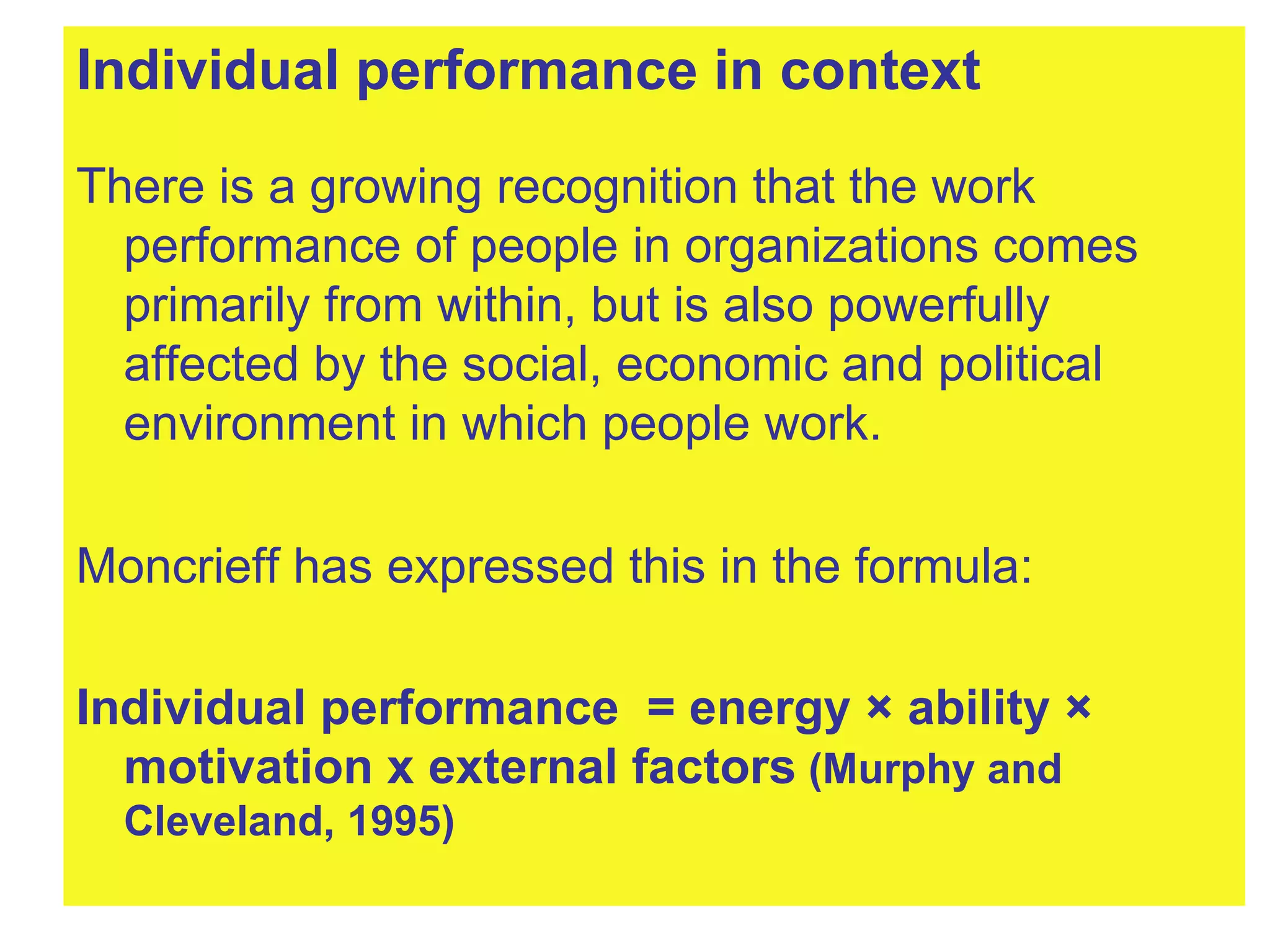
Individual performance in context There is a growing recognition that the work performance of people in organizations comes primarily from within, but is also powerfully affected by the social, economic and political environment in which people work.  Moncrieff has expressed this in the formula: Individual performance  = energy × ability × motivation x external factors  (Murphy and Cleveland, 1995)
The Appraisal interview Preparing for the interview (preview job description / appraisals) Scheduling the interview  (date, time, duration, venue)  Employee’s role Interview structure Purpose, aims and objectives /qualitative /quantitative Overview of the process Meeting skills, procedures and practice
The Appraisal interview cont. Use of praise and criticism Computer software Concluding the interview - review process and meeting Source: Mondy, Wayne, Noe, Robert, and Premeaux, Shane, ‘Human Resource Management’,pp.301- 303, Prentice Hall 2002, Dessler,Gary, ‘A Framework for Human Resource Management’, pp.175 –175 Prentice Hall, 2001 and Mabey, Christopher, Salaman, Graeme, and Storey, John, ‘ Human Resource Management’,pp.131 –150, Blackwell 1998
Use of praise and criticism - Emphasize the positive aspects of performance - Criticise the actions, not the person - Avoid making any criticism destructive or too personal - Do not surprise the employee by bringing up a problem that  should have been dealt with previously - Ask the employee how he or she would change things to  improve the situation - Avoid supplying all the answers - Be specific and give alternatives for the criticised behaviour - When criticising, concentrate on developing the employee - Try to turn the interview into a win-win situation so that all  concerned gain.
TQM  proponents usually argue for the elimination of performance appraisals. They claim that the organisation is a system of interrelated parts and that an employee’s performance is more a function of factors such as training, communication, tools, and supervision than of his or her own motivation. A TQM-based performance system would include: An appraisal scale that contains relatively few performance categories and avoids a forced distribution(Lawler,1994). Objective ways to measure results, avoiding subjective criteria such as teamwork and integrity (Markowich, 1995). A determination about whether any performance deficiency is a result of employee motivation, inadequate training, or factors such as poor supervision that are outside the employee’s control. 360-degree feedback from a number of different sources, not just supervisors but internal and possibly external “customers” of the employee as well (Antonioni, 1994).
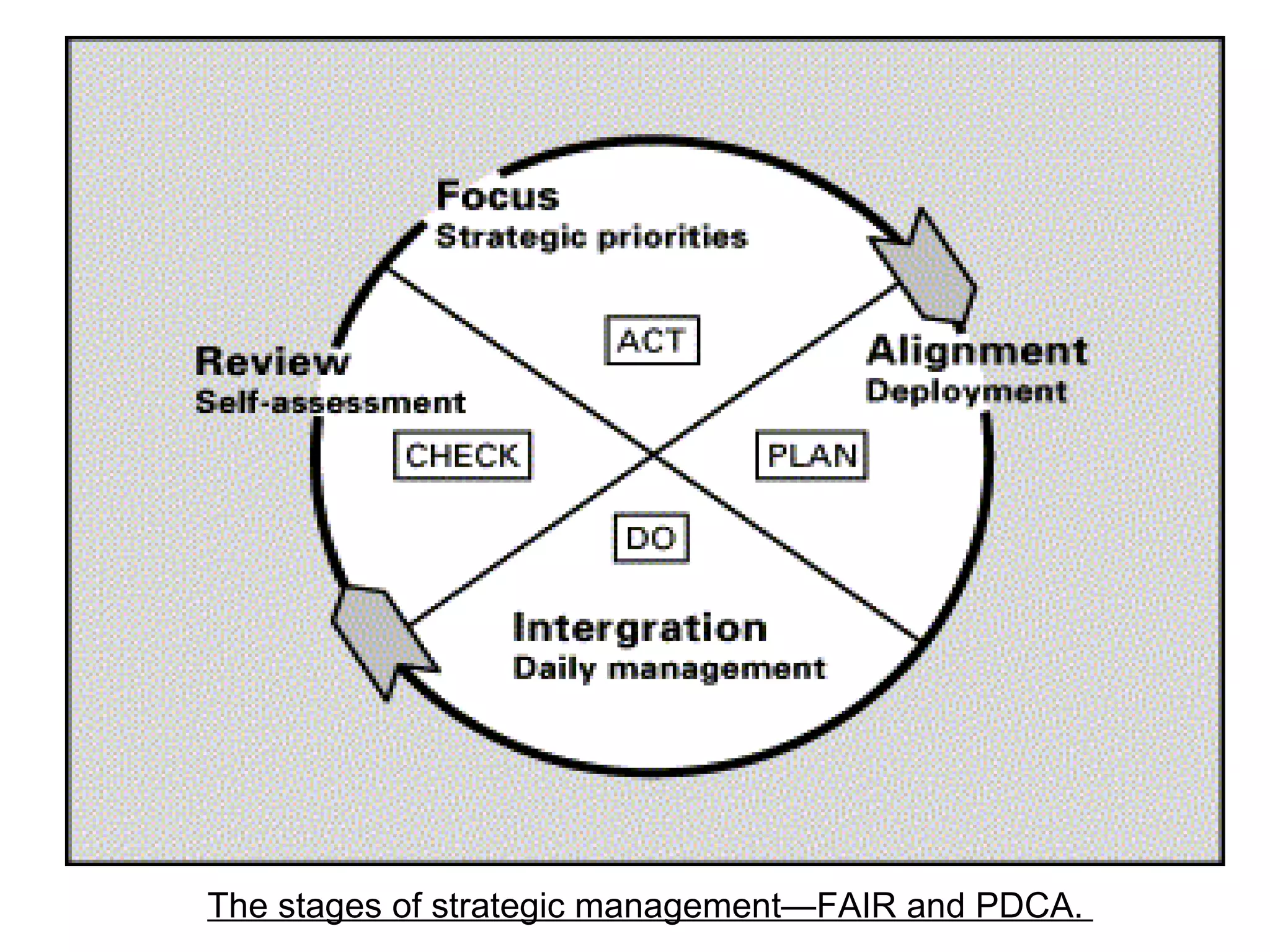
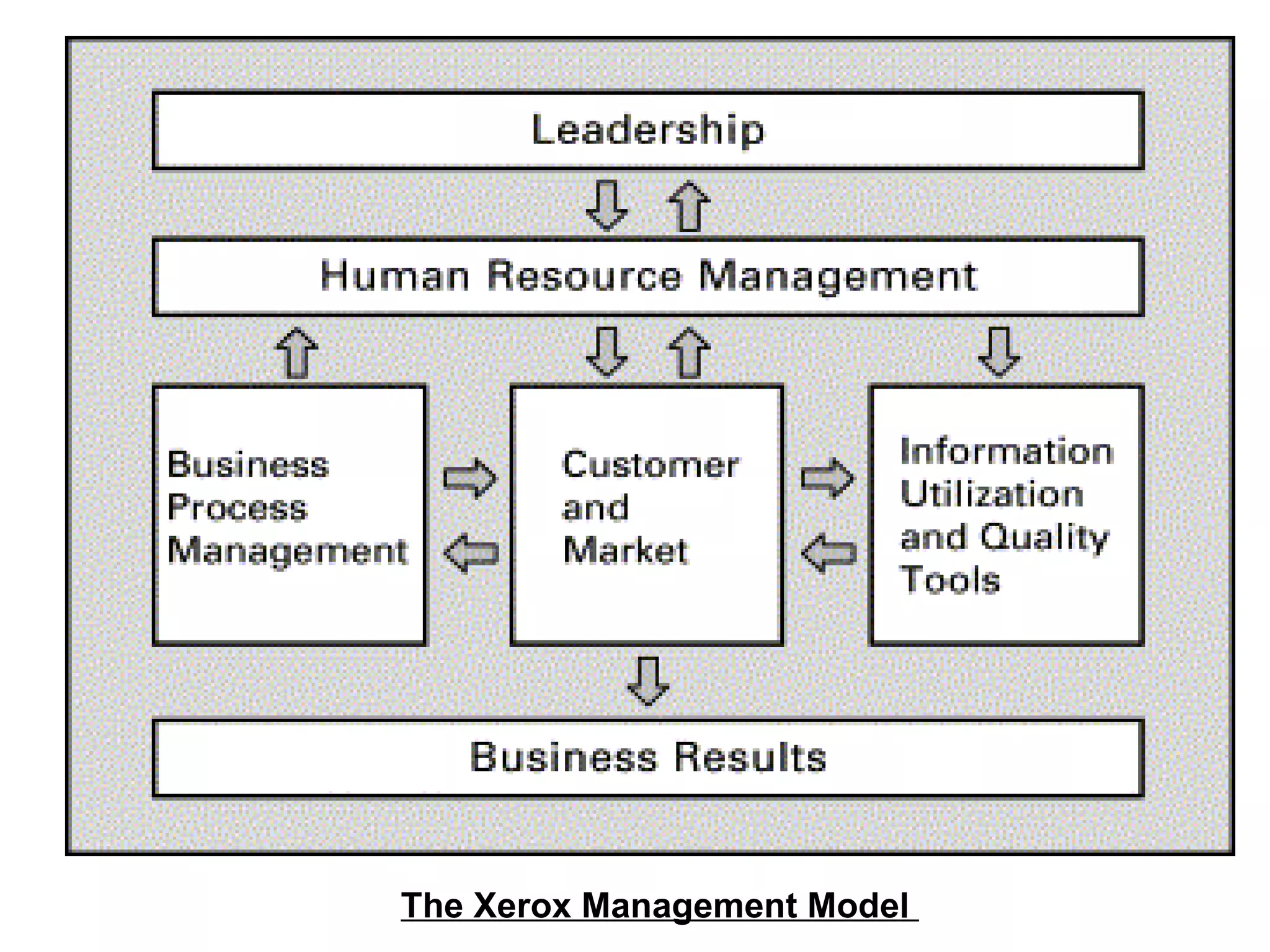
A case study of Hoshin Kanri practice at Xerox (UK) reveals the relationship between organisational strategy and appraisals (Barry Witcher and Rosie Butterworth ,1999) .  Hoshin Kanri  is a form of  TQM-based strategic management ; it provides a  link between strategic intent and its implementation in daily management .  Xerox is an exemplar of Hoshin Kanri best practice. Key features include Xerox's use of vital few programmes: the link with employee  appraisals an active role for a  network   of quality managers a participative form of  deployment a mature form of  total quality management the use of a  self-assessment model  to manage the business a structured system of  review . While implementation has been difficult,  key benefits  have been transparency  and a  common language  for  involving everybody  in  the  management of strategy .
The stages of strategic management—FAIR and PDCA.
The Xerox Management Model
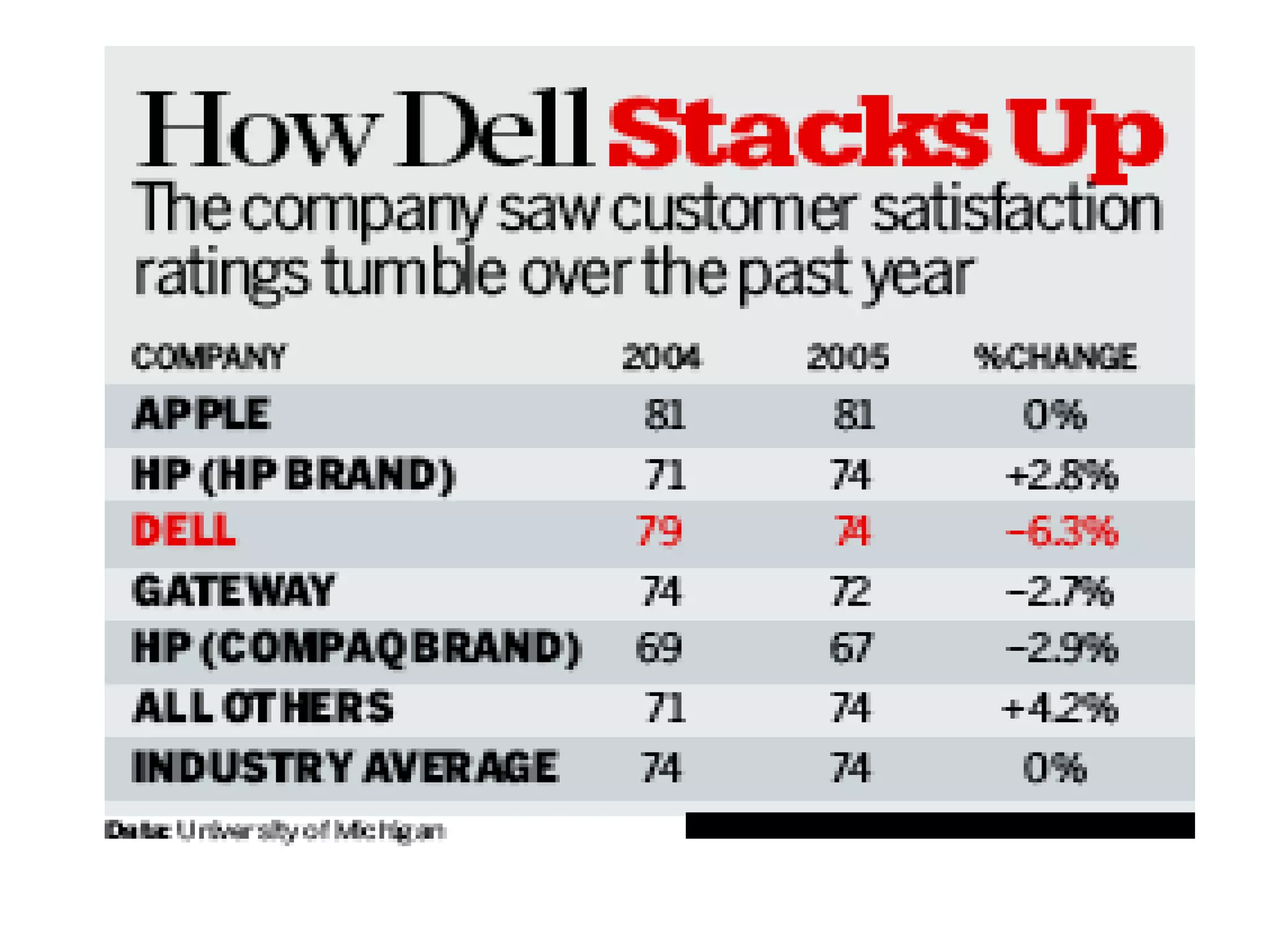
Dell case  Overall, and it holds 28.8% of the U.S. consumer market(2005), up  from 28.2% a year ago, according to researcher IDC. However, a  sagging reputation could slow sales, jeopardizing the company's  plan to reach $80 billion in revenues by 2008. In the most recent  Quarter(2005), Dell missed its sales target, one reason its stock has dropped 18%, to $34, since the start of the year.   In the last three months of 1991 Dell produced 49,269 personal  computers .  In 2004 ,during peak demand, they could exceed that  number by lunchtime.
Executives study the assembly process on a regular basis. They  wheel in video equipment to examine a work team's every  movement, looking for any extraneous bends or wasted twists.  Designers give one another high-fives for eliminating even a  single screw from a product, because that represents a saving of  roughly four seconds per machine built - the time they've  calculated it takes an employee, on average, to use the pneumatic  screwdriver dangling above his or her head. Computer software clocks the assembly-line performance of  workers, whether they're putting together PC's or the servers and  storage equipment that Dell sells to large companies. The most  able are declared "master builders" and then videotaped so that  others may watch and learn. The weak are told that it takes a  special set of talents to cut it on the Dell factory floor - and shown  the door. "I tell employees all the time that we're in a race on costs," said  Dick Hunter,the Dell executive who oversees manufacturing in the  United States. "When we lose the race on  costs  to Asia or  wherever, that puts our own security in jeopardy."
This year (2004), their goal was a 30 percent increase in the  number of machines that the company's factories spit out. Among the recent changes was a rerouting of cable so that it no  longer had to be laced over and under other parts, and the  decision to replace L-shaped tables with a single workbench, to  avoid time-consuming twists. A decision was also made to apply  one fewer sticker per machine. "We're going to get there by saving  four seconds here, and four seconds there," Mr. Myhand (day-shift  manager of Dell's flagship factory, Austin   Texas)   said. The  labour costs of a PC are "roughly 10 bucks," Mr. Rollins (Dell's chief  executive  )  said, meaning that payroll costs account for maybe 2  percent of the overall cost of the typical Dell PC. Five years ago, it  took two workers 14 minutes to build a PC; it now takes a single  worker roughly five minutes to do the same.
In ternal support systems In 2000, when the company's flagship plant opened, no  structure in it was more than maybe 10 feet high. Four  years later, the plant is now laced with  triple-decker  conveyor belts  that rise as much as 40 feet above the  factory floor. Black bins filled with parts are dispatched  via these belts and then lowered mechanically to any  one of the hundreds of employees who assemble the  machines according to each customer's specifications.  The completed machines are then transported by  conveyor belt to a shipping area, where they are  boxed  largely by robots , which were installed only recently and routed to dozens of idling big trucks. Typically, the  trucks drive away with full loads 30 minutes   after they  arrive.
Vertical co-ordination A dozen years ago,  Dell stored roughly 30 days  of inventory  - the outer casings, motherboards,  Intel  chips and other components needed to  feed the beast - in warehouses around the  Austin area. The company, based just north of  Austin in Round Rock, Tex.,  no longer operates  any warehouses ; instead,  it requires suppliers  to stock 8 to 10 days' worth of goods no further  than 90 minutes from its assembly plants .
 
Questions Define performance appraisal and briefly discuss its basic  Purposes What are the basic steps in the performance appraisal  process? What aspect of a person’s performance should an  organisation evaluate? Who should be involved in performance appraisals and  why? Outline the various problems associated with performance  appraisal? What are the characteristics of an effective appraisal  system?
Conducting  an effective appraisal is always important.  However, an appraisal can have life and death implications  when you are dealing with unstable employee, particularly  those who must be dismissed. An employee of a U.S. Postal  Service station was recently terminated. The employee  returned and shot and killed several managers who had  been instrumental in the former employee’s dismissal. It  transpired this person had a history as a troublemaker and  that many clues regarding his unstable nature over many  years had been ignored. Could a company with an effective appraisal process have missed so many signals of instability over several years? Why or why not? What safeguards would you build into your appraisal process to avoid missing such potentially tragic signs of instability and danger? What would you do if confronted during an appraisal interview by someone who began making threats regarding his or her use of firearms?
References Dessler ,Gary(2001),A Framework For human Resource Management’,Prentice Hall. Fisher, C., Schoenfeldt,L., and Shaw,J., ‘Human Resource Management’,(1996),pp. 450, Houghton Mifflin Company. Mondy, W., Noe,R.,and Premeaux,S.,(2002) ‘Human Resource Management’, Prentice Hall. Performance Management/Appraisal: Good Practice Guide, NHS in  Scotland/Management Development Group, Edinburgh, 1993. Fletcher, C., " Performance management: its nature and research base ", Developing a Performance- oriented Culture, Association for Management Education and Development, 1992. Moncrieff, J., " Empowering people to perform ", Developing a Performance-oriented Culture, Association  for Management Education and Development, London, 1992 Murphy, K.R., Cleveland, J.N., 1995, Understanding Performance Appraisal: Social, Organizational and  Goal-Based Perspectives, Sage, Thousand Oaks, CA. Murphy, K.R., Constans, J.I., 1987, " Behavioral anchors as a source of bias in rating ", Journal of Applied  Psychology, 72, 523-79.   Wiese, Danielle and  Buckley, Ronald (1998) The evolution of the performance  appraisal process, Volume: 4 Number: 3 Page: 233 – 249   Barrett, R.S., 1967, Performance Rating, Science Research Associates, Inc., Chicago. Witcher  , Barryand and  Butterworth , Rosie (1999) Hoshin Kanri: how Xerox manages  Volume 32, Issue 3  , June 1999, Pages 323-332   Rivlin, Gary (2004)   Who's Afraid of China?,nytimes.com, December 19  Boudreaux, Greg(1994) Response:What TQM Says About Performance Appraisal,  Compensation and benefits Review,(May / June):20 -24 Lawler, Edward 111(1994), Performance Management:The Next Generation,  Compensation and Benefits Review (May June) Antonioni, David(1994) Improve the Management Process Before Discontinuing  Performance Appraisals, Compensation and benefits Review,(May / June):30 Markowich ,Michael (1995) Response: We Can Make Performance Appraisals Work,  Compensation and benefits Review,(May / June):26 Cook, Mark (1995)  Performance appraisal and true performance, Journal of Managerial Psychology, Volume: 10 Number: 7 Page: 3 – 7
Appendix 1. A tag too far  (09/06/05) Workers who supply goods to companies such as Tesco,Sainsbury and Boots are being fitted with electronic  tags that effectively ‘reduce them to battery farm workers’,  a new report from union GMB has claimed. Tags are attached to the  wrist or fingers of staff in distribution centres to direct them to stock and  ensure the correct items are picked. The GMB claims the devices are  dehumanising as they ‘calculate what breaks the workers need and  how long they need to go to the toilet’. Examples of employers using  the tags cited in the report include logistics firm Tibbett & Britten and  retail group Peacock.   Source:http://www.humanresourcesmagazine.com/news/index.cfm?fus eaction=fulldetails&newsUID=adad6679-eac3-4fab-994f- 2ec17c528b0b

Performance Management System

  • 1.
    Performance Management SystemBusiness role job description Job skills / knowledge Individual skills / knowledge Team business /objectives 2. Performance planning 3. Performance development 4. Performance measurement Plan Action Evaluation
  • 2.
    Performance Management ‘A process that significantly affects organizational success by having managers and employees work together to set expectations, review results, and reward performance.’ ‘ A means whereby employees’ work behaviours are aligned with the organization’s goals.’
  • 3.
    Performance appraisal ‘A formal system of periodic review and evaluation of an individual’s or team’s job performance.’ Source: Mondy, W., Noe,R.,and Premeaux,S.,(2002) ‘Human Resource Management’, Prentice Hall ‘ the process by which an employee’s contribution to the organization during a specified period of time is assessed.’ Fisher, C., Schoenfeldt,L., and Shaw,J., ‘Human Resource Management’,(1996),pp. 450, Houghton Mifflin Company
  • 4.
    Performance appraisal andperformance management One current problem which performance appraisal faces is that the term is often used synonymously with that of "performance management” (NHS Scotland,1993). Yet performance management is clearly more than a new name for performance appraisal. Fletcher defines performance management as: ‘ an approach to creating a shared vision of the purpose and aims of the organisation, helping each individual employee understand and recognise their part in contributing to them, and in so doing manage and enhance the performance of both individuals and the organization.’
  • 5.
    performance management thereforeimplies the integration, at both conceptual and practical levels, of what are experienced currently as a series of quite diverse initiatives. These include: business planning; benchmarking; non-pay rewards; competence-based education and training; clinical audit; performance-related pay; performance indicators; use of assessment and development centres. Plus, of course, performance appraisal.
  • 6.
    Most appraisal processeshave three parts: Defining performance- it is preferable to link individual performance to organizational objectives Measuring performance: this may include multiple types of performance criteria. Feedback and coaching: employees need feedback on their past performance and help to meet the next performance targets.
  • 7.
    Purpose ofperformance appraisal improvement in the communication between boss and subordinate through the use of feedback between them Aids human resource planning Performance assessments may be useful in predicting the performance of job applicants Identifies training needs Aids career planning and development Employed to determine reward and remuneration Linked to employee relations decisions Assess employee potential
  • 8.
    Performance appraisal methods360-degree feedback – A multirater evaluation that involves input from multiple levels within the firm and external sources as well. 2. Rating scales – Employees are rated according to defined factors. 3. Critical incident – consists of a written record of highly favourable and highly unfavourable employee work. 4. Essay – the rater records a brief narrative describing an employee’s performance. 5. Work standards – employee’s performance is compared to a predetermined standard level of output.
  • 9.
    Performance appraisal methods1. Ranking [alternation] – the rater places the appraisees in rank order of overall performance. 2. Paired comparison – every employee to be rated is paired with and compared to every other subordinate on each trait. 3. Forced distribution – the rater is required to assign individuals in a work group to a limited number of categories similar to a normal frequency distribution. 4. Forced-choice – the rater is given a series of statements about an individual and indicates which items are most or least descriptive of the employee.
  • 10.
    5. 360-degreefeedback – A multirater evaluation that involves input from multiple levels within the firm and external sources as well. 6. Behaviourally Anchored Rating Scales – this combines elements of the traditional rating scale and critical incident methods. 7. Results based systems [Management by Objectives (MBO)] – the manager and the subordinate jointly agree on objectives for the next appraisal period. 8. Assessment centres -
  • 11.
    Problems in Performanceappraisal Lack of objectivity Halo error Leniency / strictness Central tendency Recent behaviour bias Personal bias Manipulating the evaluation
  • 12.
    Individual performance incontext There is a growing recognition that the work performance of people in organizations comes primarily from within, but is also powerfully affected by the social, economic and political environment in which people work. Moncrieff has expressed this in the formula: Individual performance = energy × ability × motivation x external factors (Murphy and Cleveland, 1995)
  • 13.
    The Appraisal interviewPreparing for the interview (preview job description / appraisals) Scheduling the interview (date, time, duration, venue) Employee’s role Interview structure Purpose, aims and objectives /qualitative /quantitative Overview of the process Meeting skills, procedures and practice
  • 14.
    The Appraisal interviewcont. Use of praise and criticism Computer software Concluding the interview - review process and meeting Source: Mondy, Wayne, Noe, Robert, and Premeaux, Shane, ‘Human Resource Management’,pp.301- 303, Prentice Hall 2002, Dessler,Gary, ‘A Framework for Human Resource Management’, pp.175 –175 Prentice Hall, 2001 and Mabey, Christopher, Salaman, Graeme, and Storey, John, ‘ Human Resource Management’,pp.131 –150, Blackwell 1998
  • 15.
    Use of praiseand criticism - Emphasize the positive aspects of performance - Criticise the actions, not the person - Avoid making any criticism destructive or too personal - Do not surprise the employee by bringing up a problem that should have been dealt with previously - Ask the employee how he or she would change things to improve the situation - Avoid supplying all the answers - Be specific and give alternatives for the criticised behaviour - When criticising, concentrate on developing the employee - Try to turn the interview into a win-win situation so that all concerned gain.
  • 16.
    TQM proponentsusually argue for the elimination of performance appraisals. They claim that the organisation is a system of interrelated parts and that an employee’s performance is more a function of factors such as training, communication, tools, and supervision than of his or her own motivation. A TQM-based performance system would include: An appraisal scale that contains relatively few performance categories and avoids a forced distribution(Lawler,1994). Objective ways to measure results, avoiding subjective criteria such as teamwork and integrity (Markowich, 1995). A determination about whether any performance deficiency is a result of employee motivation, inadequate training, or factors such as poor supervision that are outside the employee’s control. 360-degree feedback from a number of different sources, not just supervisors but internal and possibly external “customers” of the employee as well (Antonioni, 1994).
  • 17.
    A case studyof Hoshin Kanri practice at Xerox (UK) reveals the relationship between organisational strategy and appraisals (Barry Witcher and Rosie Butterworth ,1999) . Hoshin Kanri is a form of TQM-based strategic management ; it provides a link between strategic intent and its implementation in daily management . Xerox is an exemplar of Hoshin Kanri best practice. Key features include Xerox's use of vital few programmes: the link with employee appraisals an active role for a network of quality managers a participative form of deployment a mature form of total quality management the use of a self-assessment model to manage the business a structured system of review . While implementation has been difficult, key benefits have been transparency and a common language for involving everybody in the management of strategy .
  • 18.
    The stages ofstrategic management—FAIR and PDCA.
  • 19.
  • 20.
    Dell case Overall, and it holds 28.8% of the U.S. consumer market(2005), up from 28.2% a year ago, according to researcher IDC. However, a sagging reputation could slow sales, jeopardizing the company's plan to reach $80 billion in revenues by 2008. In the most recent Quarter(2005), Dell missed its sales target, one reason its stock has dropped 18%, to $34, since the start of the year. In the last three months of 1991 Dell produced 49,269 personal computers . In 2004 ,during peak demand, they could exceed that number by lunchtime.
  • 21.
    Executives study theassembly process on a regular basis. They wheel in video equipment to examine a work team's every movement, looking for any extraneous bends or wasted twists. Designers give one another high-fives for eliminating even a single screw from a product, because that represents a saving of roughly four seconds per machine built - the time they've calculated it takes an employee, on average, to use the pneumatic screwdriver dangling above his or her head. Computer software clocks the assembly-line performance of workers, whether they're putting together PC's or the servers and storage equipment that Dell sells to large companies. The most able are declared "master builders" and then videotaped so that others may watch and learn. The weak are told that it takes a special set of talents to cut it on the Dell factory floor - and shown the door. "I tell employees all the time that we're in a race on costs," said Dick Hunter,the Dell executive who oversees manufacturing in the United States. "When we lose the race on costs to Asia or wherever, that puts our own security in jeopardy."
  • 22.
    This year (2004),their goal was a 30 percent increase in the number of machines that the company's factories spit out. Among the recent changes was a rerouting of cable so that it no longer had to be laced over and under other parts, and the decision to replace L-shaped tables with a single workbench, to avoid time-consuming twists. A decision was also made to apply one fewer sticker per machine. "We're going to get there by saving four seconds here, and four seconds there," Mr. Myhand (day-shift manager of Dell's flagship factory, Austin Texas) said. The labour costs of a PC are "roughly 10 bucks," Mr. Rollins (Dell's chief executive ) said, meaning that payroll costs account for maybe 2 percent of the overall cost of the typical Dell PC. Five years ago, it took two workers 14 minutes to build a PC; it now takes a single worker roughly five minutes to do the same.
  • 23.
    In ternal supportsystems In 2000, when the company's flagship plant opened, no structure in it was more than maybe 10 feet high. Four years later, the plant is now laced with triple-decker conveyor belts that rise as much as 40 feet above the factory floor. Black bins filled with parts are dispatched via these belts and then lowered mechanically to any one of the hundreds of employees who assemble the machines according to each customer's specifications. The completed machines are then transported by conveyor belt to a shipping area, where they are boxed largely by robots , which were installed only recently and routed to dozens of idling big trucks. Typically, the trucks drive away with full loads 30 minutes after they arrive.
  • 24.
    Vertical co-ordination Adozen years ago, Dell stored roughly 30 days of inventory - the outer casings, motherboards, Intel chips and other components needed to feed the beast - in warehouses around the Austin area. The company, based just north of Austin in Round Rock, Tex., no longer operates any warehouses ; instead, it requires suppliers to stock 8 to 10 days' worth of goods no further than 90 minutes from its assembly plants .
  • 25.
  • 26.
    Questions Define performanceappraisal and briefly discuss its basic Purposes What are the basic steps in the performance appraisal process? What aspect of a person’s performance should an organisation evaluate? Who should be involved in performance appraisals and why? Outline the various problems associated with performance appraisal? What are the characteristics of an effective appraisal system?
  • 27.
    Conducting aneffective appraisal is always important. However, an appraisal can have life and death implications when you are dealing with unstable employee, particularly those who must be dismissed. An employee of a U.S. Postal Service station was recently terminated. The employee returned and shot and killed several managers who had been instrumental in the former employee’s dismissal. It transpired this person had a history as a troublemaker and that many clues regarding his unstable nature over many years had been ignored. Could a company with an effective appraisal process have missed so many signals of instability over several years? Why or why not? What safeguards would you build into your appraisal process to avoid missing such potentially tragic signs of instability and danger? What would you do if confronted during an appraisal interview by someone who began making threats regarding his or her use of firearms?
  • 28.
    References Dessler ,Gary(2001),AFramework For human Resource Management’,Prentice Hall. Fisher, C., Schoenfeldt,L., and Shaw,J., ‘Human Resource Management’,(1996),pp. 450, Houghton Mifflin Company. Mondy, W., Noe,R.,and Premeaux,S.,(2002) ‘Human Resource Management’, Prentice Hall. Performance Management/Appraisal: Good Practice Guide, NHS in Scotland/Management Development Group, Edinburgh, 1993. Fletcher, C., " Performance management: its nature and research base ", Developing a Performance- oriented Culture, Association for Management Education and Development, 1992. Moncrieff, J., " Empowering people to perform ", Developing a Performance-oriented Culture, Association for Management Education and Development, London, 1992 Murphy, K.R., Cleveland, J.N., 1995, Understanding Performance Appraisal: Social, Organizational and Goal-Based Perspectives, Sage, Thousand Oaks, CA. Murphy, K.R., Constans, J.I., 1987, " Behavioral anchors as a source of bias in rating ", Journal of Applied Psychology, 72, 523-79. Wiese, Danielle and Buckley, Ronald (1998) The evolution of the performance appraisal process, Volume: 4 Number: 3 Page: 233 – 249 Barrett, R.S., 1967, Performance Rating, Science Research Associates, Inc., Chicago. Witcher , Barryand and Butterworth , Rosie (1999) Hoshin Kanri: how Xerox manages Volume 32, Issue 3 , June 1999, Pages 323-332 Rivlin, Gary (2004) Who's Afraid of China?,nytimes.com, December 19 Boudreaux, Greg(1994) Response:What TQM Says About Performance Appraisal, Compensation and benefits Review,(May / June):20 -24 Lawler, Edward 111(1994), Performance Management:The Next Generation, Compensation and Benefits Review (May June) Antonioni, David(1994) Improve the Management Process Before Discontinuing Performance Appraisals, Compensation and benefits Review,(May / June):30 Markowich ,Michael (1995) Response: We Can Make Performance Appraisals Work, Compensation and benefits Review,(May / June):26 Cook, Mark (1995) Performance appraisal and true performance, Journal of Managerial Psychology, Volume: 10 Number: 7 Page: 3 – 7
  • 29.
    Appendix 1. Atag too far (09/06/05) Workers who supply goods to companies such as Tesco,Sainsbury and Boots are being fitted with electronic tags that effectively ‘reduce them to battery farm workers’, a new report from union GMB has claimed. Tags are attached to the wrist or fingers of staff in distribution centres to direct them to stock and ensure the correct items are picked. The GMB claims the devices are dehumanising as they ‘calculate what breaks the workers need and how long they need to go to the toilet’. Examples of employers using the tags cited in the report include logistics firm Tibbett & Britten and retail group Peacock. Source:http://www.humanresourcesmagazine.com/news/index.cfm?fus eaction=fulldetails&newsUID=adad6679-eac3-4fab-994f- 2ec17c528b0b

Editor's Notes

  • #2 Sheard, Angela ( ), Learning to Improve Performance,Personnel Management
  • #5 1 , Performance Management/Appraisal: Good Practice Guide, NHS in Scotland/Management Development Group, Edinburgh, 1993. 2 , Fletcher, C., " Performance management: its nature and research base ", Developing a Performance-oriented Culture, Association for Management Education and Development, 1992.
  • #6 1 , Performance Management/Appraisal: Good Practice Guide, NHS in Scotland/Management Development Group, Edinburgh, 1993. 2 , Fletcher, C., " Performance management: its nature and research base ", Developing a Performance-oriented Culture, Association for Management Education and Development, 1992.
  • #11 Murphy, K.R., Cleveland, J.N., 1995, Understanding Performance Appraisal: Social, Organizational and Goal-Based Perspectives, Sage, Thousand Oaks, CA. Murphy, K.R., Constans, J.I., 1987, " Behavioral anchors as a source of bias in rating ", Journal of Applied Psychology, 72, 523-79.
  • #13 Moncrieff, J., " Empowering people to perform ", Developing a Performance-oriented Culture, Association for Management Education and Development, London, 1992
  • #16 Boudreaux, Greg(1994) Response:What TQM Says About Performance Appraisal, Compensation and benefits Review,(May / June):20 -24
  • #17 Lawler, Edward 111(1994), Performance Management:The Next Generation, Compensation and Benefits Review (May June) Boudreaux, Greg(1994) Response:What TQM Says About Performance Appraisal, Markowich ,Michael (1995) Response: We Can Make Performance Appraisals Work, Compensation and benefits Review,(May / June):26 Compensation and benefits Review,(May / June):20 -24 Antonioni, David(1994) Improve the Management Process Before Discontinuing Performance Appraisals, Compensation and benefits Review,(May / June):30
  • #18 Barry Witcher and Rosie Butterworth (1999) Hoshin Kanri: how Xerox manages Volume 32, Issue 3 , June 1999, Pages 323-332
  • #19 Barry Witcher and Rosie Butterworth (1999) Hoshin Kanri: how Xerox manages Volume 32, Issue 3 , June 1999, Pages 323-332
  • #26 Hanging Up On Dell? Gripes about tech support are on the rise, and the PC king is scrambling to upgrade OCTOBER 10, 2005 http://www.businessweek.com/magazine/content/05_41/b3954102.htm?chan=tc RIVLIN, GARY (2004) Who's Afraid of China?,nytimes.com, December 19