IMAGE COMPRESSION
Comparison between JPEG(DCT) and JPEG
2000(DWT) compression standards
Presented by
Rishab Shah
(1313048 )
Introduction
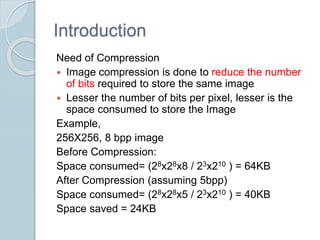
Need of Compression
 Image compression is done to reduce the number
of bits required to store the same image
 Lesser the number of bits per pixel, lesser is the
space consumed to store the Image
Example,
256X256, 8 bpp image
Before Compression:
Space consumed= (28x28x8 / 23x210 ) = 64KB
After Compression (assuming 5bpp)
Space consumed= (28x28x5 / 23x210 ) = 40KB
Space saved = 24KB
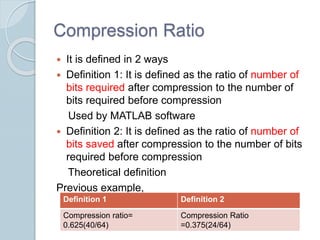
Compression Ratio
 It is defined in 2 ways
 Definition 1: It is defined as the ratio of number of
bits required after compression to the number of
bits required before compression
Used by MATLAB software
 Definition 2: It is defined as the ratio of number of
bits saved after compression to the number of bits
required before compression
Theoretical definition
Previous example,
Definition 1 Definition 2
Compression ratio=
0.625(40/64)
Compression Ratio
=0.375(24/64)
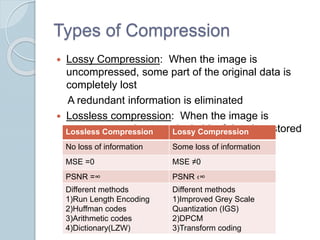
Types of Compression
 Lossy Compression: When the image is
uncompressed, some part of the original data is
completely lost
A redundant information is eliminated
 Lossless compression: When the image is
uncompressed, every single bit of data is restoredLossless Compression Lossy Compression
No loss of information Some loss of information
MSE =0 MSE ≠0
PSNR =∞ PSNR ‹∞
Different methods
1)Run Length Encoding
2)Huffman codes
3)Arithmetic codes
4)Dictionary(LZW)
Different methods
1)Improved Grey Scale
Quantization (IGS)
2)DPCM
3)Transform coding
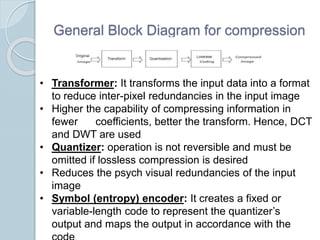
General Block Diagram for compression
• Transformer: It transforms the input data into a format
to reduce inter-pixel redundancies in the input image
• Higher the capability of compressing information in
fewer coefficients, better the transform. Hence, DCT
and DWT are used
• Quantizer: operation is not reversible and must be
omitted if lossless compression is desired
• Reduces the psych visual redundancies of the input
image
• Symbol (entropy) encoder: It creates a fixed or
variable-length code to represent the quantizer’s
output and maps the output in accordance with the
Compression process for JPEG
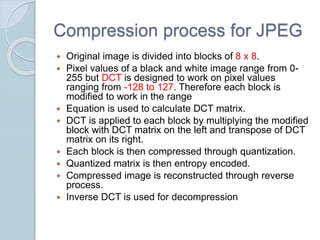
 Original image is divided into blocks of 8 x 8.
 Pixel values of a black and white image range from 0-
255 but DCT is designed to work on pixel values
ranging from -128 to 127. Therefore each block is
modified to work in the range
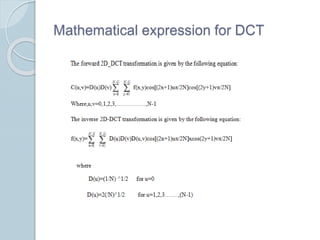
 Equation is used to calculate DCT matrix.
 DCT is applied to each block by multiplying the modified
block with DCT matrix on the left and transpose of DCT
matrix on its right.
 Each block is then compressed through quantization.
 Quantized matrix is then entropy encoded.
 Compressed image is reconstructed through reverse
process.
 Inverse DCT is used for decompression
Mathematical expression for DCT
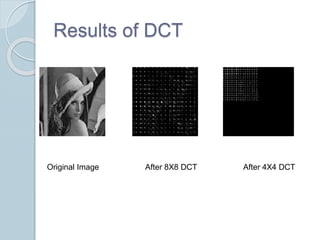
Results of DCT
Original Image After 8X8 DCT After 4X4 DCT
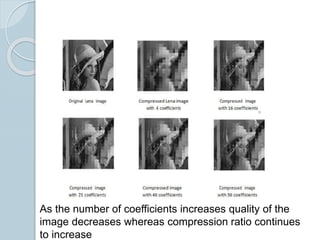
As the number of coefficients increases quality of the
image decreases whereas compression ratio continues
to increase
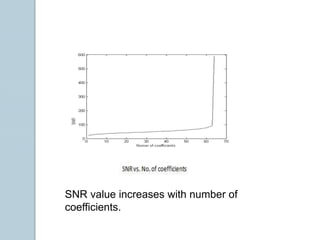
SNR value increases with number of
coefficients.
Advantages of DCT
 It has been implemented in single integrated circuit
 It has the ability to pack most information in fewest
coefficients
 It minimizes the block like appearance called
blocking artifact that results when boundaries
between sub-images become visible
JPEG 2000
Addresses the problems like
 Low bit rate compression
 Large images
 Single Decompression Architecture
 Transmission in Noisy Environment
 Computer generated imaginary
 Compound Documents
Compression steps for JPEG 2000
 Digitize the source image into a signal s, which is a
string of numbers.
 Characterized by its intensity levels or scales of gray
which range from 0(black) to 255(white)
 Decompose the signal into a sequence of wavelet
coefficients w.
 Use threshold to modify the wavelet coefficients from w
to w’.
 Use quantization to convert w’ to a sequence q.
 Entropy encoding is applied to convert q into a
sequence e.
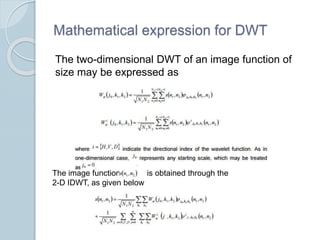
Mathematical expression for DWT
The two-dimensional DWT of an image function of
size may be expressed as
The image function is obtained through the
2-D IDWT, as given below
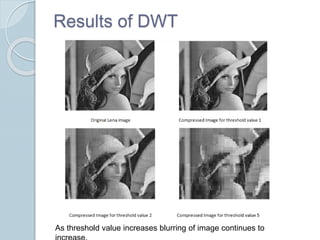
Results of DWT
As threshold value increases blurring of image continues to
Advantages of JPEG 2000
 Reduced costs for storage and maintenance
 Smaller file size compared to uncompressed TIFF
 One master replaces multiple derivatives
 Enhanced handling of large images
 Fast access to image subsets
 Intelligent metadata support
 Enables new opportunities
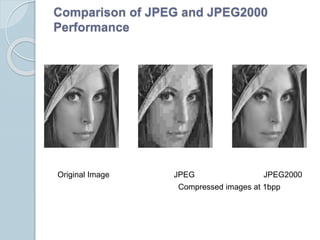
Comparison of JPEG and JPEG2000
Performance
Original Image JPEG JPEG2000
Compressed images at 1bpp
Comparison between DCT and DWT based
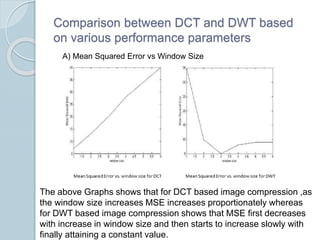
on various performance parameters
The above Graphs shows that for DCT based image compression ,as
the window size increases MSE increases proportionately whereas
for DWT based image compression shows that MSE first decreases
with increase in window size and then starts to increase slowly with
finally attaining a constant value.
A) Mean Squared Error vs Window Size
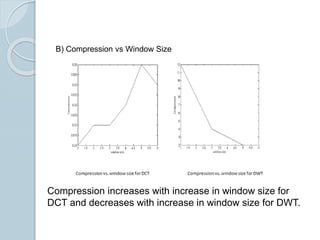
Compression increases with increase in window size for
DCT and decreases with increase in window size for DWT.
B) Compression vs Window Size
Results and Conclusion
 DCT is used for transformation in JPEG standard. DCT
performs efficiently at medium bit rates. Disadvantage with
DCT is that only spatial correlation of the pixels inside the
single 2-D block is considered and the correlation from the
pixels of the neighboring blocks is neglected. Blocks cannot
be decorrelated at their boundaries using DCT.
 DWT is used as basis for transformation in JPEG 2000
standard. DWT provides high quality compression at low bit
rates. The use of larger DWT basis functions or wavelet filters
produces blurring near edges in images.
 DWT performs better than DCT in the context that it avoids
blocking artifacts which degrade the reconstructed images.
However, DWT provides lower quality than JPEG at the Low
compression rates. DWT requires longer compression time
THANK YOU!

Comparison between JPEG(DCT) and JPEG 2000(DWT) compression standards

  • 1.
    IMAGE COMPRESSION Comparison betweenJPEG(DCT) and JPEG 2000(DWT) compression standards Presented by Rishab Shah (1313048 )
  • 2.
    Introduction Need of Compression Image compression is done to reduce the number of bits required to store the same image  Lesser the number of bits per pixel, lesser is the space consumed to store the Image Example, 256X256, 8 bpp image Before Compression: Space consumed= (28x28x8 / 23x210 ) = 64KB After Compression (assuming 5bpp) Space consumed= (28x28x5 / 23x210 ) = 40KB Space saved = 24KB
  • 3.
    Compression Ratio  Itis defined in 2 ways  Definition 1: It is defined as the ratio of number of bits required after compression to the number of bits required before compression Used by MATLAB software  Definition 2: It is defined as the ratio of number of bits saved after compression to the number of bits required before compression Theoretical definition Previous example, Definition 1 Definition 2 Compression ratio= 0.625(40/64) Compression Ratio =0.375(24/64)
  • 4.
    Types of Compression Lossy Compression: When the image is uncompressed, some part of the original data is completely lost A redundant information is eliminated  Lossless compression: When the image is uncompressed, every single bit of data is restoredLossless Compression Lossy Compression No loss of information Some loss of information MSE =0 MSE ≠0 PSNR =∞ PSNR ‹∞ Different methods 1)Run Length Encoding 2)Huffman codes 3)Arithmetic codes 4)Dictionary(LZW) Different methods 1)Improved Grey Scale Quantization (IGS) 2)DPCM 3)Transform coding
  • 5.
    General Block Diagramfor compression • Transformer: It transforms the input data into a format to reduce inter-pixel redundancies in the input image • Higher the capability of compressing information in fewer coefficients, better the transform. Hence, DCT and DWT are used • Quantizer: operation is not reversible and must be omitted if lossless compression is desired • Reduces the psych visual redundancies of the input image • Symbol (entropy) encoder: It creates a fixed or variable-length code to represent the quantizer’s output and maps the output in accordance with the
  • 6.
    Compression process forJPEG  Original image is divided into blocks of 8 x 8.  Pixel values of a black and white image range from 0- 255 but DCT is designed to work on pixel values ranging from -128 to 127. Therefore each block is modified to work in the range  Equation is used to calculate DCT matrix.  DCT is applied to each block by multiplying the modified block with DCT matrix on the left and transpose of DCT matrix on its right.  Each block is then compressed through quantization.  Quantized matrix is then entropy encoded.  Compressed image is reconstructed through reverse process.  Inverse DCT is used for decompression
  • 7.
  • 8.
    Results of DCT OriginalImage After 8X8 DCT After 4X4 DCT
  • 9.
    As the numberof coefficients increases quality of the image decreases whereas compression ratio continues to increase
  • 10.
    SNR value increaseswith number of coefficients.
  • 11.
    Advantages of DCT It has been implemented in single integrated circuit  It has the ability to pack most information in fewest coefficients  It minimizes the block like appearance called blocking artifact that results when boundaries between sub-images become visible
  • 12.
    JPEG 2000 Addresses theproblems like  Low bit rate compression  Large images  Single Decompression Architecture  Transmission in Noisy Environment  Computer generated imaginary  Compound Documents
  • 13.
    Compression steps forJPEG 2000  Digitize the source image into a signal s, which is a string of numbers.  Characterized by its intensity levels or scales of gray which range from 0(black) to 255(white)  Decompose the signal into a sequence of wavelet coefficients w.  Use threshold to modify the wavelet coefficients from w to w’.  Use quantization to convert w’ to a sequence q.  Entropy encoding is applied to convert q into a sequence e.
  • 14.
    Mathematical expression forDWT The two-dimensional DWT of an image function of size may be expressed as The image function is obtained through the 2-D IDWT, as given below
  • 15.
    Results of DWT Asthreshold value increases blurring of image continues to
  • 16.
    Advantages of JPEG2000  Reduced costs for storage and maintenance  Smaller file size compared to uncompressed TIFF  One master replaces multiple derivatives  Enhanced handling of large images  Fast access to image subsets  Intelligent metadata support  Enables new opportunities
  • 17.
    Comparison of JPEGand JPEG2000 Performance Original Image JPEG JPEG2000 Compressed images at 1bpp
  • 18.
    Comparison between DCTand DWT based on various performance parameters The above Graphs shows that for DCT based image compression ,as the window size increases MSE increases proportionately whereas for DWT based image compression shows that MSE first decreases with increase in window size and then starts to increase slowly with finally attaining a constant value. A) Mean Squared Error vs Window Size
  • 19.
    Compression increases withincrease in window size for DCT and decreases with increase in window size for DWT. B) Compression vs Window Size
  • 20.
    Results and Conclusion DCT is used for transformation in JPEG standard. DCT performs efficiently at medium bit rates. Disadvantage with DCT is that only spatial correlation of the pixels inside the single 2-D block is considered and the correlation from the pixels of the neighboring blocks is neglected. Blocks cannot be decorrelated at their boundaries using DCT.  DWT is used as basis for transformation in JPEG 2000 standard. DWT provides high quality compression at low bit rates. The use of larger DWT basis functions or wavelet filters produces blurring near edges in images.  DWT performs better than DCT in the context that it avoids blocking artifacts which degrade the reconstructed images. However, DWT provides lower quality than JPEG at the Low compression rates. DWT requires longer compression time
  • 21.