Image Compression 
Done By: 
Bassam Kanber 
Khawla Al-Hashedy 
Naglaa Fathi 
Redha Qaid 
Heba Al-Hakemy 
Hesham Al-Aghbary 
Supervisor 
Ensaf Al-Zurqa
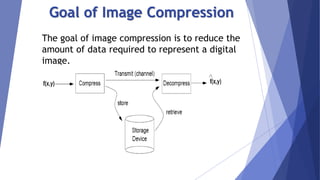
Goal of Image Compression 
The goal of image compression is to reduce the 
amount of data required to represent a digital 
image.
Data ≠ Information 
 Data and information are not synonymous terms! 
 Data is the means by which information is conveyed. 
 Data compression aims to reduce the amount of data 
required to represent a given quantity of information 
while preserving as much information as possible.
Data vs Information (cont’d) 
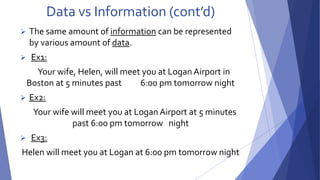
 The same amount of information can be represented 
by various amount of data. 
 Ex1: 
Your wife, Helen, will meet you at Logan Airport in 
Boston at 5 minutes past 6:00 pm tomorrow night 
 Ex2: 
Your wife will meet you at Logan Airport at 5 minutes 
past 6:00 pm tomorrow night 
 Ex3: 
Helen will meet you at Logan at 6:00 pm tomorrow night
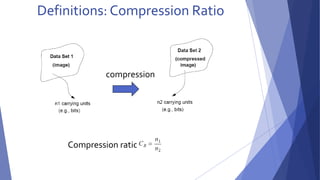
Definitions: Compression Ratio 
compression 
Compression ratio:
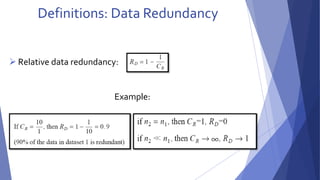
Definitions: Data Redundancy 
 Relative data redundancy: 
Example:
Types of Data Redundancy 
(1) Coding Redundancy 
(2) Interpixel Redundancy 
(3) Psychovisual Redundancy 
 Compression attempts to reduce one or more of these 
redundancy types.
Coding Redundancy 
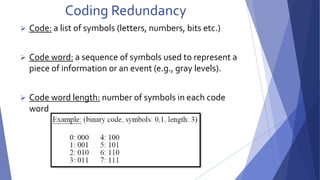
 Code: a list of symbols (letters, numbers, bits etc.) 
 Code word: a sequence of symbols used to represent a 
piece of information or an event (e.g., gray levels). 
 Code word length: number of symbols in each code 
word
Coding Redundancy (cont’d) 
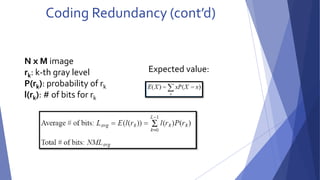
N x M image 
rk: k-th gray level 
P(rk): probability of rk 
l(rk): # of bits for rk 
Expected value:
Coding Redundancy (con’d) 
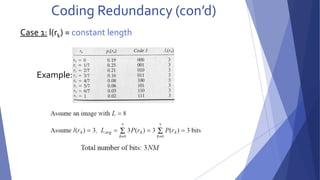
Case 1: l(rk) = constant length 
Example:
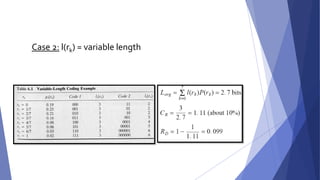
Case 2: l(rk) = variable length
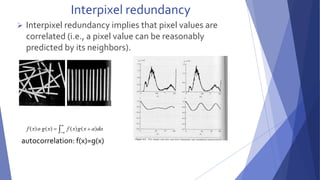
Interpixel redundancy 
 Interpixel redundancy implies that pixel values are 
correlated (i.e., a pixel value can be reasonably 
predicted by its neighbors). 
autocorrelation: f(x)=g(x)
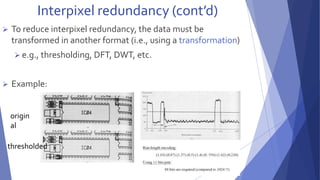
Interpixel redundancy (cont’d) 
 To reduce interpixel redundancy, the data must be 
transformed in another format (i.e., using a transformation) 
 e.g., thresholding, DFT, DWT, etc. 
 Example: 
origin 
al 
thresholded
Psychovisual redundancy 
 The human eye does not respond with equal sensitivity 
to all visual information. 
 It is more sensitive to the lower frequencies than to the 
higher frequencies in the visual spectrum. 
 Idea: discard data that is perceptually insignificant!
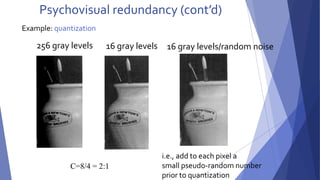
Psychovisual redundancy (cont’d) 
256 gray levels 16 gray levels 16 gray levels/random noise 
C=8/4 = 2:1 
i.e., add to each pixel a 
small pseudo-random number 
prior to quantization 
Example: quantization
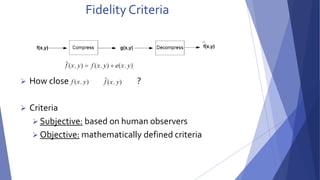
Fidelity Criteria 
 How close is to ? 
 Criteria 
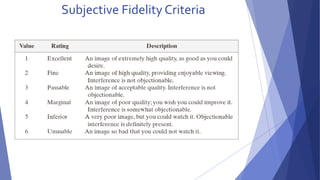
 Subjective: based on human observers 
 Objective: mathematically defined criteria
Subjective Fidelity Criteria
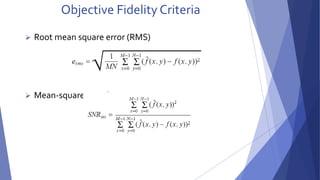
Objective Fidelity Criteria 
 Root mean square error (RMS) 
 Mean-square signal-to-noise ratio (SNR)
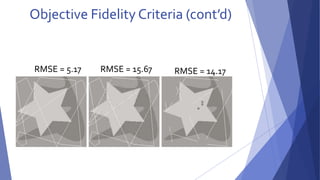
Objective Fidelity Criteria (cont’d) 
RMSE = 5.17 RMSE = 15.67 RMSE = 14.17
Image Compression Models 
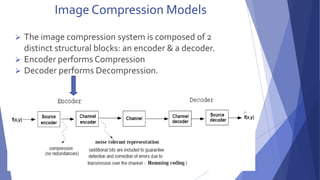
 The image compression system is composed of 2 
distinct structural blocks: an encoder & a decoder. 
 Encoder performs Compression 
 Decoder performs Decompression.
 The encoder is made up of a source encoder which removes 
input redundancies, and a channel encoder, which increases the 
noise immunity of the source encoder's output. 
 The de-coder includes a channel decoder followed by a source 
decoder. 
 
 If the channel between the encoder and decoder is noise free (no 
prone or error) the channel encoder and decoder are omitted. 
 Input image f(x,y) is fed into the encoder, which creates a 
compressed representation of input. 
 It is stored for future for later use or transmitted for storage and 
use at a remote location. 
 When the compressed image is given to decoder, a reconstructed 
output image f’(x,…..) is generated. 
 The encoded input and decoder output are f(x, y) & f’(x, y) resp. 
 In video applications, they are f(x, y, t) & f’(x, y, t) where t is time.
 1-The Source Encoder and Decoder:: 
 The source encoder is responsible for reducing or eliminating any 
coding, interpixel and psychovisual redundancies in the input 
image. 
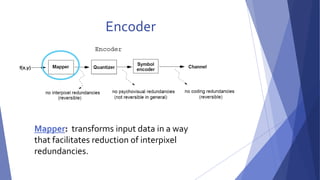
 Encoder is used to remove the redundancies through a series of 3 
independent operations. 
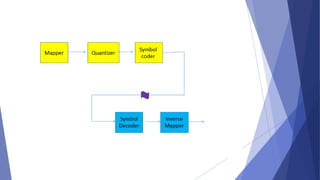
 Mapper:It transforms f(x,y) into a format designed to reduce 
interpixel redundancies. 
 It is reversible 
 It may / may not reduce the amount of data to represent image. 
 Ex. Run Length coding 
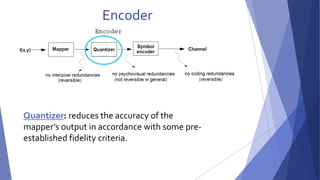
 Quantizer: reduces the accuracy of the mapper's output in 
accordance with some pre-established fidelity criterion. This stage 
reduces the psychovisual redundancies of the input image. 
 This operation is irreversible.
Encoder 
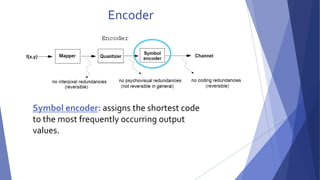
 Symbol Encoder: Generates a fixed or variable length 
code to represent the quantizer output and maps the 
output in accordance with the code. 
• In most cases, a variable-length code is used to represent 
the mapped and quantized data set. It assigns the shortest 
code words to the most frequently occurring output values 
and thus reduces coding redundancy. 
• It is reversible. 
• Upon its completion, the input image has been processed 
for the removal of all 3 redundancies.
Encoder 
Mapper: transforms input data in a way 
that facilitates reduction of interpixel 
redundancies.
Encoder 
Quantizer: reduces the accuracy of the 
mapper’s output in accordance with some pre-established 
fidelity criteria.
Encoder 
Symbol encoder: assigns the shortest code 
to the most frequently occurring output 
values.
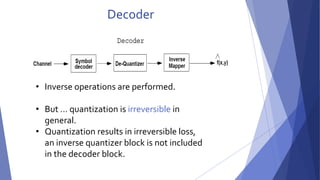
Decoder 
• Inverse operations are performed. 
• But … quantization is irreversible in 
general. 
• Quantization results in irreversible loss, 
an inverse quantizer block is not included 
in the decoder block.
Channel 
 2-The Channel Encoder and Decoder:: 
 In the overall encoding-decoding process when the channel is noisy or 
prone to error They are designed to reduce the impact of channel noise by 
inserting a controlled form of redundancy into the source encoded data. 
 As the output of the source encoder contains little redundancy, it would 
be highly sensitive to transmission noise without the addition of this 
"controlled redundancy." 
 One of the most useful channel encoding techniques was devised by R. 
W.Hamming (Hamming [1950]). 
 It is based on appending enough bits to the data being encoded to ensure 
that some minimum number of bits must change between valid code 
words. 
 Hamming(7,4) is a linear error-correcting code that encodes 4 bits of data 
into 7 bits by adding 3 parity bits. 
 Hamming's (7,4) algorithm can correct any single-bit error, or detect all 
single-bit and two-bit errors.
Elements of Information Theory 
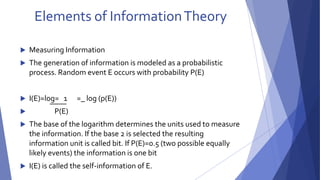
 Measuring Information 
 The generation of information is modeled as a probabilistic 
process. Random event E occurs with probability P(E) 
 I(E)=log= 1 =_ log (p(E)) 
 P(E) 
 The base of the logarithm determines the units used to measure 
the information. If the base 2 is selected the resulting 
information unit is called bit. If P(E)=0.5 (two possible equally 
likely events) the information is one bit 
 I(E) is called the self-information of E.
The Information Channel 
Information channel is the physical medium that 
connectsthe information source to the user of information. 
Self-information is transferred between an information 
source and a user of the information, through the 
information channel. 
Information source 
Generates a random sequence of symbols from a finite or 
countably infinite set of possible symbols. 
Output of the source is a discrete random variable
 The source : 
Modeled as a discrete random variable 
Source alphabet A={aj} 
Symbols (letters) aj with probabilities P(aj)
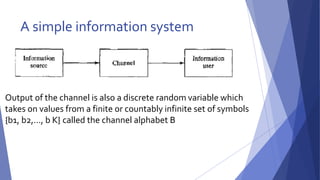
A simple information system 
Output of the channel is also a discrete random variable which 
takes on values from a finite or countably infinite set of symbols 
{b1, b2,…, b K} called the channel alphabet B
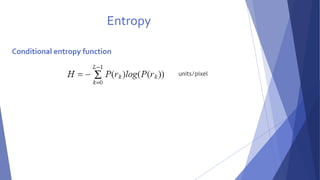
Entropy 
Conditional entropy function 
units/pixel
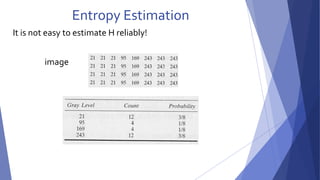
Entropy Estimation 
It is not easy to estimate H reliably! 
image
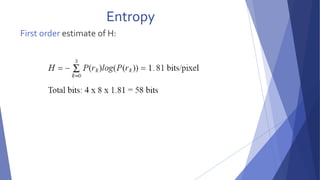
Entropy 
First order estimate of H:
Entropy 
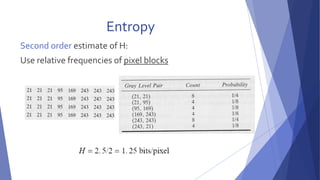
Second order estimate of H: 
Use relative frequencies of pixel blocks
Estimating Entropy 
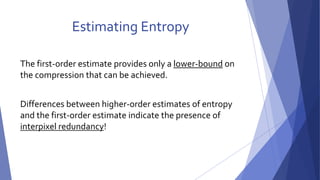
The first-order estimate provides only a lower-bound on 
the compression that can be achieved. 
Differences between higher-order estimates of entropy 
and the first-order estimate indicate the presence of 
interpixel redundancy!
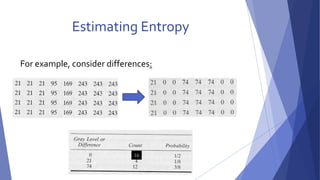
Estimating Entropy 
For example, consider differences: 
16
Estimating Entropy 
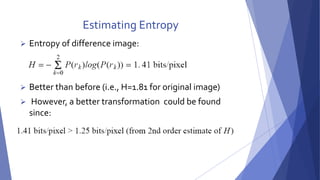
 Entropy of difference image: 
 Better than before (i.e., H=1.81 for original image) 
 However, a better transformation could be found 
since:
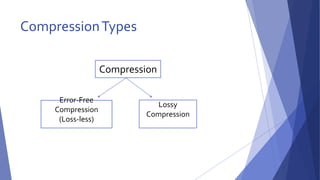
Compression Types 
Compression 
Error-Free 
Compression 
(Loss-less) 
Lossy 
Compression
Error-Free Compression 
 Some applications require no error in compression 
(medical, business documents, etc..) 
 CR=2 to 10 can be expected. 
 Make use of coding redundancy and inter-pixel 
redundancy. 
 Ex: Huffman codes, LZW, Arithmetic coding, 1D and 2D 
run-length encoding, Loss-less Predictive Coding, and 
Bit-Plane Coding.
Run-length encoding (RLE) 
 is a very simple form of data compression 
 stored as a single data value and count. 
 Ex: AAAABBCCCAA 
Sol: 3A2B3C2A
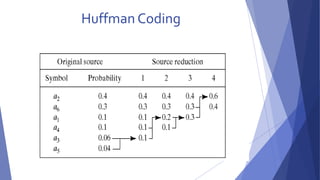
Huffman Coding 
 Huffman Coding 
 The most popular technique for removing coding 
redundancy is due to Huffman (1952) 
 A variable-length coding technique. 
 Optimal code (i.e., minimizes the number of code 
symbols per source symbol). 
 Huffman Coding yields the smallest number of code 
symbols per source symbol 
 Assumption: symbols are encoded one at a time!
Huffman Coding
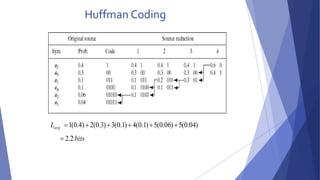
Huffman Coding 
1(0.4) 2(0.3) 3(0.1) 4(0.1) 5(0.06) 5(0.04) 
bits 
Lavg 
2.2 
 
     
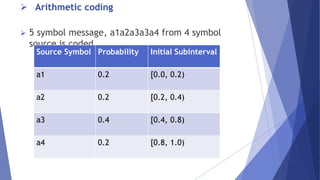
 Arithmetic coding 
 5 symbol message, a1a2a3a3a4 from 4 symbol 
source is coded. 
Source Symbol Probability Initial Subinterval 
a1 0.2 [0.0, 0.2) 
a2 0.2 [0.2, 0.4) 
a3 0.4 [0.4, 0.8) 
a4 0.2 [0.8, 1.0)
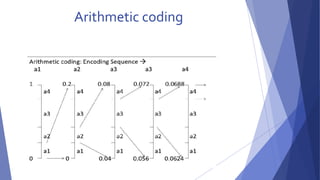
Arithmetic coding
 The final message symbol narrows to [0.06752, 
0.0688). 
 Any number between this interval can be used to 
represent the message. 
 E.g. 0.068 
 3 decimal digits are used to represent the 5 symbol 
message.
Fixed Length: LZW Coding 
 Error Free Compression Technique 
 Remove Inter-pixel redundancy 
 Requires no priori knowledge of probability 
distribution of pixels 
 Assigns fixed length code words to variable length 
sequences 
 Patented Algorithm US 4,558,302 
 Included in GIF and TIFF and PDF file formats
Coding Technique 
 A codebook or a dictionary has to be constructed 
 For an 8-bit monochrome image, the first 256 
entries are assigned to the gray levels 0,1,2,..,255. 
 As the encoder examines image pixels, gray level 
sequences that are not in the dictionary are 
assigned to a new entry. 
 For instance sequence 255-255 can be assigned to 
entry 256, the address following the locations 
reserved for gray levels 0 to 255.
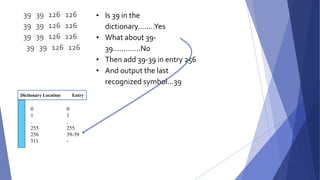
Example 
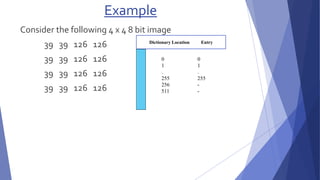
Consider the following 4 x 4 8 bit image 
39 39 126 126 
39 39 126 126 
39 39 126 126 
39 39 126 126 
Dictionary Location Entry 
0 0 
1 1 
. . 
255 255 
256 - 
511 -
39 39 126 126 
39 39 126 126 
39 39 126 126 
39 39 126 126 
• Is 39 in the 
dictionary……..Yes 
• What about 39- 
39………….No 
• Then add 39-39 in entry 256 
• And output the last 
recognized symbol…39 
Dictionary Location Entry 
0 0 
1 1 
. . 
255 255 
256 39-39 
511 -
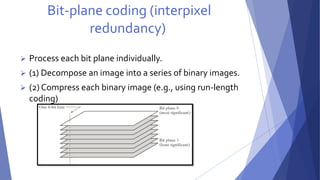
Bit-Plane Coding 
 An effective technique to reduce inter pixel 
redundancy is to process each bit plane 
individually 
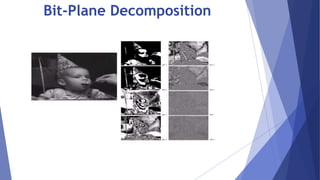
 The image is decomposed into a series of binary 
images. 
 Each binary image is compressed using one of 
well known binary compression techniques.
Bit-Plane Decomposition
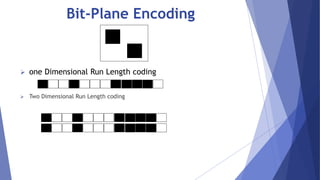
Bit-Plane Encoding 
 one Dimensional Run Length coding 
 Two Dimensional Run Length coding
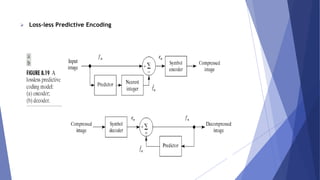
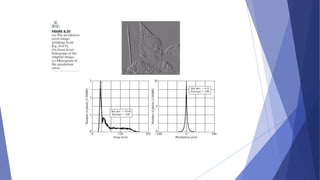
 Loss-less Predictive Encoding
Decoding LZW 
 Use the dictionary for decoding the “encoded output” 
sequence. 
 The dictionary need not be sent with the encoded 
output. 
 Can be built on the “fly” by the decoder as it reads the 
received code words.
Run-length coding (RLC) 
(interpixel redundancy) 
 Encodes repeating string of symbols (i.e., runs) using 
a few bytes: (symbol, count) 
1 1 1 1 1 0 0 0 0 0 0 1  (1,5) (0, 6) (1, 1) 
a a a b b b b b b c c  (a,3) (b, 6) (c, 2) 
 Can compress any type of data but cannot achieve 
high compression ratios compared to other 
compression methods.
Bit-plane coding (interpixel 
redundancy) 
 Process each bit plane individually. 
 (1) Decompose an image into a series of binary images. 
 (2) Compress each binary image (e.g., using run-length 
coding)
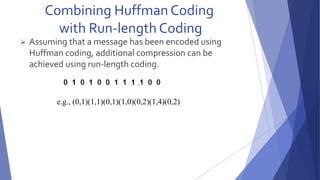
Combining Huffman Coding 
with Run-length Coding 
 Assuming that a message has been encoded using 
Huffman coding, additional compression can be 
achieved using run-length coding. 
e.g., (0,1)(1,1)(0,1)(1,0)(0,2)(1,4)(0,2)
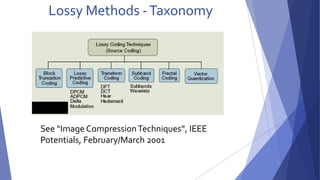
Lossy Methods -Taxonomy 
See “Image Compression Techniques”, IEEE 
Potentials, February/March 2001
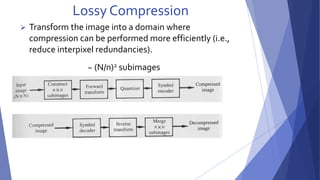
Lossy Compression 
 Transform the image into a domain where 
compression can be performed more efficiently (i.e., 
reduce interpixel redundancies). 
~ (N/n)2 subimages
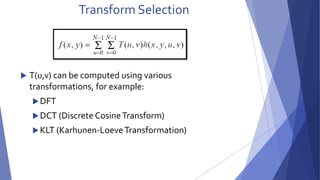
Transform Selection 
 T(u,v) can be computed using various 
transformations, for example: 
DFT 
DCT (Discrete Cosine Transform) 
KLT (Karhunen-Loeve Transformation)
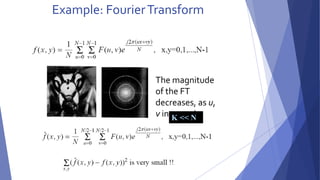
Example: Fourier Transform 
The magnitude 
of the FT 
decreases, as u, 
v increase! K << N
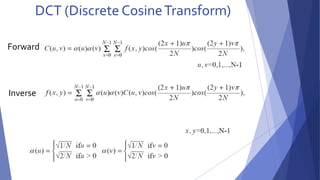
DCT (Discrete Cosine Transform) 
Forward 
Inverse
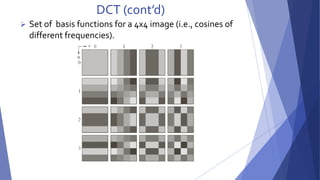
DCT (cont’d) 
 Set of basis functions for a 4x4 image (i.e., cosines of 
different frequencies).
DCT (cont’d) 
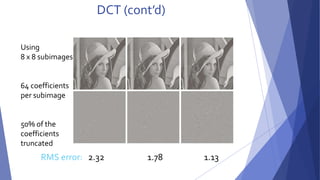
Using 
8 x 8 subimages 
64 coefficients 
per subimage 
50% of the 
coefficients 
truncated 
RMS error: 2.32 1.78 1.13
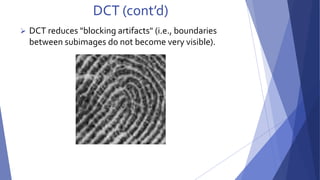
DCT (cont’d) 
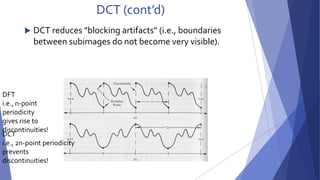
 DCT reduces "blocking artifacts" (i.e., boundaries 
between subimages do not become very visible).
DCT (cont’d) 
 DCT reduces "blocking artifacts" (i.e., boundaries 
between subimages do not become very visible). 
DFT 
i.e., n-point 
periodicity 
gives rise to 
discontinuities! 
DCT 
i.e., 2n-point periodicity 
prevents 
discontinuities!
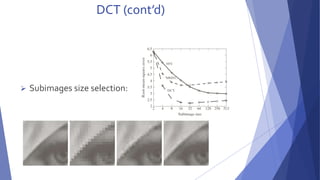
DCT (cont’d) 
 Subimages size selection:
image compression standard 
 ISO & CCITT 
 Binary 
 Continuous-tone 
 Video
Binary image compression 
 Fax: standard 
-Transmitting Docs. over Tele. Nets. 
 CCITT Group 3 (Huffman) 1D & 2D 
 CCITT Group 4 2D 
 JBIG 1
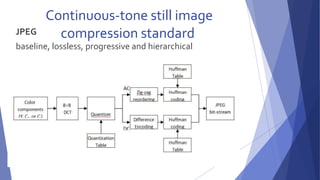
Continuous-tone still image 
JPEG compression standard 
baseline, lossless, progressive and hierarchical
JPEG 2000 
 wavelet and sub-band technologies 
 Embedded Block Coding with Optimized 
Truncation (EBCOT)
Features of JPEG2000 
 Lossless and lossy compression. 
 Protective image security. 
 Region-of-interest coding. 
 Robustness to bit errors.
JPEG-LS 
 latest ISO/ITU-T standard for lossless coding of still 
images. 
 provides for “near-lossless” compression. 
 Part-I: 
the baseline system, is based on: 
adaptive prediction, context modeling and Golomb 
coding. 
 Part-II (still under preparation). 
 Designed for low-complexity.
Video Compression Standards 
 MPEG-1 
The driving focus of the standard was storage of multimedia 
content on a standard CDROM, which supported data 
transfer rates of 1.4 Mb/s and a total storage capability of 
about 600 MB. 
 MPEG-2 
Designed to provide the capability for compressing, coding, 
and transmitting high quality, multi-channel, multimedia 
signals over broadband networks. 
ex: ATM. 
 MPEG-4 
Digital television, interactive graphics and the World Wide 
Web.

Image compression

  • 1.
    Image Compression DoneBy: Bassam Kanber Khawla Al-Hashedy Naglaa Fathi Redha Qaid Heba Al-Hakemy Hesham Al-Aghbary Supervisor Ensaf Al-Zurqa
  • 2.
    Goal of ImageCompression The goal of image compression is to reduce the amount of data required to represent a digital image.
  • 3.
    Data ≠ Information  Data and information are not synonymous terms!  Data is the means by which information is conveyed.  Data compression aims to reduce the amount of data required to represent a given quantity of information while preserving as much information as possible.
  • 4.
    Data vs Information(cont’d)  The same amount of information can be represented by various amount of data.  Ex1: Your wife, Helen, will meet you at Logan Airport in Boston at 5 minutes past 6:00 pm tomorrow night  Ex2: Your wife will meet you at Logan Airport at 5 minutes past 6:00 pm tomorrow night  Ex3: Helen will meet you at Logan at 6:00 pm tomorrow night
  • 5.
    Definitions: Compression Ratio compression Compression ratio:
  • 6.
    Definitions: Data Redundancy  Relative data redundancy: Example:
  • 7.
    Types of DataRedundancy (1) Coding Redundancy (2) Interpixel Redundancy (3) Psychovisual Redundancy  Compression attempts to reduce one or more of these redundancy types.
  • 8.
    Coding Redundancy Code: a list of symbols (letters, numbers, bits etc.)  Code word: a sequence of symbols used to represent a piece of information or an event (e.g., gray levels).  Code word length: number of symbols in each code word
  • 9.
    Coding Redundancy (cont’d) N x M image rk: k-th gray level P(rk): probability of rk l(rk): # of bits for rk Expected value:
  • 10.
    Coding Redundancy (con’d) Case 1: l(rk) = constant length Example:
  • 11.
    Case 2: l(rk)= variable length
  • 12.
    Interpixel redundancy Interpixel redundancy implies that pixel values are correlated (i.e., a pixel value can be reasonably predicted by its neighbors). autocorrelation: f(x)=g(x)
  • 13.
    Interpixel redundancy (cont’d)  To reduce interpixel redundancy, the data must be transformed in another format (i.e., using a transformation)  e.g., thresholding, DFT, DWT, etc.  Example: origin al thresholded
  • 14.
    Psychovisual redundancy The human eye does not respond with equal sensitivity to all visual information.  It is more sensitive to the lower frequencies than to the higher frequencies in the visual spectrum.  Idea: discard data that is perceptually insignificant!
  • 15.
    Psychovisual redundancy (cont’d) 256 gray levels 16 gray levels 16 gray levels/random noise C=8/4 = 2:1 i.e., add to each pixel a small pseudo-random number prior to quantization Example: quantization
  • 16.
    Fidelity Criteria How close is to ?  Criteria  Subjective: based on human observers  Objective: mathematically defined criteria
  • 17.
  • 18.
    Objective Fidelity Criteria  Root mean square error (RMS)  Mean-square signal-to-noise ratio (SNR)
  • 19.
    Objective Fidelity Criteria(cont’d) RMSE = 5.17 RMSE = 15.67 RMSE = 14.17
  • 20.
    Image Compression Models  The image compression system is composed of 2 distinct structural blocks: an encoder & a decoder.  Encoder performs Compression  Decoder performs Decompression.
  • 21.
     The encoderis made up of a source encoder which removes input redundancies, and a channel encoder, which increases the noise immunity of the source encoder's output.  The de-coder includes a channel decoder followed by a source decoder.   If the channel between the encoder and decoder is noise free (no prone or error) the channel encoder and decoder are omitted.  Input image f(x,y) is fed into the encoder, which creates a compressed representation of input.  It is stored for future for later use or transmitted for storage and use at a remote location.  When the compressed image is given to decoder, a reconstructed output image f’(x,…..) is generated.  The encoded input and decoder output are f(x, y) & f’(x, y) resp.  In video applications, they are f(x, y, t) & f’(x, y, t) where t is time.
  • 22.
     1-The SourceEncoder and Decoder::  The source encoder is responsible for reducing or eliminating any coding, interpixel and psychovisual redundancies in the input image.  Encoder is used to remove the redundancies through a series of 3 independent operations.  Mapper:It transforms f(x,y) into a format designed to reduce interpixel redundancies.  It is reversible  It may / may not reduce the amount of data to represent image.  Ex. Run Length coding  Quantizer: reduces the accuracy of the mapper's output in accordance with some pre-established fidelity criterion. This stage reduces the psychovisual redundancies of the input image.  This operation is irreversible.
  • 23.
    Encoder  SymbolEncoder: Generates a fixed or variable length code to represent the quantizer output and maps the output in accordance with the code. • In most cases, a variable-length code is used to represent the mapped and quantized data set. It assigns the shortest code words to the most frequently occurring output values and thus reduces coding redundancy. • It is reversible. • Upon its completion, the input image has been processed for the removal of all 3 redundancies.
  • 24.
    Encoder Mapper: transformsinput data in a way that facilitates reduction of interpixel redundancies.
  • 25.
    Encoder Quantizer: reducesthe accuracy of the mapper’s output in accordance with some pre-established fidelity criteria.
  • 26.
    Encoder Symbol encoder:assigns the shortest code to the most frequently occurring output values.
  • 27.
    Decoder • Inverseoperations are performed. • But … quantization is irreversible in general. • Quantization results in irreversible loss, an inverse quantizer block is not included in the decoder block.
  • 29.
    Channel  2-TheChannel Encoder and Decoder::  In the overall encoding-decoding process when the channel is noisy or prone to error They are designed to reduce the impact of channel noise by inserting a controlled form of redundancy into the source encoded data.  As the output of the source encoder contains little redundancy, it would be highly sensitive to transmission noise without the addition of this "controlled redundancy."  One of the most useful channel encoding techniques was devised by R. W.Hamming (Hamming [1950]).  It is based on appending enough bits to the data being encoded to ensure that some minimum number of bits must change between valid code words.  Hamming(7,4) is a linear error-correcting code that encodes 4 bits of data into 7 bits by adding 3 parity bits.  Hamming's (7,4) algorithm can correct any single-bit error, or detect all single-bit and two-bit errors.
  • 30.
    Elements of InformationTheory  Measuring Information  The generation of information is modeled as a probabilistic process. Random event E occurs with probability P(E)  I(E)=log= 1 =_ log (p(E))  P(E)  The base of the logarithm determines the units used to measure the information. If the base 2 is selected the resulting information unit is called bit. If P(E)=0.5 (two possible equally likely events) the information is one bit  I(E) is called the self-information of E.
  • 31.
    The Information Channel Information channel is the physical medium that connectsthe information source to the user of information. Self-information is transferred between an information source and a user of the information, through the information channel. Information source Generates a random sequence of symbols from a finite or countably infinite set of possible symbols. Output of the source is a discrete random variable
  • 32.
     The source: Modeled as a discrete random variable Source alphabet A={aj} Symbols (letters) aj with probabilities P(aj)
  • 33.
    A simple informationsystem Output of the channel is also a discrete random variable which takes on values from a finite or countably infinite set of symbols {b1, b2,…, b K} called the channel alphabet B
  • 34.
    Entropy Conditional entropyfunction units/pixel
  • 35.
    Entropy Estimation Itis not easy to estimate H reliably! image
  • 36.
    Entropy First orderestimate of H:
  • 37.
    Entropy Second orderestimate of H: Use relative frequencies of pixel blocks
  • 38.
    Estimating Entropy Thefirst-order estimate provides only a lower-bound on the compression that can be achieved. Differences between higher-order estimates of entropy and the first-order estimate indicate the presence of interpixel redundancy!
  • 39.
    Estimating Entropy Forexample, consider differences: 16
  • 40.
    Estimating Entropy Entropy of difference image:  Better than before (i.e., H=1.81 for original image)  However, a better transformation could be found since:
  • 41.
    Compression Types Compression Error-Free Compression (Loss-less) Lossy Compression
  • 42.
    Error-Free Compression Some applications require no error in compression (medical, business documents, etc..)  CR=2 to 10 can be expected.  Make use of coding redundancy and inter-pixel redundancy.  Ex: Huffman codes, LZW, Arithmetic coding, 1D and 2D run-length encoding, Loss-less Predictive Coding, and Bit-Plane Coding.
  • 43.
    Run-length encoding (RLE)  is a very simple form of data compression  stored as a single data value and count.  Ex: AAAABBCCCAA Sol: 3A2B3C2A
  • 44.
    Huffman Coding Huffman Coding  The most popular technique for removing coding redundancy is due to Huffman (1952)  A variable-length coding technique.  Optimal code (i.e., minimizes the number of code symbols per source symbol).  Huffman Coding yields the smallest number of code symbols per source symbol  Assumption: symbols are encoded one at a time!
  • 45.
  • 46.
    Huffman Coding 1(0.4)2(0.3) 3(0.1) 4(0.1) 5(0.06) 5(0.04) bits Lavg 2.2       
  • 47.
     Arithmetic coding  5 symbol message, a1a2a3a3a4 from 4 symbol source is coded. Source Symbol Probability Initial Subinterval a1 0.2 [0.0, 0.2) a2 0.2 [0.2, 0.4) a3 0.4 [0.4, 0.8) a4 0.2 [0.8, 1.0)
  • 48.
  • 49.
     The finalmessage symbol narrows to [0.06752, 0.0688).  Any number between this interval can be used to represent the message.  E.g. 0.068  3 decimal digits are used to represent the 5 symbol message.
  • 50.
    Fixed Length: LZWCoding  Error Free Compression Technique  Remove Inter-pixel redundancy  Requires no priori knowledge of probability distribution of pixels  Assigns fixed length code words to variable length sequences  Patented Algorithm US 4,558,302  Included in GIF and TIFF and PDF file formats
  • 51.
    Coding Technique A codebook or a dictionary has to be constructed  For an 8-bit monochrome image, the first 256 entries are assigned to the gray levels 0,1,2,..,255.  As the encoder examines image pixels, gray level sequences that are not in the dictionary are assigned to a new entry.  For instance sequence 255-255 can be assigned to entry 256, the address following the locations reserved for gray levels 0 to 255.
  • 52.
    Example Consider thefollowing 4 x 4 8 bit image 39 39 126 126 39 39 126 126 39 39 126 126 39 39 126 126 Dictionary Location Entry 0 0 1 1 . . 255 255 256 - 511 -
  • 53.
    39 39 126126 39 39 126 126 39 39 126 126 39 39 126 126 • Is 39 in the dictionary……..Yes • What about 39- 39………….No • Then add 39-39 in entry 256 • And output the last recognized symbol…39 Dictionary Location Entry 0 0 1 1 . . 255 255 256 39-39 511 -
  • 54.
    Bit-Plane Coding An effective technique to reduce inter pixel redundancy is to process each bit plane individually  The image is decomposed into a series of binary images.  Each binary image is compressed using one of well known binary compression techniques.
  • 55.
  • 56.
    Bit-Plane Encoding one Dimensional Run Length coding  Two Dimensional Run Length coding
  • 57.
  • 59.
    Decoding LZW Use the dictionary for decoding the “encoded output” sequence.  The dictionary need not be sent with the encoded output.  Can be built on the “fly” by the decoder as it reads the received code words.
  • 60.
    Run-length coding (RLC) (interpixel redundancy)  Encodes repeating string of symbols (i.e., runs) using a few bytes: (symbol, count) 1 1 1 1 1 0 0 0 0 0 0 1  (1,5) (0, 6) (1, 1) a a a b b b b b b c c  (a,3) (b, 6) (c, 2)  Can compress any type of data but cannot achieve high compression ratios compared to other compression methods.
  • 61.
    Bit-plane coding (interpixel redundancy)  Process each bit plane individually.  (1) Decompose an image into a series of binary images.  (2) Compress each binary image (e.g., using run-length coding)
  • 62.
    Combining Huffman Coding with Run-length Coding  Assuming that a message has been encoded using Huffman coding, additional compression can be achieved using run-length coding. e.g., (0,1)(1,1)(0,1)(1,0)(0,2)(1,4)(0,2)
  • 63.
    Lossy Methods -Taxonomy See “Image Compression Techniques”, IEEE Potentials, February/March 2001
  • 64.
    Lossy Compression Transform the image into a domain where compression can be performed more efficiently (i.e., reduce interpixel redundancies). ~ (N/n)2 subimages
  • 65.
    Transform Selection T(u,v) can be computed using various transformations, for example: DFT DCT (Discrete Cosine Transform) KLT (Karhunen-Loeve Transformation)
  • 66.
    Example: Fourier Transform The magnitude of the FT decreases, as u, v increase! K << N
  • 67.
    DCT (Discrete CosineTransform) Forward Inverse
  • 68.
    DCT (cont’d) Set of basis functions for a 4x4 image (i.e., cosines of different frequencies).
  • 69.
    DCT (cont’d) Using 8 x 8 subimages 64 coefficients per subimage 50% of the coefficients truncated RMS error: 2.32 1.78 1.13
  • 70.
    DCT (cont’d) DCT reduces "blocking artifacts" (i.e., boundaries between subimages do not become very visible).
  • 71.
    DCT (cont’d) DCT reduces "blocking artifacts" (i.e., boundaries between subimages do not become very visible). DFT i.e., n-point periodicity gives rise to discontinuities! DCT i.e., 2n-point periodicity prevents discontinuities!
  • 72.
    DCT (cont’d) Subimages size selection:
  • 73.
    image compression standard  ISO & CCITT  Binary  Continuous-tone  Video
  • 74.
    Binary image compression  Fax: standard -Transmitting Docs. over Tele. Nets.  CCITT Group 3 (Huffman) 1D & 2D  CCITT Group 4 2D  JBIG 1
  • 75.
    Continuous-tone still image JPEG compression standard baseline, lossless, progressive and hierarchical
  • 76.
    JPEG 2000 wavelet and sub-band technologies  Embedded Block Coding with Optimized Truncation (EBCOT)
  • 77.
    Features of JPEG2000  Lossless and lossy compression.  Protective image security.  Region-of-interest coding.  Robustness to bit errors.
  • 78.
    JPEG-LS  latestISO/ITU-T standard for lossless coding of still images.  provides for “near-lossless” compression.  Part-I: the baseline system, is based on: adaptive prediction, context modeling and Golomb coding.  Part-II (still under preparation).  Designed for low-complexity.
  • 79.
    Video Compression Standards  MPEG-1 The driving focus of the standard was storage of multimedia content on a standard CDROM, which supported data transfer rates of 1.4 Mb/s and a total storage capability of about 600 MB.  MPEG-2 Designed to provide the capability for compressing, coding, and transmitting high quality, multi-channel, multimedia signals over broadband networks. ex: ATM.  MPEG-4 Digital television, interactive graphics and the World Wide Web.