A Quick Illustration of
JPEG 2000
Presented by
Kim-Huei Low
Chun Data Fok
Overview
 Introduction
 Approach
 Illustration
 Annex B-H
 Comparison with JPEG
 Conclusion
 References
 Questions
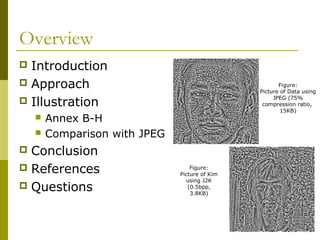
Figure:
Picture of Data using
JPEG (75%
compression ratio,
15KB)
Figure:
Picture of Kim
using J2K
(0.5bpp,
3.8KB)
Introduction
 JPEG 2000
 Drafted by the international JPEG (Joint Bi-
level Image Experts Group) and JBIG (Joint
Photographic Experts Group) groups.
 Replaces traditional JPEG.
 Focuses on hardware implementation.
 Our goal
 Present a simplified version of the standard.
 Give new users a grasp of JPEG 2000.
Approach
 Follow the same order
as the standard.
 Explain the
background.
 Illustrate each feature.
 Discuss its
applications.
 List the pros and cons.
 Will skip Annex A, C
and D.
 Feature wise, it’s not
important.
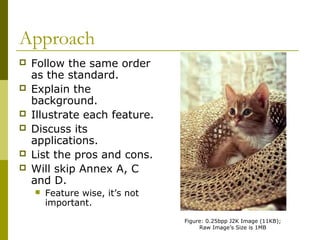
Figure: 0.25bpp J2K Image (11KB);
Raw Image’s Size is 1MB
Illustration: Annex B
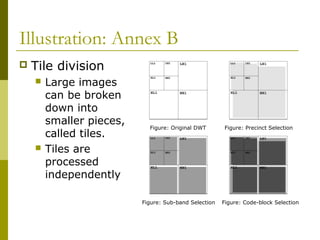
 Tile division
 Large images
can be broken
down into
smaller pieces,
called tiles.
 Tiles are
processed
independently
Figure: Original DWT Figure: Precinct Selection
Figure: Sub-band Selection Figure: Code-block Selection
Illustration: Annex B
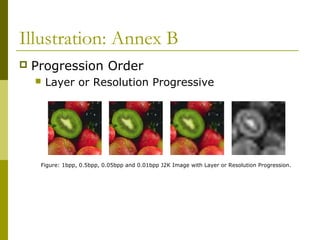
 Progression Order
 Layer or Resolution Progressive
Figure: 1bpp, 0.5bpp, 0.05bpp and 0.01bpp J2K Image with Layer or Resolution Progression.
Illustration: Annex B
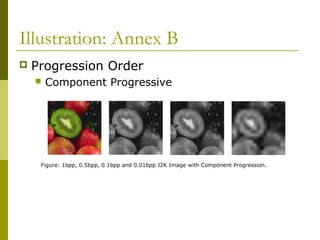
 Progression Order
 Component Progressive
Figure: 1bpp, 0.5bpp, 0.1bpp and 0.01bpp J2K Image with Component Progression.
Illustration: Annex B
 Progression Order
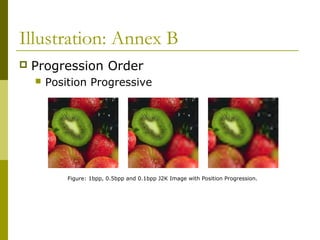
 Position Progressive
Figure: 1bpp, 0.5bpp and 0.1bpp J2K Image with Position Progression.
Illustration: Annex E
 Quantization
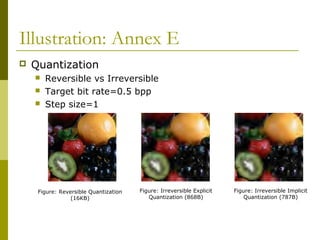
 Reversible vs Irreversible
 Target bit rate=0.5 bpp
 Step size=1
Figure: Reversible Quantization
(16KB)
Figure: Irreversible Explicit
Quantization (868B)
Figure: Irreversible Implicit
Quantization (787B)
Illustration: Annex E
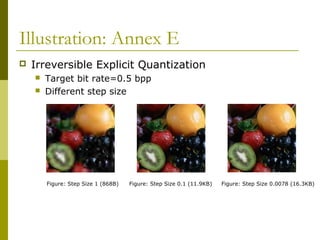
 Irreversible Explicit Quantization
 Target bit rate=0.5 bpp
 Different step size
Figure: Step Size 1 (868B) Figure: Step Size 0.1 (11.9KB) Figure: Step Size 0.0078 (16.3KB)
Illustration: Annex E
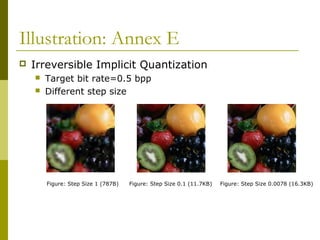
 Irreversible Implicit Quantization
 Target bit rate=0.5 bpp
 Different step size
Figure: Step Size 1 (787B) Figure: Step Size 0.1 (11.7KB) Figure: Step Size 0.0078 (16.3KB)
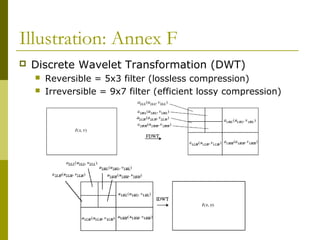
Illustration: Annex F
 Discrete Wavelet Transformation (DWT)
 Reversible = 5x3 filter (lossless compression)
 Irreversible = 9x7 filter (efficient lossy compression)
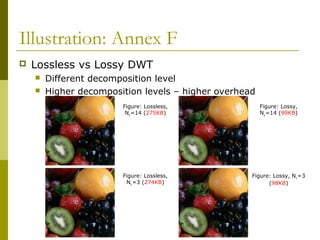
Illustration: Annex F
 Lossless vs Lossy DWT
 Different decomposition level
 Higher decomposition levels – higher overhead
Figure: Lossless,
NL=14 (275KB)
Figure: Lossy,
NL=14 (99KB)
Figure: Lossless,
NL=3 (274KB)
Figure: Lossy, NL=3
(98KB)
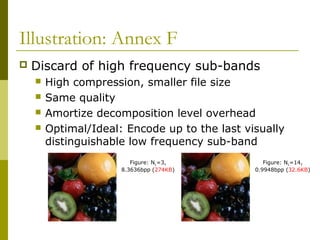
Illustration: Annex F
 Discard of high frequency sub-bands
 High compression, smaller file size
 Same quality
 Amortize decomposition level overhead
 Optimal/Ideal: Encode up to the last visually
distinguishable low frequency sub-band
Figure: NL=3,
8.3636bpp (274KB)
Figure: NL=14,
0.9948bpp (32.6KB)
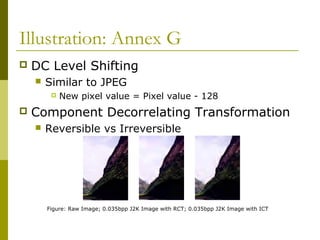
Illustration: Annex G
 DC Level Shifting
 Similar to JPEG
 New pixel value = Pixel value - 128
 Component Decorrelating Transformation
 Reversible vs Irreversible
Figure: Raw Image; 0.035bpp J2K Image with RCT; 0.035bpp J2K Image with ICT
Illustration: Annex H
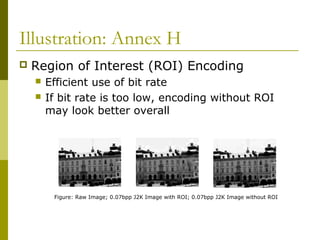
 Region of Interest (ROI) Encoding
 Efficient use of bit rate
 If bit rate is too low, encoding without ROI
may look better overall
Figure: Raw Image; 0.07bpp J2K Image with ROI; 0.07bpp J2K Image without ROI
Illustration: Comparison of JPEG 2000
with JPEG
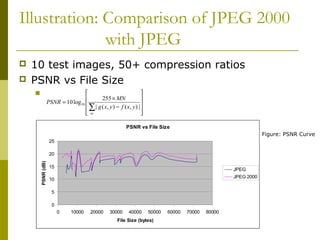
 10 test images, 50+ compression ratios
 PSNR vs File Size











−
×
=
∑xy
yxfyxg
MN
PSNR
|),(),(|
255
log10 10
PSNR vs File Size
0
5
10
15
20
25
0 10000 20000 30000 40000 50000 60000 70000 80000
File Size (bytes)
PSNR(dB)
JPEG
JPEG 2000
Figure: PSNR Curve
Illustration: Comparison of JPEG 2000
with JPEG
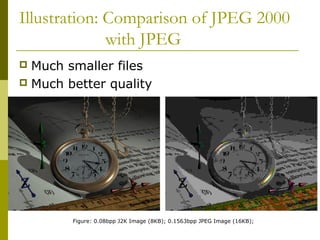
 Much smaller files
 Much better quality
Figure: 0.08bpp J2K Image (8KB); 0.1563bpp JPEG Image (16KB);
Conclusion
 Excellent compression rate
 Fully exploits the advantage of DWT
 Capable of handling extremely large
images
 Lots of user-selectable features
 Efficient for hardware implementation
 Most advanced image compression
standard
 Implication of MPEG 2000?
References
 International Telecommunication Union (ITU),
International Organization for Standardization
(ISO), “JPEG 2000 Implementation in Java,”
http://jpeg2000.epfl.ch, October 16th, 2003.
 ISO/IEC JTCI/SC29 WGI, JPEG 2000 Editor
Martin Boliek, Charilaos Christopoulos, Eric
Majani, “JPEG 2000 Image Coding System,”
http://www.jpeg.org/CDs15444.html, March
16th, 2000.

A quick illustration of jpeg 2000

  • 1.
    A Quick Illustrationof JPEG 2000 Presented by Kim-Huei Low Chun Data Fok
  • 2.
    Overview  Introduction  Approach Illustration  Annex B-H  Comparison with JPEG  Conclusion  References  Questions Figure: Picture of Data using JPEG (75% compression ratio, 15KB) Figure: Picture of Kim using J2K (0.5bpp, 3.8KB)
  • 3.
    Introduction  JPEG 2000 Drafted by the international JPEG (Joint Bi- level Image Experts Group) and JBIG (Joint Photographic Experts Group) groups.  Replaces traditional JPEG.  Focuses on hardware implementation.  Our goal  Present a simplified version of the standard.  Give new users a grasp of JPEG 2000.
  • 4.
    Approach  Follow thesame order as the standard.  Explain the background.  Illustrate each feature.  Discuss its applications.  List the pros and cons.  Will skip Annex A, C and D.  Feature wise, it’s not important. Figure: 0.25bpp J2K Image (11KB); Raw Image’s Size is 1MB
  • 5.
    Illustration: Annex B Tile division  Large images can be broken down into smaller pieces, called tiles.  Tiles are processed independently Figure: Original DWT Figure: Precinct Selection Figure: Sub-band Selection Figure: Code-block Selection
  • 6.
    Illustration: Annex B Progression Order  Layer or Resolution Progressive Figure: 1bpp, 0.5bpp, 0.05bpp and 0.01bpp J2K Image with Layer or Resolution Progression.
  • 7.
    Illustration: Annex B Progression Order  Component Progressive Figure: 1bpp, 0.5bpp, 0.1bpp and 0.01bpp J2K Image with Component Progression.
  • 8.
    Illustration: Annex B Progression Order  Position Progressive Figure: 1bpp, 0.5bpp and 0.1bpp J2K Image with Position Progression.
  • 9.
    Illustration: Annex E Quantization  Reversible vs Irreversible  Target bit rate=0.5 bpp  Step size=1 Figure: Reversible Quantization (16KB) Figure: Irreversible Explicit Quantization (868B) Figure: Irreversible Implicit Quantization (787B)
  • 10.
    Illustration: Annex E Irreversible Explicit Quantization  Target bit rate=0.5 bpp  Different step size Figure: Step Size 1 (868B) Figure: Step Size 0.1 (11.9KB) Figure: Step Size 0.0078 (16.3KB)
  • 11.
    Illustration: Annex E Irreversible Implicit Quantization  Target bit rate=0.5 bpp  Different step size Figure: Step Size 1 (787B) Figure: Step Size 0.1 (11.7KB) Figure: Step Size 0.0078 (16.3KB)
  • 12.
    Illustration: Annex F Discrete Wavelet Transformation (DWT)  Reversible = 5x3 filter (lossless compression)  Irreversible = 9x7 filter (efficient lossy compression)
  • 13.
    Illustration: Annex F Lossless vs Lossy DWT  Different decomposition level  Higher decomposition levels – higher overhead Figure: Lossless, NL=14 (275KB) Figure: Lossy, NL=14 (99KB) Figure: Lossless, NL=3 (274KB) Figure: Lossy, NL=3 (98KB)
  • 14.
    Illustration: Annex F Discard of high frequency sub-bands  High compression, smaller file size  Same quality  Amortize decomposition level overhead  Optimal/Ideal: Encode up to the last visually distinguishable low frequency sub-band Figure: NL=3, 8.3636bpp (274KB) Figure: NL=14, 0.9948bpp (32.6KB)
  • 15.
    Illustration: Annex G DC Level Shifting  Similar to JPEG  New pixel value = Pixel value - 128  Component Decorrelating Transformation  Reversible vs Irreversible Figure: Raw Image; 0.035bpp J2K Image with RCT; 0.035bpp J2K Image with ICT
  • 16.
    Illustration: Annex H Region of Interest (ROI) Encoding  Efficient use of bit rate  If bit rate is too low, encoding without ROI may look better overall Figure: Raw Image; 0.07bpp J2K Image with ROI; 0.07bpp J2K Image without ROI
  • 17.
    Illustration: Comparison ofJPEG 2000 with JPEG  10 test images, 50+ compression ratios  PSNR vs File Size            − × = ∑xy yxfyxg MN PSNR |),(),(| 255 log10 10 PSNR vs File Size 0 5 10 15 20 25 0 10000 20000 30000 40000 50000 60000 70000 80000 File Size (bytes) PSNR(dB) JPEG JPEG 2000 Figure: PSNR Curve
  • 18.
    Illustration: Comparison ofJPEG 2000 with JPEG  Much smaller files  Much better quality Figure: 0.08bpp J2K Image (8KB); 0.1563bpp JPEG Image (16KB);
  • 19.
    Conclusion  Excellent compressionrate  Fully exploits the advantage of DWT  Capable of handling extremely large images  Lots of user-selectable features  Efficient for hardware implementation  Most advanced image compression standard  Implication of MPEG 2000?
  • 20.
    References  International TelecommunicationUnion (ITU), International Organization for Standardization (ISO), “JPEG 2000 Implementation in Java,” http://jpeg2000.epfl.ch, October 16th, 2003.  ISO/IEC JTCI/SC29 WGI, JPEG 2000 Editor Martin Boliek, Charilaos Christopoulos, Eric Majani, “JPEG 2000 Image Coding System,” http://www.jpeg.org/CDs15444.html, March 16th, 2000.