PREPARED BY:
Peñarubia, Patriz Lenn
Tinonas, Apple Gay
Raboy, Joanna Jane
Mendoza, Claire Anne
ELGA – COMPARATIVE ANATOMY LECTURE
MAAM HAZEL TABO
VIDEO
PRESENTATION
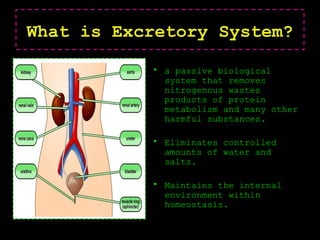
What is Excretory System?
• a passive biological
system that removes
nitrogenous wastes
products of protein
metabolism and many other
harmful substances.
• Eliminates controlled
amounts of water and
salts.
• Maintains the internal
environment within
homeostasis.
Excretion
• Excretion is the removal of the
metabolic wastes of an
organism. Wastes that are
removed include carbon dioxide,
water, salt, urea and uric
acid. All excreted wastes
travel at some time in the
blood.
General Characteristics
and Function of parts
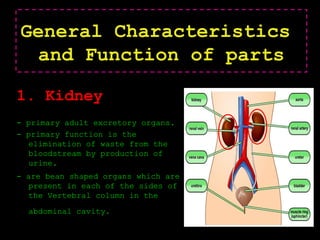
1. Kidney
- primary adult excretory organs.
- primary function is the
elimination of waste from the
bloodstream by production of
urine.
- are bean shaped organs which are
present in each of the sides of
the Vertebral column in the
abdominal cavity.
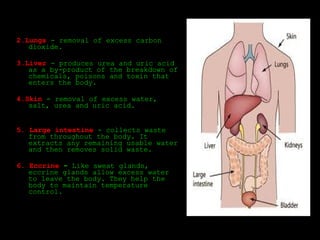
2.Lungs - removal of excess carbon
dioxide.
3.Liver - produces urea and uric acid
as a by-product of the breakdown of
chemicals, poisons and toxin that
enters the body.
4.Skin - removal of excess water,
salt, urea and uric acid.
5. Large intestine - collects waste
from throughout the body. It
extracts any remaining usable water
and then removes solid waste.
6. Eccrine - Like sweat glands,
eccrine glands allow excess water
to leave the body. They help the
body to maintain temperature
control.
Development and
Evolution of kidneys
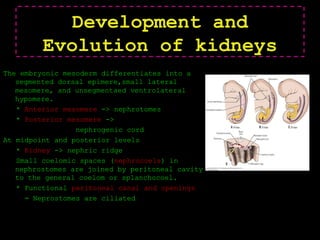
The embryonic mesoderm differentiates into a
segmented dorsal epimere,small lateral
mesomere, and unsegmentaed ventrolateral
hypomere.
* Anterior mesomere -> nephrotomes
* Posterior mesomere ->
nephrogenic cord
At midpoint and posterior levels
* Kidney -> nephric ridge
Small coelomic spaces (nephrocoels) in
nephrostomes are joined by peritoneal cavity
to the general coelom or splanchocoel.
* Functional peritoneal canal and openings
= Neprostomes are ciliated
* In AMNIOTES, peritoneal canal fail to form
instead nephrocoels are formed within the
cord by cavitation process.
* Nephrocoels -> renal capsules
• Nephric tubules -> outgrowths of the walls of
nephrocoels or solid masses of mesenchyme.
* Anterior tubules are first to develop and
its outer ends join to form nephric ducts.
* Nephric Duct extends to cloaca.
Development and
Evolution of kidneys
Holonephros:
The Ancestral Kidney
• Derived from entire mesomere.
• The entire mass of nephrogenic
tissue gives rise to this
kidney, which is usually of
simple form with a single tubule
in each segment.
• Found in larvae of Hagfishes and
Caecillians.
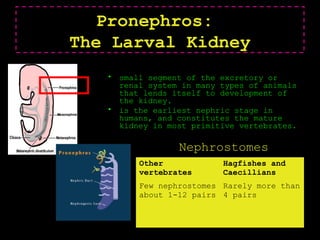
Pronephros:
The Larval Kidney
• small segment of the excretory or
renal system in many types of animals
that lends itself to development of
the kidney.
• is the earliest nephric stage in
humans, and constitutes the mature
kidney in most primitive vertebrates.
Other
vertebrates
Hagfishes and
Caecillians
Few nephrostomes
about 1-12 pairs
Rarely more than
4 pairs
Nephrostomes
Pronephros:
The Larval Kidney
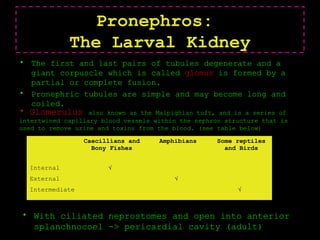
• The first and last pairs of tubules degenerate and a
giant corpuscle which is called glomus is formed by a
partial or complete fusion.
• Pronephric tubules are simple and may become long and
coiled.
Caecillians and
Bony Fishes
Amphibians Some reptiles
and Birds
Internal √
External √
Intermediate √
• Glomerulus also known as the Malpighian tuft, and is a series of
intertwined capillary blood vessels within the nephron structure that is
used to remove urine and toxins from the blood. (see table below)
• With ciliated neprostomes and open into anterior
splanchnocoel -> pericardial cavity (adult)
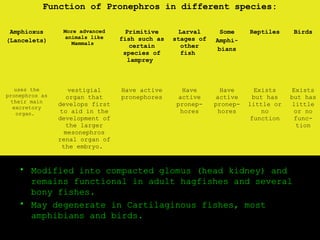
• Modified into compacted glomus (head kidney) and
remains functional in adult hagfishes and several
bony fishes.
• May degenerate in Cartilaginous fishes, most
amphibians and birds.
Function of Pronephros in different species:
Amphioxus
(Lancelets)
More advanced
animals like
Mammals
Primitive
fish such as
certain
species of
lamprey
Larval
stages of
other
fish
Some
Amphi-
bians
Reptiles Birds
uses the
pronephros as
their main
excretory
organ.
vestigial
organ that
develops first
to aid in the
development of
the larger
mesonephros
renal organ of
the embryo.
Have active
pronephores
Have
active
pronep-
hores
Have
active
pronep-
hores
Exists
but has
little or
no
function
Exists
but has
little
or no
func-
tion
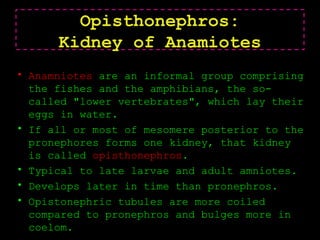
Opisthonephros:
Kidney of Anamiotes
• Anamniotes are an informal group comprising
the fishes and the amphibians, the so-
called "lower vertebrates", which lay their
eggs in water.
• If all or most of mesomere posterior to the
pronephores forms one kidney, that kidney
is called opisthonephros.
• Typical to late larvae and adult amniotes.
• Develops later in time than pronephros.
• Opistonephric tubules are more coiled
compared to pronephros and bulges more in
coelom.
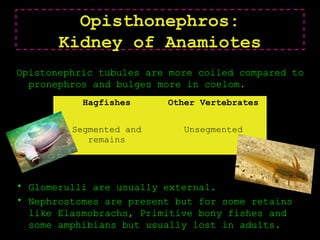
Opisthonephros:
Kidney of Anamiotes
Hagfishes Other Vertebrates
Segmented and
remains
Unsegmented
Opistonephric tubules are more coiled compared to
pronephros and bulges more in coelom.
• Glomerulli are usually external.
• Nephrostomes are present but for some retains
like Elasmobrachs, Primitive bony fishes and
some amphibians but usually lost in adults.
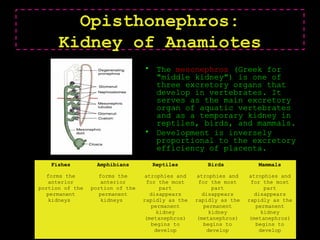
• The mesonephros (Greek for
"middle kidney") is one of
three excretory organs that
develop in vertebrates. It
serves as the main excretory
organ of aquatic vertebrates
and as a temporary kidney in
reptiles, birds, and mammals.
• Development is inversely
proportional to the excretory
efficiency of placenta.
Opisthonephros:
Kidney of Anamiotes
Fishes Amphibians Reptiles Birds Mammals
forms the
anterior
portion of the
permanent
kidneys
forms the
anterior
portion of the
permanent
kidneys
atrophies and
for the most
part
disappears
rapidly as the
permanent
kidney
(metanephros)
begins to
develop
atrophies and
for the most
part
disappears
rapidly as the
permanent
kidney
(metanephros)
begins to
develop
atrophies and
for the most
part
disappears
rapidly as the
permanent
kidney
(metanephros)
begins to
develop
Metanephros:
Kidney of Amniotes
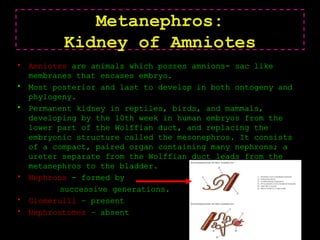
• Amniotes are animals which posses amnions- sac like
membranes that encases embryo.
• Most posterior and last to develop in both ontogeny and
phylogeny.
• Permanent kidney in reptiles, birds, and mammals,
developing by the 10th week in human embryos from the
lower part of the Wolffian duct, and replacing the
embryonic structure called the mesonephros. It consists
of a compact, paired organ containing many nephrons; a
ureter separate from the Wolffian duct leads from the
metanephros to the bladder.
• Nephrons - formed by
successive generations.
• Glomerulli – present
• Nephrostomes – absent
Metanephros:
Kidney of Amniotes
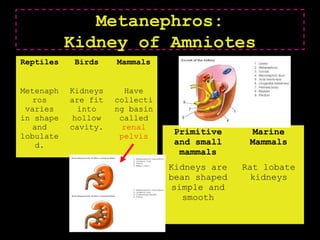
Reptiles Birds Mammals
Metenaph
ros
varies
in shape
and
lobulate
d.
Kidneys
are fit
into
hollow
cavity.
Have
collecti
ng basin
called
renal
pelvis
Primitive
and small
mammals
Marine
Mammals
Kidneys are
bean shaped
simple and
smooth
Rat lobate
kidneys
Urinary System
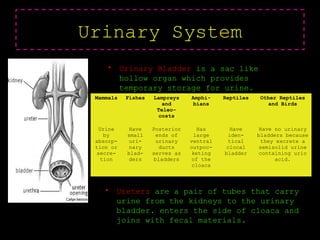
• Urinary Bladder is a sac like
hollow organ which provides
temporary storage for urine.
Mammals Fishes Lampreys
and
Teleo-
costs
Amphi-
bians
Reptiles Other Reptiles
and Birds
Urine
by
absorp-
tion or
secre-
tion
Have
small
uri-
nary
blad-
ders
Posterior
ends of
urinary
ducts
serves as
bladders
Has
large
ventral
outpoc-
keting
of the
cloaca
Have
iden-
tical
clocal
bladder
Have no urinary
bladders because
they excrete a
semisolid urine
containing uric
acid.
• Ureters are a pair of tubes that carry
urine from the kidneys to the urinary
bladder. enters the side of cloaca and
joins with fecal materials.
• Urethra is the tube through which urine passes from the
bladder to the exterior of the body.
Urinary System
Is Urinary system the same
with Excretory system?
• Basically the same thing dealing with different forms of waste
material whereas the urinary or renal system removes waste from
the blood and expels it via the bladder/urethra, while the
excretory system forms the end of the digestive tract through
which undigested material is expelled from the body.
REFERENCES
• http://en.wikipedia.org/wiki/Excretory_system
• https://whyevolutionistrue.wordpress.com/2012/02/08/evid
ence-for-evolution-development-of-our-kidneys/
• http://www.wisegeek.com/what-is-the-pronephros.htm
• http://en.wikipedia.org/wiki/Anamniotes
• http://www.embryo.chronolab.com/metanephros.htm
• Comparative Anatomy of Vertebrates Compendium

Comparative Anatomy - Excretory System

  • 1.
    PREPARED BY: Peñarubia, PatrizLenn Tinonas, Apple Gay Raboy, Joanna Jane Mendoza, Claire Anne ELGA – COMPARATIVE ANATOMY LECTURE MAAM HAZEL TABO
  • 2.
  • 3.
    What is ExcretorySystem? • a passive biological system that removes nitrogenous wastes products of protein metabolism and many other harmful substances. • Eliminates controlled amounts of water and salts. • Maintains the internal environment within homeostasis.
  • 4.
    Excretion • Excretion isthe removal of the metabolic wastes of an organism. Wastes that are removed include carbon dioxide, water, salt, urea and uric acid. All excreted wastes travel at some time in the blood.
  • 5.
    General Characteristics and Functionof parts 1. Kidney - primary adult excretory organs. - primary function is the elimination of waste from the bloodstream by production of urine. - are bean shaped organs which are present in each of the sides of the Vertebral column in the abdominal cavity.
  • 6.
    2.Lungs - removalof excess carbon dioxide. 3.Liver - produces urea and uric acid as a by-product of the breakdown of chemicals, poisons and toxin that enters the body. 4.Skin - removal of excess water, salt, urea and uric acid. 5. Large intestine - collects waste from throughout the body. It extracts any remaining usable water and then removes solid waste. 6. Eccrine - Like sweat glands, eccrine glands allow excess water to leave the body. They help the body to maintain temperature control.
  • 7.
    Development and Evolution ofkidneys The embryonic mesoderm differentiates into a segmented dorsal epimere,small lateral mesomere, and unsegmentaed ventrolateral hypomere. * Anterior mesomere -> nephrotomes * Posterior mesomere -> nephrogenic cord At midpoint and posterior levels * Kidney -> nephric ridge Small coelomic spaces (nephrocoels) in nephrostomes are joined by peritoneal cavity to the general coelom or splanchocoel. * Functional peritoneal canal and openings = Neprostomes are ciliated
  • 8.
    * In AMNIOTES,peritoneal canal fail to form instead nephrocoels are formed within the cord by cavitation process. * Nephrocoels -> renal capsules • Nephric tubules -> outgrowths of the walls of nephrocoels or solid masses of mesenchyme. * Anterior tubules are first to develop and its outer ends join to form nephric ducts. * Nephric Duct extends to cloaca. Development and Evolution of kidneys
  • 9.
    Holonephros: The Ancestral Kidney •Derived from entire mesomere. • The entire mass of nephrogenic tissue gives rise to this kidney, which is usually of simple form with a single tubule in each segment. • Found in larvae of Hagfishes and Caecillians.
  • 10.
    Pronephros: The Larval Kidney •small segment of the excretory or renal system in many types of animals that lends itself to development of the kidney. • is the earliest nephric stage in humans, and constitutes the mature kidney in most primitive vertebrates. Other vertebrates Hagfishes and Caecillians Few nephrostomes about 1-12 pairs Rarely more than 4 pairs Nephrostomes
  • 11.
    Pronephros: The Larval Kidney •The first and last pairs of tubules degenerate and a giant corpuscle which is called glomus is formed by a partial or complete fusion. • Pronephric tubules are simple and may become long and coiled. Caecillians and Bony Fishes Amphibians Some reptiles and Birds Internal √ External √ Intermediate √ • Glomerulus also known as the Malpighian tuft, and is a series of intertwined capillary blood vessels within the nephron structure that is used to remove urine and toxins from the blood. (see table below) • With ciliated neprostomes and open into anterior splanchnocoel -> pericardial cavity (adult)
  • 12.
    • Modified intocompacted glomus (head kidney) and remains functional in adult hagfishes and several bony fishes. • May degenerate in Cartilaginous fishes, most amphibians and birds. Function of Pronephros in different species: Amphioxus (Lancelets) More advanced animals like Mammals Primitive fish such as certain species of lamprey Larval stages of other fish Some Amphi- bians Reptiles Birds uses the pronephros as their main excretory organ. vestigial organ that develops first to aid in the development of the larger mesonephros renal organ of the embryo. Have active pronephores Have active pronep- hores Have active pronep- hores Exists but has little or no function Exists but has little or no func- tion
  • 13.
    Opisthonephros: Kidney of Anamiotes •Anamniotes are an informal group comprising the fishes and the amphibians, the so- called "lower vertebrates", which lay their eggs in water. • If all or most of mesomere posterior to the pronephores forms one kidney, that kidney is called opisthonephros. • Typical to late larvae and adult amniotes. • Develops later in time than pronephros. • Opistonephric tubules are more coiled compared to pronephros and bulges more in coelom.
  • 14.
    Opisthonephros: Kidney of Anamiotes HagfishesOther Vertebrates Segmented and remains Unsegmented Opistonephric tubules are more coiled compared to pronephros and bulges more in coelom. • Glomerulli are usually external. • Nephrostomes are present but for some retains like Elasmobrachs, Primitive bony fishes and some amphibians but usually lost in adults.
  • 15.
    • The mesonephros(Greek for "middle kidney") is one of three excretory organs that develop in vertebrates. It serves as the main excretory organ of aquatic vertebrates and as a temporary kidney in reptiles, birds, and mammals. • Development is inversely proportional to the excretory efficiency of placenta. Opisthonephros: Kidney of Anamiotes Fishes Amphibians Reptiles Birds Mammals forms the anterior portion of the permanent kidneys forms the anterior portion of the permanent kidneys atrophies and for the most part disappears rapidly as the permanent kidney (metanephros) begins to develop atrophies and for the most part disappears rapidly as the permanent kidney (metanephros) begins to develop atrophies and for the most part disappears rapidly as the permanent kidney (metanephros) begins to develop
  • 16.
    Metanephros: Kidney of Amniotes •Amniotes are animals which posses amnions- sac like membranes that encases embryo. • Most posterior and last to develop in both ontogeny and phylogeny. • Permanent kidney in reptiles, birds, and mammals, developing by the 10th week in human embryos from the lower part of the Wolffian duct, and replacing the embryonic structure called the mesonephros. It consists of a compact, paired organ containing many nephrons; a ureter separate from the Wolffian duct leads from the metanephros to the bladder. • Nephrons - formed by successive generations. • Glomerulli – present • Nephrostomes – absent
  • 17.
    Metanephros: Kidney of Amniotes ReptilesBirds Mammals Metenaph ros varies in shape and lobulate d. Kidneys are fit into hollow cavity. Have collecti ng basin called renal pelvis Primitive and small mammals Marine Mammals Kidneys are bean shaped simple and smooth Rat lobate kidneys
  • 18.
    Urinary System • UrinaryBladder is a sac like hollow organ which provides temporary storage for urine. Mammals Fishes Lampreys and Teleo- costs Amphi- bians Reptiles Other Reptiles and Birds Urine by absorp- tion or secre- tion Have small uri- nary blad- ders Posterior ends of urinary ducts serves as bladders Has large ventral outpoc- keting of the cloaca Have iden- tical clocal bladder Have no urinary bladders because they excrete a semisolid urine containing uric acid. • Ureters are a pair of tubes that carry urine from the kidneys to the urinary bladder. enters the side of cloaca and joins with fecal materials.
  • 19.
    • Urethra isthe tube through which urine passes from the bladder to the exterior of the body. Urinary System Is Urinary system the same with Excretory system? • Basically the same thing dealing with different forms of waste material whereas the urinary or renal system removes waste from the blood and expels it via the bladder/urethra, while the excretory system forms the end of the digestive tract through which undigested material is expelled from the body.
  • 20.
    REFERENCES • http://en.wikipedia.org/wiki/Excretory_system • https://whyevolutionistrue.wordpress.com/2012/02/08/evid ence-for-evolution-development-of-our-kidneys/ •http://www.wisegeek.com/what-is-the-pronephros.htm • http://en.wikipedia.org/wiki/Anamniotes • http://www.embryo.chronolab.com/metanephros.htm • Comparative Anatomy of Vertebrates Compendium