REPRODUCTIVE
SYSTEM
Briones, Abigail Loren
Celajes, Chrizz Shainne
Montuya, Robert Angelo
Okamoto, Eigi
INTRODUCTION
FUNCTION OF
GENERAL
STRUCTURES
Function of General Structures
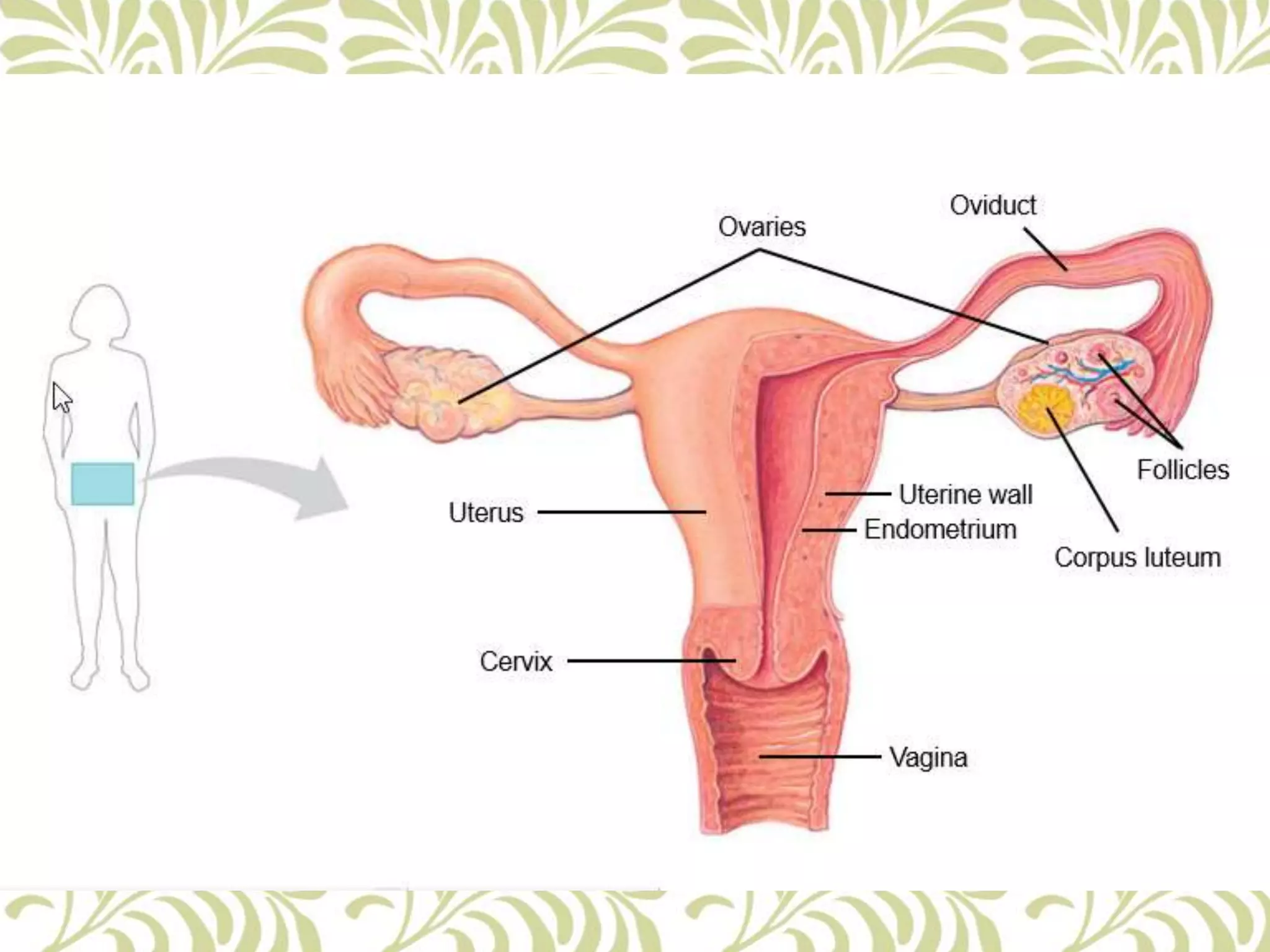
• Female Reproductive System
• The female external reproductive structures include the clitoris
and two sets of labia
• The internal organs are a pair of gonads and a system of ducts
and chambers that carry gametes and house the embryo and
fetus
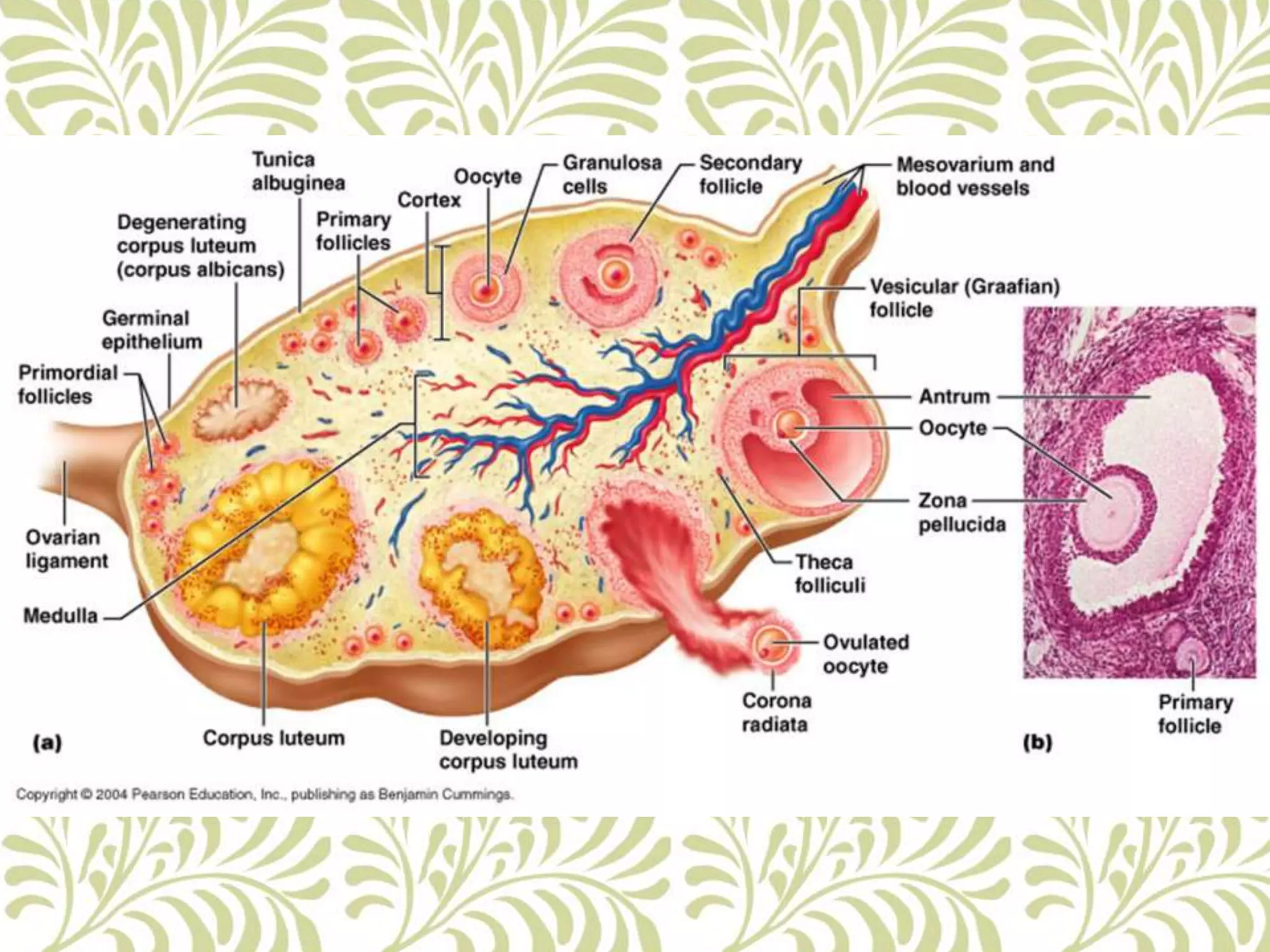
• Ovary
• Follicle
• Mesovarium
Cont.
• Female Reproductive System
• Oviducts and Uterus
• Oviduct or Fallopian tube
• Cervix
• Vagina and Vulva
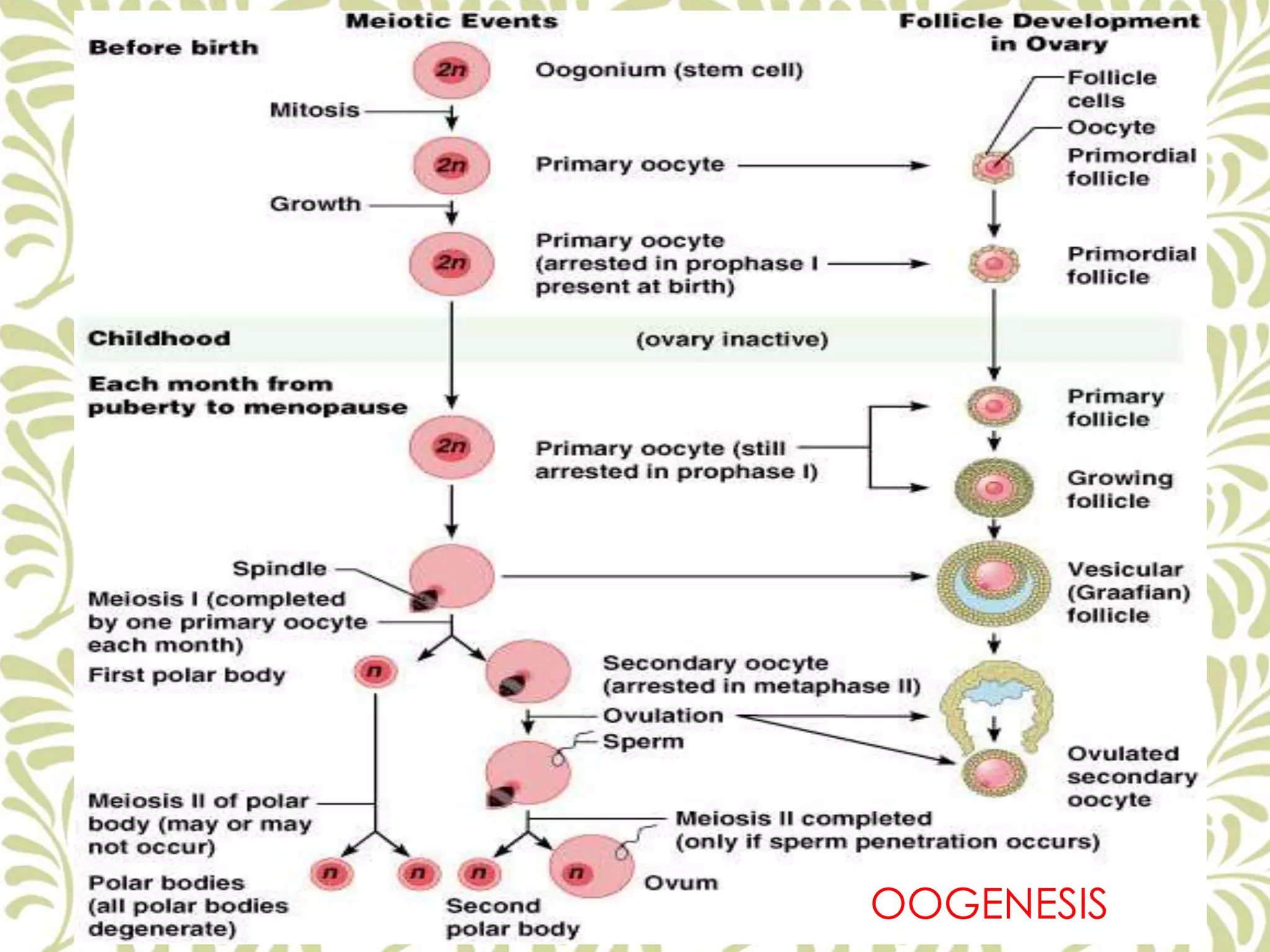
OOGENESIS
Cont.
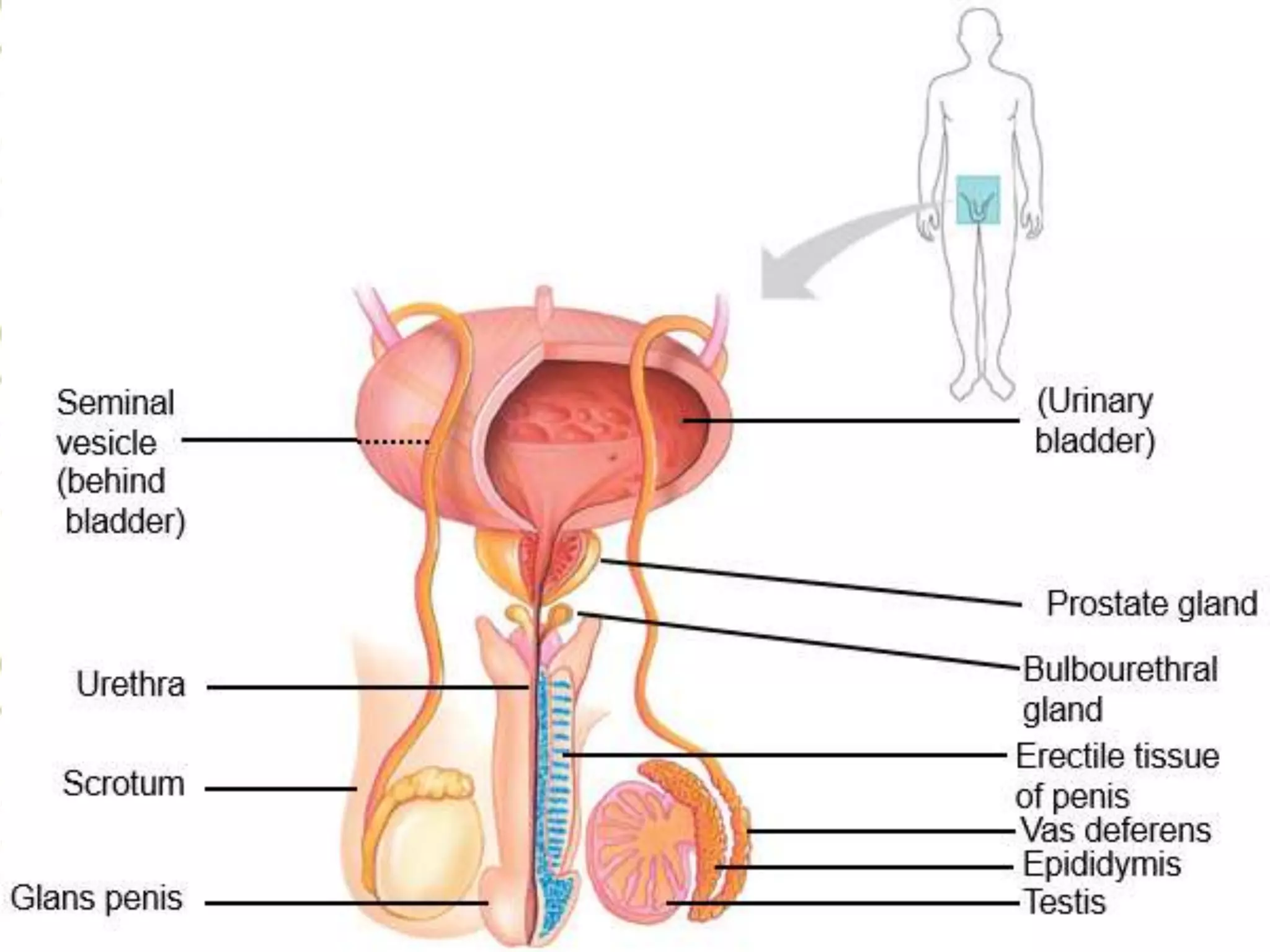
• Male Reproductive System
• The male external reproductive structures in most mammals
include the scrotum and the penis.
• The internal organs consists of gonads, which produces sperm
and hormones, and accessory glands.
• Testes
• The male gonads, or testes, consist of highly coiled tubes
surrounded by connective tissue.
• Seminiferous tubules.
• Production of normal sperm cannot occur at the body
temperatures of most mammals
Cont.
• Male Reproductive System
• Ducts
• seminiferous tubules
• Epididymis
• Vas deferens
• Urethra.
• Glands
• Seminal vesicle,
• Prostate
• Bulbourethral (Cowper’s) gland
• Seminal fluid, or semen.
COMPARATIVE
ANATOMY OF DIFFERENT
CLASSES OF VERTEBRATES
Female Reproductive System
Ovary
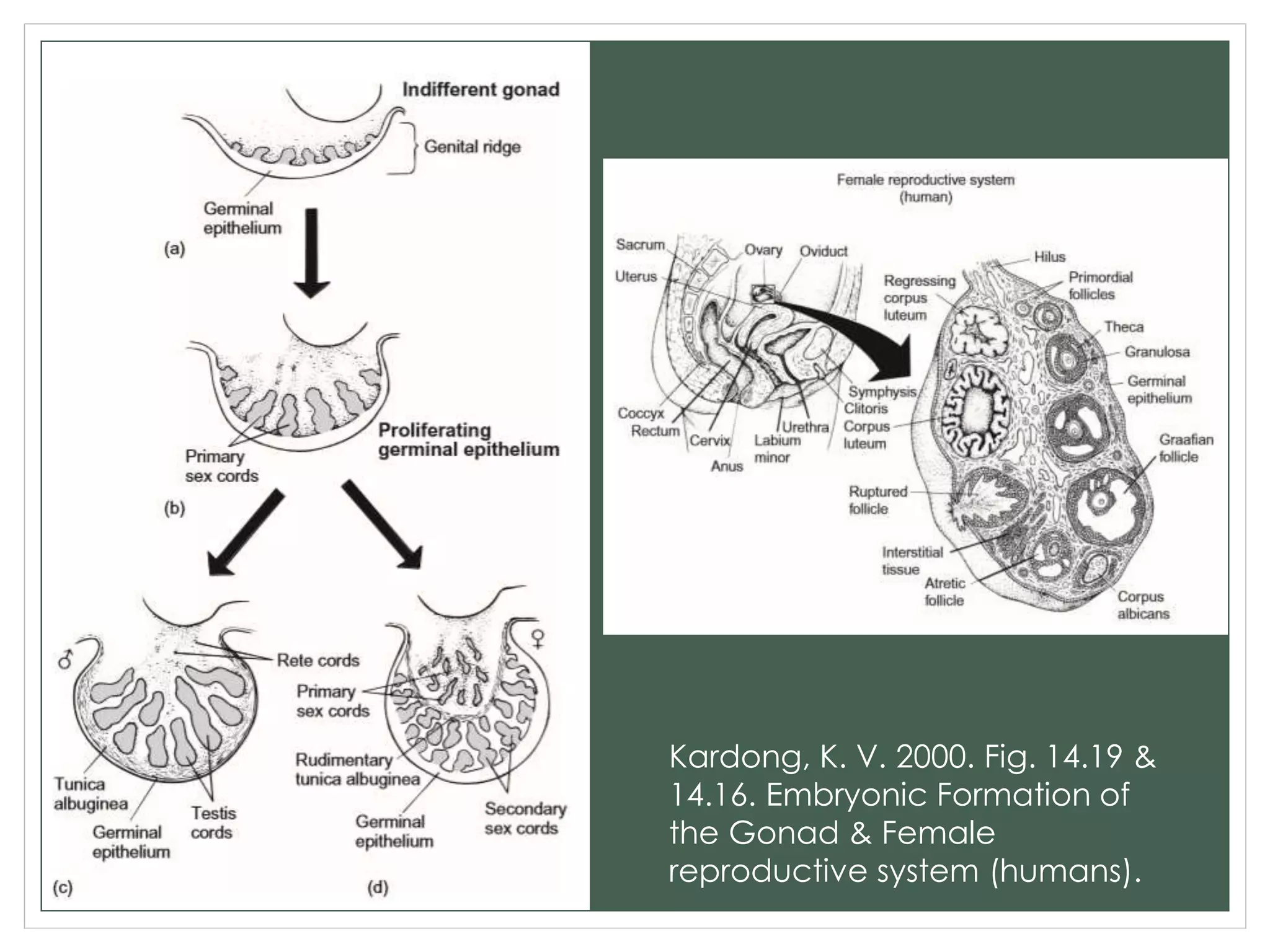
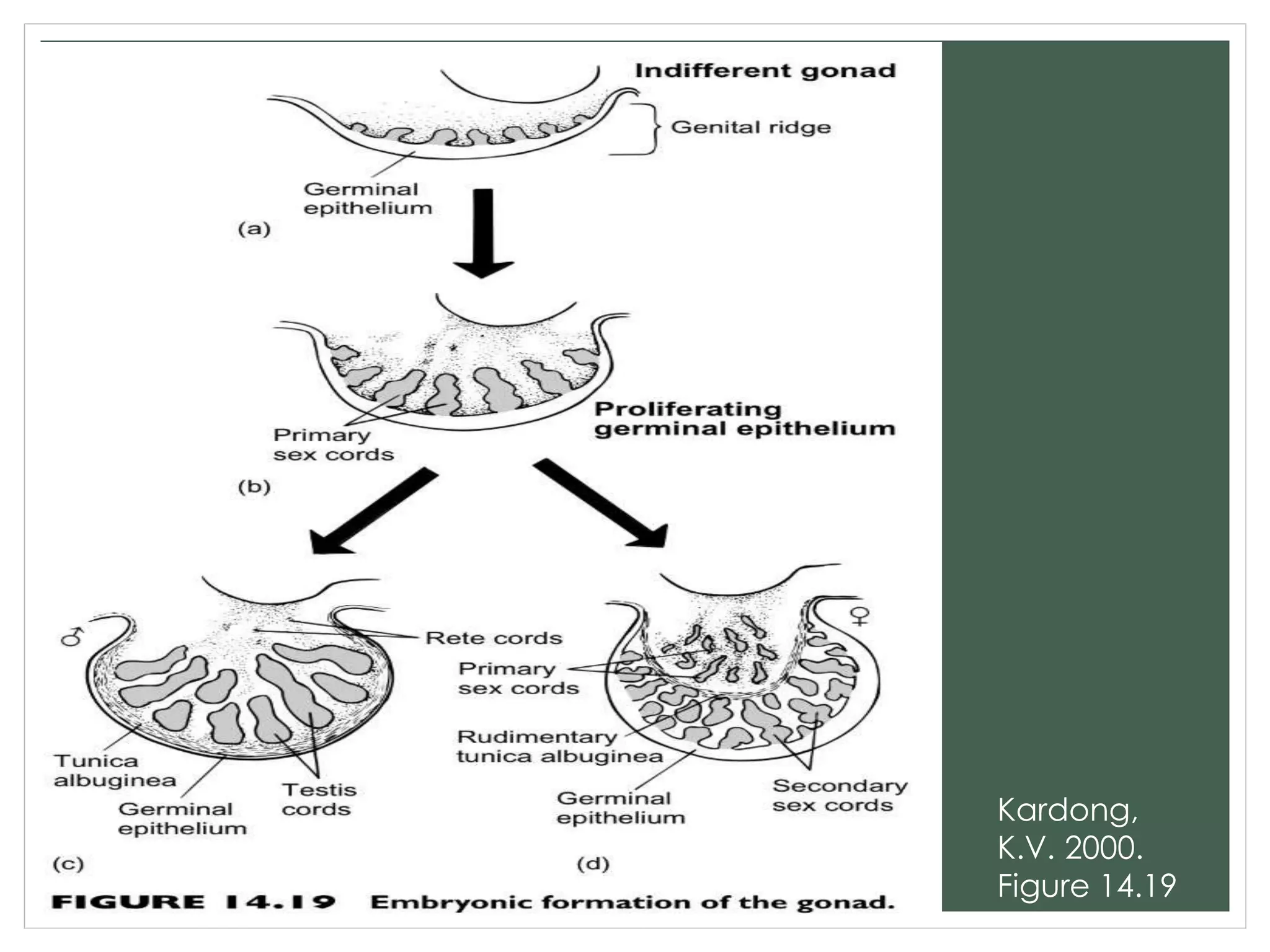
• Development
-Germinal epithelium thickens and covers the indifferent gonad
(consists of cortex and medulla)
-♀ , migrating germ cells  cortex – primary sex cords =
secondary sex cords
-follicle  ripening egg cells  theca
-blastema becomes stroma or matrix
Kardong, K. V. 2000. Fig. 14.19 &
14.16. Embryonic Formation of
the Gonad & Female
reproductive system (humans).
Female Reproductive System
Ovary
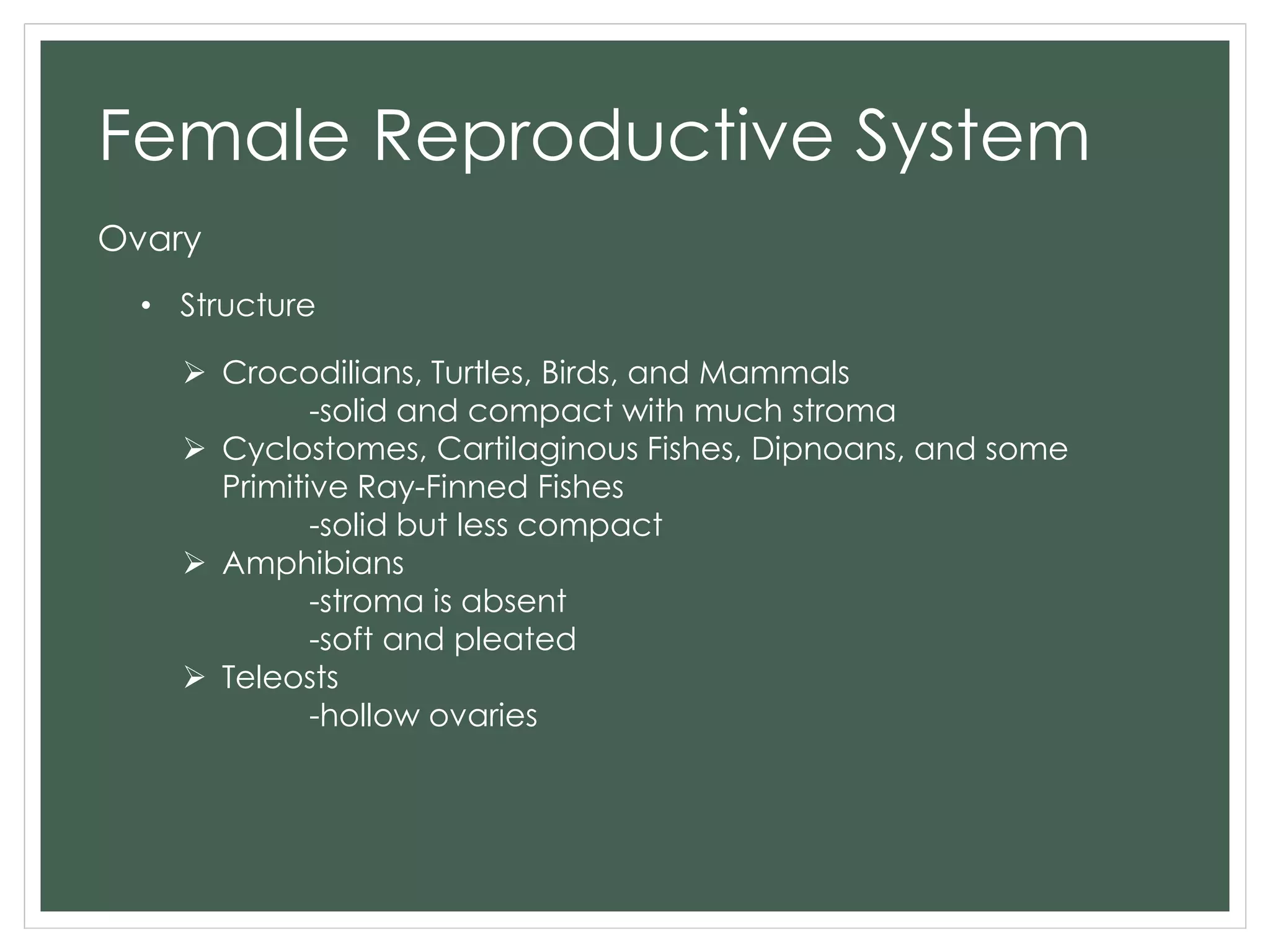
• Structure
 Crocodilians, Turtles, Birds, and Mammals
-solid and compact with much stroma
 Cyclostomes, Cartilaginous Fishes, Dipnoans, and some
Primitive Ray-Finned Fishes
-solid but less compact
 Amphibians
-stroma is absent
-soft and pleated
 Teleosts
-hollow ovaries
Female Reproductive System
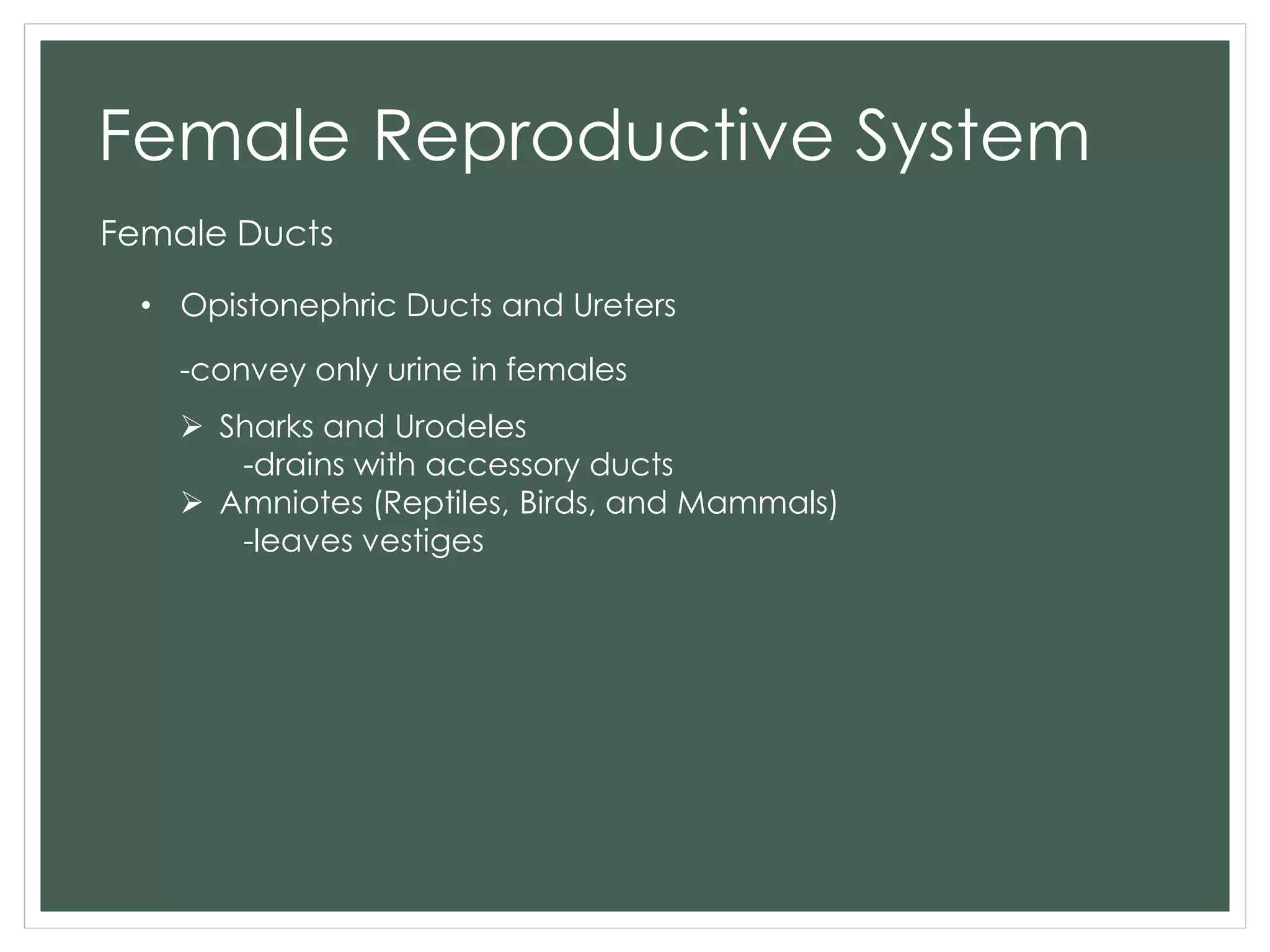
Female Ducts
• Opistonephric Ducts and Ureters
-convey only urine in females
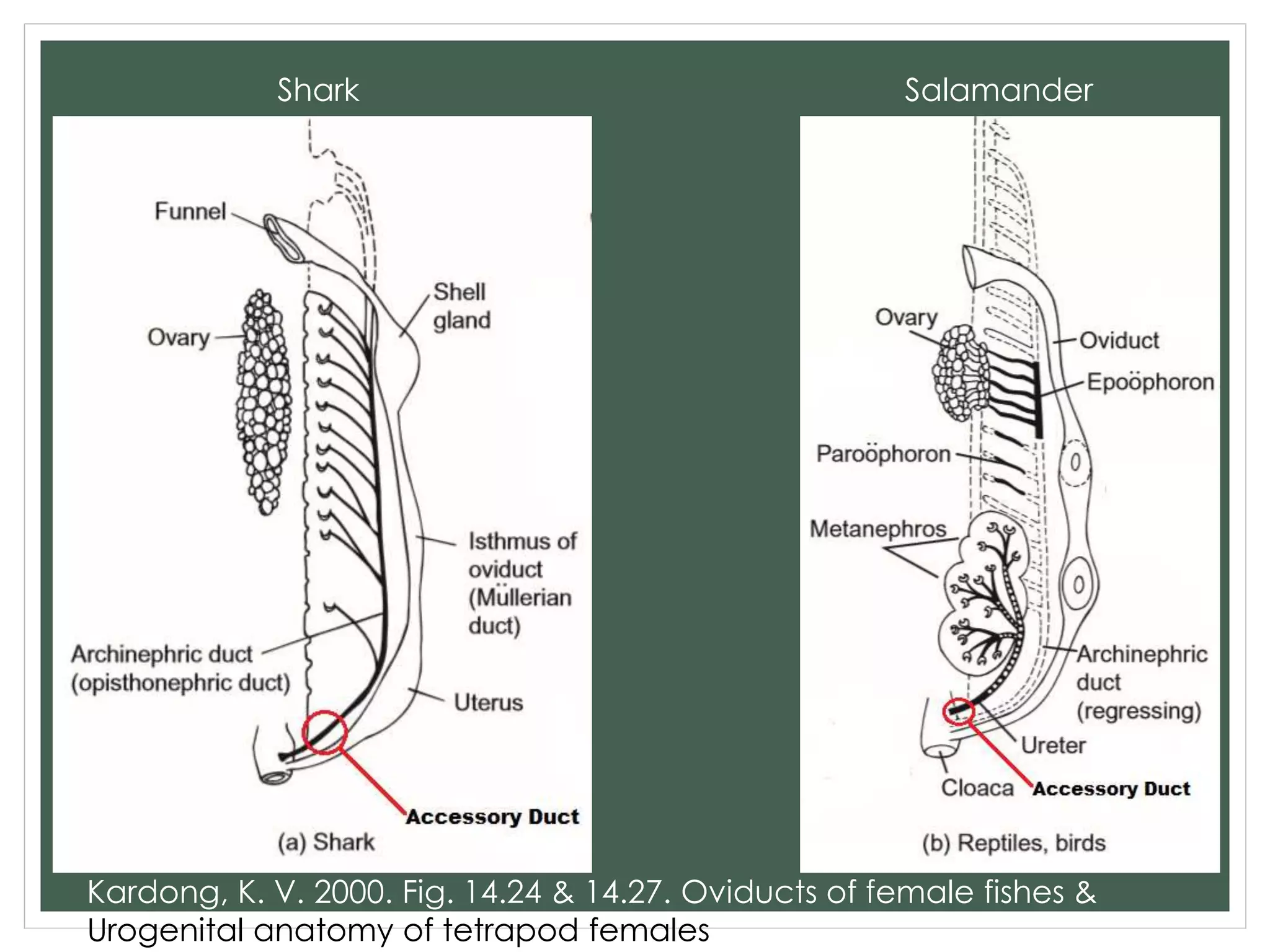
 Sharks and Urodeles
-drains with accessory ducts
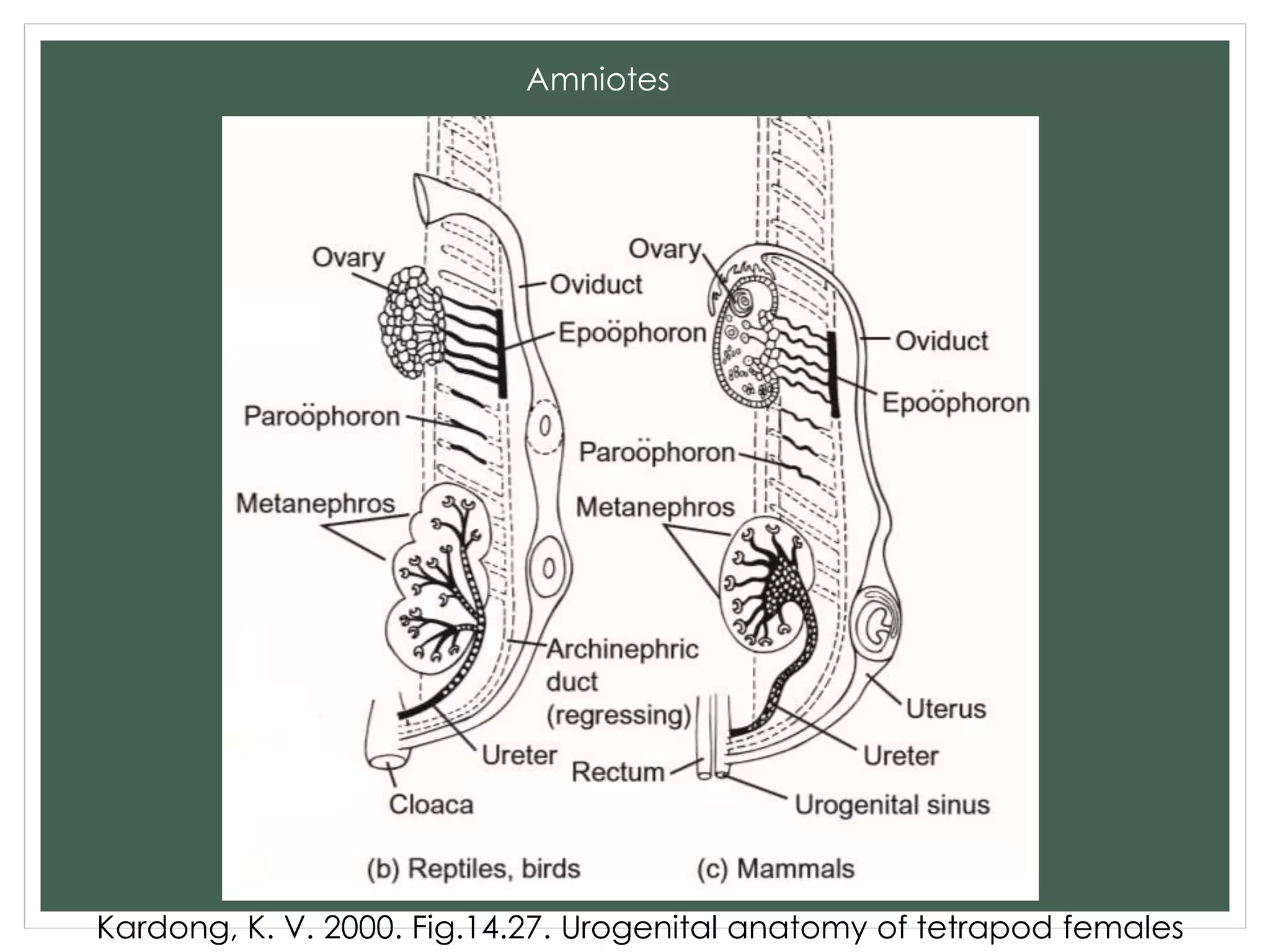
 Amniotes (Reptiles, Birds, and Mammals)
-leaves vestiges
Shark Salamander
Kardong, K. V. 2000. Fig. 14.24 & 14.27. Oviducts of female fishes &
Urogenital anatomy of tetrapod females
Amniotes
Kardong, K. V. 2000. Fig.14.27. Urogenital anatomy of tetrapod females
Female Reproductive System
Female Ducts
• Oviducts
-anterior end  funnels w/ openings
-ciliated columnar epithelium
-peristaltic contraction
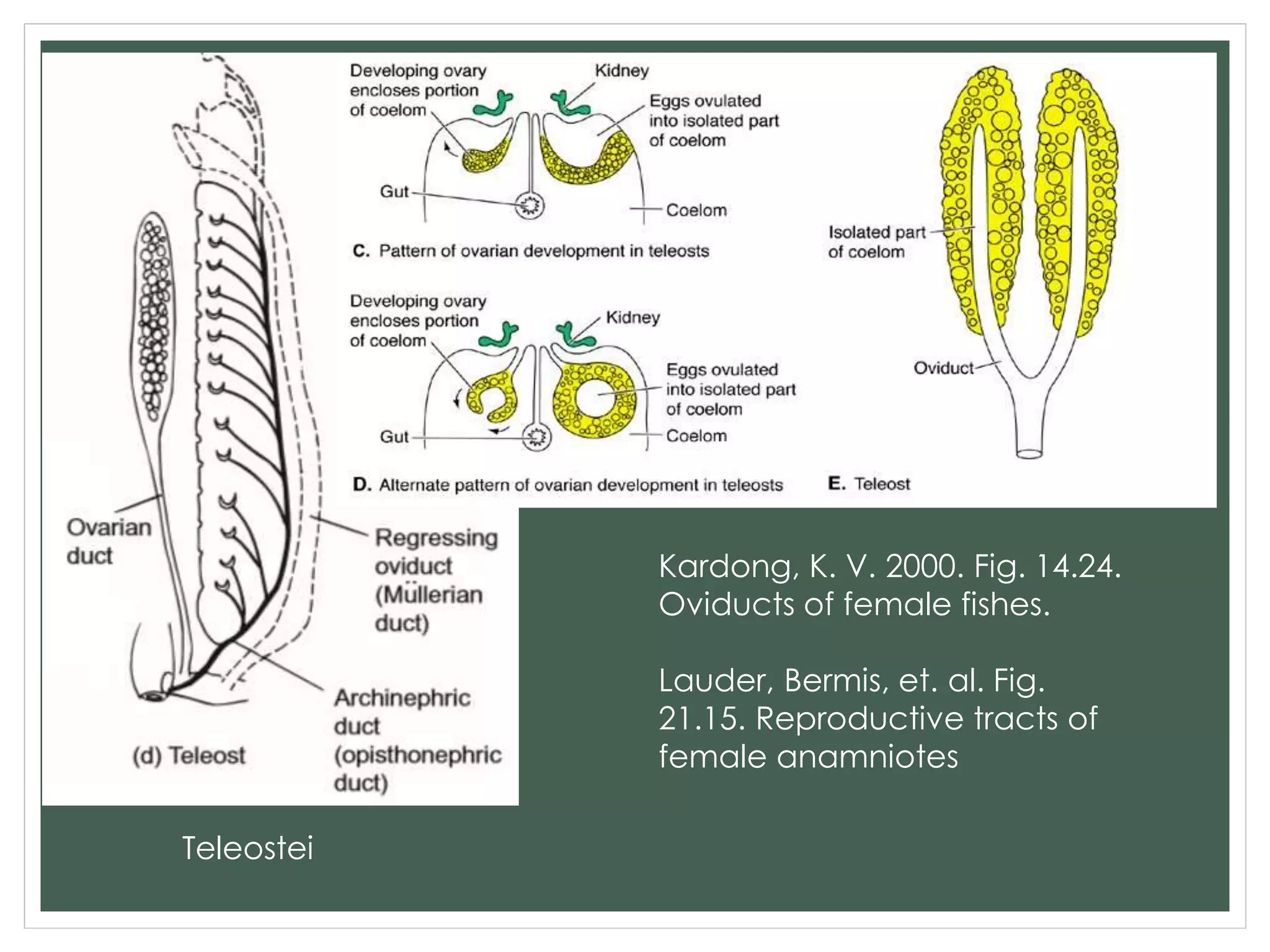
 Teleostei
-ovaries encloses pockets of coelom
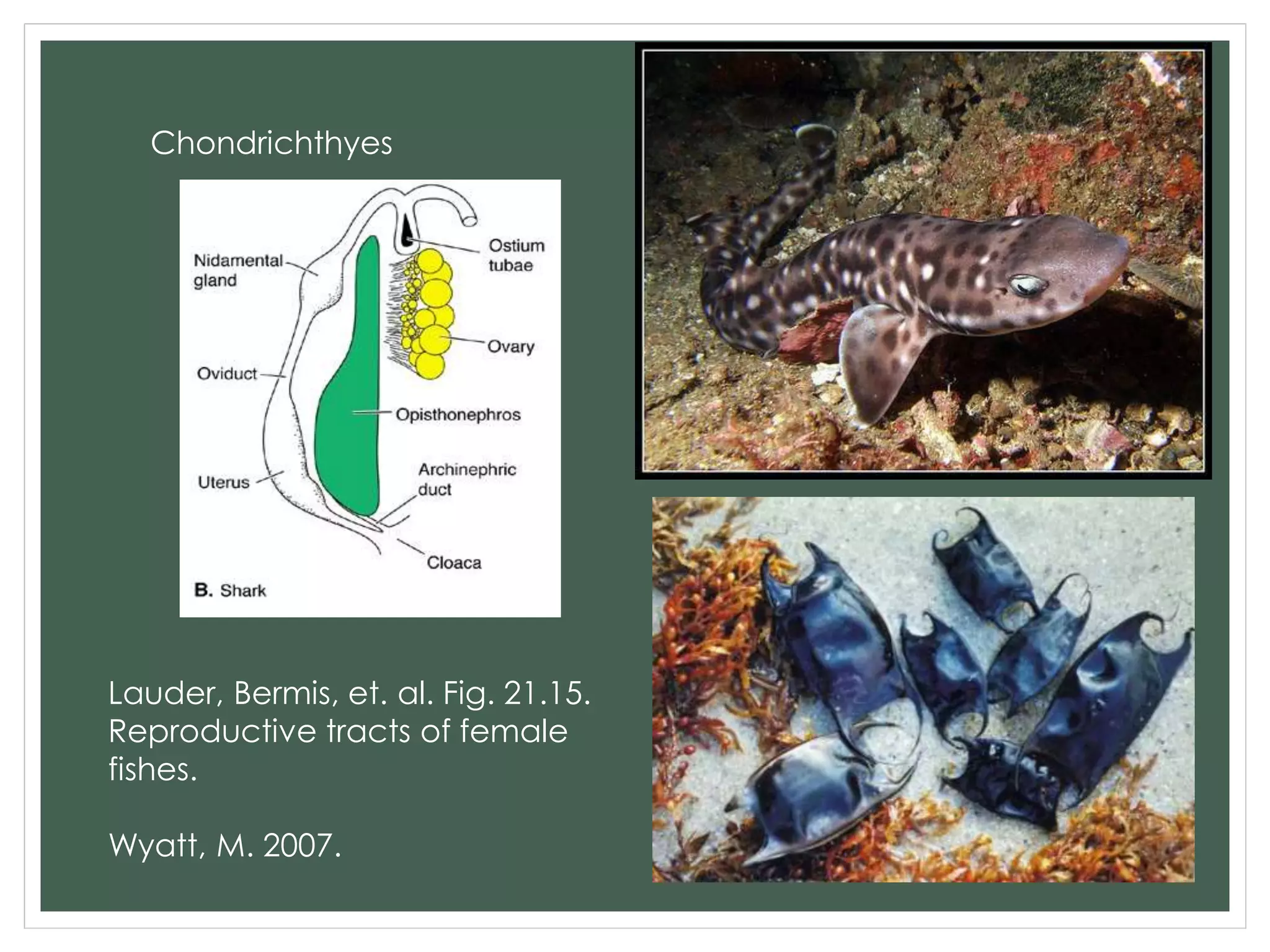
 Chondrichthyes
-fuse in the midline
-some are oviparous (shell glands)
• Mermaid purse
 Amphibians
-glandular and coiled oviducts
-posterior portion  coat of jelly
Kardong, K. V. 2000. Fig. 14.24.
Oviducts of female fishes.
Lauder, Bermis, et. al. Fig.
21.15. Reproductive tracts of
female anamniotes
Teleostei
Chondrichthyes
Lauder, Bermis, et. al. Fig. 21.15.
Reproductive tracts of female
fishes.
Wyatt, M. 2007.
Female Reproductive System
Female Ducts
• Oviducts
 Reptiles, Birds, and Monotremata
-large eggs and genital tracts vary widely
-large and pleated ovarian funnels
-glandular anterior portion  albumen
-enlarges near the cloaca  shell gland and ovisac
 Reptiles
right side is larger
 Birds
right side is vestigial
Female Reproductive System
Female Ducts
• Oviducts
 Therian Mammals
 Oviducts
-ciliated epithelium
-straight and slender; w/o albumen or shells
 Uterus
-Endometrium
-Myometrium
-Cervix
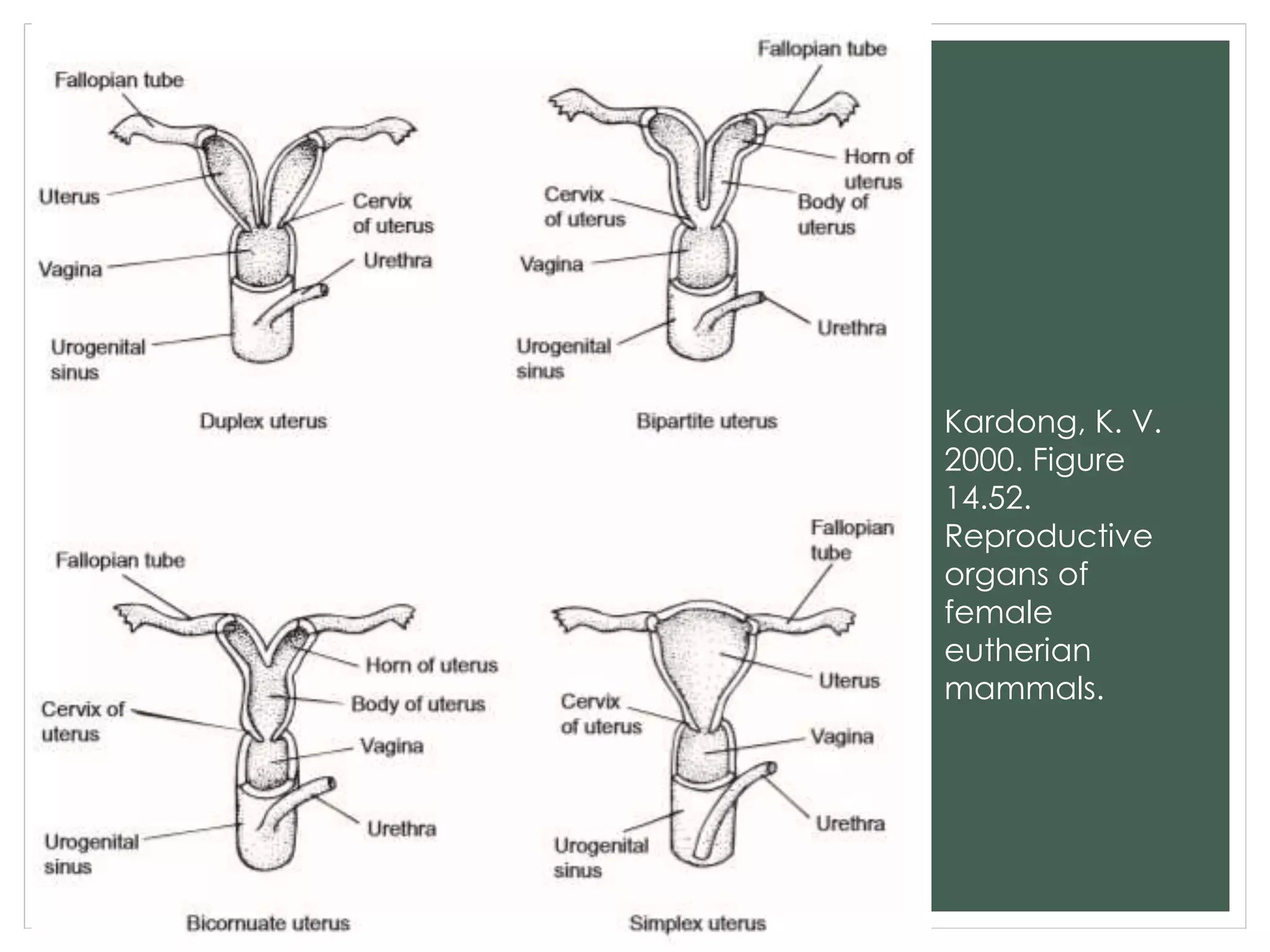
o Types of Mammalian Uterus
• Duplex (Monotremes, Marsupials, Elephants and
many Rodents)
• Bipartite (most Ungulates and most Carnivores)
• Bicornuate
• Simplex (most Primates and some Edentates
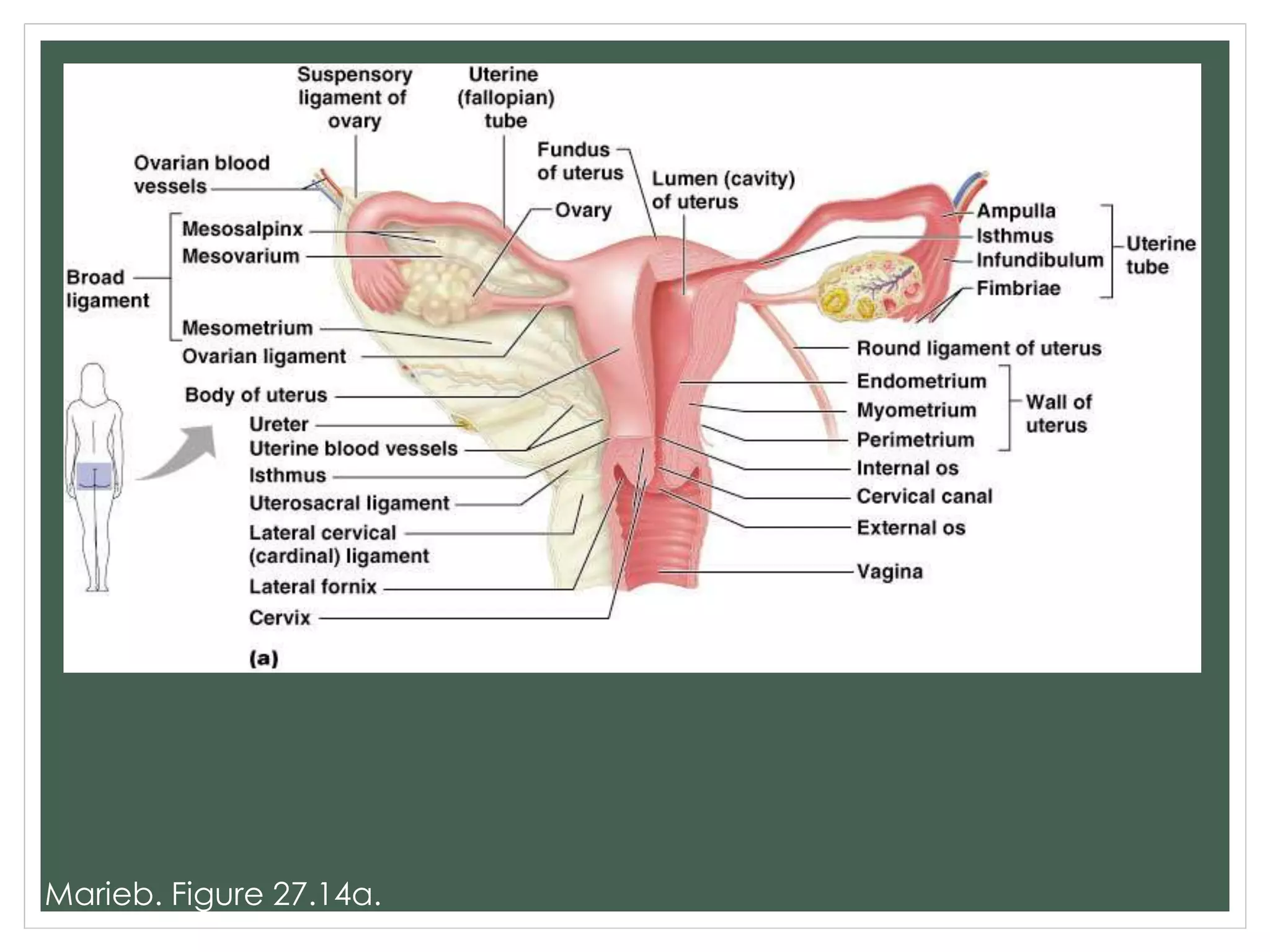
Marieb. Figure 27.14a.
Kardong, K. V.
2000. Figure
14.52.
Reproductive
organs of
female
eutherian
mammals.
Female Reproductive System
Female Ducts
• Oviducts
 Therian Mammals
 Vagina
-stratified epithelium
-receives penis during copulation
-serves as birth canal
-soft and distensible; glandular or cornified
Female Reproductive System
Female Ducts
• Oviducts
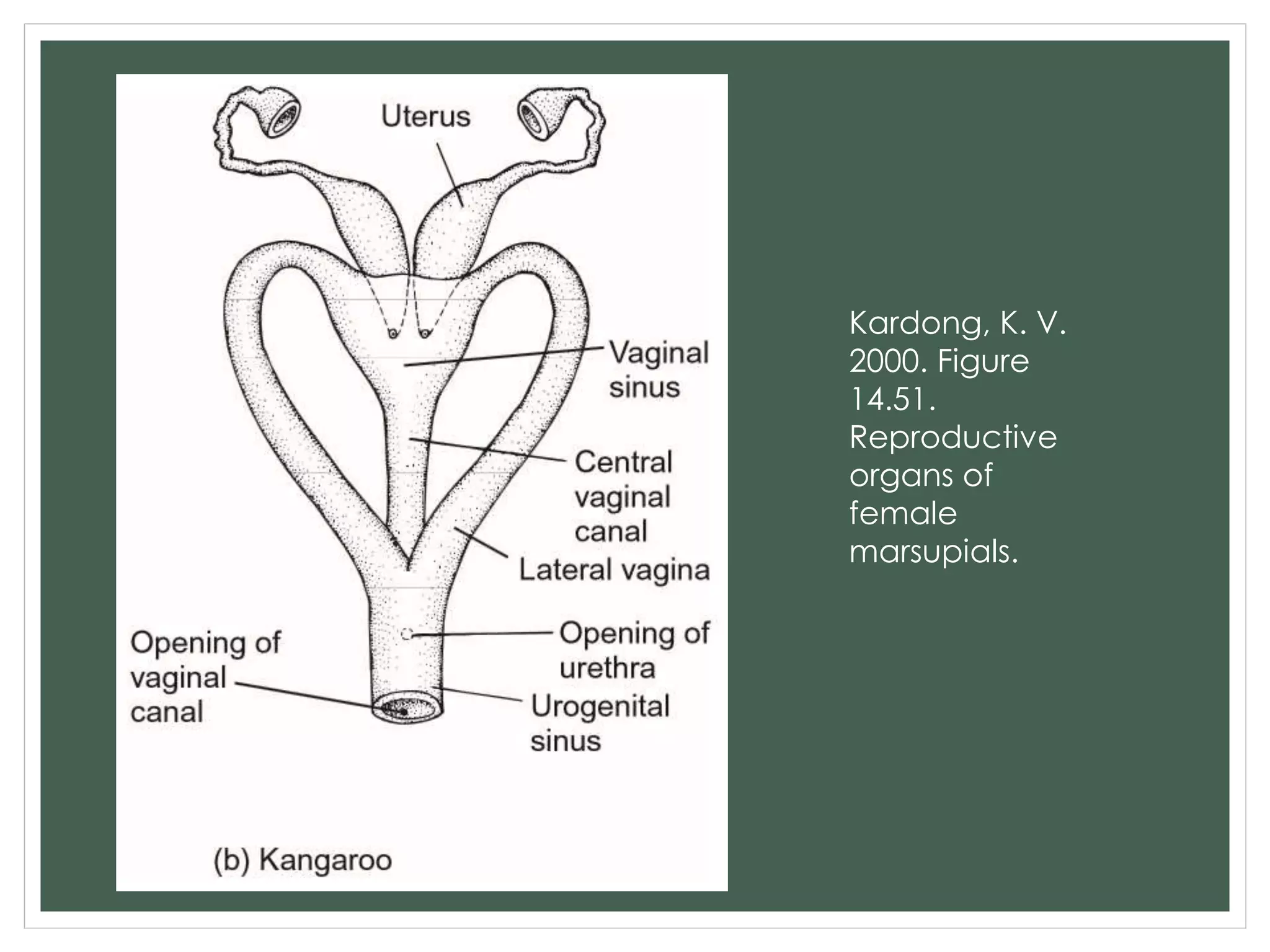
 Marsupials
-terminal part of the tract fuses  single urogenital canal
-two embryonic uteri and vaginae
-third pseudovagina grows
Kardong, K. V.
2000. Figure
14.51.
Reproductive
organs of
female
marsupials.
Development and Structure of
Testes
• Indifferent gonad - early developmental stage is similar in both sexes
which includes cortex and medulla.
• Germinal epithelium forms only the peritoneal covering of adult testes.
• Primary sex cords do NOT degenerate and secondary sex cords are NOT
formed.
• Testes are paired except in CYCLOSTOMES.
• Each testis is suspended from the dorsal wall of a coelom by a mesentery
called the mesorchium.
• Testes are paired but may be partially fused as in ELASMOBRANCHS, or
completely fused as in ADULT CYCLOSTOMES.
• Testes are elongated in CYCLOSTOMES, MOST FISHES, CAECILIANS, and
URODELES.
• Testes are compact and ovoid in some CARTILAGINOUS FISHES, ANURANS,
and AMNIOTES.
Kardong,
K.V. 2000.
Figure 14.19
Kardong K.V. 2000. Figure 14.32
Hagfish Elasmobranch Lungfish Teleost
Cont.
• Testes are elongated in CYCLOSTOMES, MOST FISHES, CAECILIANS,
and URODELES.
• Testes are compact and ovoid in some CARTILAGINOUS FISHES,
ANURANS, and AMNIOTES.
• BIRDS- abdominal air sacs; MAMMALS (PRIMATES – MOST
CARNIVORES, and MOST UNGULATES) – scrotum; MAMMALS
(MONOTREMES, WHALES, ELEPHANTS) – testes are abdominal or
pelvic in position if body temperature is relatively low.
Male Ducts
•Except in CYCLOSTOMES, sperms are released in a closed system
of ducts.
•Deferent ducts carries either the sperm or both sperm and urine.
•CHONDRICHTHYANS have paired deferent ducts that convey
ONLY SPERM.
•Several PRIMITIVE RAYFINNED FISHES and SOME DIPNOANS pass
sperm into the anterior end of deferent duct which convey both
sperm and urine.
•All AMPHIBIANS have deferent ducts, some species convey ONLY
SPERM and in others BOTH sperm and urine.
•Deferent ducts of AMNIOTES carry ONLY SPERM.
Copulatory (Intromittent)
Organs and Fertilization
• CYCLOSTOMES and MOST BONY FISHES lack copulatory organs.
• SOME TELEOST retained their eggs during development or bear
live young.
o Gonopodium- margin of the anal fin as copulatory organ in males.
• CARTILAGINOUS FISHES also have INTERNAL fertilization.
o Claspers- pelvic fins as copulatory organ in males.
• ANURANS have EXTERNAL fertilization. Hence, they don’t have
copulatory organs.
• URODELES have INTERNAL fertilization but LACK copulatory
organs.
o Cloacal kiss ( male and female press their cloacas together to
transfer sperm)
Cont.
• TURTLES and CROCODILES have evolved a grooved penis. (it is
located internally on the floor of the cloaca.
o Small clitoris are present in female turtles and crocodiles.
• BIRDS copulate by pressing the cloacas together for the transfer
of sperm.
o Primitive birds (OSTRICHES, DUCKS and GEESE) have a small penis.
• THERIAN MAMMALS have a penis formed from the genital
tubercle located anterior to the cloacal opening.
• Glans is variously shaped and is forked in MONOTREMES and
MARSUPIALS.
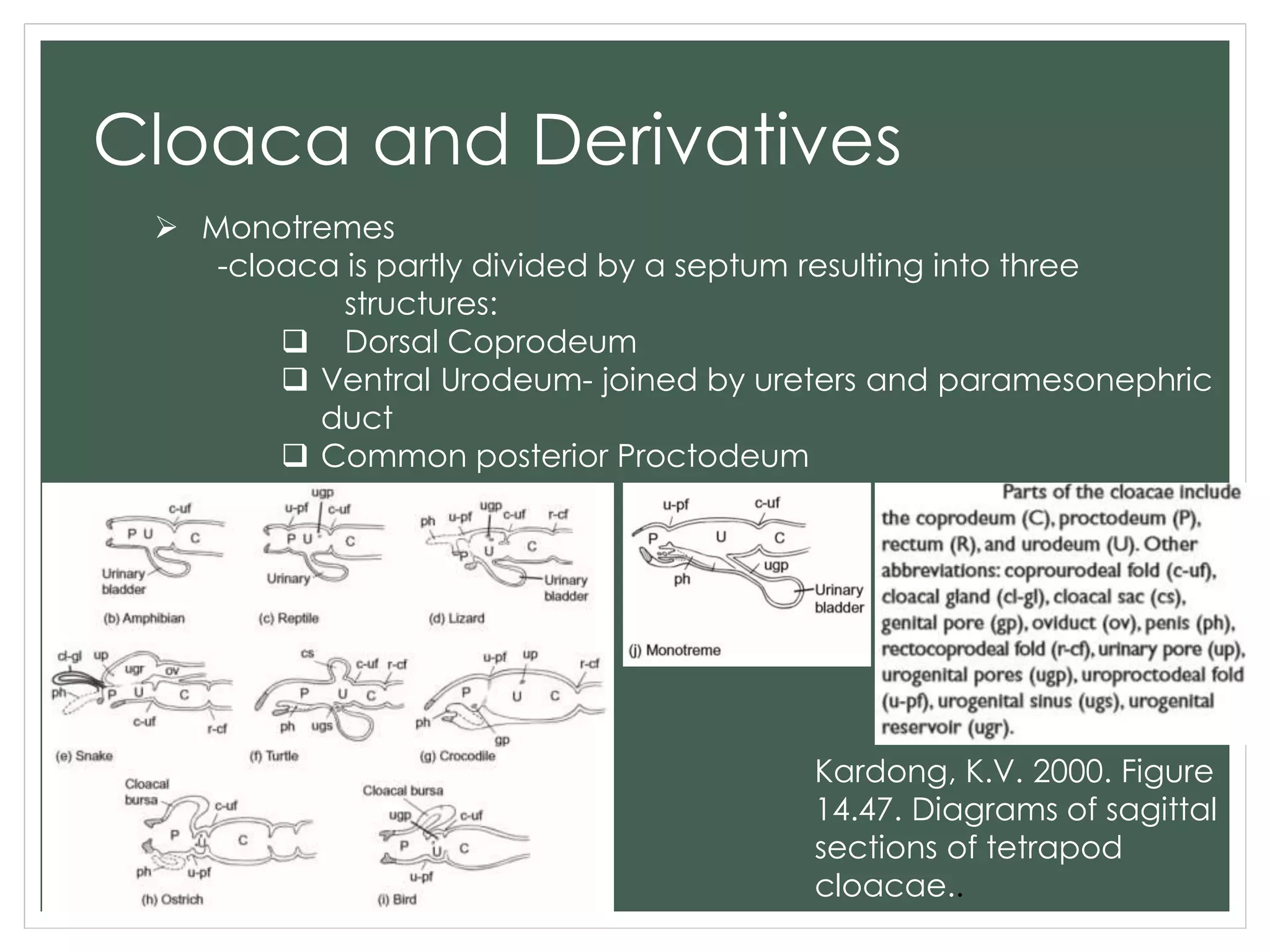
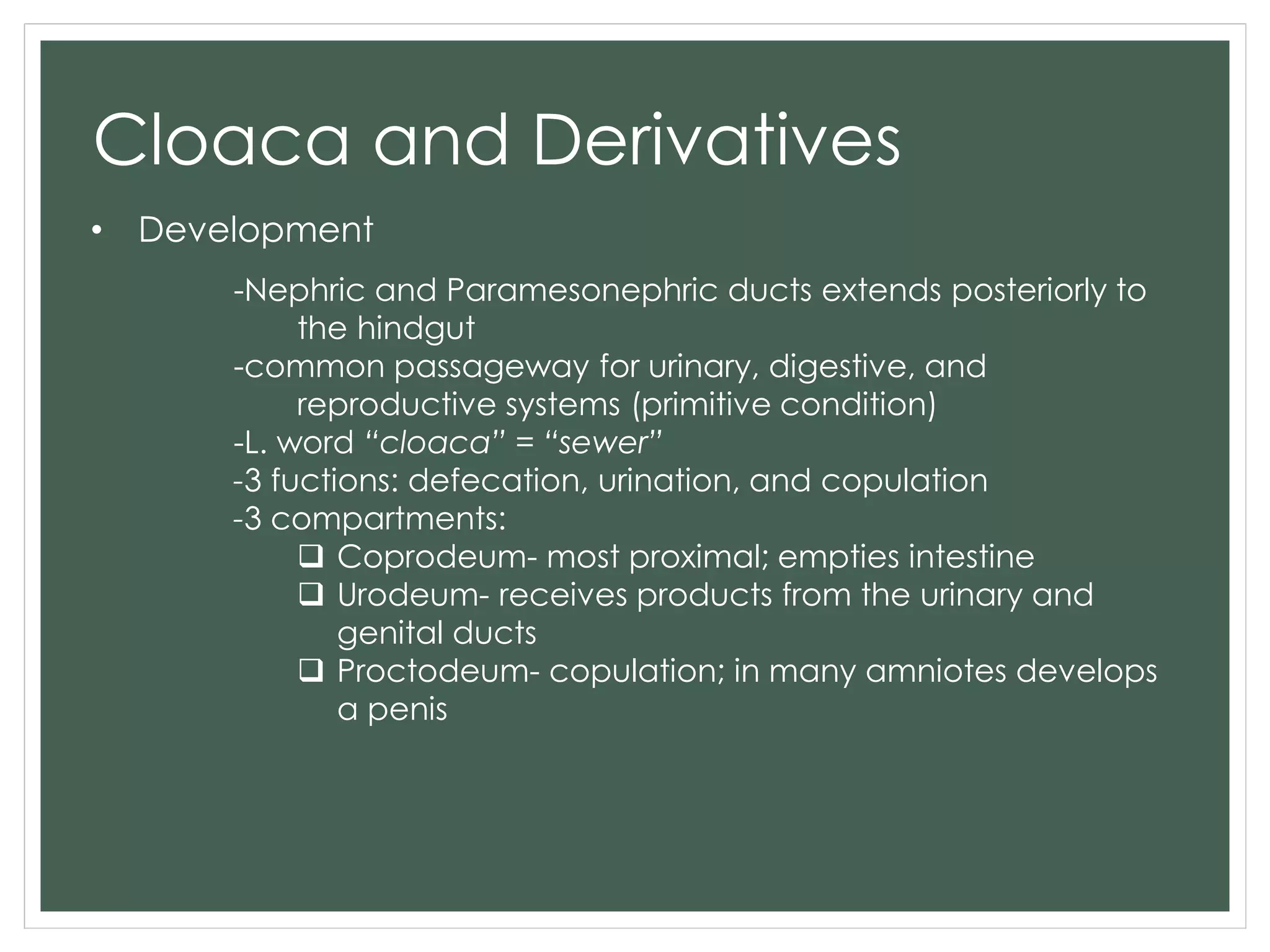
Cloaca and Derivatives
• Development
-Nephric and Paramesonephric ducts extends posteriorly to
the hindgut
-common passageway for urinary, digestive, and
reproductive systems (primitive condition)
-L. word “cloaca” = “sewer”
-3 fuctions: defecation, urination, and copulation
-3 compartments:
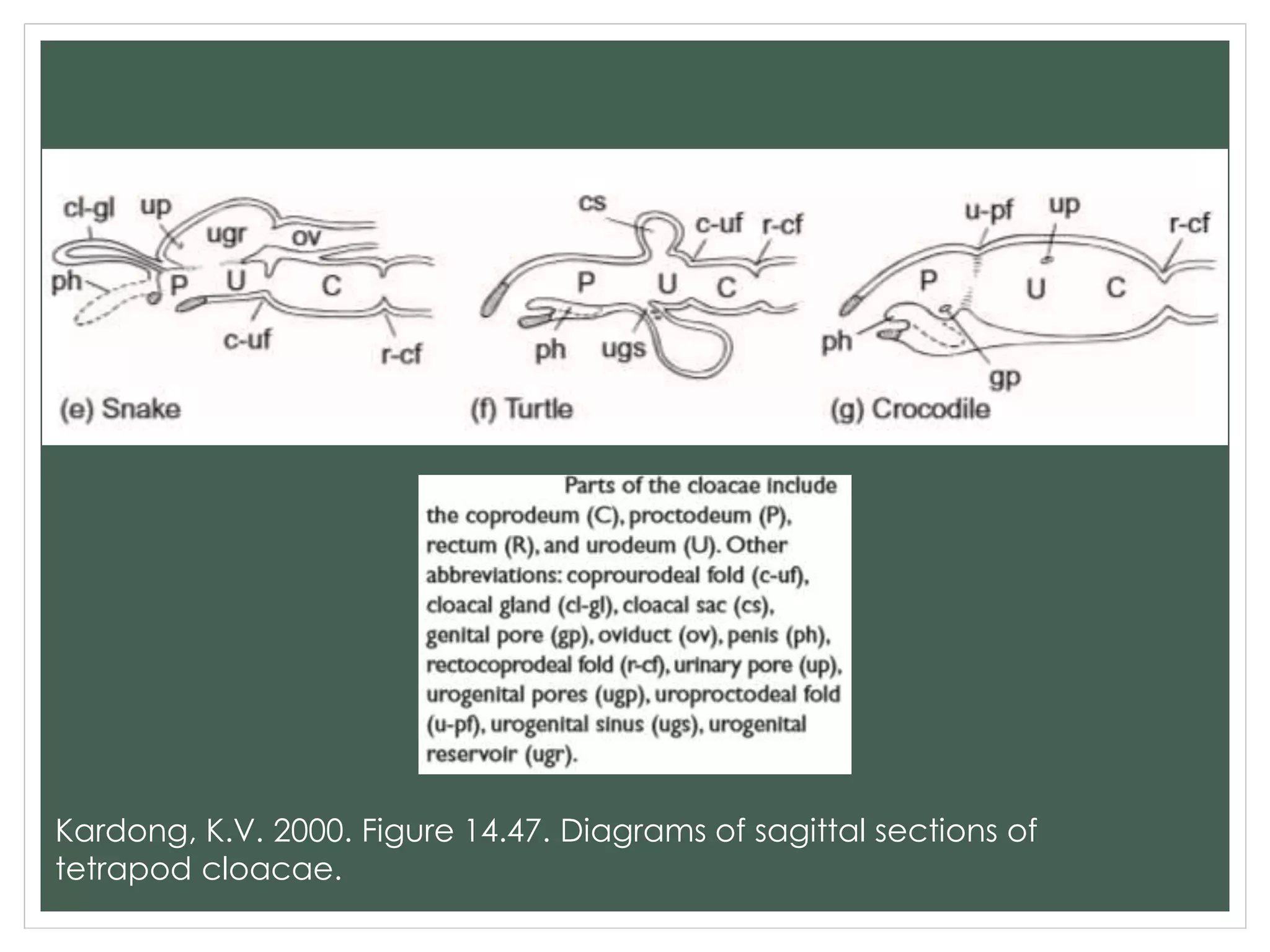
 Coprodeum- most proximal; empties intestine
 Urodeum- receives products from the urinary and
genital ducts
 Proctodeum- copulation; in many amniotes develops
a penis
Kardong, K.V. 2000. Figure 14.47. Diagrams of sagittal sections of
tetrapod cloacae.
Cloaca and Derivatives
• Development
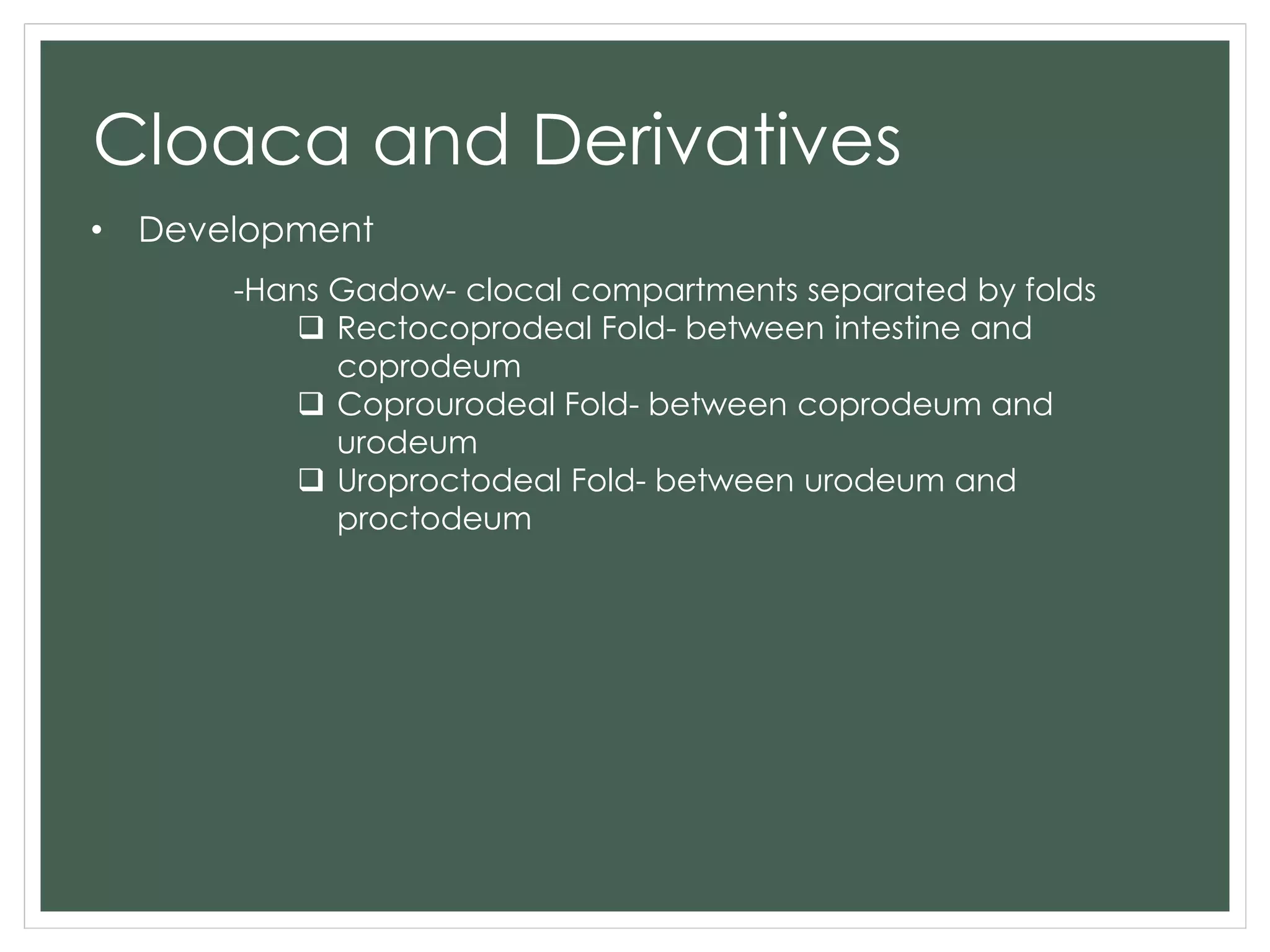
-Hans Gadow- clocal compartments separated by folds
 Rectocoprodeal Fold- between intestine and
coprodeum
 Coprourodeal Fold- between coprodeum and
urodeum
 Uroproctodeal Fold- between urodeum and
proctodeum
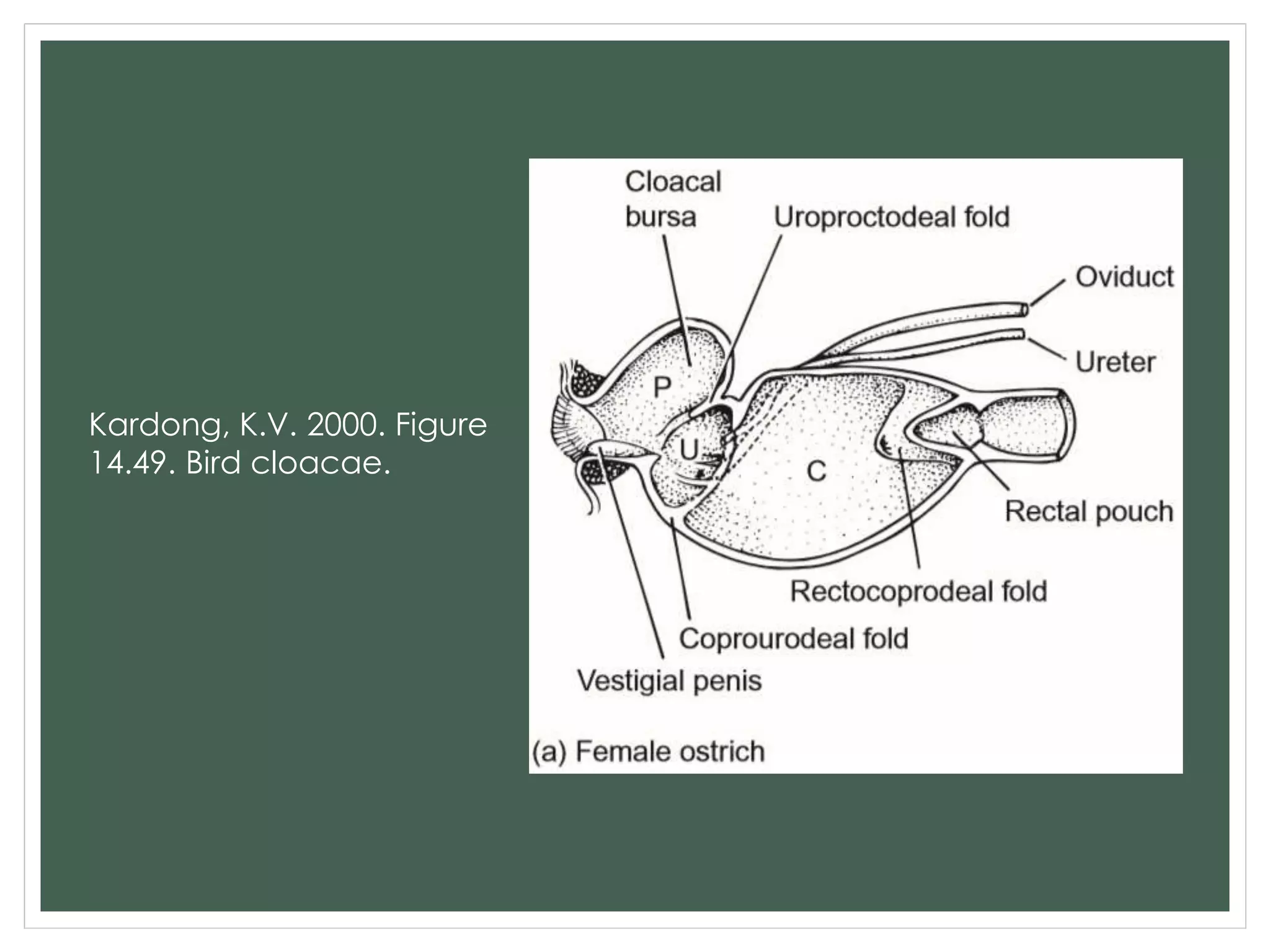
Kardong, K.V. 2000. Figure
14.49. Bird cloacae.
Cloaca and Derivatives
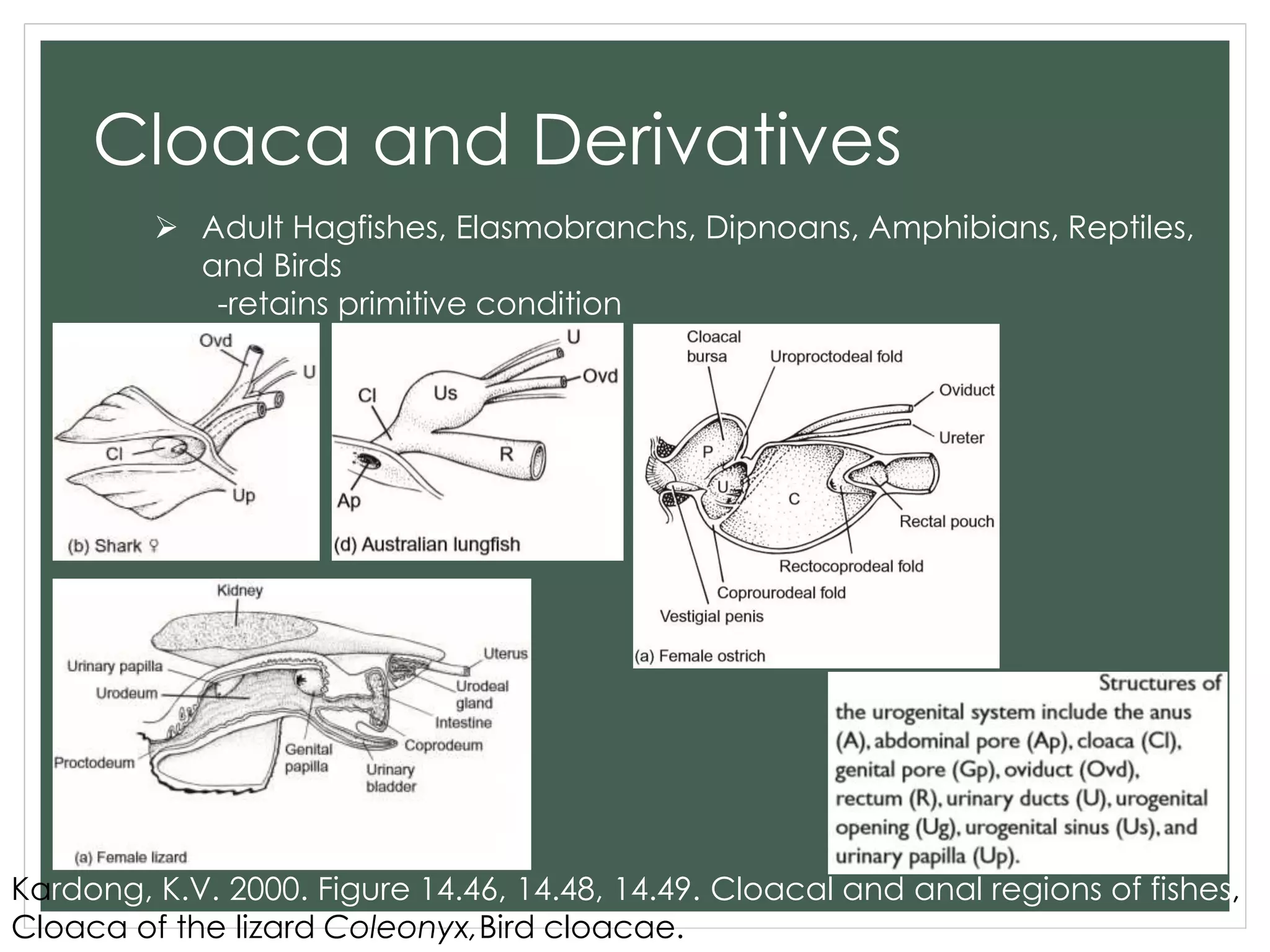
 Adult Hagfishes, Elasmobranchs, Dipnoans, Amphibians, Reptiles,
and Birds
-retains primitive condition
Kardong, K.V. 2000. Figure 14.46, 14.48, 14.49. Cloacal and anal regions of fishes,
Cloaca of the lizard Coleonyx,Bird cloacae.
Cloaca and Derivatives
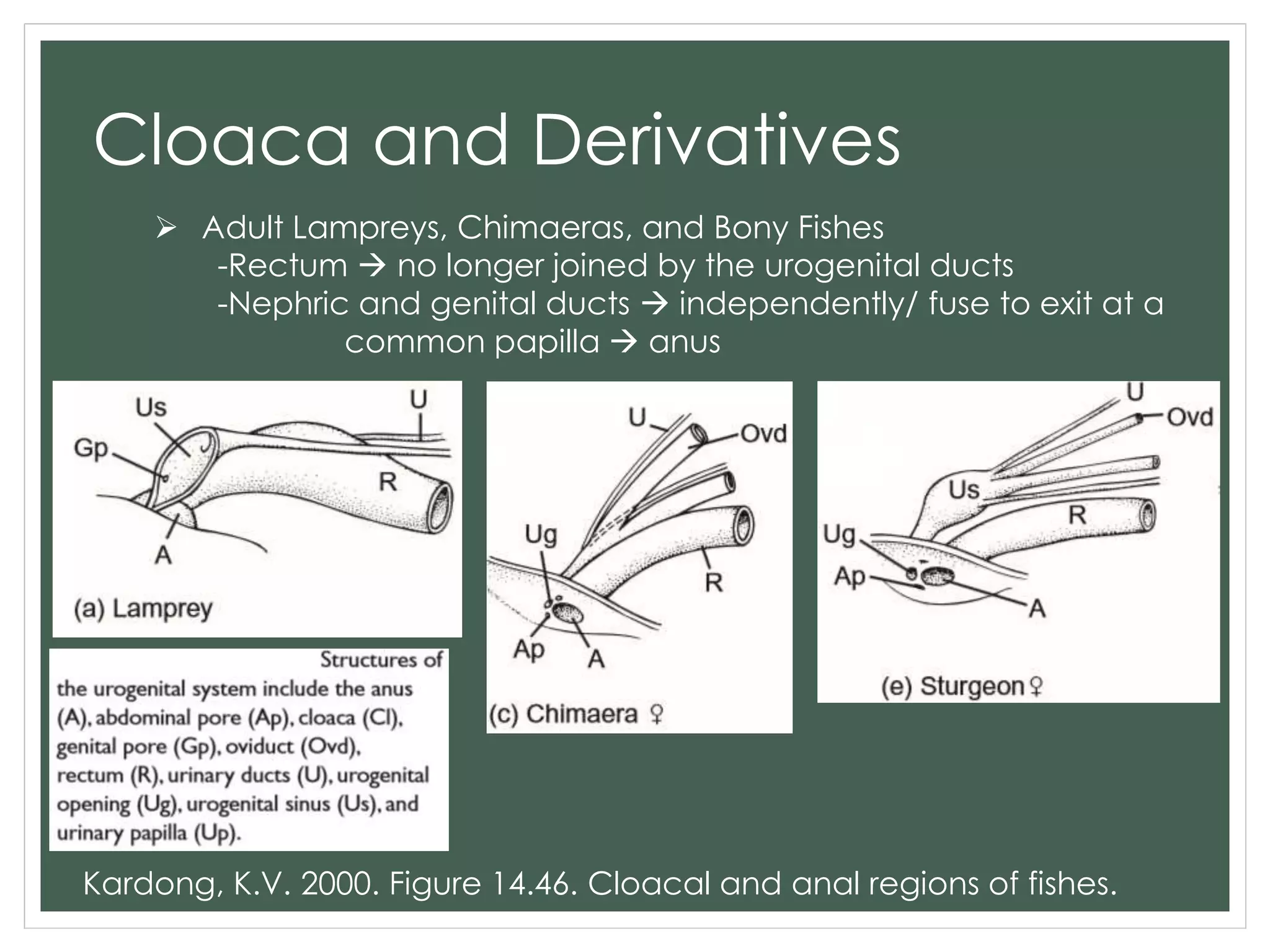
 Adult Lampreys, Chimaeras, and Bony Fishes
-Rectum  no longer joined by the urogenital ducts
-Nephric and genital ducts  independently/ fuse to exit at a
common papilla  anus
Kardong, K.V. 2000. Figure 14.46. Cloacal and anal regions of fishes.
Cloaca and Derivatives
 Monotremes
-cloaca is partly divided by a septum resulting into three
structures:
 Dorsal Coprodeum
 Ventral Urodeum- joined by ureters and paramesonephric
duct
 Common posterior Proctodeum
Kardong, K.V. 2000. Figure
14.47. Diagrams of sagittal
sections of tetrapod
cloacae..
Cloaca and Derivatives
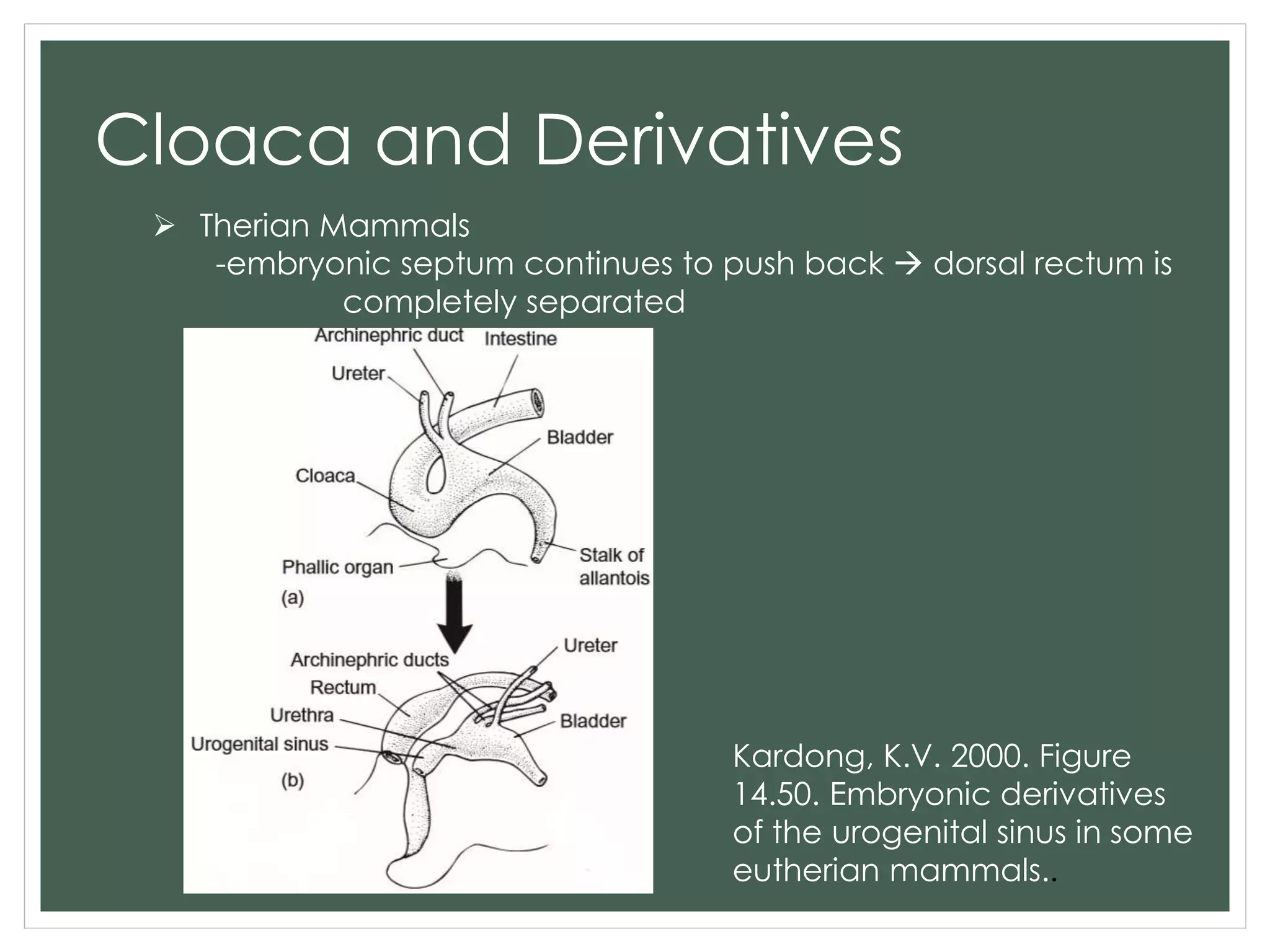
 Therian Mammals
-embryonic septum continues to push back  dorsal rectum is
completely separated
Kardong, K.V. 2000. Figure
14.50. Embryonic derivatives
of the urogenital sinus in some
eutherian mammals..
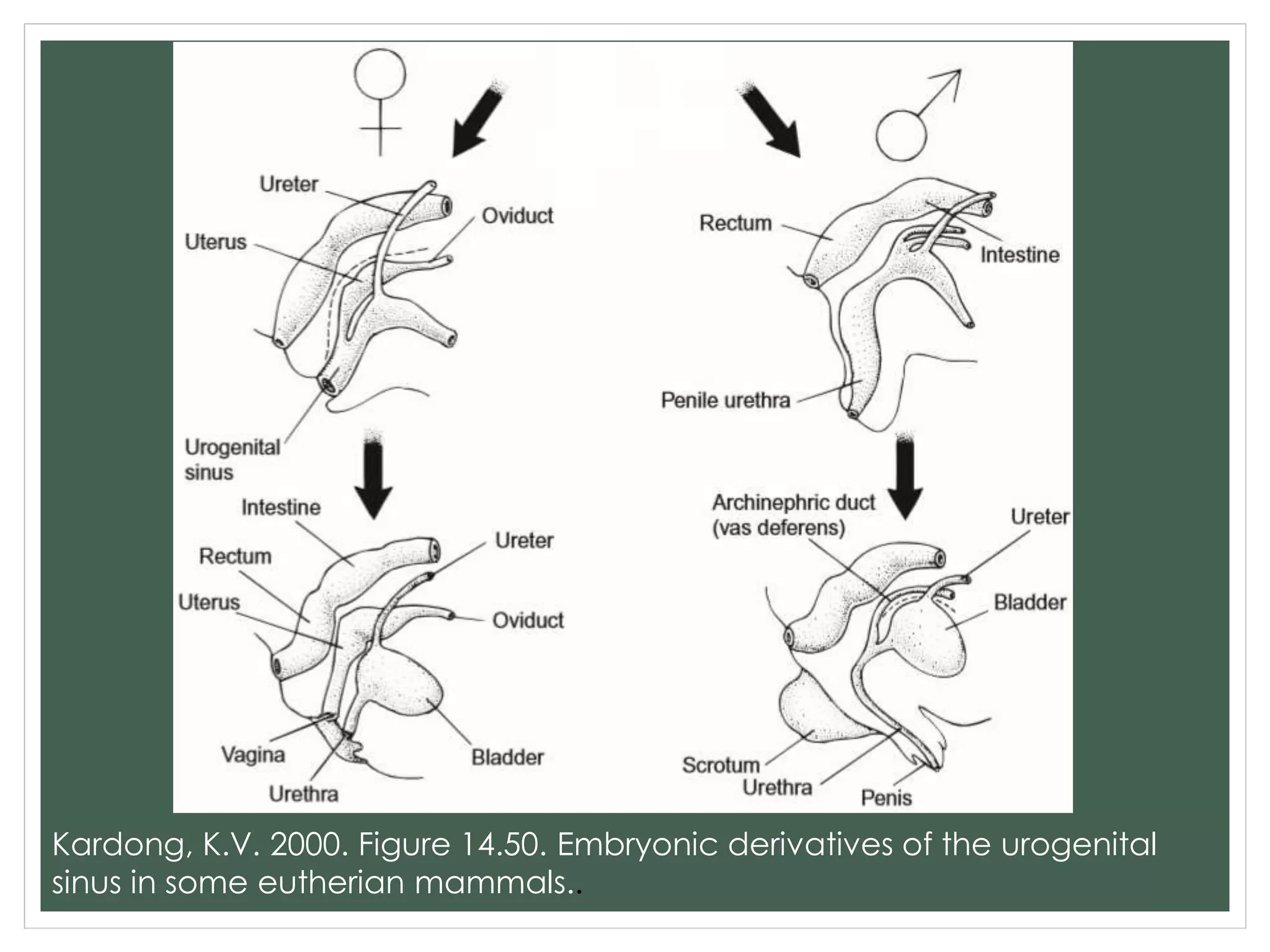
Cloaca and Derivatives
 Therian Mammals
 Males
-urine and sperm release through common urethra
 Females
• Most Mammals
-urinary and genital tracts exit by a common urogenital
sinus
• Primates and some Rodents
-Fetal eversion  anterior urethral opening and posterior
urethral opening
Kardong, K.V. 2000. Figure 14.50. Embryonic derivatives of the urogenital
sinus in some eutherian mammals..
COMPARISON AND
CONTRAST OF ORGANS
PRESENT ON DIFFERENT
CLASSES
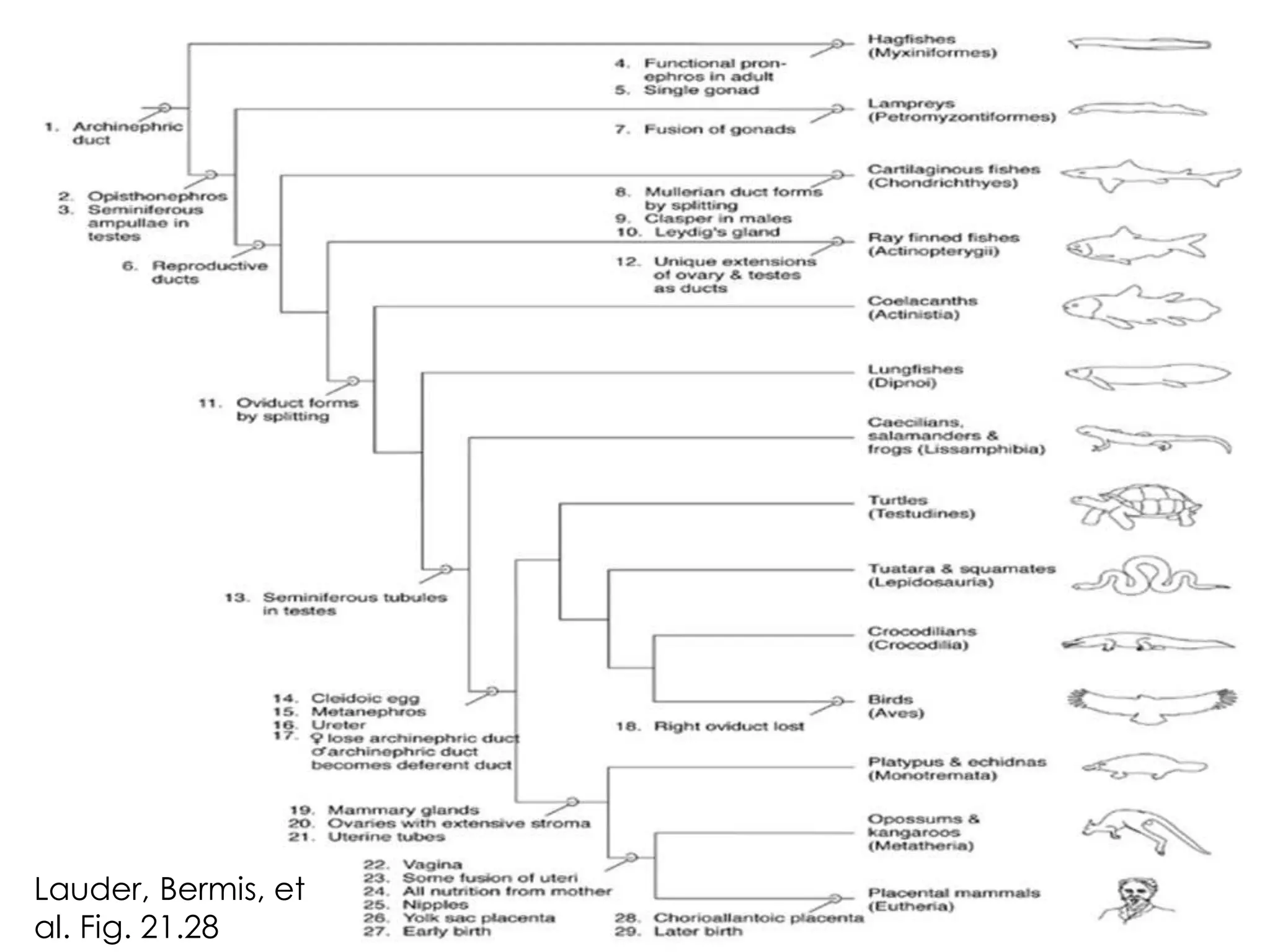
Lauder, Bermis, et
al. Fig. 21.28
END….. Thank you 

Comparative Anatomy - Reproductive System

  • 1.
    REPRODUCTIVE SYSTEM Briones, Abigail Loren Celajes,Chrizz Shainne Montuya, Robert Angelo Okamoto, Eigi
  • 2.
  • 3.
  • 4.
    Function of GeneralStructures • Female Reproductive System • The female external reproductive structures include the clitoris and two sets of labia • The internal organs are a pair of gonads and a system of ducts and chambers that carry gametes and house the embryo and fetus • Ovary • Follicle • Mesovarium
  • 7.
    Cont. • Female ReproductiveSystem • Oviducts and Uterus • Oviduct or Fallopian tube • Cervix • Vagina and Vulva
  • 8.
  • 9.
    Cont. • Male ReproductiveSystem • The male external reproductive structures in most mammals include the scrotum and the penis. • The internal organs consists of gonads, which produces sperm and hormones, and accessory glands. • Testes • The male gonads, or testes, consist of highly coiled tubes surrounded by connective tissue. • Seminiferous tubules. • Production of normal sperm cannot occur at the body temperatures of most mammals
  • 11.
    Cont. • Male ReproductiveSystem • Ducts • seminiferous tubules • Epididymis • Vas deferens • Urethra. • Glands • Seminal vesicle, • Prostate • Bulbourethral (Cowper’s) gland • Seminal fluid, or semen.
  • 13.
  • 14.
    Female Reproductive System Ovary •Development -Germinal epithelium thickens and covers the indifferent gonad (consists of cortex and medulla) -♀ , migrating germ cells  cortex – primary sex cords = secondary sex cords -follicle  ripening egg cells  theca -blastema becomes stroma or matrix
  • 15.
    Kardong, K. V.2000. Fig. 14.19 & 14.16. Embryonic Formation of the Gonad & Female reproductive system (humans).
  • 16.
    Female Reproductive System Ovary •Structure  Crocodilians, Turtles, Birds, and Mammals -solid and compact with much stroma  Cyclostomes, Cartilaginous Fishes, Dipnoans, and some Primitive Ray-Finned Fishes -solid but less compact  Amphibians -stroma is absent -soft and pleated  Teleosts -hollow ovaries
  • 17.
    Female Reproductive System FemaleDucts • Opistonephric Ducts and Ureters -convey only urine in females  Sharks and Urodeles -drains with accessory ducts  Amniotes (Reptiles, Birds, and Mammals) -leaves vestiges
  • 18.
    Shark Salamander Kardong, K.V. 2000. Fig. 14.24 & 14.27. Oviducts of female fishes & Urogenital anatomy of tetrapod females
  • 19.
    Amniotes Kardong, K. V.2000. Fig.14.27. Urogenital anatomy of tetrapod females
  • 20.
    Female Reproductive System FemaleDucts • Oviducts -anterior end  funnels w/ openings -ciliated columnar epithelium -peristaltic contraction  Teleostei -ovaries encloses pockets of coelom  Chondrichthyes -fuse in the midline -some are oviparous (shell glands) • Mermaid purse  Amphibians -glandular and coiled oviducts -posterior portion  coat of jelly
  • 21.
    Kardong, K. V.2000. Fig. 14.24. Oviducts of female fishes. Lauder, Bermis, et. al. Fig. 21.15. Reproductive tracts of female anamniotes Teleostei
  • 22.
    Chondrichthyes Lauder, Bermis, et.al. Fig. 21.15. Reproductive tracts of female fishes. Wyatt, M. 2007.
  • 23.
    Female Reproductive System FemaleDucts • Oviducts  Reptiles, Birds, and Monotremata -large eggs and genital tracts vary widely -large and pleated ovarian funnels -glandular anterior portion  albumen -enlarges near the cloaca  shell gland and ovisac  Reptiles right side is larger  Birds right side is vestigial
  • 24.
    Female Reproductive System FemaleDucts • Oviducts  Therian Mammals  Oviducts -ciliated epithelium -straight and slender; w/o albumen or shells  Uterus -Endometrium -Myometrium -Cervix o Types of Mammalian Uterus • Duplex (Monotremes, Marsupials, Elephants and many Rodents) • Bipartite (most Ungulates and most Carnivores) • Bicornuate • Simplex (most Primates and some Edentates
  • 25.
  • 26.
    Kardong, K. V. 2000.Figure 14.52. Reproductive organs of female eutherian mammals.
  • 27.
    Female Reproductive System FemaleDucts • Oviducts  Therian Mammals  Vagina -stratified epithelium -receives penis during copulation -serves as birth canal -soft and distensible; glandular or cornified
  • 28.
    Female Reproductive System FemaleDucts • Oviducts  Marsupials -terminal part of the tract fuses  single urogenital canal -two embryonic uteri and vaginae -third pseudovagina grows
  • 29.
    Kardong, K. V. 2000.Figure 14.51. Reproductive organs of female marsupials.
  • 30.
    Development and Structureof Testes • Indifferent gonad - early developmental stage is similar in both sexes which includes cortex and medulla. • Germinal epithelium forms only the peritoneal covering of adult testes. • Primary sex cords do NOT degenerate and secondary sex cords are NOT formed. • Testes are paired except in CYCLOSTOMES. • Each testis is suspended from the dorsal wall of a coelom by a mesentery called the mesorchium. • Testes are paired but may be partially fused as in ELASMOBRANCHS, or completely fused as in ADULT CYCLOSTOMES. • Testes are elongated in CYCLOSTOMES, MOST FISHES, CAECILIANS, and URODELES. • Testes are compact and ovoid in some CARTILAGINOUS FISHES, ANURANS, and AMNIOTES.
  • 31.
  • 32.
    Kardong K.V. 2000.Figure 14.32 Hagfish Elasmobranch Lungfish Teleost
  • 33.
    Cont. • Testes areelongated in CYCLOSTOMES, MOST FISHES, CAECILIANS, and URODELES. • Testes are compact and ovoid in some CARTILAGINOUS FISHES, ANURANS, and AMNIOTES. • BIRDS- abdominal air sacs; MAMMALS (PRIMATES – MOST CARNIVORES, and MOST UNGULATES) – scrotum; MAMMALS (MONOTREMES, WHALES, ELEPHANTS) – testes are abdominal or pelvic in position if body temperature is relatively low.
  • 34.
    Male Ducts •Except inCYCLOSTOMES, sperms are released in a closed system of ducts. •Deferent ducts carries either the sperm or both sperm and urine. •CHONDRICHTHYANS have paired deferent ducts that convey ONLY SPERM. •Several PRIMITIVE RAYFINNED FISHES and SOME DIPNOANS pass sperm into the anterior end of deferent duct which convey both sperm and urine. •All AMPHIBIANS have deferent ducts, some species convey ONLY SPERM and in others BOTH sperm and urine. •Deferent ducts of AMNIOTES carry ONLY SPERM.
  • 35.
    Copulatory (Intromittent) Organs andFertilization • CYCLOSTOMES and MOST BONY FISHES lack copulatory organs. • SOME TELEOST retained their eggs during development or bear live young. o Gonopodium- margin of the anal fin as copulatory organ in males. • CARTILAGINOUS FISHES also have INTERNAL fertilization. o Claspers- pelvic fins as copulatory organ in males. • ANURANS have EXTERNAL fertilization. Hence, they don’t have copulatory organs. • URODELES have INTERNAL fertilization but LACK copulatory organs. o Cloacal kiss ( male and female press their cloacas together to transfer sperm)
  • 36.
    Cont. • TURTLES andCROCODILES have evolved a grooved penis. (it is located internally on the floor of the cloaca. o Small clitoris are present in female turtles and crocodiles. • BIRDS copulate by pressing the cloacas together for the transfer of sperm. o Primitive birds (OSTRICHES, DUCKS and GEESE) have a small penis. • THERIAN MAMMALS have a penis formed from the genital tubercle located anterior to the cloacal opening. • Glans is variously shaped and is forked in MONOTREMES and MARSUPIALS.
  • 37.
    Cloaca and Derivatives •Development -Nephric and Paramesonephric ducts extends posteriorly to the hindgut -common passageway for urinary, digestive, and reproductive systems (primitive condition) -L. word “cloaca” = “sewer” -3 fuctions: defecation, urination, and copulation -3 compartments:  Coprodeum- most proximal; empties intestine  Urodeum- receives products from the urinary and genital ducts  Proctodeum- copulation; in many amniotes develops a penis
  • 38.
    Kardong, K.V. 2000.Figure 14.47. Diagrams of sagittal sections of tetrapod cloacae.
  • 39.
    Cloaca and Derivatives •Development -Hans Gadow- clocal compartments separated by folds  Rectocoprodeal Fold- between intestine and coprodeum  Coprourodeal Fold- between coprodeum and urodeum  Uroproctodeal Fold- between urodeum and proctodeum
  • 40.
    Kardong, K.V. 2000.Figure 14.49. Bird cloacae.
  • 41.
    Cloaca and Derivatives Adult Hagfishes, Elasmobranchs, Dipnoans, Amphibians, Reptiles, and Birds -retains primitive condition Kardong, K.V. 2000. Figure 14.46, 14.48, 14.49. Cloacal and anal regions of fishes, Cloaca of the lizard Coleonyx,Bird cloacae.
  • 42.
    Cloaca and Derivatives Adult Lampreys, Chimaeras, and Bony Fishes -Rectum  no longer joined by the urogenital ducts -Nephric and genital ducts  independently/ fuse to exit at a common papilla  anus Kardong, K.V. 2000. Figure 14.46. Cloacal and anal regions of fishes.
  • 43.
    Cloaca and Derivatives Monotremes -cloaca is partly divided by a septum resulting into three structures:  Dorsal Coprodeum  Ventral Urodeum- joined by ureters and paramesonephric duct  Common posterior Proctodeum Kardong, K.V. 2000. Figure 14.47. Diagrams of sagittal sections of tetrapod cloacae..
  • 44.
    Cloaca and Derivatives Therian Mammals -embryonic septum continues to push back  dorsal rectum is completely separated Kardong, K.V. 2000. Figure 14.50. Embryonic derivatives of the urogenital sinus in some eutherian mammals..
  • 45.
    Cloaca and Derivatives Therian Mammals  Males -urine and sperm release through common urethra  Females • Most Mammals -urinary and genital tracts exit by a common urogenital sinus • Primates and some Rodents -Fetal eversion  anterior urethral opening and posterior urethral opening
  • 46.
    Kardong, K.V. 2000.Figure 14.50. Embryonic derivatives of the urogenital sinus in some eutherian mammals..
  • 47.
    COMPARISON AND CONTRAST OFORGANS PRESENT ON DIFFERENT CLASSES
  • 48.
  • 49.

Editor's Notes

  • #3 Evolutionary survival depends on doing many things successfully: escaping from predators, procuring food, adjusting to the environment, and so on. All of this comes down to reproducing successfully, which is the primary biological role of the genital system. The reproductive system includes the gonads, their products, hormones and gametes, and the ducts that transport gametes. Reproductive hormones facilitate sexual behavior and parental care, prepare the reproductive ducts to receive the gametes, support the zygote, and perform other functions. Main Functions To produce the sex cells (gametes). To ensure fertilization. To provide nourishment of the embryo or fetus until hatching or birth. To release eggs or young from the maternal body.
  • #5 Ovary produces both hormones and mature ova The female gonads, the ovaries, lie in the abdominal cavity Each ovary is enclosed in a tough protective capsule and contains many follicles A follicle consists of one egg surrounded by one or more layers of follicle cells
  • #8 Female Reproductive System Oviducts and Uterus The egg cell is released into the abdominal cavity near the opening of the oviduct or fallopian tube Cilia in the tube convey the egg to the uterus Cervix is the neck of the uterus. Vagina and Vulva The vagina is a thin-walled chamber that is the repository for sperm during copulation and serves as the birth canal.
  • #10 Testes The male gonads, or testes, consist of highly coiled tubes surrounded by connective tissue. Sperm form in these seminiferous tubules. Production of normal sperm cannot occur at the body temperatures of most mammals The testes of many mammals are held outside the abdominal cavity in the scrotum, where the temperature is lower than in the abdominal cavity.
  • #12 Male Reproductive System Ducts From the seminiferous tubules of a testis, sperm pass into the coiled tubules of the epididymis where the sperm is temporarily stored. During ejaculation, the sperm are propelled through the muscular vas deferens, the ejaculatory duct, and exit the penis through the urethra. Glands Three accessory sex glands, the seminal vesicle, prostate, and bulbourethral (Cowper’s) gland, respectively, add their secretions as sperm move from the testes to the urethra. This fluid and the sperm it contains constitute seminal fluid, or semen.
  • #15 Indifferent Gonad consist of cortex and medulla The migrating germ cells from the extraembryonic endoderm will travel to the indifferent gonad and takes residence either in the cortex or in the medulla. In the case of females, the migrating germ cells will take residence in the cortex, the cortex expands, primary sex cords degenerates, the secondary sex cords will be produced which functions in housing the follicles. Follicle cells surrounds the ripening egg cells and the theca encloses the follicles. After ovulation the follicles would be converted into corpora lutea (mammals, some elasmobranchs, birds) Blastema becomes the stroma or matrix of the connective tissue in the ovary
  • #17 Pleated- folds/ with folds
  • #20 In amniotes the regressing archinephric duct leaves vestiges like epoophoron and paroophoron (epididymis and paradidymis in male counterpart respectively)
  • #21 In amphibians – the posterior portion of their oviducts provides coat of jelly for the embryo
  • #22 In Teleostei, ovaries fold to enclose pockets of coelom into which eggs rupture.
  • #23 Oviparous chondrichthyes like the catshark (in the picture above) lays eggs which are called Mermaid purse (picture above, lower left) this covering was provided by the nidamental gland (shell gland) in the anterior portion of their oviducts
  • #24 The glandular anterior portion applies albumen to the eggs The part of the tract near the cloaca enlarges because of the ovisac and shell gland The right oviducts of reptiles are larger than the left side The right oviducts of birds is vestigial (lost) because the right ovary regresses in embryos
  • #25 The genital tracts of therian mammals are divided into three regions: oviducts, uterus, and vagina Oviducts of therian mammals are straight and slender because they have relatively small eggs The uterus was lined with endometrium, houses the fetus during pregnancy and provides maternal contribution to the placenta Myometrium is the outer covering of the uterus; it has thick wall and is composed of smooth muscles having circular, longitudinal, and oblique fibers. Cervix closes the uterus
  • #27 Duplex -two cervixes/ uterus Bipartite- Y-shaped externally, nearly divided internally Bicornuate- fusion is nearly complete but does not include anterior end of the organ Simplex- single uterine chamber
  • #28 Distensible means able to stretch or expand
  • #31 (In males, the germ cells that are from the extraembryonic endoderm takes up residence in the medulla and enlarges to become the testis cords that will form the seminiferous tubules.) (In females, the cortex expands, forming secondary sex cords that house the follicles.) Germinal epithelium forms only the peritoneal covering of adult testes. Primary sex cords do NOT degenerate and secondary sex cords are NOT formed. Testes are paired except in cyclostomes ( jawless fishes having large sucking mouth – lampreys and hagfishes) Each is suspended from the dorsal wall of a coelom by a mesentery called the mesorchium. (mesovarium in females) (Testes are usually smoother, firmer, smaller than ovaries of the same species, usually develop earlier.) Testes are paired but may be partially fused as in ELASMOBRANCHS, or completely fused as in ADULT CYCLOSTOMES. (Elasmobranchs –cartilaginous fishes –sharks,rays,skates and other extinct related fishes.)
  • #34 Testes are elongated in CYCLOSTOMES, MOST FISHES, CAECILIANS, and URODELES. Testes are compact and ovoid in some CARTILAGINOUS FISHES, ANURANS, and AMNIOTES. (LABEL- a. Hagfishes (cyclostomes)- single testis that hangs in the dorsal body wall between the kidneys. b. Elasmobranch – partially fused. ) (Spermatogenesis does not occur if temperature is warmer than 36.5oC.) BIRDS- abdominal air sacs; MAMMALS (PRIMATES – MOST CARNIVORES, and MOST UNGULATES) – scrotum; MAMMALS (MONOTREMES, WHALES, ELEPHANTS) – testes are abdominal or pelvic in position if body temperature is relatively low. (birds maintain appropriate temp for spermatogenesis by the abdominal air sacs; scrotum is the cooler pouch of skin where the testis descend at maturity out of the abdominal cavity,- homologous to the large labia in females)
  • #35 Except in CYCLOSTOMES, sperms are released in a closed system of ducts.   (the efferent ducts cross the mesorchium to enter the nephric duct; now called deferent duct when it carries only sperm or both sperm and urine) Deferent ducts carries either the sperm or both sperm and urine. (provide temporary storage and contracts during ejaculation) CHONDRICHTHYANS have paired deferent ducts that convey ONLY SPERM. Several PRIMITIVE RAYFINNED FISHES and SOME DIPNOANS pass sperm into the anterior end of deferent duct which convey both sperm and urine. All AMPHIBIANS have deferent ducts, some species convey ONLY SPERM and in others BOTH sperm and urine. Deferent ducts of AMNIOTES carry ONLY SPERM. (Birds, Reptiles, Mammals)
  • #36 CYCLOSTOMES and MOST BONY FISHES lack copulatory organs. (they lay their eggs in water and male discharges his sperm over them) SOME TELEOST retained their eggs during development or bear live young. Gonopodium- margin of the anal fin as copulatory organ in males. CARTILAGINOUS FISHES also have INTERNAL fertilization. Claspers- pelvic fins as copulatory organ in males. ANURANS have EXTERNAL fertilization. Hence, they don’t have copulatory organs. URODELES have INTERNAL fertilization but LACK copulatory organs. (urodeles include newts and salamanders) Cloacal kiss ( male and female press their cloacas together to transfer sperm)
  • #37 TURTLES and CROCODILES have evolved a grooved penis. (it is located internally on the floor of the cloaca. Small clitoris are present in female turtles and crocodiles) BIRDS copulate by pressing the cloacas together for the transfer of sperm. Primitive birds (OSTRICHES, DUCKS and GEESE) have a small penis. THERIAN MAMMALS have a penis formed from the genital tubercle located anterior to the cloacal opening. (genital tubercle of males becomes the penis, while for the females, it becomes the clitoris, which is the reason why penis is said to be homologous to the clitoris) Glans is variously shaped and is forked in MONOTREMES and MARSUPIALS. (to correspond to the divided vagina of females. Ex. Kangaroo)  
  • #38 Nephric – ureters; Paramesonephric – Mullerian ducts
  • #39 Three compartments of the cloaca : C – as coprodeum U – as urodeum P – as proctodeum
  • #41 Three folds of the cloaca
  • #42 Primitive condition is where the cloaca is the common passageway of the urinary, digestive, and reproductive systems
  • #43 Rectum is independent Urinary and Reproductive ducts fuse and empties through common papilla (Urogenital opening or Genital pore) and exits through the anus