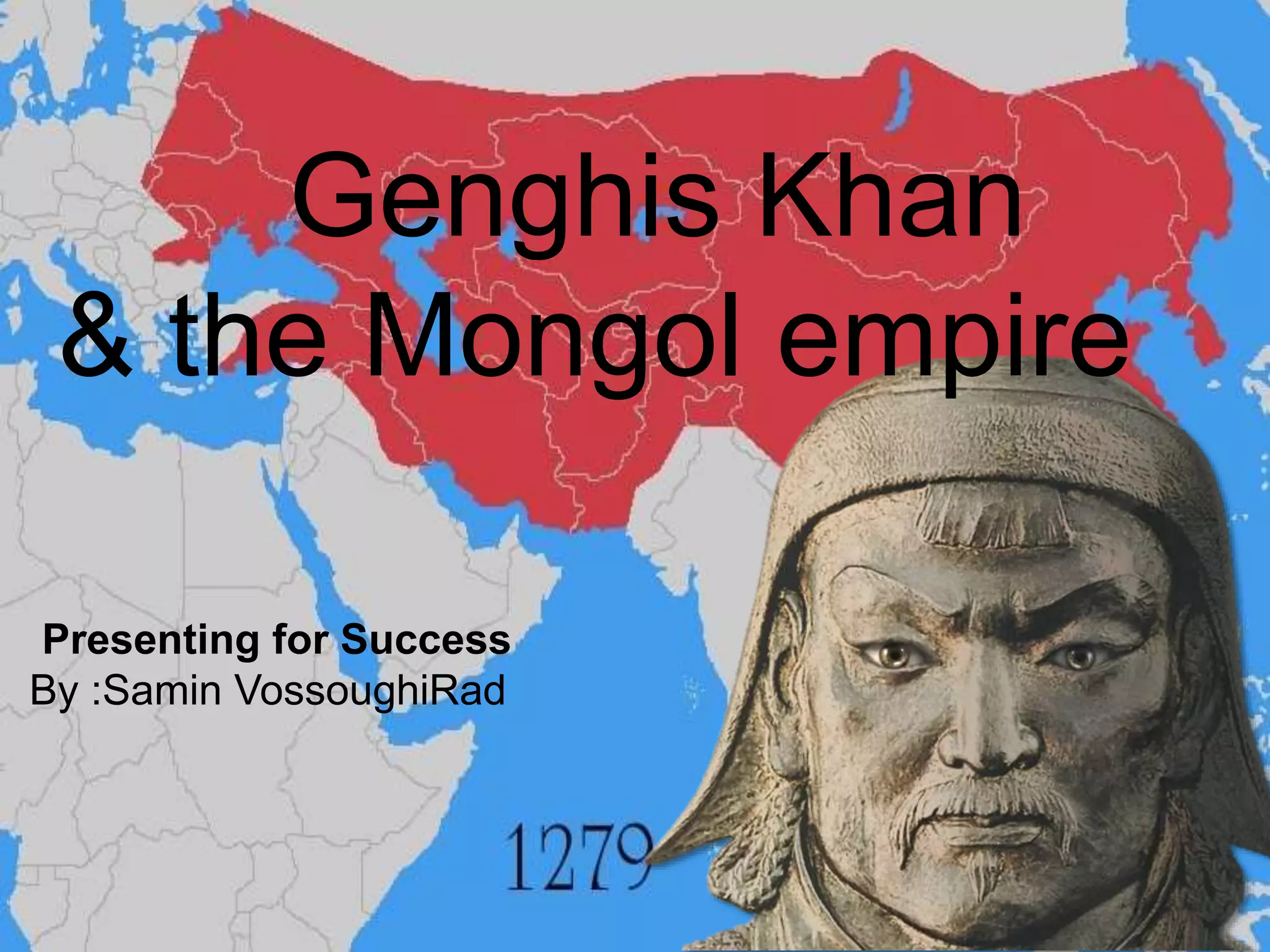
Genghis Khan
& the Mongol empire
Presenting for Success
By :Samin VossoughiRad
Uniting the Mongol confederations
Naimans, Merkits, Tatars, Khamag Mongols, Keraites
Religion
Genghis Khan was a tengrist, but was religiously
tolerant and interested in learning philosophical and
moral lessons from other religions
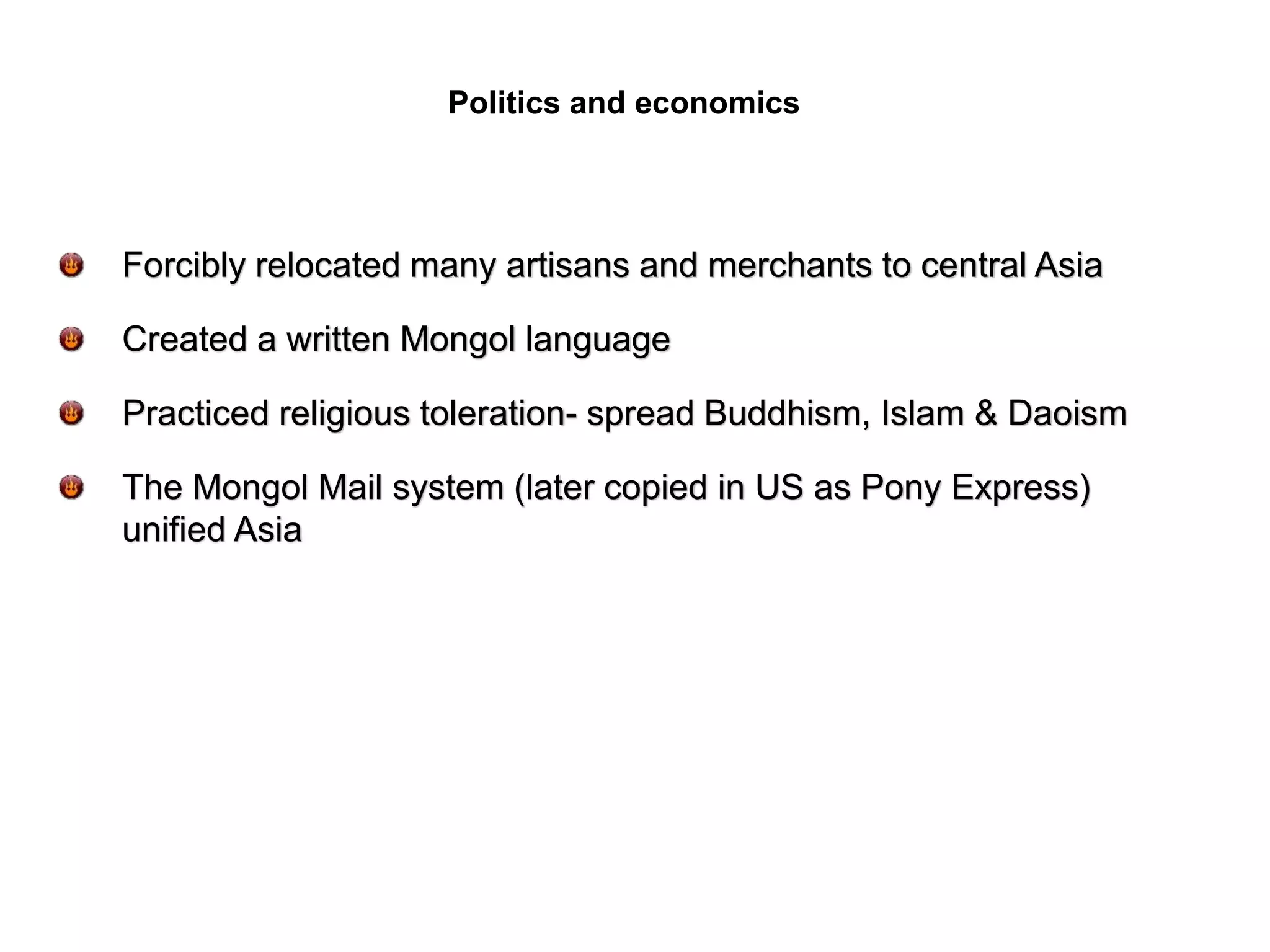
Politics and economics
Forcibly relocated many artisans and merchants to central Asia
Created a written Mongol language
Practiced religious toleration- spread Buddhism, Islam & Daoism
The Mongol Mail system (later copied in US as Pony Express)
unified Asia
Military
• Genghis Khan put absolute trust in his generals
• Regarded them as close advisors
• He allowed them to make decisions on their
own
Death and burial
In August 1227, during the fall of Yinchuan, the capital of Western Xia,
Genghis Khan died.
Years before his death, Genghis Khan asked to be buried without markings,
according to the customs of his tribe.
After he died, his body was returned to Mongolia and presumably to his birthplace
Perceptions
Positive
• Political environment
• Tolerant of religions
• After Mongol conquest, 100 years of peace
• Mongols policed the roads and made travel safe & Silk Road trade increased
• Harsh punishments for criminals helped to deter crime
• Unified parts of China, India, Central Asia, Muslim Middle East, &
Russia- transmitting all acquired cultures and technologies
Negative
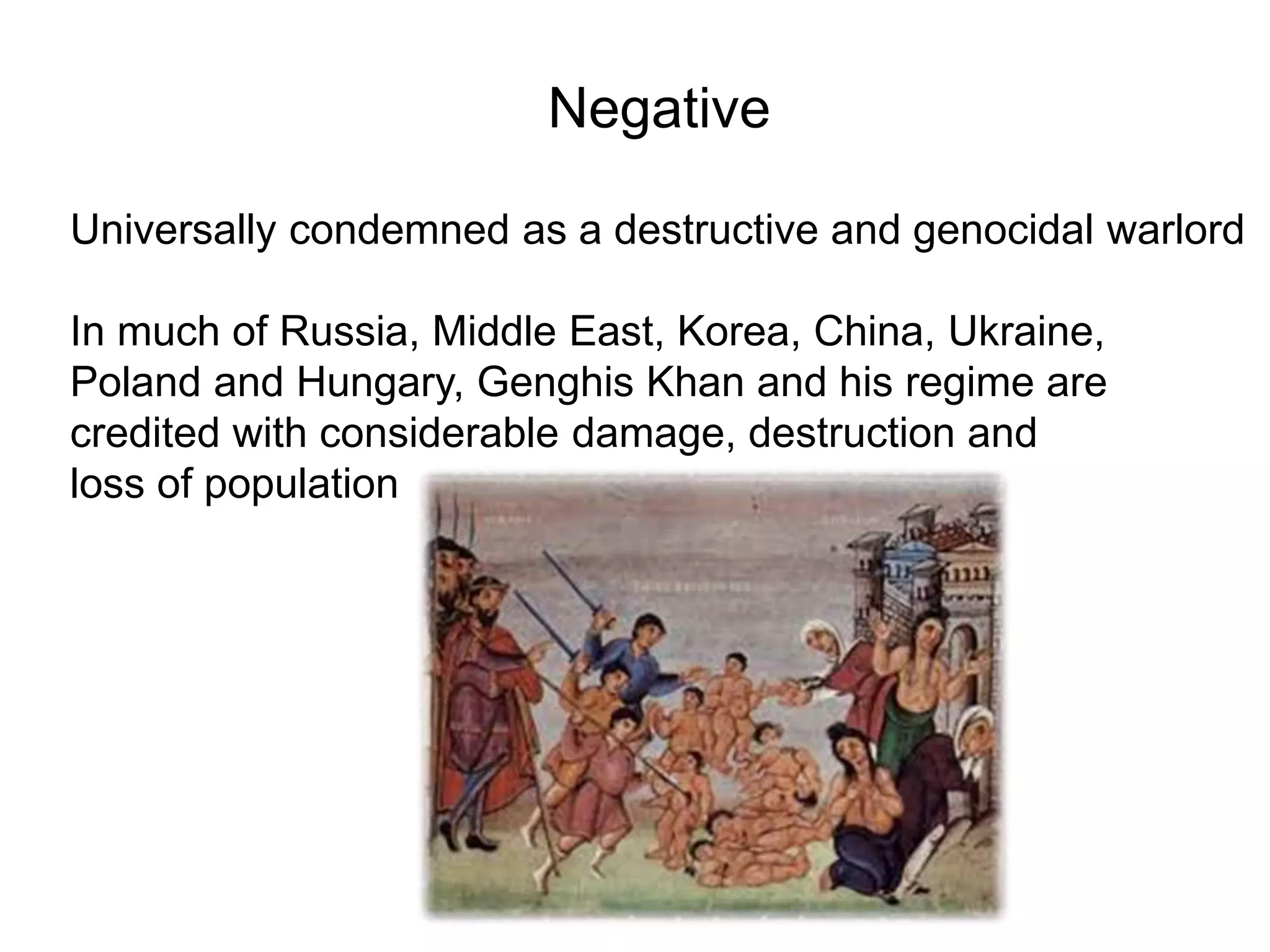
Universally condemned as a destructive and genocidal warlord
In much of Russia, Middle East, Korea, China, Ukraine,
Poland and Hungary, Genghis Khan and his regime are
credited with considerable damage, destruction and
loss of population
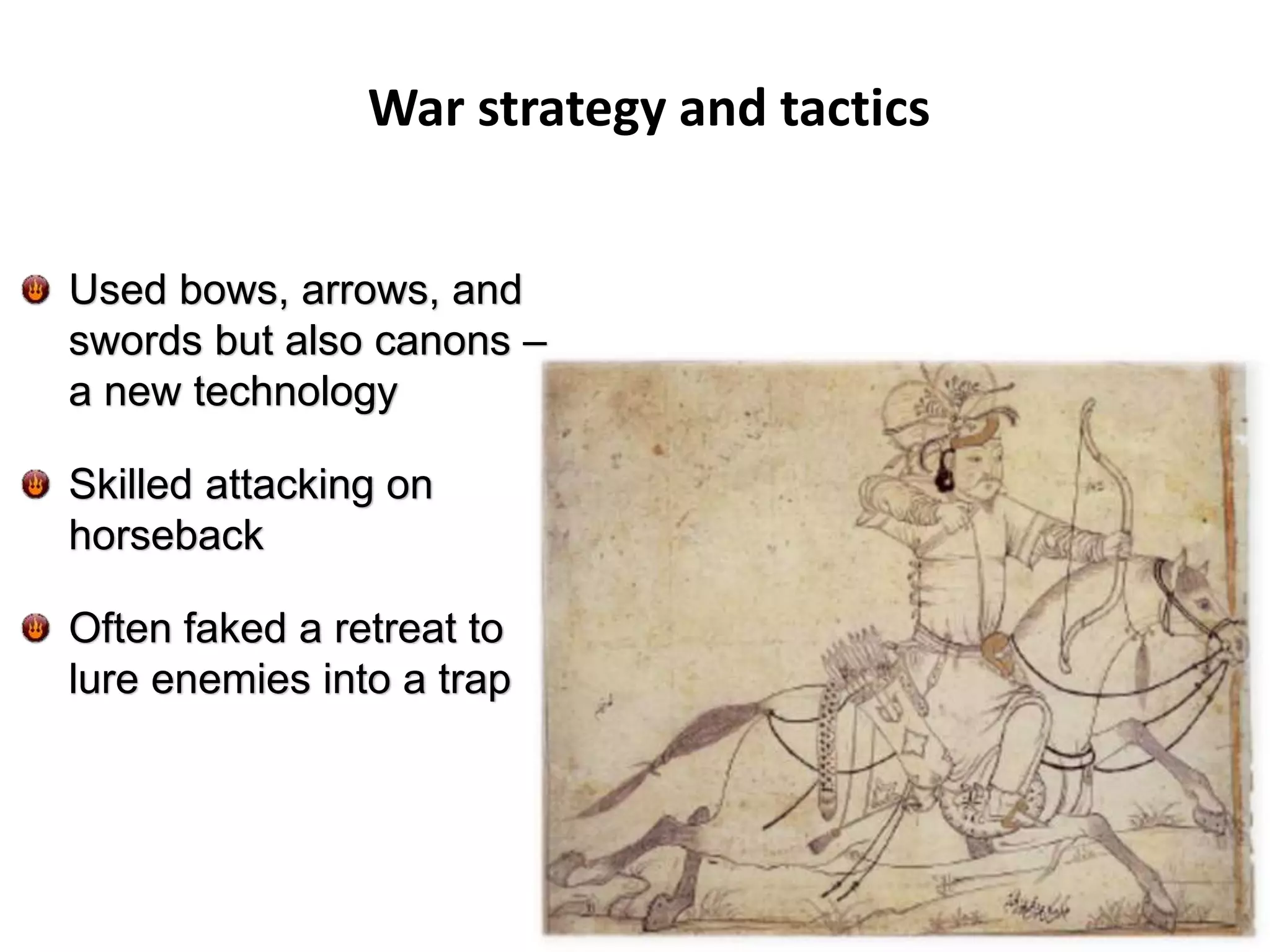
Used bows, arrows, and
swords but also canons –
a new technology
Skilled attacking on
horseback
Often faked a retreat to
lure enemies into a trap
War strategy and tactics
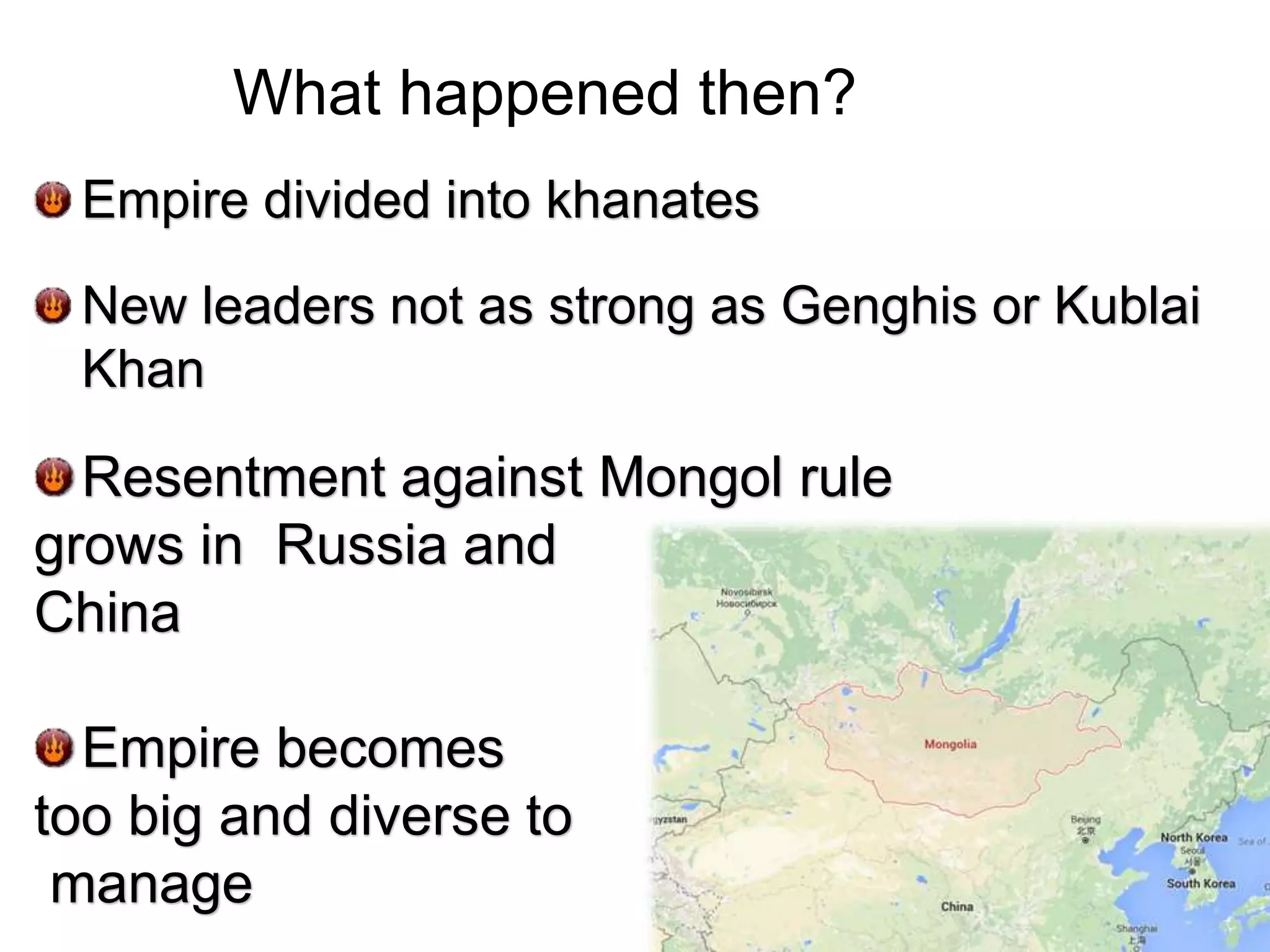
Empire divided into khanates
New leaders not as strong as Genghis or Kublai
Khan
Resentment against Mongol rule
grows in Russia and
China
Empire becomes
too big and diverse to
manage
What happened then?
Bibliography
• The Secret History of the Mongols
• 'The End of Genghis', a poem by F. L. Lucas, in which the dying Khan, attended by
his Khitan counsellor Yelü Chucai, looks back on his life.
• Morgan, David (1986). The Mongols. The Peoples of Europe. Blackwell Publishing
• Man, John (2004). Genghis Khan: Life, Death, and Resurrection. New York City: St.
Martin's Press. pp. 239–240.
• "Palace of Genghis Khan unearthed". BBC. October 7, 2004. Retrieved May
20, 2008
• Hildinger, Erik (1997). Warriors Of The Steppe: Military History Of Central Asia, 500
BC To 1700 AD. Cambridge: De Capo Press.
• Lane, George (2004). Genghis Khan and Mongol Rule. Westport, Connecticut:
Greenwood Publishing Group.
• Man, John (2004). Genghis Khan: Life, Death and Resurrection. London; New York:
Bantam Press.
• Ratchnevsky, Paul (1992, c1991). Genghis Khan: His Life and Legacy [Čingis-Khan:
sein Leben und Wirken]. tr. & ed. Thomas Nivison Haining. Oxford, UK; Cambridge,
Massachusetts, US: B. Blackwell
Genghis khan and_mongols

Genghis khan and_mongols

  • 1.
    Genghis Khan & theMongol empire Presenting for Success By :Samin VossoughiRad
  • 3.
    Uniting the Mongolconfederations Naimans, Merkits, Tatars, Khamag Mongols, Keraites
  • 4.
    Religion Genghis Khan wasa tengrist, but was religiously tolerant and interested in learning philosophical and moral lessons from other religions
  • 7.
    Politics and economics Forciblyrelocated many artisans and merchants to central Asia Created a written Mongol language Practiced religious toleration- spread Buddhism, Islam & Daoism The Mongol Mail system (later copied in US as Pony Express) unified Asia
  • 8.
    Military • Genghis Khanput absolute trust in his generals • Regarded them as close advisors • He allowed them to make decisions on their own
  • 9.
    Death and burial InAugust 1227, during the fall of Yinchuan, the capital of Western Xia, Genghis Khan died. Years before his death, Genghis Khan asked to be buried without markings, according to the customs of his tribe. After he died, his body was returned to Mongolia and presumably to his birthplace
  • 10.
    Perceptions Positive • Political environment •Tolerant of religions • After Mongol conquest, 100 years of peace • Mongols policed the roads and made travel safe & Silk Road trade increased • Harsh punishments for criminals helped to deter crime • Unified parts of China, India, Central Asia, Muslim Middle East, & Russia- transmitting all acquired cultures and technologies
  • 11.
    Negative Universally condemned asa destructive and genocidal warlord In much of Russia, Middle East, Korea, China, Ukraine, Poland and Hungary, Genghis Khan and his regime are credited with considerable damage, destruction and loss of population
  • 12.
    Used bows, arrows,and swords but also canons – a new technology Skilled attacking on horseback Often faked a retreat to lure enemies into a trap War strategy and tactics
  • 13.
    Empire divided intokhanates New leaders not as strong as Genghis or Kublai Khan Resentment against Mongol rule grows in Russia and China Empire becomes too big and diverse to manage What happened then?
  • 14.
    Bibliography • The SecretHistory of the Mongols • 'The End of Genghis', a poem by F. L. Lucas, in which the dying Khan, attended by his Khitan counsellor Yelü Chucai, looks back on his life. • Morgan, David (1986). The Mongols. The Peoples of Europe. Blackwell Publishing • Man, John (2004). Genghis Khan: Life, Death, and Resurrection. New York City: St. Martin's Press. pp. 239–240. • "Palace of Genghis Khan unearthed". BBC. October 7, 2004. Retrieved May 20, 2008 • Hildinger, Erik (1997). Warriors Of The Steppe: Military History Of Central Asia, 500 BC To 1700 AD. Cambridge: De Capo Press. • Lane, George (2004). Genghis Khan and Mongol Rule. Westport, Connecticut: Greenwood Publishing Group. • Man, John (2004). Genghis Khan: Life, Death and Resurrection. London; New York: Bantam Press. • Ratchnevsky, Paul (1992, c1991). Genghis Khan: His Life and Legacy [Čingis-Khan: sein Leben und Wirken]. tr. & ed. Thomas Nivison Haining. Oxford, UK; Cambridge, Massachusetts, US: B. Blackwell