Communism and Conflict  Berlin Airlift Alliances  Nuclear Escalation Turmoil in China
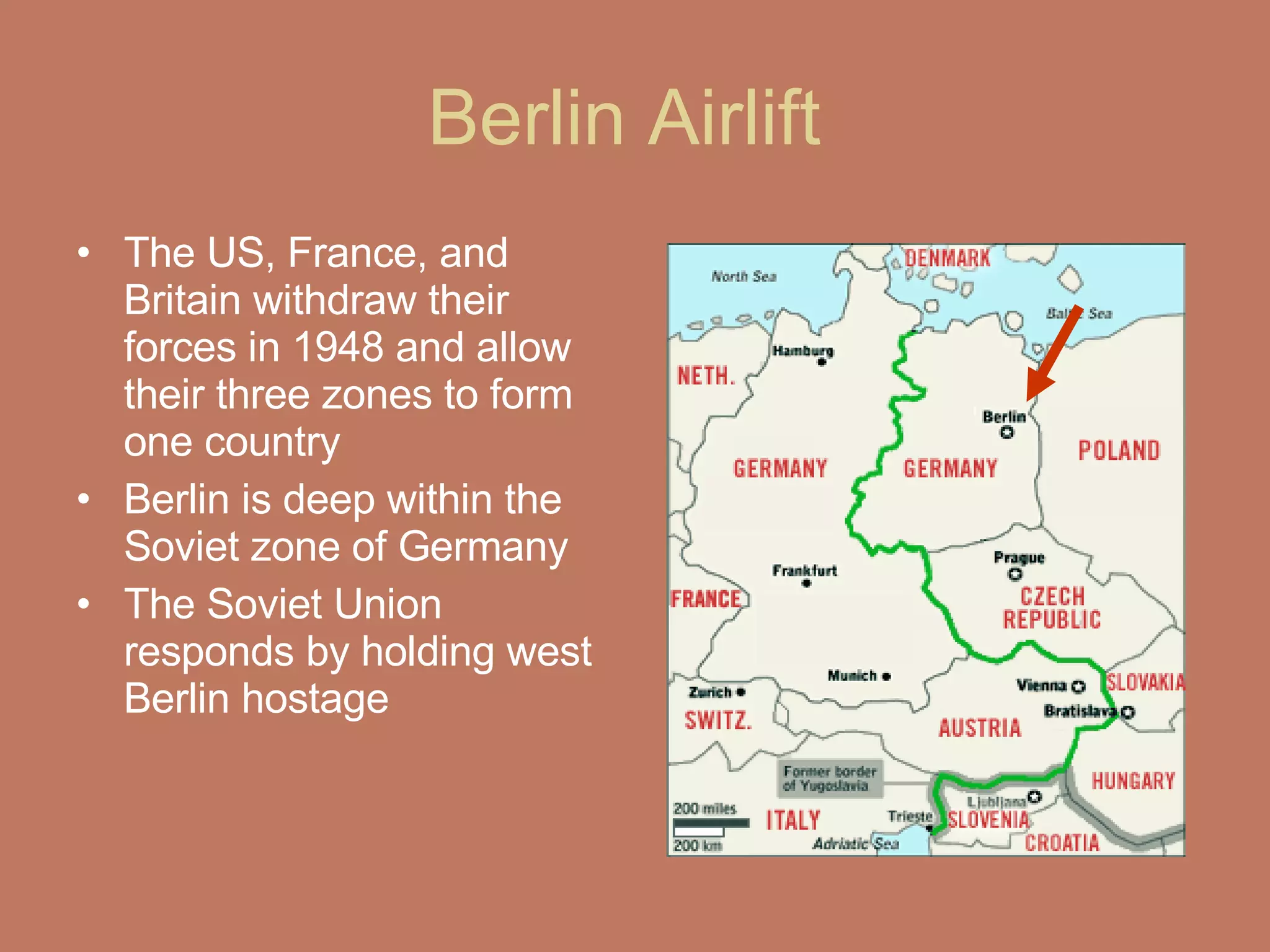
Berlin Airlift  The US, France, and Britain withdraw their forces in 1948 and allow their three zones to form one country Berlin is deep within the Soviet zone of Germany  The Soviet Union responds by holding west Berlin hostage
Berlin Airlift  Soviets cut off highway and railway access to the city as well as water  Stalin hoped this would scare the allies into surrendering west Berlin  US and Britain break the blockade with airplanes!!!!! Planes landed and took off every three minutes  277,000 flights  2.3 million tons of supplies  Soviets forced to admit defeat after 11 months  Negotiations took place at the United Nations
Alliances Form  North Atlantic Treaty Organization  Western Democracies fear WWIII erupting from the chaos and uncertainty shown by the Berlin Blockade  Fear the West would not be able to wage a war against the Soviet Union should one erupt 10 countries including US and Canada sign the collective security agreement First US peacetime military commitment
Alliances Form Soviets see NATO as a threat to their own security  Respond by forming an alliance system of their own  The Warsaw Pact included the Soviet Union and the satellite countries
Alliances Form The United States continued to search for Allies in a potential war and continue the policy of containment Southeast Asia Treaty Organization  SEATO Formed to stabilize the area after the beginning of the Korean Conflict
Nuclear Weapons The Soviet Union does not waste any time in developing its own atomic bomb (1949) The US is determined to develop an even deadlier bomb  Thermonuclear weapons were the next step  Truman okays research into the H-bomb which would be 1,000 times stronger than the A-bomb  US successfully develops this weapon by 1952 and the Soviets follow with their version months later
Arms Race  As time went on the weapons become more powerful  Constant competition to outdo the each other with sheer power  Who could create and master the most terrifying weapons of them all
Brinkmanship Eisenhower assumes the presidency in 1954  Appoints John Foster Dulles as his secretary of state who is firmly anti-communist  Declared that if the Soviet Union or its supporters launched an attack against the US the US would immediately retaliate. Willingness to go to the edge of war referred to as brinkmanship
Science and Technology  Cold war fueled scientific research and technological advances  Needed to outdo the other country in both weapons and prestige  Intercontinental Ballistic Missiles (ICBMs)
Fragile Balance  Watch the following movie and answer the questions.
Communist China  Take a moment and answer the following review questions: Who was the nationalist leader in China? Who was the communist leader in China? What was the Long March?
WWII Interrupts a Civil War During WWII China was invaded by Japan  Mao is able to beat back the Japanese in Northern China and gain control of the area  Wins the trust and loyalty of the peasants by promoting literacy and providing food  Chiang Kai-Shek now called Jiang Jieshi is still in control of the nationalists  US gives about $1.5 billion in aid to his armies to fight the Japanese Waste aide or save it for the fight with Mao instead
Civil War Resumes  Nationalist appear to be in the better position at the outset of the struggle Larger army Continued aid from the US Collapsing economy leads many nationalists to desert and defect to the communist army causing the Nationalists to lose the war
Two Chinas  Mao and the People’s Republic of China  Received aid from the Soviets and had a military alliance  Jiang and Nationalist China based in Taiwan called the Republic of China  Supported by the US
Response to the Chinas US seeks to expand its own influence in Asia  Limits USSR occupation of Japan  Splits Korea into a North and South
Chinese Expansion Under Mao  Mao expands into Inner Mongolia, India, and Tibet  Had promised autonomy to the Tibetians who were followers of the Dalai Lama  Dalai Lama forced to flee to India as communist China’s forces tighten on the region
 
Changes Under Mao Claimed to have a new “Mandate of Heaven” Communists only 1% of the population at the outset  Set up a party organization and a national government  Mao heads both
Marx and China Mao wants to model Chinese economy after Marxist system  Most farmers did not own their own land  10% of population owned 70% of the land  Agrarian Reform Law of 1950  Seized and redistributed land  Killed any landowner who resisted Forced peasants to join collective farms  What other leader has done this in history?
Marx and China  Women given an equal place in the home and the workplace as Marx suggests  In direct conflict with the Confucian beliefs and way of life Completely disrupts the social order of the country  National child care instituted to allow women the freedom to become an equal part in the workplace
Marx and China Nationalization of Industry  Government takes control of the means of production  Sets out a 5 year plan for their industry  Succeeds  Increases output of coal, cement, and electricity by 100% Steel production quadruples
Great Leap Forward  Larger collective farms called communes  26,000 established averaging 15,000 acres and supporting 25,000 people each  Worked together, ate together, slept in dormitories, raised their children together Removed personal profit motive so no reward to work hard when only the state benefited  Program fails when it is inefficient and people hate the lifestyle Crop failures also cause mass starvation in 1958 and 1961 Program officially ends 1961
Changes for China After Great Leap failure Mao diminishes role in the government  New leaders move away from Mao’s strict socialist  Allow farmers to live in their own homes  Sale of goods from small private plots  Factory workers could compete for raises, bonuses and promotions
Mao’s Objections Mao does not like the new direction  Straying away from Socialist goals  1966 launches a new campaign to try and keep the communists on track  Called on the younger generation to “learn revolution by making revolution” High School and College students leave class and form militias called the Red Guards
Cultural Revolution  Red Guards lead Cultural Revolution  Goal of the revolution was to achieve complete equality for all peasants and workers  Intellectual and artistic activities seen as useless Shut down colleges and schools  Intellectuals forced to do hard labor to purify themselves  People who did not agree were executed or jailed
Cultural Revolution Shut down factories and schools  Complete chaos and anarchy threatens to collapse the country  Mao eventually acknowledges that the revolution must be stopped In 1976 Mao gives the order to dissolve the Red Guards
Soviet Problems  Soviet Union and China pledge friendship at the outset of Mao’s rule Begin to fight over who will lead the worldwide communist movement  Territory disputes along their border  USSR ends economic aid to China in 1960

Communism And Conflict

  • 1.
    Communism and Conflict Berlin Airlift Alliances Nuclear Escalation Turmoil in China
  • 2.
    Berlin Airlift The US, France, and Britain withdraw their forces in 1948 and allow their three zones to form one country Berlin is deep within the Soviet zone of Germany The Soviet Union responds by holding west Berlin hostage
  • 3.
    Berlin Airlift Soviets cut off highway and railway access to the city as well as water Stalin hoped this would scare the allies into surrendering west Berlin US and Britain break the blockade with airplanes!!!!! Planes landed and took off every three minutes 277,000 flights 2.3 million tons of supplies Soviets forced to admit defeat after 11 months Negotiations took place at the United Nations
  • 4.
    Alliances Form North Atlantic Treaty Organization Western Democracies fear WWIII erupting from the chaos and uncertainty shown by the Berlin Blockade Fear the West would not be able to wage a war against the Soviet Union should one erupt 10 countries including US and Canada sign the collective security agreement First US peacetime military commitment
  • 5.
    Alliances Form Sovietssee NATO as a threat to their own security Respond by forming an alliance system of their own The Warsaw Pact included the Soviet Union and the satellite countries
  • 6.
    Alliances Form TheUnited States continued to search for Allies in a potential war and continue the policy of containment Southeast Asia Treaty Organization SEATO Formed to stabilize the area after the beginning of the Korean Conflict
  • 7.
    Nuclear Weapons TheSoviet Union does not waste any time in developing its own atomic bomb (1949) The US is determined to develop an even deadlier bomb Thermonuclear weapons were the next step Truman okays research into the H-bomb which would be 1,000 times stronger than the A-bomb US successfully develops this weapon by 1952 and the Soviets follow with their version months later
  • 8.
    Arms Race As time went on the weapons become more powerful Constant competition to outdo the each other with sheer power Who could create and master the most terrifying weapons of them all
  • 9.
    Brinkmanship Eisenhower assumesthe presidency in 1954 Appoints John Foster Dulles as his secretary of state who is firmly anti-communist Declared that if the Soviet Union or its supporters launched an attack against the US the US would immediately retaliate. Willingness to go to the edge of war referred to as brinkmanship
  • 10.
    Science and Technology Cold war fueled scientific research and technological advances Needed to outdo the other country in both weapons and prestige Intercontinental Ballistic Missiles (ICBMs)
  • 11.
    Fragile Balance Watch the following movie and answer the questions.
  • 12.
    Communist China Take a moment and answer the following review questions: Who was the nationalist leader in China? Who was the communist leader in China? What was the Long March?
  • 13.
    WWII Interrupts aCivil War During WWII China was invaded by Japan Mao is able to beat back the Japanese in Northern China and gain control of the area Wins the trust and loyalty of the peasants by promoting literacy and providing food Chiang Kai-Shek now called Jiang Jieshi is still in control of the nationalists US gives about $1.5 billion in aid to his armies to fight the Japanese Waste aide or save it for the fight with Mao instead
  • 14.
    Civil War Resumes Nationalist appear to be in the better position at the outset of the struggle Larger army Continued aid from the US Collapsing economy leads many nationalists to desert and defect to the communist army causing the Nationalists to lose the war
  • 15.
    Two Chinas Mao and the People’s Republic of China Received aid from the Soviets and had a military alliance Jiang and Nationalist China based in Taiwan called the Republic of China Supported by the US
  • 16.
    Response to theChinas US seeks to expand its own influence in Asia Limits USSR occupation of Japan Splits Korea into a North and South
  • 17.
    Chinese Expansion UnderMao Mao expands into Inner Mongolia, India, and Tibet Had promised autonomy to the Tibetians who were followers of the Dalai Lama Dalai Lama forced to flee to India as communist China’s forces tighten on the region
  • 18.
  • 19.
    Changes Under MaoClaimed to have a new “Mandate of Heaven” Communists only 1% of the population at the outset Set up a party organization and a national government Mao heads both
  • 20.
    Marx and ChinaMao wants to model Chinese economy after Marxist system Most farmers did not own their own land 10% of population owned 70% of the land Agrarian Reform Law of 1950 Seized and redistributed land Killed any landowner who resisted Forced peasants to join collective farms What other leader has done this in history?
  • 21.
    Marx and China Women given an equal place in the home and the workplace as Marx suggests In direct conflict with the Confucian beliefs and way of life Completely disrupts the social order of the country National child care instituted to allow women the freedom to become an equal part in the workplace
  • 22.
    Marx and ChinaNationalization of Industry Government takes control of the means of production Sets out a 5 year plan for their industry Succeeds Increases output of coal, cement, and electricity by 100% Steel production quadruples
  • 23.
    Great Leap Forward Larger collective farms called communes 26,000 established averaging 15,000 acres and supporting 25,000 people each Worked together, ate together, slept in dormitories, raised their children together Removed personal profit motive so no reward to work hard when only the state benefited Program fails when it is inefficient and people hate the lifestyle Crop failures also cause mass starvation in 1958 and 1961 Program officially ends 1961
  • 24.
    Changes for ChinaAfter Great Leap failure Mao diminishes role in the government New leaders move away from Mao’s strict socialist Allow farmers to live in their own homes Sale of goods from small private plots Factory workers could compete for raises, bonuses and promotions
  • 25.
    Mao’s Objections Maodoes not like the new direction Straying away from Socialist goals 1966 launches a new campaign to try and keep the communists on track Called on the younger generation to “learn revolution by making revolution” High School and College students leave class and form militias called the Red Guards
  • 26.
    Cultural Revolution Red Guards lead Cultural Revolution Goal of the revolution was to achieve complete equality for all peasants and workers Intellectual and artistic activities seen as useless Shut down colleges and schools Intellectuals forced to do hard labor to purify themselves People who did not agree were executed or jailed
  • 27.
    Cultural Revolution Shutdown factories and schools Complete chaos and anarchy threatens to collapse the country Mao eventually acknowledges that the revolution must be stopped In 1976 Mao gives the order to dissolve the Red Guards
  • 28.
    Soviet Problems Soviet Union and China pledge friendship at the outset of Mao’s rule Begin to fight over who will lead the worldwide communist movement Territory disputes along their border USSR ends economic aid to China in 1960