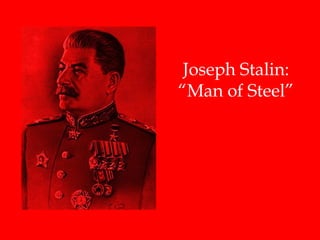
Joseph Stalin: “Man of Steel”
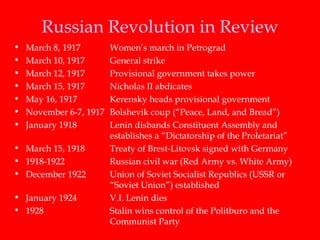
Russian Revolution in Review March 8, 1917 Women’s march in Petrograd March 10, 1917 General strike March 12, 1917 Provisional government takes power March 15, 1917 Nicholas II abdicates May 16, 1917 Kerensky heads provisional government November 6-7, 1917 Bolshevik coup (“Peace, Land, and Bread”) January 1918  Lenin disbands Constituent Assembly and  establishes a “Dictatorship of the Proletariat” March 15, 1918 Treaty of Brest-Litovsk signed with Germany 1918-1922 Russian civil war (Red Army vs. White Army) December 1922 Union of Soviet Socialist Republics (USSR or  “Soviet Union”) established January 1924  V.I. Lenin dies 1928 Stalin wins control of the Politburo and the  Communist Party
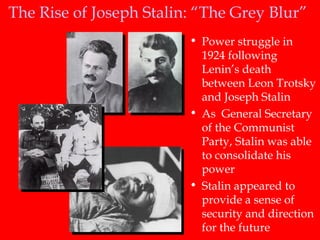
Within the party not considered as a great thinker, writer, or effective public speaker Often described as cold, hard, and impersonal, a “grey blur” Played only a small role in the Russian Revolution of 1917 The Rise of Joseph Stalin: “The Grey Blur”
Power struggle in 1924 following Lenin’s death between Leon Trotsky and Joseph Stalin As  General Secretary of the Communist Party, Stalin was able to consolidate his power Stalin appeared to provide a sense of security and direction for the future The Rise of Joseph Stalin: “The Grey Blur”
“ Socialism in One Country” Stalin argued for a position that came to be called “socialism in one country” Without abandoning the global revolutionary vision of Lenin, Stalin insisted that world revolution was out of the question for present Their duty was to create a strong socialist state, capable of defending itself against counterrevolutionaries
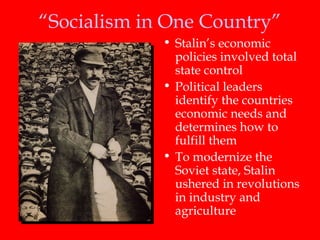
“ Socialism in One Country” Stalin’s economic policies involved total state control Political leaders identify the countries economic needs and determines how to fulfill them To modernize the Soviet state, Stalin ushered in revolutions in industry and agriculture
“ Socialism in One Country” “ We are  fifty or a hundred years behind the advanced countries. We must make good this distance in ten years. Either we do it or we shall be crushed” – Stalin
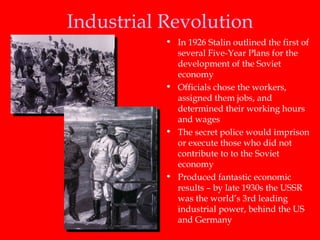
Industrial Revolution In 1926 Stalin outlined the first of several Five-Year Plans for the development of the Soviet economy Officials chose the workers, assigned them jobs, and determined their working hours and wages The secret police would imprison or execute those who did not contribute to to the Soviet economy Produced fantastic economic results – by late 1930s the USSR  was the world’s 3rd leading industrial power, behind the US and Germany
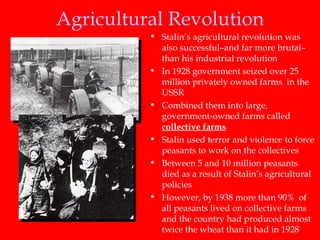
Agricultural Revolution Stalin’s agricultural revolution was also successful–and far more brutal–than his industrial revolution In 1928 government seized over 25 million privately owned farms  in the USSR Combined them into large, government-owned farms called  collective farms Stalin used terror and violence to force peasants to work on the collectives Between 5 and 10 million peasants died as a result of Stalin’s agricultural policies However, by 1938 more than 90%  of all peasants lived on collective farms and the country had produced almost twice the wheat than it had in 1928
The Purges 1936-38 14 of 16 Army Commanders 60 of 67 Corps Commanders 3 of 5 Marshalls 8 of 8 Admirals 9 of 11 Cabinet Ministers 27 top drafters of Constitution 75 of 80 members of Supreme Military Council The Terror
A worker who bungled a job, such as allowing a faulty transmission to pass through an assembly line was considered to have wrecked “socialist property.”  This was considered sabotage and punishable by death. 5 years forced labor was considered a light sentence: What is your sentence? 25 years For what? nothing You’re lying—in our country for nothing they only give you 5 years! Poetess Tanya Khodekevich was sentenced to 10 years for writing, “you can pray freely, but just so only God can hear”  The Terror
Indoctrination and Propaganda Despite having millions of Russians killed, Stalin tried to create a myth that he was the country’s father and savior Stalin relied on  indoctrination  = instruction in the government’s set or beliefs–to mold people’s minds and  propaganda  = biased or incomplete information used to sway people to accept certain beliefs or actions Soviet newspapers, radio broadcasts, and art (socialist realism) used to praise Stalin, Soviet life, and Communist values Stalin also falsified history itself through censorship and manipulation of photos and video to project a positive image of himself and the nation
Indoctrination and Propaganda
Indoctrination and Propaganda Four... Three... Two... One...
Indoctrination and Propaganda
Indoctrination and Propaganda Potsdam Conference before... and after... Time’s “Man of the Year”
Reaction to “The Great Terror” Soviet composer Dmitri Shostakovich (1906-1975) Both as a composer and a human being felt very  keenly the painful moral and artistic dilemmas of living and working in a totalitarian state Used six of his symphonies–the sixth through the ninth to express his dissatisfaction with the regime, his sense of individual and aesthetic entrapment, and his sympathy for the millions of men and women repressed by the state In  Shostakovich’s own works, these symphonies are “tombstones for the victims of Stalin”
Full Circle... Stalin dies of a massive stroke March 6, 1953 Many greeted his death with tears and foreboding, having known nothing but his all-encompassing leadership for 35 years Nikiita Kruschchev takes control of the Party and USSR “ All of us around Stalin were temporary people” Early in 1956 Khruschev delivers a lengthy speech at the 20th Party Congress in which he severely criticized Stalin for developing a “cult of personality”
Full Circle...
Full Circle... Stalin dies in 1953 “ Destalinization” of the USSR under Kruschev

Stalin Presentation

  • 1.
  • 2.
    Russian Revolution inReview March 8, 1917 Women’s march in Petrograd March 10, 1917 General strike March 12, 1917 Provisional government takes power March 15, 1917 Nicholas II abdicates May 16, 1917 Kerensky heads provisional government November 6-7, 1917 Bolshevik coup (“Peace, Land, and Bread”) January 1918 Lenin disbands Constituent Assembly and establishes a “Dictatorship of the Proletariat” March 15, 1918 Treaty of Brest-Litovsk signed with Germany 1918-1922 Russian civil war (Red Army vs. White Army) December 1922 Union of Soviet Socialist Republics (USSR or “Soviet Union”) established January 1924 V.I. Lenin dies 1928 Stalin wins control of the Politburo and the Communist Party
  • 3.
    Within the partynot considered as a great thinker, writer, or effective public speaker Often described as cold, hard, and impersonal, a “grey blur” Played only a small role in the Russian Revolution of 1917 The Rise of Joseph Stalin: “The Grey Blur”
  • 4.
    Power struggle in1924 following Lenin’s death between Leon Trotsky and Joseph Stalin As General Secretary of the Communist Party, Stalin was able to consolidate his power Stalin appeared to provide a sense of security and direction for the future The Rise of Joseph Stalin: “The Grey Blur”
  • 5.
    “ Socialism inOne Country” Stalin argued for a position that came to be called “socialism in one country” Without abandoning the global revolutionary vision of Lenin, Stalin insisted that world revolution was out of the question for present Their duty was to create a strong socialist state, capable of defending itself against counterrevolutionaries
  • 6.
    “ Socialism inOne Country” Stalin’s economic policies involved total state control Political leaders identify the countries economic needs and determines how to fulfill them To modernize the Soviet state, Stalin ushered in revolutions in industry and agriculture
  • 7.
    “ Socialism inOne Country” “ We are fifty or a hundred years behind the advanced countries. We must make good this distance in ten years. Either we do it or we shall be crushed” – Stalin
  • 8.
    Industrial Revolution In1926 Stalin outlined the first of several Five-Year Plans for the development of the Soviet economy Officials chose the workers, assigned them jobs, and determined their working hours and wages The secret police would imprison or execute those who did not contribute to to the Soviet economy Produced fantastic economic results – by late 1930s the USSR was the world’s 3rd leading industrial power, behind the US and Germany
  • 9.
    Agricultural Revolution Stalin’sagricultural revolution was also successful–and far more brutal–than his industrial revolution In 1928 government seized over 25 million privately owned farms in the USSR Combined them into large, government-owned farms called collective farms Stalin used terror and violence to force peasants to work on the collectives Between 5 and 10 million peasants died as a result of Stalin’s agricultural policies However, by 1938 more than 90% of all peasants lived on collective farms and the country had produced almost twice the wheat than it had in 1928
  • 10.
    The Purges 1936-3814 of 16 Army Commanders 60 of 67 Corps Commanders 3 of 5 Marshalls 8 of 8 Admirals 9 of 11 Cabinet Ministers 27 top drafters of Constitution 75 of 80 members of Supreme Military Council The Terror
  • 11.
    A worker whobungled a job, such as allowing a faulty transmission to pass through an assembly line was considered to have wrecked “socialist property.” This was considered sabotage and punishable by death. 5 years forced labor was considered a light sentence: What is your sentence? 25 years For what? nothing You’re lying—in our country for nothing they only give you 5 years! Poetess Tanya Khodekevich was sentenced to 10 years for writing, “you can pray freely, but just so only God can hear” The Terror
  • 12.
    Indoctrination and PropagandaDespite having millions of Russians killed, Stalin tried to create a myth that he was the country’s father and savior Stalin relied on indoctrination = instruction in the government’s set or beliefs–to mold people’s minds and propaganda = biased or incomplete information used to sway people to accept certain beliefs or actions Soviet newspapers, radio broadcasts, and art (socialist realism) used to praise Stalin, Soviet life, and Communist values Stalin also falsified history itself through censorship and manipulation of photos and video to project a positive image of himself and the nation
  • 13.
  • 14.
  • 15.
    Indoctrination and PropagandaFour... Three... Two... One...
  • 16.
  • 17.
    Indoctrination and PropagandaPotsdam Conference before... and after... Time’s “Man of the Year”
  • 18.
    Reaction to “TheGreat Terror” Soviet composer Dmitri Shostakovich (1906-1975) Both as a composer and a human being felt very keenly the painful moral and artistic dilemmas of living and working in a totalitarian state Used six of his symphonies–the sixth through the ninth to express his dissatisfaction with the regime, his sense of individual and aesthetic entrapment, and his sympathy for the millions of men and women repressed by the state In Shostakovich’s own works, these symphonies are “tombstones for the victims of Stalin”
  • 19.
    Full Circle... Stalindies of a massive stroke March 6, 1953 Many greeted his death with tears and foreboding, having known nothing but his all-encompassing leadership for 35 years Nikiita Kruschchev takes control of the Party and USSR “ All of us around Stalin were temporary people” Early in 1956 Khruschev delivers a lengthy speech at the 20th Party Congress in which he severely criticized Stalin for developing a “cult of personality”
  • 20.
  • 21.
    Full Circle... Stalindies in 1953 “ Destalinization” of the USSR under Kruschev