Classical India AP World History
The Indian Subcontinent India has three topographical zones: Northern mountainous zone Indus and Ganges Basins The peninsula - divided into another four sub-regions What do you think was the political impact of this geography diversity?
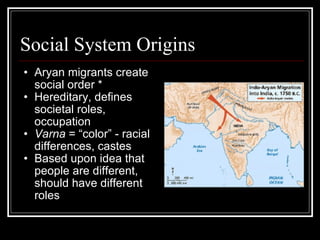
Social System Origins Aryan migrants create social order * Hereditary, defines societal roles, occupation Varna  = “color” - racial differences, castes Based upon idea that people are different, should have different roles
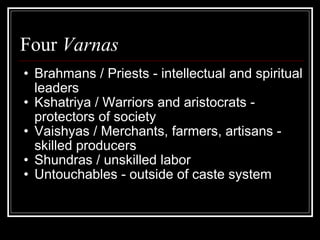
Four  Varnas Brahmans / Priests - intellectual and spiritual leaders Kshatriya / Warriors and aristocrats - protectors of society Vaishyas / Merchants, farmers, artisans - skilled producers Shundras / unskilled labor Untouchables - outside of caste system
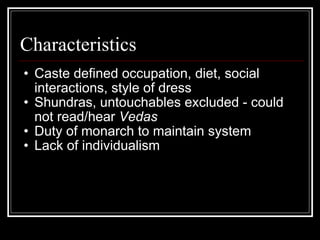
Characteristics Caste defined occupation, diet, social interactions, style of dress Shundras, untouchables excluded - could not read/hear  Vedas Duty of monarch to maintain system Lack of individualism
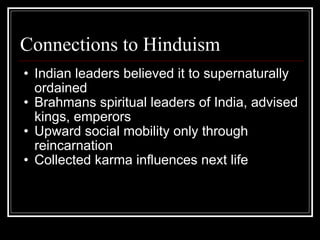
Connections to Hinduism Indian leaders believed it to supernaturally ordained Brahmans spiritual leaders of India, advised kings, emperors Upward social mobility only through reincarnation Collected karma influences next life
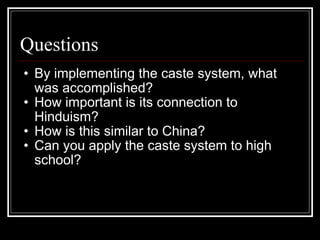
Questions By implementing the caste system, what was accomplished? How important is its connection to Hinduism? How is this similar to China?  Can you apply the caste system to high school?
Historical Patterns in India Culture: Caste system / Hinduism preserves social system across history Economics: Trade becomes a constant - part of Silk Roads, Indian Ocean Network, and more Politics: India goes eras of invasion and conquest by foreigners, large empires then falls into regional kingdoms 
Mauryan Empire 324 BCE - 184 BCE Early outside influences Achaemenid province in N. India (520 BCE) - brought gov't style Alexander Invades in 327 BCE - destroyed all regional kingdomsm Kingdom of Magahad expands under Chandragupta ( video clip )
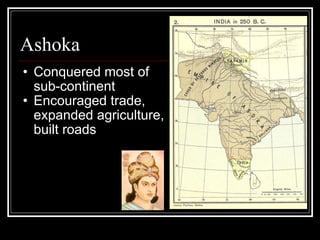
Ashoka Conquered most of sub-continent Encouraged trade, expanded agriculture, built roads
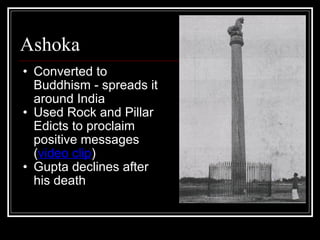
Ashoka Converted to Buddhism - spreads it around India Used Rock and Pillar Edicts to proclaim positive messages ( video clip )  Gupta declines after his death
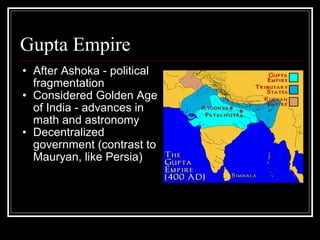
Gupta Empire After Ashoka - political fragmentation  Considered Golden Age of India - advances in math and astronomy Decentralized government (contrast to Mauryan, like Persia)
Hindu Revival - Gupta Decline of Mauryan Empire = decline of Buddhism in India Brahmans make it more appealing to common people Stressed importance of personal worship, devotion to individual gods Karma acquired by completion of caste duties / obligations
Hindu Revival - Gupta Supported Hinduism - restored Brahmans in gov’t Extensive building of temples Caste system reasserted / solidified into Indian culture - more rigid Expanded with new  Jatis Further restrictions put on Untouchables
Questions Why do you think modern day India has such a difficult time eliminating the caste system to day? Some Hindu scholars argue that the caste system actually contradicts Hinduism, what is your reaction? In the end, what single factor allowed Hinduism to flourish and Buddhism decline?

Classical India

  • 1.
    Classical India APWorld History
  • 2.
    The Indian SubcontinentIndia has three topographical zones: Northern mountainous zone Indus and Ganges Basins The peninsula - divided into another four sub-regions What do you think was the political impact of this geography diversity?
  • 3.
    Social System OriginsAryan migrants create social order * Hereditary, defines societal roles, occupation Varna = “color” - racial differences, castes Based upon idea that people are different, should have different roles
  • 4.
    Four VarnasBrahmans / Priests - intellectual and spiritual leaders Kshatriya / Warriors and aristocrats - protectors of society Vaishyas / Merchants, farmers, artisans - skilled producers Shundras / unskilled labor Untouchables - outside of caste system
  • 5.
    Characteristics Caste definedoccupation, diet, social interactions, style of dress Shundras, untouchables excluded - could not read/hear Vedas Duty of monarch to maintain system Lack of individualism
  • 6.
    Connections to HinduismIndian leaders believed it to supernaturally ordained Brahmans spiritual leaders of India, advised kings, emperors Upward social mobility only through reincarnation Collected karma influences next life
  • 7.
    Questions By implementingthe caste system, what was accomplished? How important is its connection to Hinduism? How is this similar to China? Can you apply the caste system to high school?
  • 8.
    Historical Patterns inIndia Culture: Caste system / Hinduism preserves social system across history Economics: Trade becomes a constant - part of Silk Roads, Indian Ocean Network, and more Politics: India goes eras of invasion and conquest by foreigners, large empires then falls into regional kingdoms 
  • 9.
    Mauryan Empire 324BCE - 184 BCE Early outside influences Achaemenid province in N. India (520 BCE) - brought gov't style Alexander Invades in 327 BCE - destroyed all regional kingdomsm Kingdom of Magahad expands under Chandragupta ( video clip )
  • 10.
    Ashoka Conquered mostof sub-continent Encouraged trade, expanded agriculture, built roads
  • 11.
    Ashoka Converted toBuddhism - spreads it around India Used Rock and Pillar Edicts to proclaim positive messages ( video clip )  Gupta declines after his death
  • 12.
    Gupta Empire AfterAshoka - political fragmentation  Considered Golden Age of India - advances in math and astronomy Decentralized government (contrast to Mauryan, like Persia)
  • 13.
    Hindu Revival -Gupta Decline of Mauryan Empire = decline of Buddhism in India Brahmans make it more appealing to common people Stressed importance of personal worship, devotion to individual gods Karma acquired by completion of caste duties / obligations
  • 14.
    Hindu Revival -Gupta Supported Hinduism - restored Brahmans in gov’t Extensive building of temples Caste system reasserted / solidified into Indian culture - more rigid Expanded with new Jatis Further restrictions put on Untouchables
  • 15.
    Questions Why doyou think modern day India has such a difficult time eliminating the caste system to day? Some Hindu scholars argue that the caste system actually contradicts Hinduism, what is your reaction? In the end, what single factor allowed Hinduism to flourish and Buddhism decline?

Editor's Notes

  • #13 God required constant attention five sacrifices a day for each household - conducted by a Brahman People became disillusioned with rituals, including Brahman Last Islam and, to a lesser degree, Christianity will have limited success in India? Why? When Buddhism did so well.
  • #14 Devotional cults open to all castes Created more “milestone” rituals Over time Buddha worshipped as a worldly form of Vishnu Salvation attainable by all Bhagavad Gita - Poem that represented new ethical teachings - individuals could escape cycle of reincarnation (the ultimate reality or moksha)
  • #15 Restrictions include: couldn’t worship with other castes, walk on road with merchants or Brahmans, could use only own wells.