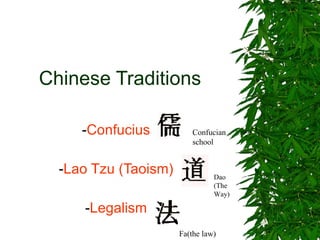
Chinese Traditions - Confucius - Lao Tzu (Taoism) - Legalism Fa(the law) Confucian school Dao (The Way)
Setting the Stage… Imagine that you live in a society that: Believes your leader rules with the blessing of Heaven Pays taxes to a leader who works to ensure that the food supply will be there for the country Has learned how to make levees and canals to control mighty rivers Uses bronze and iron tools and weapons Has built incredible cities with massive walls Participates in international trade Offers many different kinds of jobs to people Most likely makes you a peasant or farmer
Setting the Stage… Then, one day, all stability and order as you knew is was gone: You are living in near-anarchy.  Any group of soldiers can come and take all that you have with no consequence. There are six major groups who want to control your land, and five of them are “outsiders” to you.
What Would You Do? What things would you worry about the most? What existing beliefs do you already have? What would you want to see in a new leader? What would you really need to have in the meantime?
China and the Period of the Warring States 403-221 BCE Final Collapse of the Zhou Dynasty  relatively decentralized government relied on local kings to carry out edicts Had strong military, but did not monopolize metal weaponry like Shang Led to tremendous fighting between 6 regional kingdoms for dominance China had previously had imperial dynasties of some sort since about 2200 BCE
3 Major Schools of Thought Fighting and instability is bad for peasants Conscripted to fight, land/crops/labor commandeered by occupying armies Had to effectively “Make Own Way” to survive Three schools of thought emerge: Focus on nature of human beings and the universe Concerned with  immediate world  and  how to create stability Practicality is the key to these philosophies!
Build Off of Existing Cultural Elements: Patriarchal Society Family is  extremely  important Will only prosper if ALL (living and dead) work together Established Class System: Landed Elite Merchants & Traders Peasants Slaves
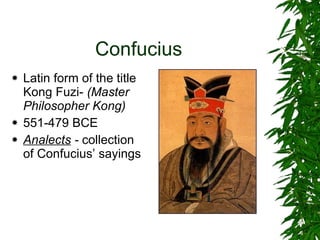
Confucius Latin form of the title Kong Fuzi-  (Master Philosopher Kong) 551-479 BCE Analects  -  collection of Confucius’ sayings
To Fix China, Be  Junzi! Junzi:  “superior individuals” look at the big picture, don’t let personal interests influence judgement  To be  Junzi , you must possess: Ren :  kindness and benevolence for others (especially important that leaders have this) Li :  Treat all with courtesy and respect, (esp.  elders  and  superiors ) Xiao :  Filial piety (family respect):  Useless to speculate on spiritual questions:  BE PRACTICAL to fix China!
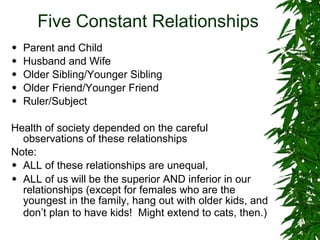
Five Constant Relationships Parent and Child Husband and Wife Older Sibling/Younger Sibling Older Friend/Younger Friend Ruler/Subject Health of society depended on the careful observations of these relationships Note:  ALL of these relationships are unequal,  ALL of us will be the superior AND inferior in our relationships (except for females who are the youngest in the family, hang out with older kids, and don’t plan to have kids!  Might extend to cats, then.)
Each person in relationship had duty to others Parents should be loving Children should revere their parents Husbands should be good, and wives obedient Elder sibling should be kind and the youngest respectful -  Rulers should be benevolent, and subjects loyal We should not be too familiar with the lower orders or with women. Woman’s virginity and chastity are more important than her life.
Significant teachings Government should NOT be limited solely to those of noble birth but should be open to all men of superior talent Concept of  rule on merit All should be  educated  and this shall determine position in society Not popular with the nobles so Confucius was not too popular while he was alive
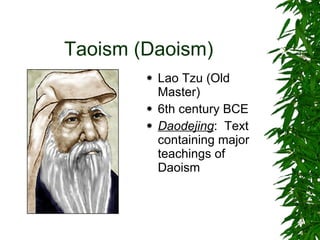
Taoism (Daoism) Lao Tzu (Old Master) 6th century BCE Daodejing :  Text containing major teachings of Daoism
What is  Dao ? Dao  = “the way,” “the way of nature” “ It’s what it’s not that makes it what it is” Dao is like the cavity of a pot:  this empty space makes the pot useful for cooking Dao is like water:  it runs through your hands in the sink, but can wash away mountains and cities Goal, then, is to live in harmony with the universe.  To do this, one must observe…
Wuwei Live simply, unpretentiously, and in harmony with nature. Ambition and activism have caused chaos in which we live Government should be as small as possible Abstain from advanced education and personal striving No countries - just small, self-sufficient communities! Reflect and think about how wonderful the Dao is
Confucianism vs. Daoism In A Nutshell Followers of Confucius believe that it is the duty of human beings to work hard to improve life on earth Daoists believe that the true way to follow the will of heaven is not action, but inaction. What do you think is most helpful?
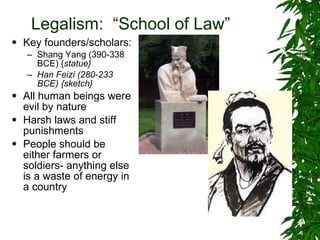
Legalism:  “School of Law” Key founders/scholars: Shang Yang (390-338 BCE) { statue} Han Feizi (280-233 BCE) {sketch} All human beings were evil by nature Harsh laws and stiff punishments People should be either farmers or soldiers- anything else is a waste of energy in a country
“ School of Law” Rejected Confucian view that government by “superior men” could solve society’s problems.  Instead, they argued for a system of impersonal laws.
Law and rules will allow societies to function Only strong ruler could create an orderly society Junzi  was touchy-feely mumbo-jumbo Harsh punishments for small offenses = discouragement for considering “bigger offenses”  (Fine for littering:  Amputation of hands or feet) Did not garner long-lasting support, relatively unpopular

Chinese Traditions

  • 1.
    Chinese Traditions -Confucius - Lao Tzu (Taoism) - Legalism Fa(the law) Confucian school Dao (The Way)
  • 2.
    Setting the Stage…Imagine that you live in a society that: Believes your leader rules with the blessing of Heaven Pays taxes to a leader who works to ensure that the food supply will be there for the country Has learned how to make levees and canals to control mighty rivers Uses bronze and iron tools and weapons Has built incredible cities with massive walls Participates in international trade Offers many different kinds of jobs to people Most likely makes you a peasant or farmer
  • 3.
    Setting the Stage…Then, one day, all stability and order as you knew is was gone: You are living in near-anarchy. Any group of soldiers can come and take all that you have with no consequence. There are six major groups who want to control your land, and five of them are “outsiders” to you.
  • 4.
    What Would YouDo? What things would you worry about the most? What existing beliefs do you already have? What would you want to see in a new leader? What would you really need to have in the meantime?
  • 5.
    China and thePeriod of the Warring States 403-221 BCE Final Collapse of the Zhou Dynasty relatively decentralized government relied on local kings to carry out edicts Had strong military, but did not monopolize metal weaponry like Shang Led to tremendous fighting between 6 regional kingdoms for dominance China had previously had imperial dynasties of some sort since about 2200 BCE
  • 6.
    3 Major Schoolsof Thought Fighting and instability is bad for peasants Conscripted to fight, land/crops/labor commandeered by occupying armies Had to effectively “Make Own Way” to survive Three schools of thought emerge: Focus on nature of human beings and the universe Concerned with immediate world and how to create stability Practicality is the key to these philosophies!
  • 7.
    Build Off ofExisting Cultural Elements: Patriarchal Society Family is extremely important Will only prosper if ALL (living and dead) work together Established Class System: Landed Elite Merchants & Traders Peasants Slaves
  • 8.
    Confucius Latin formof the title Kong Fuzi- (Master Philosopher Kong) 551-479 BCE Analects - collection of Confucius’ sayings
  • 9.
    To Fix China,Be Junzi! Junzi: “superior individuals” look at the big picture, don’t let personal interests influence judgement To be Junzi , you must possess: Ren : kindness and benevolence for others (especially important that leaders have this) Li : Treat all with courtesy and respect, (esp. elders and superiors ) Xiao : Filial piety (family respect): Useless to speculate on spiritual questions: BE PRACTICAL to fix China!
  • 10.
    Five Constant RelationshipsParent and Child Husband and Wife Older Sibling/Younger Sibling Older Friend/Younger Friend Ruler/Subject Health of society depended on the careful observations of these relationships Note: ALL of these relationships are unequal, ALL of us will be the superior AND inferior in our relationships (except for females who are the youngest in the family, hang out with older kids, and don’t plan to have kids! Might extend to cats, then.)
  • 11.
    Each person inrelationship had duty to others Parents should be loving Children should revere their parents Husbands should be good, and wives obedient Elder sibling should be kind and the youngest respectful - Rulers should be benevolent, and subjects loyal We should not be too familiar with the lower orders or with women. Woman’s virginity and chastity are more important than her life.
  • 12.
    Significant teachings Governmentshould NOT be limited solely to those of noble birth but should be open to all men of superior talent Concept of rule on merit All should be educated and this shall determine position in society Not popular with the nobles so Confucius was not too popular while he was alive
  • 13.
    Taoism (Daoism) LaoTzu (Old Master) 6th century BCE Daodejing : Text containing major teachings of Daoism
  • 14.
    What is Dao ? Dao = “the way,” “the way of nature” “ It’s what it’s not that makes it what it is” Dao is like the cavity of a pot: this empty space makes the pot useful for cooking Dao is like water: it runs through your hands in the sink, but can wash away mountains and cities Goal, then, is to live in harmony with the universe. To do this, one must observe…
  • 15.
    Wuwei Live simply,unpretentiously, and in harmony with nature. Ambition and activism have caused chaos in which we live Government should be as small as possible Abstain from advanced education and personal striving No countries - just small, self-sufficient communities! Reflect and think about how wonderful the Dao is
  • 16.
    Confucianism vs. DaoismIn A Nutshell Followers of Confucius believe that it is the duty of human beings to work hard to improve life on earth Daoists believe that the true way to follow the will of heaven is not action, but inaction. What do you think is most helpful?
  • 17.
    Legalism: “Schoolof Law” Key founders/scholars: Shang Yang (390-338 BCE) { statue} Han Feizi (280-233 BCE) {sketch} All human beings were evil by nature Harsh laws and stiff punishments People should be either farmers or soldiers- anything else is a waste of energy in a country
  • 18.
    “ School ofLaw” Rejected Confucian view that government by “superior men” could solve society’s problems. Instead, they argued for a system of impersonal laws.
  • 19.
    Law and ruleswill allow societies to function Only strong ruler could create an orderly society Junzi was touchy-feely mumbo-jumbo Harsh punishments for small offenses = discouragement for considering “bigger offenses” (Fine for littering: Amputation of hands or feet) Did not garner long-lasting support, relatively unpopular