Communication Skills:
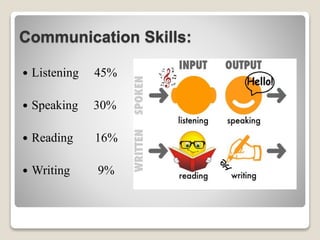
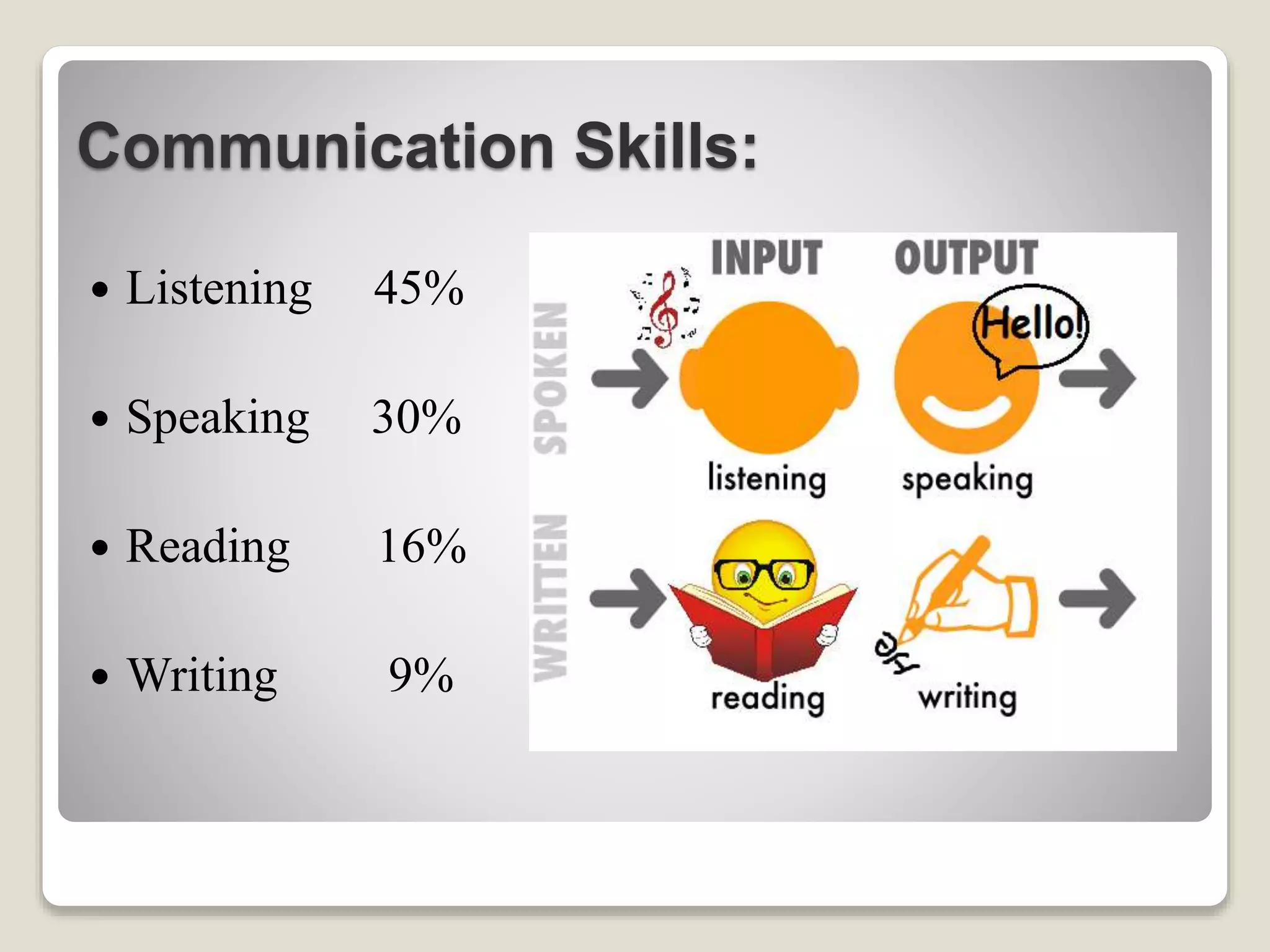
 Listening 45%
 Speaking 30%
 Reading 16%
 Writing 9%
Listening Skills
Target Skill: Listening.
Material Required: Paper balls, Basket.
Time Required: 5-7 minutes.
Participants: Whole class.
Target age group: Middle School.
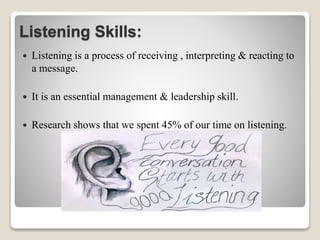
Listening Skills:
 Listening is a process of receiving , interpreting & reacting to
a message.
 It is an essential management & leadership skill.
 Research shows that we spent 45% of our time on listening.
How to improve..?
 Listen actively.
 Listen without distraction.
 Listen with intent to learn.
 Ask questions during an appropriate pause.
 Pick up key points.
 Give the speaker regular feedback.
 Wait for the speaker to pause to ask clarifying questions.
 Be open minded.
 Avoid trying to offer an immediate solution.
Activity…
Rules:
1. Throw the ball in the basket immediately after the question
is asked.
2. Total points for each correct answer are 5.
3. If a ball falls outside the basket then sorry you cannot
answer the question.
4. If you have successfully thrown the ball in the basket
however you are unable to answer the question you will lose
2 points.
5. You will lose 1 point for each wrong answer.
Good luck!
Questions:
1) The hamburger comes from _______.
a. France
b. Germany
c. America
d. Italy
2) In 19th century a lot of immigrants went to
____ from Hamburg.
a. Spain
b. India
c. Moscow
d. USA
3) It was a long journey by ____.
a. plane
b. car
c. ship
d. train
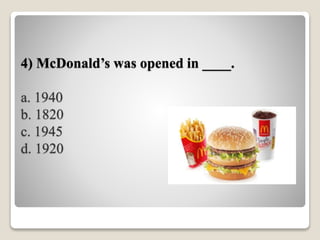
4) McDonald’s was opened in ____.
a. 1940
b. 1820
c. 1945
d. 1920
5) People are eating hamburgers in over ___
countries around the world.
a. 100
b. 16
c. 40
d. 52
6) Hamburger was named after a German
town Hamburg.
a. True
b. False
7) “White Castle” was opened in 1900.
a. True
b. False
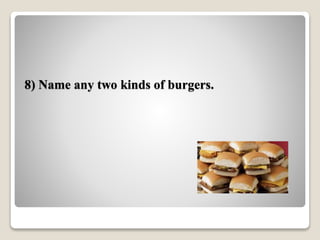
8) Name any two kinds of burgers.
Speaking Skills
Target Skill: Speaking.
Time Required: 10-15 minutes.
Participants: Whole class.
Target age group: Middle School.
What is Speaking?
 Conveying information verbally.
 Expression of thoughts.
 Expression of feelings.
 Expression of emotions.
Speaking Skills
Ability to
• convey one’s message , verbally, in a proper and suitable
manner.
• express oneself clearly in front of others.
• give one’s opinion in different matters.
Effective Speaking Skills
 Speak clearly.
 Speak to listener.
 Use a friendly tone.
 Use standard English.
 Talk “with” listener, instead, of “at” listener
Tips for enhancing Speaking
• Tips for sounding like Native speaker.
• Let me start with this word: “pronunciation”
• Its Pro-nun-c-ation
• Pronoun is ‘I, He, She, They etc.
• Pronunciation is how we speak English.
Cont.…
1) Connecting words.
i) consonants to Consonants
ii) consonants to vowels.
Cont.…
2) Squeeze words.
3) Squeeze alphabets.
Activities
Activity 1
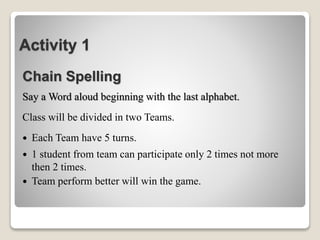
Chain Spelling
Say a Word aloud beginning with the last alphabet.
Class will be divided in two Teams.
 Each Team have 5 turns.
 1 student from team can participate only 2 times not more
then 2 times.
 Team perform better will win the game.
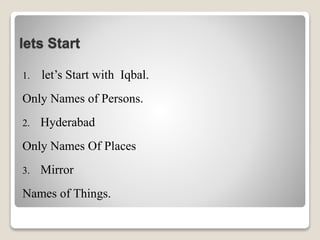
lets Start
1. let’s Start with Iqbal.
Only Names of Persons.
2. Hyderabad
Only Names Of Places
3. Mirror
Names of Things.
Activity 2
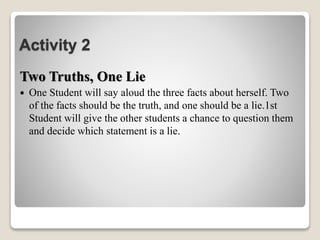
Two Truths, One Lie
 One Student will say aloud the three facts about herself. Two
of the facts should be the truth, and one should be a lie.1st
Student will give the other students a chance to question them
and decide which statement is a lie.
Reading Skills
What is reading
 Reading is the most important skill in English language from
other language skills in acquiring language.
 if students are good in reading, they will be good in other
language skills (writing, speaking, and listening).
 For this reason teachers of English language should focus on
this skill
Objectives
 To develop the skill to scan for specific information.
 To test the students' ability to comprehend.
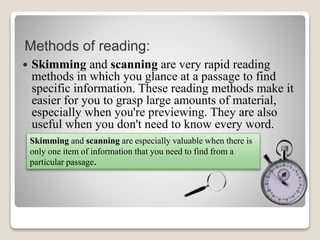
Methods of reading:
 Skimming and scanning are very rapid reading
methods in which you glance at a passage to find
specific information. These reading methods make it
easier for you to grasp large amounts of material,
especially when you're previewing. They are also
useful when you don't need to know every word.
Skimming and scanning are especially valuable when there is
only one item of information that you need to find from a
particular passage.
Read the text thoroughly.
Then four words will be displayed to you
and you will guess which was present in
the text
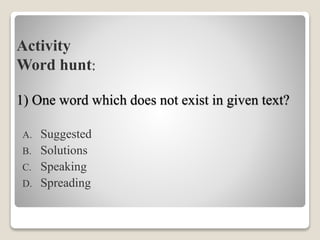
Activity
Word hunt:
1) One word which does not exist in given text?
A. Suggested
B. Solutions
C. Speaking
D. Spreading
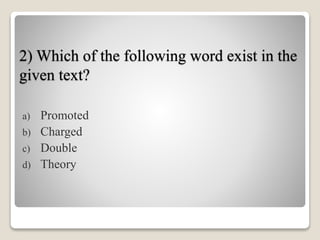
2) Which of the following word exist in the
given text?
a) Promoted
b) Charged
c) Double
d) Theory
3) Find the word case study and tell in which
paragraph it is written
A. 1st paragraph
B. 2nd paragraph
C. 3rd paragraph
D. Does not exist in any paragraph
Which of the word from the text do you
think suites as the title of the text?
Writing Skills
Introduction:
 Writing skills are an important part of
communication.
 Good writing skills allow you to communicate your
message with clarity and ease.
 The communication takes place to a far larger
audience than through face-to-face or telephone
conversations.
Audience & Format:
 The first step to writing is choosing the appropriate
format.
 The format, as well as the audience, defines the
writing voice i.e., how formal or relaxed the tone
should be.
 With everything one writes, the readers/ recipients,
should be able to define the tone as well as aspects of
the content.
Composition & Style:
 Start with your audience: The reader should be
introduced with the subject.
 Create an outline: Outlines help in identifying
which steps to take in which order.
 Use AIDA: Follow the Attention-Interest-Desire-
Action (AIDA) formula. These steps can help in the
writing process.
Structure:
 The document should be as reader friendly as
possible
 Use headings, subheadings, bullet points, and
numbering whenever possible to break up the text.
 Adding graphs and charts is also a smart way to
break up your text.
 Using questions is a good idea, questions help keep
the reader engaged and curious.
Grammatical Errors:
 It's essential to learn grammar properly, and to avoid
common mistakes that the spell checker won't find.
 Using words like “affect” instead of “effect” or
missing out the apostrophe should be avoided.
 Everything that one writes should be of a quality that
every reader will find acceptable.
Conclusion:
• It's important to know how to communicate a point quickly and
professionally.
• Identify the audience before even starting to create the document.
 If one feels that there's too much information to include, an outline
should be created to outline the thoughts.
 Learning grammatical and stylistic techniques will also help in
writing more clearly.
 Lastly, one should be sure to proof read the document before
sending it.
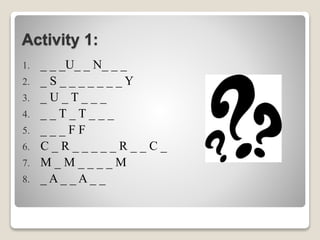
Activity 1:
1. _ _ _U_ _ N_ _ _
2. _ S _ _ _ _ _ _ _ Y
3. _ U _ T _ _ _
4. _ _ T _ T _ _ _
5. _ _ _ F F
6. C _ R _ _ _ _ _ R _ _ C _
7. M _ M _ _ _ _ M
8. _ A _ _ A _ _
Answers:
1. Lieutenant
2. Psychology
3. Tuition
4. Aptitude
5. Bluff
6. Circumference
7. Momentum
8. Narrate
Activity 2
Developing Definition
Develop and write the definition of following terms in 1
line.
1. Democracy
2. Library
3. University
Communication Skills

Communication Skills

  • 1.
    Communication Skills:  Listening45%  Speaking 30%  Reading 16%  Writing 9%
  • 2.
  • 3.
    Target Skill: Listening. MaterialRequired: Paper balls, Basket. Time Required: 5-7 minutes. Participants: Whole class. Target age group: Middle School.
  • 4.
    Listening Skills:  Listeningis a process of receiving , interpreting & reacting to a message.  It is an essential management & leadership skill.  Research shows that we spent 45% of our time on listening.
  • 5.
    How to improve..? Listen actively.  Listen without distraction.  Listen with intent to learn.  Ask questions during an appropriate pause.  Pick up key points.  Give the speaker regular feedback.  Wait for the speaker to pause to ask clarifying questions.  Be open minded.  Avoid trying to offer an immediate solution.
  • 6.
  • 7.
    Rules: 1. Throw theball in the basket immediately after the question is asked. 2. Total points for each correct answer are 5. 3. If a ball falls outside the basket then sorry you cannot answer the question. 4. If you have successfully thrown the ball in the basket however you are unable to answer the question you will lose 2 points. 5. You will lose 1 point for each wrong answer. Good luck!
  • 8.
    Questions: 1) The hamburgercomes from _______. a. France b. Germany c. America d. Italy
  • 9.
    2) In 19thcentury a lot of immigrants went to ____ from Hamburg. a. Spain b. India c. Moscow d. USA
  • 10.
    3) It wasa long journey by ____. a. plane b. car c. ship d. train
  • 11.
    4) McDonald’s wasopened in ____. a. 1940 b. 1820 c. 1945 d. 1920
  • 12.
    5) People areeating hamburgers in over ___ countries around the world. a. 100 b. 16 c. 40 d. 52
  • 13.
    6) Hamburger wasnamed after a German town Hamburg. a. True b. False
  • 14.
    7) “White Castle”was opened in 1900. a. True b. False
  • 15.
    8) Name anytwo kinds of burgers.
  • 16.
  • 17.
    Target Skill: Speaking. TimeRequired: 10-15 minutes. Participants: Whole class. Target age group: Middle School.
  • 18.
    What is Speaking? Conveying information verbally.  Expression of thoughts.  Expression of feelings.  Expression of emotions.
  • 19.
    Speaking Skills Ability to •convey one’s message , verbally, in a proper and suitable manner. • express oneself clearly in front of others. • give one’s opinion in different matters.
  • 20.
    Effective Speaking Skills Speak clearly.  Speak to listener.  Use a friendly tone.  Use standard English.  Talk “with” listener, instead, of “at” listener
  • 21.
    Tips for enhancingSpeaking • Tips for sounding like Native speaker. • Let me start with this word: “pronunciation” • Its Pro-nun-c-ation • Pronoun is ‘I, He, She, They etc. • Pronunciation is how we speak English.
  • 22.
    Cont.… 1) Connecting words. i)consonants to Consonants ii) consonants to vowels.
  • 23.
  • 24.
  • 25.
    Activity 1 Chain Spelling Saya Word aloud beginning with the last alphabet. Class will be divided in two Teams.  Each Team have 5 turns.  1 student from team can participate only 2 times not more then 2 times.  Team perform better will win the game.
  • 26.
    lets Start 1. let’sStart with Iqbal. Only Names of Persons. 2. Hyderabad Only Names Of Places 3. Mirror Names of Things.
  • 27.
    Activity 2 Two Truths,One Lie  One Student will say aloud the three facts about herself. Two of the facts should be the truth, and one should be a lie.1st Student will give the other students a chance to question them and decide which statement is a lie.
  • 28.
  • 29.
    What is reading Reading is the most important skill in English language from other language skills in acquiring language.  if students are good in reading, they will be good in other language skills (writing, speaking, and listening).  For this reason teachers of English language should focus on this skill
  • 30.
    Objectives  To developthe skill to scan for specific information.  To test the students' ability to comprehend.
  • 32.
    Methods of reading: Skimming and scanning are very rapid reading methods in which you glance at a passage to find specific information. These reading methods make it easier for you to grasp large amounts of material, especially when you're previewing. They are also useful when you don't need to know every word. Skimming and scanning are especially valuable when there is only one item of information that you need to find from a particular passage.
  • 33.
    Read the textthoroughly. Then four words will be displayed to you and you will guess which was present in the text
  • 34.
    Activity Word hunt: 1) Oneword which does not exist in given text? A. Suggested B. Solutions C. Speaking D. Spreading
  • 35.
    2) Which ofthe following word exist in the given text? a) Promoted b) Charged c) Double d) Theory
  • 36.
    3) Find theword case study and tell in which paragraph it is written A. 1st paragraph B. 2nd paragraph C. 3rd paragraph D. Does not exist in any paragraph
  • 37.
    Which of theword from the text do you think suites as the title of the text?
  • 38.
  • 39.
    Introduction:  Writing skillsare an important part of communication.  Good writing skills allow you to communicate your message with clarity and ease.  The communication takes place to a far larger audience than through face-to-face or telephone conversations.
  • 40.
    Audience & Format: The first step to writing is choosing the appropriate format.  The format, as well as the audience, defines the writing voice i.e., how formal or relaxed the tone should be.  With everything one writes, the readers/ recipients, should be able to define the tone as well as aspects of the content.
  • 41.
    Composition & Style: Start with your audience: The reader should be introduced with the subject.  Create an outline: Outlines help in identifying which steps to take in which order.  Use AIDA: Follow the Attention-Interest-Desire- Action (AIDA) formula. These steps can help in the writing process.
  • 42.
    Structure:  The documentshould be as reader friendly as possible  Use headings, subheadings, bullet points, and numbering whenever possible to break up the text.  Adding graphs and charts is also a smart way to break up your text.  Using questions is a good idea, questions help keep the reader engaged and curious.
  • 43.
    Grammatical Errors:  It'sessential to learn grammar properly, and to avoid common mistakes that the spell checker won't find.  Using words like “affect” instead of “effect” or missing out the apostrophe should be avoided.  Everything that one writes should be of a quality that every reader will find acceptable.
  • 44.
    Conclusion: • It's importantto know how to communicate a point quickly and professionally. • Identify the audience before even starting to create the document.  If one feels that there's too much information to include, an outline should be created to outline the thoughts.  Learning grammatical and stylistic techniques will also help in writing more clearly.  Lastly, one should be sure to proof read the document before sending it.
  • 45.
    Activity 1: 1. __ _U_ _ N_ _ _ 2. _ S _ _ _ _ _ _ _ Y 3. _ U _ T _ _ _ 4. _ _ T _ T _ _ _ 5. _ _ _ F F 6. C _ R _ _ _ _ _ R _ _ C _ 7. M _ M _ _ _ _ M 8. _ A _ _ A _ _
  • 46.
    Answers: 1. Lieutenant 2. Psychology 3.Tuition 4. Aptitude 5. Bluff 6. Circumference 7. Momentum 8. Narrate
  • 47.
    Activity 2 Developing Definition Developand write the definition of following terms in 1 line. 1. Democracy 2. Library 3. University