A Deeper Insight into the Skills Required for a
better communication
Before starting
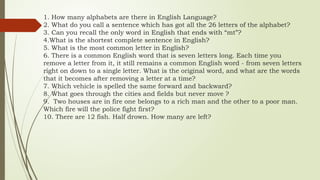
1. How many alphabets are there in English Language?
2. What do you call a sentence which has got all the 26 letters of the alphabet?
3. Can you recall the only word in English that ends with “mt”?
4.What is the shortest complete sentence in English?
5. What is the most common letter in English?
6. There is a common English word that is seven letters long. Each time you
remove a letter from it, it still remains a common English word - from seven letters
right on down to a single letter. What is the original word, and what are the words
that it becomes after removing a letter at a time?
7. Which vehicle is spelled the same forward and backward?
8. What goes through the cities and fields but never move ?
9. Two houses are in fire one belongs to a rich man and the other to a poor man.
Which fire will the police fight first?
10. There are 12 fish. Half drown. How many are left?
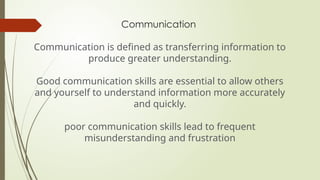
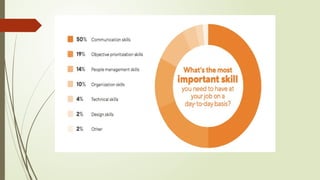
Communication
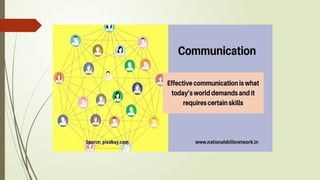
Communication is defined as transferring information to
produce greater understanding.
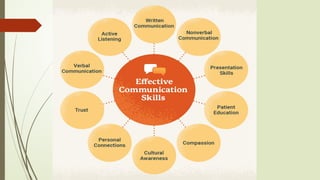
Good communication skills are essential to allow others
and yourself to understand information more accurately
and quickly.
poor communication skills lead to frequent
misunderstanding and frustration
Listening and Hearing
 The definition of hearing has more to do with the physiological act of
hearing sounds than it does with making sense and connecting with the
person who’s talking to you.
 Merriam-Webster defines hearing as the “process, function, or power of
perceiving sound; specifically: the special sense by which noises and tones
are received as stimuli.”
 Listening, on the other hand, means “to pay attention to sound; to hear
something with thoughtful attention; and to give consideration.”
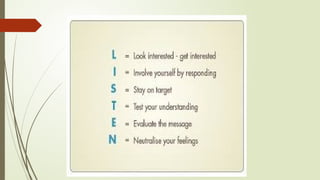
 Active Listening is a way of listening and responding to another person
that improves mutual understanding.”
To enhance listening skills:
Be curious
Ask good questions
Don’t jump into a conversation too quickly
Anchor yourself to the subject and don’t get
distracted
pay attention to the speakers body language
and make eye contact
Speaking
Speaking effectively is defined as speaking in such a way
that your message is clearly heard and, if possible, acted
upon. There are two main elements to speaking effectively:
what you say, and how you say it.
The words you choose
Your voice
Your other non-verbal communication
especially your body language
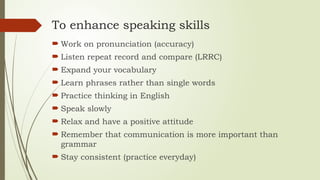
To enhance speaking skills
 Work on pronunciation (accuracy)
 Listen repeat record and compare (LRRC)
 Expand your vocabulary
 Learn phrases rather than single words
 Practice thinking in English
 Speak slowly
 Relax and have a positive attitude
 Remember that communication is more important than
grammar
 Stay consistent (practice everyday)
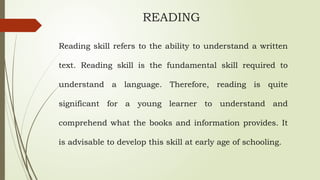
READING
Reading skill refers to the ability to understand a written
text. Reading skill is the fundamental skill required to
understand a language. Therefore, reading is quite
significant for a young learner to understand and
comprehend what the books and information provides. It
is advisable to develop this skill at early age of schooling.
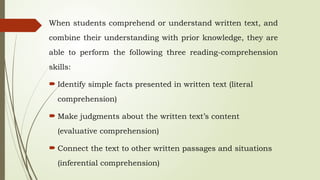
When students comprehend or understand written text, and
combine their understanding with prior knowledge, they are
able to perform the following three reading-comprehension
skills:
 Identify simple facts presented in written text (literal
comprehension)
 Make judgments about the written text’s content
(evaluative comprehension)
 Connect the text to other written passages and situations
(inferential comprehension)
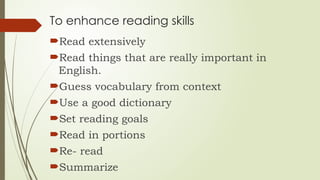
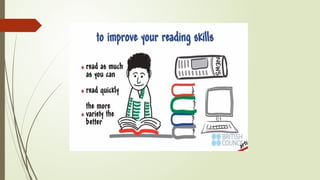
To enhance reading skills
Read extensively
Read things that are really important in
English.
Guess vocabulary from context
Use a good dictionary
Set reading goals
Read in portions
Re- read
Summarize
Writing
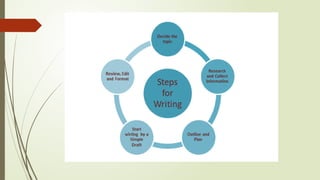
Writing skills are an important part of communication. Good writing skills allow
you to communicate your message with clarity and ease to a far larger audience
than through face-to-face or telephone conversations. Correct grammar,
punctuation and spelling is essential in written communications. The reader will
form an opinion of you, the author, based on both the content and presentation.
What to keep in mind while writing
 Audience
 Medium
 Style
 Structure
 Grammar
 Spelling
 Punctuation
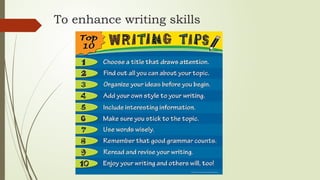
To enhance writing skills
Take away
Active listening is a lifelong skill that will serve you well in
your relationships with friends, family, and co-workers.
All it takes is a bit of effort, a lot of patience, and a
willingness to be present with another person, and
genuinely interested in what they have to say.
Before you start speaking, it’s important to
keep in mind the three W’s—Why, Who,
and What—of communication. Why are you
having this conversation? Who are you
speaking to? What do you want to
communicate?
There’s a reading genre for every literate
person on the planet, and whether your
tastes lie in classical literature, poetry,
fashion magazines, biographies, religious
texts, young adult books, self-help guides,
street lit, or romance novels, there’s
something out there to capture your
curiosity and imagination.
As you can see, there are plenty of ways in which you can benefit
from writing on a regular basis, even if you are not a professional
writer. Writing will lead you to become a more accomplished,
eloquent, and satisfied person.
Great writing skills go a long way toward establishing you as a more
complete person too. You will be able to improve your social life, and
become a better professional.
Thank you

Presentation on skills required for a better com.pptx

  • 1.
    A Deeper Insightinto the Skills Required for a better communication
  • 2.
  • 3.
    1. How manyalphabets are there in English Language? 2. What do you call a sentence which has got all the 26 letters of the alphabet? 3. Can you recall the only word in English that ends with “mt”? 4.What is the shortest complete sentence in English? 5. What is the most common letter in English? 6. There is a common English word that is seven letters long. Each time you remove a letter from it, it still remains a common English word - from seven letters right on down to a single letter. What is the original word, and what are the words that it becomes after removing a letter at a time? 7. Which vehicle is spelled the same forward and backward? 8. What goes through the cities and fields but never move ? 9. Two houses are in fire one belongs to a rich man and the other to a poor man. Which fire will the police fight first? 10. There are 12 fish. Half drown. How many are left?
  • 4.
    Communication Communication is definedas transferring information to produce greater understanding. Good communication skills are essential to allow others and yourself to understand information more accurately and quickly. poor communication skills lead to frequent misunderstanding and frustration
  • 8.
    Listening and Hearing The definition of hearing has more to do with the physiological act of hearing sounds than it does with making sense and connecting with the person who’s talking to you.  Merriam-Webster defines hearing as the “process, function, or power of perceiving sound; specifically: the special sense by which noises and tones are received as stimuli.”  Listening, on the other hand, means “to pay attention to sound; to hear something with thoughtful attention; and to give consideration.”  Active Listening is a way of listening and responding to another person that improves mutual understanding.”
  • 9.
    To enhance listeningskills: Be curious Ask good questions Don’t jump into a conversation too quickly Anchor yourself to the subject and don’t get distracted pay attention to the speakers body language and make eye contact
  • 11.
    Speaking Speaking effectively isdefined as speaking in such a way that your message is clearly heard and, if possible, acted upon. There are two main elements to speaking effectively: what you say, and how you say it.
  • 12.
    The words youchoose Your voice Your other non-verbal communication especially your body language
  • 13.
    To enhance speakingskills  Work on pronunciation (accuracy)  Listen repeat record and compare (LRRC)  Expand your vocabulary  Learn phrases rather than single words  Practice thinking in English  Speak slowly  Relax and have a positive attitude  Remember that communication is more important than grammar  Stay consistent (practice everyday)
  • 15.
    READING Reading skill refersto the ability to understand a written text. Reading skill is the fundamental skill required to understand a language. Therefore, reading is quite significant for a young learner to understand and comprehend what the books and information provides. It is advisable to develop this skill at early age of schooling.
  • 16.
    When students comprehendor understand written text, and combine their understanding with prior knowledge, they are able to perform the following three reading-comprehension skills:  Identify simple facts presented in written text (literal comprehension)  Make judgments about the written text’s content (evaluative comprehension)  Connect the text to other written passages and situations (inferential comprehension)
  • 17.
    To enhance readingskills Read extensively Read things that are really important in English. Guess vocabulary from context Use a good dictionary Set reading goals Read in portions Re- read Summarize
  • 19.
    Writing Writing skills arean important part of communication. Good writing skills allow you to communicate your message with clarity and ease to a far larger audience than through face-to-face or telephone conversations. Correct grammar, punctuation and spelling is essential in written communications. The reader will form an opinion of you, the author, based on both the content and presentation.
  • 20.
    What to keepin mind while writing  Audience  Medium  Style  Structure  Grammar  Spelling  Punctuation
  • 22.
  • 23.
    Take away Active listeningis a lifelong skill that will serve you well in your relationships with friends, family, and co-workers. All it takes is a bit of effort, a lot of patience, and a willingness to be present with another person, and genuinely interested in what they have to say.
  • 24.
    Before you startspeaking, it’s important to keep in mind the three W’s—Why, Who, and What—of communication. Why are you having this conversation? Who are you speaking to? What do you want to communicate?
  • 25.
    There’s a readinggenre for every literate person on the planet, and whether your tastes lie in classical literature, poetry, fashion magazines, biographies, religious texts, young adult books, self-help guides, street lit, or romance novels, there’s something out there to capture your curiosity and imagination.
  • 26.
    As you cansee, there are plenty of ways in which you can benefit from writing on a regular basis, even if you are not a professional writer. Writing will lead you to become a more accomplished, eloquent, and satisfied person. Great writing skills go a long way toward establishing you as a more complete person too. You will be able to improve your social life, and become a better professional.
  • 27.