Hertiki Marsaid, S.Pd Listening is Fun
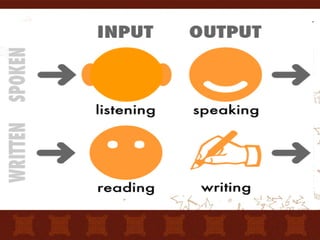
Language Skills Listening Speaking Reading  Writing
 
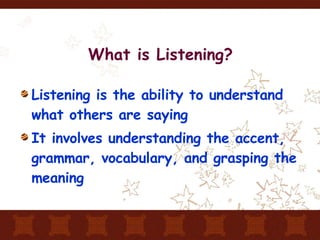
What is Listening? Listening is the ability to understand what others are saying It involves understanding the accent, grammar, vocabulary, and grasping the meaning
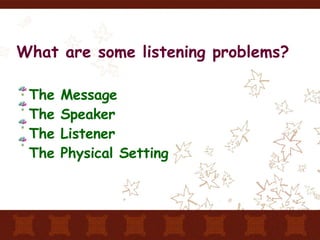
What are some listening problems? The Message   The Speaker The Listener The Physical Setting
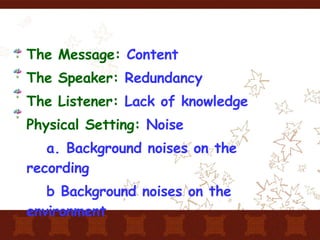
The Message:  Content The Speaker:  Redundancy  The Listener:  Lack of knowledge   Physical Setting:  Noise a. Background noises on the recording b Background noises on the environment
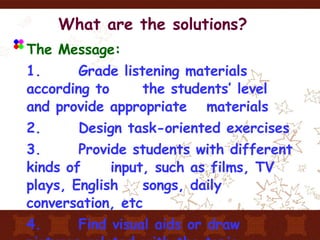
What are the solutions? The Message: 1.  Grade listening materials according to  the students’ level and provide appropriate  materials 2.  Design task-oriented exercises 3.  Provide students with different kinds of  input, such as films, TV plays, English  songs, daily conversation, etc 4.  Find visual aids or draw pictures related  with the topic
The Speaker: 1.  Give more practice to the students 2.  Make students aware of different native- speaker accents 3.  Select short and simple listening  materials for lower-level students and  complicated authentic materials for  advanced learners
The Listener: 1.  Provide background knowledge and  linguistic knowledge 2.  Help students develop the skills of  listening by providing varied tasks and  exercises at different levels with different  focuses
Stages of a Listening Lesson Pre-listening:   It helps students prepare to listen   While-listening:  It helps to focus on the listening text and guide the development of their understanding of it  Post-listening: It helps students integrate what they have learnt from the text into their existing knowledge
Activities in Listening Class Chart-filling English Songs Games
 
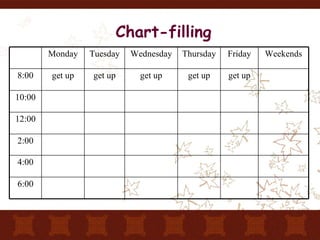
Chart-filling 6:00 4:00 2:00 12:00 10:00 get up get up get up get up get up 8:00 Weekends Friday Thursday Wednesday Tuesday Monday
Songs Fill in the blanks Scrambled Lyrics
Games Whispers Shouting Games
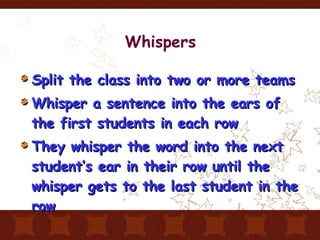
Whispers Split the class into two or more teams Whisper a sentence into the ears of the first students in each row They whisper the word into the next student’s ear in their row until the whisper gets to the last student in the row
The last student in the row has to say out the sentence The team or teams that get the right sentence scores a point
Shouting Game Prepare several sentences Divide the students into two groups Ask one of the members from each group to go in front of the class to write The two students should face the board, they have to listen carefully and write The winner is the one who can finish first
Conclusion Some teachers think that listening is the easiest skill to teach, whereas most students think it is the most difficult to improve We must find out how listening skill can be improved and what activities are useful in teaching listening
 

Workshop Listening

  • 1.
    Hertiki Marsaid, S.PdListening is Fun
  • 2.
    Language Skills ListeningSpeaking Reading Writing
  • 3.
  • 4.
    What is Listening?Listening is the ability to understand what others are saying It involves understanding the accent, grammar, vocabulary, and grasping the meaning
  • 5.
    What are somelistening problems? The Message The Speaker The Listener The Physical Setting
  • 6.
    The Message: Content The Speaker: Redundancy The Listener: Lack of knowledge Physical Setting: Noise a. Background noises on the recording b Background noises on the environment
  • 7.
    What are thesolutions? The Message: 1. Grade listening materials according to the students’ level and provide appropriate materials 2. Design task-oriented exercises 3. Provide students with different kinds of input, such as films, TV plays, English songs, daily conversation, etc 4. Find visual aids or draw pictures related with the topic
  • 8.
    The Speaker: 1. Give more practice to the students 2. Make students aware of different native- speaker accents 3. Select short and simple listening materials for lower-level students and complicated authentic materials for advanced learners
  • 9.
    The Listener: 1. Provide background knowledge and linguistic knowledge 2. Help students develop the skills of listening by providing varied tasks and exercises at different levels with different focuses
  • 10.
    Stages of aListening Lesson Pre-listening: It helps students prepare to listen While-listening: It helps to focus on the listening text and guide the development of their understanding of it Post-listening: It helps students integrate what they have learnt from the text into their existing knowledge
  • 11.
    Activities in ListeningClass Chart-filling English Songs Games
  • 12.
  • 13.
    Chart-filling 6:00 4:002:00 12:00 10:00 get up get up get up get up get up 8:00 Weekends Friday Thursday Wednesday Tuesday Monday
  • 14.
    Songs Fill inthe blanks Scrambled Lyrics
  • 15.
  • 16.
    Whispers Split theclass into two or more teams Whisper a sentence into the ears of the first students in each row They whisper the word into the next student’s ear in their row until the whisper gets to the last student in the row
  • 17.
    The last studentin the row has to say out the sentence The team or teams that get the right sentence scores a point
  • 18.
    Shouting Game Prepareseveral sentences Divide the students into two groups Ask one of the members from each group to go in front of the class to write The two students should face the board, they have to listen carefully and write The winner is the one who can finish first
  • 19.
    Conclusion Some teachersthink that listening is the easiest skill to teach, whereas most students think it is the most difficult to improve We must find out how listening skill can be improved and what activities are useful in teaching listening
  • 20.