o   Key Result Areas
o   Objectives
o   Goals
o   Measurement
o   Progress Review
o   Performance Evaluation
o   Rewards
• Key Result Areas (from the strategic
  plan) - Areas of performance essential to
  the organization's success
• Objectives (from the strategic plan) -
  Broad statements of what needs to be
  achieved in each Key Result Area
• Goals (from the strategic plan) - Specific,
  measurable, time-dated performance
  targets to be achieved. Each objective
  will have one or more goals.
• Measurement - Profit measurement,
  Monetary measurement, Non-Monetary
  measurement
• Progress Review - Information about how
  effectively the organization, department, or
  individual is performing relative to a goal.
• Performance Evaluation - Systematic
  evaluation at the end of the planning period
  of performance against goals. Typically serves
  as the basis for future goal setting.
• Rewards - Extrinsic, Intrinsic, and Psychic.
www.intercity-uk.com
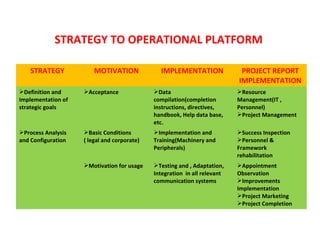
STRATEGY TO OPERATIONAL PLATFORM

    STRATEGY            MOTIVATION             IMPLEMENTATION               PROJECT REPORT
                                                                           IMPLEMENTATION
Definition and     Acceptance              Data                         Resource
Implementation of                            compilation(completion        Management(IT ,
strategic goals                              instructions, directives,     Personnel)
                                             handbook, Help data base,     Project Management
                                             etc.
Process Analysis   Basic Conditions        Implementation and           Success Inspection
and Configuration   ( legal and corporate)   Training(Machinery and        Personnel &
                                             Peripherals)                  Framework
                                                                           rehabilitation
                    Motivation for usage    Testing and , Adaptation,    Appointment
                                             Integration in all relevant   Observation
                                             communication systems         Improvements
                                                                           Implementation
                                                                           Project Marketing
                                                                           Project Completion
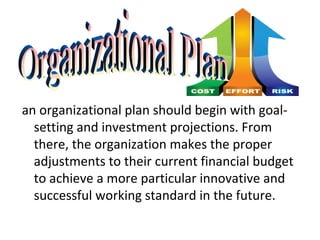
an organizational plan should begin with goal-
  setting and investment projections. From
  there, the organization makes the proper
  adjustments to their current financial budget
  to achieve a more particular innovative and
  successful working standard in the future.
LONG TERM PLAN
It involves a window planning of
five years of longer with a broader
set of guidelines and preparation
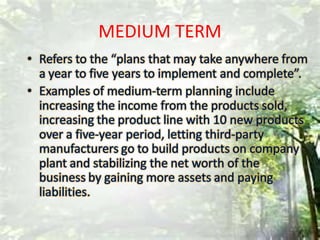
MEDIUM TERM
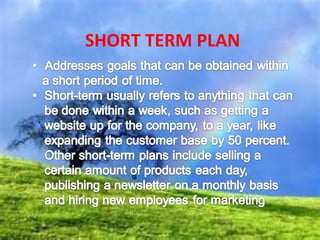
SHORT TERM PLAN
KRA
“Key Result Areas” or KRAs refer to general areas
  of outcomes or outputs for which a role is
  responsible. A typical role targets three to five
  KRA. KRAs are also known as key work outputs
  (KWOs).
KRA
• The employee is given certain responsibilities
  which will be his/her key result areas. Example
  - If I have given responsibility of induction then
  the end to end process of induction will be my
  Key Result Area. If I am doing any other work
  which is not assigned to me but I am willing to
  do it, then it will not be counted in my KRA's.
Most roles include 3 to 5
 key result areas. If
 individuals are
 accountable for more
 than this, they may be
 overloaded, or they
 may not be delegating
 effectively.
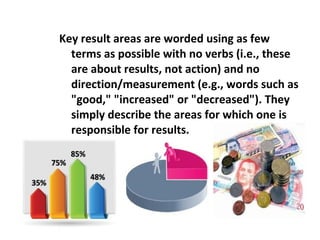
Key result areas are worded using as few
  terms as possible with no verbs (i.e., these
  are about results, not action) and no
  direction/measurement (e.g., words such as
  "good," "increased" or "decreased"). They
  simply describe the areas for which one is
  responsible for results.
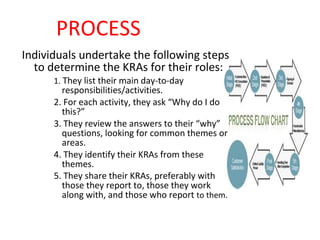
PROCESS
Individuals undertake the following steps
  to determine the KRAs for their roles:
      1. They list their main day-to-day
        responsibilities/activities.
      2. For each activity, they ask “Why do I do
        this?”
      3. They review the answers to their “why”
        questions, looking for common themes or
        areas.
      4. They identify their KRAs from these
        themes.
      5. They share their KRAs, preferably with
        those they report to, those they work
        along with, and those who report to them.
Make value-added
 decisions.
                   VALUE
DESCRIPTION
   Key result areas (KRAs)
   capture about 80% of a work
   role. The remainder of the
   role is usually devoted to
   areas of shared responsibility
   (e.g., helping team members,
   participating in activities for
   the good of the
   organization). For example,
   “image of the organization”
IMPLEMENTATION
Individuals who identify their KRAs
   typically:
· Work with those they report to,
   those they work along with, and
   those who report to them to
   identify their KRAs so all on a
   team have clarity regarding
   outputs.
· Develop specific goals and
   objectives, and plans to reach
   them.
· Take control of their time/work
   management strategies.
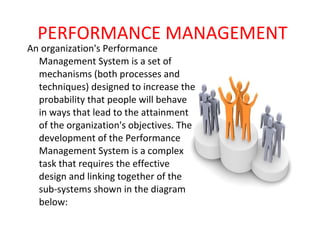
PERFORMANCE MANAGEMENT
An organization's Performance
  Management System is a set of
  mechanisms (both processes and
  techniques) designed to increase the
  probability that people will behave
  in ways that lead to the attainment
  of the organization's objectives. The
  development of the Performance
  Management System is a complex
  task that requires the effective
  design and linking together of the
  sub-systems shown in the diagram
  below:
Our Programs and
                                    Projects
1. SHAPE – (School Heads Advancement for Professional
Excellence)
This Project aims to retool/reorient school heads/managers and gain
more awareness on their managerial instructional, supervisory,
administrative, evaluative, human relations and leadership functions.
2. CREST – (Course in Reading and Speech for Teachers)
This course for teachers of beginning reading shall consist of six
modules namely:
    •Speech communication;
    •Children’s Literature;
    •Grading and Evaluation techniques for Language Teachers;
    •Content-Based Teaching;
    •Development Reading; and
    •Practicum in Teaching        web.evis.net.ph/lineagencies/deped/index.
                                  php/programs-projects
Our Programs
                                  and Projects
3. APEX – (Applied Academics for Professional Excellence)
This is a contextual approach in teaching and learning focused on students’
  academic, technical and employability skills through science and math
  funded by local school board of 8 municipalities in Leyte, Tacloban City and
  Ormoc City.

4. Project-ABC (Advancing Brilliance in Character)
This is guided by humanistic framework of the DepEd’s Values Education
   Program maintaining that at the core of development is the dignity of the
   human person as the subject and object of all initiatives. It also maintains the
   human person’s seven dimensions and puts in the realated core values that
   are adhered to most significantly by the people of Region VIII.

5. Project CRÈME – (Comprehensive Reading Education for Mastery and
   Excellence)
This is a 6-year           web.evis.net.ph/lineagencies/deped/index.
                           php/programs-projects
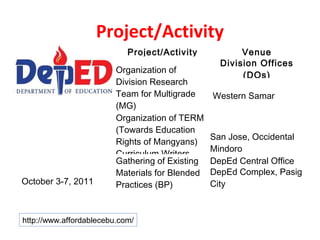
Project/Activity
         Date               Project/Activity               Venue
                                                      Division Offices
                         Organization of
                                                           (DOs)
                         Division Research
                         Team for Multigrade         Western Samar
                         (MG)                     
                         Organization of TERM
                         (Towards Education
                                                 San Jose, Occidental
                         Rights of Mangyans)
                                                 Mindoro
                         Curriculum Writers
                         Gathering of Existing   DepEd Central Office
                         Materials for Blended   DepEd Complex, Pasig
October 3-7, 2011        Practices (BP)          City


http://www.affordablecebu.com/
• Suppose, if the IT Manager
  (Training) is suppose to conduct
  the Training Programs, which
  could not be carried since funds
                                       EXPECTED
  for training which were supposed
  to be arranged by IT
  Manager(Finance) could not be
  arranged. Now, you can see this
  failure will reflect in the KRA of
  IT. Manager (Finance), Manager
  (Finance), CFO, IT Manager
  (Training), Manager (Training),
  and CPO, COO, and CEO.
• Key Result areas- The measure of
  employees main result positives
happy &
Another example, consider a server     satisfied
  in a restaurant.        “Customer
  satisfaction” is not a key work
  output—everyone          in    the
  restaurant contributes to that
  aim.      However,       “customer
  rapport” is a key work output of
  the server. Whether or not the
  food is good, on time, or hot, the
  server is expected to develop
  rapport with customers. Other
  key work outputs might include
  “paid bills” and “delivered food &
  beverages.
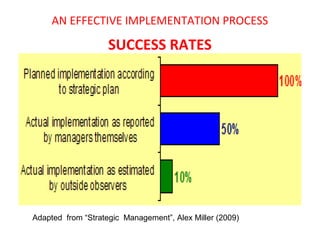
AN EFFECTIVE IMPLEMENTATION PROCESS

                    SUCCESS RATES


Adapted from “Strategic Management”, Alex Miller (2009)
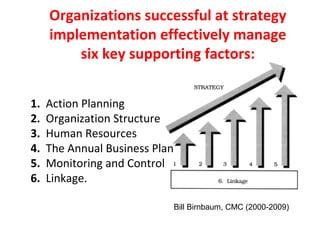
Organizations successful at strategy
     implementation effectively manage
         six key supporting factors:


1.   Action Planning
2.   Organization Structure
3.   Human Resources
4.   The Annual Business Plan
5.   Monitoring and Control
6.   Linkage.

                                Bill Birnbaum, CMC (2000-2009)
www.gov.ph/k-12
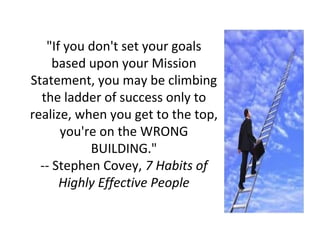
"If you don't set your goals
     based upon your Mission
Statement, you may be climbing
  the ladder of success only to
realize, when you get to the top,
      you're on the WRONG
           BUILDING."
  -- Stephen Covey, 7 Habits of
      Highly Effective People
References:
Strategic Thinking Book, Bill Burnbaum, CMC (2000-2009)
www.life-role Development Group-2011
Strategic Management-Third Edition(2008), Alex Miller
Strategy, Execution, Innovation(2008)- Vijay Govindarajan and
   Chris Tremble
www.gov.ph/k-12

Strategic Implementation

  • 2.
    o Key Result Areas o Objectives o Goals o Measurement o Progress Review o Performance Evaluation o Rewards
  • 3.
    • Key ResultAreas (from the strategic plan) - Areas of performance essential to the organization's success • Objectives (from the strategic plan) - Broad statements of what needs to be achieved in each Key Result Area • Goals (from the strategic plan) - Specific, measurable, time-dated performance targets to be achieved. Each objective will have one or more goals.
  • 4.
    • Measurement -Profit measurement, Monetary measurement, Non-Monetary measurement • Progress Review - Information about how effectively the organization, department, or individual is performing relative to a goal. • Performance Evaluation - Systematic evaluation at the end of the planning period of performance against goals. Typically serves as the basis for future goal setting. • Rewards - Extrinsic, Intrinsic, and Psychic.
  • 15.
  • 17.
    STRATEGY TO OPERATIONALPLATFORM STRATEGY MOTIVATION IMPLEMENTATION PROJECT REPORT IMPLEMENTATION Definition and Acceptance Data Resource Implementation of compilation(completion Management(IT , strategic goals instructions, directives, Personnel) handbook, Help data base, Project Management etc. Process Analysis Basic Conditions Implementation and Success Inspection and Configuration ( legal and corporate) Training(Machinery and Personnel & Peripherals) Framework rehabilitation Motivation for usage Testing and , Adaptation, Appointment Integration in all relevant Observation communication systems Improvements Implementation Project Marketing Project Completion
  • 18.
    an organizational planshould begin with goal- setting and investment projections. From there, the organization makes the proper adjustments to their current financial budget to achieve a more particular innovative and successful working standard in the future.
  • 19.
    LONG TERM PLAN Itinvolves a window planning of five years of longer with a broader set of guidelines and preparation
  • 20.
  • 21.
  • 22.
    KRA “Key Result Areas”or KRAs refer to general areas of outcomes or outputs for which a role is responsible. A typical role targets three to five KRA. KRAs are also known as key work outputs (KWOs).
  • 23.
    KRA • The employeeis given certain responsibilities which will be his/her key result areas. Example - If I have given responsibility of induction then the end to end process of induction will be my Key Result Area. If I am doing any other work which is not assigned to me but I am willing to do it, then it will not be counted in my KRA's.
  • 24.
    Most roles include3 to 5 key result areas. If individuals are accountable for more than this, they may be overloaded, or they may not be delegating effectively.
  • 25.
    Key result areasare worded using as few terms as possible with no verbs (i.e., these are about results, not action) and no direction/measurement (e.g., words such as "good," "increased" or "decreased"). They simply describe the areas for which one is responsible for results.
  • 26.
    PROCESS Individuals undertake thefollowing steps to determine the KRAs for their roles: 1. They list their main day-to-day responsibilities/activities. 2. For each activity, they ask “Why do I do this?” 3. They review the answers to their “why” questions, looking for common themes or areas. 4. They identify their KRAs from these themes. 5. They share their KRAs, preferably with those they report to, those they work along with, and those who report to them.
  • 27.
  • 28.
    DESCRIPTION Key result areas (KRAs) capture about 80% of a work role. The remainder of the role is usually devoted to areas of shared responsibility (e.g., helping team members, participating in activities for the good of the organization). For example, “image of the organization”
  • 29.
    IMPLEMENTATION Individuals who identifytheir KRAs typically: · Work with those they report to, those they work along with, and those who report to them to identify their KRAs so all on a team have clarity regarding outputs. · Develop specific goals and objectives, and plans to reach them. · Take control of their time/work management strategies.
  • 30.
    PERFORMANCE MANAGEMENT An organization'sPerformance Management System is a set of mechanisms (both processes and techniques) designed to increase the probability that people will behave in ways that lead to the attainment of the organization's objectives. The development of the Performance Management System is a complex task that requires the effective design and linking together of the sub-systems shown in the diagram below:
  • 31.
    Our Programs and Projects 1. SHAPE – (School Heads Advancement for Professional Excellence) This Project aims to retool/reorient school heads/managers and gain more awareness on their managerial instructional, supervisory, administrative, evaluative, human relations and leadership functions. 2. CREST – (Course in Reading and Speech for Teachers) This course for teachers of beginning reading shall consist of six modules namely: •Speech communication; •Children’s Literature; •Grading and Evaluation techniques for Language Teachers; •Content-Based Teaching; •Development Reading; and •Practicum in Teaching web.evis.net.ph/lineagencies/deped/index. php/programs-projects
  • 32.
    Our Programs and Projects 3. APEX – (Applied Academics for Professional Excellence) This is a contextual approach in teaching and learning focused on students’ academic, technical and employability skills through science and math funded by local school board of 8 municipalities in Leyte, Tacloban City and Ormoc City. 4. Project-ABC (Advancing Brilliance in Character) This is guided by humanistic framework of the DepEd’s Values Education Program maintaining that at the core of development is the dignity of the human person as the subject and object of all initiatives. It also maintains the human person’s seven dimensions and puts in the realated core values that are adhered to most significantly by the people of Region VIII. 5. Project CRÈME – (Comprehensive Reading Education for Mastery and Excellence) This is a 6-year web.evis.net.ph/lineagencies/deped/index. php/programs-projects
  • 33.
    Project/Activity Date Project/Activity Venue Division Offices Organization of (DOs) Division Research Team for Multigrade Western Samar (MG)   Organization of TERM (Towards Education San Jose, Occidental Rights of Mangyans) Mindoro Curriculum Writers Gathering of Existing DepEd Central Office Materials for Blended DepEd Complex, Pasig October 3-7, 2011 Practices (BP) City http://www.affordablecebu.com/
  • 34.
    • Suppose, ifthe IT Manager (Training) is suppose to conduct the Training Programs, which could not be carried since funds EXPECTED for training which were supposed to be arranged by IT Manager(Finance) could not be arranged. Now, you can see this failure will reflect in the KRA of IT. Manager (Finance), Manager (Finance), CFO, IT Manager (Training), Manager (Training), and CPO, COO, and CEO. • Key Result areas- The measure of employees main result positives
  • 35.
    happy & Another example,consider a server satisfied in a restaurant. “Customer satisfaction” is not a key work output—everyone in the restaurant contributes to that aim. However, “customer rapport” is a key work output of the server. Whether or not the food is good, on time, or hot, the server is expected to develop rapport with customers. Other key work outputs might include “paid bills” and “delivered food & beverages.
  • 36.
    AN EFFECTIVE IMPLEMENTATIONPROCESS SUCCESS RATES Adapted from “Strategic Management”, Alex Miller (2009)
  • 37.
    Organizations successful atstrategy implementation effectively manage six key supporting factors: 1. Action Planning 2. Organization Structure 3. Human Resources 4. The Annual Business Plan 5. Monitoring and Control 6. Linkage. Bill Birnbaum, CMC (2000-2009)
  • 38.
  • 39.
    "If you don'tset your goals based upon your Mission Statement, you may be climbing the ladder of success only to realize, when you get to the top, you're on the WRONG BUILDING." -- Stephen Covey, 7 Habits of Highly Effective People
  • 42.
    References: Strategic Thinking Book,Bill Burnbaum, CMC (2000-2009) www.life-role Development Group-2011 Strategic Management-Third Edition(2008), Alex Miller Strategy, Execution, Innovation(2008)- Vijay Govindarajan and Chris Tremble www.gov.ph/k-12

Editor's Notes

  • #6 Put your notes here
  • #7 Put your notes here
  • #18 Cite Source
  • #20 Businesses, careers, and the workplace are rapidly changing, and the skills that you have or plan for today may not be in demand years from now. Long-range planning should be more about identifying and developing core skills that employers will always value while developing your personal and career goals in broad strokes.
  • #29 is usually a very senior official’s key result area, but hopefully all employees contribute to this outcome.
  • #32 List down your projects in region i
  • #34 List down your project/activity in region 1
  • #37 Cite source
  • #38 Cite Source
  • #39 Cite Source